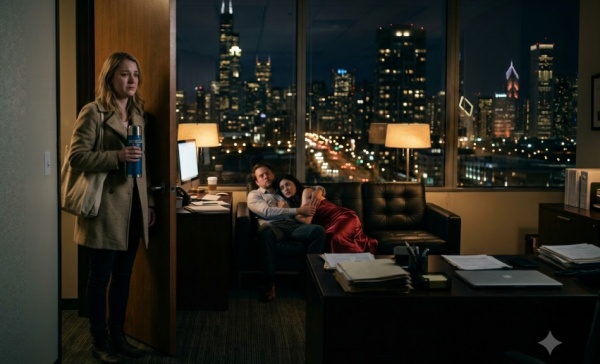
My Husband Said He Was Working Late—Then I Found Him Asleep With His Assistant on the Office Couch
W hen he texted me not to wait up, I packed his favorite soup and drove downtown like I had done so many times before. The executive floor was dark, except for his office, where I found him asleep with Sophie Lane, his assistant, tucked against him like she had been there before. What broke me wasn’t just seeing another woman in his arms—it was how naturally he held her.
Part One: The Soup
1
For three weeks, Daniel had been coming home after midnight with the same tired smile and the same explanation: the expansion was almost ready. His company was opening three new regional offices, and according to him, the entire future of the business depended on a handful of impossible deadlines. I believed him because I had spent nine years believing the ordinary things he said without asking for proof.
On Thursday night, he texted me at 8:47 p.m., just as I was putting our daughter, Lily, to bed. Don’t wait up tonight. Board prep is running late. Love you. I stared at the message while the kitchen clock ticked behind me, then typed back, I’ll leave the porch light on. I almost added a heart, but something in me hesitated, so I sent the words without it.
Daniel had forgotten his dinner on the counter again. It was chicken noodle soup, his favorite when he was stressed, packed in the blue thermos he had taken to work during the first year of our marriage. I had made it from scratch that afternoon because he had told me his stomach was bothering him, and because caring for him had become so automatic that I often did it before I realized I was doing it.
At 9:20, I looked at the thermos and imagined him sitting alone in his office, rubbing his eyes beneath the harsh white lights. I imagined the conference table covered in spreadsheets, the city shining below him, and Daniel fighting through another long night because he was building something for our family. That last thought made me pick up my keys.
Our house sat in a quiet neighborhood outside Chicago, where the streets curved around old trees and every front porch seemed to hold the same seasonal wreath. The drive downtown took forty minutes if traffic was light, which it rarely was, but I knew the route by heart. I stopped at a red light near the river and remembered how Daniel used to complain that I never visited him at work.
He had said that during our first year of marriage, back when his office was small enough for me to bring him coffee without announcing myself to three receptionists. “One day, you’ll surprise me,” he had joked. “You’ll walk in with soup, and I’ll be so impressed that I’ll finally take you somewhere expensive.” I smiled at the memory, unaware that the same gesture was about to become something I would never be able to repeat.
The office tower rose above the surrounding buildings, all glass and steel, reflecting the cold November sky. Daniel’s company occupied the top three floors, and the lobby guard recognized me immediately. He smiled and waved me toward the elevators without asking for identification.
“Mr. Mercer is still upstairs,” he said. “I saw him go up earlier.”
I thanked him and stepped inside the elevator. The doors closed, and for a few seconds I watched my reflection in the polished metal: brown hair pulled into a loose knot, wool coat buttoned to the throat, blue thermos tucked beneath my arm. I looked like a wife delivering comfort, not a woman approaching the moment her marriage would begin to fall apart.
The executive floor was almost completely dark when the elevator opened. Only the low lights near the reception desk were on, and the glass walls of the conference rooms reflected empty chairs and sleeping computer screens. At the end of the hallway, a warm rectangle of light spilled beneath the door to Daniel’s office.
I walked toward it quietly, already imagining the surprise on his face. The door was not fully closed, and I could hear the low hum of the heating system inside. I placed my hand on the handle, pushed it open, and saw Daniel asleep on the couch with Sophie Lane, his assistant, tucked against his chest.
2
For a moment, I thought I had misunderstood what I was seeing. Daniel’s arm was wrapped around Sophie’s waist, his hand resting comfortably against her side, while her head lay beneath his chin as if that position belonged to her. His jacket had been folded beneath her cheek, and one of his hands was gently curled around the sleeve of her blouse.
The soup nearly slipped from my fingers. I caught the thermos against my coat, but the metal made a small, sharp sound that seemed to cut through the room. Daniel’s eyes opened first, then Sophie’s, and both of them looked at me with the same expression: not surprise, not confusion, but recognition.
It was the recognition of people who understood immediately what had been discovered. Daniel sat up so fast that Sophie pulled away from him and nearly fell against the armrest. He said my name once, quietly, as if I were the one who had entered the wrong room.
“Emma,” he whispered.
I looked at Sophie before I looked at him. She was younger than me by at least ten years, with dark blond hair pulled into a messy ponytail and a pale face that made her look suddenly frightened. I had met her twice at company dinners, and both times she had spoken warmly about Daniel’s leadership while avoiding my eyes.
“You’re working late,” I said.
Daniel stood up. His tie was loose, his shirt wrinkled, and a red mark showed faintly along the side of his neck. I did not need to ask why Sophie was there, why his arm had been around her, or why the couch looked as though two people had been sleeping on it for hours.
“It isn’t what you think,” he said.
That sentence was almost comforting in its predictability. People in movies said it just before explaining something impossible, and I had always believed real life would be messier than that. Instead, Daniel gave me the exact line, in the exact tone, as if he had been waiting years to use it.
“What do you think I think?” I asked.
Sophie stood, smoothing the front of her blouse with shaking hands. “Emma, I’m sorry. I should go.”
“You should have gone before I got here,” I said.
Daniel turned toward her. “Sophie, wait.”
That single word was worse than the couch. He did not sound angry at her or embarrassed by her presence; he sounded concerned that she might leave before he could protect her. He sounded like a man trying to keep two separate versions of his life from touching.
I set the thermos down on his desk. “I brought you soup.”
He looked at it as if I had placed something dangerous in front of him. “You drove all the way here?”
“You told me you were working late.”
“I am working late.”
I glanced at the couch. “Is that what you call this?”
Sophie closed her eyes. Daniel’s jaw tightened, and for the first time that night, his expression changed from panic to irritation. “You’re making a scene.”
The sentence landed with such force that I almost laughed. There were three people in a dark office after midnight, one of them asleep in another person’s arms, and somehow I was the one making a scene.
3
I did not scream. I did not throw the thermos at the wall or slap Daniel or demand that Sophie explain every second of the last three weeks. I simply stood there, staring at the man I had married, and tried to understand how naturally his body had held someone else.
“What happened?” I asked.
Daniel ran both hands through his hair. “Sophie had a panic attack. She’s been under pressure with the expansion, and she was exhausted. We were talking, and she fell asleep.”
“Against you?”
“She was upset.”
“So you held her.”
“She needed comfort.”
I turned toward Sophie. “Is that what happened?”
Her lips parted, but no answer came out. Daniel looked at her, and the look was brief enough that someone else might have missed it. I did not miss it. It was a warning disguised as a request.
Sophie lowered her eyes. “I was having a difficult night.”
“That’s not what I asked.”
Daniel stepped between us. “Emma, this is a private matter.”
“Then why did you put your marriage in the middle of it?”
His face hardened. Behind him, the glass windows showed the reflection of the three of us: Daniel in the center, Sophie on one side, me on the other. It looked less like a marriage and more like a meeting where I had arrived without being invited.
He reached for my hand. I stepped backward before he could touch me.
“I’m going home,” I said.
“Emma, please.”
“I’m going home, and you are not coming with me.”
His eyes widened. “Where am I supposed to go?”
“Ask Sophie.”
Sophie flinched as if I had struck her. Shame rushed through me, but I let it remain between us for only a second before looking away. I did not want to make her the villain simply because Daniel had chosen to make her part of his deception.
He followed me into the hallway. “You’re overreacting.”
I stopped beside the elevator and turned around. “I walked into your office and found you sleeping with your assistant.”
“We weren’t having sex.”
I stared at him. It was the first time he had used the word, and the fact that he had brought it into the conversation made the air feel colder. “That is your defense?”
“I’m saying you don’t know what happened.”
“I know what I saw.”
The elevator doors opened. I stepped inside, but Daniel kept one hand between them.
“Don’t drive like this,” he said. “You’re upset.”
“Move your hand.”
“Emma, we need to talk.”
“We have been talking. You’ve been telling me about expansion deadlines while sleeping beside her.”
His face changed again, the concern thinning into something defensive and hard. “You’re going to regret the way you’re handling this.”
The elevator doors began to close. For one second, I thought he might step inside with me, and a ridiculous part of me wanted him to. Then he removed his hand, and the doors shut between us.
4
I sat in my car for nearly fifteen minutes without starting the engine. The thermos was still on his desk, which meant I had left something of myself behind in that office. I imagined Daniel picking it up after I left, opening it, smelling the soup, and deciding whether to throw it away.
When I finally drove home, the city lights blurred through the windshield. I passed restaurants full of couples leaning across small tables, their hands touching over candles and wine glasses. I wondered how many women in those restaurants were married to men who had learned to divide their lives into compartments.
At home, Lily was asleep with one arm wrapped around her stuffed rabbit. I stood in the doorway of her room and watched her breathe. She was eight years old, old enough to notice when adults lied but too young to understand why they did it.
I went into the kitchen and poured the untouched soup into the sink. The smell of chicken, celery, and thyme filled the room, and suddenly I was furious at every ingredient. I was furious at the carrots I had chopped, the broth I had simmered, and the blue thermos I had washed so many times that the lettering had faded.
Daniel arrived home at 1:36 a.m. I heard his key turn in the lock, followed by the careful silence of someone trying not to wake the house. He stopped outside the bedroom door, but he did not come in.
“Emma,” he said.
I was lying on my side, facing the wall. “Go sleep somewhere else.”
“Can we talk?”
“Not tonight.”
“You don’t understand what happened.”
“I understand enough.”
He remained in the doorway. “Sophie was upset because her father is sick. She has been carrying everything alone, and I was trying to help her.”
I closed my eyes. “You held her like a husband.”
“That’s not fair.”
“No. It wasn’t fair when you made me believe you were working.”
He was quiet for a moment. Then he said, “There was nothing physical.”
I turned around. “You keep saying that as if betrayal only begins when clothes come off.”
Daniel looked at me, and for the first time in nine years, I saw how easily he could stand in front of me and say something technically true while hiding the truth that mattered. He had not yet admitted an affair, but he had already admitted that our marriage was no longer the only place where he gave tenderness.
5
The next morning, Daniel called in sick to work. He made coffee for both of us, but I left mine untouched on the counter. Lily came downstairs wearing mismatched socks and asked why Daddy looked like he had not slept.
“Long night,” Daniel said.
She glanced at me. “Was he working again?”
The question was innocent, but Daniel looked at me as if I had coached her. I knelt beside Lily and helped her tie the laces on her sneakers.
“Your dad had a difficult night,” I said. “We’re going to keep things calm this morning.”
“Are you mad at him?”
Daniel inhaled sharply. “Mom and Dad are having an adult conversation.”
Lily’s face fell. “Did I do something?”
“No,” I said immediately. “You didn’t do anything.”
That was the first promise I made after discovering the truth: whatever happened next, our daughter would not be made responsible for it. I did not know whether Daniel could keep the same promise.
He took Lily to school while I sat at the kitchen table and stared at my phone. I opened our message history and scrolled backward through the last month. There were dozens of texts from him about deadlines, conference calls, investor dinners, and late nights.
Nothing looked suspicious until I read it all together. His messages had become shorter, his affection more deliberate, and the phrase Don’t wait up appeared seven times.
At 10:15, I called my sister, Nora. I did not tell her everything at first; I only said that I had found Daniel with someone from work and needed a place to think. There was a silence on the other end of the line, followed by the steady voice she had used when our mother was in the hospital.
“Come here,” Nora said. “Bring Lily after school. You don’t have to decide your whole life today.”
I packed an overnight bag. Then I stood in the bedroom and looked at the life Daniel and I had built: framed wedding photographs, vacation pictures, the dresser we bought after Lily was born, and the small lamp he had repaired twice instead of replacing.
Nothing in the room looked broken. That was the cruelest part. Betrayal did not leave shattered glass on the floor; it left ordinary objects exactly where they had always been, forcing you to decide whether you could bear to keep looking at them.
Part Two: The Version He Prepared
6
Daniel came home early that afternoon with flowers. They were white lilies, the kind he bought when he wanted to apologize but did not know how. He placed them in a glass vase beside the sink, then stood there with both hands resting on the counter.
“I should have told you Sophie was struggling,” he said.
“You should have told me she was sleeping in your office.”
“That’s not what I meant.”
“Then say what you mean.”
He looked exhausted, but I had started to distrust the ways he presented exhaustion. It was possible to be tired from working too much, but it was also possible to be tired from keeping track of several lies at once.
Daniel told me Sophie had received a call that her father’s surgery had been moved up. She had panicked, he said, and he had stayed with her because she had no one else nearby. They had sat on the couch, talked for hours, and fallen asleep.
“Why did she look at you like that?” I asked.
“Like what?”
“Like she was waiting for you to decide what happened next.”
He turned away. “You’re reading too much into everything.”
“Am I?”
Daniel rubbed his eyes. “Emma, I love you. I have never stopped loving you.”
It was the sentence I had wanted to hear, but it sounded rehearsed. Not false, exactly, but polished by repetition. I wondered if he had said it to Sophie, too.
When I asked whether he had kissed her, he hesitated. The hesitation was shorter than a breath, but I saw it.
“No,” he said.
“Are you sure?”
“Yes.”
“Have you slept with her?”
His face tightened. “No.”
“Have you wanted to?”
That question silenced him.
I pushed the vase of lilies away from me. “You don’t have to answer every question with a lie.”
His voice dropped. “I was confused.”
“Confused people don’t send their wives home with promises while building another relationship at work.”
“I never promised her anything.”
“Did you promise me you were working?”
He looked at the floor. That was the first honest answer I received.
7
That evening, Daniel slept in the guest room. Lily stayed with Nora, who lived twenty minutes away, and I sat alone in the living room with the television turned off. Every sound in the house felt amplified: the refrigerator humming, the furnace starting, the floorboards shifting beneath the cold.
At 11:03, my phone buzzed. It was an email from Sophie.
The subject line read: I’m sorry.
I stared at it for several minutes before opening the message. Sophie wrote that she understood if I never wanted to hear from her, but she did not want Daniel to keep telling me a partial version of the truth.
She said her father was ill, but that was not why she had been in Daniel’s office. She had gone there because she had tried to resign earlier that evening, and Daniel had asked her to stay so they could talk privately.
He told me your marriage was already over, she wrote. He said you had been living separate lives for more than a year and that you were only staying together because of Lily.
I read the sentence twice. Then I placed the phone on the coffee table and walked into the kitchen because I could not breathe in the living room.
Daniel and I had not been perfect, but I had never believed we were over. We had arguments, busy seasons, and long stretches when parenting and work consumed us, but I had believed those were problems inside a marriage, not proof that the marriage had ended.
Sophie continued. She said Daniel had told her he planned to move into a downtown apartment after the expansion launched. He had said that he and I were waiting until the timing was right to tell Lily.
At the bottom of the email, she wrote, I believed him because he was my boss, because he seemed certain, and because I was stupid enough to think a man who talked about honesty could not be lying to both of us.
I closed the email without responding. Then I opened the bedroom closet and noticed Daniel’s gray overnight bag was missing.
8
He had taken the bag two days earlier, telling me he was bringing documents to the office. I had not thought about it because Daniel carried paperwork everywhere. Now I wondered what else I had stopped noticing.
I walked into his home office and opened the desk drawer where he kept passports, tax records, and old receipts. I did not search for evidence because I wanted to invade his privacy; I searched because he had made decisions that affected our family and hidden them from me.
Behind a stack of insurance documents, I found a key attached to a small brass tag. The tag bore the name of a building downtown. I had seen the building many times from the highway, a new glass tower with balconies facing the river.
Beneath the key was a printed email from a leasing office. The message confirmed a move-in date for the following Monday. The apartment was a one-bedroom unit on the thirty-second floor, with a monthly rent of $4,800.
I sat in the desk chair and held the paper in my lap. Daniel had not rented a place for a business trip or a temporary project. He had arranged a life that did not include me.
On the bottom of the page, the tenant name was listed as Daniel Mercer. A second line had been left blank.
That blank hurt almost as much as the apartment itself. He had not yet decided whether Sophie would move in with him, or whether he wanted to keep the option open. He had created a doorway into another life and expected to choose who walked through it after he knew whether I had discovered it.
I took photographs of the lease information for my own records, then placed everything exactly where I had found it. I did not break into his email, copy his passwords, or search through Sophie’s private life. I kept only the documents already sitting in a shared household office, because I knew I would need clarity later.
When Daniel came downstairs, I was sitting at the kitchen table. I placed the apartment key between us.
He stopped moving.
9
“How long?” I asked.
Daniel looked at the key but did not touch it. “It’s not what you think.”
I almost smiled. “You need a new sentence.”
“It was supposed to be a temporary place.”
“For whom?”
“For me.”
“Why?”
He pulled out a chair and sat across from me. “I thought we needed space.”
“Space that costs $4,800 a month?”
“I was going to tell you.”
“When?”
“After the expansion.”
“So after you had moved out?”
“I hadn’t moved out.”
“You had a key.”
He pressed his palms against the table. “I was trying to figure out what I wanted.”
I thought about Lily’s room, her stuffed rabbit, and the drawing she had made for the refrigerator. Daniel’s uncertainty did not exist in a vacuum; it occupied the same house as our daughter’s trust and my entire adult life.
“Did Sophie know about the apartment?”
He said nothing.
“Did you tell her you were going to live there with her?”
“I told her I was considering leaving.”
“Did you tell her our marriage was already over?”
“I told her we were separated emotionally.”
“We were not separated.”
“You were never here.”
The accusation shocked me because it was partly true. Daniel had spent years working late, but I had also accepted his absence as the price of ambition. I had made dinners alone, attended school events alone, and learned to answer Lily’s questions about when Daddy would be home without asking myself why I kept making excuses.
“You could have talked to me,” I said.
“I tried.”
“You complained about work. You did not tell me you were planning another life.”
Daniel’s face crumpled briefly, and the sight pulled at something inside me. I hated that I could still feel tenderness for him while he explained how thoroughly he had lied.
“I never wanted to hurt you,” he said.
“That is not the same as not hurting me.”
He looked toward the hallway. “I love you.”
“No,” I said. “You love the version of me who makes it easy for you to avoid consequences.”
He flinched.
I stood and picked up the key. “You can keep the apartment.”
“Emma—”
“You already chose it.”
10
The next day, I contacted a family-law attorney recommended by a friend. Her name was Marissa Cole, and her office was in a renovated brownstone near the courthouse. She did not gasp when I described the couch, the assistant, or the apartment; she simply wrote down dates and asked practical questions.
“Do you have children?” she asked.
“One daughter.”
“Any immediate safety concerns?”
“No.”
“Any shared businesses or unusual financial activity?”
“Not that I know of.”
“Then the first step is information, not confrontation,” she said. “Do not threaten him, do not post identifiable accusations, and do not access accounts without authorization. Preserve documents you already have legal access to, and communicate about your daughter in writing.”
Her calmness gave me something Daniel had not: a structure for the next hour. Marissa explained that divorce, custody, property, and financial issues could become complicated, especially when one spouse owned a business. She reminded me that state law mattered and that her advice was specific to Illinois, not a universal rule for every American family.
Before I left, she handed me a folder. “You don’t have to decide whether you’re divorcing today,” she said. “You do need to protect your ability to make an informed decision.”
I carried the folder into the parking lot and sat in my car. The sun had come out, making the late fall trees look almost beautiful. I wondered whether beauty was always so indifferent to human suffering.
Daniel texted while I was still parked. Can we please stop involving lawyers before we talk like adults?
I stared at the word involving. I had not involved anyone in his life; I had finally involved someone in mine.
I replied, I am willing to discuss Lily and household logistics. I am not willing to discuss legal matters without counsel.
His answer arrived immediately. You’re making this bigger than it is.
I placed my phone face down.
11
That evening, Sophie sent another message. She asked if we could meet somewhere public, not to defend herself, but to answer questions about the apartment and the expansion.
I almost refused. Meeting her felt like stepping into a story Daniel had written without me, and I did not want to become a character who spent her life comparing herself with another woman.
Still, I agreed to meet at a coffee shop near the river. I arrived first and chose a table near the front window, where other people could see us. Sophie walked in wearing a navy coat and carrying no purse, as if she had come prepared to leave quickly.
“I’m sorry,” she said before sitting down.
“I know.”
“No, you don’t. I’m sorry because I believed him, but I’m also sorry because I accepted things that should have made me uncomfortable.”
I looked at her carefully. “Did you sleep with my husband?”
She took a breath. “Yes.”
The answer did not surprise me, but hearing it aloud changed the shape of the room. I stared through the window at pedestrians crossing the street, their faces turned toward the wind.
“How long?”
“Since September.”
“Were you in love with him?”
“I thought I was.”
“Did he say he loved you?”
“Yes.”
Sophie’s eyes filled with tears, but she did not reach for my hand. I appreciated that restraint. “He told me you had agreed to separate after the expansion. He said he was staying in the house for Lily and because you were afraid of public embarrassment.”
I laughed once, without humor. “He told you I was afraid of public embarrassment?”
“He said you cared more about appearances than the truth.”
I looked down at my coffee. “That sounds like him.”
Sophie reached into her coat pocket and placed several printed pages on the table. “These are messages between us. I’m not asking you to trust me. I just thought you deserved to see what he told me.”
I did not read them there. I folded them into my bag and left the coffee shop with a stranger who had once been my enemy, even though neither of us had chosen the role willingly.
Part Three: The Woman in the Other Room
12
The messages filled fourteen pages. Daniel had told Sophie that our marriage was “technically intact,” that I slept in a separate room, and that I had asked him not to tell Lily until she was older. He had written that he was only waiting for the right moment to leave.
In one message, Sophie asked whether I knew about the apartment. Daniel answered, She knows I need space. She’ll understand when the time comes.
I read that sentence three times. I had never said he needed space, but I had asked him why he seemed distant. He had kissed my forehead and told me he was tired.
There were photographs, too, but they were ordinary photographs: Sophie and Daniel at a restaurant, Sophie holding a glass of wine at a company event, Daniel’s hand resting on the back of her chair. Nothing explicit, nothing that needed to be shared with anyone else.
At the bottom of the last page, Sophie had written a note. I ended it when I realized he was telling both of us the same kind of lie. I am resigning from the company. I will cooperate with any investigation and answer whatever I can.
I called Marissa and told her what I had. She asked me to send copies through a secure portal, not by ordinary email. She also told me not to contact Daniel’s coworkers, post screenshots, or encourage a public campaign against him.
“Your pain is real,” she said. “But public exposure can create new problems while you are still trying to solve the original ones.”
That was difficult to hear because part of me wanted everyone to know. I wanted the receptionist, the board members, his parents, and the people who admired him at charity dinners to see the man I had seen on that couch.
But wanting the truth witnessed was not the same as having the right to publish every private detail. I could tell my story without turning another person’s humiliation into entertainment.
Daniel asked me to attend a meeting at the house. I agreed only if Marissa’s assistant was present by phone and if we discussed Lily first.
He arrived carrying a box of old photographs.
13
“I thought we could look at these,” he said.
I stared at the box. “Why?”
“Because this is still our life.”
“No. These are pictures of our life.”
He placed the box on the coffee table and opened it. There were photographs from our wedding, our first apartment, a beach trip to Michigan, Lily’s first birthday, and the afternoon we brought her home from the hospital.
Daniel picked up a picture of us standing beside a rented cabin. We were both twenty-seven, sunburned and smiling, with his arm around my shoulders.
“I remember this,” he said. “You hated the mattress.”
“I hated that you told me the cabin had heat.”
“It did have heat.”
“It had one space heater.”
He smiled despite himself, and for one painful second, we were simply two people remembering a joke. Then the memory collapsed beneath everything that had happened.
“You were my best friend,” he said.
“I was your wife.”
“You’re both.”
“Not anymore.”
His eyes reddened. “You can’t erase nine years because I made a terrible mistake.”
“I’m not erasing them. I’m understanding them differently.”
He leaned back. “Sophie was a mistake.”
“No. The couch was not the mistake. The apartment was not the mistake. The months of lying were not a mistake.”
“I was unhappy.”
“You were dishonest.”
“I felt invisible.”
I looked at him. “Do you know how many times I asked what was wrong?”
He had no answer.
Daniel said he wanted to repair the marriage. He wanted counseling, a temporary separation, and time to prove that Sophie was over. He said he would cancel the apartment lease and make every financial record available.
“Would you still want to repair this if I had found nothing?” I asked.
He looked away.
That was the answer I needed.
14
Lily returned from Nora’s house on Sunday afternoon. Daniel and I had agreed on a simple explanation: we were having serious adult problems, and none of them were her fault. We would continue to love her, care for her, and answer her questions honestly without sharing details she did not need to carry.
She listened while holding her stuffed rabbit against her chest. “Are you getting divorced?”
The word sounded too large in her small voice.
“We don’t know yet,” I said.
“Are you still going to live here?”
“For now,” Daniel answered.
“Are you mad at each other?”
“Yes,” I said. “But being angry does not mean we stop being your parents.”
She nodded, though she clearly did not understand everything. Children often accept uncertainty when adults explain it without pretending it is something else.
That night, Daniel slept in the guest room again. He did not ask me to come upstairs, and I did not ask him to leave the house. We moved around one another carefully, like people carrying full glasses across a crowded room.
On Monday, he canceled the downtown apartment. The leasing company kept part of the deposit, and Daniel complained about it during a phone call I overheard. The amount was $9,600, and I found myself thinking that he had lost less than I had.
He also announced that Sophie would no longer work directly for him. The company’s board hired an outside investigator after learning that their chief executive had been involved with a subordinate during a major expansion.
I did not celebrate. Sophie had made a choice that affected her career, Daniel had created a workplace problem beyond our marriage, and other employees were now dealing with the consequences.
Still, it mattered that the truth was no longer contained inside our house. Daniel could not call it a misunderstanding if it was serious enough for the board to examine.
15
My mother called from Arizona after Nora told her what had happened. She wanted me to come stay with her, but I said I needed to keep Lily’s routine stable. Then she asked whether I was going to forgive Daniel.
“I don’t know,” I said.
“You don’t have to decide today.”
Everyone said that, and yet every day felt like a decision. Whether to sit at the same table, whether to answer a text, whether to tell Lily that Daddy would not attend her school concert, whether to sleep with the bedroom door locked.
Forgiveness had always been presented to me as a moral achievement. People spoke of it as if it were a bridge I could build alone, plank by plank, until I reached the other side.
But forgiveness could not be the first step. The first step was believing my own memory. The first step was accepting that the marriage I had trusted did not exist in the way I thought it did.
Daniel began therapy. I began therapy, too, with someone who specialized in betrayal trauma and family transitions. We did not attend together.
During our first session, my therapist asked what I wanted. I expected the answer to be “my husband back,” but the words that came out were different.
“I want my life to stop depending on whether he is honest.”
She nodded. “That is a beginning.”
I went home and wrote that sentence in a notebook. Under it, I wrote the names of three things I could control: where I slept, what I told Lily, and who had access to my financial information.
It was not a grand plan. It was barely a foundation. But for the first time since the office couch, I felt as if I were standing on something solid.
16
Two weeks later, Sophie resigned. Before leaving, she sent me one final message to say that she had hired her own attorney and would not contact me again unless I asked. She wrote that she hoped we could both move forward without being defined by Daniel’s decisions.
I appreciated the boundary. We were not friends, and I did not need to become friends with her to prove that I was compassionate.
People often wanted betrayal to have simple characters: the innocent wife, the evil other woman, and the charming husband who suddenly revealed himself as a monster. Real life was less satisfying. Sophie had made choices that hurt me, but Daniel had held the greater power, and his lies had been designed to keep both of us dependent on his version of reality.
I never learned every detail of their relationship. There were questions I decided not to ask because answers would not change my next decision. I did not need to know what restaurant they visited first or which song they listened to during the drive home.
The facts that mattered were enough. He had deceived me, planned to leave without telling me, and used the same promises to manage two women at once.
One night, I found Daniel standing in the kitchen with the blue thermos in his hands. He had cleaned it and placed it beside the sink.
“I’m sorry,” he said.
I looked at the thermos. “You should be.”
“I don’t know how to make this right.”
“You can’t make it like it was.”
He nodded slowly.
“Then start by stopping.”
“Stopping what?”
“Stopping the version of you that keeps asking me to comfort you about what you did to me.”
He lowered his eyes. For once, he did not argue.
Part Four: What the Truth Costs
17
By January, Daniel and I were living in separate parts of the house. He moved into the guest room permanently, and I changed the bedroom lock after finding him standing in the doorway one night while I slept.
He said he had only wanted to see whether I was awake. I told him that wanting access to me was not the same as having permission.
The new arrangement was uncomfortable, but discomfort was not danger. I repeated that distinction whenever guilt made me question myself.
We created a shared calendar for Lily’s school activities, doctor appointments, and weekend schedules. Our messages became formal, almost businesslike, but the structure helped protect her from the mood swings that had once controlled our home.
Daniel wanted to tell Lily that he and I were “taking a break.” I refused the phrase because it suggested a temporary pause with an obvious ending. We told her that our family was changing and that adults sometimes needed separate homes to make healthy decisions.
She asked whether we would ever live together again. I told her I did not know.
It hurt to say those words, but honesty did not always sound comforting. Sometimes it sounded like an answer that left a child disappointed and an adult responsible.
At school, Lily’s teacher noticed that she had become quieter. We arranged for her to speak with the school counselor, and I told the counselor only what was necessary. Daniel wanted to attend the first meeting; I said he could attend the second.
For the first time, I stopped managing his emotions before making a decision. It felt selfish until I realized that I had confused selfishness with self-protection.
18
Daniel’s company completed an internal review in March. I never saw the full report, but Marissa told me the board had taken steps to separate Daniel from direct oversight of employees involved in his personal relationships.
There were also questions about the expansion budget. Daniel had charged several dinners and hotel stays to the company, and while the board did not accuse him of stealing, they required him to repay expenses that had not been adequately documented.
He complained that the investigation was destroying his reputation. I reminded him that I had not contacted the board or spoken to anyone at his company.
“You could have defended me,” he said.
“I could have lied for you.”
“That’s not what I meant.”
“It is what you asked me to do for nine years.”
The words surprised both of us. Daniel looked at me as if he had not realized how much of our marriage depended on me making his behavior look better than it was.
He said he was considering stepping down as chief executive. I told him that was a decision between him and the board.
“I need your support,” he said.
“You need professional advice. You also need to understand that consequences are not an attack.”
He sat across from me at the dining table, wearing the same expression he had worn when I discovered him on the couch. Tired, wounded, and certain that the central tragedy was happening to him.
I no longer felt responsible for correcting that belief.
19
My sister wanted me to write everything down for the family. She said our relatives were asking questions, and Daniel’s parents were telling people that I had abandoned him during a difficult period.
“They deserve to know the truth,” Nora said.
“Which truth?”
“The truth that he cheated.”
I understood her anger. She had watched me bring Daniel dinner, cover for his late nights, and explain his absence to Lily. She wanted to defend me loudly because she had spent months watching me defend him quietly.
But I did not want a family trial. I did not want people choosing teams, forwarding messages, or turning my private pain into a permanent record.
I told our parents that Daniel and I were separated because of a breach of trust and that we were working through legal and parenting issues privately. I did not name Sophie, describe the couch, or provide a timeline.
Some relatives found that unsatisfying. One cousin texted that I was protecting Daniel by refusing to expose him.
Maybe I was protecting myself. Public anger could feel powerful for a moment, but it could also make a person dependent on an audience that eventually moved on.
I needed a life that did not require strangers to validate what had happened. I needed Lily to grow up knowing that dignity was not the same as silence, but neither was it the same as public destruction.
20
In April, Daniel asked whether I would consider marriage counseling. He said he had ended all contact with Sophie and had accepted a senior adviser role instead of running the expansion.
I agreed to one session, not because I had decided to reconcile, but because I wanted to hear him explain himself in a room where neither of us could escape into familiar habits.
The counselor asked Daniel why he had lied. He spoke for several minutes about loneliness, pressure, aging, and the fear that his life had become a series of obligations.
When he finished, the counselor looked at me. “What do you hear?”
“I hear reasons,” I said. “I do not hear responsibility.”
Daniel looked frustrated. “I just told you why it happened.”
“You told me why you felt unhappy. You have not told me why you chose deception instead of honesty.”
He folded his hands. “I was afraid.”
“Afraid of what?”
“Of losing everything.”
I looked at him. “You were afraid of losing everything, so you secretly built a second life.”
The counselor did not interrupt. That silence was useful; it left Daniel with nowhere to hide inside my words.
He finally said, “I wanted to be wanted.”
“You were wanted,” I answered. “You just wanted to be wanted without being accountable.”
The session ended without reconciliation. In the parking lot, I felt no relief and no regret.
I had gone there expecting closure. Instead, I received something more practical: proof that an apology could exist without repair.
21
The divorce process began in May. Marissa explained the paperwork, temporary parenting arrangements, property questions, and financial disclosures in language that made the future seem less frightening.
We agreed that Lily would stay primarily at the house during the school week. Daniel rented a smaller apartment near her school, this time with the lease reviewed by both attorneys.
He complained about the rent, and I told him he was free to choose a less expensive place. He said he wanted Lily to have a bedroom that felt like hers.
I believed him. That was one of the strange things about ending a marriage: a person could hurt you deeply and still do some things well.
Daniel attended Lily’s soccer games and parent-teacher conferences. He remembered her allergy medication, packed the right snacks, and never spoke badly about me in front of her.
Those actions did not erase the affair. They did not transform him into a good husband, but they helped him become a more reliable father.
I learned to hold contradictory truths without forcing them to cancel each other out. Daniel had betrayed our marriage, and Daniel loved our daughter. I could refuse to return to him while still supporting his relationship with her.
People wanted a cleaner conclusion. They asked whether I hated him, whether I had forgiven him, and whether Sophie was still in his life.
I stopped answering questions that were really requests for a simpler story.
22
During the summer, I began considering whether to write about what happened. Not names, not dates, not photographs, and not details that could identify Sophie or Daniel’s company. Just the emotional truth of discovering that the person you trusted had been telling two different stories.
I drafted the opening several times. Every version began with the soup and ended with anger. None of them felt complete.
Then I realized the story was not about catching a husband in an affair. It was about the moment a woman understood that love could become a habit of explaining away evidence.
I changed the names and the setting. I removed the details that would make the people searchable. I wrote that it was a fictionalized story inspired by common experiences, not an accusation against any real person.
Before posting, I asked Marissa to review the draft for privacy concerns. She did not approve it as a lawyer or guarantee that it was legally risk-free, but she advised me to avoid identifying information, private communications, and statements presented as factual claims about real people.
I followed her advice. I did not upload the messages Sophie had given me. I did not describe her appearance in a way that could identify her. I did not call Daniel a criminal, a predator, or any other label I could not substantiate.
The story became less sensational and more honest. It was no longer about punishing someone; it was about naming the cost of being deceived.
I scheduled the post for a Sunday evening, then deleted it before it went live.
I was not ready to share it.
Part Five: The Life After Waiting
23
By October, the divorce was final. The judge asked whether I understood the agreement, and I answered yes. Daniel sat beside his attorney, wearing a navy suit and the expression of a man trying to behave normally at the end of something that had once been his whole world.
Outside the courthouse, he asked if he could take me to lunch. I declined.
“I thought we could mark the end together,” he said.
“We marked the end a long time ago.”
He nodded, though I knew he did not understand exactly when. For him, the end might have been the night I found him with Sophie, or the day I filed, or the morning he signed the papers.
For me, the end had arrived in stages. It began when I saw his arm around another woman, continued when I found the apartment key, and became permanent when I realized I had been protecting a marriage he had already abandoned emotionally.
Daniel asked whether I was happy.
The question annoyed me because happiness was not the standard I used anymore. I was sleeping better, managing my money, laughing with Lily, and making plans that did not require someone else’s permission.
“I’m becoming peaceful,” I said.
He looked at me for a long moment. “I miss you.”
“I know.”
“Do you miss me?”
“Sometimes.”
His face lifted with hope.
I continued, “Missing someone is not the same as wanting the life you had with them.”
The hope disappeared, but he did not argue. That was the closest thing to acceptance he had given me.
24
I moved into a smaller townhouse in a neighborhood with brick sidewalks and a bakery on the corner. The kitchen was narrow, but sunlight came through the back window in the morning. Lily chose a purple bedroom wall, and I let her pick the paint even though the color was brighter than anything I would have chosen.
The first night, we ate pizza on the floor because the dining table had not arrived. Lily told me about a science project involving paper bridges, and I pretended to understand why one bridge could hold thirty pennies while another collapsed under six.
After she went to bed, I unpacked the blue thermos. I had kept it through the move without realizing it. The letters on the side were almost gone, and a dent marked the place where I had caught it against my coat outside Daniel’s office.
I considered throwing it away. Instead, I washed it, filled it with tea, and carried it to the back porch.
The air smelled like wet leaves and distant chimney smoke. For years, I had associated the thermos with waiting: waiting for Daniel to come home, waiting for him to finish work, waiting for the marriage to return to the way it had been.
That night, it held only tea. The difference felt small, but small differences were how my new life began.
I opened my laptop and looked at the story I had saved. The title still read: My Husband Said He Was Working Late—Then I Found Him Asleep With His Assistant on the Office Couch.
The words were dramatic, but they were true to the emotional center of the story. The couch had not destroyed my marriage; it had revealed what was already there.
25
I revised the ending one final time. Instead of writing that Daniel had ruined my life, I wrote that he had changed it without my consent, and that I was learning how to change it back.
Instead of calling Sophie a homewrecker, I described her as another person who had believed a carefully constructed lie. That did not excuse her choices, but it made the story more truthful.
Instead of promising that I would never trust anyone again, I wrote that trust would return slowly, beginning with myself. I had trusted Daniel’s words over my own observations for too long.
I removed every detail that could expose private information. No addresses, company names, phone numbers, screenshots, photographs, or intimate descriptions remained.
At the top, I added a note: This is a fictionalized story. Names, settings, and identifying details have been changed. It is about emotional betrayal and rebuilding a life, not about targeting any private individual.
Then I posted it.
For several minutes, nothing happened. I made tea, checked Lily’s backpack, and folded a load of laundry while my phone remained silent on the counter.
At 9:18, the first comment appeared. A woman wrote, I thought I was the only one who kept making excuses for a husband who had already left emotionally.
Another person wrote, The soup broke my heart.
I read the comments slowly. Some people shared their own stories; others offered simple words of support. A few wanted names, proof, or more details, but I did not respond to those requests.
The story belonged to me. That did not mean every part of it belonged to the public.
26
The post reached more people than I expected. Within two days, thousands of readers had shared it, and many wrote messages about discovering affairs, rebuilding after divorce, or learning to co-parent after betrayal.
I did not use Daniel’s name. I did not confirm whether the story was based on my life. When people asked, I replied only that it was fictionalized and that the purpose was to explore what emotional betrayal feels like.
Some readers accused the wife in the story of being weak for bringing soup. Others said she should have known sooner. One person wrote that any woman who drove to her husband’s office at night was “begging to be humiliated.”
That comment stayed with me longer than I wanted it to. Then I realized it repeated the same logic Daniel had used when he said I was overreacting: if I had acted differently, perhaps the betrayal would not have hurt.
But betrayal was not caused by the person who discovered it. The soup did not create the affair. My trust did not cause his dishonesty. Caring for someone was not an invitation for them to take advantage of that care.
I deleted the cruel comments, not because criticism was forbidden, but because the page was not a place for strangers to degrade people sharing vulnerable experiences. I pinned a reminder that personal attacks, threats, and demands for private information would not be allowed.
That decision felt different from the secrecy I had practiced inside my marriage. Silence had once protected Daniel from consequences. Boundaries now protected the people who came to the page looking for comfort.
27
A month after the post went live, Sophie sent me one last message. She said she had read the story and recognized parts of herself in it, though she understood that I had changed the details.
“I’m glad you didn’t make me a monster,” she wrote.
I stared at the message before answering. “I’m glad I didn’t make myself one either.”
She replied with a heart, then nothing more. We never spoke again.
Daniel eventually saw the post. He did not ask me to remove it because he could not prove it was about him, and because there was nothing in it that identified him. He sent a short message saying the story was unfair.
I asked which part was false.
He did not respond.
That silence told me more than an argument would have. Perhaps he believed that because I had not used his name, the story was not about him. Perhaps he understood every detail and simply did not want to admit that other people might recognize themselves in his behavior.
Either way, I had stopped needing his agreement.
Lily sometimes asked whether I would date again. I told her I did not know and that adults could build happy lives with or without romantic partners.
“Would you get married again?” she asked.
“Maybe someday.”
“What would the person have to be like?”
I thought about the office couch, the apartment key, and the blue thermos.
“Honest,” I said. “Even when the truth is uncomfortable.”
28
On the first anniversary of the night I found Daniel and Sophie together, I drove downtown alone. I did not go to the office building at first. I parked near the river and walked past restaurants glowing with warm light.
The city looked different from the way it had looked through my windshield that night. Nothing had changed, and everything had changed.
I bought a bowl of soup from a small café and sat outside with a book. The soup was too salty, but I ate all of it anyway. I let the steam warm my face and watched people hurry past in coats, carrying groceries, flowers, briefcases, and secrets.
For a long time, I believed the worst part of betrayal was losing the person you loved. Now I thought it was losing confidence in your own perception.
You begin reviewing every memory, asking whether the laughter was real, whether the vacations mattered, whether the person beside you ever saw the same future. You become an investigator in your own life, searching ordinary moments for clues that you missed.
Eventually, the investigation has to end. Not because every question has been answered, but because you deserve a life that is not built around the crime scene.
I finished the soup and folded the napkin beside the bowl. Then I stood, paid the check, and walked toward the train station.
I did not feel healed. I felt present.
29
At home, Lily had left a note on the refrigerator. It said, Mom, don’t forget we have pancakes tomorrow.
I smiled and put the note beneath a magnet shaped like a red apple. Domestic life had returned in a different form, made of school schedules, grocery lists, late homework, and pancakes on Saturday mornings.
There were still difficult days. Sometimes I woke from a dream in which Daniel and I were young again, and for a few seconds I forgot everything. Sometimes I saw a gray overnight bag in a store window and felt the old ache in my chest.
Healing was not a straight line. It was more like learning a city after moving there, taking wrong turns, finding familiar streets, and gradually discovering that you could get home without asking anyone for directions.
I no longer checked Daniel’s schedule. I no longer wondered whether a delayed text meant betrayal. I no longer believed that love required me to ignore my instincts.
The story online continued to gather comments, but I visited the page less often. I did not want my identity to become “the woman whose husband cheated.” I was a mother, a daughter, a sister, a neighbor, a writer, and a person who had survived a truth she never wanted to learn.
Daniel remained part of our history and Lily’s life. He was not the center of mine anymore.
That distinction was quiet, but it was powerful.
30
Sometimes I still think about how naturally Daniel held Sophie on that couch. That image remains the sharpest one, not because it proved the affair, but because it showed me how easily he had created a place for someone else in the space where I believed I belonged.
For months, I thought the question was why he held her that way. I wondered what she had said, what he had promised, and whether he had ever held me with the same tenderness after he stopped loving me honestly.
Now I ask a different question: why did I think his arms were the only place I could feel safe?
The answer is complicated. I had built my identity around being a wife, and I had confused being needed with being secure. I had believed that if I cooked, listened, waited, forgave, and stayed calm, I could keep our family intact.
But a family cannot be held together by one person’s silence. A marriage cannot be repaired by the spouse who caused the wound refusing to look at it. And no amount of soup can make someone honest.
I still believe in love. I believe in partnership, loyalty, forgiveness, and the ordinary tenderness of two people choosing each other every day.
I also believe in leaving when the truth makes staying impossible.
Daniel said he was working late. I drove downtown because I loved him. I came home alone because I finally learned to love myself enough to believe what I saw.
