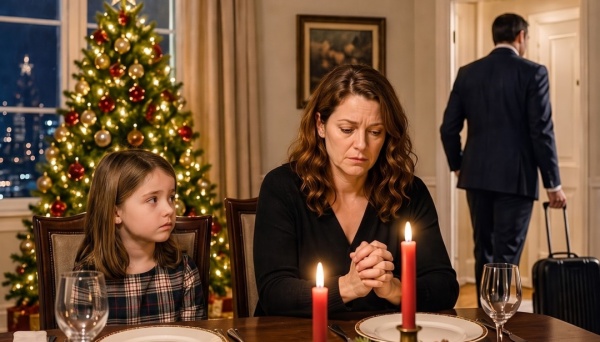
My Husband Said He Was in Atlanta for Work — Then On Christmas Eve, My Fitness Tracker Showed His Truck at a Hotel Six Miles From Home…
On Christmas Eve, I was sitting by the tree with a glass of wine, trying to make the holiday feel normal for my seven-year-old daughter while my husband was supposedly handling an emergency work trip in Atlanta. His phone call lasted less than two minutes, and something about the way he rushed me off the line made my stomach tighten. Then I remembered my Garmin fitness tracker was still in his truck. When I opened the app, the blue dot wasn’t in Georgia—it was at a Marriott in Charlotte, just six miles from our house.
PART 1 — The Business Trip That Came Out of Nowhere
My name is Jennifer Caldwell, and I live in Charlotte, North Carolina, in a two-story brick house with a red front door, a creaky back deck, and a maple tree in the yard that turns the most beautiful shade of orange every October. I am thirty-eight years old now, though when this happened two years ago, I felt about ninety and twelve at the same time. Some kinds of heartbreak make you feel ancient and helpless all at once.
I work as a dental hygienist at a family dental practice in the Ballantyne area. I make about $58,000 a year, drive a silver Toyota Highlander, and keep an emergency granola bar in my purse because motherhood teaches you that somebody is always hungry at the worst possible time. I am not dramatic by nature, which is probably why the events of that Christmas Eve still feel almost too cinematic to belong to my real life.
My husband’s name was Brandon Caldwell. He was forty-one then, a regional operations manager for a logistics company with distribution centers in Charlotte, Raleigh, and Atlanta. He was six feet tall, handsome in an easy, suburban-dad way, with dark blond hair, a quick smile, and the kind of professional confidence that made people assume he knew what he was doing even when he was improvising.
We had been married for nine years.
Our daughter, Sophie, was seven.
She had missing front teeth, strong opinions about pancake toppings, and a belief in Santa so fierce it felt less like innocence and more like a personal policy. Sophie is the reason I am telling this story carefully. Not because she needs every adult detail—she does not—but because she deserves a mother who can look back at her own life honestly.
Before I tell you about the hotel, the fitness tracker, and the Christmas Eve drive that ended my marriage, I need to tell you what our life looked like from the outside.
It looked good.
Not perfect, because nobody with a school-age child, a mortgage, two jobs, and a dog with digestive issues has a perfect life. But solid. Respectable. Warm. The kind of life people understand without needing much explanation.
We had a house in a quiet neighborhood in south Charlotte, not far from Pineville, with neighbors who waved from driveways and compared lawn care services like it mattered. Sophie went to a good elementary school. Brandon coached her soccer team one spring, badly but enthusiastically. I volunteered for class parties and made dentist jokes at PTA fundraisers because people expect dental hygienists to mention floss.
Brandon traveled sometimes for work. Not constantly, but enough that the occasional overnight trip did not raise alarms. Atlanta was part of his region, and his company had a distribution center outside the city that had caused problems before. If he said there was an emergency there, I had no obvious reason not to believe him.
That is important.
People love to ask, after betrayal, “Didn’t you know?”
The honest answer is complicated.
I knew some things felt off.
I did not know what they meant.
For several months before that Christmas, Brandon had been different in small ways. He guarded his phone more than he used to. He took calls in the garage. He started going to the gym more often, which might have been healthy if it had not come with new cologne, new shirts, and the sudden belief that his old jeans made him “look tired.”
I noticed.
Of course I noticed.
Marriage is repetition. You know the sound of someone’s keys in the bowl, the exact way they sigh when reading email, whether they shower before or after dinner, how long they take to answer a text. When those patterns shift, you feel it before you can explain it.
But feeling something is not the same as proving something.
And I had a child, a job, a house, and Christmas coming.
So I did what many women do when the evidence is not yet strong enough to justify blowing up a life. I filed the unease somewhere inside me and kept moving.
The call came on December 23rd, a Sunday, around four in the afternoon.
Sophie and I were in the living room finishing the Christmas tree. We had been decorating it in stages all weekend because she believed every ornament required “space to breathe,” which meant she would hang one, step back, tilt her head, move it two inches, and then debate whether it belonged higher. Christmas music was playing from the speaker. There was hot chocolate on the coffee table. The whole house smelled like pine needles, cinnamon, and the sugar cookies we had not yet baked but had already discussed like a major family project.
Brandon was in the kitchen when his phone rang.
I heard his voice change.
That may sound strange, but married people know what I mean. There is a tone shift that happens when someone moves from husband to employee, from casual to professional. Brandon’s voice dropped half an octave and got clipped around the edges.
“Yeah,” he said. “What happened?”
I glanced toward the kitchen, then back at Sophie.
She was holding a handmade ornament from kindergarten, a popsicle-stick reindeer with one eye slightly lower than the other. “This one has to go where Daddy can see it,” she said.
“Perfect,” I said.
A few minutes later, Brandon walked into the living room holding his phone and wearing the expression of a man who had already decided how to deliver bad news. It was apologetic but firm, which is usually the face people make when they want sympathy but not discussion.
“That was Mike,” he said.
Mike was his boss.
“What’s wrong?” I asked.
“There’s a situation at the Atlanta center. Staffing issue, shipment backlog, some system problem. It’s a mess.”
I looked at him.
“Okay.”
He exhaled, glancing at Sophie. “I need to drive down first thing tomorrow morning.”
Sophie turned from the tree.
“Tomorrow is Christmas Eve Eve,” she said, because at seven, days before Christmas require ceremonial naming.
“I know, bug,” Brandon said, kneeling beside her. “I’m so sorry.”
“When are you coming back?”
“Hopefully the twenty-sixth. Maybe earlier if we get it handled.”
Her little face fell, but she tried to be brave. “So you won’t be here Christmas morning?”
Brandon reached for her hand. “I’m going to try. But I don’t want to promise and disappoint you.”
That line bothered me later.
At the time, I thought it was responsible.
Now I hear rehearsal in it.
I did not argue. I want to be clear about that. Not because I was meek or because I had no feelings, but because there was no logical reason, in that moment, to doubt the situation. Business emergencies happen. People travel. Adults miss holidays for work sometimes, and the unfairness of that does not automatically make it suspicious.
Still, something in my chest tightened.
“On Christmas?” I asked.
“I know,” he said. “Believe me, I hate this.”
He looked sincere.
I helped him pack that night.
That is one of the details that hurts in hindsight. The intimacy of it. Folding his button-downs. Finding his toiletry bag. Reminding him to take his phone charger because he always left it behind. Putting his dress shoes in the side pocket of his suitcase.
I was helping him pack for a lie.
He stood in the bedroom doorway watching me, hands in his pockets.
“You don’t have to do all that,” he said.
“I know.”
“Jen.”
I looked up.
“I’m sorry.”
I believed he meant it.
That is the hard part about betrayal. Liars are not always lying about every feeling. Sometimes they are genuinely sorry for the pain they are actively choosing to cause. They are just not sorry enough to stop.
The next morning, Christmas Eve, he left at 7:10 a.m.
Sophie came downstairs in pajamas and hugged him at the front door. He kissed the top of her head and told her Santa would know where to find Daddy’s gifts even if Daddy was in Georgia. She asked if he would call before bed. He promised he would.
Then he kissed me.
Not passionately. Not coldly. Just normally.
That normalcy is what haunts me most.
I stood on the porch in my robe and watched his black Ford F-150 pull out of the driveway, the University of North Carolina sticker on the back window catching the gray morning light. He turned left at the end of the street and disappeared.
I went inside and found Sophie standing by the tree.
“Christmas can still be good, right?” she asked.
I smiled because mothers are sometimes required to perform miracles with their faces.
“Absolutely,” I said. “We’re going to make it wonderful.”
She considered that.
“Can we make pancakes on Christmas morning?”
“Yes.”
“With sprinkles?”
“Obviously.”
That satisfied her.
So I made coffee, started laundry, wrapped the last few gifts, and stepped into the version of Christmas Eve I thought I was having: a quiet, slightly sad holiday with my daughter while my husband worked four hours away.
I had no idea he was only six miles from home.
PART 2 — Christmas Eve and the Phone Call That Ended Too Fast
Christmas Eve felt muted from the beginning.
Not bad.
Just softer than usual, like the house knew one voice was missing.
Sophie and I did everything we always did, because traditions matter most when something else has gone wrong. We made my mother-in-law’s sugar cookie recipe, which is unnecessarily complicated and involves chilling the dough twice, rolling it to an exact thickness, and pretending the flour will not cover every surface no matter how careful you are. Sophie wore a red apron with snowmen on it and took her decorating responsibilities very seriously.
She made one cookie that was supposed to be a Christmas tree but ended up looking like a green triangle that had survived a natural disaster.
She named it Fred.
Fred went on the Santa plate.
We watched Home Alone, though Sophie hid behind a blanket during the furnace scene like she had every year. We drove through a neighborhood near SouthPark that does big Christmas light displays, the kind with inflatable Santas, synchronized music, and one house that had somehow turned its front lawn into a North Pole airport. Sophie pressed her face to the window and narrated every display like a tiny holiday broadcaster.
Brandon texted throughout the day.
Crazy morning. Miss you girls.
How’s cookie day? Send pics.
Tell Soph I love her.
Trying to get this mess handled.
I sent pictures. I told him Sophie had made a cookie named Fred. He replied with laughing emojis and wrote, Save me one.
Normal.
Everything was painfully normal.
That is how good lies work. They do not arrive wearing masks. They arrive wearing the same tone, the same punctuation, the same casual affection you are used to. They borrow the shape of ordinary life.
By six, Sophie was in her Christmas pajamas.
By seven, we had set out milk and cookies for Santa, including Fred, who was apparently “the leader cookie.”
By seven-thirty, we were reading the Christmas book we had read every year since she was two. She knew half the lines by heart but still acted surprised at the illustrations. At seven, she was caught in that fragile space between belief and suspicion, old enough to ask logistical questions about chimneys but young enough to want the answers to work.
“Does Santa come to houses where dads are in Atlanta?” she asked.
I tucked the blanket around her.
“Yes. Santa has excellent routing software.”
She giggled.
“Will Daddy call?”
“He promised he would.”
She nodded, but her eyes were already heavy.
I kissed her forehead and waited in the hallway until her breathing slowed. Then I went downstairs.
The living room was beautiful in the way Christmas Eve living rooms can be beautiful even when the people inside them are sad. The tree lights reflected in the front window. Wrapped presents sat beneath the branches. The plate of cookies rested on the coffee table beside the glass of milk. The dog, Mabel, a lazy brown mutt with one floppy ear, was asleep near the fireplace, dreaming little running dreams.
I poured a glass of white wine and sat on the couch.
For the first time all day, the house was quiet enough for my own feelings to catch up with me.
I missed my husband.
That is another part people do not always understand. Betrayal does not retroactively erase all tenderness. On that couch, before I knew, I missed him honestly. I missed the version of him who would have complained about the cookie mess, eaten broken frosting pieces, and carried Sophie upstairs when she pretended to be too sleepy to walk.
I missed the man I thought was in Atlanta.
He called at 9:15 p.m.
I answered on the second ring.
“Merry Christmas Eve,” I said.
“Merry Christmas,” he replied.
His voice was low.
Not sleepy.
Not tired exactly.
Guarded.
“How are you?” I asked. “How’s everything going?”
“Busy,” he said. “Crazy. You know.”
I frowned slightly.
“In Atlanta?”
There was half a beat of silence.
“Yeah,” he said. “At the center.”
“How bad is it?”
“Bad enough.”
I waited for more.
There was no more.
Usually, Brandon liked to talk about work. Even when I did not understand every logistics detail, he would explain delays, staffing shortages, route issues, software problems, warehouse drama. He enjoyed being the person who understood complicated systems.
That night, he gave me nothing.
“Sophie made you a cookie,” I said. “It’s terrible. You’ll love it.”
A small laugh. “Tell her I can’t wait.”
“You should call her in the morning before she opens presents.”
“Yeah. Of course.”
The silence after that was not comfortable.
I started to ask the question again, more directly this time.
“So what exactly happened at the—”
He cut me off.
Not loudly.
Abruptly.
“I can’t talk right now. I have to go.”
I sat up.
“Go where? It’s nine-fifteen on Christmas Eve.”
“Work stuff. I’ll explain later.”
“Brandon—”
“Merry Christmas. Love you.”
Then the call ended.
I stared at the screen.
Call duration: 1 minute, 43 seconds.
I remember that number exactly because my brain grabbed onto it like a handrail.
One minute and forty-three seconds.
That was all he had for his wife on Christmas Eve after leaving his seven-year-old daughter two days before Christmas for an emergency business trip.
I sat there with my phone in my hand and felt a small wrongness bloom into something larger.
Not suspicion yet.
Not fully.
It was more like hearing a familiar song played slightly off-key. The melody was still recognizable, but your body knew something was wrong before your mind could name it.
I put the phone on the couch beside me.
Picked up my wine.
Set it down without drinking.
Looked at the tree.
And then I remembered the fitness tracker.
The week before, I had taken off my Garmin fitness tracker in Brandon’s truck because the band was irritating my wrist. We had been on the way to pick Sophie up from school, and I had set it in the center console cup holder. I meant to grab it when we got home.
I forgot.
The next day, I noticed it was missing and assumed it was somewhere in the house. I checked the laundry basket, my bathroom counter, my gym bag, and then gave up because it was Christmas week and nobody has time to search for a watch that can apparently survive without being worn for three days.
Now, sitting on the couch after a call that made no sense, I remembered exactly where I had left it.
In Brandon’s truck.
The truck that was supposedly in Atlanta.
I picked up my phone again.
Opened the Garmin Connect app.
For a moment, I felt silly. Embarrassed, almost. Like I was crossing a line by checking. Like maybe I was becoming the kind of wife who tracked her husband because one short phone call had hurt her feelings.
Then I thought of the pause after I said “in Atlanta?”
I tapped the device location feature.
The map loaded slowly.
Blue dot.
At first, I did not understand what I was seeing.
Because the blue dot was not in Georgia.
It was in Charlotte.
Specifically, it was sitting in South End, at an address near the light rail, beside a cluster of restaurants and apartment buildings and hotels. I zoomed in with my fingers, my heart beginning to pound so hard I could hear it in my ears.
The location label appeared.
Marriott Charlotte South End.
Six miles from my house.
Not Atlanta.
Not a distribution center.
Not an emergency business trip.
A hotel.
On Christmas Eve.
I stared at the map until the screen dimmed.
Then I tapped it awake and stared again.
Sometimes the body understands before the mind gives permission. My hands went cold. My stomach turned hollow. The living room, with its Christmas lights and cookie plate and sleeping dog, suddenly looked staged, like a set built around a woman who had not yet realized she was the last one acting.
I did not call him.
I did not text.
I did not scream.
I sat for about ninety seconds and let the information settle.
Then I stood up.
I put on my coat.
I grabbed my keys.
And I called my neighbor Carol.
PART 3 — The Blue Dot Six Miles Away
Carol Whitaker is sixty-two, retired, widowed, and one of the few people in this world who understands the difference between curiosity and help. She has lived next door to me for seven years, which means she has seen Sophie grow up, watched Brandon shovel snow badly during the one storm Charlotte pretended was winter, and accepted enough emergency childcare requests to qualify as family.
She answered on the third ring.
“Hey, honey.”
“Carol,” I said. “Can you come over for a little while? Sophie’s asleep. I need to go somewhere.”
There was one second of silence.
Then: “I’ll be there in five.”
No questions.
That is friendship in its purest form sometimes.
She arrived in four minutes wearing sweatpants, a puffy coat over pajamas, and slippers she had clearly forgotten to change out of. Her gray hair was clipped back, and she carried a paperback book like this was a normal babysitting shift and not the moment before my life split open.
She looked at my face.
“What happened?”
“I think Brandon is not in Atlanta.”
Her mouth tightened.
“Where is he?”
“A hotel in South End.”
Carol closed her eyes for half a second.
“Oh, Jennifer.”
“I just need you to sit here in case Sophie wakes up.”
“Of course.”
I started toward the door, then stopped.
“What if I’m wrong?”
Carol looked at me gently.
“Then you come home and we drink coffee and talk about anxiety.”
I nodded.
“And if I’m not?”
“Then you still come home.”
That sentence stayed with me.
Because she was right. No matter what I found, I still had to come home. I still had a daughter sleeping upstairs. I still had Christmas morning waiting like a train that would not stop just because I was standing on the tracks.
I drove toward South End with both hands on the wheel.
Charlotte was quiet in that particular Christmas Eve way, with less traffic than usual and more lights than necessary. Houses glowed. Church parking lots were full. Restaurants had dimmed windows and staff wiping down bars before going home to their own families.
My GPS said the hotel was sixteen minutes away.
It felt like both seconds and years.
I kept thinking there had to be an explanation.
Maybe Brandon had come back early and wanted to surprise us.
At a hotel?
Maybe his truck had been stolen.
And the thief drove it to a Marriott and Brandon’s phone call sounded guilty by coincidence?
Maybe the Garmin location was wrong.
But it had been accurate at the gym, at home, at Sophie’s school, everywhere.
Every possible explanation collapsed under the weight of the blue dot.
When I pulled into the Marriott parking lot, I did not go inside immediately.
I drove slowly through the rows.
I found his truck near the side entrance.
Black Ford F-150.
UNC sticker on the back window.
Scratch near the left rear bumper from when he backed into our trash can and blamed the driveway angle.
There it was.
Proof so ordinary it felt obscene.
His truck was not supposed to be painful. It was supposed to be the vehicle we took to Lowe’s, to soccer games, to the mountains that one fall weekend when Sophie got carsick outside Asheville. Now it sat in a hotel parking lot on Christmas Eve like evidence.
I parked three rows away.
My phone buzzed.
For half a second, I thought it was Brandon.
It was Carol.
Sophie is still asleep. Take your time.
I read it twice.
Then I got out.
The air was cold, not brutally cold, but sharp enough that I pulled my coat tighter around me. The hotel lobby was visible through glass doors: warm lighting, a decorated Christmas tree near the entrance, garland along the front desk. The corporate version of holiday cheer, reliable and impersonal.
I walked inside.
A young woman at the front desk looked up with a professional smile. She was probably in her mid-twenties, with neat dark hair and a name tag that said Tessa.
“Good evening,” she said. “Welcome in.”
I stopped at the desk.
“I need some help.”
“Of course. What can I do for you?”
“My husband is a guest here. His name is Brandon Caldwell. I need to know his room number.”
Her face shifted immediately into policy mode.
“I’m sorry, ma’am, but we can’t provide guest room information.”
“I understand,” I said.
And I did.
Privacy rules exist for good reasons. Hotels should not hand out room numbers to emotional strangers, even emotional strangers wearing wedding rings and holding evidence in their phones.
“Could you call his room,” I asked, “and tell him his wife is in the lobby?”
Tessa looked at me for a moment.
Something in my face must have told her not to ask.
“Let me see what I can do.”
She typed into the computer, then picked up the phone.
I stood perfectly still.
The lobby smelled faintly of coffee, cinnamon air freshener, and carpet cleaner. Somewhere near the bar, soft jazz played. A middle-aged couple wearing matching Christmas sweaters walked past me toward the elevators, laughing quietly.
Tessa spoke into the phone.
“Good evening, Mr. Caldwell. I apologize for disturbing you. Your wife is here in the lobby.”
A pause.
Her eyes widened slightly.
Tiny.
Almost unnoticeable.
But I saw it.
“Yes, sir,” she said.
Another pause.
“No, sir. She’s at the front desk.”
Then she hung up.
“He’ll be right down,” she said carefully.
“Thank you.”
I walked to the seating area near the elevator and sat in an armchair facing the doors.
That was when my body finally began to shake.
Not visibly, I don’t think. At least, I hope not. But inside, every nerve was alive. My ears rang. My hands felt numb. My mind kept flashing stupid details: Sophie’s sprinkles, Fred the cookie, Brandon’s suitcase, the Atlanta lie, the one-minute-and-forty-three-second phone call.
The elevator doors opened three minutes later.
Brandon stepped out first.
He was wearing jeans and a blue button-down shirt, not the dress pants and company polo he had packed. His hair was damp like he had showered recently. He looked toward the front desk, then saw me.
His face changed.
I have replayed that expression more times than I want to admit.
First shock.
Then calculation.
Then something close to surrender.
Behind him, half a second later, stepped a woman I recognized.
Her name was Ashley Martin.
She worked in Brandon’s office.
I had met her at the company Christmas party two years earlier. We had talked about appetizers, her rescue dog, and how the holiday party DJ was too aggressive with early-2000s pop. She was attractive, brunette, maybe thirty-four, dressed in a cream sweater and black pants, with no coat and no visible wedding ring.
She saw me and froze.
Nobody spoke.
The lobby kept existing around us.
The Christmas tree twinkled.
The jazz played.
A guest rolled a suitcase past the front desk.
My husband stood six miles from our house on Christmas Eve beside the woman he had apparently chosen instead of coming home.
I stood up.
Brandon took one step toward me.
“Jen.”
That was all he said.
My name.
Like it explained something.
I looked at Ashley.
Then at him.
I had imagined, in the fifteen-minute drive over, that I might yell. That I might demand answers. That I might throw something, cry, create a scene so large the hotel staff would talk about it for years.
Instead, I felt completely calm.
Not peaceful.
Calm like winter pavement.
“Sophie asked if we could have pancakes with sprinkles tomorrow morning,” I said. “I told her yes.”
Brandon blinked.
“What?”
“I need you home by eight.”
He stared at me.
I adjusted my purse on my shoulder.
“She deserves Christmas morning,” I said. “Whatever this is, whatever you’ve done, you will not ruin that for her.”
Ashley looked down.
Good.
Brandon’s mouth opened.
“Jennifer, please let me—”
“Eight,” I said.
Then I walked out of the hotel.
He did not follow me.
That told me more than anything he could have said.
PART 4 — Christmas Morning With Sprinkles
Carol was sitting on my couch when I got home, watching a Christmas movie with the sound low.
She stood as soon as I came in.
I closed the door behind me and leaned against it for a moment.
Carol did not ask, “Was he there?”
She knew.
Instead, she said, “Do you want tea?”
That almost broke me.
Not the hotel.
Not seeing Ashley.
Tea.
Because kindness offered at the exact moment you are trying not to fall apart can be unbearable.
I shook my head.
“Not tonight.”
“Do you want me to stay?”
“No. I need to get through the morning.”
Carol walked over and hugged me. She smelled like lavender detergent and peppermint lotion.
“You will,” she said.
“I don’t know how.”
“One thing at a time.”
After she left, I stood in the living room.
The house was unchanged, which felt offensive. The tree still glowed. The stockings still hung from the mantel. Sophie’s handwriting still labeled Brandon’s stocking Daddy, with a little heart over the Y because she thought letters deserved decoration.
I picked up Fred the cookie from Santa’s plate.
Then I ate it.
I do not know why.
Maybe because I needed to do one absurd thing before doing all the necessary ones.
I drank half the milk too, because Santa would not be leaving evidence.
Then I put the presents under the tree.
I filled Sophie’s stocking.
I wrote the note from Santa in handwriting I had practiced since she was three.
I went upstairs and stood in her doorway.
She was asleep on her side, one arm thrown around a stuffed reindeer, completely unaware that the adults in her life had broken something she would later have to learn how to live around.
I wanted to crawl into bed beside her and cry.
Instead, I went to my room, took off my coat, and lay down fully dressed.
I did not sleep.
At 7:45 a.m., I heard Brandon’s truck in the driveway.
Fifteen minutes early.
I got out of bed.
When he opened the front door, he moved carefully, like the house itself might accuse him. He carried no suitcase. That bothered me until I realized the suitcase was probably still in the truck, the prop from his fake Atlanta trip.
He stepped into the kitchen.
I was already there, making coffee.
He looked terrible. Pale, unshaven, eyes red. For a moment, I felt the old reflex: concern. Marriage trains you to notice someone’s pain even when they caused yours.
Then I remembered the hotel elevator.
“Is Sophie awake?” he asked.
“Not yet.”
He swallowed.
“Jen—”
“Not now.”
“I need to explain.”
“No,” I said. “You need to listen.”
He stood very still.
“Sophie is going to wake up soon. She is going to be excited. She is going to want pancakes with rainbow sprinkles because I promised her. She is going to want her father here on Christmas morning because she loves you. You are going to give her that.”
His eyes filled with tears.
“I’m so sorry.”
“Not now,” I repeated.
“I ended it.”
I almost laughed.
Not because it was funny.
Because men sometimes say things that prove they still think the important part is whether they can stop bleeding on the rug after they stabbed someone.
“How long?” I asked.
He looked down.
“How long, Brandon?”
“Seven months.”
The room tilted slightly.
Seven months.
Not one mistake.
Not one drunken night.
Seven months of texts, hotel rooms, lies, business trips, probably inside jokes, probably gifts, probably complaints about me I would never hear but could easily imagine.
“Was Atlanta ever real?”
He shook his head.
“No.”
I turned away and gripped the counter.
“You packed a suitcase.”
“I know.”
“I helped you pack.”
“I know.”
“You let Sophie believe you were missing Christmas for work.”
His face crumpled.
“I know.”
That was when I saw something in him that resembled actual shame. It did not fix anything. But it existed.
Upstairs, Sophie’s bedroom door opened.
Tiny feet thudded down the hallway.
Brandon wiped his face quickly.
I looked at him.
“Pancakes,” I said.
He nodded.
Sophie came flying into the kitchen in red pajamas, hair wild, eyes bright.
“Daddy!”
Brandon knelt and opened his arms.
She crashed into him.
He held her too tightly, and I had to look away.
That morning was one of the hardest performances of my life.
We made pancakes. I added too many sprinkles because Sophie insisted Christmas pancakes should look like “confetti exploded.” Brandon burned the first one. Sophie laughed like that was the funniest thing that had ever happened.
We opened presents.
She got the art set she wanted, a science kit, glitter markers, books, and a stuffed polar bear she immediately named Waffles. She made Brandon sit beside her while she arranged the markers by color.
I watched him watch her.
Tears kept gathering in his eyes.
I felt nothing simple.
Not forgiveness.
Not love.
Not hatred, exactly.
Something more complicated and more adult than any of those words. The recognition that a person can be both a terrible husband and a tender father in the same room. That one truth does not erase the other. That betrayal does not make parenting disappear, but it does make everything harder.
At noon, Sophie went next door to show Carol her art set and Waffles.
The moment the front door closed, Brandon and I stood in the living room facing each other beneath the Christmas tree.
The ornaments shimmered behind him.
Our wedding ornament hung near his shoulder.
I noticed the date on it: nine years earlier.
He started talking.
He told me Ashley had transferred to his department the previous spring. It started with lunches, then texts, then drinks after work, then a hotel in July. He said he had tried to end it. He said he felt trapped. He said he loved me. He said he loved our family. He said he did not know why he kept going back.
I listened.
Then I said, “You knew exactly why.”
He stopped.
“You wanted both lives,” I said. “You wanted me to keep the house, raise Sophie, decorate the tree, and believe you were a good man. And you wanted her to make you feel like a man with no responsibilities. That’s not being trapped. That’s being greedy.”
He cried then.
Real tears.
I did not comfort him.
That was new.
“What happens now?” he asked.
“I don’t know,” I said honestly. “But you’re not sleeping here tonight.”
His face tightened.
“Jennifer—”
“No. You don’t get to lie to me for seven months and then ask for the guest room because you feel bad.”
He nodded slowly.
“Where should I go?”
“I don’t care,” I said. Then, after a moment, “But not to Ashley.”
He flinched.
Good.
We agreed he would tell Sophie he had to finish work things and would call her that night. It was not ideal. Nothing was ideal. But I was not going to explain infidelity to a seven-year-old on Christmas Day.
He packed properly this time.
When he left, I stood by the window and watched the same truck pull away again.
This time, I knew where it was going did not matter.
The real departure had already happened.
PART 5 — The Divorce, the Tracker, and the Life After
I did not file for divorce the next day.
People who have never had to untangle a marriage like to imagine betrayal creates instant clarity. Sometimes it does. More often, it creates a fog so thick you have to move one cautious step at a time.
I called my sister, Lindsay, in Raleigh.
She drove to Charlotte on December 26th without asking if I wanted her to. She brought coffee, clean pajamas, and a look on her face that suggested she had been waiting years for permission to dislike Brandon out loud.
“I’m not saying I knew,” she said after I told her everything. “But I never liked how easy lying looked on him.”
“Saying that now is not helpful.”
“I know. I’ll save the rest for later.”
She did.
Mostly.
I also called an attorney.
Her name was Rebecca Torres, a family law attorney in Charlotte recommended by a patient at my dental practice who had once said, during a cleaning, “If your marriage ever implodes, call Rebecca before you call your mother.” At the time, I thought that was darkly funny.
Now I understood the wisdom.
Rebecca’s office was near Dilworth, in a renovated bungalow with soft lighting and tissues placed in exactly the right locations. She was direct, kind, and did not treat my pain like entertainment.
“North Carolina requires a one-year separation before an absolute divorce,” she explained during our first meeting. “But we can address custody, child support, post-separation support if applicable, property division, and separation agreements before then.”
I nodded, trying to absorb words that sounded both legal and surreal.
“One year?”
“For divorce, yes. But separation can begin when one spouse moves out with the intent to remain separate.”
“He moved out Christmas Day.”
“Then document that.”
I almost laughed.
Document the end of my marriage like a dental chart.
But documentation became a lifeline.
Rebecca told me not to post about Brandon or Ashley online. Not to confront Ashley. Not to empty accounts. Not to use Sophie as a messenger. Not to make decisions from rage if I could make them from strategy twenty-four hours later.
“Anger is information,” she said. “It is not always instruction.”
I wrote that down.
Brandon and I began separation counseling for co-parenting, not reconciliation. That distinction mattered. I was not ready to decide whether divorce was certain, but I was very ready to protect Sophie from becoming collateral damage.
To Brandon’s credit, he did not fight me on that.
He moved into a short-term apartment near Matthews and agreed to a temporary parenting schedule. At first, Sophie stayed mostly with me and spent dinners and some weekends with him. Later, as the routine stabilized, we moved toward alternating weeks.
Telling Sophie was brutal.
We sat on the couch together, Brandon on one side, me on the other, and told her that Mom and Dad were going to live in different houses.
She cried immediately.
“Because Daddy worked on Christmas?”
My heart cracked.
“No, baby,” I said. “This is an adult problem. It is not because of anything you did, and it is not your job to fix it.”
“Do you still love me?”
Brandon made a sound like he had been hit.
“Yes,” he said. “More than anything.”
I said it too.
Again and again.
Children often ask the question beneath the question: Will I still be safe?
We answered that as many times as she needed.
The months after Christmas were ugly in quiet ways.
I found credit card charges I had missed. Hotel stays. Dinners. Gift purchases. Nothing financially catastrophic, but enough to make betrayal feel itemized. Ashley had not been some abstract mistake. She had been woven into the calendar of my life while I packed lunches, scheduled cleanings, and helped Sophie practice spelling words.
Brandon told his version to a few friends.
Not a lie exactly.
A softened truth.
He said we had “grown apart.” He said he had made mistakes. He said Christmas was “complicated.”
I corrected only when necessary.
If someone asked directly, I said, “Brandon had a seven-month affair with someone from work and lied about being in Atlanta on Christmas Eve.”
That was not gossip.
It was a sentence.
Sentences are useful when people try to bury truth under fog.
Ashley left Brandon’s company in February. Whether she resigned or was encouraged to leave, I never asked. She emailed me once, saying she was sorry and that she never meant to hurt Sophie.
I did not reply.
There are apologies that are less about healing the person harmed and more about reducing discomfort for the person who caused harm. I had no interest in helping Ashley feel cleaner.
Brandon apologized many times.
Some were useless.
Some were real.
One evening in March, after dropping Sophie off, he stood on the porch and said, “I keep thinking about you in that hotel lobby.”
“So do I.”
“You were so calm.”
“I was in shock.”
“I thought you’d scream.”
“I think you wanted me to,” I said.
He looked confused.
“If I screamed, you could make the story about my reaction. But I didn’t give you that.”
He looked down.
“No. You didn’t.”
The divorce paperwork began that spring, though the final divorce could not happen until after the required separation period. Rebecca guided me through equitable distribution, custody arrangements, child support calculations, and all the unromantic mechanics of ending a life built jointly over nine years.
North Carolina is an equitable distribution state. That does not mean everything is split exactly in half. It means marital property is divided fairly according to legal factors. The house, retirement accounts, vehicles, debts, savings, and household items all had to be addressed.
I kept the house.
Not because I won some dramatic battle, but because it made sense for Sophie’s stability and because I could refinance with help from savings and a modest settlement structure. Brandon kept his truck. We divided retirement assets. We created a parenting plan with clear holiday schedules because vague expectations are where divorced parents go to fight.
Christmas was written carefully.
Alternating years.
Specific pickup times.
Video call provisions.
Santa logistics.
Yes, Santa logistics became a legal-adjacent conversation.
Life is absurd even when it hurts.
The divorce was finalized the following year.
By then, I had become a different woman in ways that were both visible and private. I started therapy on Tuesday afternoons with a counselor named Dr. Helen Marks, who helped me understand that missing signs is not the same as causing betrayal. She also helped me stop replaying the elevator doors opening as if another ending might appear if I watched the scene enough times.
It never did.
I still work in Ballantyne.
I still live in the same house.
Carol is still next door, still answering the phone like a woman placed on earth specifically to make emergencies survivable. Lindsay still drives down from Raleigh once a month, usually claiming it is to see Sophie but bringing me wine and gossip because sisters understand dual-purpose visits.
Sophie is nine now.
She knows her parents are divorced because adult relationships sometimes break in ways children did not cause. She knows both homes have pancake mix. She knows Santa finds her wherever she sleeps. She knows she can love her father without managing my feelings and love me without rejecting him.
That last part took work.
A lot of work.
There were moments I wanted my pain to be visible enough for the world to validate it but hidden enough that Sophie never felt responsible for it. That is a difficult balance. I failed sometimes. Not catastrophically, but humanly.
When I cried in the pantry once and she found me, I told her, “I’m having a sad moment, but I’m safe, and it’s not your job to fix it.”
She brought me a napkin.
Not a tissue.
A napkin.
Then she said, “Can I still hug you?”
“Yes,” I said. “Always.”
Brandon is still in Sophie’s life.
He has become, strangely, a better father after becoming an ex-husband. Maybe guilt matured him. Maybe consequences did. Maybe having parenting time structured forced him to be fully present instead of vaguely available. I do not know.
I no longer spend energy determining whether his growth is morally satisfying.
I care that Sophie is safe, loved, and consistently shown up for.
As for me, I am okay.
Not in the glossy, revenge-dress, thriving-in-six-weeks way people like to sell online. Real healing is less photogenic. It looks like opening mail from your attorney without shaking. Sleeping through the night again. Making dinner for one adult and one child without feeling like the empty chair is accusing you. Going to a Christmas lights display and realizing you are enjoying it.
I still have the Garmin tracker.
It sits in the top drawer of my nightstand when I am not wearing it. I considered throwing it away. For a while, every time I looked at it, I saw the blue dot pulsing on the map like a tiny electronic witness.
But I kept it.
Not because I wanted to remember the pain.
Because it told me the truth when I needed the truth.
There is something honorable about an object that does exactly what it is designed to do. No excuses. No gaslighting. No “Atlanta” when the answer is Charlotte. Just location, time, and fact.
Two Christmases have passed since that night.
Last year, Sophie asked if Santa knew Daddy’s apartment address.
I said, “Absolutely. Santa has excellent routing software.”
She laughed the same way she had laughed before everything changed.
That laugh felt like grace.
On Christmas Eve, after she went to bed, I sat by the tree with coffee instead of wine. The house was quiet. The presents were wrapped. Mabel snored near the fireplace. Carol had texted, You okay?
I replied, Yes. Really.
And I was.
Not because the betrayal no longer mattered.
Because it no longer controlled the room.
I thought about the woman I had been two years earlier, sitting on the couch with a glass of wine after a one-minute-and-forty-three-second phone call, feeling wrongness bloom under the Christmas lights. I wanted to reach back through time and hold her hand. I wanted to tell her she was not crazy, not paranoid, not overreacting.
I wanted to tell her: Open the app. Trust the blue dot. Then trust yourself.
In the morning, Sophie came downstairs wearing snowman pajamas and asked for pancakes.
“With sprinkles?” I asked.
She gave me a look.
“Mom. Obviously.”
So I made them.
Rainbow sprinkles, too many.
The way she likes them.
Life goes on in the strangest ways. Not neatly. Not all at once. But in pancakes, school drop-offs, dental appointments, therapy sessions, holiday schedules, neighborly kindness, and the quiet relief of realizing the truth did not destroy you.
It only destroyed the lie.
And sometimes that is the beginning of getting your life back.
