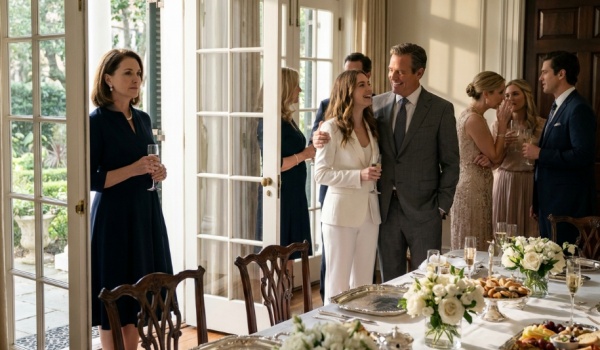
My Husband Announced His Engagement in My House—Then His Mistress Showed Up Wearing My Missing Suit… I wasn’t supposed to attend my husband’s engagement brunch, especially since we were still legally married. But when I learned he was hosting it inside the historic Charleston home my grandmother left me, I walked in quietly.
Then I saw his mistress wearing the white divorce suit that had vanished from my closet. They thought the suit proved I was weak—but by the end of brunch, it became the first piece of evidence against him.
Dịch tiếng Việt
Part 1: The White Suit
His mistress walked into my husband’s engagement brunch wearing the white divorce suit I had bought for court.
For one second, the room disappeared around me. The clinking glasses, the soft jazz playing from the patio speakers, the laughter drifting across the sunlit terrace—all of it faded into a dull ringing in my ears. I stood beside the mimosa bar in my own house and stared at the woman wearing the suit I had never had the chance to wear.
It was an ivory Alexander McQueen pantsuit, tailored at the waist, sharp at the shoulders, elegant enough to look like armor. I had bought it six months earlier for the day I planned to walk into family court and end my marriage to Graham Whitaker. I never wore it because Graham begged me to postpone, promised therapy, promised transparency, promised he would “do anything to save us.”
Apparently, “anything” included getting engaged to another woman before our divorce was final.
Her name was Madison Vale. She was thirty-one, polished, pretty, and smiling like a woman who had mistaken a borrowed spotlight for sunrise. Her blond hair fell in perfect waves over one shoulder, and the white suit fit her almost perfectly, though the sleeves were a little long.
I noticed that detail because pain makes women observant.
Graham stood beside her with his hand on the small of her back. He looked handsome, relaxed, and cruelly proud. At forty-four, he still had the kind of Southern charm that made strangers trust him before he earned it.
The brunch was supposed to be a “private family gathering,” at least according to the invitation my sister-in-law had forwarded to me by accident. It was being held at Whitaker House, the historic Charleston home Graham and I had restored together over eight years. The invitation called it Graham and Madison’s Engagement Brunch.
My house.
My husband.
His mistress.
Their celebration.
I had not planned to attend. My attorney advised against it, and my best friend, Lauren, threatened to physically block my driveway if I tried. But when I saw the address printed under their names, something inside me went cold and still.
They were not just replacing me.
They were doing it inside the rooms I had saved.
Whitaker House sat south of Broad Street, all white columns, black shutters, gas lanterns, and old money pretending not to notice new scandal. My grandmother had left it to me, not to Graham, though he loved telling people “we” inherited it. I had spent nearly $700,000 of my own trust money restoring the roof, the moldings, the heart pine floors, and the garden wall after Hurricane Matthew damaged the back wing.
Graham gave interviews about the restoration.
I signed the checks.
That morning, I wore a simple navy dress, low heels, and pearl studs. I did not wear the white suit because it had disappeared from my closet two weeks earlier, along with a pair of diamond drop earrings and a vintage Chanel clutch. Graham claimed he knew nothing about it.
Now Madison was standing ten feet away wearing my missing courage.
She saw me before Graham did.
Her smile faltered for half a second, then returned brighter and sharper. She lifted her chin, as if daring me to make a scene. Maybe she thought I would cry, or tremble, or run.
I did none of those things.
Graham turned, following her gaze. When he saw me, his face changed—not with guilt, but irritation. That told me everything I still needed to know.
He crossed the terrace with Madison on his arm.
“Evelyn,” he said quietly. “What are you doing here?”
I looked around at the floral arrangements, the catered shrimp and grits station, the champagne tower, the monogrammed napkins printed with G & M. “Funny. I was about to ask you the same thing.”
His jaw tightened. “Don’t do this.”
“Do what?”
“Embarrass yourself.”
Madison touched his sleeve. “Graham, maybe we should—”
“No,” I said, looking at her suit. “Please stay. It would be rude to leave before dessert.”
Several guests nearby went silent. Graham’s mother, Patricia Whitaker, stood under the pergola wearing pale blue and the expression of a woman who had spent her whole life confusing appearances with morality. My brother-in-law looked down at his phone, suddenly fascinated by nothing.
Graham lowered his voice. “This is not the time.”
I smiled. “You’re hosting an engagement brunch in my house while still legally married to me. I think time stopped being your strong point.”
Madison’s face flushed.
Graham’s hand moved protectively to her back. That gesture should not have hurt anymore, but it did. He used to touch me that way at fundraisers, guiding me through rooms like I was cherished rather than managed.
Then he laughed.
Not loudly. Not warmly. Just enough for the people around us to hear.
“You always bought things you never had the courage to use,” he said, glancing at the white suit Madison wore. “At least someone finally wore it well.”
The room froze.
Madison smiled like she had been crowned.
They expected me to crack then. I could feel it in the way people held their breath, waiting for the abandoned wife to collapse into the role written for her. Tears would have comforted them. Anger would have entertained them.
Instead, I looked at Graham’s hand on Madison’s back and felt the last thread snap cleanly.
“You’re right,” I said calmly.
His eyes narrowed.
“I didn’t wear it to court.”
Madison’s smile widened.
I continued, “Because I decided court deserved something better.”
The smile vanished.
I took one slow step closer. “And because that suit had already become evidence.”
Graham’s face went blank.
Only for a second.
But I saw it.
Behind him, Patricia lifted her chin. “Evelyn, this is highly inappropriate.”
I turned to her. “Patricia, your son stole clothes from my closet, jewelry from my safe, money from my company, and dignity from every room he entered. If inappropriate bothers you, you should start at home.”
A gasp traveled across the terrace.
Graham reached for my arm, but I stepped back before he touched me.
“Careful,” I said softly. “There are cameras on the terrace now.”
His eyes flicked toward the corner of the porch.
He had forgotten.
Of course he had.
Graham forgot many things when he believed he owned the room. He forgot that the house belonged to me. He forgot that Whitaker & Reed, the design-build company we ran together, had been founded with my inheritance and registered under operating agreements he barely skimmed. He forgot that the woman he called weak had spent the last six months learning how to become silent in all the ways that mattered.
Silent with banks.
Silent with lawyers.
Silent with forensic accountants.
Silent while the truth slipped slowly, legally, and permanently out of his hands.
Madison swallowed. “Graham?”
He did not look at her.
I looked at the white suit one more time. “Keep it on for the pictures,” I said. “It may be the last thing you wear today that still looks expensive.”
Then I turned and walked through the French doors into the house.
No one followed me at first.
Good.
I wanted a moment alone with the rooms that had survived worse storms than Graham Whitaker.
In the foyer, sunlight fell across the black-and-white marble floor. The antique mirror reflected a woman I almost recognized: calm, pale, upright, and more dangerous than she had ever looked while trying to be loved.
From the terrace came a murmur of voices.
Then Graham’s footsteps.
He closed the door behind him harder than necessary.
“What have you done?” he hissed.
I turned slowly.
For the first time in our marriage, I saw fear in his eyes.
Not heartbreak.
Not remorse.
Fear.
That was when I knew my attorney’s envelope had arrived.
Part 2: The House He Thought Was His
Graham had always believed confidence could become ownership if he performed it long enough.
He introduced Whitaker House as “our family home” at charity dinners. He gave tours to investors and told stories about the original plaster medallions, the hidden cistern under the garden, the ghost his grandmother supposedly saw in the upstairs hall. None of those stories belonged to him, but Graham had a gift for wearing other people’s history like a custom jacket.
The first time he brought me there, ten years earlier, he stood on the porch and said, “This place needs someone with vision.”
I was foolish enough to think he meant me.
Back then, I was thirty, newly engaged, and still grieving my grandmother, who had raised me after my parents died in a car accident outside Savannah. She left me the house, a modest trust, and her share of Reed Home Group, a small but respected renovation company she had started with my grandfather in the 1970s. Graham had ideas, energy, and a last name that opened doors in Charleston.
So I let him help.
That was how it began. Not with theft, not with affairs, not with public humiliation. It began with help.
He suggested rebranding Reed Home Group as Whitaker & Reed because his name had “regional recognition.” He suggested we use his contacts at banks. He suggested I handle design and client relationships while he managed growth, negotiations, and media.
“You’re the soul,” he would say. “I’m just the engine.”
I believed that was love.
It was not love.
It was positioning.
For years, the arrangement worked well enough to hide the rot. We restored historic homes, converted old warehouses into luxury condos, built waterfront properties for people who spoke casually about $3 million kitchens. Graham charmed clients. I made sure the work was beautiful enough to justify the invoices.
Then success made him careless.
Or maybe success revealed what had always been there.
He started calling the company “mine” in interviews. He made hiring decisions without telling me. He opened a corporate credit account I did not authorize and said it was for “operational flexibility.” When I questioned expenses, he kissed my forehead and told me not to bury my creativity in spreadsheets.
That was the first version of the insult.
Later, when Madison appeared, the insults became sharper.
Madison was hired as a marketing consultant for Whitaker & Reed eighteen months before the brunch. She arrived from Atlanta with a glossy portfolio, perfect teeth, and a talent for making Graham feel like a visionary instead of a middle-aged man terrified of becoming ordinary. She laughed at his jokes before he finished them.
I did not like her.
I also did not blame her at first.
Women are often trained to watch other women instead of the man moving pieces between them. I had no proof then, only instincts and a husband who called instincts insecurity when they inconvenienced him.
The proof arrived slowly.
A hotel charge in Asheville during a week Graham claimed to be in Nashville. A bracelet from a jewelry store I had never visited. A series of late-night “strategy calls” that ended whenever I entered the room.
Then came the white suit.
I bought it in January, after finding a message from Madison on Graham’s iPad.
Once she signs, we can finally stop pretending.
I did not confront him that night.
Instead, I called Lauren.
Lauren Bennett had been my college roommate at Duke and now practiced family law in Charleston with the kind of calm that made angry men nervous. She listened without interrupting as I told her about Madison, the messages, the company expenses, and the way Graham had begun pressuring me to sign a revised operating agreement.
When I finished, she asked one question.
“Have you signed anything recently?”
“No.”
“Good,” she said. “Do not start now.”
Two days later, I hired a forensic accountant.
Three days after that, I bought the white suit.
It was meant to be a promise to myself. I hung it in my closet where I could see it every morning. It reminded me that leaving did not have to look like defeat.
Then Graham found it.
He came home early one evening while I was in the closet packing documents into a tote bag. He saw the garment bag, unzipped it, and laughed. Not nervously. Not sadly. Cruelly.
“A divorce suit?” he asked.
I said nothing.
He held the sleeve between two fingers. “Evelyn, you can barely send back undercooked fish at a restaurant.”
That was when I understood how he saw me.
Not gentle.
Not patient.
Weak.
Two weeks later, he begged me to postpone the filing. He cried in the kitchen, apologized for being “emotionally careless,” and said Madison had meant nothing. He promised therapy, transparency, and a temporary separation if I needed space.
I agreed to postpone because I wanted to believe one last time.
The suit disappeared shortly after.
So did several documents from my office, though Graham did not know I had already copied them.
Standing in the foyer during his engagement brunch, watching him panic behind his perfect mask, I almost felt sorry for the man he had become.
Almost.
“What have you done?” he repeated.
I folded my hands in front of me. “Which part worries you most?”
His nostrils flared. “Do not play games.”
“That’s rich coming from a man hosting an engagement party while still married.”
He looked toward the terrace, lowering his voice. “Madison and I are moving forward. You need to accept that.”
“I accepted it months ago.”
“Then why are you here?”
“Because you held it in my house.”
“Our house.”
“No, Graham.”
His jaw tightened.
“This house was inherited before marriage,” I said. “It is held in the Harrington Family Trust. You know that.”
“We restored it together.”
“I paid for the restoration.”
“You used company money.”
“I used distributions from my trust and personal funds traceable in bank records. You should know. The accountant found every transfer.”
His face changed again.
There it was—the second flicker.
He had not known how much I knew.
The door opened behind him, and Madison stepped into the foyer. The white suit glowed against the marble floor. Up close, I could see where she had pinned the waist tighter, probably because my body and hers did not carry betrayal the same way.
“Graham,” she said carefully, “people are asking questions.”
He turned on her. “Go back outside.”
She froze.
I watched her understand, maybe for the first time, that Graham’s softness was conditional. He could be gentle in candlelight and sharp as broken glass in daylight. Madison was not replacing me because she was special.
She was replacing me because she was useful.
I almost told her.
But she had worn my suit to my house.
Some lessons arrive better without translation.
Before Graham could speak again, the front bell rang.
He frowned. “Who is that?”
I smiled.
“Someone with paperwork.”
The housekeeper, Marta, opened the door. A process server stood on the porch in a gray blazer, holding a manila envelope.
“Graham Whitaker?” he asked.
Graham went still.
Madison whispered, “What is happening?”
The process server handed Graham the envelope. “You’ve been served.”
No one on the terrace could see the papers yet, but they saw Graham’s face. That was enough. Conversations stopped again, spreading outward like a stain.
Graham opened the envelope with shaking fingers.
Inside were the divorce petition, temporary restraining orders regarding marital assets, notice of forensic review, and a civil complaint related to unauthorized transfers from Whitaker & Reed.
He looked up at me.
“You planned this.”
“No,” I said. “You planned all of this. I just documented it.”
His hand clenched around the papers.
Madison stepped back, suddenly less certain in white.
Outside, someone dropped a champagne flute.
It shattered on the brick terrace.
For once, I was not the broken thing in the room.
Part 3: The Company Beneath His Name
By Monday morning, Graham was telling people I had ambushed him.
That was predictable.
Men like Graham rarely object to cruelty. They object to witnesses.
His version traveled quickly through Charleston’s polite circles. Evelyn had shown up uninvited. Evelyn had made a scene. Evelyn was bitter, unstable, jealous, and trying to destroy a good man’s happiness because she could not move on.
By noon, Lauren had sent six legal notices reminding the relevant parties that false statements could become costly when repeated publicly.
By dinner, most people stopped talking.
That was the useful thing about old-money communities: they love gossip, but they love liability less.
The company was harder.
Whitaker & Reed occupied two floors of a renovated brick building near East Bay Street, with exposed beams, glass conference rooms, and framed magazine covers featuring Graham’s smile. Employees loved him because he remembered birthdays, bought expensive coffee for the break room, and gave speeches about family culture. They loved me differently—quietly, through late-night emails about design problems, budget approvals, and clients Graham had overpromised to.
When I walked in Tuesday morning, conversations stopped.
I wore a black dress, not the white suit. Let Madison keep the costume. I had no need to dress like courage when I was carrying the real thing in a leather folder.
Lauren walked beside me. Behind us came Dana Flores, the forensic accountant, and Michael Trent, the corporate attorney my grandmother’s trust had retained years earlier. Graham was already in the main conference room with his lawyer and three senior managers.
Madison was there too.
Not in my suit this time.
She wore beige.
It did not help.
Graham stood when I entered. “You cannot just march in here with a legal team.”
I looked around the conference room. “I own fifty-six percent of the voting interest. I can walk in with a marching band if I want.”
One of the senior managers coughed into their hand.
Graham’s attorney, a thin man named Phillips, cleared his throat. “Mrs. Whitaker, we’d like to keep today’s discussion civil.”
“Then tell your client to stop stealing.”
Graham slammed his palm on the table. “Enough.”
Lauren did not raise her voice. “Mr. Whitaker, I would strongly advise you to sit down.”
He looked at her, then at the attorneys, then at the glass wall where employees were definitely pretending not to watch. Slowly, he sat.
Michael opened a folder. “We are here to address unauthorized corporate transfers, undisclosed consulting compensation, misuse of company funds, and proposed restructuring documents prepared without majority approval.”
Phillips leaned back. “Those allegations are premature.”
Dana slid a spreadsheet across the table. “They are reconciled.”
That was when the room shifted.
Numbers have a different weight than accusations.
Dana walked through them calmly: charges to corporate cards at hotels unrelated to business travel, “marketing advances” paid to Madison’s consulting LLC without proper invoices, legal fees billed through the company for documents that benefited Graham personally, and a proposed asset transfer to a new development entity called Palmetto Prime Holdings.
I had never heard that name until the forensic review.
Graham planned to move our most profitable pending projects into Palmetto Prime, install himself as managing partner, and leave Whitaker & Reed with legacy costs, employee obligations, and debt. Madison’s consulting agreement included a “brand transition bonus” of $250,000 upon successful launch. Graham had described it in an email as “the clean break we need before Evelyn wakes up.”
Lauren read that sentence aloud.
No one moved.
Madison looked at Graham. “You said those emails were privileged.”
Dana glanced at her. “Not from your personal Gmail, they weren’t.”
Madison’s face drained.
Graham turned on her. “Stop talking.”
There it was again.
The tone.
The same one he used with me when guests were gone, when charm was no longer useful, when he wanted obedience instead of partnership. Madison lowered her eyes, and for one brief second, I saw my younger self sitting where she sat.
Then I remembered the white suit.
Pity is not the same as forgetting.
Michael continued. “Under the operating agreement, any transfer of major assets, client contracts, intellectual property, or development opportunities requires written approval from the majority voting member.”
He looked at me.
“Mrs. Whitaker has not granted approval.”
Graham leaned forward. “This company exists because of me.”
“No,” I said. “This company grew because of both of us. It exists because of my grandmother.”
His face hardened. “You would still be sketching kitchens for bored housewives if I hadn’t pushed you.”
“And you would still be pitching rental duplexes in strip-mall conference rooms if my family’s name had not made you respectable.”
The silence after that was almost beautiful.
Graham stared at me as if I had slapped him.
I had not.
I had simply said the part he spent years hoping I would never understand.
Phillips tried to regain control. “The company cannot function under emotional hostility.”
“Agreed,” Michael said. “Which is why we are invoking the emergency governance provision.”
Graham blinked. “What?”
Michael placed another document on the table. “Pending investigation, Mrs. Whitaker is suspending your unilateral authority over financial transfers exceeding $10,000, new vendor agreements, consulting contracts, development entity formation, and personnel changes.”
“You can’t do that,” Graham said.
“She can,” Michael replied. “You signed the agreement in 2017.”
Graham looked at me.
I almost smiled.
That was the problem with men who loved signatures only when women were signing away power. Sometimes they forgot their own signature could become a cage.
Madison stood abruptly. “I need air.”
Graham grabbed her wrist, then released it immediately when Lauren’s eyes dropped to his hand.
Madison stepped away from him.
Good.
Some lessons arrive quickly.
She left the room, and Graham watched her go with panic disguised as anger. He had not just lost control of the company. He was beginning to lose the woman who thought control looked like protection.
The meeting lasted another forty minutes.
By the end, Graham was still president in title but stripped of real access while the independent review proceeded. His company credit cards were frozen. His assistant was instructed not to schedule vendor meetings without dual approval. Madison’s contract was suspended pending review.
Employees avoided my eyes when I walked out.
That was fine.
People need time to adjust when the person they mistook for decoration picks up the blueprint.
In the elevator, Lauren looked at me.
“How are you holding up?”
I stared at the descending floor numbers.
“I thought I would feel more satisfied.”
“You will.”
“When?”
“After you sleep for about three weeks.”
I laughed then, unexpectedly.
Outside, Charleston was bright and humid, carriage horses moving slowly down the street while tourists photographed things they did not know had survived hurricanes, wars, termites, and men like Graham. I stood on the sidewalk and took my first full breath in months.
My phone buzzed.
A text from Graham.
You are making a mistake you can’t undo.
I showed it to Lauren.
She sighed. “Forward it.”
I did.
Then I blocked his number for everything except the court-approved communication app.
That evening, I returned to Whitaker House alone.
The caterers had cleared the brunch, but the terrace still smelled faintly of champagne, citrus, and white roses. In the guest bathroom, I found a lipstick Madison had left behind. On the vanity was a pale smudge where someone had wiped away tears.
I threw the lipstick in the trash.
Not dramatically.
Just where it belonged.
Then I walked upstairs to my closet.
The empty space where the white suit once hung no longer hurt me. It looked like proof. A gap where fear had been removed.
I closed the closet door.
Tomorrow, Graham would fight harder.
But tonight, the house was quiet.
And it was mine.
Part 4: Madison Learns the Price
Madison came to see me two weeks after the brunch.
She arrived at Whitaker House at 7:15 on a Thursday morning, wearing sunglasses too large for her face and no makeup that I could see. Marta watched her from the hallway with the expression of a woman who had been in America for thirty years and had no patience left for foolish people.
“She says it’s urgent,” Marta told me.
I was in the breakfast room reviewing documents with coffee I had reheated twice. The morning sun fell across the table, catching dust in the air like tiny gold warnings. I did not want to see Madison.
Then again, I had wanted many things I did not get.
“Let her in,” I said.
Madison stepped into the breakfast room slowly. Without the white suit, without Graham’s hand on her back, without an audience, she looked younger. Not innocent. Just less protected by the story she had been telling herself.
“Evelyn,” she said.
“Mrs. Whitaker,” Marta corrected from the doorway.
I almost smiled.
Madison swallowed. “Mrs. Whitaker.”
Marta left, but not before giving Madison one last look that could have lowered property values.
I gestured to the chair across from me. “Sit if you’re going to sit.”
Madison sat.
For several seconds, neither of us spoke.
Then she said, “I didn’t know the suit was yours.”
That was a disappointing beginning.
“Yes, you did.”
Her mouth opened, then closed.
I took a sip of coffee. “Try again.”
She looked down at her hands. “I knew it came from your closet. Graham said you bought it to humiliate him in court. He said you were never going to wear it, that you just wanted him to see it and feel guilty.”
“And you believed stealing it was reasonable?”
“I didn’t think of it as stealing.”
“Of course not. People rarely call it theft when a man they want hands them something that belongs to his wife.”
Her face flushed.
Good.
Shame is not fatal. Sometimes it is educational.
Madison reached into her handbag and pulled out a folder. “I brought something.”
I did not touch it.
“What is it?”
“Copies of messages between Graham and me. About Palmetto Prime. About the engagement brunch. About the suit.”
My body went still.
“Why?”
Her eyes filled with tears, but she held them back. “Because he lied.”
I leaned back. “To you or to me?”
She flinched.
“To both of us,” she said quietly. “But I know that doesn’t make us equal.”
That answer was better than the first.
She opened the folder and pushed several printed pages toward me. I glanced down. Text messages. Emails. A calendar invite labeled transition weekend. A scanned draft of a statement announcing Graham’s engagement to Madison and my “voluntary decision to step back from public involvement in Whitaker & Reed.”
Voluntary.
That word had been doing a lot of unpaid labor in men’s lies for centuries.
Madison’s voice shook. “He said once the operating agreement was signed, you would keep the house for a while, then sell it as part of the settlement.”
I looked up slowly. “He promised you this house.”
She nodded.
“He promised you my company.”
“He said it was his.”
“And you believed him.”
“I wanted to.”
That was the first fully honest thing she said.
I looked at her for a long moment. “Did you know we were still married when you accepted the proposal?”
She looked away.
“Madison.”
“Yes.”
“Did you care?”
Her eyes filled again. “Not enough.”
I appreciated that she did not insult me with excuses.
Outside, a delivery truck rumbled past on the street. Inside, the old house creaked softly around us. My grandmother used to say houses hear everything and tell only women who listen.
Madison wiped beneath one eye. “At the brunch, after you left, he told everyone you were unstable. He said you had been threatening him for months.”
“I know.”
“He said the company review was fake.”
“It isn’t.”
“I know that now.”
She pulled out one final paper. “He asked me to sign this yesterday.”
It was a nondisclosure agreement paired with a private settlement. Graham offered Madison $75,000 in exchange for silence, cooperation, and a statement that she had misunderstood certain business discussions. It also required her to return all documents and certify she had not shared them.
I almost laughed.
Seventy-five thousand dollars.
Graham had spent more than that restoring the garden fountain he told donors was symbolic of renewal.
“Did you sign it?” I asked.
“No.”
“Why not?”
Madison looked at me. “Because if he could do this to you after ten years, what would he do to me after one?”
There it was.
The education.
Late, but real.
I picked up the folder. “My attorney will review these.”
She nodded quickly. “I figured.”
“I am not your friend.”
“I know.”
“I am not protecting you.”
“I know.”
“I am also not interested in destroying you for sport.”
That made her cry.
Not loudly. Just enough that her mouth trembled and she turned toward the window as if the azaleas might offer privacy. I did not hand her a tissue. There was a box on the table. She could reach for it herself.
After a moment, she said, “The suit is at Graham’s apartment. I can get it back.”
“No.”
She looked surprised.
“Keep it,” I said.
“But it’s yours.”
“No. It’s evidence. And after that, it’s a lesson.”
Madison nodded slowly.
When she stood to leave, she paused at the doorway. “I really am sorry.”
“I hope so.”
“I am.”
“Then be sorry in ways that cost you something.”
She took that in.
Then she left.
By noon, Lauren had the folder. By four, the documents had been added to discovery. By the next morning, Graham’s attorney was requesting a settlement conference.
That was how I knew the ground beneath him had finally cracked.
The next few weeks were not glamorous.
There were depositions, bank statements, subpoenas, attorney calls, and nights when I sat on the kitchen floor eating crackers for dinner because I was too tired to cook. People imagine justice as a dramatic courtroom moment. Usually, it is PDFs, invoices, signatures, and one exhausted woman refusing to stop reading.
Graham fought everything.
He claimed the corporate charges were legitimate. He claimed Madison was an independent contractor. He claimed Palmetto Prime was only an idea. He claimed I had misunderstood, overreacted, manipulated, and conspired.
Then Lauren produced Madison’s messages.
After that, Graham became quieter.
At the temporary divorce hearing, he tried charm.
He wore a dark suit, brought his mother for emotional effect, and spoke about wanting “fairness” after years of building a life together. His attorney argued that while the house was technically separate property, Graham’s efforts had increased its value. They argued that the company, while majority-owned by me, had grown significantly due to his leadership.
Lauren listened patiently.
Then she presented the trust documents, restoration funding records, operating agreement, unauthorized transfer evidence, and the messages about moving assets before I “woke up.”
The judge was not amused.
“Mr. Whitaker,” she said, looking over her glasses, “this court is not impressed by attempts to confuse access with ownership.”
I looked down at my hands.
For one second, I wished my grandmother were alive to hear that.
By the end of the hearing, the house remained under my exclusive control. Graham was restricted from entering without written arrangement. Company protections stayed in place pending the civil matter and divorce proceedings.
Outside the courtroom, Patricia Whitaker approached me.
She looked smaller than she had at the brunch.
“Evelyn,” she said.
I waited.
“I didn’t know.”
That was what people always said when knowing would have required courage.
I looked at her carefully. “You knew enough to attend the engagement brunch.”
Her face tightened.
“My son made mistakes.”
“Yes,” I said. “And you brought a gift.”
She had no answer.
I walked past her into the bright courthouse hallway.
Graham stood near the elevators, watching me. For the first time in years, he did not look like a man entering a room he expected to own. He looked like someone waiting outside a door that would not open.
“Evelyn,” he said.
“No.”
“One minute.”
“No.”
“I loved you.”
I stopped then.
Not because I believed him.
Because the sentence deserved burial.
“You loved being chosen by me,” I said. “You loved what my name, my house, and my company gave you. You loved standing in front of things I inherited and telling people you built them.”
His face reddened.
“But you did not love me,” I said. “Because love does not steal the clothes a woman bought to survive you and put them on someone else for applause.”
The elevator doors opened.
I stepped inside.
Graham did not follow.
Good.
Some doors should close in front of witnesses.
Part 5: The Truth He Couldn’t Hold
The divorce became final nine months after the engagement brunch.
By then, the civil case had settled confidentially, though not quietly enough to save Graham’s reputation entirely. He resigned from Whitaker & Reed, surrendered any disputed management claims, repaid a portion of unauthorized expenses, and agreed to a structured settlement that let everyone avoid a trial. He called it “mutual resolution.”
I called it cheaper than prison rumors and public testimony.
Madison moved back to Atlanta.
She did not marry Graham.
I heard through Lauren, who heard through another attorney, that Madison cooperated enough to protect herself and then disappeared from Charleston’s social scene like a summer storm that had finally run out of rain. She sent the white suit back to my attorney’s office in a garment bag with no note.
I left it there for three weeks.
Then I picked it up on a Friday afternoon.
When Lauren handed me the bag, she raised an eyebrow. “Are we burning it, donating it, or framing it as a war trophy?”
“None of the above.”
“That sounds emotionally mature. I’m disappointed.”
I smiled for the first time that day.
I took the suit home and hung it in the closet. Not where it used to be. Not at the front, glowing like a promise. I placed it in the back, behind winter coats and dresses I actually liked.
It no longer felt like courage.
It felt like an old receipt.
Proof that I once thought I needed a perfect outfit to leave, when really I had needed documents, witnesses, and the final refusal to be embarrassed by someone else’s betrayal.
Whitaker & Reed changed slowly after Graham left.
For years, the company had revolved around his voice. He filled rooms, charmed clients, made bold promises, and left teams scrambling to deliver them. Without him, meetings became shorter. Budgets became clearer. Employees who had been quiet began speaking.
The first major project I signed as sole president was a historic hotel renovation near Savannah.
At the press conference, a reporter asked whether the company was entering “a new era after personal challenges.” That was a delicate way of asking about scandal without risking a lawsuit.
I smiled politely.
“Whitaker & Reed has always been built on restoration,” I said. “We understand that preserving what matters sometimes requires removing what weakens the foundation.”
The quote ran in three local papers.
Lauren sent me a screenshot with the message: Subtle as a brick. Proud of you.
I kept the house.
Of course I did.
For months after Graham left, I changed almost nothing. His absence was loud enough at first. I could still hear him in certain rooms—the library where he took calls, the terrace where he humiliated me, the dining room where he once toasted our future.
Then, slowly, the house began returning to me.
I replaced the portrait of Graham’s grandfather in the study with a black-and-white photograph of my grandmother standing in front of the house in 1968. I turned Graham’s cigar room into a small reading room with green walls and built-in shelves. I removed the monogrammed bar glasses and donated every set that carried his initials.
In the spring, I hosted a brunch.
Not an engagement brunch. Not a revenge brunch. Not some dramatic unveiling where everyone gasped at my resilience under white roses and champagne.
Just brunch.
Lauren came. Marta came on her day off and sat at the table as a guest, though she kept trying to refill plates until I threatened to take away her mimosa. Several women from the company came too, along with my neighbor Mrs. Bell, who had watched the process server arrive nine months earlier from behind her curtains and never admitted it.
We ate lemon ricotta pancakes, fruit, bacon, and shrimp salad in the garden.
No one mentioned Graham for the first hour.
That felt like victory.
After dessert, Lauren lifted her glass.
“To Evelyn,” she said.
I groaned. “Please don’t.”
“Too late.”
Everyone looked at me.
Lauren smiled. “To the woman who taught us that being quiet is not the same as being powerless.”
I looked down at my plate because suddenly the garden blurred.
Marta raised her glass. “And to cameras on terraces.”
Everyone laughed.
So did I.
Later, after the guests left, I walked through the house barefoot, carrying empty glasses to the kitchen. The afternoon light poured through the windows, warm and gold. Nothing in the house felt haunted now.
In the foyer, I stopped before the antique mirror.
For years, I had checked my reflection there before standing beside Graham at events. I would smooth my dress, fix my lipstick, and prepare to become the gracious wife of a charismatic man. I had not known then that I was practicing disappearance.
Now I saw myself clearly.
Older, yes.
Harder in some places.
Softer in others.
Free.
That evening, Graham emailed me from a new account.
The subject line was: I’m sorry.
I almost deleted it unread.
Then curiosity won.
The message was short. He wrote that he had moved to Charlotte, that he was working in consulting, that he understood now how much he had taken for granted. He said he was sorry for Madison, for the company, for the brunch, for the suit.
Then he wrote:
I thought if I could make everyone believe the life was mine, eventually it would become true.
That sentence stopped me.
Because for once, Graham had told the truth.
Not the whole truth, maybe. Not enough to repair anything. But enough to confirm what I had spent years feeling and months proving.
He had not simply cheated.
He had impersonated ownership.
Of my house.
My company.
My history.
My patience.
My silence.
I replied with one sentence:
I hope you build something honest someday.
Then I blocked that email too.
Some people think blocking is petty.
I think it is architectural.
A boundary is just a wall you build after learning which doors should no longer open.
A year after the brunch, I finally wore the white suit.
Not to court.
Not to punish Graham.
Not to reclaim it from Madison.
I wore it to the annual preservation gala at the Gibbes Museum, where Whitaker & Reed received an award for the Savannah hotel restoration. The suit had been cleaned, tailored again, and altered slightly at the sleeves. It fit me better than it ever had before.
When I stepped out of the car, photographers called my name.
For once, no one asked where Graham was.
Inside, the ballroom glowed with candlelight and old Charleston manners. People kissed cheeks, murmured compliments, and pretended not to remember last year’s scandal while absolutely remembering every detail. I let them.
Memory is not my enemy anymore.
During dinner, I accepted the award alone.
I stood at the podium in the white suit and looked out at a room full of people who had once waited to see whether I would cry before dessert. Some of them had attended Graham and Madison’s brunch. Some had believed his version first. Some had apologized. Some had not.
It no longer mattered.
“Our work is about more than beauty,” I said. “Restoration requires honesty. You cannot preserve a structure by painting over rot. You have to find what is failing, remove what cannot hold, and trust that what remains is strong enough to stand.”
The room went silent.
Then applause rose slowly, then fully.
I did not look for Graham.
He was not there.
That was another kind of restoration.
After the gala, I returned home alone, kicked off my heels in the foyer, and laughed because my feet hurt like any ordinary woman’s feet hurt after three hours of being admired in uncomfortable shoes. I walked to the terrace where Madison had entered in my suit and Graham had placed his hand on her back like a declaration.
The garden was dark except for the lanterns.
The city hummed softly beyond the walls.
I thought about that morning a year earlier, the white suit on another woman’s body, Graham’s laugh, the guests waiting for my humiliation to become entertainment. I thought about how certain they had been that I would disappear before dessert. I thought about the process server, the documents, the cameras, the frozen credit cards, the judge’s voice, Madison’s folder, and Graham’s face when ownership finally stopped pretending.
They thought courage had to be loud.
They were wrong.
Courage can be a copied file.
A locked safe.
A lawyer’s letter.
A calm voice in a foyer.
A woman standing in her own house, refusing to be treated like a guest.
Graham had put his hand on Madison’s back and told the room I never had the courage to wear the suit. Maybe he was right for a while. Maybe I had left it hanging too long, waiting for the perfect day to become brave.
But courage is not always the first step.
Sometimes courage is the last step after a hundred quiet ones no one saw.
He expected me to cry.
I documented.
He expected me to beg.
I filed.
He expected me to disappear.
I stayed.
And by the time dessert was served at that engagement brunch, the house, the company, and the truth were already slipping out of his hands.
Not because I stole them back.
Because they had always been mine.
