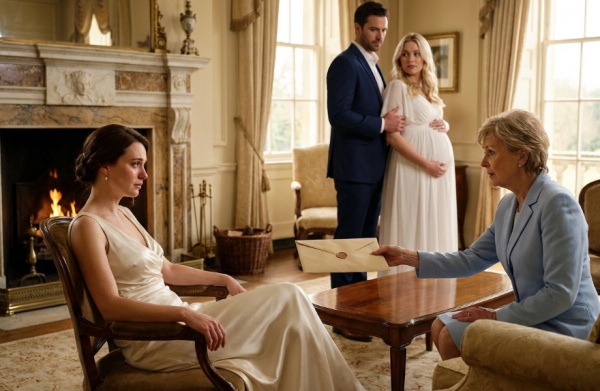
My Husband Got His Secretary Pregnant — Then They Offered Me $100 Million to Vanish. I walked into a glass conference room in Manhattan expecting an explanation, but instead, my husband, his pregnant secretary, and three attorneys were waiting for me. They slid a folder across the table with a number so large most people would have stopped breathing: $100 million. But the money wasn’t a gift — it was a price tag on my silence, my marriage, and my place in the life I had helped build.
Part 1: The Offer
My husband’s secretary was pregnant with twins, and apparently, I was the problem.
That was the first thing I understood when I walked into the private conference room on the thirty-seventh floor of Whitestone Tower in Manhattan. Not that my marriage was ending. Not that my husband had betrayed me. Not even that a twenty-eight-year-old woman named Chloe Bennett was carrying two babies he had helped create while I was still wearing his wedding ring.
No.
The urgent matter, according to the three lawyers sitting across from me, was that I needed to disappear quietly.
The room was all glass, steel, and expensive silence. Through the floor-to-ceiling windows, New York City stretched beneath us in sharp winter light, yellow cabs crawling along Madison Avenue like small bright insects. A tray of untouched coffee sat in the center of the table, beside a leather folder thick enough to ruin someone’s life.
My husband, Graham Whitestone, sat at the head of the table.
Of course he did.
Graham always sat at the head of every table, even in rooms he did not own. He was fifty-four, broad-shouldered, silver at the temples, and handsome in the polished way men become handsome when money edits their rough edges. His navy suit probably cost more than my first car.
Beside him sat Chloe.
She was wearing a cream cashmere sweater, diamond studs, and the soft, frightened expression of someone who had rehearsed being fragile. Her hand rested on her stomach, though she wasn’t showing much yet. Maybe she thought the gesture would make me look cruel if I spoke too sharply.
Across from them sat Graham’s attorney, Martin Shaw, who had the tired eyes of a man paid very well to confuse ethics with paperwork. Next to him was a woman I didn’t recognize, probably Chloe’s lawyer, and a third man from Whitestone Holdings’ legal department.
I had not brought a lawyer.
That was their first mistake.
They thought I came unprepared because I came alone.
“Evelyn,” Graham said, using the voice he normally saved for shareholders and grieving widows. “Thank you for coming.”
I took off my gloves slowly. “Your assistant said this was urgent.”
Chloe looked down.
“Secretary,” I corrected myself. “Sorry. I believe Chloe’s official title is executive secretary, isn’t it?”
Her cheeks turned pink.
Graham’s jaw tightened, but only slightly. He hated public discomfort more than actual wrongdoing.
“Let’s keep this respectful,” he said.
That almost made me laugh.
Respectful.
I had been married to Graham Whitestone for twenty-six years. I had stood beside him when his father cut him out of half the family business. I had hosted dinners for investors who treated me like furniture. I had smiled in photographs for magazines that called him a self-made billionaire, even though the first million dollars came from my father’s bridge loan and the first real estate deal came from my uncle’s contacts.
I had raised our son while Graham built towers, bought companies, and collected admiration.
And now he wanted respect.
Martin Shaw opened the leather folder and slid a document toward me.
“This is a preliminary separation proposal,” he said.
“I didn’t ask for one.”
“No,” Martin replied carefully. “But given recent developments, Mr. Whitestone believes it would be best for all parties to establish a private resolution.”
Recent developments.
That was one way to describe adultery and twins.
I looked at Graham. “Are you going to say it, or are you paying him to do that too?”
Chloe inhaled sharply.
Graham folded his hands on the table. His wedding ring was gone. I noticed because mine was still on my finger, a three-carat emerald-cut diamond he had chosen because, as he once said, “People should know I take care of what belongs to me.”
I should have paid more attention to that sentence.
“Chloe is pregnant,” he said.
“Yes,” I said. “I gathered that from the emergency meeting and the hand on the stomach.”
Chloe’s eyes filled with tears.
I did not apologize.
“With twins,” Graham added.
There it was.
Two small innocent lives placed in the center of the room like a shield.
I looked at Chloe then. Really looked at her. She was beautiful, in the soft, expensive way Manhattan teaches young women to be beautiful when powerful men are watching. Blonde hair, careful makeup, delicate gold bracelet, a nervous mouth.
She was not the first woman Graham had looked at.
But she was the first one who had walked into a conference room with lawyers.
“How far along?” I asked.
“Fourteen weeks,” Chloe whispered.
Fourteen weeks.
I did the math because women always do the math.
Fourteen weeks ago, Graham and I had attended a benefit dinner for pediatric cancer research at the Plaza. He had held my hand for photographers. He had toasted our marriage from the stage, calling me “the steady force behind everything I’ve built.”
That same week, apparently, he had been building something else.
Martin cleared his throat. “Mrs. Whitestone, the proposal is extremely generous.”
I looked down at the first page.
$100,000,000.
One hundred million dollars.
Even printed in black ink, the number looked obscene.
For a moment, no one spoke. I heard the faint hum of the heating system, the distant sound of a phone ringing outside the room, the blood moving in my ears.
Then Martin said, “In exchange, you would agree to a confidential divorce settlement, waive certain claims against Whitestone Holdings, avoid public statements regarding Mr. Whitestone or Ms. Bennett, and relocate outside New York for a minimum of five years.”
I looked up.
“Relocate.”
Graham’s mouth barely moved. “It would be better.”
“For whom?”
“For everyone.”
There it was.
The phrase men use when they mean themselves.
I turned another page. The agreement included a nondisclosure clause, a non-disparagement clause, a relocation clause, restrictions on interviews, restrictions on social media, restrictions on contact with certain board members, donors, investors, journalists, and employees. It even suggested three “approved relocation markets”: Palm Beach, Santa Barbara, or Aspen.
I almost admired the arrogance.
They were not offering me money to divorce him.
They were offering me money to vanish from the story.
Chloe finally spoke.
“I know this is painful,” she said softly.
I looked at her.
She swallowed. “Graham and I never wanted to hurt you.”
That sentence was so ordinary it became extraordinary. People said things like that after backing into someone’s mailbox. Not after sleeping with another woman’s husband long enough to conceive twins and hire counsel.
“You never wanted to hurt me,” I repeated.
“No.”
“But you were willing.”
Her face changed.
Graham leaned forward. “Evelyn, don’t direct your anger at her.”
I laughed then.
Not loudly. Not wildly. Just once, sharp enough that Martin glanced at the legal assistant’s empty chair as if hoping someone else might absorb the awkwardness.
“You brought your pregnant mistress into a room with three attorneys to pay me to leave my own life,” I said. “Please don’t lecture me about where to place my anger.”
Graham’s eyes hardened.
There he was.
Not the generous husband from magazine covers. Not the visionary CEO. Not the man who donated hospital wings and funded scholarships. Just Graham, annoyed that reality had stopped obeying him.
“You’re being emotional,” he said.
I smiled.
For twenty-six years, Graham had used that word like a broom, sweeping my intelligence into a corner. Emotional when I questioned the books. Emotional when I asked why he came home smelling like perfume. Emotional when I noticed young women rotated through his office every eighteen months.
I closed the folder.
“No.”
Martin blinked. “Mrs. Whitestone, perhaps you should review the full terms before—”
“I said no.”
Graham stared at me.
“You’re refusing one hundred million dollars?”
“I’m refusing the part where I disappear.”
His voice dropped. “Think carefully.”
“I have.”
“No, you haven’t. You’re angry.”
“Yes,” I said. “And still capable of reading.”
Chloe began crying silently. Her lawyer handed her a tissue. Graham did not touch her, which told me everything about the kind of future she was fighting for.
I stood.
Martin rose halfway. “Mrs. Whitestone, we strongly recommend you retain counsel before making a final decision.”
“Finally,” I said. “Something we agree on.”
I picked up the folder.
Graham’s hand shot out. “That document stays here.”
I looked at his hand.
Slowly, he withdrew it.
“No, Graham,” I said. “If you wanted this room to remain private, you should not have invited me into it.”
His face turned cold.
At the door, I stopped and looked back at Chloe.
“Get your own doctor, your own lawyer, and your own bank account,” I said.
She looked startled.
Graham said, “Evelyn.”
I ignored him.
“Because if he’s willing to buy the mother of his first child out of her own life,” I told her, “you should think very carefully about what he’ll offer you when you become inconvenient.”
Then I walked out.
Behind me, nobody moved.
By the time I reached the elevator, my phone had already buzzed twice.
Graham.
Then Martin.
Then Graham again.
I did not answer.
Instead, I pressed the elevator button, opened the leather folder, and looked once more at the number.
$100,000,000.
Enough money to make most people disappear.
But Graham had forgotten something.
I was already rich.
Not only in money.
In memory.
In documents.
In patience.
In twenty-six years of knowing exactly where the bodies of truth were buried.
And unlike Graham, I had never needed a conference room full of lawyers to be dangerous.
Part 2: The Wife Behind the Name
Before I was Mrs. Whitestone, I was Evelyn Hart.
That name mattered to me.
My father owned three hardware stores in upstate New York, the kind where men came in for paint and left with advice about their marriages, their gutters, and their teenage sons. My mother taught English at a public high school for thirty-four years and believed a thank-you note could repair almost anything except bad character.
We were not billionaire people.
We were comfortable. Practical. Respectable. The kind of family that paid bills early, bought cars used, and cleaned the garage every spring whether it needed it or not.
I met Graham when I was twenty-six and working in development for a museum in Albany. He was thirty, ambitious, charming, and hungry in a way I mistook for depth. He talked about building things that would outlast him: towers, companies, foundations, legacies.
He made me feel like I was standing near the beginning of a great American story.
For a while, maybe I was.
Our first apartment was a one-bedroom rental with a broken radiator and a view of a brick wall. Graham worked sixteen-hour days. I wrote grant proposals, cooked pasta at midnight, and believed exhaustion was romantic if you were building a future.
When our son, Noah, was born, Graham cried in the hospital room.
Real tears.
I remember that because people like to imagine men like Graham were never human. They were. That was the complicated part. He held our baby with shaking hands and whispered, “I’ll give you everything.”
He meant it.
He just never understood the difference between giving everything and owning everyone.
The money came slowly at first, then all at once.
A commercial property deal in Brooklyn. A distressed hotel purchase in Queens. A partnership with a private equity group. A luxury apartment development that made headlines and made Graham impossible to ignore.
By the time Noah was ten, we had moved into a limestone townhouse near Central Park, hired a housekeeper, and acquired a life that required staff to maintain.
Graham changed with money.
Not dramatically.
Worse.
He became more himself.
He discovered that people laughed harder when he had more money. They forgave lateness, arrogance, interruption, and cruelty if it came wrapped in tailored wool. He learned that a donation could turn suspicion into gratitude, and a gala speech could make people forget delayed payments, ugly lawsuits, or workers quietly underpaid by subcontractors he claimed not to know.
I saw things.
Not all at once.
A pattern is rarely visible on the first day.
At thirty-seven, I saw him humiliate a junior executive at dinner and then write a $50,000 check to a youth mentorship program before dessert. At forty-one, I saw him flirt openly with a board member’s daughter and then tell me I had “Midwestern insecurity,” even though I was from New York and he knew it. At forty-six, I saw him move a loyal employee out of the company after she questioned an expense allocation.
That was when I began keeping records.
Not because I planned revenge.
Because I had been raised by a woman who alphabetized tax documents and a father who believed receipts were “how honest people remember.”
So I remembered.
I kept copies of emails Graham asked me to print and then forgot. I kept calendars. I saved text messages. I photographed receipts left in jacket pockets before sending them to the dry cleaner. I wrote down dates when he claimed he was in Boston but his car service invoice said SoHo Grand Hotel.
At first, I thought I was documenting an affair.
Then I realized affairs were only the smoke.
There was a larger fire.
Whitestone Holdings was private, family-controlled, and deeply complicated. Graham owned the public image, but not every asset. Some properties were in trusts. Some investments involved my family’s early capital. Some charitable vehicles carried both our names.
For years, Graham told interviewers I was his “quiet partner.”
He thought that meant decorative.
It did not.
I had reviewed contracts when he was too tired to read. I had introduced him to donors, bankers, museum trustees, and real estate families who trusted me before they trusted him. I had signed documents. I had sat in meetings. I had watched.
More importantly, I had listened.
Men like Graham always forgot women in rooms were listening.
They spoke freely around wives, assistants, hostesses, mothers, and women carrying coffee because they assumed we were atmosphere. I learned more from being underestimated than Graham ever learned from being flattered.
Chloe Bennett arrived at Whitestone Holdings two years before the conference room.
She started as an executive secretary after working at a boutique PR firm in Boston. Graham praised her efficiency at dinner one night, which meant nothing. He praised many employees when he wanted me to know he was surrounded by competent admiration.
Then he started mentioning her too often.
Chloe found the missing file.
Chloe handled the investor packet.
Chloe stayed late to coordinate the Miami trip.
Chloe has excellent instincts.
The first time I met her, she was wearing a black dress at the company holiday party and looking at Graham as if he were not a man but a door.
I knew that look.
It was the way I had looked at him before I understood doors could lock from the outside.
She shook my hand and said, “Mrs. Whitestone, I’ve heard so much about you.”
I smiled. “Then you have an advantage.”
She did not know what to do with that.
The affair probably began six months later.
I say probably because certainty is a luxury betrayed women are rarely given. We are handed inconsistencies, unexplained charges, changed passwords, new cologne, delayed flights, and sentences that begin with “You’re imagining things.”
Graham did not become affectionate with me to cover his guilt. That would have required guilt.
He became impatient.
I was no longer useful to the fantasy he was having of himself. In Chloe’s eyes, he could be brilliant, misunderstood, powerful, wounded, trapped in a loveless marriage, still young enough to begin again. With me, he was a man who snored, lied badly when tired, and once forgot our anniversary because he was negotiating a parking garage purchase in Jersey City.
Chloe got the legend.
I had the man.
The pregnancy changed the math.
Twins changed the leverage.
A single baby might have been managed privately, in Graham’s mind. Trust fund, apartment, quiet support, carefully worded explanation if anyone asked. But twins made him feel chosen by fate. Twins sounded dynastic.
He did not want a scandal.
He wanted a transition.
That was why they offered me $100 million.
Not because Graham felt generous.
Because he needed me to sign away the power of being the woman who knew where everything began.
That afternoon, after leaving Whitestone Tower, I did not go home.
Home suddenly felt like a museum exhibit about a marriage.
Instead, I walked eighteen blocks in the cold without feeling my feet. Manhattan moved around me as if nothing had happened. A dog walker untangled five leashes. A bike messenger cursed at a taxi. A woman in a red coat laughed into her phone outside a bakery.
Life is rude that way.
It continues while yours catches fire.
I finally stopped outside St. Patrick’s Cathedral, though I had not been to Mass in years. I stood among tourists taking photos and office workers hurrying past with paper cups. Then I called my lawyer.
Not Graham’s lawyer.
Mine.
Her name was Rosalind Park, and she had handled a trust dispute for my family ten years earlier with the calm brutality of a surgeon removing a bullet.
She answered on the third ring.
“Evelyn?”
“Do you still handle difficult divorces?”
There was a pause.
Then she said, “How difficult?”
I looked down at the leather folder in my hand.
“One hundred million dollars difficult.”
Rosalind exhaled once.
“Come to my office,” she said. “Do not text him. Do not email him. Do not sign anything. And Evelyn?”
“Yes?”
“Do not underestimate what frightened rich men will do to protect a story.”
I looked up at the cathedral’s stone face, gray against the winter sky.
“I don’t,” I said.
And for the first time all day, I meant it.
Part 3: Chloe’s Tears
Rosalind Park’s office did not look like a place where emotions were welcome.
It was on Park Avenue, all pale wood, clean lines, and art expensive enough to be ugly on purpose. Rosalind herself was in her early sixties, Korean American, silver-haired, and elegant in a way that made diamonds seem unnecessary. She listened to the whole story without interrupting once.
When I finished, she read the proposed agreement.
Her eyebrows lifted slightly at the relocation clause.
“Palm Beach, Santa Barbara, or Aspen,” she said. “How considerate. They’re letting you choose your exile.”
“I thought so too.”
She turned another page. “This nondisclosure language is unusually broad.”
“Meaning?”
“Meaning they don’t just want silence about the affair. They want silence about business matters, charitable entities, personal conduct, employment practices, and anything that may affect Graham’s reputation.”
I looked at her.
“So this isn’t about Chloe.”
“No,” Rosalind said. “Chloe is the weather. This is about the climate.”
That was when I opened my tote bag and took out my own folder.
Rosalind looked at it.
“What’s that?”
“Receipts.”
A faint smile touched her mouth. “Your mother raised you well.”
For the next three hours, we sorted my records.
Hotel invoices. Emails. Company memos. Trust documents. Old loan agreements. A copy of the bridge financing my father had provided before Graham’s first major acquisition. Charitable foundation records. Notes from conversations. Screenshots of text messages. Photos of checks. A list of properties connected to shell entities I did not fully understand but had noticed.
Rosalind became more interested with every page.
By dusk, she had called in two associates, a forensic accountant, and a litigation partner named Anthony Russo who looked like a retired boxer wearing a $3,000 suit.
Anthony flipped through the material and said, “He offered you one hundred million dollars because he thinks that’s cheaper than discovery.”
Discovery.
Such a beautiful word.
In marriage, discovery is devastation.
In law, discovery is procedure.
I preferred the second.
Rosalind gave me rules before I left.
Do not sleep in the same bedroom as Graham. Do not discuss strategy with Noah until we decide how to handle family communications. Do not confront Chloe. Do not post, hint, like, share, or respond to anything online. Do not drink and call anyone. Do not allow guilt to make you careless.
I followed every rule except one.
I called Noah.
Our son was twenty-four, living in Seattle, working as a software engineer, and still young enough to believe his parents’ marriage was boring but stable. He answered with music in the background.
“Hey, Mom.”
The sound of his voice nearly broke me.
“Are you alone?” I asked.
The music lowered. “Yeah. What’s wrong?”
I closed my eyes.
There is no gentle way to tell your child their family has been edited without permission.
“Your father and I are separating,” I said.
Silence.
Then, “What happened?”
I told him enough.
Not everything. Not the business records. Not the $100 million offer. Not yet. But I told him about Chloe, about the pregnancy, about the twins.
Noah did not speak for so long I thought the call had dropped.
Then he said, “How long?”
“I don’t know.”
“But not one time.”
“No.”
His breathing changed.
“I’m flying home.”
“You don’t have to.”
“Mom.”
That one word carried all the years of scraped knees, school plays, fever nights, college drop-offs, and the way he still hugged me first when he came home for Thanksgiving.
“Okay,” I whispered.
Graham returned to the townhouse at 10:30 p.m.
I was in the library, where I had spent the evening moving certain documents into a safe and certain emotions into places I could reach later. He entered without knocking, still in his suit, tie loosened, face carefully arranged.
“Evelyn,” he said.
“No.”
He blinked. “Excuse me?”
“No conversation without my attorney.”
He laughed softly. “Don’t be ridiculous.”
I looked at him across my father’s old writing desk.
“Graham, I sat across from you today while you tried to purchase my disappearance. We are well past ridiculous.”
His mouth tightened. “You took the proposal.”
“Yes.”
“That was confidential.”
“Then you should have marked it properly and given it to counsel.”
That unsettled him.
Graham liked me best when I seemed intelligent in socially useful ways. He did not like being reminded that I could understand legal process.
He sat without being invited.
“Chloe is scared.”
I almost admired his consistency.
“Then Chloe should speak with her attorney.”
“She’s carrying my children.”
“So was I.”
His face flickered.
There.
A small crack.
“I never meant for this to happen,” he said.
“No. You meant for it to stay hidden.”
He looked away.
For a moment, the room held the ghost of every conversation we had avoided. Every trip he took. Every dinner I hosted while he texted under the table. Every time I chose the family photograph over the private truth.
Then he said, “One hundred million dollars is more than fair.”
I laughed quietly. “You still think this is about the number.”
“Everyone has a number.”
“That may be the saddest thing you’ve ever said to me.”
His eyes hardened. “Don’t make yourself noble.”
“I don’t have to. You’re making me look wonderful by comparison.”
He stood.
“Be careful, Evelyn.”
That was the second time that day a man had told me to think or be careful, as if caution belonged only to the person being harmed.
I reached for my phone.
“Would you like to repeat that with my recorder on?”
He stared at me.
Then he left.
The next morning, Chloe called me.
I was at the kitchen island drinking coffee that had gone cold when my phone rang from an unknown number. I almost ignored it, but something made me answer.
“Mrs. Whitestone?”
Her voice was small.
“Yes.”
“It’s Chloe.”
I looked at the skyline through the kitchen window. Central Park was bare and gray, winter trees scratching at the sky.
“You should not be calling me.”
“I know.”
“Then why are you?”
She was quiet.
Then she said, “He told me you were going to take the money.”
Of course he did.
“He was mistaken.”
“He said you didn’t care about the marriage anymore.”
I closed my eyes.
This was the part that never changed. The other woman always received a portrait painted by the man. The wife is cold, greedy, unstable, bitter, checked out, cruel. The man is lonely, misunderstood, trapped, noble, waiting for the right time.
“Chloe,” I said, “what do you want from me?”
“I don’t know.”
That sounded honest.
A car horn blared somewhere below.
She began crying. “I’m pregnant with twins. My parents in Ohio don’t even know. My job is tied to him. My apartment is in a building he owns through the company. My health insurance is through Whitestone. Everyone thinks I trapped him, but he told me he loved me.”
There it was.
Not innocence.
Dependency.
A different kind of cage.
“I’m not the person who can comfort you,” I said.
“I know.”
“You need independent counsel. Not someone Graham recommended.”
“I have a lawyer.”
“Did Graham find that lawyer?”
Silence.
“Chloe.”
“Yes,” she whispered.
I pressed my fingers to my forehead.
“Then you do not have a lawyer. You have another one of Graham’s rooms.”
She cried harder.
I did not soften my voice, but I did lower it.
“Listen carefully. I am not your enemy, but I am also not your protector. You need your own attorney, your own doctor, copies of everything you sign, and a safe place to live that Graham does not control.”
“Why are you telling me this?”
“Because the babies are innocent,” I said. “And because someday you may understand that being chosen by a powerful man is not the same as being safe.”
She was quiet for a long time.
Then she said, “He said you were cruel.”
I looked around my kitchen, at the flowers Graham’s assistant had ordered for our anniversary two months earlier, at the framed photo of Noah at age six missing both front teeth, at the life I was being asked to exit.
“No,” I said. “I was useful. He confused the two.”
After we hung up, I called Rosalind and told her everything.
She sighed.
“You’re compassionate,” she said. “That’s admirable. Don’t let it become evidence against you.”
“I won’t.”
“Good. Because Graham will use anything you give him.”
I believed her.
What I did not yet know was that Graham had already started.
By noon, Page Six had a blind item.
A prominent Manhattan real estate titan is said to be facing a “family restructuring” after a younger employee’s pregnancy created tension behind closed doors. Sources say the longtime wife is demanding an astronomical payout.
Astronomical payout.
I stared at the words until they blurred.
He was doing exactly what Rosalind predicted.
He was making me look greedy before anyone learned he had tried to buy my silence.
I forwarded the link to Rosalind.
Her reply came one minute later.
Do not respond. We respond in court.
For once, I did exactly what I was told.
Part 4: Discovery
Courtrooms are not as dramatic as television promises.
No one burst through doors with last-minute evidence. No one shouted “objection” with moral clarity. The carpet was dull, the lighting unflattering, and the judge looked like she had heard every version of human disappointment before lunch.
But when Graham and I sat on opposite sides of a Manhattan courtroom for the first temporary hearing, I felt something shift.
For twenty-six years, he had controlled the rooms.
This one belonged to neither of us.
Rosalind filed first.
Petition for divorce.
Request for temporary financial orders.
Preservation notices.
Discovery requests.
Subpoenas.
The legal language was dry, but beneath it was a message Graham understood perfectly: If you want to fight, we will open the drawers.
His attorneys tried to seal everything immediately. Privacy, they argued. Sensitive business information. Protection of unborn children. Protection of reputation. Protection of proprietary records.
The judge granted some privacy protections around medical details and the children, which was fair.
She did not grant Graham a private universe.
That upset him.
I could see it from across the room. His face remained calm, but his left hand flexed once against the table. It was the same movement he made when a contractor challenged him, when a banker asked too many questions, when I used to say, “That doesn’t sound right.”
Chloe did not attend.
I was glad.
Whatever anger I had toward her, I did not want pregnant women dragged into courtrooms for spectacle. The twins deserved quiet, even if the adults had created chaos.
Noah arrived the night before the hearing and stayed in the townhouse.
When he walked into the kitchen, he looked older than he had at Thanksgiving. Not physically, exactly. More like a curtain had been pulled back and he had seen the stagehands moving scenery.
He hugged me for a long time.
Then he said, “Dad called me.”
“I’m sure he did.”
“He said you’re trying to take the company apart.”
“I’m trying to make sure I’m not erased from what I helped build.”
Noah nodded slowly.
“He said Chloe is pregnant.”
“Yes.”
“He said they’re in love.”
I felt that one.
Not because I wanted Graham’s love anymore. Because hearing your replacement described as love gives old wounds new vocabulary.
“I don’t know what they are,” I said. “I only know what he did.”
Noah sat at the island.
“Are the babies my siblings?”
I poured him coffee even though it was almost midnight.
“Yes.”
He laughed once, bitterly. “That’s insane.”
“I know.”
“They’ll be younger than some of my friends’ kids.”
“I know.”
He rubbed his face.
“Do I have to hate them?”
That question broke my heart more than anything Graham had done.
I sat beside him.
“No,” I said. “You don’t have to hate babies. You don’t even have to know what you feel yet.”
“Do you hate them?”
“No.”
“Do you hate her?”
I thought about Chloe crying on the phone, Chloe in cashmere beside Graham, Chloe believing a married billionaire’s promises, Chloe agreeing to sit in a room where I was offered exile.
“No,” I said finally. “But I don’t trust her.”
Noah looked at me.
“Do you hate Dad?”
That answer took longer.
“I hate what he did. I hate what he tried to make normal. I hate that he put you in this position.”
“But him?”
I looked toward the dark windows.
“I’m trying to stop organizing my life around him, even emotionally.”
Noah nodded as if that made sense, though I was not sure it did.
The weeks that followed became a war fought with documents.
Graham’s team produced boxes of records slowly, incompletely, and with the offended tone of people who believed compliance was beneath them. Rosalind’s team responded with motions. Anthony Russo found inconsistencies. The forensic accountant found patterns.
Payments to consulting companies connected to Chloe.
Apartments leased at below-market rates.
Travel expenses categorized as business development.
Transfers between entities that looked less like strategy and more like concealment.
None of it was simple. Wealth at Graham’s level rarely is. Money moved through LLCs, partnerships, trusts, holding companies, management fees, loans, and “strategic reimbursements.” It was a maze, but Graham had forgotten something important.
He had spent decades telling me pieces of the map because he thought I was too loyal to use them.
During my deposition, his attorney tried to make me look like an angry wife chasing money.
“Mrs. Whitestone, isn’t it true that your husband offered you one hundred million dollars and you rejected it?”
“Yes.”
“Because you wanted more?”
“No.”
“Then why reject such a substantial offer?”
I looked at Graham across the conference table.
He looked bored.
That was another performance.
“Because it required me to leave New York, remain silent about matters beyond the divorce, waive claims I had not yet fully investigated, and allow my husband to publicly rewrite our marriage as if I had voluntarily stepped aside.”
The attorney paused.
Rosalind almost smiled.
“Isn’t it true,” he continued, “that you were jealous of Ms. Bennett?”
“I was betrayed by my husband. Jealousy is not the most accurate word.”
“Were you angry?”
“Yes.”
“Very angry?”
“Yes.”
“Angry enough to damage Mr. Whitestone’s reputation?”
I folded my hands.
“Mr. Whitestone’s actions damaged his reputation. My documentation made that damage harder to hide.”
The room went quiet.
Graham’s boredom disappeared.
After that deposition, settlement talks became more serious.
The first new offer removed the relocation clause.
I rejected it.
The second removed most of the nondisclosure language.
I rejected it.
The third acknowledged my contributions to certain assets.
I did not reject it immediately.
That was progress.
Meanwhile, Chloe vanished from Whitestone Holdings.
Officially, she was on medical leave. Unofficially, Graham had moved her into a townhouse on the Upper East Side through one of his entities. The tabloids found out within forty-eight hours.
Pregnant former secretary living in $8.5 million home owned by billionaire boss.
I did not leak it.
I did not need to.
Graham had built his life inside a glass tower and was shocked when people looked in.
One afternoon in April, Chloe appeared at my door.
She was visibly pregnant then, her face tired, her coat too light for the weather. My doorman called first, bless him, and asked whether I wanted to allow her upstairs.
I should have said no.
Instead, I said yes and texted Rosalind immediately.
Chloe stood in my foyer looking around at the art, the staircase, the flowers, the house where Graham’s first family lived.
“I’m sorry,” she said.
I did not invite her to sit.
“For what?”
Her eyes filled. “For all of it.”
“That’s too large to be useful.”
She nodded, accepting the correction.
“For believing him when he said you were finished. For sitting in that room with the lawyers. For thinking money made it cleaner.”
That one landed.
“Why are you here?”
She took an envelope from her purse.
“He wants me to sign something.”
I did not take it.
“Then show it to your lawyer.”
“I did.”
“Your lawyer or Graham’s lawyer?”
“My new lawyer.”
Good.
“And what did your lawyer say?”
“She said not to sign it.”
“Then don’t.”
Chloe looked toward the living room, where a photograph of Noah at college sat on the piano.
“He says if I don’t sign, he’ll make sure I get nothing but child support the court forces him to pay. He says I’ll be alone with twins and no career.”
There it was again.
Graham’s love, once the lighting changed.
“I can’t advise you,” I said. “I’m not your attorney.”
“I know.”
“You should not be here.”
“I know.”
But she did not leave.
I finally took the envelope, opened it, and read only the first page.
Confidentiality. Waiver. Housing terms. Conduct provisions. Financial support structured through Graham-controlled entities. Restrictions on public statements. Restrictions on future claims.
A smaller cage, decorated for a nursery.
I handed it back.
“Chloe, you need to understand something. Graham does not build homes for women. He builds rooms he can lock.”
Her lips trembled.
“He says he loves me.”
“Maybe he believes that when you are easy to love.”
She looked wounded, but not surprised.
“When I was your age,” I said, “I thought being chosen by him meant I had won something. I didn’t realize the prize came with terms and conditions.”
Chloe held the envelope against her chest.
“I don’t know how to do this.”
“Then let your lawyer help you. Let your family help you, if they can. Let people who don’t profit from your silence help you.”
She nodded.
At the door, she turned back.
“Do you think the babies will hate me someday?”
I thought of Noah at the kitchen island asking if he had to hate them.
“No,” I said. “But they may ask you hard questions. Tell them the truth in age-appropriate pieces. Children can survive complicated truth better than polished lies.”
She cried then, quietly.
After she left, I called Rosalind.
“You let her into the house?” Rosalind asked.
“Yes.”
“Evelyn.”
“I know.”
There was a long silence.
Then Rosalind said, “Did you at least avoid giving legal advice?”
“Mostly.”
“Mostly is not a legal category I enjoy.”
Despite everything, I smiled.
Two weeks later, Graham’s team requested mediation.
Rosalind said that meant one of two things: either they were ready to resolve, or they were ready to perform.
With Graham, it was usually both.
Part 5: The Price of Staying
The final mediation took place at a neutral office overlooking Bryant Park.
Graham sat with four lawyers.
I sat with Rosalind, Anthony, and the forensic accountant.
Noah was not there. Chloe was not there. The twins, still unborn, were not there. Yet somehow, all of them occupied the room more than the people billing by the hour.
The mediator was a former judge named Caroline Mercer, who had the patience of a saint and the eyes of someone who had seen too many wealthy people confuse money with morality.
For nine hours, we moved between conference rooms.
Numbers changed.
Terms changed.
Graham resisted any language that made it sound as if I had contributed to his empire.
I resisted any language that made me sound like a retired employee.
At 6:20 p.m., Graham asked to speak with me privately.
Rosalind said no before I could answer.
Then Graham said, “With counsel present, then.”
We met in the larger conference room. Rosalind sat beside me. Martin sat beside Graham.
For a moment, neither of us spoke.
Outside the window, the city had turned blue with evening. Office lights glowed in nearby buildings. Somewhere below, people were buying coffee, rushing to trains, arguing over dinner plans, living ordinary lives.
Graham looked tired.
Not humbled.
Tired.
“There were good years,” he said.
I hated him a little for saying it because it was true.
“Yes,” I said.
“I loved you.”
“I know.”
He looked surprised.
That almost made me laugh. Graham had expected me to deny him even that. But denial would have been another kind of lie, and I was done organizing my life around falsehood.
“You loved me,” I said. “And you used me. And you betrayed me. Those truths can stand in the same room.”
His eyes shone, but no tears fell.
“What do you want, Evelyn?”
For once, the question sounded real.
I looked at him, the man who had been my husband longer than I had been anything else. Longer than I had been a mother. Longer than I had been wealthy. Longer than I had been old enough to understand that love without respect becomes a very pretty prison.
“I want what is legally and morally mine,” I said. “I want no relocation clause. I want no silence that protects misconduct. I want my name separated from your future choices. I want Noah treated with honesty. I want the twins protected from being used as public relations. And I want you to stop mistaking control for peace.”
Martin wrote something down.
Graham leaned back.
“You always did know how to make a speech.”
“No,” I said. “I learned because you kept giving me things I needed to say.”
The settlement was reached at 11:48 p.m.
It was not one hundred million dollars.
It was more.
Not only in cash, though there was plenty of that. There were property divisions, trust adjustments, charitable governance changes, asset transfers, tax provisions, and written acknowledgments of my ownership interests in certain entities. There were confidentiality protections around the children and legitimate business information, but no clause requiring my disappearance.
I stayed in New York.
I kept the townhouse.
I stepped down from certain Whitestone charitable boards and created my own foundation under my maiden name.
The Hart Literacy Initiative launched six months later with a simple mission: books, tutoring, and college application support for students in underfunded school districts across New York State.
My mother would have loved that.
My father would have asked if we had saved the receipts.
We did.
Chloe gave birth in late summer.
Two boys.
Ethan and Miles.
Noah told me their names before Graham did. He had decided, after much internal struggle, that the babies were not responsible for adult failures. He sent a small gift through a neutral family assistant: two soft blankets, one blue, one green.
I was proud of him in a way that hurt.
Graham sent me a birth announcement by email.
No message.
Just a photo of two tiny sleeping faces wrapped in hospital blankets.
I stared at it for a long time.
Then I wrote back: I hope they are healthy and loved.
That was all.
I meant it.
Chloe did not stay with Graham.
That surprised the gossip columns and absolutely no woman who had ever watched a powerful man turn affection into paperwork. Six months after the twins were born, she moved back to Ohio to be near her parents. Her lawyer negotiated a custody and support agreement that, according to Rosalind, was “strong enough to irritate Graham,” which I considered a compliment.
Graham saw the boys regularly, or so Noah told me.
He tried to repair his relationship with our son slowly, awkwardly, and with mixed success. Noah loved him because children often love parents who disappoint them. But love, Noah learned, did not require blindness.
As for me, I learned to live without waiting for Graham’s footsteps.
At first, freedom felt like standing in a house after the power goes out. Quiet, unfamiliar, full of small sounds you had never noticed before. The refrigerator hum. The radiator click. Your own breathing.
I changed the bedroom first.
New paint. New sheets. No framed wedding photo on the dresser. I replaced Graham’s heavy leather chair with a reading lamp and a small table where I kept novels, tea, and my mother’s old fountain pen.
Then I changed my name professionally.
Evelyn Hart.
Not because I wanted to erase twenty-six years. Because I wanted to remember the woman who existed before them.
The press eventually moved on.
They always do.
For a while, I was the wronged wife in headlines. Then I was the billionaire ex-wife. Then I was the philanthropist launching a literacy initiative. Then someone else’s scandal took my place, and the world’s attention turned like a weather vane.
I did not miss it.
One year after the conference room meeting, I hosted the first Hart Literacy Gala at the New York Public Library.
I wore a black dress, emerald earrings, and no wedding ring. Noah attended with his girlfriend, a kind woman from Seattle who asked thoughtful questions and did not treat me like a tragic museum piece. Rosalind came too, claiming she hated galas while somehow looking magnificent in burgundy silk.
We raised $12 million that night.
Not Graham money.
Not silence money.
Future money.
During my speech, I stood beneath the library’s high ceiling and looked out at teachers, donors, students, writers, and people who believed stories could change the size of a life.
“My mother taught English for thirty-four years,” I said. “She believed every child deserved language for their own experience. She used to say that if you can name a thing clearly, it becomes harder for someone else to control the story.”
I paused.
The room was very quiet.
“For a long time, I lived inside a story that was written around me instead of by me. Many people do. In families, in marriages, in workplaces, in rooms where money speaks first and truth is asked to wait outside.”
I saw Rosalind’s eyes soften.
“But truth does not disappear because someone offers it a check,” I continued. “Dignity does not become less valuable because someone puts a large number beside silence. And no one should have to leave their own life so another person can enjoy the version of events they prefer.”
Applause began before I finished.
I let it.
Not because I needed approval.
Because witness matters.
After the gala, I walked outside alone for a moment. Fifth Avenue was cold and bright. The library lions sat in their old stone patience, watching over taxis, tourists, and people hurrying home with coat collars turned up against the wind.
My phone buzzed.
A message from Graham.
Congratulations on tonight. Your mother would be proud.
I looked at it for a long time.
Then I put the phone back in my purse without replying.
Some messages do not require an answer.
A week later, I saw Chloe in person for the last time.
It happened in a hotel lobby in Chicago, of all places. I was there for a literacy conference, and she was passing through with the twins and her mother. The boys were in a double stroller, round-cheeked and sleepy, one clutching a stuffed giraffe.
Chloe saw me and froze.
For a second, the old story tried to rise between us.
Wife.
Mistress.
Money.
Babies.
Betrayal.
Then one of the twins sneezed, startling himself awake, and the spell broke.
Chloe smiled nervously. “Hi, Evelyn.”
“Hello, Chloe.”
Her mother looked between us with the alert discomfort of a woman who knew enough but not everything.
The boys were beautiful.
That was inconvenient, emotionally speaking, but true.
“This is Ethan,” Chloe said softly, touching the blanket on the left. “And Miles.”
I looked at them.
“Hello, Ethan. Hello, Miles.”
Miles blinked at me with Graham’s gray eyes.
Life has a strange sense of humor.
Chloe shifted her weight. “I heard about your foundation. It’s wonderful.”
“Thank you.”
“I’m working part-time now,” she said. “For a nonprofit in Columbus. Nothing glamorous.”
“Glamour is overrated.”
She laughed quietly.
Then her face grew serious.
“I never thanked you.”
“For what?”
“For telling me to get my own lawyer.”
I looked at the babies.
“You did that yourself.”
“Maybe. But I heard your voice when I did.”
I did not know what to say.
So I told the truth.
“I was angry at you for a long time.”
“I know.”
“I still don’t think what you did was harmless.”
“It wasn’t.”
“But I’m glad you and the boys are safe.”
Her eyes filled.
“Thank you,” she said.
Then her mother announced that their rideshare was outside, and Chloe pushed the stroller toward the revolving doors. Before she left, she turned back.
“He offered you one hundred million dollars,” she said.
“Yes.”
“I used to think that meant you were lucky.”
I smiled, but not kindly.
“I wasn’t lucky because he offered it. I was lucky because I knew the price was too high.”
She nodded.
Then she left.
That night, in my hotel room, I thought about the girl I had been at twenty-six, falling in love with a hungry man who promised to build a life big enough for both of us. I thought about the woman I became, polished and patient and quietly recording the truth. I thought about Chloe, young and frightened, learning motherhood and consequence at the same time.
And I thought about Graham.
Not with longing.
Not even with rage.
With a kind of distant sadness reserved for people who could have been better and chose power instead.
My husband’s secretary got pregnant with twins, and then they offered me $100 million to disappear.
For one brief moment, I understood why some people take the money.
Not because they are weak.
Because disappearing can look like peace when staying has cost you so much.
But I had spent too many years making myself smaller so Graham could look larger. I had softened truths, edited sentences, smiled through dinners, forgiven what had not been confessed, and called it marriage because the alternative felt too frightening to name.
So when the offer came, I finally named it.
Not generosity.
Erasure.
And I refused.
I refused to leave New York.
I refused to surrender my history.
I refused to let a man who confused money with morality decide what my silence was worth.
In the end, I did not destroy Graham.
That was never my job.
I simply stopped holding up the walls he had built from lies.
And when they began to crack, everyone finally saw what I had known for years.
A woman does not disappear just because a powerful man writes a number on a page.
Sometimes, that is the exact moment she becomes impossible to erase.
