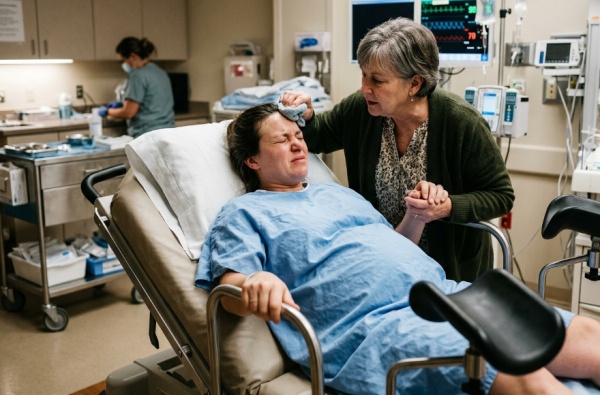
While I was fighting through contractions, my husband accidentally sent me proof that he was with his assistant in a downtown hotel room. He expected me to be too weak, too emotional, or too afraid to do anything. But he forgot one thing: his mother loved the truth more than she loved protecting his lies.
Part 1: He Said He Would Be Right Back
Ryan promised he would be right back before our baby arrived.
That was the last normal sentence my husband ever said to me.
It was 1:17 a.m. on a rainy Thursday in Nashville, Tennessee, and I was in Labor and Delivery at St. Thomas Midtown Hospital, gripping the side rail of the bed while another contraction rolled through my body like a freight train. The room smelled like sanitizer, warm blankets, and the peppermint oil my nurse had dabbed on a cotton ball because I said I felt nauseous. Outside the window, downtown Nashville glowed through the rain, all blurred lights and wet pavement.
Our daughter was coming three weeks early.
Not dangerously early, the doctor had said. Just early enough to make everyone move faster. Early enough that the hospital bag I had packed so carefully was still sitting by the front door at home, beside the car seat Ryan had installed crookedly two days earlier and promised to fix “before the real thing.”
The real thing, apparently, had no respect for his schedule.
At 12:08 a.m., my water broke while I was standing in our kitchen making toast because pregnancy hunger does not care about reasonable hours. Ryan had been in his home office with the door closed, “finishing a quarterly report,” though I later learned that was only one of many lies stacked neatly inside our marriage. When I called his name, he came running, pale and wild-eyed, still holding his phone.
For one beautiful second, I thought panic had turned him back into the man I married.
He helped me into the car. He called my OB’s after-hours line. He drove too fast down West End Avenue while telling me to breathe, even though he was the one who sounded like he might pass out. When we pulled up to the hospital entrance, he kissed my forehead and said, “We’re doing this, Meg. We’re going to meet our girl.”
Meg.
He had not called me that in months.
My full name is Megan Walker, but before everything changed, Ryan called me Meg like it belonged to him. We had been married six years, together eight, and somewhere between mortgage payments, fertility treatments, baby registries, and his promotion at the real estate development firm, he had stopped touching my shoulder when he passed behind me in the kitchen. He had stopped telling me small things.
A marriage can go quiet before it goes cold.
I knew something was wrong long before I knew her name.
Her name was Kelsey.
Kelsey Hart, twenty-seven years old, Ryan’s assistant, though he always corrected me when I used that word.
“She’s the project coordinator,” he said once, too sharply.
That was the first warning.
Men with nothing to hide do not turn job titles into courtroom objections.
Kelsey had glossy brown hair, a delicate gold necklace she wore in every office photo, and the kind of social media presence that made her life look curated instead of lived. She posted iced lattes, hotel lobbies, mirror selfies, and inspirational quotes about “choosing yourself.” She also appeared in too many of Ryan’s work stories, standing beside him at site visits, charity mixers, and company dinners where spouses were somehow not invited.
I asked about her twice.
The first time, Ryan laughed.
“Kelsey? She’s like my little sister.”
The second time, he got angry.
“I can’t do my job if you turn every woman in the office into a threat.”
After that, I stopped asking.
Not because I believed him.
Because pregnancy had made me tired in places sleep could not reach, and I had decided to survive until the baby came. I told myself we would talk after she was born. I told myself becoming a father might wake something up in him. I told myself women had been wrong before.
Women also tell themselves many things to stay standing.
At the hospital, everything moved quickly. A nurse named Brianna got me checked in, wrapped monitors around my belly, and asked Ryan to fill out forms. He sat in the corner chair, tapping rapidly on his phone while I tried not to scream through contractions.
“Ryan,” I said after one particularly sharp wave of pain.
He looked up. “Yeah, babe?”
“Can you put the phone away?”
He blinked like he had forgotten where we were. “Of course. Sorry.”
For five minutes, he was perfect.
He held my hand. He fed me ice chips. He told me I was strong. When the nurse said I was progressing faster than expected, Ryan’s eyes filled with tears, and he whispered, “She’s coming tonight.”
Then his phone buzzed again.
He glanced down.
His face changed.
It was so small, most people would have missed it. But wives notice weather. We know the shift in air pressure before the storm is visible.
“What is it?” I asked.
“Nothing.”
“Ryan.”
He stood too quickly. “I just realized the hospital bag is still at home.”
“I know. My mom can bring it in the morning.”
“No, no, you need your stuff. The going-home outfit, the charger, the baby blanket.”
“I need you here.”
“I’ll be thirty minutes,” he said.
Another contraction started, and I squeezed my eyes shut. “Ryan, please don’t leave.”
He leaned over and kissed my temple. His lips were warm. His voice was gentle enough to break my heart later.
“I promise I’ll be right back before she arrives.”
I wanted to believe him.
That was the cruelest part.
Even then, with every instinct in me screaming, I wanted to believe my husband would not leave me in labor unless he truly thought he was helping. I wanted to believe the man who had cried at our first ultrasound would not choose anything over the birth of his daughter.
So I let go of his hand.
He grabbed his coat from the chair and hurried toward the door.
“I love you,” he said.
I was breathing through pain and could barely answer.
“I love you too.”
The door closed behind him at 1:24 a.m.
Our daughter was born at 3:02.
Ryan was not there.
Part 2: The Text He Didn’t Mean To Send
For the first twenty minutes after Ryan left, I defended him in my own mind.
The roads were wet. Maybe traffic was worse than usual. Maybe he stopped for gas because he had ignored the empty light again. Maybe he was rushing through the house, grabbing the bag, the car seat base manual, the little pink blanket his mother had knitted, and the framed ultrasound photo he insisted we bring “for good luck.”
I had always been good at creating innocent explanations for guilty behavior.
At 1:51 a.m., I called him.
No answer.
At 1:57, I called again.
No answer.
At 2:03, I texted.
Where are you? Nurse says things are moving fast. Please come back.
The message showed delivered.
No reply.
At 2:11, another contraction hit so hard I forgot his name for a minute. Brianna, my nurse, leaned close and told me to breathe with her. She had kind eyes and a calm voice, the kind of calm that makes you trust a stranger because your body has no room left for pride.
“Is your support person coming back?” she asked gently.
“My husband,” I said. “He went home for the bag.”
She looked at the clock, then at me.
Nurses know things too.
“We’ll keep calling,” she said.
At 2:18, Ryan finally texted.
Or at least, I thought he did.
My phone lit up on the bedside table while I was trying to sip water through a straw. Brianna handed it to me, and I saw Ryan’s name.
For half a second, relief flooded me.
Then I read the message.
Room 817. Don’t come to the lobby. Megan thinks I’m getting the bag, but this is moving faster than I expected. I can only stay a little while.
Underneath the message was a photo.
It showed a hotel room.
Not our bedroom. Not our living room. Not the front hallway where the hospital bag waited.
A hotel room.
The picture was taken from the doorway, as if someone had snapped it quickly to show they had arrived. I saw a king-size bed with a gray upholstered headboard, a room service tray, a woman’s black coat draped across a chair, and the Nashville skyline through rain-streaked glass.
On the desk was a small card.
The Joseph, Nashville.
I stared at the screen until the letters stopped making sense.
Brianna said my name.
“Megan?”
I could not answer.
The next contraction arrived, but for the first time that night, the pain in my body was not the worst pain in the room.
Ryan had not gone home.
Ryan had gone downtown.
Ryan had gone to a hotel room.
And the message was not meant for me.
My hand shook so badly Brianna took the phone before I dropped it.
“Do you want me to call someone?” she asked.
I looked at her, and for a moment I was embarrassed. Isn’t that strange? I was the one abandoned in labor, and still shame tried to climb into the hospital bed with me. Shame always knows where wounded women are.
“My mother-in-law,” I said.
Not my mother.
My mother lived in Knoxville and could not get to Nashville quickly enough. My sister was in Atlanta. My closest friend had two toddlers and a husband deployed overseas.
But Ryan’s mother lived fifteen minutes from the hospital.
Her name was Diane Walker, and she loved her son fiercely. Too fiercely sometimes. She made excuses for him when he forgot birthdays, defended him when he worked through holidays, and once told me, “Ryan has always had big dreams. Men like that can be hard to live with.”
But Diane had one quality Ryan underestimated.
She hated being lied to.
I unlocked my phone with trembling fingers and called her.
She answered after one ring.
“Megan? Is it time?”
Her voice was bright, hopeful, already halfway to tears.
“Diane,” I said, and my voice cracked.
Everything in her changed.
“What happened?”
I tried to explain, but another contraction stole the words. Brianna took the phone and, with my permission, told Diane that I was in active labor, Ryan had left, and I needed support. She did not mention the hotel. She did not need to.
When Brianna gave me the phone back, Diane’s voice was no longer bright.
It was steady.
“I’m on my way.”
“Diane,” I whispered. “He sent me something.”
“Who?”
“Ryan.”
“What did he send?”
I looked at the photo again, and my throat closed.
“Proof he’s at a hotel.”
There was silence.
Not confusion.
Not denial.
Silence like a match being struck in the dark.
“Send it to me,” she said.
I did.
She did not ask if I was sure. She did not tell me to calm down. She did not say there must be an explanation. She did not protect him from the truth by pretending the truth was unclear.
She only said, “I’ll be there in ten minutes.”
Then she hung up.
At 2:32 a.m., Diane walked into my hospital room wearing jeans, rain boots, and Ryan’s old Vanderbilt sweatshirt. Her gray hair was pulled into a messy clip, and her face looked like it had aged ten years in ten minutes. She came straight to my bedside and took my hand.
“I’m here,” she said.
That was all.
No questions. No speeches. No defense of her son.
Just presence.
I broke down then, not loudly, because labor did not leave room for theatrics. But tears slid sideways into my hair while Diane pressed a cool cloth to my forehead and told me I was doing beautifully. She stood where Ryan should have stood.
At 2:44, my doctor came in and said things were moving quickly.
At 2:51, I asked Diane to call Ryan.
She stepped into the hallway.
I heard only her side of the conversation.
“Where are you?”
A pause.
“Do not lie to me.”
Another pause.
“Ryan Thomas Walker, I am standing beside your wife while she is about to deliver your daughter, and I have seen the hotel photo you accidentally sent her.”
Silence.
Then Diane’s voice dropped lower.
“You get here now. And if you bring that woman anywhere near this hospital, security will be waiting.”
When she came back into the room, her eyes were wet, but her voice was steady.
“He’s coming,” she said.
But he was too late.
At 3:02 a.m., my daughter entered the world with a sharp, beautiful cry that split me open in a way betrayal could not touch.
They placed her on my chest, warm and tiny and furious, her little fists curled under her chin. She had a full head of dark hair and Ryan’s mouth, which almost made me laugh and cry at the same time. Diane stood beside the bed with one hand over her heart, whispering, “Oh, sweetheart. Oh, sweet girl.”
I looked down at my baby and felt the entire universe narrow to six pounds, eight ounces.
“Grace,” I whispered.
Ryan and I had chosen the name months earlier, back when I still believed names were promises.
Grace Elizabeth Walker.
She blinked against my skin, alive and perfect and utterly uninterested in the wreckage waiting outside the room.
For a few minutes, I forgot Ryan existed.
That was her first gift to me.
Part 3: His Mother Loved The Truth More
Ryan arrived at 3:27 a.m.
Twenty-five minutes after his daughter was born.
Forty-three minutes after his mother told him she knew.
More than two hours after he walked out promising he would be right back.
By then, Grace had been weighed, wrapped, and placed in the clear bassinet beside my bed. I was exhausted in a way language cannot fully capture, but also strangely clear. Birth had taken everything from me except the truth, and the truth was sitting on my phone in the form of a message my husband never meant to send.
Ryan pushed open the door without knocking.
He looked frantic.
His hair was wet from the rain, his shirt was half untucked, and he was carrying the hospital bag like a prop in a play no one believed anymore. For one absurd second, I noticed he had grabbed the wrong bag. He had brought the old navy duffel from the laundry room, not the carefully packed gray diaper bag by the front door.
That told me everything about where he had actually been.
“Meg,” he said, breathless. “I’m here.”
Diane turned slowly from the bassinet.
I had never seen her look at him that way.
It was not anger exactly. It was worse. Disappointment sharpened into something almost formal.
“You missed it,” she said.
Ryan looked past her to the baby.
His face changed.
I wish I could say I felt nothing when he saw Grace for the first time. I wish I could say his tears did not touch me. But the truth is, when Ryan’s eyes filled and his mouth trembled, a piece of my heart still remembered loving him.
That is one of the unfair things about betrayal.
Love does not always leave when respect does.
He stepped toward the bassinet.
Diane moved in front of him.
“Wash your hands first,” she said.
He blinked. “Mom.”
“Wash. Your. Hands.”
He went to the sink.
While water ran, he looked at me in the mirror. “Megan, I can explain.”
I was holding Grace now, tucked against my chest. Her tiny breath warmed the neckline of my hospital gown. I looked at my husband, and I realized he expected the room to bend around his explanation.
It always had before.
Not this time.
“You sent me the explanation,” I said.
His face went pale.
“I was—”
“No,” Diane said.
Ryan turned toward her.
She stepped closer, keeping her voice low because there was a newborn in the room and nurses in the hallway. “You will not stand beside the bed where your wife just delivered your child alone and insult her with another lie.”
His jaw tightened. “This is between me and Megan.”
Diane’s eyes flashed. “Not anymore.”
That was when he started to understand.
His mother was not there to help him manage the situation. She was there as a witness.
Ryan looked at me. “Kelsey was having a panic attack.”
I almost smiled. Not because it was funny, but because it was so predictable.
“In a hotel room?” I asked.
“It wasn’t like that.”
“Then what was it like?”
He opened his mouth.
Nothing came out.
There are lies people prepare and lies they improvise. Ryan had clearly prepared a version for me, but he had not prepared one that survived his mother’s eyes.
Diane crossed her arms. “Where is Kelsey now?”
Ryan looked away.
“Ryan,” she said.
“She left.”
That meant she had been there.
I closed my eyes briefly.
Grace made a small sound against my chest, and I opened them again. She needed me awake. She needed me clear.
Brianna knocked gently and entered to check my vitals. The room went quiet in the way guilty rooms do when innocent people walk in. She looked from Ryan to Diane to me and understood enough.
“Do you want visitors limited?” she asked me.
Ryan looked offended. “I’m her husband.”
Brianna did not look at him.
She looked at me.
That small act of respect nearly made me cry.
“Yes,” I said.
Ryan stared at me. “Megan.”
I held Grace a little closer. “I want your mother here. I want you to leave for now.”
His face crumpled into anger, then shock, then embarrassment. “You’re kicking me out of my daughter’s room?”
“No,” I said. “I’m asking for peace after giving birth without you.”
Diane whispered, “Ryan, go.”
He turned to her. “You’re taking her side?”
Diane’s answer came immediately.
“I’m taking the baby’s side. And tonight, that means taking Megan’s.”
That sentence changed the room.
Ryan looked at his mother like he did not recognize her.
Maybe he didn’t.
He had known her as the woman who mailed him birthday checks, defended his forgotten obligations, and told relatives he was “busy building something important.” He had forgotten she was also the woman who raised him after his father died, worked double shifts at a clinic, and taught him that character mattered when no one was watching.
Apparently, she still believed that.
Security did not have to remove him. He left because Diane walked him to the door, and for once in his life, Ryan obeyed his mother.
Before he stepped out, he looked back at Grace.
“Can I at least hold her?”
I wanted to say yes.
That is the truth.
Some part of me wanted to preserve the story for our daughter, to give her a photo of her father holding her in the first hour of her life, to pretend one clean moment could exist inside that dirty night.
But my body was shaking. My heart was breaking. And Ryan still had not said the words I needed most.
Not I’m sorry I left you.
Not I failed you.
Not Is she okay? Are you okay?
Only explanations. Only damage control.
“Not right now,” I said.
His face hardened.
That confirmed I had made the right decision.
A remorseful man would have accepted the consequence. Ryan was offended by it.
After he left, Diane sat beside my bed and cried silently.
“I am so sorry,” she said.
“You didn’t do it.”
“No,” she whispered. “But I raised him.”
I reached for her hand.
“You also came.”
She covered her mouth with her other hand, and for a long moment, the only sound was Grace breathing softly against me.
Outside, rain tapped against the hospital window.
Inside, my marriage ended in a room full of baby blankets and fluorescent light.
Part 4: The House Of Excuses Collapsed
By 8:00 a.m., Ryan was in full crisis mode.
Not husband mode.
Not father mode.
Crisis mode.
He had texted me seventeen times. He had called Diane nine times. He had left two voicemails that started with apologies and ended with accusations. That was Ryan’s pattern—begin soft, end sharp.
Meg, I know how this looks, but you need to hear me out.
I was scared. Kelsey was upset. I made a terrible judgment call.
Don’t let my mom turn this into something bigger.
You’re emotional right now. Please don’t make decisions while you’re recovering.
That last one made Diane take the phone from my hand.
“She just delivered a baby alone because of you,” she said to the screen, though she did not send anything. “If anyone was too emotional to make decisions, it was the man who ran to a hotel room.”
I almost laughed, and it hurt.
At 9:15, Diane stepped into the hallway to call her attorney.
That surprised me.
I thought she was calling Ryan again, or maybe her sister, or maybe the church prayer chain that somehow knew everyone’s business before lunch. Instead, she called a family lawyer she had used years earlier when settling her late husband’s estate.
When she came back, she sat beside me with her hands folded.
“Megan,” she said, “I need to tell you something.”
My stomach tightened.
“What?”
“The house is not only in Ryan’s name.”
I blinked.
“What do you mean?”
“When you and Ryan bought it, he told you I gave him money for the down payment.”
“Yes.”
“I did. But it was structured as an investment through the family trust because he had poor credit at the time from that failed restaurant partnership. I never told you the details because Ryan was embarrassed, and I thought I was protecting him.”
She looked ashamed.
“The trust still holds an interest. He cannot force you out. He cannot sell it, refinance it, or use it to pressure you without documentation and consent.”
I stared at her.
Ryan had always called it his house when he was angry.
His house. His mortgage. His office. His rules.
But it was not that simple.
Diane continued, “I also changed my estate documents last year after he asked me to move certain assets directly into his name. Something felt wrong. I didn’t know what, but I delayed it.”
I thought of Kelsey. The hotel. The message. The phrase Megan thinks I’m getting the bag.
“How long do you think this has been going on?” I asked.
Diane’s eyes filled again.
“I don’t know. But I intend to find out enough to stop being useful to his lies.”
At noon, Ryan’s older brother, Mark, arrived at the hospital.
Mark was a firefighter in Franklin, broad-shouldered, blunt, and the kind of man who did not speak unless he had something to say. He brought flowers, a stuffed lamb for Grace, and a breakfast sandwich for Diane because he said she looked like she might start biting people.
He hugged me carefully.
“I’m sorry,” he said.
That was it.
No defense. No questions.
Then he looked at Grace and smiled so softly it changed his whole face.
“She’s perfect.”
“She is,” I said.
Mark glanced at Diane. “Ryan called me.”
“I’m sure he did,” Diane said.
“He said Megan is keeping him from the baby.”
Diane’s mouth tightened. “Ryan missed the birth because he was at The Joseph with Kelsey.”
Mark closed his eyes.
For a second, he looked like he was counting backward from ten.
Then he said, “That idiot.”
It was such a simple, brotherly summary of catastrophe that I did laugh this time.
Ryan showed up again that afternoon carrying flowers from the hospital gift shop and a teddy bear that still had the price tag on it. He looked calmer, which meant he had rehearsed. Diane stood when he entered, but I shook my head.
“I can handle it,” I said.
He approached slowly. “Can we talk privately?”
“No.”
His eyes flicked to Diane and Mark. “Megan, this is humiliating.”
I looked down at Grace sleeping in my arms.
“Interesting,” I said. “I was thinking the same thing at 2:18 this morning.”
Mark coughed into his fist.
Ryan’s face reddened. “I made a mistake.”
“You made a choice.”
“I panicked.”
“You booked a hotel room?”
He swallowed.
There it was again.
Silence where denial should have been.
Diane stepped forward. “Ryan, tell the truth now. All of it.”
He looked at her, then at Mark, then at me.
“Kelsey and I were ending things,” he said.
I felt the sentence land in the room like spoiled milk.
“Ending things,” I repeated.
He nodded quickly, encouraged by the fact that I had not thrown anything. “Yes. It had gotten complicated. I was trying to end it before the baby came.”
“By meeting her in a hotel room while your wife was in labor?” Mark asked.
Ryan glared at him. “Stay out of this.”
Mark’s voice dropped. “You made Mom drive to the hospital in the rain to stand beside your wife because you were with another woman. I’m in it.”
Ryan turned back to me. “Meg, I was scared. The baby coming early, everything changing, the pressure at work—”
“No,” I said.
He stopped.
“No more using pressure as a permission slip.”
His eyes filled with tears. Once, those tears would have undone me. I would have reached for him, comforted him, helped him turn betrayal into stress, stress into confusion, confusion into something we both had to heal from.
But I had a daughter now.
And one day, she might ask me what I did when I learned her father left us when we needed him most.
I wanted to be able to answer without shame.
“I’m not discussing our marriage today,” I said. “I’m recovering. Grace is my priority. You can coordinate visits through Diane for now.”
He looked stunned. “Through my mother?”
“Yes.”
Diane nodded once.
Ryan stared at her. “You’re really doing this?”
Her voice was quiet. “You did this.”
He left again, this time without asking to hold Grace.
That told me more than any apology could have.
Part 5: Grace Came First
The first night home without Ryan was not lonely.
It was quiet.
There is a difference.
Diane drove Grace and me home from the hospital two days later. Mark followed in his truck with flowers, diapers, and the correct hospital bag, which Diane had retrieved from our front hall after telling Ryan he would wait in the driveway. She had also changed the garage code.
Legally, she explained, no one was being locked out of their property permanently. Practically, she said, a postpartum mother and newborn were not going to be surprised by a man who thought hotel rooms counted as emergencies.
Ryan was staying with a friend.
Or Kelsey.
Or no one.
For the first time in years, I did not need to know.
The house looked exactly the same when I walked in. The gray sofa we bought on sale over Memorial Day weekend. The framed wedding photo in the hallway. The nursery with sage green walls, white curtains, and a rocking chair Diane had reupholstered herself.
But I was not the same woman who had left that house in labor.
I carried Grace into the nursery and sat in the rocking chair. She made tiny newborn sounds against my chest, rooting and sighing, completely unaware that she had been born into the middle of a storm. I looked around the room, at the tiny clothes folded by size, the diapers stacked in neat rows, the baby monitor still in its box.
For months, I had prepared for motherhood.
I had not prepared for betrayal to arrive in the same hour.
But maybe no one ever prepares for the thing that finally wakes them up.
Over the next few weeks, Diane became the kind of mother-in-law people write fictional stories about because real life rarely allows such grace. She stayed in the guest room, cooked soup, washed bottles, answered the door, and never once told me what to feel. When Ryan came for scheduled visits, she remained in the house, not hovering, but present.
Ryan hated it.
He said I was turning his family against him.
Diane said, “No, Ryan. Your choices introduced us to the truth. We’re reacting to the introduction.”
Mark laughed so hard when she told him that he nearly dropped a casserole.
Kelsey disappeared from Ryan’s office within a month.
I learned this not because I asked, but because Nashville is a city dressed up as a small town. Someone always knows someone who knows someone from HR. Officially, she resigned for “personal reasons.” Unofficially, the company had begun asking questions after Ryan used his corporate card at The Joseph on the night his daughter was born.
He tried to blame stress.
The finance department did not reimburse stress.
By the time Grace was six weeks old, I had met with a family law attorney named Caroline Brooks. She was practical, direct, and did not waste my billable hour on outrage. She reviewed the messages, the hotel photo, Ryan’s texts, Diane’s statement, and the financial information about the house.
“You have options,” she said.
That sentence felt like oxygen.
For so long, I had thought my options were emotional: stay, forgive, fight, collapse, pretend. Caroline reminded me there were practical options too. Custody. Support. Temporary possession of the home. Financial disclosures. Boundaries in writing.
Ryan did not take it well when he received the first letter from Caroline.
He called me immediately.
I did not answer.
Then he texted.
So you’re really going to punish me forever for one bad night?
I looked at Grace sleeping beside me in her bassinet.
One bad night.
That was how he wanted the story packaged. Small enough to forgive. Small enough to put away. Small enough that I would seem cruel for not stepping over it.
But it was not one bad night.
It was every lie that led him to that hotel. Every time he made me feel paranoid for noticing. Every excuse he built so he could leave his laboring wife and still think of himself as a decent man.
I typed back only what Caroline had told me to say.
Please direct divorce-related communication to my attorney. Parenting communication can remain in writing.
Ryan replied with three angry paragraphs.
I did not read them until after I fed Grace.
That was my new life.
Grace first.
Drama later, if ever.
By spring, my world had become smaller and stronger. Morning coffee gone cold on the counter. Burp cloths over every chair. Walks around the neighborhood with Grace bundled in a stroller while dogwoods bloomed pink and white along the sidewalks. Diane came by most afternoons, sometimes with groceries, sometimes with nothing but open arms.
One day, as she held Grace near the kitchen window, she said, “I keep thinking about that night.”
“Me too.”
“I keep wondering if I failed Ryan somehow.”
I shook my head. “Diane, he is a grown man.”
“I know,” she said. “But mothers wonder anyway.”
I understood that more deeply now.
She looked down at Grace. “I want her to know the truth someday, but not as poison.”
I nodded.
That became our quiet agreement.
Grace would not be raised on hatred. She would not be told adult details before she could carry them. But she would also not be raised inside a lie where her father was the victim of my boundaries.
Truth without cruelty.
That was the goal.
Ryan eventually became a better father than he had been husband, though I say that carefully. Better does not mean perfect. Better does not erase. Better simply means that after court orders, therapy, financial consequences, and his mother refusing to cushion reality, he learned to show up on time with diapers and humility.
The first time he held Grace during a supervised visit at Diane’s house, he cried quietly into her blanket.
I watched from the doorway.
Part of me hurt.
Part of me was relieved.
Part of me remembered the man I wanted him to be and grieved the fact that he had chosen not to become that man when it mattered most.
Diane stood beside me and whispered, “You don’t have to forgive him today.”
“I know.”
“You don’t have to forgive him ever.”
I looked at her, surprised.
She kept her eyes on Ryan and Grace. “Forgiveness is not rent you pay to stay a good person.”
I never forgot that.
The divorce was finalized when Grace was ten months old.
It was not dramatic. No screaming courtroom scene. No judge delivering a speech about morality. Just paperwork, parenting schedules, support calculations, signatures, and the strange hollow feeling of legally ending something that had emotionally ended months before.
I kept the house for the first few years of Grace’s life, with financial terms worked out through the trust and the settlement. Ryan had regular parenting time. Diane remained in Grace’s life as Grandma Di, which was what she had wanted to be called from the beginning.
On Grace’s first birthday, we had a small party in the backyard.
Pink balloons. A grocery store cake. A folding table covered with snacks. Grace wore a strawberry-print dress and smashed frosting into her hair while everyone cheered like she had won an Olympic medal.
Ryan came.
So did Diane, Mark, my mother, my sister, and a few friends who had carried me through the hardest year of my life.
For a moment, as Grace sat in her high chair laughing with cake on her cheeks, I felt something loosen in my chest.
Not because everything was fixed.
Because everything was honest.
Ryan walked over while I was gathering paper plates.
“She looks just like you when she smiles,” he said.
I glanced at him. “She has your mouth.”
He nodded, looking down. “Meg, I know I can never make up for missing it.”
I did not answer immediately.
The old me might have comforted him. She might have said, “It’s okay,” just to smooth the air between us. She might have carried his regret for him because she was used to carrying things.
But Grace was watching from her high chair, banging a spoon against the tray.
So I told the truth.
“No,” I said. “You can’t.”
Ryan swallowed.
“But you can show up now,” I added. “For her. Consistently. Without making your guilt my responsibility.”
He nodded slowly.
“I’m trying.”
“I hope you keep trying.”
That was all I gave him.
And it was enough.
That night, after everyone left and Grace finally fell asleep, Diane stayed behind to help clean the kitchen. We washed cake plates and wiped pink frosting from places frosting had no business being. The house was quiet except for the dishwasher and the baby monitor humming on the counter.
Diane handed me a towel.
“You know,” she said, “when Ryan was little, I used to think loving your child meant protecting them from consequences.”
I looked at her.
She dried her hands slowly. “I was wrong. Sometimes loving them means refusing to lie for them.”
I leaned against the counter, suddenly close to tears.
“You saved me that night,” I said.
Diane shook her head. “No, honey. You called. You told the truth. I just chose to believe you.”
Maybe that was its own kind of saving.
Later, after she left, I went upstairs to Grace’s room. She was asleep on her back, one hand open beside her face, her breath soft and even. I stood by the crib and thought about the night she was born.
The rain. The contractions. The message. The hotel room. Diane’s hand in mine. Ryan arriving too late with the wrong bag and the wrong excuses.
For a long time, I thought that night would always be the story of what Ryan took from me.
But it became something else.
It became the night I learned that I could survive the truth even when it arrived at the worst possible moment. It became the night I stopped begging a man to become who I needed and started becoming who my daughter needed. It became the night Diane chose integrity over image, and in doing so, gave me permission to do the same.
Ryan missed his daughter’s birth for a hotel room lie.
That will always be true.
But another truth stands beside it.
Grace was born into love anyway.
Not the perfect love I had planned. Not the family photo I had imagined. Not the story I thought I would tell her someday about her father crying beside me as she entered the world.
But real love.
A nurse who respected my voice.
A grandmother who drove through rain.
An uncle who showed up with flowers and fury.
A mother who held her baby for the first time and realized she was not weak, not trapped, not too emotional, and not alone.
Ryan thought I would be too fragile to do anything.
He forgot that birth is not fragile.
Birth is force.
And when they placed Grace on my chest, tiny and furious and alive, I understood something Ryan should have understood long before that night.
You do not become powerful by avoiding pain.
Sometimes, you become powerful because the smallest person in the room needs you to rise.
So I rose.
Not all at once.
Not perfectly.
But enough.
Enough to tell the truth. Enough to protect my peace. Enough to let his mother see him clearly, even if it broke her heart. Enough to build a life where my daughter would never have to confuse abandonment with love.
Years from now, when Grace asks about the night she was born, I will not start with the hotel.
I will start with the rain over Nashville.
I will tell her she came fast, loud, and strong.
I will tell her Grandma Di held my hand.
I will tell her the nurse said she had the most beautiful cry.
I will tell her that the first thing I felt when I saw her was not fear, not betrayal, not heartbreak.
It was love.
And if someday she is old enough to learn the rest, I will tell her carefully.
I will tell her that people can fail you in moments that should have been sacred.
I will tell her that truth can hurt and still set you free.
I will tell her that the people who love you well are the ones who show up when it costs them something.
And I will tell her this:
The night she was born, her father missed the miracle.
But I didn’t.
I was there.
I saw her first breath.
I heard her first cry.
I held her against my heart while the world I had known fell apart and a new one began.
Ryan lost that night to a lie.
Grace and I survived it with the truth.
And in the end, the truth gave us a better life than his lies ever could.
