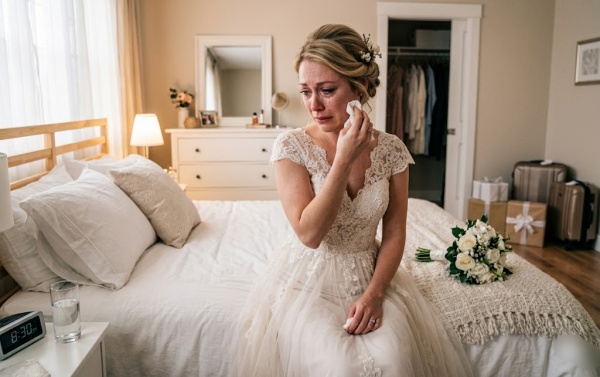
On Our Wedding Night, My Husband Left Me At The Plaza To Pick Up His Lover—By Sunrise, His Billion-Dollar Empire Was No Longer His
I was still in my wedding dress, sitting alone in a suite at The Plaza, when my husband said he had to leave for “an emergency.” The emergency had a name, a flight landing at JFK, and a suitcase waiting at arrivals. He thought I would cry quietly, forgive him, and protect his reputation by morning. Instead, one forgotten phone revealed the truth behind our marriage—and changed the future of his $1.8 billion company before breakfast.
Part 1: The Bride Left Alone
On our wedding night, I sat alone in a presidential suite at The Plaza Hotel in New York City, still wearing my wedding dress, while my husband left to pick up another woman at JFK Airport.
Not his mother. Not a stranded cousin. Not a business partner whose flight had been delayed.
His lover.
Her name was Vanessa Cole, and until that night, my husband had insisted she was “just a close family friend.” She was thirty-one, glossy, ambitious, and always standing too close to him in photos. She had the kind of smile that looked harmless until you realized it never reached her eyes.
My name is Eleanor Whitmore, though most people call me Ellie. I was twenty-nine when I married Grant Harrington, the youngest billionaire in the Northeast tech-finance world and the public face of Harrington Meridian, a private investment and logistics empire valued at approximately $1.8 billion. To the magazines, he was a visionary. To charity boards, he was generous. To investors, he was brilliant.
To me, for almost two years, he had been charming enough to make warnings sound like jealousy.
Our wedding had been the kind of event people pretend not to care about but secretly discuss for months. The ceremony took place at St. Bartholomew’s on Park Avenue, followed by a reception at The Plaza with white orchids, champagne towers, a twelve-piece band, and a guest list full of senators, CEOs, venture capitalists, old-money heirs, and women wearing diamonds large enough to have their own insurance policies.
My father walked me down the aisle with tears in his eyes. Grant stood at the altar in a black Tom Ford tuxedo, smiling like I was the only woman in Manhattan. When he took my hands, his fingers were warm, steady, and completely convincing.
That was his gift.
Grant could make any room believe whatever version of himself he needed them to see.
During our vows, he looked straight into my eyes and said, “Ellie, I promise there will never be a day when you wonder whether you come first.”
People sighed.
My maid of honor cried.
His mother dabbed her eyes with a silk handkerchief.
And I believed him.
That is the part I used to feel ashamed of. I believed him because I loved him, because he had pursued me for months with handwritten notes, Sunday morning coffee runs, museum dates, and quiet dinners where he asked questions like he cared about the answers. I believed him because he remembered my favorite flowers were peonies, not roses, and because he proposed at the Metropolitan Museum of Art in front of a painting I had once told him made me feel calm.
I believed him because sincere people often assume sincerity in others.
The first crack appeared during the reception.
I was talking with my college roommate near the dessert table when I saw Grant step into the hallway with his phone pressed to his ear. His expression had changed. Not worried exactly, but alert, focused, the way he looked before hostile negotiations.
A few minutes later, he returned and kissed my cheek.
“I need to handle something,” he whispered.
“Now?” I asked, laughing because I thought he was joking.
“It’ll be quick.”
“It’s our wedding.”
“I know, baby. I’m sorry. Something came up with one of the Asia partners.”
That was the first lie of the night.
I did not know it yet.
An hour later, when the band played our last song and guests lined the hotel lobby with sparklers for our exit, Grant was beside me again, smiling for cameras. He helped me into the vintage Rolls-Royce we had rented, held my hand while photographers shouted our names, and kissed me under the flash of a hundred phones.
If betrayal had a soundtrack, ours was applause.
By 11:48 p.m., we were upstairs in the suite.
The room was covered in white flowers, champagne chilled in a silver bucket, and someone had arranged chocolate-dipped strawberries beside a handwritten card from the hotel manager. My feet ached. My cheeks hurt from smiling. My dress weighed more than I wanted to admit.
I remember standing by the window, looking down at Fifth Avenue glowing under the city lights, thinking, I am someone’s wife now.
Grant came out of the bathroom holding his phone.
His face was pale.
“Ellie,” he said, “I need to leave for about an hour.”
I turned slowly. “What?”
“There’s an emergency.”
My stomach tightened. “With the Asia partners?”
He looked away just long enough for me to notice.
“Yes.”
“Grant, it’s midnight on our wedding night.”
“I know.”
“Then call someone else.”
“I can’t.”
The room suddenly felt too large. Too quiet. My wedding dress rustled when I stepped toward him, the sound absurdly delicate for the moment.
“Tell me what’s really happening,” I said.
He exhaled sharply, as if I was making things difficult. “Vanessa just landed at JFK. Her connection got canceled, and she’s upset.”
For a few seconds, I could not process the sentence.
“Vanessa,” I repeated.
“She doesn’t have anyone here.”
“She lives in Boston.”
“She flew in because she needed to talk.”
“On our wedding night?”
His jaw tightened. “Don’t make this dramatic.”
That sentence is a door. Once a man says it, he is already standing on the other side of your pain, judging the volume.
I stared at him. “You are leaving your wife on your wedding night to pick up Vanessa at the airport?”
“She’s having a crisis.”
“So am I.”
He looked at me then, really looked, but not with guilt. With irritation.
“Ellie, you knew Vanessa was important to me.”
“I knew you said she was a family friend.”
“She is.”
“Then send a car.”
“She asked for me.”
There it was.
Not the emergency. Not the flight. Not the crisis.
She asked for him, and he was going.
I stepped back, my train brushing against the carpet. “If you walk out that door tonight, don’t expect to come back to the same woman.”
He sighed like I was a child throwing a tantrum.
“I’ll be back before you calm down,” he said.
Then my husband picked up his coat, walked out of our honeymoon suite, and left me standing there under $40,000 worth of flowers.
For a while, I did nothing.
I did not cry. I did not scream. I did not call my mother. I simply stood in the middle of the suite, wearing a couture wedding dress and a diamond ring heavy enough to feel like a handcuff.
Then his phone buzzed on the nightstand.
Grant had left his second phone behind.
The screen lit up with a message from Vanessa.
Did she cry when you left? Tell me you still chose me.
That was the moment my marriage ended.
Not legally. Not publicly. Not yet.
But inside me, something closed.
Part 2: The Phone He Forgot
I did not unlock the phone at first.
I want that to be clear.
I picked it up only because it was vibrating repeatedly on the nightstand in the hotel suite I was standing in alone on my wedding night. The lock screen showed enough. Vanessa’s messages kept appearing one after another, each more revealing than the last.
I hated watching her wear white.
You promised tonight would prove she was just business.
Come fast. I don’t want to wait in arrivals like some random girl.
Then another message.
After tomorrow, she won’t matter anyway. Once the trust transfer closes, we’re free.
My blood went cold.
Trust transfer.
Business.
She won’t matter.
I may have been heartbroken, but I was not stupid.
Before I met Grant, I worked as a corporate attorney specializing in governance and shareholder agreements. I had left practice two years earlier to help manage my family’s philanthropic foundation after my father’s health declined, but I still knew how to read a contract. More importantly, I knew how to recognize language that did not belong in a love affair unless money was involved.
I sat down slowly on the edge of the bed.
Then I remembered something my father had said three months earlier.
“Ellie, love him if you love him. Marry him if you want to. But never sign anything you don’t understand, and never confuse romance with governance.”
My father, Charles Whitmore, was not a billionaire, but he had spent forty years building Whitmore Capital into one of the most respected private equity firms in New York. He was polite, old-fashioned, and terrifyingly careful with paper. Before the wedding, his lawyers had reviewed every financial document connected to my marriage, including the prenuptial agreement Grant’s team had tried to rush through.
Grant had acted offended.
“Do we really need all this?” he asked.
“My father insists,” I said.
“What about trust?”
“Trust reads before signing.”
He laughed then, but not kindly.
In the end, Grant signed our prenuptial agreement because he wanted access to something more valuable than my last name. My father’s firm controlled a quiet but powerful stake in Harrington Meridian through a series of preferred equity holdings, debt instruments, and voting agreements negotiated years before Grant became CEO. The arrangement was complicated, but the heart of it was simple.
Grant’s empire was not as independent as he liked people to believe.
Harrington Meridian looked like his kingdom from the outside. His face was on magazine covers. His interviews moved markets. His name opened doors from Manhattan to Palo Alto.
But underneath the shine, the company carried obligations.
And one of those obligations was a morality and fiduciary conduct clause connected to a planned post-marriage governance restructuring. Grant had needed our marriage to help close a family consolidation deal that would strengthen his control. My father had agreed to support the restructuring only if Grant signed strict terms protecting me, the family’s investment, and the company from personal misconduct that could create reputational or financial harm.
At the time, I thought it was excessive.
Standing in that suite with Vanessa’s messages lighting up the forgotten phone, I understood my father had seen a shadow I had mistaken for charm.
Another message appeared.
You told me she was the bridge. Don’t start acting guilty now.
The bridge.
That was what I was.
Not a wife. Not a partner. Not a woman he had vowed to honor six hours earlier before God, family, and half of New York society.
A bridge.
I placed the phone on the bed and took pictures of the lock screen messages with my own phone. I did not guess passwords. I did not try to break into anything. I documented only what appeared openly on the screen in front of me.
Then I called my father.
It was 12:23 a.m.
He answered on the second ring.
“Ellie?” His voice sharpened immediately. “What’s wrong?”
I tried to speak, but the words tangled in my throat.
“Dad,” I said finally, “Grant left.”
There was silence.
“What do you mean, left?”
“He went to JFK to pick up Vanessa.”
Another pause. Shorter. Colder.
“Are you safe?”
That question nearly broke me.
“Yes.”
“Are you alone?”
“Yes.”
“Good. Listen carefully. Do not leave the hotel. Do not drink anything. Do not answer Grant’s calls. Take screenshots or photos of anything relevant. I’m calling Martin.”
Martin was my father’s general counsel.
“Dad,” I whispered, “Vanessa texted his other phone. She said something about the trust transfer closing tomorrow. She said I was the bridge.”
My father did not respond immediately.
When he did, his voice had changed into the voice I had heard only twice in my life: once when a partner tried to cheat him, and once when a doctor misread my mother’s scan.
“Ellie,” he said, “put the phone in the room safe if you can do so without unlocking it. Photograph the screen first. Then wait for my call.”
At 12:41 a.m., my phone rang again.
This time it was Martin.
He did not waste words.
“Eleanor, I need you to email me the photographs of the messages immediately. Use the secure address I’m texting you. Do not forward anything to friends. Do not post anything. Do not threaten Grant or Vanessa. We’re going to handle this cleanly.”
“Is he doing something illegal?” I asked.
“I don’t know yet,” Martin said. “But based on the language you described, there may be an attempt to induce a governance transfer through fraudulent marital representations. At minimum, it creates a serious disclosure issue.”
Lawyers have a gift for making betrayal sound like a weather report.
I emailed the photos.
Then I unzipped my wedding dress.
It took me nearly ten minutes because the buttons ran all the way down the back, and my hands had started shaking. I folded the dress across a chair, put on the white silk robe the hotel had provided, and stood in front of the bathroom mirror.
My makeup still looked perfect.
That felt offensive.
At 1:18 a.m., Grant texted my personal phone.
Still awake?
I stared at the message.
Then another.
She was stranded. Don’t turn this into something ugly.
Then another.
I’ll explain when I get back.
I did not answer.
At 1:46 a.m., Martin called again.
“Eleanor, your father has convened emergency counsel. Grant’s scheduled control transfer is being paused.”
“Paused?”
“Yes.”
“What does that mean?”
“It means the voting support your father’s entities were going to provide at 8:00 a.m. will not be provided.”
I sat down on the closed toilet seat because my legs felt unreliable.
Martin continued. “There are also trigger provisions if Grant acted in bad faith to secure the marriage for financial or governance purposes. We’re not making accusations tonight. We are preserving rights.”
“What happens if the transfer doesn’t close?”
There was a pause.
“Grant does not obtain majority voting control. His existing lenders may view that as a material governance failure. The board may act quickly.”
I looked toward the window, where the city was still glowing as if nothing had happened.
“So his company—”
“His company is not gone,” Martin said carefully. “But his control over it may be.”
That distinction mattered legally.
Emotionally, it did not.
At 2:30 a.m., my father arrived at the suite with Martin, two security staff members, and my older brother, Henry. My father was still in his tuxedo from the wedding, bow tie undone, face pale with contained fury. When he saw me, his expression broke.
For one second, he was not Charles Whitmore of Whitmore Capital.
He was just my dad.
“I’m sorry,” he said, pulling me into his arms.
That was when I finally cried.
Not because Grant left.
Because my father came.
Part 3: The Empire Built On A Lie
Grant returned at 4:07 a.m.
By then, I was no longer alone.
My father sat near the window with a cup of black coffee he had not touched. Martin was at the desk reviewing documents on his laptop. Henry stood near the door, arms crossed, looking like he wanted to solve the situation in a way our attorneys would strongly discourage.
I was sitting on the sofa in hotel slippers, my hair pinned halfway down, no longer wearing my wedding ring.
When Grant opened the suite door, he stepped inside with the irritated confidence of a man expecting tears.
Then he saw my father.
He froze.
Behind him, in the hallway, Vanessa stood with a small silver suitcase.
That image stayed with me for years.
My husband on our wedding night, returning to the honeymoon suite with another woman behind him, both of them suddenly realizing the stage was not set the way they expected.
“Ellie,” Grant said slowly. “What is this?”
I looked at Vanessa.
She was wearing a camel coat, red lipstick, and the expression of someone who had planned for an emotional bride, not a room full of attorneys. Her eyes flicked to my father, then to Martin’s laptop, then to my bare left hand.
My father stood.
“Vanessa,” he said. “You should leave.”
She lifted her chin. “I came with Grant.”
“And now you can leave without him.”
Grant stepped forward. “Charles, don’t speak to her like that.”
My father looked at him with terrible calm. “You left my daughter alone on her wedding night to collect this woman from the airport. I am being remarkably polite.”
Vanessa’s face flushed.
Grant shut the door behind him, leaving her in the hallway. That was the kind of man he was. When consequences entered the room, loyalty exited.
“Ellie,” he said, turning to me. “This looks bad, but you need to understand—”
“No,” I said.
It was the first word I had spoken to him since he left.
He blinked. “No?”
“No explanations tonight.”
His expression hardened. “You called your father?”
“You left your second phone.”
The color drained from his face.
There it was.
Not guilt. Not concern for me. Fear.
“What did you see?” he asked.
Martin answered. “Enough to pause tomorrow’s scheduled governance support.”
Grant turned sharply. “You can’t do that.”
“We already have,” Martin said.
Grant stared at him. “On what basis?”
“Bad faith, potential misrepresentation, reputational risk, and pending review under the morality and fiduciary conduct provisions you signed.”
Grant laughed once, too loudly. “This is insane. This is my wedding night.”
Henry spoke for the first time. “Interesting thing to remember now.”
Grant ignored him and looked at my father. “Charles, you cannot blow up a $1.8 billion company because Ellie is upset.”
My father’s voice was quiet. “I am not blowing up anything. I am declining to hand voting control to a man who appears to have married my daughter under false pretenses.”
“I love Ellie,” Grant snapped.
The room went still.
I looked at him, and for the first time all night, I felt something like pity. Not because I believed him, but because he believed love was still a useful word after what he had done.
“You left me alone in this room,” I said. “You brought her back here.”
“She was upset.”
“I was your wife.”
“You are my wife.”
“No,” I said softly. “I was your bridge.”
His face changed.
He knew then exactly what I had seen.
Martin closed his laptop. “Grant, all further communication should go through counsel.”
Grant stared at him as if Martin were a waiter refusing a billionaire a table.
“This is a personal matter,” he said.
“Not anymore,” Martin replied.
That was the moment Grant began to panic.
He pulled out his phone and stepped toward the window, dialing rapidly. First his chief operating officer. Then his personal attorney. Then someone named Blake, who I later learned was a board ally. His voice went from controlled to sharp to nearly pleading within twenty minutes.
“What do you mean they’re convening early?”
“No, they can’t suspend anything without me.”
“Tell them the Whitmore vote is still coming.”
“No, it is not a marital issue. It’s a misunderstanding.”
The word misunderstanding did a lot of work that morning.
At 5:12 a.m., Vanessa called Grant from the hallway. He declined the call.
She texted him.
His phone was angled just enough that I saw the preview.
Don’t let them blame me. You promised.
Grant turned the screen down.
My father saw it too.
He said nothing.
By 6:30 a.m., the suite felt less like a honeymoon room and more like a war room. Coffee cups covered the desk. Legal documents were open across the table. The flowers looked ridiculous now, their soft white petals surrounding the collapse of a marriage that had lasted less than one night.
At 7:05 a.m., Grant’s attorney arrived.
He was a tired-looking man named David Levin, still wearing the previous night’s dress shirt under a gray overcoat. He asked to speak privately with Grant in the bedroom. They stayed there for seventeen minutes.
When they came out, David looked at Martin and said, “We need to discuss a standstill.”
Grant looked furious.
Martin said, “The time for a standstill was before your client left his bride to retrieve another woman while a control transaction was pending.”
David closed his eyes briefly.
Even his own lawyer knew how bad it sounded.
At 8:00 a.m., the voting support did not go through.
At 8:17 a.m., Harrington Meridian’s board convened an emergency session.
At 8:46 a.m., the board’s independent directors suspended Grant’s authority over certain transactions pending review.
At 9:22 a.m., the lenders issued a notice requiring governance clarification.
At 10:03 a.m., Grant was removed as interim executive chairman and placed on administrative leave as CEO.
Not fired permanently.
Not bankrupt.
Not destroyed in the comic-book way people imagine when they hear “empire gone.”
But gone from his hands.
The empire that had made him untouchable at midnight no longer answered to him by morning.
And he had done it to himself.
Part 4: When The World Found Out
The public statement came at noon.
Harrington Meridian Announces Temporary Leadership Transition Pending Internal Governance Review.
That was the headline.
Corporate language is fascinating because it can hide a hurricane inside a teacup. There was no mention of a wedding, a lover, a suite at The Plaza, or a bride sitting alone in hotel slippers while her husband begged board members to answer his calls. There were only words like continuity, independent review, stakeholder confidence, and fiduciary obligations.
By 12:30 p.m., CNBC mentioned it.
By 1:00 p.m., financial Twitter was guessing.
By 2:15 p.m., someone leaked that Grant’s leadership transition had followed “a personal incident involving a major shareholder family.”
By 3:00 p.m., my name was trending in circles I never wanted to know existed.
I did not post anything.
I did not give interviews.
I did not sell my story.
I sat in my father’s townhouse on the Upper East Side wearing borrowed sweatpants while my mother made tea and pretended not to cry in the kitchen.
Grant called me twenty-six times that day.
I answered none of them.
His texts moved through the predictable stages of a man losing control.
First, anger.
You had no right to involve your father.
Then bargaining.
We can fix this quietly if you tell them you misunderstood.
Then romance.
Ellie, I love you. I panicked. Please don’t let one mistake define us.
Then blame.
Your family has wanted control from the beginning. You were part of this.
That last one almost made me laugh.
I had been many things that day: humiliated, betrayed, furious, exhausted, heartbroken.
But I had not been strategic enough to plan my husband’s affair for corporate leverage.
At 4:40 p.m., Vanessa posted a cryptic Instagram story.
A black screen with white text.
Powerful families always protect their own. The truth will come out.
It disappeared within an hour, probably after someone with legal training called her.
But screenshots live forever.
By evening, Grant’s mother called me.
Vivian Harrington had never liked me. She preferred women who treated Grant like a weather system—something powerful, unpredictable, and not responsible for the damage he caused. At the rehearsal dinner, she had told me, “Grant needs a wife who understands the demands of greatness.”
I should have run then.
When I answered, she did not ask if I was okay.
She said, “Eleanor, you need to stop this.”
I sat in my childhood bedroom, looking at the pale blue wallpaper I had chosen when I was fourteen. “Stop what?”
“This attack on my son.”
“Your son left me alone on our wedding night to pick up another woman.”
There was a pause.
Then Vivian said, “Men under pressure make mistakes.”
“Women under pressure are expected to smile through them.”
“He loves you.”
“No, Vivian. He needed me.”
Her voice sharpened. “Do you have any idea what you’re risking? Thousands of employees depend on that company.”
That was the same shield Grant had tried to use. The employees. The investors. The ecosystem. The empire. As if protecting all of them required handing control to a man willing to use marriage as a transaction.
“My father’s team is working to protect the company,” I said. “From Grant.”
She inhaled sharply.
“You will regret humiliating him.”
I looked at my bare ring finger.
“No,” I said. “I regret marrying him.”
I hung up.
That night, Martin and a family attorney named Priya Shah came to discuss my options. Annulment was possible to explore, though not guaranteed. Divorce was straightforward. There were also civil claims depending on what the investigation uncovered about Grant’s intent, communications, and representations during the prenup and governance negotiations.
I listened like I was underwater.
Finally, Priya closed her folder and said, “Eleanor, you do not have to decide everything tonight.”
“I decided one thing,” I said.
They looked at me.
“I’m not staying married to him.”
My mother covered her mouth.
My father looked down.
Priya nodded. “Then we begin there.”
The next morning, Grant showed up at my father’s townhouse.
Security did not let him upstairs, but the doorman called to say he was in the lobby. I watched him on the security feed from my father’s office. He wore the same tuxedo pants from the wedding, now wrinkled, with a sweater under his overcoat. He looked less like a billionaire and more like a man who had finally met a locked door.
My father asked, “Do you want to see him?”
“No.”
Grant stood in the lobby for twenty-three minutes.
Then he looked up at the camera.
For a second, I thought he might apologize.
Instead, he called me.
This time, I answered.
His voice was rough. “Ellie, please.”
I said nothing.
“I made a terrible mistake.”
“Yes.”
“I never meant for it to go this far.”
That sentence did something to me. It burned away the last fragile thread of grief.
“You didn’t mean to get caught,” I said.
He exhaled. “That’s not fair.”
“Fair was our wedding vows. You broke those before the flowers wilted.”
“Vanessa means nothing.”
“Then you left me for nothing.”
Silence.
That one landed.
He lowered his voice. “If you help me stabilize the board, I’ll sign anything you want. A postnup. A public apology. I’ll cut Vanessa off completely.”
“You still think this is a negotiation.”
“Everything is a negotiation.”
“No,” I said. “Some things are consequences.”
He whispered my name.
I ended the call.
Downstairs, on the security camera, Grant stared at his phone like it had betrayed him.
Then he left.
Part 5: The Woman Who Was Not A Bridge
The investigation lasted months.
It revealed what I already knew in my bones, but seeing it documented in emails, calendar invites, and testimony gave it a different weight. Grant had been involved with Vanessa before he proposed. He had discussed the marriage in terms of “stability,” “control optics,” and “Whitmore alignment.” He had assured his advisers that once the marriage was complete, my father would not “embarrass his daughter” by withholding support.
That phrase haunted me.
Embarrass his daughter.
Grant had counted on my shame as part of his business strategy.
He believed I would stay quiet because public humiliation would hurt me too. He believed my family would protect appearances. He believed the wedding itself would become a cage made of flowers, photographs, and social expectations.
He miscalculated one thing.
My father loved me more than he loved quiet.
The board eventually made Grant’s removal permanent. Harrington Meridian was restructured under independent leadership, with Whitmore Capital and other stakeholders supporting a stabilization plan that protected employees, vendors, and investors. Grant retained wealth, of course. Men like him rarely fall all the way to the ground.
But he lost control.
He lost the CEO title.
He lost the voting structure he had spent years chasing.
He lost the myth that he was untouchable.
Vanessa disappeared from New York social media for a while. Then she resurfaced in Miami, posting beach photos with captions about healing and false narratives. I wished her no harm. I also wished her no place in my life.
As for me, I filed for annulment first, then proceeded with divorce filings when Grant contested everything. He argued that the marriage was valid. He argued that private betrayal did not erase public vows. He argued, through lawyers, that I was emotionally reactive and influenced by my father.
Grant had always been good at turning his choices into someone else’s instability.
But facts are patient.
They waited in timestamps, contracts, hotel records, board minutes, and messages he thought would never be seen.
The legal process was long, expensive, and deeply unromantic. There were no dramatic courtroom speeches where everyone gasped. Mostly, there were conference rooms, affidavits, settlement drafts, and attorneys saying things like “material misrepresentation” while I tried not to think about the wedding cake we had never cut properly.
Six months after the wedding, I moved into a brownstone apartment in Brooklyn Heights. It had creaky floors, tall windows, and a view of a sycamore tree that changed with the seasons. For the first time in years, my home did not feel curated for someone else’s approval.
I bought my own flowers.
Not orchids.
Peonies.
I returned to legal work part-time, advising nonprofits and women-led startups on governance protections. I did not want my pain to become my personality, but I also refused to waste what it had taught me. Contracts cannot make someone love you, but they can keep their lies from taking everything else.
My mother worried I had become too guarded.
Maybe I had.
But guarded is not the same as broken.
One afternoon in October, I walked past The Plaza on my way to meet a friend for lunch. For a moment, I stopped across the street and looked at the entrance where Grant and I had smiled under sparklers, where photographers had shouted our names, where I had believed I was stepping into forever.
I expected to feel rage.
Instead, I felt distance.
The kind that comes when a memory still belongs to you but no longer controls the weather inside your chest.
My phone buzzed.
It was a message from an unknown number.
Ellie, it’s Vanessa. I know you probably hate me, but Grant lied to both of us. I’m sorry for my part. I really am.
I stared at the screen.
There was a time when I would have needed to answer. To correct her. To explain that being lied to did not excuse helping him lie to me. To tell her that apology was not a key she could use to enter my peace.
Instead, I blocked the number.
Peace has boundaries.
A year after the wedding, my father hosted a small dinner at his townhouse. Not an anniversary. Not a replacement celebration. Just dinner. My parents, Henry, my closest friend Margot, and me.
After dessert, my father raised a glass.
“To Ellie,” he said.
I groaned. “Dad, please don’t.”
He smiled. “Just one sentence.”
“That has never been true in your life.”
Everyone laughed.
He looked at me, and his eyes softened. “To my daughter, who was never a bridge to anyone’s empire.”
For a second, I could not breathe.
Then I lifted my glass.
That night, when I got home, I opened the box where I had stored my wedding things. The veil. The shoes. The invitation. A few printed photos from before everything collapsed.
And the ring.
Grant had demanded it back early in the divorce, then stopped asking when Priya reminded his attorneys that gifts given in contemplation of marriage can become legally complicated depending on circumstances, especially when the giver has bigger problems to solve. I did not keep it because I wanted it.
I kept it because I had not yet decided what it meant.
I took it out and placed it on my kitchen table.
Under the warm light, it looked beautiful and empty.
That was the strangest thing about symbols. They can hold whatever story you pour into them until one day, they become only objects again.
I did not cry.
I did not miss him.
I did not wonder what might have happened if he had stayed in the suite that night, if Vanessa had never texted, if the phone had not been left behind, if the transfer had closed before the truth appeared.
Those questions belonged to a version of me who still thought love could be proven by endurance.
The woman I had become knew better.
Love is not a man saying vows in front of five hundred people.
Love is what he protects when no one is applauding.
Grant had thought leaving me alone on our wedding night would teach me my place. He thought I would learn that his desires came first, that Vanessa’s tears mattered more than mine, that his empire was too large for me to challenge. He thought I was decorative, useful, and too embarrassed to fight back.
By morning, he learned what every arrogant man learns too late.
A woman who knows the truth and has nothing left to protect but herself is not weak.
She is free.
Grant’s $1.8 billion empire did not vanish because I destroyed it. It vanished from his hands because he built his control on lies, and lies do not survive well under fluorescent lights, legal review, and board minutes. He came back at dawn expecting a crying bride.
He found witnesses.
He found consequences.
He found an empty space where my ring had been.
And me?
I found out that humiliation can become clarity if you refuse to wear it as shame.
I found out that a wedding can end before sunrise and still save you from a lifetime of being used.
I found out that sometimes the worst night of your life is not the night everything is taken from you.
Sometimes it is the night you finally see what was never yours to keep.
Grant Harrington lost an empire that morning.
But I gained myself.
And unlike him, I never had to lie to keep her.
