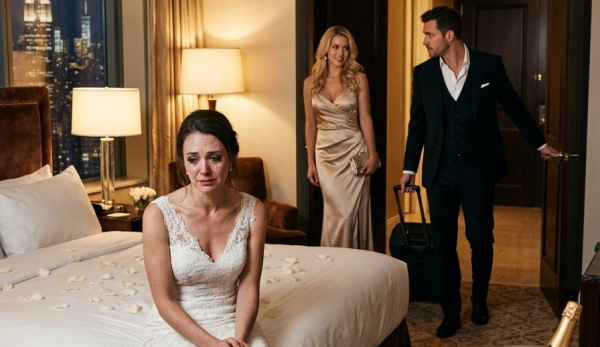
The honeymoon suite was ready, but before the night could truly begin, my husband chose to leave his bride alone so he could comfort the ex who still wanted him. He thought I would cry myself to sleep and forgive him by morning. What he did not know was that…
Part 1: The Door Closed Behind Him
On our wedding night, my husband buttoned his tuxedo jacket in front of the mirror and told me he was leaving to comfort another woman.
Not his mother. Not his sister. Not some friend whose car had broken down on the side of I-95.
His ex-girlfriend.
Her name was Sophie Lane, and she had spent the entire reception looking at me like I was wearing something stolen. She had stood near the champagne tower at the Fairmont Copley Plaza in Boston, dressed in pale silver, smiling with her mouth but not her eyes. Every time Ethan looked away from me, he found her in the crowd.
I noticed because brides notice everything.
I noticed when she cried during our first dance. I noticed when she left the ballroom twice and Ethan checked his phone both times. I noticed when his best man, Patrick, pulled him aside near the bar and said something that made Ethan’s jaw tighten.
But I told myself not to be dramatic.
That was the word Ethan always used when I saw something he wanted me to ignore.
Dramatic.
If I asked why Sophie still texted him at midnight, I was dramatic. If I asked why she was invited to our rehearsal dinner, I was insecure. If I said it was strange that she still called his mother “Mom C,” I was being controlling.
So I spent my wedding day smiling through every strange little moment. I smiled when Sophie hugged Ethan too long in the receiving line. I smiled when his mother told me, “Sophie will always be family to us, honey, but don’t worry, we’re happy for you.” I smiled when Ethan gave his toast and thanked “everyone who shaped him into the man standing here tonight,” while looking directly at Sophie for one second too long.
By 11:48 p.m., the reception was over.
My feet hurt. My hair had begun to fall from the elegant low bun I had paid $450 to have styled. The bottom of my dress was smudged from the hotel lobby floor, and my cheeks ached from smiling at people who kept telling me I was the luckiest woman in Boston.
Upstairs, in the honeymoon suite, the room looked like a magazine spread. White roses covered the side table. A bottle of chilled Veuve Clicquot sat in a silver bucket. Someone from the hotel had sprinkled rose petals across the king-size bed and left chocolate-covered strawberries beside a handwritten card that said, Congratulations, Mr. and Mrs. Caldwell.
Mrs. Caldwell.
I stared at that card and tried to feel the joy I had expected.
Ethan stood by the window, looking down at Copley Square with his phone in his hand.
“Everything okay?” I asked.
He did not answer right away.
That was when my stomach dropped.
He had done this before—not on a wedding night, of course, because we had only had one of those—but many times during our engagement. The pause. The lowered voice. The careful sadness that meant Sophie needed something, and I was about to be asked to prove I was mature enough not to object.
He turned around slowly.
“Sophie is not doing well,” he said.
I looked at him, still wearing my wedding dress.
“Excuse me?”
“She’s downstairs in the lobby. She’s crying. Patrick said she’s having some kind of panic attack.”
I waited for the punchline. None came.
“And?” I said.
Ethan frowned. “And I need to go talk to her.”
The room seemed to tilt slightly.
The champagne bucket gleamed between us. My bouquet lay on the sofa, white peonies and garden roses tied with a silk ribbon from my grandmother’s sewing box. My new husband was standing twelve feet away from me, explaining that another woman’s tears required his presence more urgently than his wife did on the first night of their marriage.
“No,” I said.
The word came out quieter than I expected.
His eyebrows lifted. “No?”
“No, Ethan. You are not leaving our honeymoon suite on our wedding night to comfort your ex-girlfriend.”
His expression hardened, but only a little. He was still trying to look patient, like a man explaining the weather to a child.
“Claire, don’t do this.”
I almost laughed. My name is not Claire. My name is Margaret Whitaker, though everyone calls me Maggie. But in that moment, he spoke to me like I was some generic difficult woman, a problem in a white dress.
“Don’t do what?” I asked.
“Make this about you.”
That sentence landed harder than I expected.
I looked around the room. The flowers. The champagne. The white dress. The wedding band still unfamiliar on my finger. If there had ever been a night that was allowed to be about me, surely this was it.
“It is about me,” I said. “I’m your wife.”
He looked away.
Then he did something I will never forget.
He sighed.
Not the sigh of a man torn between compassion and duty. Not the sigh of someone who knew he was hurting me. It was the tired, irritated sigh of a man disappointed that his new wife was not performing the role he had assigned her.
“You knew Sophie was fragile,” he said.
“I knew Sophie was your ex.”
“She lost me today.”
“No,” I said. “She lost you two years ago. Today you married me.”
His mouth tightened. “You don’t have to be cruel.”
Cruel.
I stood there in fifteen pounds of silk and lace, with pins digging into my scalp and my wedding makeup still perfect except for the mascara threatening to betray me. My husband was leaving me for his ex on our wedding night, and I was cruel for objecting.
He walked to the chair near the bed and picked up his tuxedo jacket.
“Ethan,” I said.
He slid one arm into the sleeve.
“If you walk out that door tonight, you are making a choice you cannot dress up as kindness tomorrow.”
He looked at me in the mirror.
For one second, I thought he might stop.
Instead, he buttoned his jacket.
“She needs me,” he said.
I swallowed the pain in my throat. “And what do I need?”
He turned toward me, and his eyes were cold in a way I had only seen twice before.
“You need to stop acting like love is a competition.”
That was when I understood.
He wanted me jealous. He wanted me frightened. He wanted me crying in that room until morning, terrified that my marriage had already become something I had to fight another woman to keep. He wanted me to learn, on the first night, that his affection was not a promise but a prize.
He wanted me to chase him.
Instead, I stepped aside.
The surprise on his face was small but real.
“Go,” I said.
He blinked. “Maggie—”
“No. Go comfort her.”
His eyes narrowed, suspicious now. He had expected tears, anger, maybe begging. He did not know what to do with calm.
“I’ll be back in a few minutes,” he said.
I said nothing.
He opened the hotel room door, paused like he was waiting for me to break, then stepped into the hallway. The door clicked shut behind him.
For ten seconds, I did not move.
Then I walked to the nightstand, picked up my phone, and called the attorney who had already prepared for that exact moment.
Part 2: The Warning Before the Vows
Six months before the wedding, my father asked me if I was sure.
He did not ask it dramatically. He did not bang his fist on the table or call Ethan names. He asked while we were sitting on his back porch in Concord, drinking iced tea from Mason jars while the late April sun turned the maple trees gold.
My father, Harold Whitaker, had built Whitaker Kitchens from a two-truck cabinet installation business into one of the most respected custom home contractors in Massachusetts. He was not flashy. He wore the same L.L.Bean jacket for fifteen years and drove a Ford F-150 even after he could have bought anything he wanted.
He trusted slow evidence more than quick charm.
Ethan was quick charm in human form.
He was a senior brand strategist at a boutique agency in Boston, handsome in the polished New England way—dark hair, straight teeth, expensive sweaters, and the ability to make every room feel like he had just improved it by entering. He knew which wine to order, which donor to flatter, which story to tell at a dinner table.
When we met at a charity auction for children’s literacy, he bid $3,200 on a weekend in Nantucket he later admitted he could not afford. I thought that was romantic then. Later, I understood it was a warning.
Ethan loved grand gestures. He sent flowers to my office, surprised me with Red Sox tickets, rented a cabin in Vermont after six weeks because he said fall made him think of forever. When he proposed in Beacon Hill under gas lamps and light snow, strangers actually clapped.
I said yes before I knew the whole cast of our marriage would include Sophie.
Sophie Lane had dated Ethan for five years before me. They had broken up because, according to Ethan, she wanted too much and trusted too little. According to his mother, Sophie had “been through a lot” and Ethan had “helped her become herself again.”
That phrase bothered me.
Helped her become herself again.
It sounded less like an old relationship and more like an unfinished rescue mission.
At first, I tried to be understanding. They shared friends. Their families knew each other. Sophie had no siblings, and Ethan’s mother had apparently adopted her emotionally sometime around Thanksgiving of 2018.
I told myself adult people could have complicated histories.
Then came the boundaries Ethan refused to set.
Sophie called him when her apartment heat broke. Sophie texted him when she had trouble sleeping. Sophie asked him to review job applications, recommend restaurants, talk her through anxiety before presentations, help pick a birthday gift for his mother.
Once, during our engagement party, she cried in the guest bathroom because seeing Ethan “move on so publicly” was harder than she expected.
I found her there with my cousin Olivia, who looked trapped beside the sink.
Sophie dabbed her eyes with a paper towel and whispered, “I’m sorry. I didn’t want to ruin anything.”
But somehow, women like Sophie always cried loudly enough for the right man to hear.
Ethan came to the hallway five minutes later.
He spent twenty-two minutes comforting her while my relatives cut the engagement cake without him.
When I confronted him that night, he accused me of lacking compassion.
“She’s grieving,” he said.
“Grieving what? You’re not dead.”
He stared at me like I had said something monstrous.
“You don’t understand her history.”
“No,” I said. “I understand that I’m marrying a man who keeps asking me to make room for a woman who wants my place.”
He slept on the couch that night.
The next morning, he apologized beautifully.
That was Ethan’s gift. He could apologize like a poet and change nothing like a politician.
My father noticed.
He noticed how often Ethan checked his phone. He noticed Sophie’s name lighting up the screen during Sunday dinners. He noticed that Ethan always seemed most affectionate with me when someone important was watching.
Two days after the engagement party, Dad invited me to lunch at Legal Sea Foods near the harbor.
“Maggie,” he said after we ordered, “I need you to hear me as your father, not as a man trying to control your life.”
I put down my water glass.
“I don’t dislike Ethan,” he said.
“That sounds like something people say before explaining how much they dislike someone.”
He smiled faintly. “I dislike how he handles responsibility.”
I felt myself tense.
“He’s ambitious,” I said.
“So are you. Ambition isn’t the problem.”
“What is?”
Dad leaned back in his chair. “He treats discomfort like something other people should absorb for him.”
I did not answer.
He continued gently. “That woman, Sophie. Whatever their past is, he keeps using your patience to avoid making a decision. That tells me something.”
“It’s complicated.”
“Most things are. Character is what people do when complicated costs them something.”
I looked out the window at the harbor. Ferries moved across the gray water, steady and indifferent.
Dad placed a folder on the table.
“I want you to talk to Elaine Mercer before the wedding.”
Elaine Mercer was not just any attorney. She was my father’s attorney, a sharp, silver-haired woman who had handled business acquisitions, family trusts, and one ugly lawsuit from a former partner who tried to claim part of Whitaker Kitchens.
“Dad,” I said, embarrassed, “we already signed a prenup.”
“I know. Elaine reviewed it.”
“Then why?”
“Because the prenup protects assets. I want you to have a plan that protects you.”
I almost argued.
Then I remembered Ethan in the hallway with Sophie while my aunt served our engagement cake.
So I met Elaine.
Her office was on the twenty-first floor of a glass building near the Financial District, with a view of Boston Harbor and shelves full of files labeled in neat black type. She greeted me with a firm handshake and did not waste time pretending romance had anything to do with her job.
“Your father is concerned,” she said.
“My father worries.”
“Good fathers often do.”
I gave her the clean version first. Ethan had an ex. The ex was emotional. Boundaries were difficult. The wedding was already planned.
Elaine listened without interrupting.
Then she said, “Do you feel confident that Mr. Caldwell understands marriage as a legal and emotional commitment to you above former partners?”
The question was so clinical that I almost laughed.
“I want to,” I said.
“That is not what I asked.”
I looked down at my hands.
“No,” I admitted.
Elaine nodded once, as if I had confirmed a number on a spreadsheet.
Over the next month, she reviewed everything. The prenup. The wedding contracts. My family trust. My role in Whitaker Kitchens. Joint accounts Ethan wanted to open “for simplicity.” His debt disclosures. His request that we buy a Back Bay condo together after the wedding using part of my inheritance as the down payment.
Elaine’s advice was simple.
Do not combine major assets yet.
Do not add him to family business documents.
Do not transfer inheritance funds into a joint account.
Keep written records of major agreements.
If something happens that shows fraud, coercion, or immediate abandonment, call immediately.
I thought that last part was excessive.
Elaine did not.
“Sometimes,” she said, “people reveal themselves as soon as they believe the contract is locked.”
I left her office unsettled but grateful.
I did not tell Ethan about the full emergency plan. I told him Elaine had reviewed the prenup and business matters. He rolled his eyes and said my father treated marriage like a merger.
Maybe he was right.
But by the night of the wedding, when Ethan walked out of our honeymoon suite to comfort Sophie, I understood something my father had known months earlier.
Some mergers need an exit clause.
Part 3: The Call at Midnight
Elaine answered on the second ring.
That alone told me my father had warned her tonight might matter.
“Maggie,” she said, calm and awake. “Are you safe?”
It was the first question anyone had asked that night that centered me.
I looked at the hotel door.
“Yes,” I said.
“Where is Ethan?”
“He left.”
A pause.
“Left where?”
“To comfort Sophie. In the lobby, I think. Maybe outside. I don’t know.”
Elaine exhaled softly, not surprised, just disappointed on behalf of facts.
“On your wedding night?”
“Yes.”
“Did he say why?”
“He said she wasn’t doing well. He said I was making it about me.”
“And you are alone in the suite?”
“Yes.”
“Good. Do not follow him. Do not confront her. Do not post anything. Do not call his family right now. Start by writing down exactly what happened while your memory is fresh.”
I looked at myself in the mirror across the room.
The bride in the reflection looked composed from a distance. Up close, her eyes were too bright, her mouth too still. Her dress made her look like a woman in a portrait of someone else’s happiness.
“I feel stupid,” I whispered.
“You are not stupid,” Elaine said. “You are newly informed.”
That sentence saved me from the first wave of shame.
Elaine continued. “Did anyone witness him leaving?”
“I don’t know. Maybe hotel staff in the hall. Maybe cameras.”
“Do you have texts from tonight?”
“Yes.”
“Save them. Screenshot them. Forward them to yourself. If he messages, do not engage emotionally. Keep responses brief and factual, if any response is necessary.”
I sat on the edge of the bed. Rose petals stuck to the skirt of my dress.
“What happens now?” I asked.
“Legally, that depends on several facts we will review in the morning. Emotionally, you need to decide whether this is a marriage you wish to enter in practice, not just on paper.”
“He already entered it.”
“No,” she said. “He attended a ceremony. Tonight he is showing you how he intends to behave inside the marriage.”
I closed my eyes.
From somewhere below, faint music drifted up through the old hotel walls. Maybe the bar was still open. Maybe wedding guests were still drinking cocktails, laughing about centerpieces and speeches, unaware that the bride was upstairs documenting the first abandonment of her marriage.
Elaine gave me instructions.
Photograph the room as it was. Save the congratulatory card. Screenshot Ethan’s messages before and after he left. Make a note of the exact time he walked out. If he returned, record your recollection immediately afterward and avoid arguments.
“I can have a petition drafted quickly if that is what you choose,” she said. “But tonight, your priority is safety, documentation, and rest if possible.”
Rest.
The word seemed absurd.
After we hung up, I stood slowly and began doing what she told me.
I took photos of the suite. The untouched champagne. The flowers. The bed. The card that said Mr. and Mrs. Caldwell. I photographed the clock on the nightstand showing 12:13 a.m.
Then I screenshotted Ethan’s earlier messages from the reception.
Ethan: Sophie is having a hard time. Please be kind tonight.
Ethan: Don’t start anything with her.
Ethan: She’s still important to my family.
Ethan: I need you to be the bigger person.
The bigger person.
Women are always asked to be the bigger person when someone else wants permission to make them smaller.
At 12:26 a.m., Ethan texted.
Ethan: I’m with her. She’s calming down. Don’t wait up angry.
I stared at the message.
Don’t wait up angry.
As if anger were a rude hobby I had picked up to inconvenience him.
I did not answer.
At 12:41, another text came.
Ethan: Maggie, don’t punish me for being compassionate.
I almost threw the phone.
Instead, I forwarded the screenshot to Elaine.
At 1:08, my sister called.
Olivia was three years older than me, married to a firefighter, and blessed with the kind of temper that made people choose honesty for safety reasons. I considered ignoring her because Elaine had said not to create a family emergency at midnight.
But Olivia always knew when something was wrong.
“Why did Patrick just text Jason asking if Ethan came back upstairs?” she said, without saying hello.
I stared at the carpet.
“Because Ethan left.”
There was silence.
“Left where?”
“To comfort Sophie.”
Olivia said nothing for four seconds, which was how I knew she was trying not to commit a felony in her imagination.
“On your wedding night?”
“Yes.”
“I’m coming up.”
“No.”
“Maggie.”
“No,” I said again. “I need you to listen carefully. I am safe. I have spoken to Elaine. I am not confronting anyone tonight.”
“You called Elaine?”
“Yes.”
Olivia’s voice changed. “Good.”
That was when I started to cry.
Not loudly. Not dramatically. Just enough for the mascara to finally give up. I had held myself together through the reception, through Ethan’s speech, through Sophie’s stare, through the moment my husband chose to leave.
But hearing my sister say good broke something open.
Olivia softened.
“Take the dress off,” she said. “You can’t think in a wedding dress.”
That was practical enough to make me laugh through tears.
After we hung up, I unbuttoned the back as far as I could reach, then twisted awkwardly until the fabric loosened. It took ten minutes, two broken hairpins, and one whispered curse, but eventually the dress slipped to the floor in a heavy white circle.
I stepped out of it.
The woman in the mirror wore a strapless slip, smeared mascara, and a diamond necklace borrowed from her mother. She looked less like a bride and more like a witness.
I hung the dress carefully in the closet.
Then I washed my face.
At 1:37 a.m., the hotel room door opened.
Ethan stepped inside quietly, as if sneaking into his own wedding night would make it less insulting. His hair was slightly disheveled, and his bow tie was gone. He smelled faintly like the lobby bar and Sophie’s perfume—soft, floral, expensive.
He stopped when he saw me sitting in the armchair by the window, wearing the hotel robe.
“You’re awake,” he said.
It was such a stupid sentence that I almost admired it.
“Yes.”
He closed the door behind him.
“How is Sophie?” I asked.
His eyes flickered. He had expected accusation, not politeness.
“She’s okay,” he said. “She was just overwhelmed.”
“By my wedding?”
“Our wedding,” he corrected.
“No,” I said. “You left our wedding night. I think the pronouns changed while you were gone.”
His face hardened. “I’m not doing this right now.”
“That makes two of us.”
I stood.
He looked toward the bed, then back at me, as if only now realizing the room no longer felt like a honeymoon suite. It felt like a conference room with flowers.
“Why are you acting like this?” he asked.
“Like what?”
“Cold.”
I smiled faintly. “You left me alone on our wedding night to comfort your ex-girlfriend, and you’re disappointed that I’m not warm?”
He ran a hand through his hair. “You knew Sophie would struggle today.”
“I knew you might let her.”
He stared at me.
Then he laughed under his breath, the cruel little laugh people use when they want to make sanity sound ridiculous.
“My God, Maggie. You really are jealous.”
There it was.
The word he had been waiting to use.
Jealous.
I looked at him in his wrinkled tuxedo, this man I had legally married hours earlier, and felt something inside me go quiet and clean.
“No,” I said. “I’m finished competing.”
His expression changed.
“What does that mean?”
“It means you should sleep somewhere else tonight.”
He blinked. “This is our suite.”
“It was.”
“You’re kicking me out of our honeymoon suite?”
“I’m asking you to leave the room you walked out of.”
His jaw tightened. “You’re making a huge mistake.”
“No,” I said. “I made one at 4:00 p.m. The paperwork just hasn’t caught up yet.”
For the first time, Ethan looked afraid.
Part 4: The Morning After
Ethan did not leave immediately.
Men like Ethan rarely accept consequences the first time they are introduced. They argue with them, flirt with them, insult them, and finally try to negotiate as if reality were a hotel bill with incorrect charges.
“You’re tired,” he said.
“I am.”
“You’re emotional.”
“Also true.”
“So let’s not make permanent decisions at two in the morning.”
I looked at him. “You made one at midnight.”
He paced near the bed, careful not to step on the rose petals, which suddenly seemed ridiculous scattered across the floor like evidence from a crime against dignity.
“I was helping someone who was in distress.”
“You were teaching your wife that another woman’s distress outranks her dignity.”
“That’s not fair.”
“Neither was tonight.”
His face flushed. “You’re acting like I cheated.”
“Did you?”
The question landed between us.
He looked away.
That was answer enough.
Maybe he had not touched Sophie that night. Maybe he had only held her while she cried in some velvet chair downstairs. Maybe nothing physical had happened during our engagement, though the silence after my question made that difficult to believe.
But marriage can be betrayed before bodies are involved.
There are emotional rooms a husband should not enter once he has promised his wife the house.
“I can’t believe this,” he muttered.
“Neither can I.”
He turned back toward me. “What are you going to tell people? That I comforted a friend and you ended the marriage?”
“No,” I said. “I’m going to tell people nothing unless I need to. But if facts become necessary, I’ll use them.”
His eyes narrowed. “Facts.”
“Yes. Those things you keep trying to rename.”
He grabbed his phone from the nightstand.
“Fine,” he said. “I’ll get another room.”
“That would be best.”
He paused at the door.
“You know Sophie was right about one thing,” he said.
I did not ask, but he continued anyway.
“She said you’d never understand what it’s like to need someone so much that you can’t breathe.”
I felt the sentence enter me and look for a wound.
It found one.
But it did not kill me.
“No,” I said quietly. “I understand needing someone. I just don’t confuse need with entitlement.”
He stared at me.
Then he left for the second time that night.
This time, I locked the door.
At 2:18 a.m., I texted Elaine.
He returned. I asked him to leave. He left. I am safe.
She responded within one minute.
Document your recollection. Try to sleep. We will speak at 8:00.
I wrote everything down. Not because I wanted to become cold, but because my memory was already trying to protect Ethan from himself. It wanted to soften his voice, blur the cruelty, add context where there had been choice.
So I wrote the words exactly.
She needs me.
Don’t make this about you.
Love is not a competition.
You’re jealous.
You’re making a huge mistake.
Then I closed the notebook.
I did not sleep much.
At 6:30 a.m., sunlight entered the room through cream curtains. Boston looked clean and bright outside the window, as if nothing ugly had happened under its old stone buildings. A trolley bell rang faintly below, and somewhere in the hallway, a housekeeper laughed.
My wedding bouquet had begun to wilt.
I ordered coffee and toast from room service because grief is worse on an empty stomach. When the server arrived, she looked at the untouched champagne, the unslept-in bed, and my bare left hand. I had removed the wedding band at 4:00 a.m. and placed it beside the congratulatory card.
She said nothing.
That kindness nearly undid me.
At 7:52, Ethan texted.
Ethan: We need to talk before brunch.
Ethan: My parents are asking where you are.
Ethan: Please don’t make this into a spectacle.
There was the concern again.
Not for me.
For the audience.
The farewell brunch was scheduled for 10:00 a.m. in a private dining room downstairs. Fifty relatives and close friends would gather over eggs Benedict, fruit, coffee, and polite exhaustion. They expected to see newlyweds glowing with happiness.
Instead, they saw me arrive alone.
I wore a navy wrap dress Olivia had packed in my overnight bag and the same pearl earrings I had worn to the rehearsal dinner. My hair was brushed straight, my makeup simple. I looked less like a woman abandoned on her wedding night and more like someone attending a board meeting with excellent posture.
The room quieted when I entered.
My mother stood first.
She had known. Of course she had known. Olivia must have told her enough to prepare her face.
Ethan’s mother, Caroline, rushed toward me in a pale pink suit.
“Maggie, sweetheart,” she said too brightly, “there you are. Ethan said you weren’t feeling well.”
I looked at her.
“I wasn’t.”
Her smile trembled. “Weddings are emotional.”
“Yes,” I said. “Especially when the groom leaves the bride on the wedding night to comfort his ex-girlfriend.”
The room went silent.
Not loud silence. Not dramatic movie silence. Worse.
Social silence.
The kind where forks stop moving and people suddenly discover they have been breathing too loudly.
Caroline’s face drained of color.
My mother stepped beside me.
Ethan appeared near the doorway, hair damp from a shower, wearing a blue suit and the expression of a man arriving at a fire he had expected to control.
“Maggie,” he said warningly.
I turned to him.
“No,” I said. “You don’t get to use that tone today.”
His father stood. “Maybe this conversation should be private.”
“It should have been,” I said. “Your son made sure it wasn’t.”
Ethan walked toward me, lowering his voice. “You promised you wouldn’t make a spectacle.”
“I promised nothing.”
Caroline placed one hand on her chest. “This is humiliating.”
I looked at her, and for the first time in two years, I saw clearly how much of Ethan’s behavior had been raised, polished, and protected by the people around him.
“Yes,” I said. “It is.”
Sophie was not at brunch.
That was the smartest thing she had done all weekend.
Ethan tried to take my elbow. I stepped back before he touched me.
“Don’t,” I said.
Several people saw it. Good.
My father entered then, late because he had been on the phone with Elaine. He was wearing a charcoal suit and no expression at all. That frightened Ethan more than shouting would have.
“Harold,” Ethan said, forcing a smile. “This has gotten out of hand.”
My father looked at him.
“No,” he said. “It got out of hand when you left my daughter alone on her wedding night.”
Ethan opened his mouth, then closed it.
Dad turned to me. “Are you ready?”
I nodded.
We left the brunch together.
Behind me, people began whispering. Let them. For months, I had been asked to protect Sophie’s feelings, Ethan’s image, Caroline’s fantasy, and everyone else’s comfort.
I was done making silence my wedding gift.
Part 5: The Marriage That Ended Before It Began
By noon, I was in Elaine Mercer’s office.
By 12:30, my wedding dress was hanging in my childhood bedroom in Concord.
By 1:15, Ethan had called fourteen times.
I did not answer.
Elaine explained that ending a marriage legally is rarely as simple as people on the internet imagine. There were filings, jurisdictional rules, timelines, and facts to review. Annulment was not guaranteed simply because the groom had acted like a fool, and divorce was not instant just because the marriage had emotionally died before breakfast.
But the prenup was clear.
My family assets remained mine. Whitaker Kitchens remained protected. No joint property had been purchased. No inheritance funds had been mixed. Ethan had no claim to the trust my grandparents built, the company my father created, or the condo I had kept in my name despite his repeated pressure.
“Your restraint helped you,” Elaine said.
I almost laughed. “It didn’t feel like restraint.”
“Most restraint doesn’t.”
The next week was a master class in how quickly a man changes tone when consequences become written documents.
First, Ethan sent apologies.
Not real apologies. Beautiful ones. Apologies that sounded like wedding vows with better grammar.
He wrote that he had been overwhelmed. He wrote that Sophie had manipulated the situation. He wrote that he had made “one terrible error in judgment” and that a marriage should not be destroyed over “a moment of misplaced compassion.”
Misplaced compassion.
I read that phrase three times.
Then I sent it to Elaine.
Next came his anger.
He accused me of embarrassing him in front of both families. He said my father had poisoned me against him. He said Olivia had always hated him. He said I cared more about pride than love.
Then came the bargain.
Couples therapy. A private apology. A second honeymoon. A promise to cut Sophie off “for a while.” He actually wrote those words.
For a while.
That was when I knew he still did not understand.
I did not want to win Sophie’s place in line. I wanted a husband who knew there should not be a line.
Caroline called my mother and cried.
My mother listened for seven minutes, which was six minutes longer than I would have managed.
Then she said, “Caroline, my daughter did not abandon her husband on their wedding night. Your son abandoned his wife. Start there.”
Caroline hung up.
Patrick, Ethan’s best man, called me three days later. I almost did not answer, but Patrick had always seemed more honest than the others.
“I’m sorry,” he said.
I stood in my father’s kitchen, watching rain streak the windows.
“For what?”
“For texting him about Sophie. I thought he’d send his mom or something. I didn’t think he’d go himself.”
“Did you know they were still involved?”
Silence.
That was answer enough.
“Patrick.”
He sighed. “I knew she still loved him. I knew he liked being needed. I told him before the wedding he had to end that whole thing cleanly.”
“And?”
“He said you were strong enough to handle it.”
I closed my eyes.
Strong enough.
How convenient to call a woman strong when asking her to tolerate disrespect.
“Thank you for telling me,” I said.
“I really am sorry, Maggie.”
“I believe you.”
After we hung up, I cried for the first time in daylight.
Not because I missed Ethan, though part of me did. Grief is not logical; it does not wait for someone to deserve it. I cried because the wedding had been beautiful, and my vows had been real, and the man I married had treated my sincerity like a stage prop in his personal drama.
Two weeks later, Sophie emailed me.
Subject: I never meant to hurt you
Maggie,
I know you probably hate me. Ethan told me he was confused and that you understood our history. He said the wedding was moving too fast and he needed closure. I should not have leaned on him that night. I am sorry.
I read it once.
Then I forwarded it to Elaine.
I did not respond.
Sophie wanted absolution, or maybe she wanted to hand me another piece of proof without realizing it. Either way, silence served me better than anger.
By the end of the month, Ethan’s agency quietly removed our wedding photos from their social media because clients kept commenting things like, “Is this the wedding where the groom left?” Boston is a city with universities, hospitals, old money, new money, and gossip that travels through all of them wearing a wool coat.
I never posted a word.
I did not need to.
People talk when a bride leaves brunch with her father and the groom’s mother cries into a mimosa.
The legal process took longer than my heartbreak wanted. It always does. Movies make exits look clean; real life has paperwork, deposits, vendors, thank-you notes that never get sent, and relatives who ask questions because they care or because they are bored.
The hotel kept part of the wedding suite charge.
The florist refused any refund, which was fair because the flowers had done nothing wrong.
The photographer emailed proofs, and I stared at them for one painful hour. In the pictures, Ethan looked happy. I looked radiant. Sophie appeared in the background of one reception shot near the bar, watching us cut the cake.
I closed the laptop and did not look again for six months.
My father never said “I told you so.”
That was one of the greatest gifts he ever gave me.
Instead, he put me to work.
“Come to the Cape project meeting,” he said one Monday morning. “The client changed the appliance package again, and if I have to hear one more person say ‘European farmhouse’ without knowing what that means, I’ll retire.”
So I went.
Work saved me in pieces. Blueprints. Cabinet samples. Site visits in muddy boots. Coffee in paper cups. Contractors who did not care about my wedding because they needed answers about delivery dates.
Slowly, I remembered who I had been before Ethan made my emotional life a courtroom where Sophie was always the emergency witness.
I was not a woman competing with an ex.
I was a woman who knew how to build things that lasted.
Three months after the wedding, Ethan asked to meet.
Elaine approved a public place and limited time. I chose a coffee shop near Boston Common, busy enough to feel safe, quiet enough to hear the truth if he accidentally told it.
He looked thinner. Handsome still, but in a faded way, like a photograph left in sunlight. He wore the navy coat I had helped him pick out for our engagement photos.
“Maggie,” he said when I sat down.
“Ethan.”
He looked at my left hand. No ring.
His mouth tightened.
“I cut Sophie off,” he said.
I nodded.
“Completely.”
I nodded again.
“She’s blocked.”
“That must have been hard for her.”
He flinched. “For me too.”
There it was again. The center of the universe, reporting weather from his own skin.
“I loved you,” I said.
His eyes filled quickly. Ethan always had easy tears. Once, I thought that meant depth. Now, I knew some people cry because feeling consequences hurts more than causing them.
“I love you,” he said.
“No,” I said gently. “You loved being chosen by me while still being needed by her. That’s different.”
He looked down.
“I made a mistake.”
“You made a demonstration.”
“What does that mean?”
“You showed me the marriage. I believed you.”
He wiped his eyes. “If you had just waited until morning—”
I stood.
That was the end.
Because even then, after everything, he still believed the problem was the timing of my reaction, not the nature of his choice.
The final paperwork came through in early winter.
Outside Elaine’s office, snow fell softly over Boston, dusting the sidewalks and turning traffic into red and white ribbons. I signed where she told me to sign. My hand did not shake.
When it was done, Elaine closed the folder.
“You’re free,” she said.
Free felt too big for the room.
That night, I went home to my condo, the one Ethan had once called “too small for our future.” I made tomato soup, changed into sweatpants, and watched old episodes of a cooking show until nearly midnight.
At 11:48 p.m., I realized the time.
Almost exactly one year earlier, I had been standing in a honeymoon suite while my husband told me another woman needed him more than I did.
I looked around my quiet living room.
No rose petals.
No champagne.
No tuxedo jacket.
No woman downstairs waiting to test my worth.
Just my books, my coffee table, the city lights beyond the window, and a peace I had not known how badly I needed.
My phone buzzed.
A message from Olivia.
You okay tonight?
I smiled.
Yes, I typed. I really am.
Then I opened the bottom drawer of my desk and took out the wedding photos. Not all of them. Just one.
It showed me standing alone before the ceremony, looking out a window in my dress. I was holding my bouquet. My face was turned slightly toward the light.
For the first time, I did not see a foolish woman.
I saw a woman about to learn the truth.
I placed the photo in a simple frame and set it on my bookshelf—not as a memory of a marriage, but as proof of a rescue.
People sometimes ask if I regret the wedding.
I regret the pain. I regret the money spent, the guests inconvenienced, the vows wasted on someone who treated them like theater. I regret ignoring the small humiliations that arrived before the big one.
But I do not regret how I handled the night he walked out.
Ethan expected me to cry until morning.
Maybe part of me did.
But another part of me watched the hotel door close, picked up the phone, and chose not to spend the rest of my life auditioning for the role of wife.
He went to comfort another woman.
I went to save myself.
