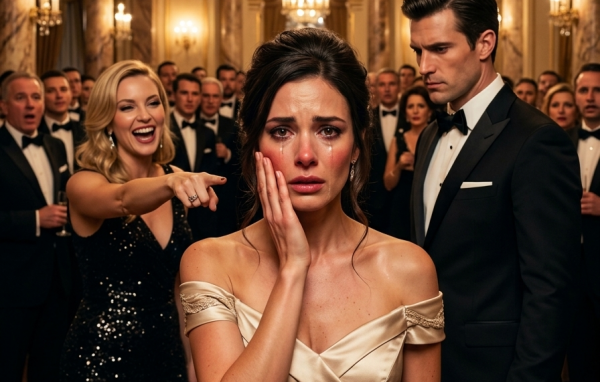
When my husband’s mistress slapped me in the middle of a crowded Charleston ballroom, everyone expected me to lose control. But the real shock came when my husband protected his mistress and threatened to divorce me if I fought back. I didn’t scream, didn’t slap anyone, and didn’t cause a scene. I simply…
Part 1: The Slap Everyone Heard
My husband’s mistress slapped me in front of three hundred guests.
Not in a dark hallway. Not in some private corner where people could later pretend they had not seen it. She slapped me under the crystal chandeliers of the Magnolia Ballroom at the Charleston Harbor Hotel, while a string quartet played near the entrance and waiters carried trays of crab cakes and champagne through a sea of evening gowns and black tuxedos.
Her name was Vanessa Hart, and she was twenty-eight years old, with glossy auburn hair, a white satin dress, and the kind of confidence that only comes from believing a married man has chosen you over his wife. My name is Claire Whitmore, and at forty-two, I had spent fourteen years building the life she thought she could step into.
The slap cracked across my face so loudly that the room seemed to lose its breath.
For one second, no one moved. The mayor’s wife froze with a champagne flute halfway to her mouth. A judge from the county circuit court turned his head slowly, as if he could not believe what he had just witnessed in public. Somewhere behind me, a woman gasped, “Oh my God.”
I tasted blood before I felt pain. A sharp metallic warmth spread along my lower lip, and my left cheek burned as if someone had pressed a hot iron against it. My pearl earring had fallen onto the marble floor and rolled toward the hem of Vanessa’s dress.
She was breathing hard, her eyes bright with anger and panic. “Stay away from him,” she said.
From him.
As if my husband were a lost wallet she had found and claimed.
Before I could answer, Daniel stepped between us.
Daniel Whitmore, my husband of fourteen years, father of my daughter, partner in the life I thought we were still building, moved quickly—not toward me, his bleeding wife, but toward her. He put one arm out in front of Vanessa like a shield and turned his body so she was protected behind him.
“Claire,” he said, low and warning, “do not touch her.”
I stared at him.
There were three hundred people in that ballroom. Donors, doctors, local business owners, board members from the children’s hospital foundation, two newspaper reporters, and half the social circle Daniel had spent years trying to impress. All of them had seen his mistress hit me, and all of them watched him protect her.
I lifted one hand to my mouth. My fingertips came away red.
Daniel’s eyes flicked to the blood, but only for a moment. Then his face hardened, as if my injury were an inconvenience that might embarrass him.
“I mean it,” he said. “If you touch her, I will divorce you before midnight.”
The old Claire might have collapsed right there. The old Claire might have screamed, cried, slapped him, slapped her, or begged him to remember who I was. The old Claire might have tried to save the marriage in front of strangers because she still believed humiliation could be reversed if she loved hard enough.
But something in me went very still.
Maybe it was the blood on my fingers. Maybe it was the look on Vanessa’s face, already shifting from rage to fear as she realized exactly how many people had seen what she had done. Or maybe it was Daniel’s voice, calm and threatening, as if I were the danger in the room.
I picked up my pearl earring from the floor.
Then I looked at my husband, the man who had promised to honor me in a church full of flowers and family, and I smiled just enough for him to notice.
“Daniel,” I said quietly, “you won’t need to divorce me before midnight.”
His jaw tightened. “What does that mean?”
I wiped the blood from my lip with the cocktail napkin someone had silently handed me. Then I looked past him at Vanessa, who had started to tremble behind his shoulder.
“It means I’m going to return that slap ten times,” I said, “and I won’t have to raise my hand once.”
The room stayed silent.
Then I turned and walked away.
I did not run. I did not cry. I did not give them a scene they could later use against me. I walked through the ballroom with my head up, my cheek burning, my lip bleeding, and every pair of eyes following me to the double doors.
Outside, the warm South Carolina air hit my face. The harbor was dark and glittering beyond the terrace, with lights from boats trembling on the water. I stood there for a moment, breathing through the pain, listening to the muffled music continue behind the glass.
My daughter, Lily, was away at college in Virginia. Thank God for that. She had wanted to come home for the hospital gala, but I had told her to focus on finals and not waste a weekend on adult small talk and dry chicken.
For the first time that night, I was grateful she had listened.
My best friend, Marissa, followed me onto the terrace two minutes later. She was a divorce attorney, though not mine yet, and she had the expression of a woman who had just watched a legal case create itself under ballroom lighting.
“Claire,” she said softly, “do you need a doctor?”
“No.”
“You’re bleeding.”
“I know.”
“Do you want me to call security?”
I looked through the glass doors. Daniel was still inside, speaking sharply to Vanessa while two members of the foundation board hovered nearby, looking horrified. People were pretending not to stare, which made the staring worse.
“Yes,” I said. “But not because I want drama.”
Marissa nodded once. “Because she assaulted you in front of witnesses.”
I looked at her.
The word landed with the force of a bell.
Assault.
Not a messy romantic scene. Not a wife-mistress confrontation. Not a scandal people could reduce to gossip over brunch.
A woman had struck me in public, hard enough to split my lip, and my husband had threatened me for being the injured party.
“Yes,” I said. “Because she assaulted me.”
Marissa took out her phone.
While she called hotel security, I called my driver. Daniel and I had arrived together in the black Lincoln he liked to use for events because he said valet lines made him feel “ordinary.” He could find his own way home.
My phone buzzed before the driver answered.
Daniel: Where are you?
I ignored it.
Another message came through.
Daniel: Do not embarrass me tonight.
I stared at the screen, almost laughing.
Do not embarrass me.
Not: Are you okay?
Not: I’m sorry.
Not: She should never have done that.
Not: I lost my mind and protected the wrong person.
Just: Do not embarrass me tonight.
I took a screenshot.
Then I texted back one sentence.
You embarrassed yourself.
By the time security came outside, my cheek had begun to swell. A hotel manager named Theresa brought a small first-aid kit and a bottle of water. She was professional, quiet, and kind in the way Southern women can be when they are trying not to say everything they are thinking.
“Mrs. Whitmore,” she said, “we have the incident on hallway and ballroom cameras. We can preserve the footage if needed.”
Marissa looked at me.
“Please do,” I said.
Theresa nodded. “Of course.”
I did not know it then, but that sentence would become the first brick in the wall that Daniel and Vanessa would later walk into face-first.
At 10:47 p.m., I left the Charleston Harbor Hotel alone.
My lip was swollen. My pearl earring was in my clutch. My husband was still inside with his mistress, trying to contain a fire he had helped start.
And by midnight, the divorce he had threatened me with would no longer belong to him.
Part 2: The Marriage Behind the Ballroom Smile
Daniel and I had not started as a bad marriage.
That is the part people never understand when they hear a story like mine. They want the villain to have been obvious from the first date, the red flags waving like sirens, the wife foolish for ignoring what everyone else could see. But life is rarely that generous.
When I met Daniel, he was thirty-three, charming, and broke in a well-dressed way. He worked in commercial real estate, drove an old Mercedes that looked better from far away, and spoke with the confidence of a man who had never considered failure permanent. I was twenty-eight, managing operations for my father’s family construction company, Whitmore Development, and already better with money than most men in the room.
Daniel loved that about me at first. He said my mind was “beautifully practical.” He used to sit across from me at dinner and ask questions about zoning approvals, subcontractor costs, and how my father negotiated land deals.
“You’re incredible,” he told me after our third date. “Most people talk about dreams. You know how to build them.”
I believed him.
We married two years later in Savannah, under live oak trees dripping with Spanish moss. My father walked me down the aisle with tears in his eyes, and Daniel cried so openly during his vows that my aunt still mentioned it every Thanksgiving. He promised to protect my heart, respect my mind, and never let pride become bigger than love.
For a while, he kept those promises.
We bought a house in Mount Pleasant with white columns, blue shutters, and a back porch that faced the marsh. Lily was born eighteen months later, and Daniel became the kind of father people complimented in grocery stores. He carried her everywhere, sang old country songs off-key, and once drove forty minutes at midnight because the only pacifier she wanted had been left at my mother’s house.
But as Daniel rose in his career, admiration became oxygen to him. He did not just want to succeed; he wanted to be seen succeeding. He wanted the biggest table at restaurants, the best parking spot, the handshake from the mayor, the photograph in the society pages after every fundraiser.
I understood ambition. I had my own. But Daniel’s ambition had hunger under it, and hunger can become dangerous when it learns to wear a tuxedo.
My father died when Lily was seven, and I took over Whitmore Development completely. Overnight, I became the person everyone called when permits stalled, budgets broke, or investors panicked. The company had survived recessions, hurricanes, and family disagreements that could have split it apart, and I refused to let grief make me careless.
Daniel was proud of me in public.
In private, it became more complicated.
At first, he joked about being “Mr. Claire Whitmore.” Then the jokes became sharper. If a waiter recognized me before him, he grew quiet. If a client asked for my opinion at dinner, he interrupted. If my name appeared in the Charleston Business Journal, he congratulated me with a kiss that felt more like a performance than affection.
I made excuses because wives are trained, quietly and constantly, to translate disrespect into insecurity.
He’s under pressure.
He feels overshadowed.
He needs reassurance.
He doesn’t mean it that way.
By our twelfth anniversary, Daniel had become partner at his firm, mostly because Whitmore Development sent business his way. I recommended him to developers, invited him to investor dinners, and introduced him to people who trusted me. He called it networking, but I knew the truth.
I had built the bridge he walked across.
Then Vanessa Hart appeared.
She joined Daniel’s firm as a public relations consultant for a luxury condo project on King Street. The first time I met her, she was wearing a red dress at a rooftop event, laughing at Daniel’s story before he reached the punchline. She had the kind of beauty that makes people forgive impatience and call it confidence.
“She’s intense,” I said in the car afterward.
Daniel smiled at the windshield. “She’s talented.”
“She watched you like you invented sunlight.”
He laughed too loudly. “Don’t be jealous, Claire.”
That sentence irritated me more than the red dress.
Jealousy was such a convenient word. It turned observation into weakness. It made a wife sound small for noticing what a husband wanted to hide.
Over the next year, Vanessa became unavoidable. She managed press releases, charity appearances, donor lists, event photography, and eventually, Daniel’s schedule. Suddenly, she knew where he was before I did.
He said she was indispensable.
I said secretaries used to be called that before men started sleeping with them.
He did not speak to me for two days.
The affair did not reveal itself all at once. It arrived in pieces, like mail from a country I had never wanted to visit. A late meeting. A changed password. A new cologne. A receipt from a boutique hotel in Greenville when Daniel had told me he was driving back from Columbia.
I confronted him once, six months before the gala.
We were in the kitchen. Lily had already left for college, and the house felt too large without her music and laundry and half-finished cups of iced coffee everywhere. Daniel was standing at the island, scrolling through his phone with a smile that vanished the second he saw me watching.
“Are you having an affair?” I asked.
He looked offended so quickly I almost believed him.
“Wow,” he said. “That’s where we are now?”
“I’m asking.”
“No, Claire. You’re accusing.”
“There’s a difference?”
“Yes. One comes from concern. The other comes from control.”
There it was again—the trick of turning my question into my flaw.
He told me I had become cold, too focused on work, too critical of him, too uninterested in “feeling like a woman instead of a CEO.” He said Vanessa admired him in ways I no longer did. He said it like a warning, not a confession.
I remember standing there, gripping the edge of the counter, feeling my marriage rearrange itself around me.
“So she does admire you,” I said.
He sighed. “Everyone admires someone who makes them feel seen.”
That night, he slept in the guest room.
The next morning, he brought me coffee, kissed my forehead, and said he wanted us to be better. I wanted that too, so I accepted the apology he never actually gave. That was my mistake.
By the time the hospital gala arrived, I already knew something was wrong. I simply did not know it would choose that night, that ballroom, and three hundred witnesses to show its face.
The event was mine more than Daniel’s. Whitmore Development had pledged $250,000 toward the children’s hospital expansion, and I chaired the fundraising committee. Daniel attended as my husband, though he behaved as if the evening existed for his reputation.
Vanessa was there because Daniel had insisted his firm needed PR representation.
“She has contacts,” he said.
“She has nerve,” I replied.
He ignored me.
For the first hour, I played my part. I greeted donors, thanked doctors, posed for photos, and smiled until my cheeks ached. Daniel stood beside me when cameras appeared and drifted away when they did not.
I saw Vanessa watching us from near the bar. She was not subtle. Every time Daniel touched my back or leaned toward me for a photograph, her mouth tightened.
At 9:30 p.m., I stepped into a side hallway to call Lily. She answered on the third ring, breathless, probably walking back from the library.
“Mom, is Dad behaving?” she asked.
The question was light, but something in it pierced me.
“Mostly,” I said.
“Tell him not to make that speech voice.”
I laughed. “You mean the one where he sounds like he’s running for governor?”
“Yes. That one.”
I promised I would call her the next day and told her I loved her. When I hung up, Vanessa was standing at the end of the hallway.
“Enjoying your performance?” she asked.
I should have walked away. Truly, I should have. But there are moments when years of swallowed humiliation rise to the surface and ask for one honest sentence.
“I’m not the one performing,” I said.
Her face changed.
“You don’t know anything,” she said.
“I know enough.”
“You know what Daniel tells you.”
“No,” I said. “I know what men like Daniel tell women like you.”
She stepped closer. “Women like me?”
“Young enough to mistake being chosen in secret for being valued in public.”
That was when she slapped me.
And that was when Daniel chose her in front of everyone.
Part 3: I Did Not Raise My Hand
The first thing I did after leaving the hotel was not call my mother, though every part of me wanted to hear her voice. My mother was seventy-one, sharp as a sewing needle, and capable of saying things that could ruin a man’s sleep for years. If I called her while bleeding, she would have shown up at Daniel’s office the next morning wearing church pearls and carrying destruction in her purse.
So I called Lily’s godmother, Marissa, who had followed me outside and stayed with me until the driver arrived.
“Go home,” she said. “Lock the doors. Photograph your injury in good lighting. Save every message. Do not answer Daniel unless it is in writing.”
“I know.”
“No, Claire. Knowing and doing are different when your heart is involved.”
She was right.
At 11:18 p.m., I walked into my house alone. The porch lights were on, the dishwasher was humming, and Daniel’s golf shoes were still by the mudroom door like he had every right to return to the life he had just disgraced. I stood there looking at them for a long moment.
Then I took a photo of my face in the powder room mirror.
My left cheek was red and swollen. My lip had split near the corner. It looked uglier under the bright bathroom lights than it had felt in the car.
I took another photo with that day’s newspaper beside my face because Marissa told me to. Then I emailed the images to myself, uploaded them to a private folder, and wrote a short timeline while the details were still clean in my memory. Time, place, witnesses, words spoken, injury, security involvement.
At 11:42 p.m., Daniel called.
I watched his name pulse across the screen.
My husband.
My betrayer.
Lily’s father.
The man who had told me he would divorce me before midnight if I defended myself.
I let it go to voicemail.
He called again. Then again. Then he texted.
Daniel: You left and made everything worse.
Daniel: Vanessa is hysterical.
Daniel: Do you understand what you did to my reputation?
Daniel: Call me. Now.
Not one word about my lip.
At 11:56 p.m., another message came.
Daniel: If you’re trying to punish me, congratulations. You win.
I almost replied. My thumbs hovered over the keyboard, anger moving through me like electricity. I wanted to write paragraphs, to peel him open with every truth I had swallowed.
Instead, I remembered my promise.
Ten times. Without raising my hand.
I screenshotted the messages and sent them to Marissa.
At 12:07 a.m., I received an email from Theresa, the hotel manager. She confirmed that hotel security had documented the incident and preserved relevant camera footage pending lawful request. She also included the names of two security staff members who responded after the slap.
Professional. Polite. Devastating.
At 12:19 a.m., I called a different attorney.
Marissa was my best friend, and she could advise me as a friend, but I needed someone separate, someone Daniel could not accuse of emotional bias. I chose Rebecca Sloane, a family law attorney in downtown Charleston known for handling high-asset divorces with quiet brutality.
Her office voicemail said to call the emergency line for urgent matters involving safety, children, or asset protection.
I hesitated.
Then I looked at my face in the dark phone screen and called.
Rebecca herself answered on the fourth ring. Her voice was calm and awake, as if women with bleeding lips called her after midnight more often than anyone wanted to admit.
I explained in five minutes.
She asked precise questions. Was I safe? Was Daniel in the home? Were there firearms in the house? Was Lily a minor? Were the business assets separate, marital, or mixed? Did I have access to joint financial accounts? Did Daniel have access to company funds?
“Do not lock him out unlawfully,” she said. “Do not empty accounts. Do not contact Ms. Hart. Do not post anything online. Preserve evidence. Communicate in writing. If he comes home and you feel unsafe, call law enforcement.”
“I don’t think he’ll hurt me.”
“Tonight, he chose public intimidation over concern for your injury. We don’t make safety decisions based on who someone used to be.”
That sentence sat down beside me and stayed there.
At 12:38 a.m., Daniel arrived.
I saw his headlights sweep across the living room wall. My body reacted before my mind did; my hands went cold, and the inside of my chest tightened. Through the window, I watched him sit in the driveway for nearly a minute before getting out of the car.
He had taken off his bow tie. His shirt was wrinkled. He looked less like the polished man from the ballroom and more like someone whose mask had slipped and been stepped on.
He tried the front door.
Locked.
He knocked once, hard.
“Claire,” he called. “Open the door.”
I stood ten feet away, phone in hand, recording audio because Rebecca had told me I could document interactions in my own home state as long as I followed the law. I did not speak at first.
He knocked again. “This is ridiculous.”
I opened the door with the chain still on.
His eyes went to my face, and for one second, something like shame appeared.
Then he ruined it.
“You shouldn’t have provoked her,” he said.
I looked at him through the narrow opening.
“She hit me,” I said.
“You humiliated her.”
“She is your mistress, Daniel. Humiliation came with the job.”
His mouth tightened. “Don’t use that word.”
“Mistress?”
“Vanessa is not some—”
“Do not finish that sentence in front of me.”
He stared at me, breathing hard. “Let me in.”
“No.”
“This is my house too.”
“The deed is in both names, so yes, legally, you have rights here. But tonight, I am asking you not to enter while emotions are high.”
He gave a short, bitter laugh. “You’ve already called a lawyer, haven’t you?”
“Yes.”
The answer changed him. The anger cooled into calculation.
“Claire,” he said, softening his voice, “this got out of hand. I know you’re hurt.”
“You know I’m injured. Hurt is what happened before she touched me.”
He closed his eyes. “I didn’t mean what I said about divorcing you.”
“I did.”
His eyes opened.
“I am filing,” I said.
The silence that followed was not empty. It was full of fourteen years collapsing.
Daniel lowered his voice. “Think about Lily.”
“I am.”
“She’ll be devastated.”
“She will be more devastated if I teach her that a woman should stay where she is publicly disrespected and privately blamed.”
He flinched, but only slightly.
“You’re angry,” he said. “You don’t mean this.”
“I have never meant anything more.”
Behind him, the marsh was dark and still. Somewhere in the distance, a dog barked twice. The normal world continued, rude and indifferent.
Daniel stepped closer to the door. “If you do this, I will not make it easy.”
There it was. Not love. Not remorse. A threat.
I smiled, though my lip hurt when I did.
“You already made it impossible,” I said. “Easy is no longer the goal.”
Then I closed the door.
He stayed on the porch for twelve minutes. He called, texted, knocked twice more, and finally left after I told him through the door that further communication should be in writing. I watched his taillights disappear down the street and realized I was shaking.
Not from regret.
From withdrawal.
I had been addicted to keeping peace with a man who confused peace with obedience.
At 1:22 a.m., I sat at my kitchen island and opened my laptop. I created a folder called Daniel — Evidence. Inside it, I saved photos, screenshots, the hotel email, and a written account of the night.
Then I opened another folder.
Whitmore Development — Exposure.
Because Daniel did not just have a marriage problem. He had a business problem. And I was done protecting both.
Part 4: Ten Slaps Without a Hand
The first slap I returned was silence.
That may not sound dramatic, but for Daniel, it was unbearable. He was used to my words, my explanations, my emotional labor, my need to make him understand what he had done. Silence gave him nothing to argue with.
By Monday morning, he had sent twenty-three text messages and left seven voicemails. Some were apologetic. Some were angry. Some were strange little speeches about forgiveness, pride, family, and how “one terrible night should not erase fourteen years.”
I did not answer any of them.
Rebecca filed the initial divorce paperwork that afternoon.
The second slap was the police report.
I did not demand Vanessa’s arrest in some dramatic scene. I did not call her names online or try to destroy her socially. I simply went to the proper office, gave a factual statement, provided photographs of my injury, and listed witnesses.
The officer taking my statement was a woman around my age with tired eyes and a steady voice. She did not call it drama. She did not ask what I said to provoke Vanessa. She wrote down the facts.
When she asked if I wanted to pursue the matter, I said, “I want the incident documented and handled according to the law.”
That sentence became another brick in the wall.
The third slap was the hospital foundation board.
I had chaired the gala committee for two years. I knew the bylaws, donor policies, and conduct expectations better than most of the men who liked to stand near podiums and take credit for women’s work. I requested a private meeting with the executive committee and brought Rebecca with me.
I did not cry. I did not rant. I stated that I had been physically struck by a guest at a foundation event, that my husband had a personal relationship with the guest, and that the hotel had preserved footage.
The board chair, a retired pediatric surgeon named Dr. Elaine Foster, looked like she wanted to set the table on fire.
“Claire,” she said, “I am deeply sorry this happened at our event.”
“Thank you.”
“What do you need from us?”
“Documentation. Cooperation if lawful requests are made. And assurance that future foundation events will not place me in proximity to someone who assaulted me.”
Dr. Foster nodded. “You have it.”
That afternoon, Vanessa was removed from all foundation-related vendor communications.
The fourth slap was financial.
Daniel had built part of his professional image on access to my company. Whitmore Development had referred clients to his firm for years, and those referrals had made him look more successful than he was. On Tuesday, I instructed my executive team to review every active arrangement involving Daniel’s firm.
Not cancel unfairly.
Not breach contracts.
Review.
That was the beauty of lawful consequences. They did not need exaggeration.
Within forty-eight hours, our general counsel found two agreements up for renewal and one pending referral that had not yet been finalized. I declined the referral. I allowed the expiring agreements to end naturally. I informed my leadership team that future vendor recommendations would go through a conflict review.
No speeches. No revenge. Just governance.
Daniel called me nine times that day.
I answered none.
The fifth slap was Lily.
That was the one I dreaded most.
She came home from college on Thursday after seeing a vague post from someone’s mother about “shocking behavior at the gala.” I had wanted to tell her in person before gossip reached her, but Charleston gossip moves faster than weather.
She arrived at the house wearing leggings, a UVA sweatshirt, and the expression of a nineteen-year-old trying not to be a child.
“Mom,” she said, standing in the kitchen doorway, “what happened?”
I had rehearsed a version that was gentle but honest. Rebecca had advised me not to overburden her with adult details or use her as emotional support. My job was not to make Lily hate her father. My job was to stop lying to her.
So I told her the truth in clean lines.
“Your father had an inappropriate relationship with a woman named Vanessa. At the gala, she hit me in front of guests. Your father protected her instead of me and threatened divorce. I am safe, and I have an attorney.”
Lily stared at my healing lip.
“Dad let her hit you?”
“No. She chose to hit me. Your father chose what he did afterward.”
Her eyes filled, but she did not cry yet. “Did he apologize?”
“Not in a way that matters.”
She sat down at the kitchen island, suddenly looking much younger than nineteen. “I knew something was wrong.”
My heart tightened.
“What did you know?”
She looked at her hands. “He was always texting her. At Christmas, when you were cooking and Grandma needed help, he was outside laughing on the phone. When I asked who it was, he said work. But he looked guilty.”
I closed my eyes for one second.
Children always know more than parents hope and less than adults fear.
“I’m sorry,” I said.
Lily shook her head. “Why are you apologizing?”
“Because you deserved better from both of us. From him for what he did, and from me for pretending things were normal when they weren’t.”
That was when she cried.
I held her at the kitchen island while her shoulders shook, and I silently returned the sixth slap to Daniel without touching him at all. Because the fantasy he had tried to build—that his affair was separate from his family, that his choices lived in a private room with no windows—died in his daughter’s tears.
The seventh slap was Vanessa’s own panic.
She emailed me on Friday morning.
Subject: Please read
Claire,
I know you hate me, but Daniel told me your marriage was over. He said you both stayed together for appearances and business. I should not have slapped you. I was emotional and humiliated. Please don’t ruin my life over one mistake.
I read it twice.
Then I forwarded it to Rebecca and did not respond.
Vanessa wanted me to become the villain because villains are easier to fight than consequences. She wanted a woman-to-woman conversation where she could cry, explain, soften the edges, and maybe convince herself she had been misled rather than selfish. But I had no obligation to help her feel like a better person.
The eighth slap was the truth reaching Daniel’s firm.
Not from me.
That distinction mattered.
Hotel staff had seen the incident. Board members had seen the incident. Donors had seen the incident. A local columnist had been in the room. By the weekend, the story had traveled through Charleston’s professional circles with the speed of a lit match in dry grass.
Daniel’s firm placed him on leave pending an internal review.
He left me a voicemail that night, his voice hoarse.
“You did this,” he said. “You wanted to destroy me.”
I saved the voicemail.
The ninth slap was refusing his rescue narrative.
Daniel came to the house two weeks later, after Rebecca and his attorney had arranged a time for him to collect personal items. He arrived with his brother, Mark, who looked embarrassed enough for both of them. I stayed in the living room with Rebecca while Daniel packed clothes, golf trophies, and the framed law school diploma he had hung in my home office because he liked how it looked behind him on video calls.
When he came downstairs, he paused near the front door.
“Can we talk privately?” he asked.
“No,” Rebecca said.
His eyes went to me. “Claire, please.”
I considered him.
He looked thinner, older, and more human than he had at the gala. For a moment, I could see the man who once held our newborn daughter like she was made of glass. Memory is cruel that way; it brings flowers to funerals.
“You can speak here,” I said.
He swallowed. “I made a terrible mistake.”
“Yes.”
“I got caught up in something.”
“No,” I said. “You made choices.”
His face tightened. “Do you need to correct every word?”
“Only the dishonest ones.”
Mark looked at the floor.
Daniel lowered his voice. “Vanessa meant nothing.”
It was the ugliest thing he had said so far.
Not because I cared about Vanessa, but because he thought making her smaller would make the betrayal smaller too. A woman had risked her career, reputation, and dignity for him, and now he was reducing her to nothing because I was the audience he wanted back.
“She meant enough for you to protect her while I was bleeding,” I said.
He looked away.
“I was shocked,” he said.
“So was I.”
He had no answer.
The tenth slap was the one he never saw coming.
Three months after the gala, Daniel and I sat across from each other in a mediation room overlooking Broad Street. The divorce was not final, but the major terms were being negotiated: the house, investment accounts, business interests, retirement funds, and Daniel’s claim that he had contributed substantially to Whitmore Development’s growth through “strategic networking.”
Rebecca let his attorney speak for nearly twenty minutes.
Then she opened a folder.
Inside were emails, contracts, referral records, compensation histories, and documentation showing that Daniel’s firm had benefited from my company far more than mine had benefited from him. There were also expense records indicating questionable charges connected to Vanessa during periods when Daniel claimed to be traveling for client development.
His attorney’s expression changed first.
Daniel’s changed second.
Rebecca did not accuse him of crimes. She did not need to. She simply said that if Daniel intended to claim a larger share based on business contributions, we were prepared to examine financial conduct, conflicts of interest, and reputational harm in much greater detail.
The room went quiet.
Daniel looked at me across the table.
For the first time since the slap, he looked afraid of my calm.
That was when I realized my promise had been fulfilled.
I had returned the slap ten times.
Not with violence.
Not with screaming.
Not with revenge posts or broken windows or public humiliation for sport.
With silence.
Documentation.
Law.
Boundaries.
Truth.
And the simple refusal to keep protecting the people who hurt me.
Part 5: The Woman After the Slap
The divorce was finalized eight months after the gala.
By then, Charleston had moved on to other scandals because every city, no matter how polite, has an appetite. A councilman’s son was arrested for something involving a boat. A restaurant owner was caught underpaying staff. Someone’s husband ran off to Asheville with a yoga instructor, which gave the lunch crowd fresh material.
I became old news.
That was a gift.
Daniel moved into a condo near Daniel Island, close enough to tell people he was still in Charleston society and far enough from our old neighborhood that I did not have to pass his driveway. His firm allowed him to return in a reduced role, though he lost several major accounts. Vanessa left Charleston before Christmas.
People told me she moved to Atlanta.
I did not ask.
Lily struggled for a while, as children do when one parent breaks the picture frame around their childhood. She still loved her father, and I never tried to stop that. But she saw him differently, and that was his consequence to carry, not mine to soften.
One Sunday afternoon, she sat with me on the back porch while the marsh grass moved in the wind.
“Do you hate him?” she asked.
I thought carefully before answering.
“No,” I said. “Hate is too much work.”
She smiled a little.
“Do you miss him?”
“I miss the life I thought I had,” I said. “That’s different.”
She nodded, looking older than nineteen in the way heartbreak can make young people briefly ancient.
“I’m proud of you,” she said.
Those four words did more for me than any settlement term ever could.
The house changed slowly after Daniel left. At first, every room felt haunted by what he had taken from it. His chair by the fireplace. His coffee mug. His cologne in the bathroom cabinet. The side of the bed where he used to sleep while I lay awake wondering why my marriage felt lonelier than being alone.
I did not redecorate all at once. That would have felt like pretending. Instead, I changed things when I was ready.
I painted the dining room a soft green. I replaced the heavy leather sofa Daniel loved with a cream sectional that would have terrified him because it showed every spill. I turned his office into a reading room with built-in shelves, a blue velvet chair, and a small desk where Lily could work when she came home.
The first night I slept through until morning, I woke up confused.
No dread.
No phone buzzing on Daniel’s side of the bed.
No mental inventory of his moods.
No quiet fear that I would find another clue and have to decide whether to confront it.
Just sunlight.
It came through the curtains in pale gold stripes and landed on the hardwood floor. I lay there for several minutes, listening to birds outside and the old house settling around me. Peace felt unfamiliar at first, almost suspicious.
Then it became addictive.
In April, I returned to the children’s hospital for the groundbreaking ceremony of the new family wing. I had considered skipping it, but Dr. Foster called me personally.
“You earned your place there,” she said. “Do not let other people’s behavior exile you from your own good work.”
So I went.
The ceremony was outdoors, beneath a white tent, with donors seated in rows and hospital staff standing near the back in scrubs. I wore a navy dress and the pearl earrings Daniel had once given me for our tenth anniversary. Not because I missed him, but because they were beautiful and belonged to me.
People were kind. Some too kind, in that careful way that says they know something painful and are trying not to step on it. Others treated me normally, which I appreciated more.
After the ceremony, a woman I barely knew approached me near the lemonade table. Her name was Patricia, the wife of a banker Daniel had always tried to impress.
“I just wanted to say,” she began, then stopped.
I braced myself.
She looked down at her hands. “My husband embarrassed me for years. Not like yours did, but enough. I stayed because I thought leaving would be the humiliation. Watching you walk out that night made me realize staying can be humiliating too.”
I did not know what to say.
So I took her hand.
Sometimes survival becomes permission for someone else.
That afternoon, when I returned home, I placed the ceremony program on my kitchen island and stood there looking at it. The family wing would carry my father’s name, not Daniel’s. Whitmore Family Center. A name that had survived the man who tried to borrow its shine.
I laughed then, not loudly, but honestly.
One year after the gala, I was invited to another foundation event at the same hotel.
For three days, I considered not going. The Magnolia Ballroom existed in my memory like a bruise. I could still hear the slap sometimes, absurdly clear, as if the room itself had recorded it.
But healing, I learned, is not avoiding every place where you were hurt. Sometimes it is walking back in with different shoes, different breath, and no need to prove anything.
So I went.
The chandeliers were the same. The marble floor was the same. The harbor lights still shimmered beyond the terrace doors, and the string quartet still played music elegant enough to make rich people feel generous.
But I was not the same.
I stood near the entrance for a moment, remembering the woman who had walked out bleeding. I wanted to reach back to her and tell her what she did not yet know: that the worst public moment of her life would become the doorway to her private freedom.
Marissa appeared beside me with two glasses of sparkling water.
“You okay?” she asked.
I looked around the ballroom.
“Yes,” I said. “Actually, I am.”
She smiled. “You know, people still talk about that night.”
“I know.”
“Does that bother you?”
I thought about it.
Once, it would have. Once, being talked about felt like exposure, and exposure felt like shame. But shame only belongs to you when you accept delivery.
“No,” I said. “They saw me get slapped. They also saw me walk away.”
Marissa lifted her glass. “To walking away.”
I clinked mine against hers.
Across the room, the mayor’s wife waved. Dr. Foster hugged me near the stage. A young doctor thanked me for the donation that helped create sleeping rooms for parents whose children were in long-term care.
Not one person mentioned Daniel.
That was another kind of justice.
Later, I stepped onto the terrace alone. The air was warm, and the harbor smelled like salt and summer rain. I stood in almost the exact spot where I had waited for my driver one year earlier with blood on my lip and humiliation burning through my body.
Back then, I had promised to return the slap ten times without raising my hand.
I had meant Daniel and Vanessa. I had meant consequences. I had meant proof, law, money, reputation, and the collapse of lies.
But standing there one year later, I understood something deeper.
The real return was not what happened to them.
It was what happened to me.
I returned to my own life.
I returned to my own name.
I returned to my daughter with a better example than silent endurance.
I returned to rooms I had once wanted to avoid.
I returned to myself without asking anyone’s permission.
The slap had been loud.
My leaving had been quiet.
But my peace, when it finally came, was louder than both.
