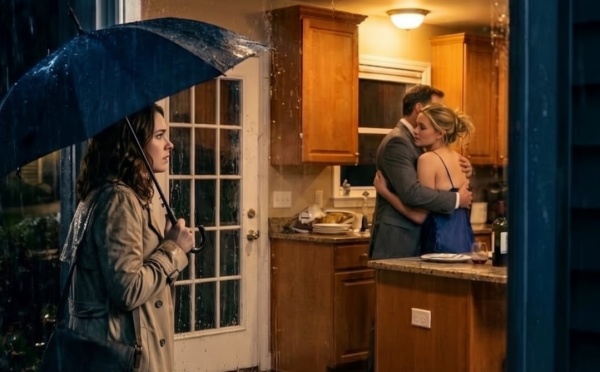
I Thought My Best Friend Was Helping Me Through My Marriage — Until I Saw Her in My Husband’s Arms
Rachel had been my best friend for twenty-two years. So when I saw her in my kitchen leaning back into my husband’s arms, my mind tried to reject what my heart already knew. Then she said, “She almost caught us,” and suddenly all the late texts, business trips, and private jokes I had ignored came rushing back. I had not just walked in on one terrible moment — I had stepped into the hidden version of my marriage that everyone but me seemed to know…
PART I — THE KITCHEN LIGHT
Rachel had been my best friend for twenty-two years, the woman who held my hand through grief, loss, and every hard season of my marriage.
So when I saw her in my kitchen leaning back into my husband’s arms, my mind tried to reject what my heart already knew.
It was 9:17 p.m. on a Thursday in late October, and the porch light of our house in Westfield, New Jersey was still off because I was not supposed to be home yet. My husband, Nathan Carter, thought I was stuck in Philadelphia overnight after a conference panel ran late. Rachel thought so too, because I had texted her at 6:40 p.m. complaining about traffic on the Pennsylvania Turnpike.
But the panel had ended early.
A storm was moving in, my hotel lost power for nearly an hour, and something in me felt too tired to stay in a room that smelled like wet carpet and elevator disinfectant. So I drove the ninety miles home in the rain, thinking I would surprise Nathan, sleep in my own bed, and maybe wake up to a Saturday that felt less like we were politely sharing a mortgage and more like we were still married.
I parked down the block because a utility truck was blocking our driveway.
That was the only reason they did not hear my car.
Our kitchen windows faced the side yard, and the blinds were not fully closed. Warm light spilled onto the wet grass. Through the narrow gap between the slats, I saw Rachel first.
She was wearing my gray cashmere cardigan.
The one Nathan bought me for Christmas three years earlier.
Her hair was loose, falling over one shoulder, and she was laughing softly at something he said. Nathan stood behind her, his arms around her waist, his chin close to her temple. Not a friendly hug. Not a comforting embrace. Not two old friends sharing a tragic misunderstanding.
A familiar embrace.
A practiced one.
The kind bodies learn over time.
For a few seconds, I stood in the rain with my conference tote slipping off my shoulder, unable to understand why my best friend looked so natural inside my husband’s arms.
Then Rachel tilted her head back and said, clear enough for me to hear through the cracked kitchen window, “She almost caught us last week.”
Nathan laughed under his breath.
“She never suspects you.”
That sentence did not break my heart all at once.
It opened a door.
Behind it were two years of late-night texts, sudden business trips, Rachel stopping by “just to check on me,” Nathan smiling at his phone in the dark, private jokes that went quiet when I entered the room, and the way both of them had always seemed to know what the other wanted for dinner before I did.
My name is Lauren Carter. I was forty-one years old then, a high school English teacher, married for fifteen years, childless not by choice, and loyal to people long after loyalty had become self-harm.
Rachel Monroe and I met freshman year at Rutgers University.
She lived across the hall from me in a dorm that smelled like microwave popcorn and cheap laundry detergent. I was shy, homesick, and terrified everyone could tell I was there on scholarships and part-time jobs. Rachel was loud, funny, effortlessly charming, and the kind of girl who could walk into a dining hall alone and leave with six new friends.
She chose me anyway.
That was how I used to describe it.
She chose me.
She dragged me to parties, edited my essays, taught me how to use eyeliner, and sat with me in the emergency room when my father had his first heart attack during sophomore year. She was beside me when he died six years later. She stood next to me in a dark green dress at my wedding and cried harder than my mother.
When Nathan and I struggled with infertility, Rachel was the one who brought groceries, drove me home from appointments, and held me on our bathroom floor after the second failed IVF cycle.
When my mother moved into assisted living in Morristown, Rachel helped me pack the house.
When my marriage became quiet and brittle, Rachel told me every relationship had seasons.
“Don’t give up too fast,” she would say. “Nathan loves you. He’s just not good at showing things when he’s stressed.”
I believed her because she had always been my witness.
I did not know she was also his alibi.
Standing outside my own kitchen that night, rain soaking through my blazer, I watched Nathan kiss the side of her neck.
Rachel closed her eyes.
My body finally moved before my mind did.
I walked to the back door and opened it with my key.
They separated so fast Rachel knocked over a wineglass on the island.
It shattered against the hardwood floor.
Nathan stared at me like I had walked in holding a weapon instead of a laptop bag and a dripping umbrella.
Rachel pulled my cardigan closed across her chest.
For one absurd second, all I could think was that she had stretched the sleeves.
No one spoke.
The rain behind me filled the silence.
Then Rachel said, “Lauren.”
Just my name.
Not an apology.
Not an explanation.
Just the sound she had made at funerals, hospitals, birthdays, graduations, and now at the scene of her own betrayal.
I looked at Nathan.
“How long?”
His mouth opened, but nothing came out.
I turned to Rachel.
“How long?”
She looked down at the broken glass.
That was when I knew it was not weeks.
Not a mistake.
Not a terrible moment.
Nathan finally said, “We need to sit down.”
I almost laughed.
Of course he wanted to sit.
Men like Nathan always want chairs for consequences.
“No,” I said. “You’re going to answer me standing.”
Rachel’s eyes filled with tears.
“Lauren, it’s complicated.”
That sentence did something strange to me.
It steadied me.
Because complicated was the word people used when they wanted sympathy for a betrayal they had organized.
“No,” I said quietly. “My father dying was complicated. Infertility was complicated. My mother forgetting my name is complicated. This is not complicated. This is cruel.”
Nathan flinched.
Rachel started crying then, one hand over her mouth, as if she had stumbled into pain instead of building a home inside mine.
I set my bag on the bench by the back door.
My hands were shaking, but my voice did not.
“Get out.”
Rachel looked at Nathan.
That hurt more than I expected.
Even then, she looked to him first.
“Lauren,” Nathan said, “don’t do this.”
“Don’t do what? Interrupt?”
He swallowed.
“I mean don’t make decisions while you’re in shock.”
“You made decisions while I was at funerals, doctors’ offices, parent-teacher conferences, and hotel rooms. I think I can make one in my kitchen.”
Rachel whispered, “I’m sorry.”
I looked at her wearing my sweater, standing beside my husband, crying on the floor where I had fed her soup when her divorce became final.
“No,” I said. “You’re caught.”
Her face crumpled.
“That’s not the same thing.”
I stepped aside from the door.
“Take off my cardigan before you leave.”
For a moment, no one moved.
Then Rachel slowly removed it, folded it out of reflex, and placed it on the counter like she still knew how to behave in my house.
She walked past me without meeting my eyes.
The woman who had once slept beside me on a hospital waiting room floor left through my back door in the rain, carrying her purse and twenty-two years of my trust with her.
Nathan stayed.
He looked at me as if we were about to begin a difficult conversation.
But I had already begun something else.
I picked up my phone, opened the camera, and took pictures of the broken wineglass, the two glasses on the island, Rachel’s lipstick on the rim, her coat over the chair, and the cardigan on the counter.
Nathan’s face changed.
“What are you doing?”
“Remembering accurately.”
“Lauren, come on.”
I photographed the second place setting, the half-eaten pasta, the candle burning beside the sink.
“This is our private life,” he said.
I looked at him then.
“No. This was my private life. You invited an audience.”
PART II — THE BEST FRIEND WHO KNEW WHERE TO HURT ME
I slept in the guest room that night.
Actually, I did not sleep.
I locked the door, sat on the floor with my back against the bed, and watched my phone light up with messages from both of them.
Nathan’s came first.
Please let me explain.
This isn’t how I wanted you to find out.
Rachel didn’t mean to hurt you.
That one made me put the phone face down for ten minutes.
Rachel did not mean to hurt me.
As if hurt were a weather pattern instead of the direct result of choices.
Rachel’s messages began at 10:04 p.m.
Please talk to me.
I know you hate me. You have every right.
I never stopped loving you as my friend.
I stared at that last sentence until the words lost meaning.
Because in one sense, maybe she believed it.
Maybe Rachel had created a version of love flexible enough to include comforting me through my loneliness while causing it. Maybe she believed friendship and betrayal could occupy separate rooms if she kept the doors closed.
That was what made it worse.
A stranger would not have known where the doors were.
Rachel knew everything.
She knew how badly I wanted a family. She knew Nathan and I had spent nearly $42,000 out of pocket on fertility treatments after insurance limits ran out. She knew about the miscarriage at nine weeks that I did not tell my department chair about because I could not bear condolences in the teacher’s lounge.
She knew Nathan stopped touching me after the second failed IVF cycle.
She knew I blamed myself.
She knew I wondered whether he resented me.
She knew because I told her.
On her couch.
Over coffee.
In whispered phone calls from school parking lots.
And the whole time, she was in his arms.
By 1:00 a.m., I had made a list.
Not an emotional list.
A factual one.
Dates Nathan was “traveling.”
Dates Rachel came over unusually late.
Receipts I remembered.
Times Rachel repeated phrases Nathan had used as if she had heard them from me, though I knew I had never said them aloud.
At 2:20 a.m., I checked our shared credit card account.
There it was.
A hotel in Princeton charged on a Friday Nathan claimed he had attended a commercial real estate seminar and stayed over because of weather. Dinner for two at a restaurant I had never been to. A jewelry store purchase in Short Hills two weeks before Rachel’s birthday.
My stomach turned.
At 3:05 a.m., I emailed screenshots to myself.
At 3:30, I sent a message to Mara Feldman, a family law attorney in Montclair whose name I had saved years earlier after helping a colleague through her divorce.
I need a consultation. Urgent. Husband having affair with my best friend. Possible financial issues.
She replied at 7:12 a.m.
I can speak at 9:00. Are you safe?
That question made me cry.
Not because I feared Nathan would hurt me physically. He had never been violent, never threatened me, never raised a hand. But safety suddenly meant more than locks.
Was I emotionally safe?
Financially safe?
Legally safe?
Was I safe from people who knew my wounds well enough to press them and call it love?
At 8:15 a.m., Nathan knocked on the guest room door.
“Lauren?”
I did not answer.
“I called in sick,” he said. “We need to talk.”
I opened the door because avoiding him inside a house we both owned was not a plan.
He looked terrible.
I hated that I noticed.
His eyes were swollen. His hair was messy. He wore the Rutgers sweatshirt I bought him our first Christmas together. The manipulation may not have been intentional, but the effect landed anyway.
“How long?” I asked.
He sat on the edge of the hallway bench.
“Lauren—”
“How long?”
He closed his eyes.
“Almost two years.”
The floor seemed to tilt.
Two years.
Two birthdays.
Two Christmases.
My mother’s diagnosis.
Our last IVF consult.
My 40th birthday weekend in Cape May, where Rachel had joined us because Nathan said a group trip would be “less pressure.”
I leaned against the doorframe.
“Did she come to Cape May because of you?”
He looked down.
I covered my mouth.
Not to stop myself from crying.
To stop myself from being sick.
“Nothing happened that weekend,” he said quickly.
“But you wanted it to.”
He did not deny it.
I thought of Rachel helping me choose a dress for dinner that night, zipping me up, telling me I looked beautiful, then sitting across from my husband at a candlelit table making him laugh in a way I had not heard from him in months.
“How could you let her comfort me?” I asked.
Nathan looked genuinely ashamed then.
That somehow made me angrier.
“Sometimes she was the only person you would listen to,” he said.
I stared at him.
“You used her to manage me.”
“No. That’s not what I meant.”
“Yes, it is.”
And suddenly I saw the machinery.
Whenever I questioned Nathan’s distance, Rachel told me he was depressed.
Whenever I wondered if he was lying, Rachel reminded me stress made people secretive.
Whenever I considered leaving, Rachel told me not to make decisions from pain.
She had not just betrayed me.
She had kept me in place.
My phone rang at 9:00.
Mara Feldman.
I stepped into the guest room and answered while Nathan sat outside the door.
Mara listened without interrupting as I told her what happened.
When I finished, she said, “New Jersey is a no-fault divorce state. The affair itself may not determine property division. But financial records matter. If marital funds were used for the affair, gifts, hotels, travel, or anything similar, we can address that. Do not move money impulsively. Do not post about this. Preserve evidence. Communicate in writing when possible.”
“What if he deletes things?”
“Assume he might,” she said. “Save what you legally have access to now.”
“What about Rachel?”
“Do not threaten her. Do not contact her while emotions are high. If she has relevant information, we can obtain it properly.”
I almost laughed at the calmness of it.
Properly.
My life had been gutted in my kitchen, and the answer was folders.
But folders were something I could do.
By noon, I had copied bank statements, credit card bills, tax returns, mortgage documents, retirement account summaries, and receipts from shared accounts. I photographed Rachel’s cardigan on the counter before placing it in a box. I saved every text she sent me.
At 1:30 p.m., Rachel appeared at the front door.
I watched her through the camera.
She had no umbrella.
Her face was red from crying.
For one second, twenty-two years rose inside me like muscle memory. I wanted to open the door. I wanted to ask if she had eaten. I wanted to make the pain stop by pretending there was still someone on the other side worth saving.
Then she pressed the doorbell again and texted:
Please. I need my best friend.
I looked at the message for a long time.
Then I typed back:
You should have thought about that before you became my husband’s affair partner. Do not come to my house again.
She stepped back as if I had slapped her.
Then she left.
Nathan watched from the hallway.
“That was harsh,” he said.
I turned slowly.
“Harsh?”
He seemed to realize too late what he had said.
“Lauren, I just mean—”
“No. Keep talking. I want to hear how I should be gentler with the woman you brought into our kitchen.”
He said nothing.
That was the first smart thing he had done in twelve hours.
PART III — THE HIDDEN VERSION OF MY MARRIAGE
The hidden version of my marriage did not reveal itself all at once.
It arrived in pieces.
A dinner receipt.
A hotel folio.
A Venmo payment Nathan forgot was public.
A photo Rachel’s sister had posted months earlier from a backyard barbecue where Nathan stood in the background, half cropped out, wearing the shirt he told me he had packed for a business trip to Boston.
Every discovery hurt, but not equally.
Some were sharp.
Some were humiliating.
Some were almost absurd.
There was a charge for two tickets to a Broadway revival I had begged Nathan to see with me. He said he hated sitting through musicals. Apparently, he hated sitting through them with me.
There was a weekend rental in the Poconos during the same weekend Rachel told me she was visiting her aunt in Connecticut and Nathan claimed he was at a leadership retreat.
There was a $1,180 bracelet from a store in Short Hills.
My birthday gift that year had been a Kindle case.
Not because I needed expensive gifts.
Because the contrast told a story.
Mara called it dissipation.
I called it proof that I had been living inside a budget while he was financing a fantasy.
The worst part came from my own messages with Rachel.
I searched her name in my phone and scrolled back through two years of friendship that now read like evidence.
Me: He’s distant again. I don’t know what I’m doing wrong.
Rachel: You’re not doing anything wrong. He shuts down when he’s overwhelmed. Give him a little grace.
Me: I feel like he doesn’t want me anymore.
Rachel: He loves you. Don’t spiral.
Me: Sometimes I think he’s hiding something.
Rachel: Lauren, I say this with love: your anxiety is looking for a target.
That one made me sit down on the bathroom floor.
Your anxiety is looking for a target.
She had not just lied.
She had taught me to mistrust my instincts so she could keep access to my life.
I printed the messages.
Mara’s assistant created a digital evidence folder labeled Timeline and Financial Concerns.
There is something both horrible and healing about turning pain into records. Horrible because every receipt makes denial harder. Healing because truth becomes less dependent on memory, and memory is fragile when people have spent years bending it.
Nathan moved into the basement “temporarily.”
He asked for marriage counseling.
I asked whether he had ended the affair.
He said yes.
Rachel texted him fourteen times the next day.
I knew because his Apple Watch lit up while he was in the shower and I saw her name.
I did not open it.
I did not need to.
That evening, I told him he had to leave.
“This is my house too,” he said.
“Yes,” I replied. “And Mara says I cannot force you out without legal steps unless there’s a safety issue. But I can tell you that if you stay, every conversation will be in writing, and I will not pretend we’re working on the marriage while you’re still emotionally managing your exit.”
He stared at me.
“You’ve changed.”
That sentence almost broke me.
Not because it was cruel.
Because it was true.
“I finally have accurate information,” I said.
He moved into a corporate apartment in Summit three days later.
Neighbors noticed.
Of course they did.
Suburban streets are built for surveillance disguised as concern.
Mrs. Donnelly from two houses down brought banana bread and said, “Everything okay with Nathan?”
I smiled.
“We’re dealing with some private family matters.”
That phrase became my shield.
Private family matters.
It worked until Rachel started talking.
She did not post publicly. She was smarter than that. But she told mutual friends a softer version.
She said she and Nathan had “fallen in love during a painful season.”
She said my marriage had been “over emotionally for years.”
She said she had tried to support me but could no longer deny her own happiness.
That language reached me through friends who did not know whether to warn me or perform neutrality.
Neutrality became its own betrayal.
People who had eaten at my table suddenly wanted to avoid taking sides, as if one side had not been my husband and best friend lying to my face while discussing my anxiety like a household inconvenience.
The first friend I lost was Monica Blake.
She called and said, “I love you, but I don’t want to be in the middle.”
“You’re not in the middle,” I said. “You’re on the edge, choosing whether to look.”
“That’s not fair.”
“No,” I replied. “It isn’t.”
By Thanksgiving, the social circle had rearranged itself.
Some people disappeared.
Some sent casseroles.
Some quietly confessed they had suspected something.
That last group hurt the most.
“How long?” I asked one woman, Allison, who had hosted Rachel and me for book club for years.
She cried.
“I didn’t know. I just thought their energy was weird.”
“When?”
She looked at her hands.
“Last Christmas.”
Last Christmas.
At my house.
When Rachel wore red velvet and Nathan carved the turkey.
I thanked Allison for telling me, then hung up and vomited in the kitchen sink.
The hidden version of my marriage had been visible to other people in fragments.
No one had loved me enough to assemble them aloud.
Or maybe they had feared being wrong.
That is the charitable interpretation.
Some days I could believe it.
Other days I could not.
PART IV — THE COST OF A TWENTY-TWO-YEAR FRIENDSHIP
Divorce paperwork was filed in January in Union County Superior Court.
Nathan responded through counsel, which made everything both colder and easier.
The complaint cited irreconcilable differences. New Jersey did not need the entire ugly story to begin dissolving the legal structure of our marriage. But behind the official language, Mara pursued the financial truth.
Hotel charges.
Travel expenses.
Gifts.
Restaurant bills.
The Poconos rental.
The Broadway tickets.
The bracelet.
Nathan’s attorney argued that these were “minor discretionary expenses” in the context of a fifteen-year marriage.
Mara did not raise her voice.
“Then your client should have no objection to reimbursing the marital estate for them.”
I loved her for that.
The total was not life-changing compared to our home equity and retirement accounts, but it mattered. Not because I needed every dollar back. Because money is how secret lives become measurable.
Nathan eventually agreed to account for a portion of the spending in the settlement.
He hated that.
He wanted the divorce to be about emotions, because emotions could be framed as mutual failure. Financial records were less cooperative.
Rachel was not part of the divorce legally, not in the way people imagine from movies. There was no dramatic courtroom scene where she took the stand in tears while I destroyed her with one perfect question. Real life is more paperwork and fewer speeches.
But she became part of the consequences anyway.
Her ex-husband heard.
Her sister stopped speaking to her for months.
Our old college group fractured around the story.
Then, in March, Rachel sent me a letter.
A real letter.
Four pages, handwritten on cream stationery, because Rachel always knew how to make things look meaningful.
She wrote that she hated herself.
She wrote that it had started as emotional closeness after her divorce.
She wrote that Nathan understood her loneliness and she understood his sadness over our infertility.
That sentence made my vision blur.
Our infertility.
As if it belonged to him and not the body I had injected, tested, monitored, blamed, and mourned.
She wrote that she never meant to replace me.
She wrote that she missed her best friend every day.
I read the letter once.
Then I placed it in a drawer for three days.
On the fourth day, I wrote back.
Not four pages.
Four sentences.
Rachel, you were not a stranger who fell in love with my husband. You were the person I trusted with the pain you used to justify betraying me. I hope you become honest enough someday to understand the difference. Do not contact me again.
I mailed it before I could soften it.
For weeks afterward, I grieved her harder than Nathan.
That surprised people.
It surprised me too.
But Nathan had been my husband for fifteen years. Rachel had been part of my identity for twenty-two. She knew the girl I was before marriage, before infertility, before my mother’s illness, before life became a series of appointments and compromises.
Losing her felt like losing the witness to my own history.
My therapist, Dr. Lena Ortiz, helped me understand why the grief felt so disorienting.
“You are not only mourning the friend,” she said. “You are mourning the version of yourself who believed that friendship was safe.”
That was exactly it.
After Rachel, every kindness looked suspicious for a while.
When a coworker invited me to coffee, I wondered what she wanted.
When a neighbor offered to help carry groceries, I heard pity.
When my sister-in-law sent flowers, I checked the card twice for hidden meanings.
Betrayal does not end when the people leave.
It lingers as a new operating system.
You become efficient.
Alert.
Hard to surprise.
Harder to comfort.
Spring came slowly that year.
I returned to teaching after winter break because teenagers, for all their chaos, were easier than adults. My students still needed help with essays, still complained about Shakespeare, still believed prom drama was the highest form of human suffering. Their normal problems steadied me.
In April, my mother had a lucid afternoon.
I visited her at the memory care facility after school, carrying tulips from Trader Joe’s. She looked at me and said, clearly, “Laurie, you look tired.”
I sat beside her and took her hand.
“I am, Mom.”
“Is Nathan being good to you?”
The question landed like a stone.
For a second, I considered lying.
Then I said, “No.”
Her fingers tightened around mine.
She looked toward the window, where rain streaked softly down the glass.
“Then don’t give him the rest of you,” she said.
Five minutes later, she asked whether my father was coming for dinner.
But the sentence stayed.
Don’t give him the rest of you.
So I stopped.
I stopped reading Rachel’s old messages.
I stopped checking Nathan’s social media.
I stopped asking mutual friends what they had heard.
I stopped trying to understand how two people I loved could do something unforgivable and still believe themselves wounded.
Some questions are traps disguised as healing.
PART V — THE ROOM I DIDN’T ENTER
The divorce finalized the following October, almost exactly one year after I came home early and saw Rachel in my kitchen.
I kept the house after refinancing it in my name.
That surprised me.
For months, I thought I would need to sell it because every room held a memory I did not trust anymore. But one Saturday in June, I painted the kitchen walls a deep green, replaced the island stools, and donated every wineglass from the set that had shattered that night.
The house began changing because I did.
Nathan took his furniture from the basement, his golf clubs, his suits, half the holiday decorations, and a box of framed photos I did not want. We divided retirement accounts through proper court orders. We split savings. We negotiated the home equity.
It was not clean.
It was not friendly.
But it ended.
Two weeks after the divorce was final, I received an invitation to Rachel’s birthday dinner.
Not from Rachel.
From an automated group reservation link someone forgot to remove me from.
The dinner was at a restaurant in Hoboken.
Twelve guests.
Nathan Carter listed as attending.
For ten full minutes, I stared at the screen and imagined walking in.
I imagined Rachel’s face going pale.
I imagined Nathan standing too quickly.
I imagined saying something devastating, elegant, unforgettable.
Then I pictured myself driving home afterward with shaking hands, having handed them another piece of my life.
I declined the invitation.
Reason: No longer part of this group.
Then I closed the laptop and made soup.
That was not a dramatic victory.
But it was a real one.
A year earlier, I would have walked into pain just to prove I could survive it.
Now I understood survival did not require attendance.
In December, I hosted a small dinner for people who had shown up without demanding performance from me.
My sister.
Two coworkers.
Mara, who insisted she did not usually attend clients’ dinners but made an exception because my lasagna had become “legally relevant to morale.”
Allison came too, nervous but sincere, after months of making amends without rushing my forgiveness.
We ate in the kitchen.
The same kitchen.
The green walls glowed under warm lights. Rain tapped gently against the windows. Someone opened a bottle of wine, and for one brief second, the sound of glass on the counter pulled me back to that October night.
Then my sister reached over and squeezed my hand.
I returned to the room I had chosen.
That is what healing felt like for me.
Not forgetting.
Not forgiving on schedule.
Not turning betrayal into a neat inspirational quote.
Healing was learning I could stand in the same kitchen where my life cracked open and not feel like a ghost haunting someone else’s story.
Months later, I saw Rachel once.
It happened at a bookstore in Montclair.
She was standing near the new fiction table, holding a novel I had recommended to her years earlier. Nathan was not with her. She looked thinner, older, less polished, and for a moment I felt the old reflex rise again.
Ask if she’s okay.
Ask about her mother.
Ask whether she still reads the last chapter first.
She saw me.
Neither of us moved.
Then she said, softly, “Lauren.”
I nodded once.
Not warmly.
Not cruelly.
Just acknowledgment.
She looked like she wanted to say more, but I turned and walked to the register.
Outside, I sat in my car for a few minutes before starting the engine. My heart was racing, but I was not undone. That mattered.
I drove home without calling anyone.
That mattered too.
Nathan emailed me once around that same time.
He said he was sorry.
Not the frantic apology of a man caught in the kitchen. A quieter one. He wrote that he had minimized my pain because admitting its size meant facing who he had become. He wrote that he and Rachel were no longer together.
I read the email twice.
Then I archived it.
Some women might have felt satisfaction.
I mostly felt tired.
Their relationship ending did not restore what they took. It did not give me back the years I doubted myself, the friendship I lost, or the version of marriage I thought I had.
But it did confirm something I had slowly learned.
A relationship built in the hiding places of someone else’s life often cannot survive daylight.
People ask sometimes whether I miss Rachel.
The honest answer is yes.
Not the real Rachel, maybe.
The Rachel I thought existed.
I miss the girl in the Rutgers dorm who pulled me into the world when I was lonely. I miss the woman who knew my father’s favorite song, my coffee order, the names I had imagined for children I never had. I miss having someone who could read my face across a crowded room.
But I do not confuse missing her with needing her back.
That distinction took therapy, legal fees, sleepless nights, and a kitchen full of ghosts.
As for Nathan, I miss him less.
That sounds harsh, but it is true.
By the time I saw him with Rachel, I had already been lonely beside him for years. Losing him was painful, but it was also like setting down a heavy bag I had forgotten I was carrying.
The greater shock was realizing my loneliness had been curated by two people who kept telling me to be patient.
Now, my life is quieter.
I teach.
I visit my mother.
I take long walks in Echo Lake Park.
I bought new wineglasses, not because I drink much wine, but because I wanted a set with no history.
Sometimes on rainy nights, I still remember standing outside the kitchen window, seeing Rachel lean back into Nathan’s arms.
I remember her saying, “She almost caught us.”
For a long time, that sentence haunted me.
Now another sentence answers it.
She did catch you.
Not just in an embrace.
Not just in a lie.
She caught the truth that had been living under her own roof, wearing friendship’s face and speaking in her husband’s voice.
I thought my best friend was helping me through my marriage.
She was helping my husband keep me inside it until they were ready to leave on their terms.
But they miscalculated one thing.
They thought my trust made me weak.
It did not.
It meant I had loved honestly.
And when honesty finally became impossible to avoid, I was the only one who knew how to stand in it without hiding.
That night, I walked into my kitchen and lost my husband, my best friend, and the story I had been telling myself for years.
But I found something too.
My own voice.
My own instincts.
My own life, waiting beneath all the lies.
And this time, when the room went silent, I did not ask either of them what was true.
I already knew.
