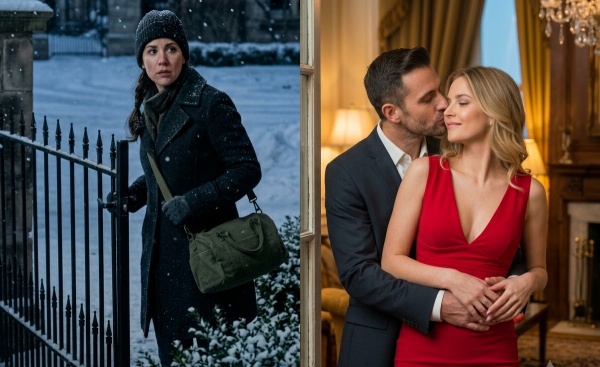
At 12:17 a.m., I watched my husband kiss the woman he swore was no longer part of his life. I didn’t confront him, because something about the way she stood inside our gated estate told me this wasn’t just betrayal—it was a plan. Before sunrise, I packed one bag and slipped toward the only exit I thought I could use, but then I saw the security camera above the door was already dark. Someone had disabled it before I ever decided to leave.
PART I — THE WINDOW AT 12:17 A.M.
At 12:17 a.m., I stood barefoot behind the velvet curtains of my husband’s second-floor library and watched him kiss the woman he had spent five years telling me was buried in his past.
My name is Evelyn Hartwell, thirty-seven years old, former acquisitions director for a boutique publishing house in Chicago, and for the past five years, wife to Nathaniel Hartwell, a forty-four-year-old venture capitalist whose family estate sat behind iron gates on three private acres in Lake Forest, Illinois.
The house was the kind of place people called “historic” when they meant intimidating. Limestone walls, black shutters, surveillance cameras tucked discreetly beneath copper gutters, a gated driveway long enough to make visitors feel small before they ever reached the front door. Nathaniel liked to call it a sanctuary, but I had started thinking of it as a fortress.
That night, snow had begun falling lightly over the lawn, covering the hedges and stone fountain in a thin white layer that made the entire property look staged, almost peaceful.
I had gone downstairs for chamomile tea because I could not sleep. Nathaniel had told me he was working late in his study, taking calls with investors on the West Coast. I had believed him because, until that moment, believing him had still seemed easier than questioning every polished explanation he gave me.
Then I heard a laugh from the east terrace.
Not loud. Not careless. A soft, familiar laugh from a woman who sounded entirely too comfortable standing outside my home after midnight.
I moved toward the library windows because they overlooked the terrace below. The curtains were half closed, and through the narrow gap, I saw Nathaniel standing beneath the outdoor heater, still wearing the navy sweater he had worn at dinner. Across from him stood Marissa Vale.
For one absurd second, my mind refused to understand what my eyes were seeing.
Marissa Vale was not supposed to exist in our life anymore.
She was Nathaniel’s former fiancée, the woman who had left him eight years earlier after what he described as “a difficult emotional chapter.” He had told me she moved to California, remarried, and became irrelevant to him before I ever arrived. Her name had come up only twice in our marriage, both times because someone else mentioned her at a fundraiser and Nathaniel went cold enough to change the temperature of the room.
Yet there she was, standing on our terrace at 12:17 a.m., wearing a long camel coat and leather gloves, looking up at my husband as if she had never truly left him at all.
Nathaniel reached for her face first.
That detail mattered later, when I tried to avoid blaming myself for misunderstanding what happened. He stepped toward her, not the other way around. He cupped her cheek with the gentleness he had not used with me in months, and then he kissed her.
I did not gasp.
I did not throw open the window.
I did not run downstairs demanding answers.
Something colder than shock moved through me, something sharper and steadier. Maybe because I had spent the last year ignoring the feeling that my marriage was becoming a room with no exits. Maybe because some part of me had been waiting for proof that my unease was not irrational.
I watched them for maybe ten seconds, though it felt like an entire season of my life passed in that narrow strip of window.
Then Marissa stepped back and said something I could not hear. Nathaniel looked toward the house, not at my window exactly, but close enough that I felt my lungs stop working. I backed away from the curtain and pressed my hand over my mouth, not because I was about to cry, but because I suddenly understood something very important.
If Nathaniel had hidden Marissa from me, he had hidden other things too.
And if she was standing on the terrace of our gated estate after midnight, she had not arrived there by accident.
I went back to our bedroom quietly, every step measured, every floorboard avoided by memory. The bedroom was enormous, decorated in muted grays and creams by an interior designer who had never once asked me what colors made me feel at home. Nathaniel’s side of the bed was untouched.
I stood in the closet beneath the soft automatic lights and stared at my clothes.
For five years, I had lived inside Nathaniel’s world. His house. His staff. His schedule. His lawyers. His security system. His version of every story.
I pulled a small overnight bag from the top shelf.
I packed deliberately: two pairs of jeans, three sweaters, underwear, my passport, my Social Security card, the jewelry that had belonged to my grandmother, and the slim leather folder where I kept copies of documents Nathaniel never remembered I had duplicated.
Then I opened the small safe behind my shoe shelves.
Nathaniel thought I did not know the code. That was one of his more insulting assumptions. He used the same six digits for everything: the month and year Hartwell Capital closed its first major deal.
Inside were my emergency cash envelope, an external hard drive, and a sealed packet from my attorney, Rebecca Sloan, whom I had consulted quietly six weeks earlier after Nathaniel suggested I sign a “postnuptial clarification” his legal team had prepared.
I had not signed it.
Instead, I had taken it to Rebecca.
She read the document for twenty minutes in silence, then looked up and said, “Evelyn, this isn’t clarification. This is containment.”
That word returned to me now as I placed the packet into my bag.
Containment.
The estate, the cameras, the staff, the accounts Nathaniel monitored, the way he always knew which friends I had lunch with before I mentioned them. It all came together with sickening clarity.
I was not just a wife who had discovered an affair.
I was a woman inside a system designed to keep her manageable.
And before sunrise, I intended to be gone.
PART II — THE HOUSE THAT WATCHED EVERYTHING
Leaving the Hartwell estate was not as simple as walking out the front door.
Nathaniel had built his life around control, and the house reflected that obsession in every polished surface. There were cameras covering the driveway, the front gate, the garage, the side garden, the terrace, the mudroom entrance, and the hallway leading toward the back stairs. He always said it was because people with money had to be careful.
I used to believe that.
Then I noticed how often security became his excuse for knowing things he should not know.
If I drove to Evanston to visit my friend Laura, Nathaniel would ask over dinner whether traffic on Sheridan Road had been bad. If I ordered something online, he somehow knew before the box reached the front hall. If I took a call outside, he would appear ten minutes later asking if everything was okay, his concern polished enough to make suspicion feel rude.
The estate had a security office near the garage, managed by a private firm Nathaniel retained for “property monitoring.” Most nights, one guard sat there until 2:00 a.m., then switched the system to remote monitoring. But on Wednesdays, the overnight guard did a patrol rotation between 3:30 and 4:00.
I knew that because I had spent six weeks preparing for the possibility that I might need to leave quickly.
At the time, it had felt paranoid.
Now it felt like survival.
I waited until 3:42 a.m.
Nathaniel had come upstairs around 1:10, showered in the guest bathroom, and climbed into bed beside me as if nothing had happened. I kept my breathing slow and even, one hand beneath the pillow, my eyes closed while every nerve in my body screamed. He smelled faintly of winter air and Marissa’s perfume.
When his breathing deepened, I waited another hour.
Then I got up.
I dressed in black leggings, a wool sweater, boots, and my long down coat. I left my wedding ring on the vanity, not dramatically placed, not with a note. Just there, beside the sink, as if it had become too heavy to carry.
My bag was already hidden inside the laundry room cabinet near the back stairs.
I took the servants’ corridor because it had fewer motion sensors and led toward the mudroom exit near the greenhouse. That door opened onto a stone path screened from the main driveway by tall arborvitae. From there, I could cross to the old garden gate, walk half a mile to the service road, and call a rideshare from the gas station near Waukegan Road.
I had planned this route in theory.
Living it felt entirely different.
The house was silent except for the hum of heating vents and the faint creak of old wood settling in the cold. I kept one hand on the wall as I moved through the dark corridor, not because I needed balance, but because I needed proof that I was still moving forward.
At the mudroom, I stopped.
Above the exit door, mounted in the corner near the ceiling, was camera E-4, the one covering the greenhouse path. It had a tiny red status light that glowed whenever the camera was active. I had noticed it dozens of times.
That red light was off.
I stared at it, my hand frozen on the door handle.
At first, I thought perhaps the angle of the hallway shadow made it look dark. I took one cautious step closer and looked directly up at the camera. No red light. No quiet mechanical adjustment. Nothing.
Camera E-4 was disabled.
My first reaction should have been relief. A disabled camera meant I could leave without Nathaniel seeing the exact moment I exited. But relief never came.
Because I had not disabled it.
I had not told anyone I was leaving.
I had not even decided, truly decided, until 12:17 a.m.
Yet someone had shut off the camera protecting my exit before I ever stepped into that hallway.
The realization moved through me like cold water.
Someone else knew I would need that exit.
Or someone else wanted that exit unrecorded.
I reached slowly into my coat pocket and pulled out my phone. No missed calls. No messages. The Wi-Fi was still connected, though weak near the mudroom. I opened the security app Nathaniel had installed on my phone “for emergencies,” expecting it to deny me access as it usually did for advanced settings.
Instead, the feed page loaded.
Camera E-4 showed a gray screen with a timestamp frozen at 2:31 a.m.
The last recorded image was the empty mudroom door.
No malfunction alert.
No system-wide outage.
Only one camera offline.
I took a screenshot.
Then another.
Then I heard something from the direction of the garage.
Not footsteps exactly. A soft metallic sound, like a latch shifting or a key ring brushing against a door.
I did not wait to learn more.
I opened the mudroom door and stepped into the freezing dark.
The cold hit my face so hard my eyes watered instantly. Snow crunched under my boots as I moved quickly down the path, keeping close to the hedge line. The greenhouse loomed to my left, glass panels black in the moonless morning.
Halfway to the garden gate, I looked back.
A figure stood in the mudroom doorway.
Tall. Still. Watching.
I could not see the face.
For one terrifying second, I thought it was Nathaniel.
Then the figure raised one hand—not to stop me, not to wave exactly, but to signal something.
Go.
My heart hammered so hard I could barely breathe.
The figure stepped back into the house and closed the door.
The garden gate was unlocked.
That was wrong too.
Nathaniel kept every exterior gate coded and alarmed after midnight. The service gate required a four-digit keypad entry, and if opened incorrectly, security received an alert. But when I pressed the latch, it gave way silently.
Someone had not only disabled the camera.
Someone had opened the path.
I ran.
PART III — THE WOMAN AT THE GAS STATION
By the time I reached the gas station on Waukegan Road, my lungs burned from the cold and my hands were shaking so badly I could barely unlock my phone.
The station was open twenty-four hours, harsh fluorescent lights spilling across wet pavement, the kind of place that felt both exposed and safe because nobody expected secrets under lighting that ugly. A clerk behind the counter glanced at me as I entered, then looked back down at his phone.
I moved to the far aisle near the coffee machines and ordered a rideshare to Laura’s apartment in Evanston.
The driver was nineteen minutes away.
Nineteen minutes felt impossible.
I bought a bottle of water I did not want, mostly to justify standing inside. Then my phone buzzed with a message from an unknown number.
Don’t go to Laura’s. He’ll check there first.
I nearly dropped the phone.
A second message arrived.
Use the cash. Take a cab from the train station. Go somewhere he doesn’t know.
I looked around the gas station. The clerk. A man filling coffee. A woman buying lottery tickets. Nobody was looking at me.
My fingers hovered over the screen.
Who is this?
The answer came ten seconds later.
Someone who should have warned you sooner.
I stared at those words until they blurred.
The rideshare driver’s arrival time ticked down from nineteen minutes to seventeen. I canceled the ride.
Then I walked out of the gas station and headed toward the Lake Forest Metra station, half a mile away, pulling my hood low against the snow. Every car that passed made my shoulders tense. Every pair of headlights looked like it might slow beside me.
At 4:38 a.m., I reached the station platform.
The first train to Chicago would not arrive for nearly forty minutes, but there was a taxi idling near the curb, the driver smoking beside the open door. I asked if he took cash. He looked at my bag, my pale face, my too-expensive coat, and nodded without asking questions.
“Where to?”
I almost said Laura’s.
Instead, I gave him the address of the Palmer House Hilton downtown, a hotel Nathaniel hated because he said it was “tourist nostalgia pretending to be luxury.” That made it perfect.
As the taxi pulled away, my phone buzzed again.
Good. Keep moving. Don’t use your cards.
This time, I responded faster.
Were you the one at the door?
No answer.
Did you disable the camera?
Still no answer.
The city gradually appeared through the windshield as we drove south, the dark lake on one side, winter streets empty except for plows and delivery trucks. I watched Chicago emerge from the night like a witness that had seen too much and said too little.
At 5:41 a.m., I checked into the Palmer House using cash and the emergency ID I kept tucked behind my passport.
The woman at the front desk looked at me gently and asked if I needed anything else.
“A room where no one can call up asking for me,” I said.
Her expression changed, not dramatically, but enough to tell me she understood more than I had explained.
“Of course,” she said. “I’ll mark your reservation private.”
Inside the room, I locked the door, set the chain, pushed an armchair against it anyway, and sat on the edge of the bed with my coat still on.
Only then did I let myself shake.
Not cry. Not yet.
My body shook as if it had been waiting for permission since 12:17 a.m.
At 6:08, another message arrived.
He knows you’re gone. Do not answer him.
Ten seconds later, Nathaniel called.
Then again.
Then again.
By the fifth call, his texts started arriving.
Where are you?
Evelyn, this is childish. Come home.
We need to talk like adults.
If you’re at Laura’s, I’m coming there.
I took screenshots of everything and forwarded them to Rebecca Sloan.
She called within two minutes.
“Tell me where you are,” she said.
“A hotel downtown. I paid cash. Reservation is private.”
“Good. Are you physically safe?”
“I think so.”
“Did he threaten you?”
“Not directly. But someone disabled one of the security cameras before I left. Someone also unlocked the garden gate. Then someone started texting me instructions.”
Rebecca was silent for just long enough that my fear sharpened.
“Evelyn,” she said carefully, “do not respond to the unknown number again. Send me screenshots. I want you to preserve everything exactly as received. Do not delete anything.”
“Could it be Nathaniel?”
“It could be anyone,” she said. “Which means we treat it seriously.”
I sent her the screenshots.
While I waited, I opened my laptop and connected the external hard drive from my safe.
For the past six weeks, I had been copying documents from the estate office whenever Nathaniel left me alone near his files: account summaries, property deeds, trust statements, emails he printed and forgot to shred, notes from meetings with attorneys about the postnuptial agreement he wanted me to sign.
I thought I had been gathering financial protection.
Now I wondered if I had gathered evidence of something far more dangerous.
One folder stood out because I did not recognize it.
It was labeled M.V. HOLDINGS.
M.V.
Marissa Vale.
I opened it.
Inside were scanned wire transfers totaling $740,000 over fourteen months, routed through a consulting entity registered in Delaware. The payments were described vaguely: advisory fees, private placement review, strategic research. But attached to the final transfer was a memo from Nathaniel’s assistant, Graham, noting: Per N.H., ensure no household visibility. M.V. arrangement remains confidential until transition.
Transition.
The word sat on the screen like a blade.
I clicked the next document.
It was a draft property transfer agreement involving a condo in Streeterville, purchased through the same Delaware entity, with Marissa listed as beneficial occupant.
Nathaniel had not simply kissed a woman from his past.
He had been funding her life.
And someone inside that house had known enough to help me leave before I became part of whatever “transition” Nathaniel had planned next.
PART IV — THE PERSON WHO OPENED THE GATE
Rebecca arrived at the hotel at 8:30 a.m. with coffee, a second phone, and the calm expression of a woman who had spent twenty years helping people survive the moment their private lives became legal emergencies.
She reviewed the documents in silence, occasionally asking short questions.
“When did you first see this folder?”
“This morning.”
“Did he know you copied these files?”
“I don’t think so.”
“Did anyone else have access to the estate office?”
“His assistant, Graham. Security. Sometimes the house manager, Celia.”
Rebecca paused at the name Celia.
“Tell me about her.”
Celia Martin had managed the Hartwell estate for almost seven years. She was fifty-two, widowed, efficient to the point of invisibility, and one of the only people in that house who had never made me feel like a guest in my own marriage. She knew which teas I liked, which flowers gave me headaches, and how often Nathaniel canceled plans with me after promising he would change.
“She was there last night,” I said slowly. “She usually leaves by seven, but she stayed late because of the dinner party cleanup.”
“Could she access the security panel?”
“Yes. For service vendors and deliveries.”
Rebecca looked at me.
“And the garden gate?”
“Yes.”
My phone buzzed again.
Unknown number.
Room 714. Don’t open the door unless your lawyer is with you.
Rebecca saw my face change.
“What?”
I showed her.
She stood immediately and moved toward the peephole.
Nobody was there.
“Do not reply,” she said again.
But a minute later, the hotel room phone rang.
Rebecca picked it up instead of me.
“This is counsel for Ms. Hartwell,” she said sharply. “Identify yourself.”
A pause.
Then Rebecca’s expression changed.
She covered the receiver and mouthed one word.
Celia.
I felt my knees weaken.
Rebecca put the call on speaker.
“Mrs. Hartwell,” Celia’s voice said, quieter than I had ever heard it, “I’m sorry. I know I shouldn’t have contacted you this way, but I didn’t know who else in that house I could trust.”
“Celia,” I said, gripping the edge of the desk. “Were you the one who disabled the camera?”
“Yes.”
“And the gate?”
“Yes.”
“Why?”
Her breath trembled through the speaker.
“Because I heard Mr. Hartwell and Ms. Vale arguing in the wine room after you went upstairs. He told her the postnup wasn’t signed yet, but that it would be handled soon. She said she was tired of waiting. Then he said you had become ‘too aware’ and that after the holidays, arrangements would be made for you to spend time somewhere quiet until you became reasonable.”
The room seemed to tilt.
Rebecca’s face hardened instantly.
“Celia,” she said, “I need you to be very precise. Did he threaten physical harm?”
“No,” Celia said quickly. “Not directly. But it scared me. He mentioned a wellness retreat in Arizona. He said the right doctor could document exhaustion if needed. He said nobody would question it because Mrs. Hartwell had become anxious and unstable.”
I sat down before my legs gave out.
There it was.
Not violence. Something cleaner. Something more socially acceptable. A narrative. A legal and medical cage built out of concern.
Rebecca’s voice remained controlled.
“Did you record this conversation?”
“No. I wish I had. But I took photos of the wine room ledger after they left. Ms. Vale signed in under a false name twice this month. And Graham left documents on the service desk yesterday—emails about the retreat. I photographed those too.”
“Where are you now?” Rebecca asked.
“In my car. I left the estate after Mr. Hartwell started yelling at security about the missing footage. He thinks the system malfunctioned.”
“Do not go back,” Rebecca said. “Send everything to my secure email. Then go somewhere safe. If Nathaniel contacts you, do not respond except in writing if necessary.”
Celia hesitated.
“There’s one more thing.”
I closed my eyes.
“Tell me,” I said.
“The camera wasn’t only off after I disabled it. Someone had already accessed that feed remotely earlier in the night. I saw the log. Graham’s admin credentials. At 12:04 a.m.”
Twelve minutes before I saw the kiss.
Rebecca leaned closer to the phone.
“Are you saying someone intentionally disabled or altered monitoring before Evelyn ever left?”
“Yes,” Celia said. “I think Graham was hiding Ms. Vale’s arrival. I only disabled the mudroom camera later because I wanted Mrs. Hartwell to have a way out without him tracking her.”
The terrifying truth clarified all at once.
The security camera protecting my exit had been disabled before I decided to leave because someone else had already been covering Nathaniel’s secret visit.
Celia had not created the danger.
She had created the escape route.
By noon, Rebecca had filed an emergency petition in Cook County Circuit Court, requesting exclusive possession of the marital residence, preservation of all security footage, financial restraining orders preventing asset transfers, and a protective order limiting Nathaniel’s direct contact with me pending further proceedings.
Illinois law did not allow Nathaniel to simply force me out of marital property because he preferred a cleaner narrative. The estate, though inherited in part, had been substantially renovated using marital funds. The accounts, the transfers, the Delaware entity, the Streeterville condo—all of it now mattered.
By 3:00 p.m., Nathaniel’s tone had changed.
His texts went from commanding to careful.
Evelyn, please call me. This has gotten out of hand.
I don’t know what you think you saw, but you’re being influenced by people who don’t understand our marriage.
Coming home is the best thing for you.
Rebecca read them and said, “That last sentence is useful.”
“Useful?”
“It shows control language. Save it.”
So I did.
I saved everything.
For the first time in years, I stopped explaining myself and started building a record.
PART V — WHAT THE FORTRESS COULD NOT KEEP
The court hearing took place nine days later in downtown Chicago, in a room far less dramatic than the life Nathaniel had tried to construct around himself.
No chandeliers. No iron gates. No staff moving silently through corridors. Just fluorescent lights, legal pads, attorneys, and a judge who seemed entirely unimpressed by Nathaniel’s attempts to frame me as “emotionally overwhelmed.”
Rebecca presented the timeline cleanly.
At 12:04 a.m., Graham’s admin credentials accessed the east terrace camera feed. At 12:17 a.m., I saw Nathaniel kissing Marissa Vale. At 2:31 a.m., camera E-4 went offline. At 3:42 a.m., I exited through the mudroom. The garden gate had been unlocked from the internal service panel.
Then came the financial documents.
The Delaware consulting entity.
The $740,000 in transfers.
The Streeterville condo.
The draft postnuptial agreement.
The emails Celia had photographed regarding a “wellness retreat” and “documentation of emotional instability,” phrased carefully enough to sound administrative until placed beside Nathaniel’s messages urging me to come home because it was “best for me.”
Nathaniel’s attorney argued that I had misunderstood private marital discussions and that Marissa Vale was a “business consultant” with whom Nathaniel shared a complicated personal history.
The judge looked at the wire transfers and asked whether the consultant’s duties typically required late-night terrace meetings and false-name guest entries.
Nathaniel said nothing.
That silence did more than any dramatic confession could have.
The judge granted temporary exclusive possession of the Lake Forest estate to me, ordered preservation of all digital security records, prohibited Nathaniel from transferring marital assets outside ordinary expenses, and restricted his direct contact with me to written communication through attorneys except in genuine emergencies.
Celia submitted a sworn statement and resigned from the estate the same week.
Graham, faced with his own exposure in the security logs, turned over additional records showing that Nathaniel had instructed him to limit what appeared in household-accessible camera archives whenever Marissa visited. He insisted he had only followed orders. Whether that saved him professionally, I never cared enough to find out.
Marissa disappeared from Chicago society almost immediately.
The Streeterville condo was sold during the divorce proceedings and its value treated as part of the marital estate because Rebecca successfully argued that funds had been routed through deceptive channels during the marriage. The $740,000 became a central issue in settlement negotiations, not because Illinois courts punish affairs directly in property division, but because hiding and diverting marital assets is a very different matter.
Nathaniel fought hard for the image of himself more than anything else.
He cared less about the house than about the story. He wanted people to believe I had unraveled, that I had fled dramatically, that he had been left managing a wife’s sudden instability with patience and dignity. But records have a way of stripping elegance from lies.
The timestamps did not flatter him.
Neither did the money.
The divorce finalized eleven months after the night I left, almost exactly the length of time I later learned Nathaniel had been financially supporting Marissa through that Delaware entity.
I kept a significant share of the marital assets, including enough from the estate settlement to purchase a townhome in Lincoln Park, smaller than the Lake Forest property but infinitely more peaceful. It had no gate, no guard office, no cameras in every corner. The first night I slept there, I woke at 3:00 a.m. and realized nobody knew where I was unless I chose to tell them.
That freedom felt almost unfamiliar.
Celia and I stayed in touch. She eventually became operations manager for a nonprofit housing organization in Evanston, work she said helped her sleep better than managing wealthy people’s secrets. She never apologized again after the first time, because I told her she did not owe me apology.
She had opened the gate.
Sometimes that is what saving someone looks like—not confronting the person hurting them, not making a scene, not becoming the hero of the story, but quietly creating an exit before the person trapped inside realizes they are ready to use it.
As for Nathaniel, I saw him only once after the divorce, at a charity reception downtown. He looked thinner, still expensive, still composed, but diminished in the way controlling people often become once the room stops accepting their version of events automatically.
“You could have asked me what was happening,” he said when he found me near the coat check.
I looked at him for a long moment, this man who had built cameras into walls and called it protection, who had tried to turn concern into confinement, who believed a fortress could keep a wife from becoming a witness.
“I saw enough,” I said.
Then I walked away.
People sometimes ask why I did not confront him at 12:17 a.m., why I did not storm onto the terrace or demand answers beneath the snow.
The truth is simple.
Confrontation would have given Nathaniel the stage he wanted. He would have performed confusion, concern, maybe even affection. He would have turned my pain into evidence, my anger into instability, my fear into something he could label and manage.
Leaving gave me something better.
It gave me distance.
Distance gave me records.
Records gave me truth.
And truth, once preserved, became the one thing his fortress could not keep out.
At 12:17 a.m., I watched my husband kiss the woman he swore was buried in his past. Before sunrise, I walked through a gate someone else had quietly opened for me. By the time Nathaniel realized I was gone, the house he built to watch everything had already betrayed him with the one thing he forgot to control.
Its own history.
