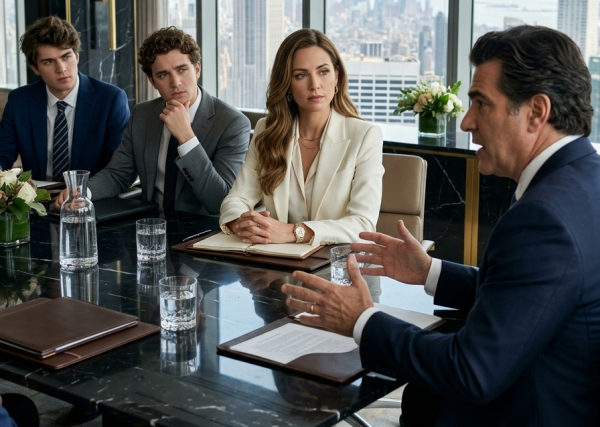
He Abandoned Me on Our Wedding Day — Then Froze When My Twin Sons Walked Into His Billion-Dollar Boardroom
The last time Grayson Vale saw me, I was standing in lace, humiliated in front of two hundred guests after he vanished before our vows. He never knew that three weeks later, I found out I was pregnant with twin boys. For fifteen years, his family buried every message I sent, every letter I mailed, and every truth that could have changed our lives. Then his company tried to buy mine — and I decided it was time for him to meet the sons his empire had helped erase.
PART I — THE BOARDROOM ON THE FORTY-SECOND FLOOR
Fifteen years after Grayson Vale left me standing in a wedding dress, I walked into his boardroom carrying a leather portfolio, a sealed envelope, and the only truth powerful enough to make a billionaire’s hands shake.
My name is Eleanor Hayes, though when Grayson knew me, I was still Ellie Montgomery, twenty-six years old, hopelessly in love, and foolish enough to believe a man’s vows meant more than his family’s money. I had grown up in Maine, in a town where people still waved at passing trucks and measured distance in minutes instead of miles. Grayson came from Boston money, the kind with private schools, summer houses, and names etched into university buildings.
We met in graduate school at Columbia University, long before his face appeared on business magazines and before the Vale family turned Vale Harbor Capital into one of the most aggressive private equity firms on the East Coast. He was charming back then in a way that felt unpracticed. He remembered little details, asked real questions, and once stood outside my apartment in the snow with soup because I had mentioned a sore throat during a phone call.
For three years, I believed I had found the kind of love that could survive class, family pressure, and the cruel politeness of people who smiled while deciding you did not belong.
Then came our wedding day.
It was supposed to happen at a historic estate outside Newport, Rhode Island, overlooking the Atlantic. There were white hydrangeas everywhere, string quartet music drifting across the lawn, and two hundred guests in silk dresses and tailored suits pretending not to study me like a temporary mistake. My dress had lace sleeves, a cathedral train, and buttons down the back that my mother fastened with trembling fingers.
Grayson never made it to the altar.
His mother, Vivian Vale, entered the bridal suite twenty minutes before the ceremony with a face so calm it looked rehearsed. She closed the door behind her, handed me an envelope, and told me her son had made a difficult but necessary decision.
I remember laughing because the sentence made no sense.
A difficult decision was choosing table linens.
A difficult decision was changing jobs.
A man did not make a difficult decision to disappear on his wedding day without speaking to the woman waiting in a dress his hands had helped choose.
Inside the envelope was a brief note in Grayson’s handwriting.
Ellie, I’m sorry. I can’t do this. Please don’t come after me. You deserve better than a man who is not strong enough to choose you. — G
I read it three times before the room started to tilt.
My mother began crying.
My father, who had worked thirty-two years repairing fishing boats, stood so still I thought he might break in half.
Vivian watched us with the restrained sympathy of a woman observing bad weather from behind expensive glass.
“There will be no scandal,” she said. “We will make sure you are taken care of.”
Taken care of.
Like a canceled vendor.
Like a damaged package.
Like a woman whose heartbreak could be settled with a check.
I walked out of that estate still wearing the dress. Guests turned their heads as I passed. Some looked away. Some whispered. Some lifted champagne flutes to their mouths because people with money often use glassware to hide discomfort.
Grayson was gone.
By sunset, the Vale family’s official statement had already reached the local society column: mutual decision, private matter, request for respect.
There had been nothing mutual about it.
Three weeks later, I found out I was pregnant.
Six weeks after that, I learned there were two heartbeats.
Twin boys.
I called Grayson.
His number had been disconnected.
I emailed him.
No reply.
I sent a certified letter to the Vale family office in Boston.
It came back marked refused.
Then Vivian called me from a private number and told me something that changed the next fifteen years of my life.
“Do not make this harder than it needs to be, Eleanor,” she said.
It was the first time she had used my full name, and somehow that made it colder.
“He doesn’t want contact,” she continued. “Whatever you think you have to say, it will only embarrass everyone.”
“I’m pregnant,” I whispered.
There was a pause.
Not surprise.
Calculation.
“How far along?”
I should have hung up.
I should have called a lawyer that very day.
But I was twenty-six, abandoned, humiliated, pregnant with twins, and grieving a future that had vanished so violently I still woke up reaching for it.
“Almost ten weeks,” I said.
Vivian exhaled.
Then she told me Grayson had moved overseas for work, that he had made it clear he wanted no further communication, and that if I pursued public drama, the Vale family had resources I could not imagine. She never directly threatened me. Women like Vivian did not need to. They placed words carefully enough that fear assembled itself.
“I can arrange support,” she said. “Quietly.”
“No.”
“Think carefully.”
“I said no.”
I hung up shaking.
For fifteen years, I raised my sons without Grayson Vale.
Their names are Noah and Lucas Hayes.
Noah was born first by four minutes, serious from the beginning, with dark eyes that seemed to judge the hospital lighting. Lucas arrived furious, red-faced and loud, as if he already objected to the circumstances of his entrance. They were five pounds each, tiny enough that every nurse called them fighters.
They became my whole world.
Not in the sentimental way people say when they want motherhood to sound simple.
They became my world because there were nights when I had no money left after rent, formula, and daycare. There were mornings when I graded freelance editing work at 3:00 a.m. with one baby asleep on my chest and the other kicking in a borrowed bassinet. There were years when I wore the same winter coat until the zipper broke because the boys needed boots.
I built a life.
Slowly.
Stubbornly.
I moved from Rhode Island to New Haven, Connecticut, took contract work in communications, finished certifications online, and eventually started a crisis strategy firm that helped nonprofits, small businesses, and later larger institutions survive public scandals without destroying innocent people in the process.
I learned reputation management because the Vale family had used reputation like a weapon.
I learned corporate law language because fear loses power when translated into procedure.
I learned that silence is expensive, but truth, timed correctly, can bankrupt a lie.
By the time Noah and Lucas were fifteen, they were taller than me, sharp-minded, and different in every way except the shape of their smile. Noah loved robotics, chess, and carefully organized notebooks. Lucas loved debate team, basketball, and asking questions that made adults uncomfortable. Both of them knew their father had left before they were born.
They did not know his name until they asked at thirteen.
I told them the truth carefully.
Not the tabloid version.
Not the wounded version.
The human version.
“He was a man I loved,” I said. “He left before I knew about you. I tried to reach him. His family blocked communication. I made choices to protect our peace.”
Noah asked if Grayson knew.
“I do not believe he was told the full truth,” I said.
Lucas asked if I hated him.
“No,” I answered after a long pause. “Hate would have kept him too close.”
That was mostly true.
Then, two years later, Grayson Vale tried to buy my company.
Not directly.
Men like him rarely begin directly.
Vale Harbor Capital acquired a majority stake in NorthBridge Media Group, a regional communications company that had offered to purchase my firm, Hayes Strategic Counsel, for $18.7 million. The offer was generous enough that my CFO nearly dropped her coffee. It was also strange, because NorthBridge had not previously shown interest in boutique crisis firms.
I reviewed the documents.
There, buried in the ownership disclosures, was the name I had not seen in a professional context for fifteen years.
Grayson M. Vale, Chairman and Chief Executive Officer, Vale Harbor Capital.
For three full minutes, I stared at the page without breathing properly.
Then I did what I had trained myself to do.
I stopped being the woman left in the wedding dress.
I became the strategist.
I hired outside counsel.
I commissioned a review of all acquisition communications.
I requested a meeting with the ultimate decision makers before signing any letter of intent.
NorthBridge agreed faster than expected.
That was how I came to be standing in the lobby of Vale Harbor Capital on the forty-second floor of a glass tower in Boston’s Financial District on a cold Tuesday morning in November, with my sons beside me in navy blazers and polished shoes they hated.
Noah adjusted his cuff.
Lucas leaned toward me and whispered, “This feels like a villain headquarters.”
“Inside voice,” I said.
“It was an inside voice.”
“It was a lawsuit voice.”
He shut up.
The receptionist looked at the three of us with polite curiosity. She recognized my name from the meeting schedule, not theirs. To her, Noah and Lucas were probably interns, junior analysts, or the kind of overachieving prep school students Boston firms liked to parade through leadership programs.
They were none of those things.
They were Grayson Vale’s sons.
And he had no idea.
The boardroom was all glass, walnut, and arrogance. It had a long table large enough to seat twenty-four people, a view of Boston Harbor, and a wall screen displaying the NorthBridge acquisition deck. Around the table sat executives, attorneys, advisors, and three members of the Vale family.
Grayson was at the head.
Fifteen years had refined him instead of aging him.
His hair was darker than I expected, touched with gray at the temples. His suit probably cost more than my first car. He looked composed, successful, and entirely unprepared for the fact that the past had just entered his boardroom wearing heels and carrying evidence.
He stood when he saw me.
Professional reflex.
Then his eyes shifted to Noah and Lucas.
For half a second, nothing happened.
Then the color drained from his face.
Because blood recognizes itself before the mind catches up.
Noah had Grayson’s eyes.
Lucas had his mouth.
Both boys had the Vale jawline that had appeared for generations in oil portraits, society photos, and university donor plaques.
The room noticed him noticing.
That was the first fracture.
“Ms. Hayes,” Grayson said, but his voice caught slightly.
“Mr. Vale.”
His gaze returned to the boys.
“These are my sons,” I said evenly. “Noah Hayes and Lucas Hayes. They are here with my consent and at their own request because this meeting concerns a company that may affect their future.”
Noah nodded politely.
Lucas smiled just enough to be dangerous.
Grayson gripped the back of his chair.
Across the table, Vivian Vale went perfectly still.
She was older now, her silver hair pinned at the nape of her neck, diamonds at her ears, spine straight as a courtroom lie. I had wondered for fifteen years what I would feel when I saw her again.
Rage.
Fear.
Satisfaction.
Instead, I felt clarity.
She knew.
She had always known.
But even then, my sons were not the most dangerous thing I had brought into that room.
The most dangerous thing was in the sealed envelope inside my portfolio.
And Vivian had no idea I had finally obtained it.
PART II — THE BOYS HE NEVER KNEW
The first ten minutes of that meeting were a masterclass in wealthy people pretending the ceiling had not just collapsed.
Grayson introduced his team.
His chief legal officer, Marianne Holt, a composed woman in a charcoal suit whose eyes missed nothing. His younger half-brother, Bennett Vale, who ran investor relations and looked confused enough to suggest he had not been fully briefed. Two NorthBridge executives. Three outside attorneys. Vivian, officially listed as a senior family advisor though everyone in Boston knew she controlled half the decisions Grayson believed were his.
Then there was Celia Vale.
Grayson’s wife.
I knew he had married eventually. I had seen one photo years earlier in a business magazine at a dentist’s office and closed it so quickly the receptionist asked if I was all right. Celia sat to Grayson’s right in a cream suit, elegant and pale, with a gold wedding band and the controlled face of a woman who had learned to receive bad news in public.
She looked at my sons once.
Then at her husband.
Not angry yet.
Careful.
That was worse for him.
“Ms. Hayes,” Marianne said, saving the room from silence, “we appreciate you coming in person. I understand you requested this meeting to discuss governance assurances before proceeding.”
“Yes.”
I opened my portfolio and removed a neatly tabbed folder.
“We were approached by NorthBridge regarding acquisition. During due diligence, we discovered Vale Harbor’s controlling interest. Given the nature of my firm’s work, I am unwilling to sell any portion of Hayes Strategic Counsel to an entity with undisclosed reputational conflicts.”
Grayson seemed to recover slightly.
“What conflicts?”
I met his eyes.
“Personal ones, to start.”
The room tightened.
Noah sat beside me with his hands folded, calm because he had practiced. Lucas leaned back in his chair, calm because anger had made him graceful. I had offered to keep them out of this. I had begged them, in fact, to let me handle it alone.
Lucas had said, “He helped create us and then got to be a myth. I want to see his face when the myth ends.”
Noah had said, “I need to know whether he knew.”
That was the sentence that decided it.
Not revenge.
Information.
Children are owed truth, even when adults are afraid of what it costs.
Grayson looked at me as if trying to calculate whether this was happening.
“How old are they?” Celia asked quietly.
Her voice cut through the room.
Grayson turned toward her. “Celia—”
She did not look at him.
“How old?” she repeated.
“Fifteen,” I said.
Celia closed her eyes briefly.
Around the table, people began doing math.
Fifteen years.
A canceled wedding.
Two teenage boys.
A powerful family.
A mother who looked like she had swallowed a secret.
Vivian finally spoke.
“This is not appropriate for a corporate meeting.”
I smiled faintly.
“No, Vivian. Abandoning a pregnant woman and burying communication from her was not appropriate. This is simply inconvenient.”
Grayson’s eyes snapped to his mother.
Pregnant woman.
That phrase landed exactly where I intended.
He turned back to me slowly.
“You were pregnant?”
His voice was barely above a whisper.
I watched him carefully.
There are performances of shock.
This was not one.
His face had gone slack in a way no public relations consultant would recommend. His eyes moved from me to the boys and back again, as if the present had become too large to process all at once.
Noah saw it too.
His shoulders lowered by maybe half an inch.
Lucas did not soften.
Good.
Both responses were valid.
“I found out three weeks after the wedding,” I said.
Grayson’s lips parted, but no sound came out.
Vivian said, “Grayson, this is obviously—”
“Did you know?” he asked her.
The room went silent enough to hear the climate system hum.
Vivian’s face did not move.
“That is a complicated question.”
“No,” Lucas said.
Every head turned toward him.
He sat up straighter.
“It’s actually the least complicated question in the room.”
I placed a hand gently near his arm, not to silence him, only to steady him.
Grayson stared at Vivian.
“Did you know?”
Vivian looked at me then, and for a moment, fifteen years vanished. I saw the woman in the bridal suite, smooth and cold, holding the envelope like grief was a scheduling problem. She could still hurt me if I let memory become the room.
I did not let it.
“She knew,” I said.
Grayson did not look away from his mother.
Vivian folded her hands.
“She called claiming pregnancy after you had already made your choice.”
“My choice?” Grayson repeated.
“You were clear that you wanted no contact.”
His face changed.
“I never knew she called.”
Celia whispered, “Grayson.”
He looked at me.
“I never knew.”
I believed him.
Not fully.
Not easily.
But enough that the shape of my anger shifted.
For years, I had pictured him receiving my calls, my letters, my truth, and turning away. I had built a wall around my sons with that image as its foundation. Now the wall was still necessary, but the foundation cracked.
“Did you receive a certified letter?” I asked.
“No.”
“Emails?”
“No.”
“Any message from me after the wedding?”
His eyes moved to Vivian.
“No.”
Marianne Holt, the chief legal officer, had gone very still.
She understood what others were just beginning to understand.
This was not only family drama.
This was potential misconduct.
Mail interference.
Fraudulent communications.
Suppression of material personal information.
Possibly corporate exposure, depending on whether Vale family resources, employees, or counsel had been used.
And because Vale Harbor Capital was involved in a regulated financial environment, reputational risk had just walked into the boardroom with witnesses.
But still, the boys were not the most dangerous thing in the room.
I removed the sealed envelope and placed it on the table.
Vivian’s eyes dropped to it.
For the first time, I saw fear.
Real fear.
Not embarrassment.
Not irritation.
Fear.
“This,” I said, “is why I agreed to meet in person.”
Grayson looked at the envelope.
“What is it?”
“A copy of an internal memorandum dated fourteen years and eleven months ago from the Vale family office. It was sent to outside counsel, copied to Vivian, and archived under a restricted family governance file.”
Vivian stood abruptly.
“This meeting is over.”
Marianne Holt said, “Mrs. Vale, please sit down.”
The authority in her voice shifted the power in the room.
Vivian did not sit.
I continued.
“The memo references my pregnancy, my attempted contact, your mother’s instruction that all communication from me be intercepted, and a proposed settlement strategy designed to prevent public claims by ‘the Montgomery woman and any potential issue.’”
Celia’s hand went to her mouth.
Bennett Vale whispered, “Jesus.”
Grayson reached for the envelope, then stopped as if afraid it might burn him.
“How did you get this?” Vivian demanded.
I looked at her.
“You should be more concerned that it exists.”
Marianne extended her hand toward the envelope.
“May I?”
I nodded.
“This is a copy. My attorney has the authenticated version.”
That sentence changed everything.
Because until that moment, they might have hoped I had come emotionally.
Instead, I had come prepared.
Marianne opened the envelope and read.
The longer she read, the paler she became.
Grayson remained standing behind his chair, staring at the table like it might explain how his life had just split open.
Noah looked at him, then at me.
Lucas watched Vivian with open dislike.
I wished I could protect them from all of it.
But protection built on silence had caused enough damage.
Finally, Marianne placed the memo flat on the table.
“Mr. Vale,” she said carefully, “we need to pause this acquisition discussion immediately.”
Vivian snapped, “This is privileged material.”
Marianne’s voice stayed calm.
“Privilege may be contested if the communication furthered or concealed wrongful conduct. We are not litigating that in this room.”
Celia stood.
Not dramatically.
Slowly.
She looked at Grayson.
“Did you leave her at the altar?”
He closed his eyes.
“Yes.”
“Why?”
His answer came after a long silence.
“Because my mother told me Eleanor had taken money from my father to disappear after the wedding.”
I almost stopped breathing.
Vivian’s head turned sharply toward him.
Grayson opened his eyes and looked at me.
“She said you had doubts. That you were embarrassed by our family. That you agreed to end it quietly if we avoided a scene. She gave me a note she said you wrote.”
My mind flashed back to the bridal suite.
To his note.
To Vivian’s envelope.
Two forged stories crossing in opposite directions.
Each of us handed a lie.
Each of us told the other had chosen abandonment.
Noah whispered, “Mom?”
I turned to him.
“I never took money.”
“I know,” he said quickly.
He did not say it for himself.
He said it because he could see my face.
Grayson looked destroyed.
But destruction is not the same as innocence.
“You still left,” I said.
He swallowed.
“I did.”
“You did not come to the room. You did not look me in the eye. You let your mother deliver a note like I was a business inconvenience.”
His face tightened with shame.
“Yes.”
“That part is yours.”
He nodded once.
Slowly.
“Yes.”
For fifteen years, I had wanted him to admit that.
Not to heal me.
Healing had been my work.
But because truth has weight, and I had carried too much of it alone.
Vivian sat down at last.
Not defeated.
Calculating again.
I saw it happen.
So did Lucas.
“She’s thinking about damage control,” he said.
Vivian’s eyes flashed.
“Your son is impertinent.”
Grayson turned on her.
“My son,” he said, and the words shook, “has more right to speak in this room than you do.”
The room changed again.
Because he had said it.
My son.
Noah’s face went unreadable.
Lucas looked away first.
Celia stared at Grayson as if seeing a stranger wearing her husband’s suit.
Then she picked up her purse.
“Celia,” Grayson said.
She paused at the door.
“I have spent twelve years defending your mother’s influence in this family,” she said quietly. “Do not ask me to do it for one more minute.”
She left.
That was the second fracture.
The first had been recognition.
The second was consequence.
And the third was still coming.
PART III — THE MEMO THAT BURNED THE VALE FAMILY
We did not finish the acquisition meeting.
There was nothing left to acquire that day except legal counsel, crisis plans, and oxygen.
Marianne Holt moved quickly. She suspended the NorthBridge acquisition discussion, instructed everyone in the room to preserve documents, and requested that no one discuss the matter outside attorney-directed channels. She was professional, but I could see the fury beneath her restraint.
Not moral fury only.
Institutional fury.
Someone had hidden a personal scandal inside family office structures connected to a financial empire, and now that scandal had surfaced in a room full of witnesses, including minors.
My sons.
I regretted that part.
Even though they had insisted.
Even though they deserved answers.
Even though no answer in that room had been clean enough to spare them pain.
When we stepped out into the hallway, Grayson followed.
“Eleanor.”
I turned.
Noah and Lucas stood on either side of me.
Not children anymore.
Not quite men.
Both trying very hard to be stronger than they should have had to be.
Grayson stopped several feet away, as if distance were the first respectful thing he had managed all day.
“I don’t know what to say.”
Lucas gave a short laugh.
“Great start.”
“Lucas,” I said softly.
“No, it’s fine,” Grayson said. “He’s right.”
That surprised all of us.
He looked at the boys.
“I am not going to ask you for anything. Not forgiveness. Not time. Not a conversation you don’t want to have. I need to understand what happened, and I need to take responsibility for what I did know and what I should have questioned.”
Noah studied him.
“You should have come to the bridal suite.”
Grayson’s face tightened.
“Yes.”
“You should have asked her.”
“Yes.”
“You should have wondered why the woman you said you loved would suddenly disappear for money.”
A muscle moved in Grayson’s jaw.
“Yes.”
Noah nodded once, as if filing the answers away.
Lucas crossed his arms.
“You’re saying yes because you feel bad.”
“I am saying yes because it is true.”
“That’s convenient now.”
“Yes,” Grayson said. “It is.”
Lucas looked thrown by the honesty.
So was I.
Grayson turned back to me.
“Can I contact you through your attorney?”
“For legal matters, yes.”
“For them?”
I looked at my sons.
This was not my decision alone anymore.
Noah said, “Not yet.”
Lucas said, “Maybe never.”
Grayson absorbed both.
“Understood.”
We left without another word.
In the elevator down from the forty-second floor, Lucas stared at the doors and said, “I hate that he didn’t know.”
Noah looked at him.
“Why?”
“Because it would be easier if he was just evil.”
Noah said nothing.
Then he whispered, “Yeah.”
I closed my eyes.
There it was.
The cruelty of complicated truth.
Villains are easier to survive than cowards, liars, and people who fail in human-sized ways that still ruin entire lives.
That night, we drove back to New Haven in near silence. The boys sat in the back seat like they had when they were little, except now their knees almost touched the front seats. Rain moved across the windshield in silver lines. Boston disappeared behind us.
At home, I made grilled cheese sandwiches because none of us had eaten, and grief sometimes requires food simple enough not to ask anything of you.
Lucas took two bites and pushed his plate away.
“Did you love him the whole time?”
The question landed gently and brutally.
“No,” I said. “Not the whole time.”
Noah looked up.
“But you did for a while after.”
“Yes.”
“How long?”
I thought about lying.
Not a big lie.
A mother lie.
The kind meant to soften pain.
But we had just watched what family lies can do.
“Years,” I said.
Lucas’s face twisted.
“Even after he left?”
“Yes.”
“Why?”
“Because love doesn’t shut off when someone hurts you. Sometimes it becomes anger. Sometimes it becomes grief. Sometimes it becomes a locked room you stop entering.”
Noah traced a line on the table with his finger.
“What is it now?”
“History.”
That answer seemed to help.
Maybe because history is real but not alive in the same way.
The next morning, my attorney, Dana Whitaker, called at 7:15 a.m.
“I assume the meeting was eventful.”
“That is one word.”
“Vale Harbor’s general counsel contacted me before 6:00. They want to discuss document preservation, potential settlement, and parentage issues.”
I stood in my kitchen, watching steam rise from my coffee.
“Parentage issues?”
“Grayson wants DNA testing.”
My hand tightened around the mug.
“Of course he does.”
“Eleanor.”
“I know. It’s reasonable.”
“It is.”
“I hate that it feels insulting.”
“That is also reasonable.”
Dana had represented me for six years, first on corporate matters, then quietly when I began investigating whether any evidence existed of the Vale family blocking contact. She was the one who found the retired family office assistant willing to speak. She was the one who located the archived memo. She was the one who told me not to use truth as a weapon unless I was prepared for the shrapnel.
“I’ll ask the boys,” I said.
“They’re minors. You can consent.”
“They’re fifteen. They get a voice.”
Dana paused.
“Good.”
When I told Noah and Lucas, Noah said yes immediately.
Lucas said no, then yes, then called it humiliating, then asked if it would require blood, then accused Grayson of being the kind of guy who probably had monogrammed DNA kits.
The test was done privately through legal counsel.
No publicity.
No drama.
No daytime television nonsense.
The results came back with what everyone already knew.
Probability of paternity: greater than 99.99%.
Grayson Vale was their biological father.
Dana sent the result to his counsel.
Within an hour, Grayson requested permission to write the boys a letter.
Not to call.
Not to visit.
A letter.
That mattered.
Maybe because it was cautious.
Maybe because it was the only thing he could offer that did not demand immediate emotional labor from them.
I asked the boys.
Noah said yes.
Lucas shrugged and said, “I’m going to hate-read it.”
The letter arrived two days later by courier.
Two copies.
One for each boy.
Handwritten.
Noah took his upstairs.
Lucas read his at the kitchen island with a bowl of cereal going soggy beside him.
I did not ask what it said.
After ten minutes, Lucas said, “He didn’t blame her.”
“Vivian?”
“Yeah.”
I looked at him.
“He said she lied, but he still chose not to face you. He said that was his failure.”
I swallowed.
Lucas pushed the letter toward me.
“You can read it.”
“Only if you want me to.”
“I do.”
The letter was careful, imperfect, and devastating.
Grayson told Lucas he had learned of his existence in the boardroom and would regret that for the rest of his life. He wrote that he would not pretend biology created trust. He acknowledged leaving me without speaking to me face-to-face, believing a lie because it was easier than standing up to his family. He said if Lucas never wanted contact, he would respect that, but he would still make legal and financial provisions because responsibility was not something a child had to request.
At the end, he wrote:
Your mother owed me nothing, but she raised you anyway. Whatever anger you have toward me, do not let anyone convince you it belongs to her.
I cried after reading that sentence.
Not because it fixed anything.
Because for fifteen years, no one from the Vale family had said out loud that I had carried what he abandoned.
Noah did not show me his letter.
That was fine.
Later that night, I passed his room and saw him sitting on the floor, the letter open beside him, staring at nothing.
I knocked softly.
“Want company?”
He nodded.
I sat beside him.
He leaned his head on my shoulder, something he had not done in years.
“He sounds sad,” Noah whispered.
“He probably is.”
“I don’t want to feel bad for him.”
“You don’t have to.”
“But I do a little.”
“That’s allowed too.”
Noah wiped his face quickly.
“I hate this.”
“I know.”
“Do you?”
I wrapped my arm around him.
“Yes.”
Because I did.
Not for myself in the same way.
For them.
For the boys who had grown up with a clean absence and now had to face a messy presence.
For the sons who had imagined their father as either monster or ghost, only to discover he was a man shaped by cowardice, manipulation, privilege, and regret.
That is harder.
Ghosts do not ask to write letters.
PART IV — GRAYSON VALE’S HOUSE OF GLASS
The public story broke twelve days later.
Not from me.
Not from Grayson.
From someone inside the Vale orbit who leaked enough to a Boston business reporter to start a wildfire.
The headline did not name my sons, thank God.
But it named me.
Vale Harbor Acquisition Paused Amid Allegations of Family Office Misconduct Tied to CEO’s Canceled Wedding
By noon, my office phone had received forty-seven calls.
By 2:00 p.m., reporters were outside Vale Harbor’s building.
By 4:30 p.m., NorthBridge issued a statement confirming the acquisition process was under review.
By evening, Vivian Vale’s name was trending locally among people who pretended not to enjoy rich families bleeding in public.
I did not post.
I did not comment.
I gathered my sons, ordered pizza, and told them the rules.
“No reading comments.”
Lucas groaned.
“Mom.”
“No.”
“I’m literally on debate team. I can handle idiots.”
“No comments.”
Noah handed over his phone voluntarily.
Lucas objected for nine minutes, then surrendered his too, calling it unconstitutional.
“It’s not,” Noah said.
“Emotionally unconstitutional.”
I let that one pass.
Dana issued a short statement on my behalf:
Ms. Hayes is focused on protecting her children, her business, and the integrity of the legal process. She will not comment on private family matters involving minors.
It was boring.
Boring was safe.
Facebook, tabloids, and comment sections love women’s pain when it is dressed up as spectacle. I refused to feed them my sons.
Grayson’s statement came later that night.
It was also restrained.
He acknowledged that serious questions had been raised regarding past family office conduct, announced an independent investigation, confirmed Vivian Vale would step back from advisory responsibilities, and requested privacy for all minors involved.
He did not deny.
That was important.
Vivian did.
Through her own attorney, she called the allegations “distorted,” “deeply personal,” and “motivated by financial opportunism.”
Lucas read the statement before I could stop him because teenagers have the investigative capacity of federal agencies when motivated.
“She called you a gold digger,” he said.
“Not in those words.”
“In rich-person words.”
“Yes.”
He looked furious.
Noah sat very still.
“Are we rich-person scandal kids now?”
“No,” I said firmly. “You are Noah and Lucas Hayes. You have school tomorrow. You will take your Spanish quiz, attend robotics and practice, and not punch anyone.”
Lucas looked disappointed by the last instruction.
At school, the administration handled it better than I expected. I had already contacted the principal. Counselors were made available discreetly. Teachers were told not to discuss media reports. Still, whispers happened. They always do.
Lucas got into one argument in history class when another student made a joke about “secret trust fund babies.”
He did not punch him.
He did, however, verbally dismantle him so thoroughly that his teacher emailed me with the phrase “impressive but inappropriate.”
Noah withdrew.
That worried me more.
He went to school, did his homework, ate dinner, answered questions politely, and disappeared into his room. On the fifth night, I found him at the kitchen table after midnight, reading articles about Grayson.
“Hey,” I said softly.
He shut the laptop too quickly.
“I know I’m not supposed to.”
I sat across from him.
“What did you find?”
He hesitated.
“He has another family.”
I nodded.
“Yes.”
“A wife.”
“Yes.”
“Any kids?”
“No biological children that I know of. He and Celia have a foundation that supports foster youth programs, but I don’t believe they have children.”
Noah looked at the closed laptop.
“Do you think she hates us?”
The question broke my heart.
“No. I think she is hurt by adults, not by you.”
“How do you know?”
“Because I saw her face in that boardroom.”
He absorbed that.
Then he said, “Do you think he wanted kids?”
I took a breath.
“I think he did. But wanting children and being ready to stand up for them are different things.”
Noah nodded slowly.
“Do we have to meet him?”
“No.”
“Do you want us to?”
“I want you to have whatever truth helps you become whole. If that includes meeting him someday, I will support you. If it doesn’t, I will support you.”
“What do you want for yourself?”
That was the question I had avoided.
For myself, I wanted peace.
I wanted the past to stop knocking.
I wanted Vivian held accountable.
I wanted Grayson to suffer enough to understand but not so much that my sons confused vengeance with healing.
I wanted impossible things.
“I want to stop making decisions from fear,” I said.
Noah looked at me.
“That sounds hard.”
“It is.”
He opened the laptop again, turned it toward me, and showed me an old photo of Grayson at a charity event.
“He looks like Lucas when Lucas is pretending not to care.”
I laughed before I could stop myself.
Noah laughed too.
It was small.
It helped.
The independent investigation moved quickly because pressure from investors made delay expensive. Vale Harbor’s board, previously decorative in the way many family-controlled boards are, suddenly discovered governance principles. Outside counsel interviewed former staff, reviewed archived communications, and examined whether Vale resources had been used to intercept or suppress my communications.
The findings were not all public, but Dana received enough through negotiations to confirm the core truth.
Vivian had instructed family office staff to return my certified letter.
She had directed an assistant to monitor communications.
She had approved a draft settlement strategy regarding my pregnancy without informing Grayson.
She had maintained files under restricted access.
She had also, years earlier, given Grayson a handwritten note supposedly from me stating I could not marry into his world and had accepted financial support to leave quietly.
Forgery was difficult to prove after fifteen years, but the memo referenced “maintaining separate narratives.”
Separate narratives.
One lie for him.
One lie for me.
Two lives split cleanly by a woman who believed family legacy mattered more than human beings.
Celia filed for legal separation three weeks after the boardroom meeting.
That news reached me through Dana, not tabloids.
I sat with it for a long time.
I did not celebrate.
Celia had done nothing to me.
She was another woman waking up inside a marriage with hidden rooms.
Grayson stepped down temporarily as CEO pending the investigation, though he remained chairman in a limited capacity. Investors hated uncertainty. The board hated headlines. Vivian hated losing control.
My company withdrew from acquisition talks entirely.
NorthBridge increased the offer twice.
I declined both.
Lucas asked if turning down nearly $20 million physically hurt.
“Yes,” I said.
“Then why?”
“Because not every check is freedom.”
He nodded solemnly, then said, “But some checks are probably freedom.”
“Go do your homework.”
A month after the boardroom meeting, Dana called with news.
“Grayson wants to establish trusts for the boys.”
I closed my eyes.
“How much?”
“Substantial.”
“Define substantial.”
She did.
I sat down.
The proposed trusts would cover education, health care, living expenses, and future support. They would be irrevocable, administered independently, and not conditional on the boys having a relationship with him. There was also an offer to reimburse me for past child-related expenses.
I laughed once.
Not because it was funny.
Because no number can price fifteen years of motherhood.
“What do you think?” Dana asked.
“I think responsibility is late.”
“Yes.”
“But still responsibility.”
“Yes.”
I discussed it with a financial advisor, Dana, and a child therapist before telling the boys. Money attached to guilt can become another form of control if structured badly. We made sure it would not.
When I explained, Noah asked, “Do we have to take it?”
“No.”
Lucas asked, “Can we take it and still be mad?”
“Yes.”
“Then I vote yes.”
Noah smiled faintly.
I said, “This is not payment for you. It is not payment for me. It is an obligation he should have carried from the beginning.”
Noah nodded.
Lucas looked at the table.
“Does it mean he cares?”
I answered carefully.
“It means he is trying to act responsibly. Caring is something people prove over time.”
That became the theme of everything.
Over time.
Not in statements.
Not in letters.
Not in money.
Over time.
Grayson requested one mediated meeting with me before any possible meeting with the boys.
I agreed.
Not because I owed him.
Because I needed to look at him without a boardroom between us.
We met in a private conference room at Dana’s office in Hartford, with both attorneys present. Grayson wore no tie. He looked tired in a way money could not polish. For the first time, he looked older than the man who left me.
“Eleanor,” he said.
I sat across from him.
“Grayson.”
For a moment, neither of us spoke.
Then he said, “I am sorry I left you that way.”
Fifteen years ago, that apology would have been oxygen.
Now, it was something else.
A document.
A fact entered into record.
“You should be.”
“I am.”
I studied him.
“Why didn’t you come to me? Even if you believed I took money. Even if you believed I wanted out. Why didn’t you ask me?”
His eyes lowered.
“Because I was humiliated. Because I was angry. Because part of me was relieved that I could blame you instead of confronting my mother and my own doubts.”
There it was.
The truth beneath all the other truths.
“Doubts?”
“Not about loving you. About whether I was strong enough to break from my family.”
“You weren’t.”
“No.”
I appreciated that he did not argue.
It did not soften the past.
But it made the present less insulting.
“I raised them alone,” I said.
His eyes shone.
“I know.”
“No, you don’t. You know the fact. You do not know fevers at 2:00 a.m., daycare bills, parent-teacher conferences, teaching two boys to shave, explaining Father’s Day projects, working three contracts while they slept, or lying awake wondering whether I had failed them by not fighting harder to reach you.”
His face tightened painfully.
“You did not fail them.”
“I know that now.”
He nodded.
“They’re extraordinary.”
“Yes,” I said. “They are.”
A tear slipped down his face.
I looked away.
Not to spare him.
To spare myself the old habit of comforting him.
He wiped it quickly.
“I would like to know them if they ever allow it.”
“That will be their choice.”
“I understand.”
“And if they do, you will not bring Vivian near them.”
His expression hardened.
“No.”
“Not now. Not later. Not when she is old. Not when she cries. Not when she says family should forgive.”
“No.”
I leaned forward.
“Do not say no because you hate her today. Say no because you understand that children are not tools for repairing adult guilt.”
He looked at me for a long moment.
Then he said, “No. Because I understand.”
That was the first time I believed he might become safe enough for a supervised conversation.
Not a father.
Not yet.
Maybe not ever in the full sense.
But a man capable of beginning with boundaries.
PART V — WHAT I REALLY BROUGHT INTO THAT ROOM
The first meeting between Grayson and the boys happened three months after the boardroom.
It took place at a family counseling center in Providence, halfway between our worlds and close enough to the ocean that I could breathe. The therapist, Dr. Amelia Ross, specialized in reunification and high-conflict family systems. She did not care that Grayson was wealthy, which made her instantly trustworthy to Lucas.
The rules were clear.
Ninety minutes.
I would be present.
No gifts.
No promises.
No emotional declarations that placed pressure on the boys.
No discussion of Vivian unless the boys raised it.
Grayson arrived early.
We arrived on time.
He stood when we entered, then seemed unsure whether standing was too formal and sat back down awkwardly. Lucas noticed and smirked. Noah looked nervous but determined.
“Hi,” Grayson said.
“Hi,” Noah replied.
Lucas nodded.
Dr. Ross began gently, inviting everyone to say what they hoped for from the meeting.
Noah said, “I want answers that aren’t filtered through lawyers.”
Lucas said, “I want to know if he’s going to pretend he’s our dad now.”
Grayson took that without flinching.
“I am not your dad in the way that matters most,” he said. “Your mother did that work. I am your biological father, and I would like to earn whatever place, if any, you decide I can have.”
Lucas looked annoyed that the answer was good.
Noah asked, “Did you ever look for her?”
Grayson inhaled slowly.
“No.”
“Why?”
“Pride. Anger. Cowardice. Believing what I was told because it made my pain easier to understand.”
Noah’s eyes filled, but he held steady.
“If you had known about us?”
Grayson’s voice broke.
“I would like to believe I would have come. But I failed your mother so badly before I knew you existed that I don’t want to make myself sound better than I was. I hope I would have. I should have.”
Lucas leaned forward.
“That’s not comforting.”
“No,” Grayson said. “But it is honest.”
The meeting was not cinematic.
No one hugged.
No music swelled.
No wound closed neatly.
But Noah asked about Grayson’s childhood. Lucas asked whether Vivian had always been “that terrifying.” Grayson gave a surprised laugh and said yes, but that was not an excuse. The boys told him about school, cautiously at first, then with more detail when he listened without interrupting.
At one point, Lucas mentioned basketball.
Grayson said, “I played in high school.”
Lucas narrowed his eyes.
“Were you good?”
“No.”
Lucas smiled for real.
For one second, I saw what might have been.
Then I let it go.
What might have been is a dangerous country. You can visit, but you cannot live there.
After the meeting, Grayson walked us to the parking lot but kept appropriate distance.
“Thank you,” he said to the boys.
Noah nodded.
Lucas said, “This doesn’t mean we’re doing Thanksgiving.”
Grayson almost smiled.
“I assumed.”
As we drove home, the boys were quiet.
Then Lucas said, “He’s less awful than I wanted.”
Noah looked out the window.
“He’s sadder than I expected.”
I said nothing.
They did not need my interpretation.
They needed room to build their own.
Over the next year, Grayson showed up carefully.
Monthly therapeutic meetings became occasional supervised outings. A museum in Boston. A robotics competition where he sat three rows behind me and did not attempt to perform fatherhood for anyone watching. A basketball game where he cheered too quietly and Lucas later complained that rich people even clap with restraint.
He paid support.
He contributed to college funds.
He sent birthday cards that were warm but not overwhelming.
He asked before doing anything.
That mattered more than I expected.
Vivian did not go quietly.
She gave one disastrous interview suggesting she had made “difficult decisions to protect a vulnerable family enterprise from manipulation.” The backlash was immediate. Investors disliked scandal, but the public despised a wealthy matriarch framing a pregnant abandoned woman as a threat. Within weeks, she resigned from every formal position connected to Vale Harbor entities.
Grayson cut personal contact with her.
At least, that is what Dana told me.
I did not ask for details.
Vivian sent me one letter.
Cream stationery.
No return address.
I considered throwing it away unopened.
Instead, I read it in Dana’s office.
It was not an apology.
It was a defense disguised as regret. She wrote about pressure, legacy, Grayson’s future, my unsuitability, and the fear that I would pull him away from everything he was born to lead. She admitted she had “managed communications” but insisted she had acted from love.
I placed the letter down.
Dana asked, “Do you want to respond?”
“Yes.”
“What do you want to say?”
I thought about fifteen years.
The wedding dress.
The phone calls.
The twins.
The boardroom.
The way Vivian’s choices had shaped lives she never believed were equal to hers.
Then I said, “Nothing.”
Dana smiled slightly.
“Excellent response.”
Silence can be dignity when it is chosen freely.
Not when it is forced.
That was the difference.
My company survived the attention and grew because of it, though I refused interviews about my personal life. Clients trusted me more, not because I had been hurt, but because I had proven I could walk into a room full of power and not lose my voice. I kept Hayes Strategic Counsel independent. We expanded into ethical crisis advisory, helping organizations tell the truth before lies became architecture.
Noah and Lucas turned sixteen.
Then seventeen.
They changed in ways that had nothing to do with Grayson and everything to do with becoming themselves. Noah got into a summer engineering program at MIT and pretended not to be thrilled. Lucas made varsity basketball and discovered he loved constitutional law because, as he put it, “people are always trying to get away with things, and rules are how you catch them.”
Grayson attended when invited.
Only when invited.
That became his redemption, if redemption is even the right word.
Not grand gestures.
Not speeches.
Restraint.
Consistency.
Respecting no.
One evening, almost two years after the boardroom, Noah asked if Grayson could come to dinner at our house.
I nearly dropped the bowl I was washing.
“Our house?”
“Yes.”
Lucas, from the couch, said, “I support this only if he brings dessert from that expensive bakery near his office.”
I dried my hands.
“Are you both sure?”
Noah nodded.
Lucas shrugged.
“He’s weird, but he’s trying.”
So Grayson came to dinner in New Haven with a chocolate cake that cost too much and a nervousness money could not hide. He stood in my kitchen, the same kitchen where I had packed school lunches, paid bills, celebrated birthdays, cried quietly over impossible choices, and built the life he had missed.
For the first time, he saw the wall of photos.
Noah missing two front teeth.
Lucas covered in mud.
First day of kindergarten.
Halloween costumes.
Science fair ribbons.
Beach trips.
Fifteen years arranged in frames.
Grayson stood before them for a long time.
When he turned back, his eyes were wet.
“I’m sorry,” he said.
Not loudly.
Not for performance.
To all of us.
Noah looked down.
Lucas cleared his throat and said, “Cake?”
We ate.
It was awkward.
It was ordinary.
It was something.
After dinner, Grayson helped wash dishes. He was terrible at it. Lucas filmed him holding a sponge like an unfamiliar corporate instrument and threatened to use it in future negotiations.
Noah laughed so hard he had to sit down.
I watched them and felt an ache so deep it almost became peace.
Not because we had become a family in the traditional sense.
We had not.
Grayson did not move in.
I did not fall back in love.
Celia eventually divorced him, and I sent her a private note through Dana wishing her peace. She replied with one sentence: I hope we both get lives no one else controls. I kept that note.
Grayson remained in the boys’ lives, carefully, imperfectly, increasingly. He became someone they called Grayson for a long time. Later, Noah sometimes said Dad in quiet moments. Lucas resisted longer, then used it once during a college tour when asking where “Dad parked the car,” and everyone pretended not to notice because tenderness sometimes survives best without witnesses.
As for me, I never forgot the woman in the wedding dress.
I stopped being embarrassed for her.
That was the final healing.
For years, I had pictured myself abandoned and humiliated, standing in lace while strangers whispered. I thought of her as naive. Weak. A girl who should have known better than to love into a world that had never intended to welcome her.
Now I see her differently.
She was not weak.
She survived something designed to erase her.
She carried twins alone.
She refused dirty money.
She built a company.
She raised sons who could sit across from the father they never knew and ask honest questions without cruelty.
She walked into a boardroom fifteen years later not to beg, not to scream, not to collapse, but to place the truth on polished walnut and let everyone else decide whether they could bear to look at it.
People later asked why I brought the boys that day.
Some said it was too dramatic.
Some said minors should not have been present.
Some said I should have handled it privately.
Maybe in a gentler world, I would have.
But powerful families often depend on privacy to keep their cleanest lies alive. My sons had lived inside a lie created before they took their first breath. They deserved to witness the moment it ended.
Still, they were not the most dangerous thing I brought into that room.
The memo was dangerous.
The evidence was dangerous.
The legal exposure was dangerous.
But even those were not the deepest threat.
The most dangerous thing I brought into Grayson Vale’s boardroom was a life that had continued without him.
A life he could not buy back.
A life Vivian could not erase.
A life built from sleepless nights, school forms, scraped knees, grocery budgets, bedtime stories, hard truths, and love that did not require a family name to be legitimate.
That was what fractured them.
Not just the sons.
The proof that we had become whole without their permission.
Fifteen years after Grayson left me standing in a wedding dress, I walked into his boardroom with Noah and Lucas beside me.
By the time he realized who they were, his family had already begun to break open.
But I did not go there to destroy him.
I went there because my sons deserved truth.
I went there because silence had taken enough.
And I went there because the woman in the wedding dress had waited fifteen years for someone to finally say she had not imagined the cruelty.
In the end, I said it myself.
Then I walked out with both my sons.
Not abandoned.
Not ashamed.
Not erased.
Chosen.
By them.
By truth.
And at last, by myself.
