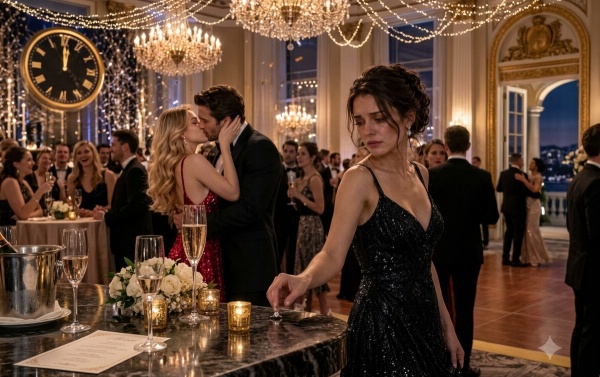
At 12:00 a.m., while the Palmer House ballroom counted down to the New Year, my husband crossed the floor and kissed the woman he swore was only a business consultant. I stood twenty feet away holding the champagne he had just handed me, watching our marriage become entertainment for nine hundred guests.
PART I — THE COUNTDOWN
At midnight, my husband crossed a ballroom full of nine hundred people to kiss another woman while I stood twenty feet away holding the champagne he had handed me.
He did not stumble into it, mistake her for me beneath the confetti, or blame too much alcohol later. He looked directly at Sophie Mercer, made a choice, and let the entire room count him down to it.
Three.
Two.
One.
The chandeliers inside the Palmer House Hilton ballroom went dark.
Gold fireworks bloomed across the projection screens I had designed, bathing the painted ceiling in artificial light. Confetti cannons fired from the balconies. The orchestra crashed into “Auld Lang Syne” as strangers hugged, crystal glasses rose above heads, and the entire room erupted into the kind of expensive joy only Chicago’s wealthiest people can purchase by the table.
And Adrian Vale, my husband of nine years, put both hands around Sophie Mercer’s face and kissed her.
I remember tiny things from that second.
The champagne flute sweating against my palm. The cold bead of condensation that slid over my knuckle. The silver cufflink on Adrian’s right wrist catching the screen light as he leaned toward her.
I remember Sophie’s red dress, the exact shade of winter berries, and how she did not look surprised.
That was the part that stayed with me.
She did not freeze. She did not pull away. She did not glance around as if she realized she had been caught in something reckless and public.
She smiled before his mouth even reached hers.
The people closest to them reacted first. A woman in a black sequined gown gasped and touched her husband’s arm. Two men near the bar stopped mid-toast. Someone laughed awkwardly, the way people laugh when money and scandal collide and nobody knows yet whether it is safe to acknowledge what they just saw.
I stood there in my emerald satin gown, holding the champagne Adrian had handed me ninety seconds earlier, while my marriage became public entertainment beneath ten thousand dollars’ worth of falling confetti.
My name is Claire Vale. I am thirty-eight years old, born in Evanston, raised mostly in Oak Park, and for the past twelve years I have worked in event design for nonprofit galas, private foundations, and corporate fundraisers across Chicago.
The New Year’s Eve gala at the Palmer House was supposed to be my largest event of the year.
It was also supposed to be Adrian’s professional comeback.
Adrian owned a boutique investment advisory firm in River North, the kind that served families rich enough to say “wealth preservation” instead of “money.” For years, he had moved easily through rooms like that ballroom, shaking hands with museum trustees, hospital board members, developers, attorneys, and donors whose names appeared on university buildings.
But the previous eighteen months had been difficult.
Two major clients had left his firm. A private fund he promoted had underperformed badly. There were whispers about liquidity issues, though Adrian insisted they came from competitors jealous of his relationships.
This gala mattered because half the people he needed to impress were in that room.
I had helped secure the event contract through my own reputation. I had spent four months coordinating floral installations, projection design, sponsor recognition, donor seating, entertainment timing, catering flow, and the midnight sequence that was meant to make everyone feel, for one perfect minute, that they were standing inside a golden snow globe.
Adrian had spent the evening telling people how proud he was of me.
He had placed his hand on the small of my back as we greeted board members. He had introduced me as “the genius behind all this.” He had kissed my cheek at 11:37 p.m. near the champagne tower and whispered, “You saved me tonight, Claire.”
Then, at 11:58, he pressed a glass into my hand.
“Stay here,” he said. “I need to say Happy New Year to someone before the countdown.”
I thought he meant a client.
That was how completely I still lived inside the version of our marriage where his explanations were ordinary.
Sophie Mercer was not ordinary.
She was thirty-two, a communications strategist, and the newest public relations consultant for Adrian’s firm. She had joined his orbit six months earlier after being introduced by a mutual contact at a private club downtown. Adrian described her as “sharp,” “useful,” and “very connected for her age.”
I noticed he said her name too often.
At first, I dismissed it because I did not want to become the kind of wife who mistook every ambitious woman for a threat. Sophie was polished, attractive, and fluent in the language of Chicago power circles. That did not automatically make her dangerous.
But then Adrian started taking late calls on the terrace.
He started guarding his phone face down.
He started saying “Sophie thinks” before decisions that used to begin with “Claire, what do you think?”
Still, suspicion is not proof.
And a marriage, if it has any hope of surviving, requires some tolerance for uncertainty. At least that is what I told myself every time something felt wrong.
Then midnight came.
And uncertainty ended.
For seven seconds, Adrian kissed Sophie Mercer in front of nine hundred people while the New Year began around them.
Seven seconds is longer than people think.
It is long enough for your mind to reject what your eyes are seeing, accept it, search for explanations, discard them, and understand that a life you spent years building has changed shape forever.
When he pulled back, Sophie touched his lapel.
Then she looked past his shoulder and saw me.
Her smile faded.
Adrian turned.
Our eyes met across the ballroom.
That was the first moment he looked afraid.
Not guilty. Not ashamed. Afraid.
Because Adrian knew me well enough to understand that I was not the kind of woman who screamed in public.
I was the kind who noticed details.
And the details had just started arranging themselves.
PART II — THE WOMAN WHO DESIGNED THE ROOM
I did not throw the champagne.
People always imagine dramatic betrayal as something that demands an equally dramatic response. A slap. A shattered glass. A public accusation that freezes the orchestra and turns every head in the room.
But real humiliation has weight.
It presses down on your ribs. It slows your blood. It makes your body strangely efficient because some part of you understands that if you break down too early, the people who hurt you will control the story before you can even name what happened.
So I smiled.
Not happily. Not convincingly to anyone watching closely. But enough to move through the ballroom without becoming the scene Adrian had already created.
I set the champagne flute on a passing tray. I turned toward the service corridor. I walked away before Adrian could cross back to me and begin whatever explanation he thought could survive what nine hundred people had witnessed.
Behind me, the orchestra continued.
The countdown graphics I had designed transitioned into the sponsor montage, a glittering sequence of logos and donor names drifting across three massive projection screens. The room glowed gold and white. People laughed too loudly, pretending not to stare.
I entered the service hallway near the ballroom’s south entrance and finally inhaled.
The hallway smelled like coffee, floor polish, and hot trays from the kitchen. Staff moved quickly around me, too professional to ask why the event designer was standing against the wall with one hand pressed to her stomach.
“Claire?”
I looked up and saw Maya Brooks, my assistant and closest friend, carrying a headset and an iPad. Maya was twenty-nine, brilliant, and capable of making a florist in tears and a banquet captain with a clipboard both feel equally managed within ninety seconds.
Her face changed the moment she saw mine.
“What happened?”
I opened my mouth, but no sound came out.
Then her eyes moved past me toward the ballroom doors, and she heard the first fragments of gossip slipping into the hallway.
“Did you see Adrian Vale?”
“With Sophie Mercer?”
“Wasn’t his wife right there?”
Maya’s expression hardened.
“Oh my God,” she whispered.
“I need the control room,” I said.
She did not ask why.
The production control room was a temporary setup in a smaller conference space behind the ballroom, crowded with laptops, video switchers, audio boards, backup drives, and two technicians hired for the night. I had spent hours there earlier testing every projection cue.
The screens were mine.
The midnight sequence was mine.
The sponsor montage was mine.
But there was one additional folder loaded into the system that no one else knew about.
Not because I had planned revenge.
Because I had learned, over years of working high-end events, that powerful people rarely fell because of what everyone saw. They fell because of what someone preserved.
Three weeks before the gala, I had found a discrepancy in Adrian’s firm sponsorship payment.
The gala committee received a $75,000 sponsorship from Vale Harbor Advisory, Adrian’s company. The confirmation email listed the funds as a corporate marketing expense. But when I saw the wire receipt by accident on Adrian’s desk at home, the sending entity was not Vale Harbor Advisory.
It was a private client escrow account.
I am not a financial expert, but I know enough to understand that client escrow accounts are not personal piggy banks.
When I asked Adrian about it, he snapped so quickly that the conversation burned into my memory.
“Don’t involve yourself in things you don’t understand,” he said.
That sentence changed something in me.
For the next three weeks, I did not confront him again. I documented. Quietly. Carefully. Legally enough to avoid accessing anything I had no right to access, but thoroughly enough to preserve what passed through shared household spaces, joint email threads, event communications, and documents he left in places where I could see them.
I took photos of papers on our kitchen island.
I forwarded emails from my own inbox.
I saved texts where Adrian asked me to “keep sponsor details simple” and “not over-explain funding pathways” to the gala committee.
Then, two days before New Year’s Eve, Sophie Mercer sent me the wrong attachment.
It arrived in a thread about media placements for the gala.
The file was titled Donor_Talking_Points_Final.docx.
But buried in the document properties and tracked changes was a comment from Sophie to Adrian: Once tonight lands well, we can control the announcement. Claire doesn’t need to know until after the first week of January.
Control the announcement.
Claire doesn’t need to know.
I spent half an hour staring at those words before I realized my hands had gone numb.
I did not yet know what “the announcement” meant, but I knew enough to make copies. I sent everything to my attorney, Denise Holloway, whom I had quietly contacted earlier that month when Adrian began pushing me to sign a revised marital asset agreement.
Denise had one instruction: preserve evidence, do not escalate, and do not make public claims I could not support.
So I preserved.
In the control room, Maya closed the door behind us.
“What do you need?” she asked.
“The incident camera feed from the ballroom.”
Maya’s mouth tightened. “The kiss?”
“Yes.”
The production company had three cameras recording wide shots for sponsor recap footage. One camera faced the stage. One moved through the crowd. One was mounted from the balcony, capturing the midnight countdown and the ballroom floor.
The balcony camera would have seen everything.
One technician looked uneasy when I asked for the footage.
“Mrs. Vale, I’m not sure we can release raw event footage without approval from the client.”
“I am the event designer on the contract,” I said. “And you’re not releasing it publicly. You are preserving a copy at my request because an incident occurred involving my spouse and a consultant tied to one of the event sponsors.”
Maya stepped beside me.
“Make two copies,” she told him. “Now.”
The technician hesitated for half a second, then decided whatever loyalty he might feel toward the gala committee was not worth standing between two women who clearly understood documentation.
At 12:26 a.m., while Adrian was likely searching the ballroom for me, I watched the kiss replay on a production monitor.
There was no ambiguity.
The camera caught Adrian crossing the room. It caught Sophie watching him approach. It caught him taking her face in his hands before the confetti cannons fired.
It also caught something I had missed in the moment.
Sophie had been standing beside Grant Keller, one of Adrian’s largest remaining clients.
Grant saw the kiss. Then he saw me watching. Then he leaned toward the man beside him and said something that made both of them stop smiling.
The room had not just witnessed adultery.
It had witnessed instability.
And in Adrian’s world, instability was fatal.
My phone began vibrating.
Adrian.
Then Adrian again.
Then Sophie.
That surprised me.
I let both calls go unanswered.
A text from Adrian appeared.
Where are you? We need to talk before this becomes something it isn’t.
I read it twice.
Something it isn’t.
Even then, he was already trying to rename it.
PART III — THE PRIVATE ROOM
At 12:41 a.m., Adrian found me in the Palmer House’s Empire Room, a smaller event space off the main corridor where the floral team had stored empty crates and backup arrangements.
Maya stood near the door like a guard.
Adrian entered without knocking.
He looked perfect from a distance. Black tuxedo, white shirt, bow tie slightly loosened in a way that probably made him look charming to people who had not just watched him detonate his marriage under a confetti cannon.
Up close, he looked pale.
“Claire,” he said. “You disappeared.”
I almost laughed.
Disappeared.
As if I had performed the shocking act of the evening.
“You kissed Sophie Mercer in front of nine hundred people,” I said.
His jaw tightened.
“It wasn’t like that.”
“It was exactly like that.”
Maya moved slightly, and Adrian noticed her for the first time.
“This is private,” he said.
“No,” I replied. “It stopped being private when you crossed a public ballroom at midnight.”
He looked at Maya again, then lowered his voice.
“I made a mistake.”
“Did you?”
“Yes.”
“You looked very intentional.”
Something flickered across his face then. Irritation. Not remorse. Irritation that I had chosen the correct word.
“Claire, please. People saw something emotional and misunderstood it. Sophie has been helping me through an impossible few months with the firm. She got caught up in the moment. I got caught up in the moment.”
“You walked to her.”
He exhaled sharply.
“I know how it looked.”
“Good. That means we don’t have to waste time pretending.”
For the first time, his polished control slipped.
“You do not want to handle this impulsively,” he said.
There it was.
The warning beneath the apology.
I had heard that tone before, though usually softened by candlelight or hidden inside financial language. It was the tone Adrian used when a client questioned fees, when an employee pushed back, when I asked too many questions about documents he thought were above my comprehension.
“I am not being impulsive,” I said. “I am being very careful.”
His eyes narrowed.
“What does that mean?”
“It means I have preserved the event footage.”
For a moment, he simply stared at me.
Then he looked toward the door, as if calculating who might already know, who might have copies, how quickly a public embarrassment could become a professional problem.
“Claire,” he said slowly, “do not turn one personal mistake into a reputational disaster.”
“You did that at midnight.”
His phone buzzed. He glanced down despite himself, and I saw Sophie’s name flash across the screen.
That small betrayal, after the larger one, did something final inside me.
“You should answer,” I said. “She probably wants to coordinate stories.”
“She is scared.”
“So am I.”
That stopped him.
Not because he cared, I realized, but because fear in my mouth complicated the version of events he wanted to build. If I was angry, he could call me emotional. If I was humiliated, he could call me dramatic. If I was afraid, then people might ask why.
“Afraid of what?” he asked.
I picked up my clutch from the table.
“Of how quickly you started lying.”
He took one step toward me.
Maya immediately said, “Don’t.”
Adrian froze.
It was not a threat. It did not need to be. It was a boundary spoken by a witness.
He looked between us and seemed to understand, perhaps for the first time that night, that he was no longer in a private marriage where every conversation could be reshaped later behind closed doors.
“I’m going home,” I said. “Not with you.”
“Claire, don’t be ridiculous. It’s freezing outside, it’s New Year’s Eve, and every car in Chicago is either booked or stuck downtown.”
“Maya already called me a car.”
His mouth tightened again.
“You planned this fast.”
“No, Adrian. You just gave me clarity fast.”
As I moved toward the door, he said the sentence that told me everything I needed to know about what came next.
“If you damage my firm over this, you damage yourself too.”
I turned back.
He must have realized his mistake the second the words left his mouth.
Because that was not the plea of a husband trying to save a marriage. That was the calculation of a man who saw his wife as collateral.
“Thank you,” I said.
“For what?”
“For saying that in front of a witness.”
Maya lifted her phone slightly.
“I didn’t record,” she said, calm as glass. “But I heard every word.”
Adrian’s face went still.
We left him standing in the Empire Room beneath rows of empty floral buckets and boxes of unused candles, looking for the first time like a man who had walked too far into his own performance and forgotten where the exits were.
PART IV — THE MORNING AFTER
I spent the first morning of the new year in a suite at the Chicago Athletic Association Hotel, looking out over Millennium Park while my marriage unraveled through text messages.
Adrian sent twenty-three before 8:00 a.m.
Some were apologetic.
I am sorry. I humiliated you and I know that. Please let me fix this.
Some were strategic.
We need to present a united front until I understand how many people are talking.
Some were insulting in the smooth, careful language of a man who never considered himself cruel because he rarely raised his voice.
You are reacting from pain right now, and pain is not a legal strategy.
I screenshotted everything and sent it to Denise Holloway.
She called at 8:17.
“Are you safe?”
“Yes.”
“Are you alone?”
“Maya stayed in the connecting room.”
“Good. Do not meet Adrian privately. Do not speak by phone unless Illinois recording consent rules are fully understood and we discuss it first. Communicate in writing when possible.”
Denise was direct, practical, and entirely uninterested in drama. That was why I liked her. She did not gasp when I told her about the kiss. She asked whether the footage existed, who controlled it, and whether Adrian had made any statements referencing his firm.
I told her about the Empire Room.
“If you have a witness to him linking your silence to the firm’s reputation, that matters,” she said.
“For the divorce?”
“For several things.”
Several things.
By noon, I understood what she meant.
The gala board chair called first.
Her name was Margaret Ellison, a retired hospital executive with white hair, perfect posture, and the ability to make disappointment sound like a formal memo.
“Claire,” she said, “I want to begin by saying the event itself was extraordinary.”
“Thank you, Margaret.”
There was a pause.
“I also need to ask whether there is anything the board should know regarding Vale Harbor Advisory’s sponsorship.”
I closed my eyes.
So Grant Keller had spoken.
“I think you should direct any financial questions to your counsel,” I said carefully. “I have concerns, but I do not want to make unsupported statements.”
“That is a very measured answer.”
“I’m trying to give measured answers today.”
“I appreciate that.”
She lowered her voice.
“Claire, I have known men like Adrian for forty years. If you have documents, preserve them before he decides they are misunderstandings.”
After we hung up, I sat quietly for several minutes.
There is a particular grief in realizing that other people suspected parts of your life before you were ready to name them. It makes you feel foolish at first. Then, slowly, it makes you angry.
At 2:00 p.m., Denise arrived with her associate and a secure laptop.
We reviewed what I had gathered: the sponsorship emails, the wire receipt from the client escrow account, Sophie’s mistaken attachment, Adrian’s texts, and the event footage showing the kiss. Denise was careful to separate the personal betrayal from the legal concerns.
“An affair is painful,” she said, “but Illinois is a no-fault divorce state. The court generally is not going to divide marital property based on who kissed whom at midnight. However, misuse of funds, concealment of assets, pressure to sign agreements without full disclosure, or retaliation tied to business interests are different issues.”
“What happens if the sponsorship came from money that wasn’t his to use?”
“Then Adrian may have a serious professional problem.”
I looked toward the window.
Below, tourists crossed Michigan Avenue bundled in winter coats, carrying shopping bags and coffees, unaware that twenty floors above them, a woman in last night’s gown was learning which parts of her humiliation were legally relevant.
By late afternoon, Adrian changed tactics.
He sent flowers to the hotel.
White roses.
Our wedding flowers.
The card read: Come home. We can still control this.
Not fix this.
Not heal this.
Control this.
Maya read the card and made a sound of disgust.
“Do you want me to throw them away?”
“No,” I said. “Photograph them first.”
By evening, Sophie finally texted me.
Claire, I know you hate me. But you need to understand Adrian told me your marriage was already over. He said you were staying together publicly until after the gala because of business optics. I never would have let last night happen like that if I knew he was lying to both of us.
I stared at the message for a long time.
It would have been satisfying to hate her cleanly.
But life rarely offers clean lines.
Sophie had kissed my husband in front of me. She had participated in secrecy. She had sent strategy documents that implied I was an obstacle to be managed.
But she had also just given me something Adrian never had.
A written admission that he had created a narrative before the betrayal became public.
I replied with one sentence.
Send anything you believe I should have before you speak to him again.
Ten minutes later, files began arriving.
Screenshots.
Emails.
Messages from Adrian dating back months.
In them, he told Sophie that our marriage was “functionally finished.” He said I was “attached to the optics” of being Mrs. Vale. He said after New Year’s, he would “resolve the domestic side” and they could decide how public to be.
Then came the message that made Denise sit up straight.
Adrian to Sophie, three weeks before the gala:
Once Claire signs the revised agreement, the risk drops dramatically. Until then, keep everything quiet.
The revised agreement.
The one he had urged me to sign after Thanksgiving.
The one that would have limited my claim to certain marital assets, waived parts of spousal support, and required confidential arbitration for disputes involving his firm.
Denise read the message twice.
“Well,” she said. “That is useful.”
I did not feel victorious.
I felt cold.
Because the kiss at midnight, humiliating as it was, had not been the beginning of the betrayal.
It had been the moment the hidden structure became visible.
PART V — THE STORY HE COULD NOT CONTROL
Adrian tried to control the story for exactly six days.
He called board members. He contacted donors. He told mutual friends that New Year’s Eve had been “a painful misunderstanding amplified by alcohol and spectacle.” He suggested I was exhausted from work, emotionally overwhelmed, and misinterpreting a moment that looked worse than it was.
The problem was that nine hundred people had eyes.
And at least three cameras had memory.
Grant Keller withdrew his assets from Adrian’s firm on January 4. Two other clients requested immediate accounting reviews. By January 6, the gala board’s counsel had sent a formal inquiry regarding the sponsorship funds.
I did not leak the footage publicly.
That mattered to me.
This was not about internet revenge. I did not want strangers making memes of the worst moment of my life. I did not want my pain flattened into gossip for people who had never sat on a hotel bathroom floor wondering how long their own husband had been converting love into leverage.
Instead, Denise sent relevant materials through appropriate legal channels.
To my divorce counsel.
To the gala board’s attorney.
To the financial professionals whose clients may have been affected.
To the people who had a right to know.
Adrian hated that more than if I had screamed online.
A public scandal he could have called hysteria. A careful record was harder to dismiss.
The divorce filing happened in Cook County two weeks later. Denise requested temporary financial restraints to prevent unusual transfers, preservation of business records, and a full accounting of marital assets. Because Illinois follows equitable distribution, the court would divide assets fairly, not automatically equally, based on statutory factors.
Adrian’s attorney argued that I was trying to punish him for a private indiscretion.
Denise replied that kissing Sophie Mercer under confetti was not the legal issue.
The money was.
The pressure to sign an agreement without full disclosure was.
The texts tying secrecy to business risk were.
The use of marital reputation to shield financial decisions was.
I sat beside Denise in court wearing a navy suit and the pearl earrings my mother gave me when I turned thirty. Adrian sat across the aisle looking immaculate and furious. Sophie was not there, but her messages were.
Outside court, a reporter from a local business publication approached us.
“Mrs. Vale, do you have any comment?”
Denise began to answer, but I touched her arm.
“Yes,” I said.
The reporter lifted her recorder.
“My comment is that personal betrayal is painful, but financial transparency is not optional. That’s all.”
It ran as one sentence in a much larger article about Vale Harbor Advisory facing client questions after the New Year’s Eve gala.
Adrian texted me within ten minutes of publication.
You just declared war.
I forwarded it to Denise.
She replied with a thumbs-up emoji, which was the closest I ever saw her come to humor.
Over the next six months, the life Adrian had built began to separate into its real and false parts.
The real parts were smaller than he wanted anyone to know.
The firm had been struggling. The sponsorship payment had been improperly sourced. The revised marital agreement had been drafted while Adrian was actively concealing both a relationship with Sophie and financial instability that materially affected our household.
The false parts had been expensive.
The tuxedos. The donor tables. The polished introductions. The way he stood beside me and called me brilliant while privately preparing to reduce what I would be entitled to once he left.
Sophie eventually gave a sworn statement.
She admitted Adrian told her we were separated in everything but appearance. She admitted he asked her to help manage the public messaging after the gala. She denied knowing about any improper financial conduct, and from what I could tell, that was probably true.
I did not forgive her exactly.
Forgiveness felt too grand for what existed between us.
But I stopped carrying her as the central villain of my story.
She had been reckless. Adrian had been strategic. There was a difference.
The divorce finalized in early November, ten months after the kiss.
I kept the condo in Lincoln Park, a substantial portion of the marital investment accounts, and a settlement reflecting both the length of the marriage and the financial realities Adrian had tried to obscure. The firm survived in a diminished form after regulatory scrutiny and client departures, but Adrian’s effortless reputation never fully recovered.
Reputations are funny that way.
They look solid until people realize they were standing on performance instead of trust.
The following New Year’s Eve, I did not work a gala.
I hosted twelve friends in my apartment. We ordered Thai food from a place on Clark Street, drank reasonably priced champagne, and watched the fireworks over Navy Pier from my rooftop in winter coats and gloves.
At midnight, nobody kissed the wrong person.
Nobody performed happiness for donors.
Nobody handed me a glass of champagne and walked away to destroy my life twenty feet from where I stood.
Maya hugged me as the fireworks reflected across the lake.
“You made it,” she said.
I looked at the skyline, at all those lit windows stacked against the dark, and thought about the woman I had been one year earlier. How still she had stood. How carefully she had breathed. How badly she had wanted not to become a spectacle.
“I did,” I said.
People later asked what I remembered most from that night at the Palmer House.
They expected me to say the kiss.
But the kiss was only the obvious thing.
What I remembered most was the moment immediately after, when Adrian turned and saw me watching. For one second, all his charm disappeared. Not because he had hurt me. Not because he regretted it.
Because he knew there were witnesses.
That was when I finally understood my husband.
He was not afraid of breaking my heart.
He was afraid of being seen breaking it.
So I made sure the truth was seen by the right people, in the right rooms, with the right records attached.
Not for revenge.
For freedom.
At midnight, Adrian Vale crossed a ballroom full of nine hundred people and kissed Sophie Mercer while I stood twenty feet away holding the champagne he had handed me.
By sunrise, he was already trying to rename what happened.
But he forgot one thing.
I was the woman who designed the room.
I knew where every camera was pointed.
