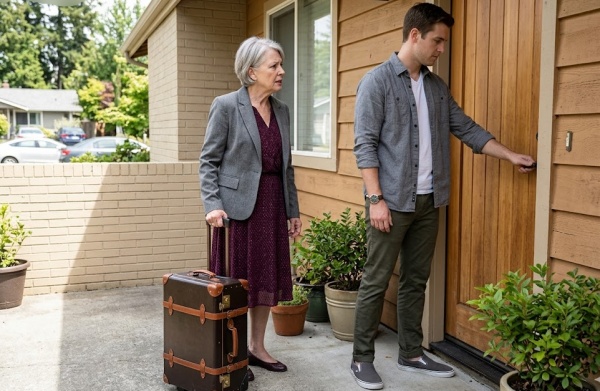
I FLEW 1,400 MILES TO SEE MY SON. HE TOLD ME TO WAIT OUTSIDE. I SAT ON MY SUITCASE FOR 15 MINUTES — THEN I WALKED AWAY. THE 27 MISSED CALLS CAME TOO LATE
I FLEW 1,400 MILES TO SEE MY SON. He glanced at his watch and remarked, “You are 15 minutes early. Just wait outside!”. I SAT ON MY SUITCASE FOR 15 MINUTES — THEN I WALKED AWAY. THE 27 MISSED CALLS CAME TOO LATE.
PART 1: THE INVITATION I HELD ONTO LIKE A LIFELINE
My name is Dorothy Marsh, and I am 69 years old. I live alone in a two-bedroom house in Boise, Idaho, in a quiet neighborhood where the winters are long and the evenings are longer. My husband, Gerald, passed away four years ago from a heart attack — sudden, without warning, without a chance to say goodbye. After that, the house stopped feeling like a home and started feeling like a waiting room. I was always waiting for something. For the phone to ring. For a reason to cook a real meal. For one of my children to say, “Mom, come visit.”
I have two kids. My daughter, Patricia, lives in Portland with her husband and calls me every Sunday without fail. She is steady and warm and reliable in the way that second children sometimes are — as if they absorb all the love the firstborn didn’t know how to receive. And then there is Nick. My firstborn. My boy who used to fall asleep on my chest during thunderstorms and who once told me, at age seven, that he was going to build me a mansion when he grew up. Nick lives in Scottsdale, Arizona, with his wife Linda and their two kids — my grandchildren, Mason and Ava — whom I had not held in nearly eleven months.
Nick is successful. He’ll be the first to tell you that. He runs a mid-size logistics company, drives a white Range Rover, and lives in a house with a pool and a three-car garage in one of those gated communities where every lawn looks identical. He works hard. I know that. I raised him to work hard. But somewhere between the corner office and the gated driveway, something shifted — and the boy who used to save me the last piece of birthday cake started checking his watch when I arrived at his door.
About a month before my trip, we were on the phone — one of those brief, surface-level calls where he was clearly multitasking — and he said, almost offhandedly, “Mom, you can come anytime.” I know how those words sound to someone on the outside. Casual. Polite. Maybe even obligatory. But to a 69-year-old widow sitting alone in Boise on a Tuesday evening with a photo of her grandchildren as her phone wallpaper, those four words felt like an open door. So I walked through it.
PART 2: THE TRIP I PLANNED WITH MY WHOLE HEART
I booked my flight three weeks in advance — a direct Southwest Airlines flight from Boise to Phoenix Sky Harbor, departing on a Friday afternoon. I confirmed the date twice. I texted Nick the details. He replied with a thumbs-up emoji. I told myself that was enough.
I spent the week before my trip preparing with the kind of care that only a mother understands. I went to Target and picked out a LEGO set for Mason, who had just turned eight and was obsessed with space. I found a soft stuffed rabbit for Ava, who was four and still slept with plush animals. I baked a tin of my oatmeal raisin cookies — Nick’s favorite since he was in middle school — and wrapped it carefully so it wouldn’t crumble in my carry-on. I ironed my best dress, a navy blue wrap dress I had bought at Macy’s the previous spring and saved for a special occasion. I wanted to look like someone who belonged there. Like a grandmother. Like family.
The flight landed twenty minutes early. I took an Uber from the airport, and the driver was a cheerful man named Carlos who told me about his own mother in Tucson and how she always brought tamales when she visited. We laughed about how mothers always arrive with food and love and too much luggage. I felt light. I felt hopeful. I watched the desert landscape blur past the window and thought about Mason’s face when he saw the LEGO set, about Ava running toward me with her arms out, about sitting at Nick’s kitchen table with a cup of coffee and finally — finally — feeling like I was somewhere I was supposed to be.
The Uber pulled up to the house at 3:45 p.m. We had agreed on 4 o’clock. I was fifteen minutes early. I almost asked Carlos to drive around the block, but I thought — it’s fifteen minutes. It’s my son. Surely that doesn’t matter. I rolled my suitcase up the driveway, smoothed my dress, and rang the doorbell with a smile already on my face.
Nick opened the door. He did not hug me.
PART 3: THE PORCH, THE SUITCASE, AND THE SILENCE
He looked at his watch first. That’s the detail I keep coming back to — not his expression, not his words, but the fact that the first thing he did when he saw his mother standing on his doorstep after eleven months was look at his watch.
“Mom,” he said. “We said 4 o’clock. It’s only 3:45.”
I laughed a little, the way you laugh when you’re hoping something is a joke. “I know, honey — the Uber was fast. I just couldn’t wait to see you and the kids.” I stepped forward slightly, the way you do when you expect someone to step back and let you in. He didn’t move.
“Linda’s still setting up,” he said, his voice low and flat. “The house isn’t ready. Just wait outside, okay? It’s only fifteen minutes.”
Then he closed the door.
I stood there for a moment, my hand still slightly raised, my smile frozen on my face like something that hadn’t gotten the message yet. Through the door, I could hear voices. Laughter. Music — something upbeat, something that didn’t match the way I felt standing on that porch in my best dress with a tin of oatmeal raisin cookies in my carry-on bag. I set my suitcase down next to the potted cactus by the front door and waited.
Five minutes passed. Then ten. I watched a hummingbird hover near a feeder hanging from the eaves. I thought about Gerald — about how he would have knocked again, loud and laughing, and nobody would have dared leave him standing outside. I thought about the seven-year-old boy who promised me a mansion. I thought about the thumbs-up emoji. At the fifteen-minute mark, I sat down on my suitcase because my legs had started to ache — the arthritis in my left knee flares up when I travel — and that’s when something settled over me. Not anger. Not yet. Something quieter and heavier than anger. The understanding that I had not arrived early. I had simply not been expected at all.
I took out my phone and pulled up Nick’s contact. I stared at his name for a long moment. Then I locked the screen and put the phone back in my purse. I stood up, straightened my dress, picked up my carry-on, and pulled my suitcase back down the driveway. I did not knock again. At the corner of his street, I opened the Uber app, then closed it, then flagged down a passing Yellow Cab instead. The driver looked at me in the rearview mirror — a woman in a nice dress, alone, with luggage, standing on a residential street corner in Scottsdale at four in the afternoon.
“Where to?” he asked.
“Anywhere cheap,” I said.
PART 4: THE MOTEL ROOM AND THE MORNING AFTER
He took me to a Budget Inn off Scottsdale Road — $79 a night, a room that smelled faintly of air freshener and carpet cleaner, with a window that faced the parking lot and a TV bolted to the dresser. I set my suitcase by the bed, sat down on the edge of the mattress, and looked at myself in the mirror across the room. Still in my navy dress. Still wearing the small pearl earrings I had put on that morning because I wanted to look nice for the grandchildren. The tin of cookies was still in my bag, still wrapped.
I did not turn on my phone. I knew what would be on it, and I wasn’t ready. I wasn’t ready to hear Nick’s voice explaining, justifying, minimizing. I wasn’t ready to be told I was overreacting, that I was being sensitive, that it was just fifteen minutes and why did I have to make everything into a big deal. I had heard those words before — not from Nick specifically, but from the version of events that gets rewritten after the fact, where the person who was hurt becomes the person who caused the problem. I was too tired for that rewrite. I ordered a grilled cheese sandwich and a cup of tomato soup from the diner next door, ate it alone at the small table by the window, and went to bed at 8:30 p.m. still in my dress because I didn’t have the energy to change.
I lay in the dark and thought about what it means to get old in America. Not the greeting-card version — the wise grandmother, the silver-haired matriarch surrounded by grateful children — but the real version. The one where you become inconvenient. Where your presence requires preparation, scheduling, and a readiness that nobody quite gets around to. Where you travel 1,400 miles and are asked to wait outside because the house isn’t ready. I thought about my own mother, Eloise, who had died at 84 in a nursing home in Spokane, Washington, and how I had driven four hours every month to sit with her and hold her hand and bring her the butterscotch candies she loved. I had never once asked her to wait outside.
I turned my phone on at 7:14 the next morning. The screen lit up like a small emergency. Twenty-seven missed calls — fourteen from Nick, six from Linda, four from Patricia, two from a number I didn’t recognize, and one from Mason’s school iPad, which meant someone had handed a child a device and told him to call his grandmother. There were also nineteen text messages. The first few from Nick were short and confused — “Mom? Where are you?” and “Mom, please call me.” Then they got longer. Then Linda’s came in, formal and careful in the way that daughters-in-law write when they know they are potentially being screenshotted. Then Patricia’s, which simply said: “Dorothy Ann Marsh, you call me right now.” She only uses my full name when she means it.
PART 5: WHAT I NEEDED THEM TO UNDERSTAND
I called Patricia first. She answered on the first ring, and I could tell she had been awake for a while. She didn’t ask me what happened — she already knew, because Nick had called her in a panic the night before. She just said, “Are you okay?” and something about hearing my youngest child’s voice ask me that simple question made me cry for the first time since I’d sat down on that suitcase. Not loud, ugly crying — just the quiet kind, the kind that comes when you’ve been holding something in for too long and someone finally gives you permission to put it down.
I called Nick an hour later. He answered immediately, his voice tight with something that was trying to be anger but was actually closer to shame. He said he was sorry. He said Linda had been stressed about the house not being clean enough, that she had anxiety about hosting, that he hadn’t meant for it to come across the way it did. He said he had been worried sick all night. He said Mason had cried. I listened to all of it. And when he was finished, I said something I had never said to my son in forty-three years of being his mother.
“Nick, I didn’t come to see a clean house. I came to see you. I came to see my grandchildren. I flew 1,400 miles in my best dress with a tin of your favorite cookies and a LEGO set for Mason and a stuffed rabbit for Ava, and you asked me to wait outside like I was a delivery that had arrived at an inconvenient time. I am your mother. I am 69 years old. I live alone. And I will not wait outside.”
The silence on the other end of the line lasted a long time.
He came to the motel that afternoon — alone, without Linda. He sat across from me at the small table by the parking-lot window, and for the first time in years, he looked like the boy I remembered. Not the man with the Range Rover and the gated driveway, but the boy who used to fall asleep on my chest during thunderstorms. He didn’t make excuses this time. He just said, “I’m sorry, Mom. I’m really sorry.” And I believed him. Not because the words were enough — they weren’t, not entirely — but because of the way he said them. Like he meant them. Like he had spent the night understanding something he hadn’t understood before.
We spent two days together after that. Not at his house — not right away. We had lunch at a little café on Old Town Scottsdale’s Main Street, just the two of us, and talked for three hours in a way we hadn’t talked since Gerald’s funeral. On the second day, he brought Mason and Ava to meet me at a park near the motel. Mason tore into the LEGO set with the focused intensity of a child who has been waiting for exactly this. Ava climbed into my lap within thirty seconds of meeting me and stayed there for the better part of an hour, clutching her new rabbit. I held her and breathed her in and thought — this is why I came. This is the whole reason.
I flew home to Boise on Sunday. Patricia called me as soon as I landed. We talked for an hour. She said, “You know you could have called me and I would have driven down.” I told her I knew. I told her that sometimes a person needs to sit alone in a motel room for one night to figure out what they’re actually worth. She laughed and said that was the most Dorothy Marsh thing she had ever heard.
I’m sharing this because I know I’m not the only one. I know there are mothers and fathers reading this right now who have felt the particular ache of being an afterthought in the lives of the children they gave everything to. I know there are grandparents who have learned to shrink themselves — to call less, to ask for less, to arrive exactly on time and leave before they become a burden. I want to say this to every single one of you:
You are not a burden. You are not an inconvenience. You do not have to wait outside.
The people who love you — truly love you — will open the door before you even ring the bell. And the ones who make you wait? Sometimes they just need one quiet night and 27 missed calls to remember what they almost lost.
I still have the tin of cookies. I brought them home unopened. Last week, I baked a fresh batch and mailed half of them to Nick. He called me when they arrived. He said they were perfect. He said Mason ate four of them before dinner.
He also said, “Mom — next time, just come. Don’t even text. Just come.”
I think we’re going to be okay.
