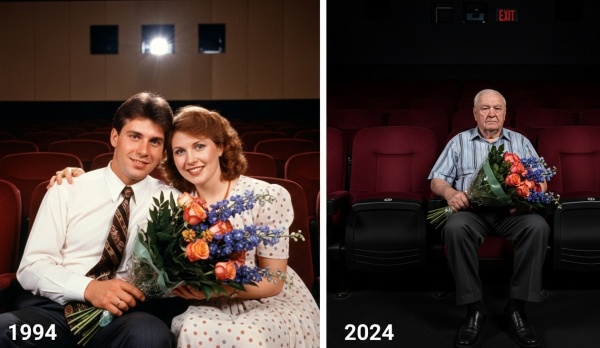
For Years, the Old Man in the Suit Bought Two Tickets and Sat Alone. Nobody Knew Who the Second Seat Was For. Until That Day…
The staff at the Majestic Cinema in Savannah called him “the gentleman” — Edward Whitmore, 70 years old, suit pressed, white gardenias in hand, Row G seat 7, every single weekday morning without exception. He always bought two tickets. He always placed the flowers on seat 8. He always watched the movie alone.
For years, nobody knew the full story: that thirty years earlier, a woman named Evelyn had worked the ticket counter at that same cinema, that one October night had changed everything, and that she had disappeared before she ever got to sit in that seat. Edward had spent three decades keeping it warm for her anyway. On the morning he finally broke down and cried in the dark…
Part 1: The Man in the Suit With the Flowers
My name is not important to this story. What is important is that I worked the concession stand at the Majestic Cinema on Elm Street in downtown Savannah, Georgia for eleven years, and in all those years, the most remarkable thing I ever witnessed had nothing to do with any movie that played on our six screens. It had to do with an old man named Edward Whitmore, a bouquet of white gardenias, and the kind of love that most people spend their entire lives reading about in novels and quietly doubting is real. I am writing this down because Edward asked me to, in the way that people ask for things when they understand that their time for asking is running short. He said, “Claire, you were there for all of it. You should be the one to tell it.” So I am telling it.
Edward Whitmore was 70 years old when I first noticed the pattern, though the pattern had apparently been going on for years before I was paying close enough attention to recognize it for what it was. He was a tall man, slightly stooped at the shoulders in the way of tall men who have spent decades unconsciously trying to take up less space, with white hair combed neatly to the side and the kind of face that had clearly been handsome once and had aged into something better — weathered and kind and deeply lined around the eyes from what I eventually understood was a lifetime of both laughing and grieving. He wore a suit every single time he came in. Not a casual blazer, not slacks and a sport coat — a full suit, pressed and proper, with a pocket square that matched his tie. In eleven years, I never saw Edward Whitmore enter the Majestic Cinema in anything less.
He came every weekday morning for the first screening, which at the Majestic ran at 10:15 AM. He arrived at approximately 9:50, which gave him time to stop at the flower stand two doors down — a small operation run by a Vietnamese family named the Nguyens — and purchase a bouquet of white gardenias. He carried the gardenias in his left hand and his wallet in his right, and he approached the ticket window with the unhurried dignity of a man who has nowhere else to be and considers that a privilege rather than a loss. He always bought two tickets. Always for the same seats: Row G, seats 7 and 8, center of the house, what the old-timers called the “sweet spot” for sound and picture.
He sat in seat 7 and placed the gardenias on seat 8, and he watched whatever was playing with the attentive courtesy of a man who believes that showing up for something fully is a form of respect. After the movie, he folded his program — he always took a program, even when they were just photocopied sheets — placed it in his breast pocket, gathered the gardenias, and left. The flowers went with him. Seat 8 remained empty. Every single day. For years. My colleague Marcus, who had worked at the Majestic longer than anyone, told me Edward had been coming in since long before I started — since at least 2009, possibly earlier. That was when I began to understand that what I was witnessing was not eccentricity. It was devotion.
Part 2: The Love That Started at a Ticket Counter
I asked Edward about the two tickets on a Tuesday morning in March, about three years into my time at the Majestic. I had been working up to it for months, afraid of intruding on something private, but that morning he had come in looking more tired than usual, and something in his expression made me feel that he might actually want to be asked. I handed him his tickets and said, as gently as I could manage, “Mr. Whitmore, I hope you don’t mind me asking — who’s the second ticket for?” He looked at me for a moment with those deeply lined eyes, and then he smiled, and it was the saddest smile I have ever seen on a human face. “Her name is Evelyn,” he said. “I’m waiting for her.”
He told me the story in pieces, over the months and years that followed, in the way that old people tell the stories that matter most — not all at once, but in installments, as if the telling needs to be rationed to be survived. The short version is this: thirty years earlier, in the early 1990s, Edward had been a 40-year-old architect living in Savannah, recently separated from his first wife, professionally successful and personally adrift in the specific way of men who have built the life they were supposed to want and found it slightly hollow. He had started going to the Majestic Cinema alone on weekday mornings because the empty theater felt like the only place in the city where no one expected anything from him.
Evelyn worked the ticket counter. She was 35, with dark hair and a laugh that Edward described, every single time he mentioned it, as “the kind of laugh that makes you feel like the world is fundamentally okay.” She had grown up in Savannah, had a degree in literature from Armstrong State that she’d never quite figured out how to use, and had been working at the Majestic for two years when Edward first noticed her. He noticed her the way you notice something that changes the quality of the light in a room — not dramatically, not all at once, but in a way that makes you realize, looking back, that everything was different from the moment it happened. He started coming to the cinema more often. He started arriving earlier. He started finding reasons to linger at the ticket counter.
Their romance, by Edward’s account, was electric in the way that romances are electric when they happen between two people who are both old enough to know what they want and young enough to still be surprised by it. Candlelit dinners at a small Italian restaurant on Congress Street that has since closed. Long walks along the Savannah River in the evenings. Conversations that went until two in the morning and felt, Edward said, like finding out that someone had been reading the same book you’d been reading your whole life and had dog-eared all the same pages. And one night — a warm Friday in October, with the windows open and the smell of the river in the air — that was, in Edward’s careful, private telling of it, the kind of night that becomes the standard against which every subsequent night is measured.
They parted in the early morning hours of that Saturday with the plan that Edward would come to the cinema Monday morning, buy two tickets, and they would see a movie together for the first time — not him watching from the audience while she worked the counter, but side by side, in the dark, like a real beginning. He bought the gardenias on the way. He bought two tickets. He sat in Row G, seat 7, and he placed the flowers on seat 8, and he waited. Evelyn never came. Not that Monday. Not the Tuesday after. By Wednesday, Edward went to the counter and asked for her, and a different woman — young, apologetic, clearly uncomfortable — told him that Evelyn no longer worked there. She had been let go over the weekend. No forwarding information. No way to reach her. Just gone, the way people disappeared before the internet made disappearing nearly impossible.
Part 3: The Years Between and the Promise He Kept to Himself
Edward spent the better part of a year trying to find Evelyn through the limited means available in the early 1990s — asking mutual acquaintances, checking the phone book, driving past the apartment building where she’d mentioned she lived and finding a different name on the mailbox. She had left Savannah, someone eventually told him, though no one seemed to know where she’d gone or why she’d left so suddenly. Edward was a methodical man — an architect’s brain, precise and persistent — and the fact that she had simply vanished without a trace was something he could not fully accept. But accepting and understanding are different things, and eventually he had to accept that Evelyn was gone even though he never understood why.
Life continued, as it does, with the indifferent momentum of time. Edward remarried in 1998 — a woman named Margaret, a schoolteacher from Savannah who was warm and steady and genuinely good, who knew about Evelyn in the general way that spouses know about the significant loves that preceded them and who never asked Edward to pretend that chapter hadn’t existed. Edward loved Margaret in the real, daily, chosen way that long marriages are built on, and he was faithful to her and present for her and genuinely grateful for the life they built together. They had no children — a quiet grief they carried together — but they had thirty years of Tuesday evenings and Sunday mornings and the particular intimacy of two people who have decided to know each other completely.
Margaret died in 2019, after a brief and brutal battle with pancreatic cancer that took her from diagnosis to death in eleven weeks. Edward was 67 years old and alone for the first time in two decades, and the grief of losing Margaret was real and deep and took everything he had for the better part of a year. But grief, Edward told me once, has a way of clarifying things — of burning away the things you’ve been telling yourself and leaving only what’s actually true. And what was true, in the quiet of his house in the Ardsley Park neighborhood of Savannah, in the months after Margaret’s death, was that he had never stopped wondering about Evelyn. Not as a betrayal of Margaret — he was clear about that, and I believed him — but as an unfinished sentence in the story of his life that had been sitting incomplete for thirty years.
He started coming to the Majestic in the spring of 2020, a few months after Margaret’s death. He bought two tickets. He sat in Row G, seat 7. He placed the gardenias on seat 8. He watched the movie. He went home. He came back the next morning and did it again. I asked him once what he thought would happen — whether he actually believed Evelyn would walk through the door. He was quiet for a long time before he answered. “I don’t know if I believe she’ll come,” he said finally. “But I know that if she ever does come back to Savannah, and if she ever walks past this cinema, and if something makes her walk in — I want her to find me here. I want her to know I waited.” He paused. “And if she never comes, then at least I spent my mornings somewhere that reminds me of the best thing that ever happened to me. That’s not nothing, Claire. That’s actually quite a lot.”
Part 4: The Morning Everything Changed
It was a Wednesday in late September — I remember because we had just changed the marquee to reflect the new fall releases, and I had been up on the ladder doing it myself because our maintenance guy had called in sick. Edward arrived at his usual time, 9:50, with his usual gardenias, in his usual suit — a charcoal gray one I recognized as his favorite, the one with the faint pinstripe that he wore when, I had come to understand, he was feeling something more than usual. He bought his two tickets. He said good morning to me with the courtesy he always showed, asked about my daughter Emma’s soccer season, and made his way into Theater Two, where a quiet drama about a lighthouse keeper was playing to an otherwise empty house.
I watched the movie from the doorway for a few minutes, the way I sometimes did when the morning was slow. Edward sat in his seat with the gardenias on the seat beside him, and he watched the screen with the focused attention he always brought, and he looked, from the back, like a man who was entirely at peace. But when I came back twenty minutes later to check the theater, I saw something I had never seen before in all the years I had known him. Edward had his face in his hands. His shoulders were moving in the small, controlled way of a person trying very hard not to make a sound. The gardenias sat on seat 8, white and fragrant and patient, and Edward Whitmore was crying in the dark of an empty movie theater, and the sight of it broke something open in my chest that I am not sure has fully closed since.
I was about to go to him — I had actually taken two steps into the theater — when I heard the lobby door open behind me. I turned, expecting a late arrival for the 10:15, and instead found a woman standing in the entrance of the Majestic Cinema with the particular stillness of someone who has just arrived somewhere they weren’t entirely sure they were going to be able to make themselves come to. She was about 65, with silver hair cut short and neat, wearing a pale blue cardigan and carrying a small handbag, and she was looking at the door to Theater Two with an expression I recognized immediately even though I had never seen it before — the expression of someone standing at the edge of something they have been approaching for a very long time.
She looked at me, and I looked at her, and she said, quietly, “Excuse me. I know this is an unusual question.” She paused. “Is there — is there still a man who comes here every morning? An older gentleman, tall, always in a suit?” My heart stopped. Then it started again, faster. “Row G,” I said. “Seat 7.” Her eyes filled with tears so quickly it looked like a physical response rather than an emotional one, like something her body did before her mind gave permission. “He’s still here,” she whispered. It was not a question. She said it the way you say something you have been afraid to hope for so long that hearing it confirmed feels dangerous. “He’s still here,” I said. “He’s been here every morning.” She pressed her hand over her mouth for a moment. Then she straightened, smoothed her cardigan, and said, “Could you tell me — does he still buy two tickets?”
Part 5: Seat 8
I did not follow her into the theater. Some moments are not meant to have witnesses, and I understood instinctively that this was one of them. I stood at the door and watched her walk down the aisle in the dim light of the movie screen, and I watched the moment she stopped at Row G, and I watched Edward Whitmore — who had his face in his hands and did not hear her footsteps over the sound of the film until she was very close — go completely still.
He told me afterward, in the careful, precise way he told all the things that mattered most, what those first seconds were like. He said he heard footsteps — soft, unhurried, moving down the aisle with the particular rhythm of someone who knows where they’re going. He said he smelled gardenias, which confused him for a moment because the gardenias were already on seat 8, and then he realized the smell was different — not his flowers but a perfume, a specific perfume that hit him somewhere below memory and above reason, in the place where the body stores the things the mind has tried to let go of. He said his heart did something he didn’t have a word for. He said he was afraid to look up because he was 70 years old and had been waiting for thirty years and the possibility that he was imagining it was more than he could bear to confirm.
But he looked up. Because Edward Whitmore had been buying two tickets and placing gardenias on an empty seat for five years, and before that had spent twenty-five years carrying a quiet, faithful hope in the back of his heart like a pilot light that never quite went out, and a man who does that is a man who, when the moment finally comes, finds the courage to look. He raised his head. And Evelyn — Evelyn, thirty years older and silver-haired and more beautiful to him in that moment than she had been at 35, because she was real and she was here and she was standing in the aisle of Row G looking at him with tears running down her face — said the only thing there was to say. “I’m sorry I’m late,” she said. And she sat down in seat 8.
I learned the rest of the story over the weeks that followed, in pieces, the way the best stories are always told. Evelyn had been let go from the Majestic in October 1993 because the cinema had been sold to new ownership and the new owners had brought in their own staff — a business decision that had nothing to do with her and everything to do with the timing that had kept two people apart for three decades. She had left Savannah because she had family in Atlanta and no reason to stay, and she had spent years wondering about the man who had bought two tickets and waited in Row G and never known that she hadn’t chosen to disappear. She had married, briefly and unhappily, in her early forties. She had built a quiet life in Atlanta working as a librarian, which suited her literature degree and her temperament perfectly. She had thought about Edward Whitmore more times than she could count.
She had come back to Savannah to help her niece settle an estate, and on her second day in the city she had driven past the Majestic on her way to the attorney’s office and seen the marquee and felt something pull at her that she had been feeling, in various forms, for thirty years. She had driven past three more times over two days before she finally parked the car and walked to the door. She told me she had almost turned back four times on the way from the parking lot to the entrance. She told me what stopped her was the flower stand two doors down — the Nguyens’ stand, still there after all these years — and the fresh gardenias in the bucket by the door, and the thought that a man who still bought gardenias after thirty years deserved, at minimum, to know that she had come.
Edward and Evelyn sat in Row G, seats 7 and 8, through the rest of that Wednesday morning film and the afternoon showing that followed it. They talked in the lobby for two hours after that. He took her to dinner at a new Italian restaurant on Congress Street — not the same one, that one had closed years ago, but close enough in spirit. They talked until the restaurant closed. He drove her back to her niece’s house and walked her to the door and held both her hands in his for a long moment before he said goodnight. He came to the Majestic the next morning at 9:50 with white gardenias, bought two tickets, and sat in Row G, seat 7. At 10:12, three minutes before the film began, Evelyn walked in and sat in seat 8.
She has sat in seat 8 every morning since. She moved back to Savannah four months after that Wednesday, into a small house in the Ardsley Park neighborhood — two streets from Edward’s house, which was either coincidence or the universe making a point. They are not in a hurry. They are 70 and 65 years old and they have already spent thirty years being in a hurry in the wrong direction, and they have decided, by what appears to be mutual and unspoken agreement, to take the time they have left slowly and with full attention. Edward still wears his suit. He still buys the gardenias. The difference is that now, when he places them on seat 8, he doesn’t leave them there. He hands them to Evelyn when she sits down, and she holds them in her lap through the whole film, and afterward they fold their programs and put them in their pockets and walk out of the Majestic together into whatever the Savannah morning has to offer.
I asked Edward once, not long after Evelyn came back, whether the thirty years felt like a waste. He thought about it for a long time — the way he thought about everything that mattered, slowly and without apology for the slowness. Then he said: “You know what an architect learns, Claire? That the foundation is the whole thing. You can change the walls, you can change the roof, you can renovate everything above the ground. But the foundation is what holds. Thirty years didn’t waste anything. Thirty years was the foundation.” He paused. “Besides,” he said, with the smile that was no longer sad, “she came. She sat down. That’s the whole story, right there.”
He was right. That is the whole story. The rest is just the two of them, in Row G, seats 7 and 8, watching whatever is playing, together.
