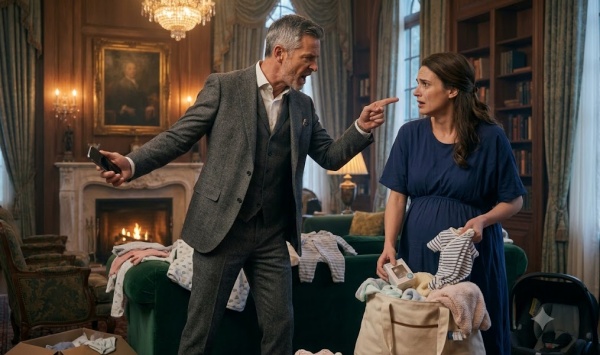
Hours Before Giving Birth, I Found Out My Husband Sent Our $1 Million Birth Fund to His Ex
I was packing the last tiny onesies into my hospital bag when a bank alert lit up my phone. One million dollars—the money meant for my delivery, recovery, and our baby’s future—was gone. My husband had sent it to his ex-girlfriend without telling me, then looked me in the eye and said she needed it more.
Part 1: The Night Before Everything Changed
I was thirty-nine weeks and six days pregnant when I found out my husband had emptied the account we called our “birth fund.” It was almost midnight, and I was standing in our kitchen in Austin, Texas, barefoot on the cold tile, one hand under my belly and the other holding my phone so tightly my knuckles hurt. The screen showed a wire transfer for $1,000,000, and the recipient’s name was not mine, not the hospital’s, not our child’s.
It was Vanessa Hart.
My husband’s ex-girlfriend.
For a few seconds, I thought I was reading it wrong. Pregnancy had made everything feel foggy lately—dates, passwords, even the names of people I met twice at baby showers. But numbers do not become blurry just because you are nine months pregnant, and a million dollars does not accidentally walk out of a bank account.
The account had not been just for labor and delivery. That was what we called it because it sounded softer, less frightening, and maybe a little sweet. In truth, it was the money that was supposed to carry us through my unpaid maternity leave, medical bills, a night nurse for the first few months, my recovery, the baby’s first year, and the down payment on the house we had been planning to buy before kindergarten became a word we actually had to worry about.
Most of that money came from my side of the family. My grandmother had passed away the year before, leaving me investments she built from a tiny bakery she opened in San Antonio in the 1970s. She used to tell me that money was not love, but it could protect love from panic, and I had believed that when I moved those funds into an account my husband and I could both access.
I had trusted him because that was what wives were supposed to do, at least in the version of marriage I had been trying to build. Trust your husband when he says he will handle the bank paperwork. Trust him when he says joint access makes things easier if you go into labor suddenly. Trust him when he kisses your forehead and says, “Baby, we’re a team.”
That night, the “team” was sleeping upstairs while I was staring at proof that he had sent our future to a woman he claimed he barely spoke to anymore. My belly tightened, not in the sharp way my doctor had warned me about, but in a slow, hard wave that made me grab the edge of the kitchen counter. I breathed the way our childbirth instructor had taught us, in through the nose, out through the mouth, but nothing about that class had prepared me for betrayal.
At first, I did not wake him. I sat at the kitchen island and opened every banking email I could find, scrolling through confirmations, security alerts, and one message that had landed in my spam folder that afternoon. The wire had been initiated at 2:14 p.m., while I was at my final prenatal appointment, smiling at an ultrasound photo and telling the nurse my husband was “just stuck at work.”
The bank had flagged the transaction because of the amount. There were two verification calls, both completed. The notes said the account holder confirmed the transfer was intentional and urgent, which meant he had looked someone in the eye, or at least answered someone’s questions, while moving one million dollars away from his pregnant wife and unborn child.
A strange calm came over me then. It was not peace, and it was not numbness. It was the kind of calm I imagine comes before a tornado, when the sky turns the wrong color and every bird disappears because even nature knows to get out of the way.
I climbed the stairs slowly, gripping the railing through another contraction. Our bedroom door was half open, and the soft glow of the baby monitor screen lit the wall, even though the crib was still empty. Mark was asleep on his side, one arm stretched across my pregnancy pillow like he had missed me.
For one weak second, I wanted to crawl back into bed and pretend I had not seen anything. I wanted to be the woman I had been that morning, the woman who packed tiny socks into a hospital bag and laughed because newborn clothes looked too small to be real. I wanted my biggest fear to be whether I would need an epidural, not whether my marriage had already ended while I was still wearing my wedding ring.
“Mark,” I said.
He stirred, but did not wake.
“Mark,” I said again, louder this time.
He opened his eyes, blinking into the dark. “Em? Are you okay? Is it time?”
I held up my phone. “What did you do?”
He looked confused for half a second. Then his eyes found the screen, and the color drained from his face in a way that told me everything before he said a word. He sat up slowly, like sudden movement might make the truth worse.
“Emily,” he said. “I can explain.”
And somehow, those three words hurt more than the wire transfer itself.
Part 2: The Explanation That Broke Me
I had heard women say before that betrayal feels physical, but I never understood it until that night. It was not just sadness or anger. It was heat behind my eyes, pressure in my chest, and a coldness in my hands that made my phone feel like a piece of ice.
“Explain,” I said.
Mark rubbed his face and looked toward the nursery door, as if the room full of unopened diapers and neatly folded onesies might defend him. “Vanessa was in trouble,” he said. “Serious trouble.”
I waited, because I wanted him to hear how insane that sounded without my help.
“She called me last week,” he continued. “Her business deal collapsed, and she was about to lose everything. Her condo, her company, maybe even custody time with her son if she couldn’t stabilize things. She was desperate.”
“So you sent her a million dollars,” I said.
“It was a loan.”
I laughed once, but it came out so sharp and ugly that he flinched. “A loan you didn’t mention to your wife. From an account you knew was for our baby. Hours before I’m supposed to give birth.”
His jaw tightened. “You’re making it sound like I stole it.”
“What would you call it?”
“I had access to the account too.”
There it was—the kind of technical truth people use when the moral truth is too disgusting to touch. He did have access. I had given it to him because my grandmother’s attorney said married couples often shared accounts for household planning, and because Mark had smiled across the conference table and squeezed my knee.
I stared at him and remembered that day clearly. He had worn the navy suit I loved, the one that made him look responsible and kind. He had told my mother he would “protect Emily and the baby with everything I have,” and everyone in the room had believed him.
“Did Vanessa know where the money came from?” I asked.
He looked away.
That was the second answer.
“Did she know I’m due tomorrow?”
He stood up and started pacing. “This isn’t about you.”
Something inside me went still.
I think every marriage has a sentence that cannot be unsaid. For some people, it is an affair confession, a cruel insult, or a secret debt. For me, it was my husband telling his pregnant wife, while she was having contractions in their bedroom, that giving away their child’s safety net was “not about her.”
I set the phone on the dresser because I was afraid I might throw it. “Then who is it about, Mark?”
He dragged both hands through his hair. “Vanessa had nobody else.”
“She has you.”
“That’s not fair.”
“Neither is labor.”
He closed his eyes. “You don’t understand what she’s been through.”
That was when I really saw him. Not the man who painted the nursery sage green because I said white walls felt too cold. Not the man who cried at our gender-neutral baby shower when his sister gave us a framed copy of the baby’s ultrasound. I saw a man who still believed another woman’s emergency outranked his wife’s entire life.
“What has she been through that requires our birth fund?” I asked. “And why does her crisis matter more than your child?”
“She was there for me before you knew me.”
The words landed quietly, but they opened a door I had spent years politely not looking at. Vanessa had always been “complicated history,” according to Mark. They dated for nearly four years in their twenties, broke up because they “wanted different things,” and stayed in the same extended social circle because Austin was somehow both a city and a small town when people wanted excuses.
When we got engaged, Vanessa sent us a bottle of champagne and a card that said, “Wishing you both peace.” I remember thinking it was odd, not rude exactly, but heavy in a way congratulations should not be. Mark told me I was overthinking it.
After our wedding, she appeared at charity events, mutual friends’ birthdays, and one Fourth of July barbecue where she hugged Mark for too long while holding a sparkler in her other hand. I mentioned it in the car afterward, and he laughed. “She’s like family,” he said.
Now, standing in our bedroom with my hospital bag packed by the door, I understood that “like family” had always meant something more dangerous. Family was obligation. Family was history. Family was the person you answered when they called at midnight.
“I am your wife,” I said. “The baby is your family.”
His eyes filled, but I could not tell if it was guilt or fear of consequences. “I know that.”
“No,” I said. “You know it when it’s convenient.”
He reached for me, and I stepped back. The movement was small, but it changed the room. His face crumpled a little, like I had finally done something unforgivable.
“Emily, please,” he said. “We can fix this.”
“How?”
“I’ll get it back.”
“When?”
He hesitated.
I nodded slowly. “You don’t know.”
“She said she could return it after the sale closes.”
“What sale?”
“Her investors—”
“Stop.” I held up my hand. “Do you have a signed loan agreement?”
His silence was louder than shouting.
“Did you talk to an attorney?”
“No.”
“Did you ask the bank whether this could be reversed?”
“I didn’t think—”
“No,” I said. “You didn’t think about me.”
A contraction rolled through me then, stronger than the others. I gripped the dresser and bent forward, breathing through my teeth. Mark moved toward me instinctively, but I shook my head.
“Don’t touch me.”
He froze.
When the contraction passed, I stood up straight and felt different. Not stronger exactly, but clearer. I had spent months being afraid of childbirth, afraid of pain, afraid of tearing, afraid of not knowing how to be a mother, but suddenly those fears felt smaller than staying married to a man who could look at me and our unborn child and choose someone else.
“I’m going to the hospital in the morning,” I said. “My mother will drive me.”
His face went pale again. “You don’t mean that.”
“I do.”
“I’m the father.”
“Yes,” I said. “And tomorrow, you can decide what kind of father you’re going to be. But tonight, you already showed me what kind of husband you are.”
He sat down on the bed like his legs had given out. For a moment, I saw the man I had loved, terrified and small in the wreckage he had made. But love, I learned that night, does not always die in one explosion.
Sometimes it steps backward, quietly, until you realize it is no longer standing beside you.
Part 3: The Morning I Became a Mother
My mother arrived at 5:38 a.m. with coffee she knew I would not drink, a tote bag full of snacks, and a face that told me Mark had already called her. She did not ask questions at first. She just walked into the kitchen, saw me sitting at the table with my coat on, and put one hand on my shoulder.
“Do you have your hospital bag?” she asked.
“Yes.”
“Insurance card?”
“Yes.”
“Phone charger?”
“Yes.”
“Do you want me to say anything to him?”
I looked toward the hallway where Mark stood barefoot, unshaven, and ruined-looking. He had spent the rest of the night downstairs, apparently calling Vanessa, the bank, and maybe God for all I knew. None of them had produced a million dollars by sunrise.
“No,” I said. “I want to go.”
Mark followed us to the driveway with my bag in his hand. The Texas sky was still gray, and the air smelled like wet pavement from a storm that had passed during the night. I remember thinking it was unfair that the world looked washed clean when I felt contaminated by everything I now knew.
“Emily,” he said beside the car. “Please let me come.”
My mother opened the back door and looked at me, letting the choice be mine.
I had imagined this moment so differently. Mark was supposed to be nervous and sweet, making bad jokes at red lights, holding my hand while I timed contractions on an app. He was supposed to cut the cord, cry when the baby cried, and tell me I was incredible even if I screamed at him during transition.
Instead, he stood in our driveway after giving another woman the money meant to protect us.
“You can come to the hospital,” I said. “But not in this car.”
His eyes flashed with hope, which made me almost sorry for what I said next.
“And not in my room unless I say so.”
He swallowed. “That’s not fair.”
I looked at him for a long second. “You keep using that word like you still know what it means.”
My mother drove carefully, hands at ten and two, like I was made of glass. She did not curse Mark, though I know she wanted to. She only asked how far apart the contractions were and whether I had eaten anything, because mothers understand that rage still needs blood sugar.
About halfway to St. David’s, I started crying. Not sobbing, not dramatically, just tears running down my face while I stared out the window at coffee shops opening and people walking dogs in hoodies. Life was beginning everywhere, ordinary and careless.
“I’m so embarrassed,” I whispered.
My mother’s hands tightened on the wheel. “For what?”
“For trusting him.”
She shook her head. “No. Shame belongs to the person who broke the trust, not the person who gave it.”
I wanted to believe her, but humiliation is sticky. It clings to the innocent because the guilty are often too busy explaining themselves to carry it. I thought about every friend who had told me Mark was “one of the good ones,” every cousin who said I was lucky, every photo on Instagram where we looked like a soft-filtered version of happiness.
At the hospital, the lobby smelled like disinfectant, coffee, and something faintly floral from a gift shop display near the entrance. A volunteer in a red vest asked if we needed Labor and Delivery, and my mother said yes before I could answer. The word “delivery” sounded too simple for what was happening.
Upstairs, a nurse named Denise checked me in. She was around my mother’s age, with silver hair pulled into a bun and the kind of calm voice that made you feel like maybe humans could survive anything. She asked if I felt safe at home as part of the standard intake, and I stared at the wall for a second too long.
My mother looked at me.
Denise looked at me too, but gently.
“I’m not in physical danger,” I said. “But I don’t want my husband in the room unless I approve it.”
Denise did not blink. “We can note that.”
Just like that.
No courtroom, no family debate, no pleading from Mark, no pressure to be a “good wife” while my body prepared to split itself open for our child. A nurse wrote down my boundary, and the world did not end.
When they gave me the hospital bracelet, I looked at my wrist and felt the strange officialness of it. Name, date of birth, medical record number. Proof that I existed separately from my marriage.
Mark arrived forty minutes later. I knew because my phone lit up with his texts first, then my mother stepped out to speak with someone at the nurses’ station. I was in a triage room wearing a hospital gown that opened in the back and made dignity feel like a hobby I had temporarily abandoned.
His first message said, I’m here. Please.
His second said, Vanessa says she can send some of it back next week.
His third said, Don’t punish me by keeping me from our baby.
I stared at that one for a long time.
Punish him.
As if my labor room were a VIP lounge and not the place where I was about to endure the most vulnerable hours of my life. As if access to my pain was something he was owed because biology had given him a title.
Denise came in to check on me, and I asked her if fathers had automatic rights to be in delivery rooms. She said the patient decides who is present during labor and delivery, and she said it with the firm kindness of someone who had repeated that sentence many times before. My mother stood behind her, eyes shining.
“Then he waits,” I said.
And he did.
For six hours, Mark waited outside while my labor took over everything. I stopped being a betrayed wife and became a body with a single purpose. Contractions came like waves with teeth, and I held my mother’s hand so hard she later joked I nearly retired her fingers.
Between contractions, my mind wandered to strange places. The nursery mobile. The million dollars. Vanessa’s name on the screen. My grandmother’s hands dusted with flour.
During one brutal contraction, I heard myself say, “I can’t do this.”
Denise leaned close. “You are doing it.”
That sentence carried me.
Not Mark’s apologies through text. Not memories of our wedding vows. Not the fantasy of the family I thought I was building.
You are doing it.
At 2:17 p.m., my daughter was born.
She came into the world furious, red-faced, and loud enough to make everyone in the room laugh with relief. When they placed her on my chest, she stopped crying for half a second, as if she recognized the rhythm she had been living under for months.
My mother cried openly. Denise wiped her eyes and pretended she had allergies. I looked down at my daughter’s tiny mouth, her wrinkled forehead, her impossibly small fingers curling against my skin, and something ancient rose inside me.
Her name was Clara June.
Clara for my grandmother, whose bakery money had become a battlefield. June because Mark and I once joked that it sounded like sunshine. I did not know yet whether I would keep the middle name, but in that moment, with my daughter breathing against me, I could not hate anything connected to her.
Denise asked softly if I wanted Mark to come in.
I closed my eyes.
I had promised myself all morning that he would not be there for the birth. He had not earned that. But this baby was not a weapon, and I refused to make her first day alive only about what he had destroyed.
“Give me ten minutes,” I said.
Those ten minutes were mine.
I kissed Clara’s damp hair and whispered things I had not planned. I told her she was safe. I told her she was loved. I told her I would never make her compete with someone else for basic loyalty.
When Mark finally entered, he looked like a man walking into church after committing a sin he had not yet confessed out loud. His eyes went straight to the baby, and his face collapsed. He covered his mouth with one hand.
“She’s beautiful,” he whispered.
“She is,” I said.
He came closer, but stopped when I did not invite him all the way in. For once, he seemed to understand that a boundary was not a negotiation. He looked at Clara, then at me, and tears slipped down his face.
“Emily,” he said. “I’m so sorry.”
I looked down at my daughter instead of at him.
“So am I,” I said.
Part 4: The Truth Behind the Million Dollars
By the next morning, the hospital room had become a strange little island. Nurses came and went, Clara slept in short unpredictable bursts, and my mother had become a professional at opening tiny diaper tabs. Outside the window, Austin traffic moved along like nothing sacred or terrible had happened.
Mark slept in a chair for maybe twenty minutes at a time. I had allowed him to stay during visiting hours, mostly because watching him hold Clara told me things I needed to know. He loved her, or at least he was overwhelmed by her, but loving a baby in a hospital room is not the same as being trustworthy when life gets complicated.
At 9:12 a.m., my phone rang. It was a number I did not recognize, and normally I would have ignored it. But something told me to answer.
“Is this Emily Carter?” a woman asked.
“Yes.”
“My name is Rachel Stein. I’m an attorney with Hill & Navarro. I represent a private lender who has been trying to locate Mark Carter regarding a financial guarantee connected to Vanessa Hart.”
My blood turned cold.
I looked at Mark, who was standing near the bassinet trying to swaddle Clara and failing. He looked up when he heard his name. The room seemed to narrow around us.
“I just gave birth yesterday,” I said slowly. “So whatever this is, you need to speak very clearly.”
The attorney paused. Her voice softened, but only slightly. “I’m sorry to contact you at this time. We were given your number as an emergency contact.”
“By whom?”
“Your husband.”
Mark closed his eyes.
That was how I learned the million dollars was not a rescue gift, and it was not simply a loan to an ex-girlfriend in crisis. It was part of a larger mess involving Vanessa’s failed boutique hotel investment outside Santa Fe, a private loan, and Mark’s signature on documents he claimed he had not fully understood. He had guaranteed part of Vanessa’s obligation months earlier, when I was in my second trimester and spending my evenings comparing car seats online.
I put the call on speaker.
Rachel explained that the transfer did not clear the whole problem. It only bought time. Vanessa still owed money, Mark might also be liable depending on the signed agreements, and there were questions about whether marital funds had been moved without proper disclosure.
Mark sat down heavily in the chair.
“Tell her it’s not like that,” he said.
Rachel went quiet.
I almost laughed again, but Clara stirred in the bassinet, and the sound anchored me. “Mark,” I said, “do not speak to me through the attorney you dragged into my postpartum hospital room.”
My mother picked up Clara before the baby could cry. She held her against her shoulder and began bouncing gently, eyes fixed on Mark with a level of restraint that deserved national recognition. If anger could have a temperature, that room would have set off the sprinklers.
After the call ended, Mark tried to explain. Again. Explanations had become his favorite hiding place.
He said Vanessa came to him months ago, ashamed and frantic. He said she reminded him of how she had supported him after his father died, how she had covered his rent one summer, how she had believed in him before he became the kind of man who owned good suits and talked about equity portfolios. He said he signed the guarantee because he thought it was symbolic.
“Symbolic?” I repeated.
“I didn’t think it would come to this.”
“You didn’t think it would come to your pregnant wife finding out in a hospital gown?”
He pressed his palms against his eyes. “I was going to fix it before you knew.”
That sentence was the final nail.
Not because it was the worst thing he had said, but because it showed me the shape of his thinking. He did not regret deceiving me because deception was wrong. He regretted getting caught before he could make the evidence disappear.
I asked him to leave the room.
He begged.
I asked again.
He said, “Please don’t do this to our family.”
That was when my mother spoke for the first time in nearly an hour. Her voice was quiet, but it cut through everything.
“You did this to your family, Mark.”
He looked at her, then at me, then at Clara. I saw him understand that there would be no dramatic speech capable of reversing what had happened. No tears big enough. No flowers expensive enough.
After he left, I called my grandmother’s attorney, Mr. Alvarez. He had known me since I was fourteen and once scolded me for signing a gym membership contract without reading the cancellation clause. When I told him what happened, he did not sound shocked, which somehow made me feel worse.
“Emily,” he said, “do not sign anything. Do not agree to any repayment plan. Do not discuss details by text beyond the basics, and do not let anyone pressure you while you’re recovering.”
“I don’t even know what I’m allowed to do,” I said.
“You are allowed to protect yourself and your child.”
The simplicity of that sentence made me cry.
Over the next two days, while nurses checked my blood pressure and lactation consultants tried to help Clara latch, my life split into two tracks. On one track, I was a new mother learning how to hold a baby, feed a baby, burp a baby, and sleep in twenty-minute pieces. On the other, I was a woman documenting bank records, forwarding emails to an attorney, and realizing my husband’s betrayal had roots longer than one terrible night.
Vanessa texted me once.
I had never given her my number, which meant Mark had. Her message appeared while Clara was asleep on my chest.
Emily, I know you must hate me, but this is more complicated than you understand. Mark wanted to help. I never meant to hurt you or the baby.
I stared at the screen until the letters blurred.
Then another message arrived.
I’ll pay it back when I can. Please don’t destroy him over this.
There it was again. Protect Mark. Understand Vanessa. Be reasonable. Be soft.
No one had asked who protected me.
I did not respond. Instead, I took a screenshot and sent it to Mr. Alvarez. Then I blocked her number, because motherhood had introduced me to a kind of efficiency I had never possessed before.
On discharge day, Mark arrived with flowers. White roses, which would have been funny if I had been in the mood to appreciate dark comedy. He also brought a car seat, installed correctly because apparently guilt had turned him into a YouTube-certified safety technician overnight.
“I want to drive you both home,” he said.
I was sitting on the edge of the hospital bed in loose sweatpants, moving slowly because my body felt like it had been rearranged by weather. Clara was bundled in a blanket printed with tiny yellow stars. My mother stood near the door holding the discharge folder like it contained nuclear codes.
“I’m not going home with you,” I said.
His face changed. “What do you mean?”
“I’m going to my mother’s house.”
“Emily, come on.”
“No.”
“We need to talk.”
“We will. Through attorneys for now.”
He stared at me like I had become someone he did not recognize. Maybe I had. Maybe the woman who arrived at the hospital was still half hoping for a miracle, but the woman leaving it had a daughter in her arms and no patience left for men who mistook forgiveness for access.
“You’re taking my child away?” he asked.
“I’m taking our daughter somewhere calm while I recover,” I said. “You can discuss visitation with my attorney.”
He lowered his voice. “This is cruel.”
I looked at Clara, then back at him.
“No,” I said. “Cruel is making your postpartum wife learn from a stranger that you tied her future to your ex-girlfriend’s debt.”
The nurse arrived with a wheelchair, ending the conversation before it could become another circle. Mark followed us into the hallway, still carrying the roses. People glanced at us, probably seeing only a tired new mother, a concerned husband, and a proud grandmother.
They did not know I was leaving the hospital as two people.
A mother.
And a woman no longer willing to be someone’s second choice.
Part 5: The Life I Chose After Leaving
My mother’s house was in a quiet neighborhood in Cedar Park, with live oak trees, wind chimes, and neighbors who waved even when they were taking out the trash. She had turned her guest room into a temporary nursery before I arrived, though she insisted it was “just in case.” There were diapers stacked on the dresser, a rocking chair by the window, and a framed photo of my grandmother near the lamp.
The first week was not triumphant. People like to imagine leaving as a clean, cinematic moment, but real leaving often smells like formula, laundry detergent, and witch hazel pads. I cried in the shower, leaked through shirts, forgot words mid-sentence, and once put my phone in the freezer while trying to warm a bottle.
But even in the exhaustion, I noticed something important.
There was no dread in the house.
No footsteps making my shoulders tighten. No phone lighting up with a name I had been trained to ignore. No husband asking me to be understanding while I bled, healed, and learned the shape of my daughter’s needs.
Mark texted constantly at first. Some messages were apologies, some were explanations, and some were carefully polished statements that sounded like they had been drafted by a public relations team. He loved Clara. He missed us. He made a mistake. He wanted counseling. He could not believe I would “throw away a marriage” during such an emotional time.
I saved every message and answered only what was necessary about the baby. Feeding times. Pediatrician appointment. Safe visitation windows. Nothing else.
My attorney filed the paperwork within two weeks. The legal process was not dramatic like television, at least not at first. It was forms, financial disclosures, temporary orders, and conversations where everyone used calm voices to describe events that had shattered my life.
The million dollars did not magically return. Some of it was eventually recovered through negotiations I will never discuss publicly in detail. Some of it disappeared into obligations, fees, and the kind of financial fog that dishonest people create so nobody can see where responsibility begins.
But here is what did return.
My sense of reality.
That may sound small if you have never had someone you love convince you that your instincts are overreactions. For years, Mark had trained me to doubt the little alarms inside my own body. Vanessa was just a friend. The late calls were nothing. The private lunches were business-related. The password changes were for security.
After the hospital, I stopped negotiating with my instincts.
If something felt wrong, I looked at it directly. If someone gave me a partial truth, I treated it like a locked door and asked what was behind it. If Mark tried to rush me into emotional forgiveness, I reminded myself that pressure is not remorse.
Clara grew anyway, which felt both rude and miraculous. She gained weight, lost that newborn scrunch, and developed a habit of sighing dramatically after sneezes. At six weeks, she smiled at the ceiling fan like it had told her the funniest joke in Texas.
Mark visited under the schedule our attorneys arranged. The first time he held Clara in my mother’s living room, I watched him with a calm I did not expect. I was not softening toward him, exactly; I was learning that anger did not have to be loud to be real.
He looked tired. Older. Less certain.
“I’m in therapy,” he told me once, while Clara slept against his shoulder.
“I hope it helps you become a better father,” I said.
He flinched a little. “Not a better husband?”
I looked at him for a long moment. “That job opening closed.”
It was the first time I saw him truly understand that consequences were not a mood I was going to wake up from.
Vanessa tried to reach me through a mutual friend two months later. The friend, Lauren, asked if I would be open to a conversation because Vanessa felt “misunderstood” and wanted “closure.” I nearly laughed loud enough to wake the baby.
I told Lauren, kindly but firmly, that Vanessa’s closure was not my responsibility. Then I asked her not to carry messages between us again. She apologized, and to her credit, she never did.
The strange thing about public betrayal is that people want the betrayed person to perform healing on a schedule that makes everyone else comfortable. Some friends wanted me to forgive quickly because they hated conflict. Some wanted me to destroy Mark because rage entertained them. Some wanted details they could pretend were concern.
I learned to say, “I’m not discussing that.”
At first, the sentence felt rude. Then it felt like a door with a lock. Eventually, it felt like peace.
Months passed. Clara’s hair came in soft and brown, her eyes stayed gray-blue, and she developed a deep suspicion of peas. I returned to work part-time from my mother’s dining table, answering emails while rocking a bouncer with one foot and discovering that women have been running the world under impossible conditions for centuries.
The divorce moved slowly, as divorces often do when money and pride are involved. Mark disputed some things, conceded others, and occasionally sent me long messages at midnight about regret. I stopped reading them after the first paragraph and forwarded them to my attorney if they contained anything relevant.
One afternoon, almost six months after Clara was born, I drove back to the house Mark and I had shared to pick up the last of my personal belongings. My mother kept Clara, and I went alone because I needed to know I could. The nursery was still sage green.
The crib stood by the wall, unused.
For a moment, grief hit me so hard I had to sit in the rocking chair. Not because I wanted Mark back, but because I mourned the version of motherhood I thought I would have. The late-night feedings in that room. The family photos on the wall. The husband standing in the doorway with sleepy eyes and a bottle.
I let myself cry for that woman.
Then I stood up and packed the framed ultrasound photo, the handmade quilt from my aunt, and a small wooden elephant my grandmother had bought at a craft fair years before I was pregnant. I left behind the decorative sign that said Our Greatest Adventure Begins Here. Some lies are too heavy to move.
Before leaving, I walked through the kitchen. The same kitchen where I discovered the transfer. The island had been wiped clean, the counters empty, the tile no longer cold under my feet because I was wearing boots.
I expected to feel haunted.
Instead, I felt finished.
Mark arrived as I was loading the last box into my car. He looked surprised to see me, though he knew I was coming. For a few seconds, we stood in the driveway where months earlier he had begged to ride to the hospital with me.
“Emily,” he said quietly.
“Mark.”
He looked at the box in my arms. “Is that the last of it?”
“Yes.”
He nodded, then looked down at his hands. “I never stopped loving you.”
I believed him, which was the saddest part.
Love had never been the whole problem. People can love you and still be selfish. They can love you and still lie. They can love you and still choose their own guilt, ego, or unfinished past over your safety.
“I know,” I said. “But you loved me in a way that made me unsafe.”
His eyes filled with tears. “I’ll regret this for the rest of my life.”
“I hope you learn from it for Clara’s sake.”
He wiped his face and nodded. “Can I see her this weekend?”
“Saturday at ten,” I said. “My mom will be there.”
He looked hurt, but he did not argue. That mattered, though not enough to change anything.
As I drove away, I did not look back at the house until I reached the stop sign. In the rearview mirror, it looked smaller than I remembered. Maybe betrayal makes everything shrink once you stop living inside it.
Clara was awake when I got back to my mother’s house. She was on a blanket in the living room, kicking her legs like she was training for a marathon no one had announced. When she saw me, she smiled with her whole face.
That smile undid me.
I picked her up and held her close, breathing in the warm, milky scent of her hair. She grabbed my shirt with one tiny fist, and I thought about how close I had come to teaching her the wrong lesson before she even learned to speak. I could have stayed for appearances. I could have told myself every marriage has problems. I could have let her grow up watching her mother swallow betrayal and call it loyalty.
Instead, I chose a harder truth.
Her father could love her and still not be trusted with my heart. Her mother could be heartbroken and still be brave. A family could change shape and still be real.
On Clara’s first birthday, we had a small party in my mother’s backyard. There were cupcakes from a local bakery, pink lemonade in glass pitchers, and a banner that said ONE in gold letters that kept twisting backward in the breeze. Clara smashed frosting into her hair and clapped for herself while everyone laughed.
Mark came. He brought a gift, stayed respectful, and left when the party ended. We were not friends, not exactly, but we were learning how to stand in the same yard without turning every breath into a battle.
That night, after everyone went home and Clara fell asleep, I sat on the porch with my mother. The Texas heat had softened, and somewhere down the street a dog barked at nothing. My mother handed me a cup of tea and looked at me the way mothers do when they are trying not to say they are proud because they know it might make you cry.
“Do you ever miss him?” she asked.
I thought about it honestly.
“I miss who I thought he was,” I said.
She nodded.
“But I don’t miss being uncertain in my own home.”
The divorce was finalized three weeks later. I walked out of the courthouse wearing a navy dress, low heels, and the necklace my grandmother left me. There was no dramatic music, no rainstorm, no movie ending.
Just sunlight.
Just my attorney asking if I was okay.
Just my phone buzzing with a photo from my mother: Clara in her high chair, grinning with banana smeared across her cheek.
I looked at that photo and felt something I had not felt in a long time.
Not happiness exactly.
Not yet.
But space.
Space to breathe. Space to rebuild. Space to become the kind of mother who does not teach her daughter that love means disappearing inside someone else’s choices.
People sometimes ask when I knew my marriage was over. They expect me to say it was when I saw the bank transfer, or when Mark admitted Vanessa had needed the money, or when the attorney called my hospital room. Those moments mattered, of course.
But the truth is, I knew when I walked into the hospital.
I knew because every step through those sliding glass doors felt like crossing a border. Behind me was the life where I waited for Mark to choose me. Ahead of me was the life where I chose my daughter and myself.
I walked in scared, swollen, betrayed, and still wearing my wedding ring.
I walked out holding Clara.
And by then, even before the paperwork, even before the lawyers, even before the million-dollar mess was sorted into legal language, I understood the truth clearly.
I had gone to the hospital to give birth to my baby.
But somewhere between the contractions, the tears, and the first cry of my daughter, I had also given birth to the woman who would save us both.
