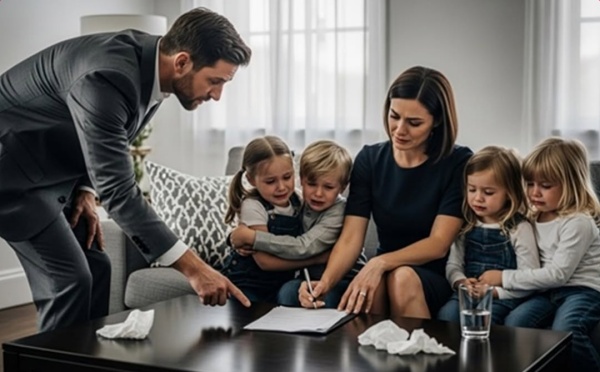
My Husband Left Me With 4 Kids to Save His Ex. He Chose His College Ex Over Our Family. He Turned Me Into a Single Mom of 4 — But He Didn’t Know I Was About to Become Unstoppable
The night Mark asked for a divorce, I was holding a wooden spoon, dinner was burning, and our youngest child was crying in the next room. He looked me in the eyes and said his ex was fragile, that she needed him more, and that I was strong enough to be fine without him. What he didn’t understand was that my strength was never his permission to abandon me.
Part 1: The Night He Chose Her
Before the college reunion, my life looked perfect from the outside. We had a five-bedroom house in Irvine, California, two SUVs in the driveway, a built-in grill in the backyard, and four children whose shoes were always scattered by the front door. If you drove past our quiet cul-de-sac on a Saturday morning, you would have seen what most people call the American dream.
My husband, Mark, was a Sales Director at a medical software company in Orange County. He made around $250,000 a year before bonuses, wore custom suits, and talked about quarterly targets like they were battlefield victories. At school fundraisers and neighborhood barbecues, people called him a family man.
I believed them because I wanted to. I believed him because I had built twelve years of marriage around the idea that we were partners. We had four children together: Emma was nine, Caleb was seven, Noah was five, and little Grace was three.
Our days were loud, messy, expensive, and full. There were soccer cleats in the hallway, lunch boxes on the counter, art projects drying on the dining table, and at least one child crying about the wrong color cup every morning. I was tired all the time, but it was the kind of tired that came from loving people who needed you.
Mark used to say he loved our chaos. He would toss Caleb over his shoulder, dance with Grace in the kitchen, and tell Emma she was going to run the country one day. He called Noah “Professor” because our five-year-old asked questions about everything from dinosaurs to mortgage rates.
Then came his ten-year college reunion at UC Irvine. I almost went with him, but Grace had a fever and Noah had thrown up twice after dinner, so I told Mark to go alone. I kissed him by the garage door and joked, “Don’t come home acting twenty-two again.”
He smiled, but something about that smile was already halfway gone. “It’s just one night,” he said. “Old friends, boring speeches, cheap wine.”
He came home after midnight smelling like expensive bourbon instead of cheap wine. His shirt was wrinkled, his eyes were glossy, and his mind seemed to be somewhere else entirely. When I asked if he had fun, he stared at me for a second too long before saying, “Yeah. It was interesting.”
That was the first word that scared me. Not amazing. Not boring. Interesting.
Over the next few weeks, Mark became a ghost in his own house. He sat on the patio smoking cigars even though he had not smoked since our first child was born. He smiled at his phone in the dark and snapped it face down whenever I walked into the room.
The children felt it before I could name it. Caleb stopped asking Mark to play catch after being told “later” too many times. Emma began watching him with the careful eyes of a child who knows adults are hiding something.
One Saturday, while I was folding laundry on the bed, I saw a name flash across his phone: Lily Hart. I knew the name immediately. Lily was his college girlfriend, the one he had described years ago as “a long story that ended badly.”
When I asked about her, he laughed too quickly. “She was at the reunion. We caught up. That’s all.”
But “that’s all” became late-night texts, sudden business dinners, and long drives to “clear his head.” I had been married long enough to understand that when a man starts needing space from the life he helped create, another woman is often waiting inside that space.
Exactly three months after the reunion, Mark called me into his home office. It was 6:42 p.m. on a Tuesday, and I remember the time because dinner was burning in the oven and Grace was crying because Noah had taken her stuffed bunny. My wooden spoon was still in my hand when he closed the door behind me.
“Sarah,” he said, sitting behind his desk like this was a performance review. “I want a divorce.”
The spoon slipped from my hand and hit the hardwood floor with a hollow crack. For a moment, I thought I had misheard him. Then I saw his face, cold and determined, and understood he had practiced this.
“What?” I whispered. “Are you joking?”
“I’m not joking,” he said. “I reconnected with Lily at the reunion.”
There it was. Not a storm. Not a mystery. Just one woman’s name dropped into the middle of my kitchen smoke, my crying toddler, and the life I thought we had both chosen.
Mark looked down at his hands. “She’s struggling. She’s a single mom. Her son’s father isn’t involved, her health isn’t good, and financially she’s barely surviving. She needs someone.”
I stared at him. “She needs someone?”
“She needs a protector,” he said, and I almost did not recognize the man in front of me. “I realized I never stopped loving her. What happened between us in college was a misunderstanding.”
“A misunderstanding?” I repeated. “Mark, we have four children.”
He flinched, but not enough. “You’re strong, Sarah. You’ve always been strong. You run this house, you manage everything, you’ll be okay.”
The words were so insulting that for a second I could not even feel them. He was using my strength as a permission slip to abandon me. He was turning my competence into evidence that I did not deserve care.
“So let me understand,” I said slowly. “You feel sorry for a woman raising one child alone, so your solution is to turn your own wife into a single mother of four?”
His jaw tightened. “That’s not fair.”
“No,” I said. “It’s exact.”
He stood and walked to the window overlooking our backyard. The swing set we had bought from Costco sat under the orange glow of the porch lights. Four small bikes leaned against the fence like witnesses.
“Lily is fragile,” he said. “She’s been through a lot. She needs me more than you do.”
That sentence became the knife I carried for years.
I thought about begging. I thought about reminding him of hospital births, mortgage documents, late-night fevers, school plays, and every promise he had made with his hand on my stomach while our babies kicked from inside me. Then I looked at his face and saw that he had already turned himself into the hero of another woman’s tragedy.
You cannot argue with a man who has made betrayal sound noble in his own head. You cannot shame someone who has renamed selfishness as destiny. So I wiped my face, bent down, picked up the wooden spoon, and placed it on his desk.
“Fine,” I said. “You want to be her hero? Go.”
His eyes widened. He had expected tears, maybe screaming, maybe a fight that would let him feel trapped. My calmness confused him.
“But heroes pay prices,” I continued. “And if you want an uncontested divorce, here are mine.”
He nodded too fast. “Anything.”
“You leave the house to me and the kids. Both SUVs stay here. The $150,000 in savings stays here. You sign over your interest in the house equity now, and you agree to guideline child support under California law.”
His face changed at the word support. “Sarah—”
“No,” I said. “You do not get to abandon four children and call yourself romantic. You can leave me, but you do not leave them financially exposed.”
He swallowed. “That’s almost everything we have.”
“That is the point,” I said. “You are choosing Lily. I am choosing your children.”
For a moment, I thought he might come back to himself. I saw the math pass through his eyes: the mortgage, the vehicles, the savings, the retirement accounts, the cost of starting over. Then I saw Lily win again.
“I make a quarter million a year,” he said. “Money is just paper. Love is once in a lifetime.”
I almost laughed. Not because it was funny, but because men say things like that when they have never been the parent standing in Target calculating the cost of shoes for four growing children.
The legal process was not as instant as Mark imagined. California does not let people erase obligations with a dramatic signature in a home office. But he wanted out so badly that he agreed to terms through mediation that heavily favored stability for the children.
The divorce was finalized months later, with proper filings, child support orders, property agreements, and the kind of paperwork that turns heartbreak into numbered paragraphs. Mark signed because he believed he was walking toward true love. I signed because I knew survival required structure.
The day he packed his suitcases, the children sat on the stairs. Emma understood enough to look betrayed. Caleb kept asking if Daddy was going on a trip.
Mark gave them distracted hugs. He told them he would see them soon, that everything would be okay, that grown-ups sometimes needed different paths. Then his phone buzzed, and I watched his eyes move toward the screen before his youngest child had even let go of his leg.
Lily was waiting in an Uber at the curb. I could see her silhouette through the tinted window, long hair falling over one shoulder. Mark walked out with two suitcases and the confidence of a man who thought he was starring in a love story.
Grace pressed her face against my thigh and sobbed. Noah asked, “Did Daddy forget us?” Caleb kicked the wall so hard he dented the baseboard. Emma turned away and walked upstairs without a word.
The Uber pulled away from our house, carrying my husband toward his soulmate and leaving me with four shattered children, a mortgage, a silence so big it filled every room, and the first clear thought I had felt in months.
He thought he was leaving a burden behind.
He had no idea he had just left his entire future.
Part 2: The House He Thought Would Break Me
The first year after Mark left did not feel like empowerment. It felt like dishes, fevers, court emails, school forms, overdue library books, and crying in the laundry room where no child could see me. People love stories where a woman rises immediately, but real survival begins with brushing your teeth when you do not want to be alive in your own life.
The house in Irvine was beautiful, but it became a battlefield of logistics. Five bedrooms meant five rooms to clean, five closets to organize, and endless square footage where Mark’s absence echoed. Every unpaid bill, broken sprinkler head, and parent-teacher conference sat on my shoulders.
The children reacted in four different ways. Emma became too responsible, packing Grace’s preschool bag and making her own lunch before I could stop her. Caleb became angry and got into trouble at school for shoving a boy who said his dad had “moved on.”
Noah became quiet. He stopped asking his thousand questions and started sleeping with the hallway light on. Grace, too young to understand divorce, asked every morning if Daddy was coming home after work.
I wanted to hate Mark publicly, loudly, and completely. Instead, I had to be careful. Family court does not reward emotional explosions, and children should not be turned into messengers, weapons, or therapists.
So I learned to speak in clean sentences. “Daddy lives in another home now.” “He loves you, even though adults make choices that hurt.” “You are safe.” “This is not your fault.”
Then I would go into the garage, sit inside the SUV he had left behind, grip the steering wheel, and let myself fall apart for seven minutes. Seven minutes was all I could afford before someone needed a snack, homework help, or a clean soccer uniform.
Mark’s new life with Lily looked glamorous online at first. She posted pictures of brunch in Laguna Beach, sunset drives along Pacific Coast Highway, and captions about second chances. Mark commented with red hearts like a man who had never once packed four school lunches at 6 a.m.
He moved into Lily’s two-bedroom apartment in Costa Mesa at first. Then, six months later, he leased a luxury townhouse they could not really afford. He told mutual friends he was “finally living authentically.”
Authentically became expensive very quickly.
Lily’s health problems were real enough to require appointments, but vague enough to expand whenever responsibility appeared. Her son, Mason, was ten and clearly uncomfortable with the whole situation. Mark tried to become his instant father figure, buying him a PlayStation, expensive sneakers, and private baseball lessons.
Meanwhile, my four children waited for their father to remember their birthdays without my reminders.
Child support arrived, but not always on time. Mark complained through attorneys about the amount, even though it followed California guidelines and he had helped create four dependents. He said he was under financial pressure because Lily needed help.
Elaine, my attorney, answered in one sentence: “Mr. Daniels’ voluntary romantic obligations do not reduce his legal responsibilities to his children.”
I printed that email and kept it in a folder labeled “When I Feel Guilty.”
Money was terrifying. Yes, I had the house, the SUVs, and the savings, but $150,000 disappears faster than people think when you are raising four children in Orange County. Property taxes, insurance, groceries, therapy, childcare, medical co-pays, and school activities came like waves.
Before the divorce, I had worked part-time from home doing operations consulting for small businesses. Mark used to call it “Sarah’s little side projects,” which should have told me more about him than it did. After he left, that little side project became my lifeline.
I built my consulting business from the kitchen island after the kids went to bed. I helped local service companies organize payroll systems, customer databases, vendor contracts, and hiring processes. My clients were plumbers, dental offices, boutique fitness studios, and family-owned restaurants that had grown too fast for spreadsheets.
I named the company Harbor Lane Operations because I wanted something that sounded calm even though my life was not. The first month, I made $2,400. The second month, I made $3,100 and cried over the QuickBooks dashboard like it was a love letter.
I used part of the savings to hire a part-time babysitter three afternoons a week. Her name was Denise, a retired kindergarten teacher from Tustin who had the patience of a saint and the posture of a general. She walked into my chaos and somehow made it breathe.
With Denise’s help, I could take client calls without Grace screaming about applesauce in the background. I could attend meetings in Newport Beach wearing a blazer over a shirt that did not have peanut butter on it. I could remember that I had a brain beyond grocery lists.
One of my first bigger clients was a struggling café in Laguna Niguel. The owner, Patricia, was a widow in her late fifties who made excellent pastries but kept terrible financial records. I rebuilt her vendor system, renegotiated her supply contracts, and helped her increase margins by 18% in four months.
Patricia hugged me after our final review. “You saved my business,” she said.
I almost told her she had saved me too. Instead, I smiled and said, “You were already doing the hard part. I just organized the numbers.”
That became my reputation. I was the woman who could walk into a messy small business, find where the money was leaking, and create systems that let owners sleep again. Referrals came from accountants, attorneys, and one very grateful bakery owner who paid me in sourdough for three months.
At home, the children slowly stabilized. Emma joined a robotics club and stopped trying to be the second parent. Caleb found peace in soccer and therapy, though he still refused to call Mark’s townhouse “Dad’s place.”
Noah started asking questions again. Mostly hard ones. “Can someone love you and still leave?” “If Dad loves Lily, did he stop loving us?” “Why does Mason get to live with him and we don’t?”
I answered as honestly as I could without poisoning them. “Adults can make selfish choices.” “Your dad’s choices are about him, not your worth.” “Love is not just a feeling. It is what people show up for.”
Grace drew our family with Mark outside the house for almost a year. In her pictures, he stood by a car while the rest of us were inside holding hands. The therapist said this was normal processing, which is a phrase adults use when children are breaking your heart in crayon.
Mark visited less than the custody schedule allowed. At first, he had excuses: work travel, Lily’s appointments, Mason’s baseball tournaments, financial stress. Eventually, the children stopped being surprised.
That was the real abandonment. Not the dramatic day with suitcases. The real abandonment was every Saturday he canceled, every recital he missed, every time his children learned not to look toward the door.
By the end of the first year, my business was earning more than I had ever made personally. Not Mark’s salary yet, but enough to cover the house without touching savings every month. I slept five hours a night, drank too much coffee, and learned to fix a garbage disposal from a YouTube video at midnight.
I was not thriving. Not yet. But I was no longer drowning.
Mark, on the other hand, had begun to sink.
His sales numbers dropped because he was distracted and constantly taking time off. His boss warned him twice. Lily resented his travel, Mason resented his rules, and the fantasy of being needed turned into the reality of being drained.
He called one night after missing Caleb’s soccer championship. I stepped into the pantry because it was the only quiet place in the house. He sounded tired, older somehow.
“Sarah, I’m sorry about the game,” he said. “Lily had a flare-up and Mason needed a ride.”
“Caleb scored twice,” I said. “He looked for you after every goal.”
There was silence. Then Mark sighed. “You don’t understand what it’s like here.”
I looked at the shelves full of cereal, paper towels, and bulk snacks from Costco. Behind me, four children were arguing about whose turn it was to feed the dog. I almost laughed.
“You’re right,” I said. “I have no idea what it’s like to be overwhelmed by one household.”
He did not like that. “You always have to be sarcastic.”
“No, Mark,” I said. “I have to be both parents because you decided being a hero somewhere else mattered more.”
He hung up.
That night, I stood in the kitchen long after the children were asleep. For the first time, I did not feel like the woman he had left behind. I felt like the woman still standing after he mistook her for disposable.
Part 3: Building a Life He Couldn’t Imagine
The second year was when everything changed. Not overnight, not in a movie montage, but in the slow, steady way real success grows when nobody is clapping yet. Harbor Lane Operations moved from my kitchen island into a small office suite above a Pilates studio in Irvine.
I hired my first employee, Maya, a former restaurant manager with a brilliant mind for scheduling systems and no patience for excuses. Then I hired a bookkeeper named Russell, who wore Hawaiian shirts and could find a missing $700 expense faster than most people find their keys. Suddenly, I was not just surviving on contract work; I was building a company.
Our specialty became helping family-owned businesses prepare to scale, sell, franchise, or recover from financial chaos. We created systems for payroll, inventory, staffing, vendor contracts, and compliance. In Southern California, where small businesses are everywhere and rent is brutal, our services became valuable quickly.
One client became five. Five became fifteen. By the middle of the second year, I had a waiting list and a reputation among local business attorneys as “the fixer you call before everything catches fire.”
I still drove carpool in leggings. I still packed lunches and knew which child hated crusts. But between school drop-off and dinner, I was negotiating contracts with restaurant groups, dental practices, landscaping companies, and boutique hotel owners.
The children watched me change. Emma once sat at the kitchen counter while I reviewed a proposal and said, “Mom, you talk different on business calls.” I looked up, worried.
“Different how?”
She smiled. “Like people should listen.”
That sentence meant more to me than any invoice I had ever sent.
Caleb healed in motion. Soccer gave him discipline, therapy gave him words, and time gave him a kind of guarded acceptance. He still loved Mark, but he stopped waiting for him with his whole body.
Noah became my little philosopher again. One night, while helping me unload groceries, he said, “Dad wanted to be a hero, but heroes don’t leave kids, right?” I paused with a gallon of milk in my hand.
“Real heroes stay responsible,” I said. “Even when life gets complicated.”
Grace grew out of asking when Daddy was coming home. Instead, she asked if he was coming to things, which was somehow sadder. Children learn to lower their expectations before they learn multiplication.
Mark’s life unraveled in stages. First, he lost his sales director position after missing targets for three straight quarters. His company offered him a lower role, but his pride refused it. He told everyone he was “exploring better opportunities.”
Better opportunities did not arrive.
The tech sales market had shifted. His reputation as a rainmaker was dated, his references were lukewarm, and he struggled to explain the employment gap that followed. He blamed the economy, his former boss, remote work, younger candidates, and “corporate politics.”
He never blamed himself.
Lily, according to the pieces I heard through mutual friends, did not respond well to financial pressure. The townhouse lease became impossible without Mark’s old salary. They moved to a smaller apartment in Anaheim, then argued constantly about money.
Mark tried commission-only sales. He tried consulting. He tried flipping high-end watches online and lost several thousand dollars. Every attempt had the same pattern: big confidence, poor planning, painful collapse.
Child support became a fight. When his income changed, his attorney filed for modification, which was legally allowed. My attorney did not object to a fair recalculation, but we did object to Mark claiming poverty while still paying for Lily’s expenses and Mason’s private sports training.
The judge was not impressed. Mark was reminded that his first responsibility was to his children. The amount changed, but not as much as he wanted.
He called me after court, furious. “You’re punishing me.”
“No,” I said. “The court is calculating support.”
“You got the house, the cars, the savings, and now you still want money?”
I closed my eyes. “For groceries. For school supplies. For shoes. For your four children.”
“You’re doing fine,” he snapped. “Your business is taking off.”
“And that makes them stop being yours?”
He had no answer. Men like Mark often confuse a woman’s recovery with evidence that the wound was not serious. Because I had learned to stand, he decided I had never been pushed.
That year, I received an offer to sell part of Harbor Lane to a regional consulting group. It was not a massive corporate buyout, but it was real money, more than I had ever personally controlled. I turned down the first offer, negotiated the second, and accepted the third.
The deal allowed me to keep majority ownership while expanding into Los Angeles and San Diego. I paid off credit card debt, rebuilt emergency savings, and started college accounts for the kids. I also replaced the broken dishwasher that had sounded like a helicopter for eight months.
On the day the deal closed, I drove to Newport Beach after school drop-off and sat alone at a café overlooking the water. I ordered avocado toast and a latte I did not have to justify to anyone. Then I cried into a cloth napkin because success did not erase what it cost.
I wanted to call someone. For twelve years, that someone would have been Mark. That realization hurt more than I expected.
Instead, I called Emma at school pickup and asked if she wanted pizza for dinner. She said, “Is something wrong?” because celebration had become unfamiliar in our house. I said, “No, honey. Something is right.”
We ate pizza on paper plates that night. I let the kids drink root beer, and Grace got sauce on her pajamas. Caleb asked if we were rich now, and Noah asked if rich meant we could buy a robot vacuum.
“We are safe,” I said. “That matters more.”
Emma watched me carefully. “Did you do it by yourself?”
I looked at their four faces around the table. “No,” I said. “I did it because I had you.”
That was the truth. Mark thought leaving me with four children would weigh me down forever. He did not understand that sometimes responsibility becomes the anchor that keeps you from drifting into despair.
By the end of year two, our home no longer felt like the place he had abandoned. It felt like ours. The kids helped paint the guest room, we turned Mark’s old office into a homework and art room, and I replaced his oversized leather chair with a long table where the children built Lego cities.
I removed the last framed wedding photo from the hallway and replaced it with a picture from a beach day in Crystal Cove. In it, all four kids were running toward the water, and I was behind them laughing. My hair was a mess, my sunglasses were crooked, and I looked alive.
Mark saw the photo once during a pickup and stared at it for a long time. “You changed the hallway,” he said.
“Yes,” I replied. “We live here now.”
He looked as if he wanted to say something else. Then his phone rang, and Lily’s name appeared on the screen. He stepped outside to answer it, and I closed the door behind him.
The difference was that this time, the sound of him leaving did not break me.
Part 4: The Bistro Where the Tables Turned
Three years after Mark left, I walked into a small bistro in Laguna Beach for a meeting with a potential client. It was a bright Thursday morning, the kind of Southern California day that makes postcards look underfunded. The ocean air carried salt, sunscreen, and money.
The bistro was called Maribel’s, tucked between an art gallery and a boutique that sold linen dresses for prices that made no sense. My meeting was with the owners, a married couple hoping to expand to a second location without destroying the charm that made the first one profitable. They had been referred by Patricia, my very first major café client.
I arrived ten minutes early, wearing a cream blazer, dark jeans, and heels I had bought for myself after the San Diego expansion closed. My phone buzzed with a text from Emma: “Grace forgot her library book but I found it. Don’t panic.” I smiled because my nine-year-old had turned into a responsible twelve-year-old who understood logistics better than most adults.
A hostess led me to a patio table with a view of the street. I opened my notebook, checked the proposal, and ordered coffee without looking up. “Americano, please. No cream.”
“Of course,” the server said.
Something in the voice made my pen stop moving.
I looked up.
Mark stood beside my table in a black apron, holding a small notepad. His hair was thinner, his face narrower, and the confident shine he used to carry had dulled into something tired and careful. For a second, neither of us breathed.
“Sarah,” he said.
“Mark.”
The world did not stop. A couple at the next table laughed over mimosas. A delivery truck beeped in the alley. Somewhere inside, milk steamed loudly.
He looked down at his apron as if seeing it through my eyes. “I’m just helping out here temporarily.”
I did not ask. People explain things like that when they are explaining them to themselves.
“I hope you’re well,” I said.
His mouth twitched. “You look… successful.”
“I am well,” I replied. It was not the same thing, and we both knew it.
He took a breath. “Americano, no cream?”
“Yes, thank you.”
As he walked away, I watched the man who had once believed $150,000 was just paper move between patio tables refilling water glasses. He had left our family to become a hero. Now he was serving coffee to the woman he had decided would be fine without him.
And the most shocking part was that I felt no joy.
I had imagined moments like this during the worst nights. I had pictured him ruined, regretful, stunned by my success. I had rehearsed speeches in the shower while crying quietly so the children would not hear.
But when the moment arrived, it was not sweet. It was just sad.
Mark returned with my coffee and set it down carefully. His hand trembled slightly. “The kids look good,” he said. “From the pictures Emma posts sometimes.”
“They are good,” I said. “They have worked hard to be good.”
He nodded as if he deserved part of that. “I miss them.”
“They missed you too,” I said. “For a long time.”
His face tightened. “I know I made mistakes.”
I looked at him then, really looked. Three years earlier, that sentence would have fed some starving part of me. Now it felt small compared to the size of what had happened.
“You made choices,” I said. “Mistakes are when you forget a lunchbox.”
He looked away.
My clients arrived before he could respond. Maribel and Daniel were warm, energetic, and anxious in the way business owners are when success becomes bigger than their systems. I stood, shook hands, and began the meeting.
Mark served our table for the next hour. He brought water, refilled coffee, cleared plates, and heard pieces of my professional life spoken out loud. Revenue projections. Expansion strategy. Staffing models. Vendor renegotiations.
At one point, Daniel said, “Patricia told us you helped save her café. She said hiring you was the smartest money she ever spent.”
Mark was placing a plate of lemon ricotta pancakes on the table when he heard it. His face did not change much, but his shoulders lowered as if something heavy had just landed there. Maybe he remembered how he used to call my work little projects.
Maribel turned to me and said, “Honestly, Sarah, if this works, we may want Harbor Lane involved in all our locations long-term.”
“We can build a phased plan,” I said. “Growth should feel structured, not chaotic.”
Mark looked at me when I said that. Structured, not chaotic. It was almost funny, considering he had mistaken chaos for love and structure for weakness.
After the meeting ended, Maribel and Daniel left excited and relieved. I stayed behind for a moment to finish my coffee and send Maya a quick message. Mark approached with the check.
“It’s on the house,” he said softly.
“No,” I replied. “I pay my bills.”
He flinched. I had not meant it cruelly, but truth sometimes sounds cruel when it arrives too late. I placed my company card on the tray.
When he returned with the receipt, he lingered. “Lily and I aren’t together anymore,” he said.
I looked at the receipt, not him. “I heard.”
“She left last year,” he continued. “After the money got bad. She said I brought too much baggage.”
That word almost made me laugh. Baggage. Four children, a decade of marriage, court orders, regret, and reality had become baggage in Lily’s final version of the story.
“I’m sorry,” I said, because I was. Not for losing Lily, but for the kind of emptiness that must follow when someone realizes they burned down a home for a mirage.
Mark leaned against the empty chair across from me, then seemed to remember he did not have permission and straightened. “I thought I was doing something meaningful. I thought she needed me.”
“Your children needed you,” I said.
His eyes filled with tears, and I looked away because I did not want his pain to become my responsibility again. That had been my job for too long: translating his regret into comfort, making his consequences softer, giving him emotional shelter after he created storms.
“I know,” he whispered.
“No,” I said. “You know now. That is different.”
He nodded slowly.
The bistro owner called his name from inside, and Mark wiped his eyes quickly. “I should get back.”
“Yes,” I said. “You should.”
Before he left, he looked at me one more time. “Did I lose you forever?”
I thought about the woman I had been in his office three years earlier, holding a wooden spoon while he explained why another woman deserved protection more than his wife and children. I thought about the children on the stairs. I thought about every night I had carried fear alone.
“You lost me the day you decided my strength meant I did not deserve loyalty,” I said.
He closed his eyes as if the sentence had struck him physically. Then he nodded and walked back inside.
I signed the receipt, added a 25% tip because my children were watching the kind of person I chose to be even when they were not present, and left the bistro. Outside, sunlight bounced off parked cars and the ocean glittered at the end of the street.
My phone buzzed again. Caleb had scored in his afternoon match. Emma had sent a blurry video with the caption: “He said this one was for you.”
I stood on the sidewalk and smiled.
That was the real table turning. Not Mark in an apron. Not me with a company card. Not the shock in his eyes when he realized I had become someone he could no longer reach.
The real table turning was that my life no longer paused for his regret.
Part 5: What He Really Lost
After the bistro, Mark tried harder with the children. At first, I did not trust it. Neither did they.
He started showing up on time for pickups. He attended Caleb’s games, Emma’s robotics showcase, Noah’s science fair, and Grace’s kindergarten graduation. He sat in the back row, clapping with the awkward humility of a man who finally understood he was a guest in the lives he had helped create.
The children responded cautiously. Emma stayed polite but distant. Caleb accepted rides to soccer but did not confide in him.
Noah asked Mark hard questions, because Noah had always been brave in the way quiet children sometimes are. “Did you leave because we were too much?” he asked one Sunday at the park. Mark called me later crying, asking what he was supposed to say.
“The truth,” I told him. “Age-appropriate, but the truth.”
“What if they hate me?”
“Then you sit with it,” I said. “You do not make them comfort you.”
That was one of the hardest lessons Mark had to learn. Regret does not entitle you to forgiveness on your schedule. Being sorry is not a remote control that rewinds other people’s pain.
Grace adjusted fastest because she had the fewest memories of him living at home. That broke my heart in a different way. Sometimes mercy is only possible because memory is incomplete.
Mark remained at the bistro for several months while rebuilding his sales career from the bottom. He eventually found a lower-level account manager job at a smaller company in Riverside. The salary was nowhere near what he had once made, and the title did not impress anyone at reunions.
He stopped talking about destiny. He stopped posting quotes about love. He stopped calling himself a protector.
I think reality humbled him, but I no longer built my life around interpreting his growth. Whether he became better was between him, his children, and God, if God had the patience for men who learn late. My job was not to supervise his redemption.
My life kept expanding. Harbor Lane opened a Los Angeles office, then partnered with a hospitality group to support independent restaurants across Southern California. I began speaking at women’s business events, though I always hated being introduced as “inspiring.”
Survival is not inspirational when you are inside it. It is unpaid bills, legal documents, therapy appointments, and learning to breathe through humiliation. The inspirational part only appears later, when people see the clean version.
At one event in Newport Beach, a woman approached me afterward. She had two young kids, a shaking voice, and the exhausted eyes of someone standing at the beginning of a storm. She said, “My husband left last month. I don’t know how you did it.”
I wanted to give her something powerful. Instead, I gave her the truth.
“You do the next necessary thing,” I said. “Not the next brave thing. Not the next impressive thing. Just the next necessary thing.”
Pay the bill. Call the attorney. Make the breakfast. Answer the school email. Cry in the car if you must, then go inside.
That is how lives get rebuilt.
People sometimes ask if I regret taking so much in the divorce. I do not. The house, the savings, the vehicles, the stability — those things were not revenge. They were a shield between four children and the consequences of their father’s fantasy.
Mark believed he could make it all back in two years. That arrogance was not my responsibility. If he wanted to gamble his comfort for romance, he was free to do so, but he was not free to gamble the children’s security.
Three years after he left, our home is different. There are still shoes by the door, but now Emma’s sneakers are almost my size. Caleb’s soccer bag smells terrible no matter what I spray on it.
Noah has a telescope by his window and gives long lectures about planets at dinner. Grace leaves glitter everywhere and insists our dog understands English. The house is loud again, but not haunted.
Sometimes Mark comes to the porch for pickup and looks through the open door at the life still moving inside. I can see the recognition on his face. He did not lose a wife only.
He lost Saturday pancakes. He lost bedtime stories and missing teeth. He lost the private jokes that develop inside a family when you stay long enough to earn them.
He lost the right to be the first person the children called from school. He lost lazy Sundays, grocery store arguments, Christmas morning chaos, and the ordinary intimacy of being known in a home. He lost the future where he grew old beside the woman who remembered him before he became impressed with himself.
He lost the kingdom because he wanted to rescue a tragedy.
As for Lily, I do not hate her anymore. Hate requires too much maintenance. She was not innocent, but she was also not the root.
Mark was the one who had vows. Mark was the one with four children. Mark was the one who stood in our home and decided another woman’s need mattered more than his family’s trust.
For a long time, I wondered if I had been too strong. Maybe if I had seemed more fragile, more helpless, more dramatic, he would have stayed. That is the cruel question women ask themselves when men reward weakness and exploit resilience.
Now I know better.
A good man does not need you to collapse before he decides you deserve care. A loyal partner does not abandon you because you are capable. Strength should make someone respect you more, not leave you with heavier burdens.
Mark mistook my strength for permission.
That was his failure, not mine.
The last time I saw him at Maribel’s, months after that first meeting, he was no longer serving tables. He had come in as a customer with Caleb after a soccer tournament. Caleb saw me first and waved, then ran over to show me a grass stain on his uniform like it was a trophy.
Mark approached slowly. “We had a good day,” he said.
“I’m glad,” I replied.
He looked toward Caleb, who was already asking the hostess if they had chocolate chip pancakes. “Thank you for not turning them against me.”
I studied him for a moment. “I told them the truth in ways they could survive. Your relationship with them is yours to build or lose.”
He nodded. “I know.”
This time, I believed he did know.
But knowing did not change the ending. Some doors close not because of bitterness, but because the house has been rebuilt without them. You cannot walk back into a life that had to become stronger in your absence and expect to find your old room waiting.
I left the bistro with a coffee in my hand and my daughter’s glitter sticker on the sleeve of my blazer. My phone was full of messages from clients, children, and Maya asking about a contract revision. My day was busy, imperfect, and fully mine.
Three years earlier, Mark had driven away in an Uber toward the woman he called his once-in-a-lifetime love. He thought I would remain behind as the abandoned wife, frozen in the doorway with four children and a broken heart. He thought my life would become the sad background to his romantic second chance.
Instead, I became the author of everything he assumed I could not build without him.
And him?
He learned that playing hero for one woman can turn you into a stranger to the people who actually needed saving. He learned that money is not “just paper” when it feeds children, keeps a roof overhead, and buys peace after betrayal. He learned that a family is not a burden you can drop and reclaim when your fantasy expires.
Most of all, he learned that I was never the weak one.
I was simply the one holding everything together.
And when he let go, he expected me to fall.
Instead, I built a life so strong that when he finally came back to serve me coffee, I did not need revenge, anger, or even an explanation.
I just took the cup, paid the bill, tipped him fairly, and walked back into a future he no longer owned.
