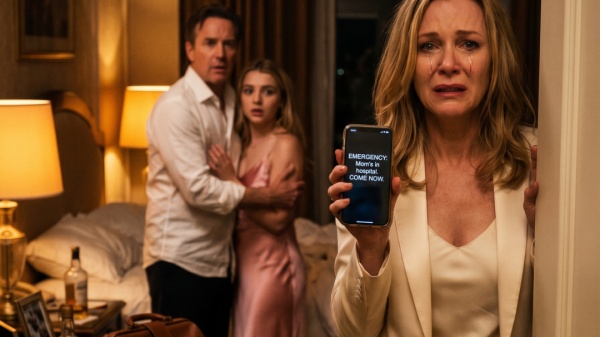
The Hospital Said My Surgeon Husband Wasn’t on Call. My Sister’s Location Said She Was at The Aster Hotel. When Room 714 Opened, the Lie He Sent Me Was Still Glowing on My Phone…
Part 1: The Text Message That Didn’t Feel Right
My name is Claire Mitchell, and until last October, I believed there were two kinds of silence in a marriage.
There was the comfortable kind, the one that settled over a kitchen after dinner while the dishwasher hummed and two people moved around each other without needing instructions. And then there was the other kind — the kind that made every room feel like a waiting area, every unanswered question feel like a diagnosis nobody wanted to say out loud. By the time my husband texted me that he had emergency surgery and wouldn’t be home, our house in Franklin, Tennessee had been living in that second kind of silence for months.
My husband, Dr. Daniel Mitchell, was a trauma surgeon at a hospital in Nashville. He was forty-two, respected, charming in that calm medical way people trust before they even know why. He could walk into a room full of panic and make everyone breathe slower. That was one of the reasons I married him.
I was thirty-eight, a high school English teacher, and for twelve years I had been the woman behind the man everyone admired.
I packed his overnight bag when he was on call. I washed the scrubs he left on the laundry room floor. I smiled through hospital fundraisers, holiday galas, residency dinners, and conversations where people told me how lucky I was to be married to a lifesaver. I used to feel proud when they said that.
Later, I wondered how many women are trained to mistake public admiration for private character.
That Friday started like any other school day. I taught two sections of junior English, confiscated a vape pen in the hallway, graded half a stack of essays on The Great Gatsby, and drove home through early evening traffic with a headache blooming behind my right eye. I remember stopping at Kroger for almond milk because Daniel had switched to it after deciding regular milk was “inflammatory.”

That detail still makes me laugh sometimes.
Not because it is funny.
Because a man can lie to your face for months and still lecture you about inflammation.
When I got home, the house was quiet. Daniel’s SUV was gone, which wasn’t unusual. Surgeons keep strange hours, and I had spent most of our marriage adjusting my expectations around hospital schedules. Dinner alone was normal. Sleeping before he came home was normal. Waking up to find him in the shower at 2:00 a.m. was normal.
But lately, something about his absences had changed.
He no longer sounded tired when he came home.
He sounded satisfied.
He stopped leaving his phone face-up. He started taking calls in the garage. He began buying new shirts, the kind that looked casual but cost $145 at Nordstrom. And he had become strangely critical of me, in small ways that were easy to dismiss until they collected into a pattern.
“Are you wearing that to the hospital dinner?”
“You used to do your hair differently.”
“You seem tense lately.”
“You’re always reading into things.”
The worst part was how reasonable he sounded. Daniel never yelled. He lowered his voice. He used the tone he probably used with frightened patients, soft and measured, as if my instincts were symptoms that needed management.
At 7:18 p.m., while I was reheating soup, my phone buzzed.
Daniel: Emergency surgery. Running late. Won’t be home tonight. Love you.
I stared at the message longer than I should have.
There was nothing obviously wrong with it. Emergency surgeries happened. Overnight shifts happened. Daniel had sent me similar messages hundreds of times. But this one felt wrong in a way I couldn’t explain.
Maybe it was the wording.
Maybe it was the timing.
Maybe it was the fact that he had written “Love you” when he usually wrote “Love you, C.”
Or maybe the body knows before the mind is ready to admit it.
I typed back: Everything okay?
Three dots appeared.
Then disappeared.
Then appeared again.
Daniel: Complicated case. I’ll call when I can.
He did not call.
At 8:04, I texted my younger sister, Madison.
She was twenty-one, a senior at Belmont University, and she had been staying with us on and off for the past semester while her apartment situation got messy with two roommates who treated rent like a suggestion. Madison was beautiful in the careless way very young women can be beautiful before the world teaches them what attention costs. Long blonde hair, big brown eyes, tiny gold necklaces, and the kind of confidence that made strangers hold doors a second longer.
She was also my baby sister.
I had changed her diapers when our mother worked night shifts. I taught her how to drive in an empty church parking lot. I paid for her prom dress when Dad forgot child support again. When she called crying from college because she felt lonely, I drove forty minutes with ice cream and sat on her dorm floor until she stopped pretending she was fine.
That was the history I trusted.
That was the history she betrayed.
I texted her because she had borrowed one of my cream blazers earlier that week for a presentation and hadn’t brought it back.
Me: Hey, are you coming by tonight? I need my blazer this weekend.
No answer.
That wasn’t strange either. Madison was twenty-one. Her phone lived in her hand, but somehow she never answered when anyone needed something practical.
At 9:11 p.m., I called Daniel’s hospital.
I told myself I was not checking up on him. I told myself I was being a worried wife. I told myself a lot of things in those days. The operator transferred me to the surgical floor, then to the trauma desk, where a tired-sounding nurse answered.
“Hi,” I said. “This is Dr. Mitchell’s wife. I just wanted to see if he was still in surgery.”
There was a pause.
Not long.
Just long enough.
“Dr. Mitchell?” she asked.
“Yes. Daniel Mitchell.”
Another pause.
“I’m sorry, ma’am. Dr. Mitchell isn’t on call tonight.”
My hand tightened around the phone.
“Are you sure?”
“Yes, ma’am. He was here earlier today, but he left around 5:30.”
The kitchen seemed to tilt.
I thanked her because women are conditioned to be polite even when the floor has disappeared beneath them. Then I hung up and stood beside the stove while the soup bubbled over onto the burner. The smell of scorched tomato filled the kitchen.
I did not cry.
Not yet.
Instead, I opened Find My iPhone.
Daniel had turned off location sharing two months earlier after claiming it was draining his battery. But Madison had not. She had been on my family location plan since she was sixteen and had never bothered to remove herself.
Her dot was sitting at The Aster Hotel in downtown Nashville.
A boutique hotel.
Twenty-seven miles from my house.
Twelve minutes from Daniel’s hospital.
I stared at that little blue dot until my vision blurred.
Then I grabbed my keys.
Part 2: Room 714
The drive from Franklin to Nashville felt longer than any road I had ever taken.
I remember the glow of brake lights on I-65, the orange construction barrels, the country station playing too cheerfully on the radio before I turned it off. My hands were steady on the wheel, which surprised me. I had expected shaking. I had expected panic. Instead, I felt frighteningly calm, as if some emergency switch inside me had flipped and turned me into someone built for evidence.
The Aster Hotel sat on a corner near downtown, all black-framed windows, valet parking, and warm lobby lights that made betrayal look expensive.
I parked in a public garage two blocks away because I did not want the valet to remember me. That was the first proof that some part of me already understood the importance of staying controlled. I walked through the cool October air in heels I had worn to teach all day, carrying my purse and wearing the same beige coat Madison had once said made me look “like a rich mom on Pinterest.”
The lobby smelled like cedar, perfume, and money.
A couple checked in at the front desk. Two men in suits laughed near the bar. A woman in a black dress took selfies beside a marble fireplace. Life was continuing everywhere around me, completely unaware that mine was about to split open.
I did not know the room number.
Not yet.
So I sat in a chair near the lobby bar and watched the elevators.
At 10:03 p.m., Madison stepped out.
She was wearing a pale pink satin dress I had never seen before and carrying a small black clutch. Her hair was curled, her makeup flawless, her mouth shiny with gloss. She looked older than twenty-one and younger than she thought, which somehow made what I was seeing worse.
She walked toward the bar and ordered something from the bartender.
I stayed frozen behind a large potted plant like a woman in a bad movie, except nothing about it felt dramatic. It felt clinical. Like observing a wound before deciding whether it required stitches.
Then Daniel stepped out of the elevator.
My husband.
Not in scrubs.
Not exhausted.
Not rushing from emergency surgery.
He was wearing dark slacks, a white dress shirt with the sleeves rolled to his forearms, and the watch I had given him for our tenth anniversary. He saw Madison and smiled. Not a polite smile. Not a brother-in-law smile. A private smile.
She smiled back.
He placed his hand on her lower back.
Something inside me went silent.
I had imagined many things during the drive. A misunderstanding. A group event. A medical conference. Maybe Madison was meeting friends at the hotel and Daniel had stopped by for some reason he could explain. The human mind will build a hundred bridges to avoid standing in the truth.
Then he touched her like that, and every bridge burned.
They took two drinks back into the elevator.
I waited until the doors closed, then walked to the front desk.
The young woman working there looked barely older than Madison. She had perfect eyeliner and a name tag that said Kayla. I knew immediately that she could not legally tell me what room they were in, and I knew I could not demand it without becoming the hysterical wife Daniel would later describe.
So I did something else.
I showed her my phone.
On the screen was Daniel’s text.
Emergency surgery. Running late. Won’t be home tonight. Love you.
Then I showed her my driver’s license.
Then I showed her a photo from my phone of Daniel and me at a hospital gala, his arm around my waist, both of us smiling in formal clothes.
“My husband is here,” I said quietly. “I am not asking you to break policy. But I need to know if I should call an attorney tonight or an ambulance.”
Kayla’s face changed.
Not shock exactly.
Recognition.
There are women who understand before you finish the sentence.
She looked over her shoulder, then back at me. “Ma’am, I really can’t give out guest information.”
“I understand.”
She hesitated.
Then she said, “If you already know who you’re looking for, hotel security can do a wellness escort to a floor. If there’s a concern.”
A wellness escort.
A phrase polite enough to carry a bomb.
I nodded. “There is a concern.”
Ten minutes later, a security supervisor named Mr. Harris accompanied me into the elevator. He was in his sixties, broad-shouldered, with kind eyes and the weary patience of a man who had seen too many private disasters play out in public places. He did not ask questions. I appreciated that more than he knew.
We got off on the seventh floor.
My pulse finally started pounding.
The hallway was carpeted in navy and gold, the kind of pattern designed to hide stains and secrets. We walked past rooms 702, 704, 706. At room 714, Mr. Harris stopped.
He knocked.
“Hotel security,” he said. “Wellness check.”
There was movement inside.
A muffled voice.
Then Daniel opened the door.
For one impossible second, we stared at each other.
His face emptied first.
Then refilled with calculation.
“Claire,” he said.
Behind him, Madison appeared near the bed, one hand at her throat, wearing the pink satin dress and no shoes. On the nightstand were two cocktails, a room service tray, and my cream blazer draped over a chair.
My blazer.
That stupid blazer.
That was the detail that almost broke me.
Not my husband.
Not my sister.
The blazer.
Because it meant she had taken something from my closet to wear while betraying me with my husband.
Daniel stepped into the hallway and pulled the door partly closed behind him.
“This is not what it looks like,” he said.
I looked at him.
Then at the door.
Then back at him.
“Daniel,” I said, and my voice sounded far away, “I am a high school English teacher. Do not insult me with bad fiction.”
Mr. Harris turned his gaze politely toward the carpet.
Daniel lowered his voice. “You need to calm down.”
There it was.
The old tool.
Not apology.
Not shame.
Control.
I reached into my purse, took out my phone, and held up his text message.
“Emergency surgery?”
His jaw tightened.
“Claire, listen to me.”
“No.”
That one word surprised both of us.
Madison began crying behind the door. Softly at first, then louder when she realized silence would not save her. Daniel glanced back, annoyed, not protective. Even then, even standing in the wreckage, I noticed that. He was not worried about her pain. He was worried about exposure.
“How long?” I asked.
Daniel said nothing.
Madison whispered, “Claire, I’m sorry.”
I looked at her through the gap in the door.
My sister.
The little girl whose hair I braided before school.
The young woman I had welcomed into my home.
“Do not say my name like you still get to be close to it,” I said.
She covered her mouth.
Daniel reached for my arm.
I stepped back.
“Do not touch me.”
Mr. Harris shifted slightly, not threatening, just present. Daniel noticed and dropped his hand.
That was when I raised my phone and took one photo.
Not of anything indecent.
Just Daniel in the doorway.
Madison visible behind him.
The room number on the wall.
The timestamp preserved automatically.
Evidence does not need to be loud.
It only needs to exist.
Part 3: The Man Everyone Trusted
Daniel came home at 1:17 a.m.
I know because I was sitting at the kitchen table when the garage door opened.
The house was clean, too clean, in the way houses become when you are trying not to fall apart and start wiping counters instead. I had placed his printed text message on the table beside a legal pad. I had also called my best friend, Elena, who was an attorney, though not a divorce attorney. She told me three things: do not leave the house tonight, do not destroy anything, and do not let him make you discuss this without a witness if you feel unsafe.
I did not feel physically unsafe.
But I did feel like I had been living beside a stranger with access to all my passwords.
Daniel walked into the kitchen still wearing the white shirt from the hotel, now wrinkled at the cuffs.
He looked tired for the first time that night.
Not guilty.
Tired.
“Claire,” he said, “we need to talk.”
I almost laughed.
It was always “we need to talk” after the lie stopped working.
I looked at the chair across from me. “Sit down.”
His eyebrows lifted slightly. He was not used to me giving instructions. In our marriage, Daniel explained and I adjusted. Daniel decided and I accommodated. Daniel disappeared and I trusted.
He sat.
For several seconds, neither of us spoke.
The refrigerator hummed. A car passed outside. Somewhere upstairs, the guest room door was still open from where Madison had left clothes in a laundry basket, a pair of her sneakers by the bed, a half-used bottle of perfume on the dresser.
Finally, Daniel said, “I know this looks terrible.”
“No,” I said. “It is terrible.”
He rubbed his face with both hands. “It wasn’t supposed to happen this way.”
That sentence made something sharp rise in me.
“What way was it supposed to happen, exactly? Were you planning a PowerPoint?”
His mouth tightened. “Sarcasm isn’t going to help.”
“Neither did hotel rooms.”
He looked away.
I asked again, “How long?”
He said nothing.
“How long, Daniel?”
He exhaled.
“Since July.”
Four months.
Madison had moved into our guest room in August.
I felt the room shift around that fact.
“So while she was staying here?”
He closed his eyes. “It started before that.”
“As if that improves it.”
He leaned forward, physician voice returning, controlled and low. “Madison is an adult.”
I stared at him.
“She is twenty-one,” I said. “She is my sister. She was living in our home. She trusted you. I trusted you.”
“You’re making it sound like I forced—”
“Do not finish that sentence.”
He stopped.
I did not accuse him of a crime, because Madison was legally an adult and I had no evidence of coercion. But legality is a low floor for morality. A thing can be legal and still rotten enough to poison every room it touches.
Daniel tried another approach.
“I was lonely.”
That sentence did make me laugh.
One short sound.
Cold.
“You were lonely in the marriage where I cooked your meals, covered for your schedule, attended your events, listened to your hospital stories, hosted your residents, and let my sister stay in our house because I thought we were family?”
“You were always tired.”
“I teach teenagers all day, Daniel. Of course I’m tired.”
“We stopped connecting.”
“We did not stop connecting,” I said. “You stopped reaching for your wife and started reaching for someone barely old enough to rent a car without extra fees.”
His face flushed.
That landed.
Good.
He deserved at least one sentence he could not sterilize.
Then he said the thing men say when they want forgiveness without accountability.
“I never meant to hurt you.”
I looked at him across the table.
“No,” I said. “You meant to avoid consequences. There’s a difference.”
His eyes changed then.
For the first time, he looked afraid.
Not of losing me.
Of what I might do with the truth.
“You can’t tell people like this,” he said.
I tilted my head.
“There it is.”
“Claire, I’m serious. My job—”
“Your job?”
“My reputation. The hospital. Patients. The board. You don’t understand how this could be twisted.”
That was when I fully understood Daniel.
He was not asking about my heart.
He was asking about damage control.
The man everyone trusted with trauma cases, emergency decisions, and frightened families was calculating how to manage the story of sleeping with his wife’s twenty-one-year-old sister while lying about emergency surgery.
I stood up.
“I’m going upstairs.”
“Claire.”
“You can sleep in the guest room. Actually, no. You can sleep somewhere else.”
“This is my house too.”
“Yes,” I said. “And tomorrow we can let attorneys discuss that.”
His face hardened.
“Don’t be dramatic.”
I smiled then, not because I felt amused, but because the sentence was so predictable it almost bored me.
“You told your wife you were performing emergency surgery while you were in a hotel room with her baby sister,” I said. “If drama exists tonight, Daniel, you brought it home.”
He had no answer.
At 2:06 a.m., he left.
I locked the door behind him.
Then I walked upstairs to Madison’s guest room.
Her clothes were still there. Her textbook was open on the desk. A framed photo of us from her high school graduation sat beside the lamp. I picked it up and looked at my own smiling face beside hers, both of us wearing white dresses, our mother crying behind the camera.
Then I put the photo facedown.
For the first time that night, I cried.
Not because of Daniel.
Because I had lost my sister before I had even figured out how to mourn her.
Part 4: What the Truth Cost
By morning, the story had already started trying to escape.
Madison called me seventeen times.
I did not answer.
My mother called six times.
I answered the seventh because I knew Madison had reached her first.
“Claire,” Mom said, voice trembling, “what is going on?”
I stood in the kitchen, looking at Daniel’s coffee mug in the sink.
“You need to ask Madison.”
“She’s hysterical.”
“She should be.”
“Claire, please. She said you showed up at a hotel and scared her.”
I closed my eyes.
Of course.
The first person to tell the story often tries to build the frame.
“She was at The Aster Hotel with my husband,” I said.
Silence.
A long, terrible silence.
Then Mom whispered, “No.”
“Yes.”
“She said it wasn’t like that.”
“Mom.”
Another silence.
Then crying.
My mother’s crying was the sound of a family line snapping.
I did not comfort her. I could not. For once, I did not volunteer to manage everyone else’s pain so they would not have to face what caused mine.
By noon, I had an appointment with Marsha Bell, a family law attorney in Brentwood recommended by Elena. Marsha was in her fifties, with silver hair, navy glasses, and the direct expression of a woman who billed by the hour and did not waste sentences. Her office smelled like lemon polish and printer toner.
I brought everything.
Daniel’s text.
The hospital call log.
A screenshot of Madison’s location at the hotel.
The photo from room 714.
Credit card statements showing hotel charges I had not noticed before because they were hidden among medical conferences and professional expenses.
Marsha reviewed everything without flinching.
“Tennessee is an equitable distribution state,” she said. “Infidelity may be relevant in certain circumstances, especially if marital funds were spent on the affair. It does not mean a judge hands you everything, and we won’t pretend that. But documentation matters.”
I nodded.
“Do you feel physically unsafe?”
“No.”
“Do you have access to joint accounts?”
“Yes.”
“Do not drain them. Do not post online. Do not threaten his job. Do not contact the hospital board. Not yet.”
I looked at her.
“Not yet?”
She gave me a steady look. “There may be professional implications if he lied about being in emergency surgery, especially if hospital resources, schedules, or patient care representations are involved. But we handle facts carefully. Revenge feels good for ten minutes and ruins strategy for ten months.”
That sentence became my rule.
Facts first.
Strategy second.
Emotion somewhere safe where it could not drive.
Marsha filed for divorce two weeks later.
Daniel was furious.
Not because I filed.
Because I refused to meet privately.
He wanted dinner. Then coffee. Then “one honest conversation.” When I said all communication could go through counsel, he sent a text that said: You’re treating me like a criminal.
I replied: No. I’m treating you like someone I can no longer trust.
Then I blocked him everywhere except email.
Madison moved out of our house while I was at work. My mother helped her. I knew because the guest room was empty when I came home, except for one earring under the dresser and the graduation photo still facedown. Madison left a letter on the bed.
I did not read it for three days.
When I finally did, it was exactly what I expected and worse.
She said she was sorry.
She said Daniel made her feel seen.
She said she knew it was wrong but felt like she was “drowning” and he understood her.
She said she never meant to hurt me.
Nobody ever means to hurt you.
They just mean to have what they want while you absorb the impact.
The hardest part was not Daniel’s betrayal. That surprised people when I said it, but it was true. Daniel was my husband, yes, but he was also a grown man with an ego large enough to justify anything. Madison was the wound I could not categorize.
Was she manipulated?
Maybe emotionally, in some way.
Was she responsible?
Also yes.
She was twenty-one, not twelve. She knew he was married. She knew I was her sister. She knew the layout of my kitchen, the password to my Wi-Fi, and the side of the bed where I slept.
Two truths can stand in the same room and refuse to cancel each other out.
The hospital found out in January.
Not from me.
That matters.
Daniel had apparently used a hospital scheduling excuse to cover absences more than once. A resident who had been blamed for paging delays questioned a timeline. Someone in administration reviewed call records. Then the rumor of “emergency surgery” on a night no such case existed started moving through the staff like smoke under a door.
When HR requested a statement, Daniel called Marsha’s office demanding that I “stop spreading lies.”
Marsha sent his attorney a copy of the text he had sent me.
Emergency surgery.
Running late.
Won’t be home tonight.
Love you.
The lie had his name on it.
Not mine.
Daniel was not fired immediately. Real institutions move slower than gossip. But he was removed from certain leadership responsibilities during review. His hospital privileges were not publicly discussed, and I will not pretend to know every internal detail. What I do know is that the man who had worried most about his reputation finally met a room full of people who documented things as carefully as he once charted patient notes.
By spring, he had resigned from his committee positions.
By summer, he had accepted a position at a smaller surgical group two counties away.
He called it a fresh start.
I called it geography.
Part 5: The Door I Finally Closed
The divorce took eleven months.
Not because there were children — thank God, there were not — but because Daniel believed negotiation was something that happened after he exhausted every method of control. He delayed financial disclosures. He disputed hotel charges. He claimed several expenses were “professional networking.” He argued about furniture he had never once dusted.
Marsha remained calm through all of it.
“He is used to being believed,” she told me once. “Men like that struggle when belief is replaced by verification.”
That became the theme of the divorce.
Verification.
Bank records verified where money went.
Phone records verified timelines.
Hotel receipts verified dates.
The hospital verified he had not been in emergency surgery the night he told me he was.
And I verified, slowly, painfully, that a marriage can be over long before the court says so.
Madison tried to see me twice.
The first time, she came to the school where I taught and waited in the parking lot by my car. I saw her from across the lot — thin, pale, wearing a hoodie from Belmont, no makeup, eyes swollen. For a moment, she looked sixteen again, like the girl who used to call me when she had panic attacks before exams.
My heart moved toward her.
Then my body stopped.
I walked back into the building and asked the school resource officer to escort me to my car.
That sounds harsh.
Maybe it was.
But healing sometimes looks cruel to people who benefited from your softness.
The second time, she sent a long email.
She said Daniel had ended things. She said he blamed her for “ruining his life.” She said she realized too late that he had made her feel special only when secrecy served him. She said she missed me. She said she understood if I never forgave her.
I did not respond for a week.
Then I wrote one paragraph.
Madison, I hope you get counseling. I hope you learn why being chosen by an unavailable man felt like love. I hope you build a life where you never again confuse attention with safety. But I cannot be the person who helps you heal from the wound you helped create in me.
I sent it.
Then I cried for an hour.
That was the closest thing to forgiveness I had in me.
My mother struggled the most. She wanted family dinners, holidays repaired, sisters reunited by Thanksgiving because mothers often want peace before truth has finished speaking. I told her I loved her, but I would not sit at a table with Madison so everyone else could pretend the fracture was decorative.
For the first time in my life, I let my mother be disappointed in me.
It did not kill either of us.
The divorce was finalized on a rainy Thursday in August.
I kept the house for six months, then sold it because every hallway contained a version of me waiting for Daniel to come home. I moved into a smaller place in East Nashville, a 1940s cottage with creaky floors, blue cabinets, and a porch just wide enough for two chairs. I bought dishes Daniel would have hated. I painted my bedroom a deep green. I adopted a senior golden retriever named Mabel who snored like an old man and followed me from room to room as if supervision were her life’s calling.
The first night in that house, I slept nine hours.
No pager.
No garage door.
No phone buzzing with lies dressed as emergencies.
Just rain against the windows and Mabel breathing beside the bed.
People asked if I regretted going to the hotel.
Never.
Not once.
I regret trusting silence too long. I regret explaining away Daniel’s distance because his career was stressful. I regret assuming Madison would never cross certain lines because love and history protected us. But I do not regret opening that hotel room door.
The truth was already there.
I only stopped letting it happen without me.
Sometimes, when I drive through Nashville, I pass near The Aster Hotel. I do not stop. I do not look too long. But I always remember the hallway, the navy carpet, the room number, Daniel’s face when the door opened and he realized his lie had walked in wearing a beige coat.
For months, I thought that moment was the end of my life.
It was not.
It was the end of my participation in a lie.
There is a difference.
Daniel eventually married someone else, not Madison. I heard it from a mutual acquaintance who said it carefully, as if delivering medical results. I felt less than I expected. Not nothing, but close. He became a story my body no longer braced for.
Madison moved to Atlanta after graduation.
My mother says she is in therapy.
I hope that is true.
I do not hate her anymore. Hate requires carrying someone too closely. But I do not invite her into my life either. Some doors can remain closed without being slammed.
As for me, I still teach English. I still correct comma splices. I still drink coffee too late in the day. I still own the cream blazer, though I had it dry-cleaned twice and did not wear it for a year. Eventually, I put it on for a parent-teacher conference because I refused to let one night own a piece of clothing I had paid for with my own money.
That sounds small.
It was not.
Reclaiming yourself often happens through small things.
A blazer.
A bedroom color.
A blocked number.
A dinner where nobody lies about why they are late.
If there is anything I learned, it is this: respected men can still be dishonest men. Family can still betray you. A polished excuse can still be a lie. And sometimes the sentence that changes everything is not shouted in a courtroom or whispered in confession.
Sometimes it is just a text message glowing on your phone.
Emergency surgery. Running late. Won’t be home tonight. Love you.
He thought those words would keep me home.
Instead, they led me straight to room 714.
And when that hotel door opened, I finally stopped being the wife who waited.
I became the woman who saw everything clearly — and walked away with proof.
