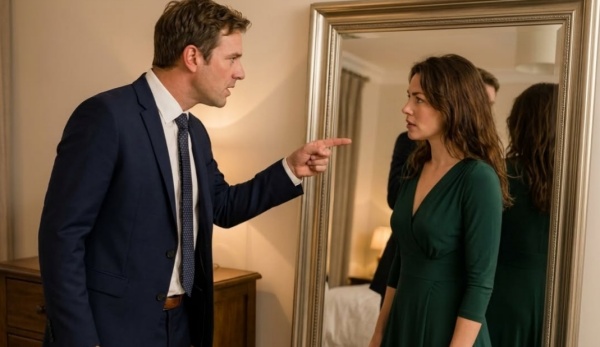
“Are You Getting All Dolled Up to Go Stand on the Street?” my husband demanded, even though he hadn’t spent a single night at home in weeks. While he was busy playing house with his mistress, he never noticed I was quietly packing away the life we’d built together.
Then, just after midnight, he unlocked the front door expecting another argument. Instead, he found half my closet empty, silence filling the house… and one letter on the dining table that made him realize he’d underestimated me all along.
PART 1 — The Question That Finally Ended My Marriage
“Are you getting all dolled up to go stand on the street?”
That was the sentence my husband chose to throw at me on a Thursday evening in Nashville, Tennessee, while I stood in front of our bedroom mirror wearing a black dress, simple gold earrings, and the red lipstick I had not worn in months.
His name was Ethan Walker, and he had not slept in our home for seventeen nights.
Seventeen.
I know because I had stopped sleeping properly after the fourth night and started counting after the seventh. By the tenth, I had stopped texting him after 9 p.m. By the fourteenth, I had stopped pretending to myself that he was “working late.” By the seventeenth, I had already made arrangements he knew nothing about.
But there he was, standing in the doorway of our bedroom like a man who still believed he had the right to inspect me.
Ethan was thirty-eight, a commercial real estate broker with a face people trusted and a voice designed for closing deals. He was tall, broad-shouldered, clean-shaven, and always dressed as if a photographer might appear. At charity events, women told me I was lucky.
For years, I smiled and said, “I know.”
That was before I learned luck could rot quietly behind closed doors.
I turned away from the mirror and looked at him.
“Excuse me?”
He leaned against the doorframe, arms crossed, eyes moving slowly from my hair to my heels. He gave a short laugh that did not contain humor.
“You heard me. New dress, lipstick, perfume. What’s the occasion, Hannah? Or should I not ask?”
My name is Hannah Walker, though not for much longer.
I was thirty-five years old, senior event director for a nonprofit arts foundation downtown, and for nine years I had been Ethan’s wife. I had managed our home, our calendars, our holidays, our tax documents, his mother’s birthday gifts, his client dinners, his dry cleaning, and every social obligation that helped make him look polished.
I had also helped build the business contacts he now used to pretend he had outgrown me.
The black dress was not for another man.
It was for a donor reception at the Frist Art Museum, where I was expected to speak briefly on behalf of the foundation. Ethan knew that. I had told him twice and sent him the calendar invite three weeks earlier.
He had accepted the invitation.
Then disappeared.
“You know where I’m going,” I said.
He shrugged.
“Do I?”
I stared at him for a second, trying to understand how a man could abandon his wife for weeks and still come home with accusations in his mouth.
“You haven’t been here,” I said quietly.
His expression hardened.
“Don’t start.”
That was his favorite phrase.
Don’t start.
As if I were a car alarm, not a woman asking where her husband slept.
“I’m not starting anything,” I said. “I’m going to work.”
“At seven at night?”
“It’s an evening reception.”
“Convenient.”
I almost laughed.
Convenient.
The man who claimed emergency client meetings had suddenly stretched into overnight absences was suspicious of my scheduled work event because I wore lipstick.
“Where were you last night?” I asked.
He looked away.
“Business.”
“With who?”
“A client.”
“Which client?”
He rubbed his jaw and gave me that tired look he used when he wanted me to feel small.
“You don’t know them.”
“I might.”
“No, Hannah. You wouldn’t.”
There it was.
The dismissal.
Not loud.
Not dramatic.
Just the steady erosion of respect that had become the soundtrack of our marriage.
The truth was, I already knew exactly where he had been.
I knew her name.
Madison Reed.
Twenty-nine years old. Interior designer. Divorced once. Hired by Ethan’s firm to stage luxury properties. Blond hair, wide smile, Instagram full of soft lighting, champagne glasses, and captions about “choosing joy.”
For three months, Ethan had been choosing joy in her condo in The Gulch while telling me he was trapped in late closings, investor dinners, and early site visits.
I knew because Madison posted carelessly.
A dinner table with two wineglasses and Ethan’s watch in the corner.
A photo of a hotel lobby in Franklin on the same weekend Ethan said he was in Atlanta.
A mirror selfie with a man’s navy suit jacket draped over a chair behind her.
That suit jacket was hanging in our closet until it wasn’t.
I also knew because my neighbor, Mrs. Alvarez, had seen Ethan leave with a garment bag on a Tuesday morning and return forty minutes later without it. Because our shared credit card showed restaurant charges he claimed were “client development.” Because a woman answering Madison’s salon phone once said, “Oh, Ethan’s picking her up at six,” before realizing I was not Madison.
I was not ignorant.
I had simply stopped reacting before I was ready to act.
Ethan did not know that.
He thought my silence meant defeat.
That evening, as he stood in the bedroom doorway insulting me, I felt a strange calm settle over me. It was not numbness. It was not shock. It was the peace that arrives when the last piece of denial breaks cleanly off and falls away.
“Move,” I said.
His eyebrows lifted.
“What?”
“You’re blocking the door.”
He laughed again, sharper this time.
“You’re really going to walk out dressed like that after I asked you a question?”
“No,” I said. “I’m going to walk out because I have a job, a life, and an event full of people waiting for me. Your question doesn’t deserve an answer.”
His face changed.
Ethan was used to tears. He was used to me explaining myself, softening myself, trying to make him understand that I was hurt instead of angry. He was not used to me sounding finished.
He stepped aside.
I picked up my clutch from the dresser.
As I passed him, he said, “Don’t embarrass yourself tonight.”
I stopped in the hallway.
For one second, the old Hannah almost turned around. The old Hannah would have asked what he meant. The old Hannah would have tried to defend her character to a man who had abandoned his own.
Instead, I said, “That’s your department now.”
Then I walked out.
The reception was beautiful.
The Frist’s galleries glowed under warm lights, and the December air outside made people arrive flushed and grateful for wine. I shook hands with donors, thanked board members, introduced artists, and spoke for three minutes about community programs for public school students. No one knew my husband had just asked whether I was dressing up to humiliate myself.
That is one of the strange things about heartbreak.
You can be breaking apart in private and still pronounce every name correctly in public.
At 9:14 p.m., Ethan texted.
Where are you?
I stared at the message while standing beside a sculpture installation.
Then I put my phone back in my clutch.
At 9:28, he texted again.
Answer me.
At 9:41:
You’re making this worse.
Worse.
That word told me everything.
He thought this was still a fight.
He did not understand that the fight was over.
At 10:06, Madison posted an Instagram story.
A dimly lit kitchen.
Two glasses of red wine.
A man’s hand reaching for one glass.
Ethan’s wedding ring was not on his finger.
The caption read:
Some people feel like home.
I looked at the photo for a long time.
Then I sent it to my attorney.
Her name was Caroline Price, and she had been quietly advising me for six weeks.
She replied in less than a minute.
Saved. Do not respond to him tonight. Proceed as planned.
Proceed as planned.
Those three words steadied me more than any comfort could have.
Because while Ethan had been busy playing house with Madison, I had been quietly packing away the life we built together.
Not emotionally.
Legally.
Financially.
Physically.
And just after midnight, he would finally notice.
PART 2 — What Ethan Didn’t Notice While He Was Gone
Six weeks earlier, I had found the receipt.
Not the first receipt.
The receipt.
The one so specific that even my tired, hopeful heart could not explain it away.
It was tucked into the side pocket of Ethan’s gym bag, folded twice and soft from being carried around. I had not been snooping. I was doing laundry because he had complained that his workout clothes smelled “off,” as if laundry happened by natural law and not by my hands.
The receipt was from Lumen, a high-end restaurant downtown.
Two tasting menus.
One bottle of Pinot Noir.
One dessert with the note: Happy three months, M.
The charge was $412.78.
Three months.
M.
I sat on the laundry room floor with that tiny piece of paper in my hand and felt something inside me tilt.
The date matched a night Ethan said he had an out-of-town investor dinner in Birmingham. I remembered because I had made him chicken soup before he left, thinking he was getting sick. He kissed my forehead at the door and said, “Don’t wait up.”
I had not waited up.
I had trusted him.
Trust is humiliating in hindsight when the other person used it as camouflage.
I took a photo of the receipt.
Then I put it back exactly where I found it.
That was the first time I did not confront him.
For years, confrontation had been my instinct.
If Ethan came home late, I asked. If he seemed distant, I asked. If he snapped at me, I asked what was wrong. I believed communication could fix anything because every marriage book, every therapist on social media, and every well-meaning older woman had said some version of the same thing: talk to your husband.
So I talked.
And Ethan learned to lie better.
He learned which details reassured me. He learned to look exhausted instead of guilty. He learned to say, “Baby, I’m doing this for us,” when he meant, “I am doing whatever I want and counting on you to absorb the cost.”
After the Lumen receipt, I changed strategies.
I stopped asking questions I already knew he would answer falsely.
I started documenting.
Not obsessively.
Not illegally.
Carefully.
I created a folder on a password-protected drive. I saved credit card statements from accounts bearing my name. I saved screenshots of public social media posts. I saved texts he sent me claiming to be in one city while location-tagged photos placed him in another. I saved restaurant charges, hotel charges, rideshare receipts, and copies of shared bills.
I called Caroline Price after the second hotel charge.
Caroline was a family law attorney in Nashville, recommended by a board member at work who simply said, “If you ever need someone strong, call her.”
I sat in Caroline’s office on a rainy Tuesday afternoon and tried not to cry beneath a framed diploma from Vanderbilt Law School.
“My husband is cheating,” I said.
Caroline did not gasp.
She did not say she was sorry in the soft voice people use when they want the room to stay comfortable.
She opened a yellow legal pad and said, “Tell me what you know.”
So I did.
I told her Ethan had stopped coming home regularly. I told her about Madison. I told her about the receipts, the credit card charges, the lies, the insults, the way he had started hinting that the house was “basically his” because he earned more.
Caroline listened.
Then she explained Tennessee divorce law in plain English.
She told me fault could still matter in some circumstances, but divorce was not a revenge machine. She told me documentation mattered most for financial clarity, property division, and credibility. She told me not to empty accounts, not to threaten him, not to post anything online, not to confront Madison, and not to move out without a plan.
“Your job,” she said, “is to become calm and organized.”
“I don’t feel calm.”
“You don’t have to feel it. You have to behave it.”
That sentence became my anchor.
Calm and organized.
While Ethan stayed at Madison’s condo, I quietly gathered documents.
Mortgage statements.
Tax returns.
Investment accounts.
Insurance policies.
Car titles.
Retirement balances.
Loan documents.
Business expense records.
The deed to our house in 12 South, which Ethan loved telling people he had “bought for Hannah.” In reality, the down payment had come partly from the sale of my condo, which I owned before marriage. Ethan had forgotten that because he did not respect anything that existed before him.
I had not forgotten.
Neither had the closing documents.
Paper remembers what men rewrite.
I also opened a separate checking account at a credit union where Ethan had no access. I changed the direct deposit for my paycheck. I rented a small furnished townhouse under my maiden name, Hannah Ellis, on a quiet street near Sylvan Park.
Not forever.
Just long enough to breathe.
My best friend, Lauren, helped me move boxes little by little while Ethan was “working late.” We packed photo albums, winter coats, my grandmother’s dishes, tax files, professional clothes, my jewelry, sentimental items, and the watercolor painting my sister made for our wedding.
I left the furniture.
I left the big television Ethan loved.
I left the leather sectional he insisted made the living room look “masculine.”
I left every wedding gift from his side of the family.
What I took were the things that mattered and the things that were mine.
Half my closet disappeared slowly.
A few dresses one week.
Shoes the next.
Then off-season clothes.
Then files.
Then books.
Ethan never noticed.
That was almost more painful than the affair.
A stranger could have robbed our home more attentively than my husband lived in it.
One Saturday morning, while he showered after coming home at dawn, I found a small velvet box in his coat pocket.
Inside was a bracelet.
Rose gold.
Tiny diamonds.
I had once admired a bracelet just like it in a boutique window, and Ethan had said, “That’s a little much, don’t you think?”
This bracelet was not for me.
I took a photo, returned it to the pocket, and later found it on Madison’s Instagram.
Her caption:
Spoiled by someone who knows my worth.
I laughed when I saw that.
Not because it was funny.
Because Madison thought a bracelet bought with marital money proved her worth.
What it proved was Ethan’s lack of originality.
I sent the screenshot to Caroline.
She replied:
Add to spending log.
By then, I had learned the power of boring phrases.
Spending log.
Asset inventory.
Temporary order.
Separate account.
Certified mail.
The language was not dramatic.
That was why it worked.
At home, Ethan became crueler as my silence increased.
He accused me of being cold. He asked whether I was “seeing someone” because I no longer cried when he canceled dinner plans. He mocked my work clothes, my early mornings, my “little nonprofit events,” even though those events connected him to half the donors he now pretended were his network.
One night, he came home at 2:00 a.m. smelling like Madison’s vanilla perfume.
I was in the kitchen drinking water.
He looked annoyed to see me awake.
“Can’t sleep?” he asked.
“No.”
“You should try. You look tired.”
I looked at him over the rim of my glass.
“So do you.”
He smiled slowly.
“Jealousy isn’t attractive, Hannah.”
I wanted to throw the glass.
Instead, I put it in the dishwasher.
Calm and organized.
Every cruel sentence became confirmation.
Every absence became preparation time.
Every lie became another page in the folder.
By the night he asked if I was getting dressed “to go stand on the street,” most of my necessary belongings were already gone. My new townhouse had a bed, towels, coffee, a desk, a lamp, groceries, and a row of unpacked boxes labeled in Lauren’s handwriting.
The utilities were in my name.
The internet worked.
The locks were changed.
A divorce petition was drafted.
The letter was written.
All that remained was to leave it where Ethan could not ignore it.
On the dining table of the house he thought I would never walk away from.
PART 3 — The Night I Left
After the donor reception, I did not go straight home.
That was part of the plan.
Lauren met me at a twenty-four-hour diner near West End Avenue, still wearing her scrubs from the hospital where she worked as a nurse practitioner. She slid into the booth across from me, took one look at my face, and said, “Tonight?”
“Tonight.”
She nodded and waved at the waitress.
“Then you need fries.”
“I’m not hungry.”
“You’re leaving your cheating husband. Your blood sugar matters.”
That was Lauren.
Practical loyalty.
She had hated Ethan for longer than I had allowed myself to admit. Not loudly, not rudely, but in the way best friends hate men who make their friends smaller. She never pushed me to leave before I was ready. She just kept showing up with storage bins and questions like, “Do you want the blue dress or does it have bad memories now?”
At the diner, I told her what Ethan had said before I left.
Her eyes went flat.
“He said what?”
I repeated it.
Lauren placed both hands on the table.
“I’m not a violent person.”
“You once threatened a vending machine.”
“It stole my peanut M&M’s.”
“You shook it.”
“It needed accountability.”
I laughed for the first time that night.
Then I cried.
Quietly.
Into a paper napkin that smelled faintly like fryer oil.
Lauren reached across the table and took my hand.
“You’re doing the right thing.”
“I know.”
“Do you?”
I looked out the window at the wet streetlights.
“Yes,” I said. “I just hate that doing the right thing feels like losing.”
She squeezed my hand.
“It feels like losing because you kept trying to win a marriage he already abandoned.”
That sentence hurt because it was true.
Ethan left emotionally long before he left physically. He left every time he lied. Every time he made me feel foolish for noticing. Every time he spent money on Madison and let me compare grocery prices. Every time he slept elsewhere and came home acting like I was the one who owed him peace.
I was not ending the marriage.
I was documenting its death certificate.
At 11:18 p.m., Ethan texted.
Still out?
At 11:21:
Unbelievable.
At 11:24:
Don’t bother coming home with an attitude.
Lauren read the messages and snorted.
“Sir, she is not coming home at all.”
At 11:40, we pulled up behind my house.
My house.
Our house.
The porch light was on. The front windows glowed softly. From the street, it looked warm, stable, intact. People walking by would never guess that inside, half the drawers were empty and a marriage was about to become paperwork.
Ethan’s car was not in the driveway.
Madison lived twelve minutes away.
I knew because I had driven past once and hated myself for doing it.
Lauren parked around the corner while I went inside alone.
Not because I was afraid of her seeing my pain, but because I needed one final moment with the house.
The key turned smoothly.
The entryway smelled like cedar, lemon cleaner, and faint traces of Ethan’s cologne. My heels clicked against the hardwood floor. The silence inside felt different from before, no longer lonely but expectant.
I walked from room to room.
The kitchen where I had baked birthday cakes for Ethan.
The living room where we hosted Christmas parties.
The guest room I once imagined might become a nursery before Ethan decided “maybe kids would slow us down.”
The bedroom where I had slept alone for more nights than I wanted to count.
I did not take the wedding photo from the hallway.
I left it hanging.
Let him look at it.
Let him see the version of us he helped destroy.
In the bedroom, I opened my closet one last time. The left side still held some clothes: older sweaters, a few dresses, shoes I no longer wanted. The right side, Ethan’s side, remained untouched and crowded.
My half looked like a quiet confession.
Empty hangers.
Open space.
A missing life.
I removed my wedding ring.
I had worn it to the donor reception because I had not wanted questions. Now, alone in the bedroom, I twisted it off slowly and felt the small indentation it left behind on my finger.
For nine years, that ring had announced that I belonged to a promise.
The promise was gone.
The ring was just metal.
I placed it on Ethan’s nightstand beside the framed photo from our honeymoon in Charleston. In the picture, we were tan, laughing, wrapped around each other in front of the ocean. I remembered that trip. I remembered believing happiness was proof of permanence.
It wasn’t.
Happiness is only proof of a moment.
Character decides what happens after.
I went downstairs with the letter in my hand.
It was three pages long, typed and printed on plain white paper. Caroline had advised me not to include threats, insults, or anything that could be twisted later. Lauren said I was allowed one emotionally devastating sentence if it was classy.
I found several.
I placed the letter on the dining table.
Beside it, I placed a copy of the divorce attorney’s business card.
Not the petition.
That would come through proper legal service.
This letter was not legal notice.
It was an ending.
At 12:03 a.m., headlights swept across the front windows.
Ethan.
My heart slammed once against my ribs.
I moved to the hallway, out of sight from the front door but close enough to hear. I had planned to be gone before he arrived. But the house had held me too long, and now the moment was happening with me still inside.
The key turned.
The front door opened.
Ethan stepped in, muttering something under his breath.
He closed the door, dropped his keys into the bowl, and called, “Hannah?”
I did not answer.
He walked toward the living room.
“Hannah?”
His voice changed slightly.
Less irritated.
More uncertain.
He went upstairs first.
I heard his footsteps cross the bedroom.
A pause.
Closet door sliding open.
Longer pause.
Then:
“What the hell?”
I closed my eyes.
He came back downstairs fast.
“Hannah!”
Still, I said nothing.
He entered the dining room.
Silence.
Then paper shifting.
I imagined his hands picking up the letter.
I imagined his face tightening at the first line.
I did not need to stay.
I opened the side door quietly and slipped into the driveway, then down the side path toward Lauren’s car around the corner.
My phone buzzed before I reached the sidewalk.
What is this?
Then:
Where are you?
Then:
Answer me right now.
Lauren started the car as soon as I got in.
“You okay?”
I looked at the house through the windshield.
The dining room light was on.
Ethan was inside reading the truth I had finally stopped swallowing.
“No,” I said.
Then I took a breath.
“But I will be.”
PART 4 — The Letter on the Dining Table
Ethan later told mutual friends that my letter was “cold.”
I hope it was.
Warmth had not worked.
For years, I had given him warmth. Warm dinners, warm apologies, warm forgiveness, warm excuses when he embarrassed me, warm silence when he came home smelling like someone else. Warmth had only taught him that I could be burned without consequence.
The letter began simply.
Ethan,
By the time you read this, I will be gone. This is not a disappearance, a tantrum, or an invitation to argue. It is the result of months of your choices and weeks of my preparation.
That was the first blow.
I know because he quoted it later in a voicemail, furious that I had used the word preparation.
He hated that word.
Preparation meant I had not left because of one insult, one bad night, one misunderstanding. It meant while he was telling himself I was too emotional to think clearly, I had been thinking clearly enough to plan my exit.
The letter continued.
You have not spent a full night in this house for nearly three weeks. You have repeatedly lied about your location, your spending, and your relationship with Madison Reed. I know about the dinners, the hotel stays, the bracelet, the trips, and the social media posts you thought I would not see.
Do not insult either of us by denying it.
That line was Lauren’s favorite.
Caroline approved it because it was not a threat.
Just a boundary.
The second page was about the practical things.
I have retained counsel. All communication about legal matters should go through Caroline Price, whose card is on the table. You will be served properly. Do not empty accounts, sell marital property, destroy documents, or attempt to remove financial records from the house. Copies have already been secured.
That was the part that likely made him sit down.
Ethan loved control, but he hated records.
He hated anything that turned charm into evidence.
The third page was mine.
Not Caroline’s.
Mine.
Tonight, before I left for a work event you had forgotten about, you asked if I was getting dressed to stand on the street. I want you to understand something clearly: I was not dressing for another man. I was dressing for a room full of people who respect me, listen when I speak, and know what I contribute.
That is more than I can say for my husband.
You mistook my patience for weakness. You mistook my silence for ignorance. You mistook my love for dependence. Those were your mistakes, not mine.
I am not leaving because I stopped caring overnight. I am leaving because I cared for years and watched you turn that care into something you believed you were entitled to waste.
Do not come to my workplace. Do not contact my friends or family to pressure me. Do not show up where I am staying. If you need to communicate, use the attorney.
I hope one day you understand that losing me was not something that happened to you. It was something you built.
— Hannah
Ethan called seventeen times that night.
I did not answer.
At 12:19 a.m.:
You’re being dramatic.
At 12:23:
This is insane. Come home and talk to me.
At 12:31:
Madison is not what you think.
At 12:34:
You had no right to go through my things.
At 12:37:
Please answer.
At 12:52:
I’m sorry.
That last one almost got me.
Not because I believed it.
Because I had wanted to hear those words for so long that my body reacted before my brain could remind it of the truth.
Lauren took my phone gently.
“Nope.”
“I wasn’t going to answer.”
“You were looking at it like it had medicine in it.”
I hated that she was right.
The townhouse felt strange that first night.
Too clean.
Too quiet.
Too temporary.
There were boxes stacked against the wall and only one lamp in the living room. The bed had sheets Lauren bought because I forgot bedding. The refrigerator held yogurt, grapes, sparkling water, and a rotisserie chicken she insisted counted as meal planning.
I sat on the floor still wearing the black dress.
At 1:30 a.m., I finally cried properly.
Not gracefully.
Not quietly.
I cried like someone had pulled a decade out of my chest and left the roots exposed.
Lauren sat beside me without trying to fix it.
After a while, she said, “You know you didn’t fail, right?”
I wiped my face.
“It feels like failure.”
“I know.”
“I stayed too long.”
“Maybe.”
I looked at her.
“You’re supposed to say no.”
“I’m supposed to tell you the truth. Maybe you stayed too long. But you left when you could. That counts.”
That counts.
I held onto those words through the next week.
Ethan tried every tactic.
Anger first.
He claimed I abandoned the marriage. He claimed I had been “building a case” instead of communicating. He called my documentation “creepy” and “vindictive,” which was rich coming from a man whose mistress posted his hand on Instagram.
Then came guilt.
He texted that he could not sleep in the house alone. He sent a photo of our wedding picture and wrote, This meant something once.
I wanted to reply, To me too. That was the problem.
I did not.
Then came fear.
He said divorce would ruin us financially. He said people would talk. He said my reputation would suffer if everyone knew our private business. He said Madison would “make things difficult” if I dragged her into it.
I forwarded everything to Caroline.
Caroline’s responses became my emotional support system.
Do not respond.
Saved.
Expected.
He is testing boundaries. Maintain them.
Madison blocked me on Instagram after three days.
I had never followed her.
That told me enough.
The legal process began with the dull force of reality.
Ethan was served at his office on a Monday morning.
He called immediately.
I did not answer.
Then he left a voicemail.
“Hannah, having me served at work was humiliating.”
I listened once.
Then deleted it after saving a copy.
Humiliating.
Not cheating.
Not insulting me.
Not sleeping elsewhere for weeks.
Being served legal papers in a place where other people could see.
That was Ethan’s wound.
Visibility.
Men like Ethan can survive cruelty as long as it stays private.
What they fear is documentation under fluorescent lights.
PART 5 — The Life He Thought I Wouldn’t Build
Divorce is not a lightning strike.
It is weather.
It rolls in slowly, fills every room, soaks every document, changes the temperature of every conversation. People imagine one dramatic confrontation and then freedom. Real divorce is passwords, appraisals, bank statements, attorney emails, temporary agreements, and learning which household items you care about only after someone else claims them.
Ethan fought over the espresso machine.
Not the retirement account at first.
Not the house.
The espresso machine.
Caroline said this was normal.
“Control often shows up through objects,” she told me.
“He doesn’t even know how to descale it.”
“Then it isn’t about coffee.”
Nothing was about what it appeared to be.
The house was not about shelter; it was about image.
The affair was not about love; it was about ego.
The insults were not about suspicion; they were about projection.
The espresso machine was not about caffeine; it was about making sure I did not leave cleanly.
Ethan’s attorney described him as “committed to reconciliation.”
Caroline asked for that commitment to be shown through disclosure, financial transparency, respectful communication, and a pause in contact with Madison.
Suddenly, his commitment became complicated.
Madison did not last long once the divorce became real.
I heard through a mutual acquaintance that she thought Ethan was separated when they began dating. Maybe she did. Maybe he lied to both of us in different ways. Maybe she saw the ring and chose not to care. By then, I had stopped making her the center of my pain.
Ethan had made vows to me.
Madison had not.
That distinction helped me heal.
It kept me from wasting my recovery on someone who had not promised to protect my heart.
The financial disclosures were illuminating.
Not because Ethan was hiding millions.
He was not.
This was not a movie.
But he had spent thousands of marital dollars on Madison: restaurants, hotel rooms, gifts, weekend travel, concert tickets, spa charges, and one ridiculous private cooking class he had once told me was “a client team-building event.”
Caroline added everything to a marital spending summary.
Ethan called it petty.
The mediator called it relevant.
I called it math.
The house became the biggest issue.
Ethan wanted it because he hated losing. I wanted a fair outcome, not the burden of maintaining a museum of broken promises. In the end, we agreed to sell it and divide proceeds according to negotiated terms that accounted for my premarital contribution from the condo sale.
Ethan did not like that.
The paperwork liked it just fine.
Paper remembers.
The day I went back to pack the last of my belongings, I brought Lauren, my brother, and a professional organizer. Ethan was not there, by agreement. The house looked smaller than I remembered. The dining table was bare. The wedding photo in the hallway was gone.
For a second, grief rose so sharply I had to put one hand on the wall.
Lauren noticed.
“Want a minute?”
I nodded.
I stood alone in the dining room where I had left the letter.
I remembered the woman who placed it there.
Black dress.
Red lipstick.
Hands steady only because she forced them to be.
She had been terrified.
But she had left anyway.
“I’m proud of you,” I whispered to her.
Maybe that sounds strange.
But sometimes survival requires going back and thanking the version of yourself who did the hardest thing.
Six months later, the divorce was finalized.
I went back to my maiden name.
Hannah Ellis.
The first time I saw it on my new driver’s license, I cried in the parking lot of the DMV. Not because the name was new, but because it was old. It had been waiting for me beneath the wreckage.
My life became smaller at first.
The townhouse. Work. Therapy. Dinner with Lauren. Long walks at Percy Warner Park. Sunday mornings without Ethan’s golf clothes on the floor. Nights when the silence felt peaceful instead of punishing.
Then slowly, it expanded.
I accepted a promotion at the foundation.
I traveled to New York for a donor summit and stayed an extra day just to walk through museums alone. I bought myself a sapphire ring for my right hand. Not a replacement. A reminder. I started taking pottery classes badly and loved being bad at something no one could use against me.
Ethan emailed me once after the divorce was final.
The subject line was:
I understand now.
I stared at it for a full minute before opening it.
The email was not long.
He wrote that the house felt empty after I left. He wrote that Madison had not been what he thought. He wrote that he missed the way I made life feel “steady.” He wrote that he regretted what he said the night I wore the black dress.
Then he wrote:
I didn’t realize how much you did until you stopped doing it.
That sentence should have satisfied me.
It did not.
Because I did not want to be valued only by the labor he noticed in my absence.
I wanted to be loved while present.
I closed the email and did not respond.
A year after I left, I attended another donor reception at the Frist.
I wore the same black dress.
Not because I had to prove anything.
Because it looked good on me.
The room was full of artists, donors, teachers, and students whose programs we had funded. I gave a speech about resilience in community arts, and halfway through, I realized I was no longer pretending to be okay for the sake of appearances.
I was okay.
Not every minute.
Not perfectly.
But truly.
After the reception, I walked outside into the cool night air. Downtown Nashville glittered around me. Music floated from a bar down the street. My phone buzzed with a text from Lauren asking if I wanted tacos.
I smiled.
Yes.
Always yes.
As I waited for my rideshare, I thought about Ethan standing in our old doorway, asking if I was getting dressed to go stand on the street. Back then, the insult had landed because some small part of me still wanted him to see me clearly.
Now I understood.
His inability to see me had never reduced my worth.
It had only revealed his limits.
He thought I was dressing for attention.
I was dressing for myself.
He thought my silence meant I had no idea.
I was gathering evidence.
He thought my patience meant I would stay.
I was packing.
He thought the house, the marriage, the reputation, and the story belonged to him.
Then he came home after midnight and found half my closet empty.
Silence in every room.
A ring on the nightstand.
And a letter on the dining table telling him the truth he should have known from the beginning.
I was never the woman he could leave waiting forever.
I was only the woman who needed time to remember it.
