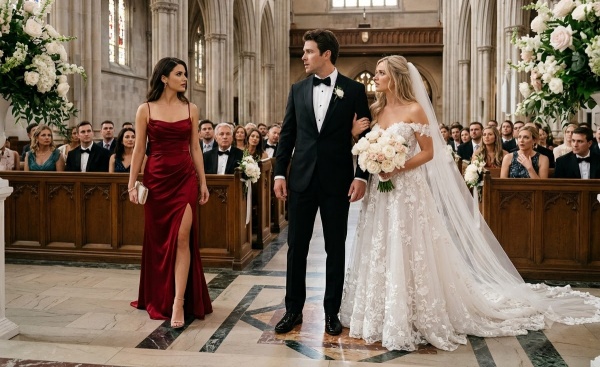
My Husband Texted “I Miss You, My Wife”—Minutes Before He Was Supposed to Marry Someone Else. My husband thought I was away at a work conference when he sent me a loving message on the morning of his wedding. What he didn’t know was that the bride had invited me—and I was already there. He spotted me among the guests before he reached the altar, but by then I had seen a photograph that exposed more than his affair.
Part 1: The Invitation
My husband arrived at a lavish wedding wearing the anniversary watch I had given him, ready to marry my former classmate while still texting, “I miss you, my wife.” I was among the guests, and before he reached the altar, he would see the wife he thought was safely out of sight. But the wedding photographs had already revealed something worse than the affair.
The message came at 10:14 on a Saturday morning, while I was sitting in a hotel room in Charlotte, North Carolina. I had told Michael I was there for a work conference, and that part was true. What he didn’t know was that the conference had ended the previous afternoon, and I had spent the evening studying photographs from his wedding weekend.
I miss you, my wife, he wrote. Hope your meetings aren’t too boring. Call me when you get a chance.
I looked at the message for a long time. Then I set my phone on the bed beside the navy dress I planned to wear and opened the photograph again. Michael stood in a sunlit garden, smiling at a woman in a white dress I recognized from the invitation.
Her name was Vanessa Cole. She and I had graduated from the same high school in Raleigh sixteen years earlier, though we hadn’t been close back then. We had reconnected online the previous spring after discovering that we both worked with nonprofit organizations.
The photograph wasn’t from the ceremony. A local photographer had posted a preview of Vanessa and Michael’s welcome party, held the night before at an estate outside Charlotte. Beneath the picture, the caption called them “the happiest couple,” and several people had already commented on how perfect they looked together.
Michael wore a dark suit and the silver watch I had given him for our tenth wedding anniversary. I could see the blue face clearly because his hand rested on Vanessa’s shoulder. The watch had cost me three months of careful saving, and I had engraved the back with the words Still my favorite person.
I zoomed in until the image blurred. Behind them, propped against a display of flowers, was a framed photograph of a small yellow house with a wide front porch. My mother’s house.
For a moment, I thought I must be mistaken. Plenty of houses in North Carolina had white railings and blue shutters, and the picture on the table was partly hidden by roses. But there was no mistaking the crooked dogwood tree beside the driveway or the ceramic rabbit my father had placed near the front steps.
A small sign beneath the photograph read, Our next chapter.
I felt a chill move through me. My mother, Elaine, had lived in that house for thirty-eight years. My father had built the porch swing himself, and after he died, Mom had refused to replace it even when the paint began to peel.
Michael knew what the house meant to her. He also knew that I had been helping Mom review offers from contractors because the roof needed work. As far as I knew, she had no intention of selling it.
I called her immediately. She answered on the third ring, sounding cheerful and slightly distracted. I could hear the television in the background and the familiar clink of her spoon against a coffee mug.
“Have you talked to Michael about your house?” I asked.
“He came by last week with a woman from his office,” Mom said. “They said they might know someone who could help with the roof.”
My hand tightened around the phone. “What did the woman look like?”
Mom described Vanessa almost perfectly: dark hair, bright green eyes, and a voice that made every sentence sound like a compliment. She said Vanessa had introduced herself as someone who helped Michael with property investments. They had taken a few photographs of the exterior and asked whether Mom ever thought about moving somewhere smaller.
“What did you tell them?”
“That I’d think about it when I was ready. Why?”
I didn’t want to tell her everything over the phone, but there was no gentle way to begin. I told her Michael was in Charlotte, that he appeared to be planning a wedding with Vanessa, and that a photograph of her house had appeared at their welcome party. When she didn’t speak, I worried the call had dropped.
“Mom?”
“I’m here,” she said. “I’m just trying to understand why my son-in-law would bring another woman to my house and tell her it might be hers.”
The answer was sitting somewhere between the photograph and the wedding invitation. I had received that invitation six weeks earlier, and until two days ago, I had no idea the groom was my husband. It had been addressed to me by my maiden name, the name Vanessa remembered from high school.
I had met Vanessa for lunch in May when she came to Raleigh for a fundraiser. We talked about our teachers, old classmates, and the way the football field seemed enormous when we were seventeen. She mentioned that she was dating someone named Michael, but she called him Mike, and she never showed me a photograph.
There were a lot of men named Mike in North Carolina. She said he worked in commercial property and traveled often, which also described thousands of people. I had no reason to connect him to my husband, whose job was in sales for a building-supply company.
When the invitation arrived, I noticed the groom’s name was listed as Michael Reed. My husband’s name was Michael Bennett. I assumed Vanessa had found someone new, and when I saw her at another fundraiser, she told me they were keeping the celebration relatively small.
“Mostly family, a few old friends, and the people who helped us through a difficult year,” she said.
I had almost declined because of the conference. Then she told me how much it meant to reconnect with someone who remembered her before she had built her career. I said I would come if I could rearrange my travel plans.
On Thursday, Vanessa sent me a link to the wedding website because the printed invitation didn’t include directions to the estate. The homepage showed a photograph of her and Michael standing with their backs to the camera. He was wearing a baseball cap, and I still didn’t recognize him.
I clicked through to the gallery while waiting for a conference session to begin. The first picture showed Vanessa holding a glass of champagne. The second showed the two of them at a restaurant, his arm around her, his face turned toward the camera.
I knew that face better than my own. I knew the small scar above his eyebrow, the crease beside his mouth, and the way he tilted his head when he was trying to look patient. For the first time in eleven years, seeing my husband made me feel as if I was looking at a stranger.
I left the conference room and called him. He answered from what he said was a customer meeting in Greensboro. When I asked what he was doing that weekend, he said he planned to clean the garage and watch football.
“I wish you were here,” he added. “The house feels empty.”
I didn’t confront him. I told him I had to return to my session, then ended the call before my voice gave me away. I needed to understand what Vanessa knew and why my husband had another last name.
Back in my hotel room, I opened the wedding website again. There were pictures from a holiday trip, a charity dinner, and a family barbecue. In one photograph, Vanessa stood beside a woman I recognized as Michael’s older sister, Karen.
Karen had attended my birthday dinner three months earlier. She had hugged me goodbye in my driveway and told me to call if I needed anything. In the photograph, she was holding a sign that read, Future sister-in-law.
I called her before I could talk myself out of it. She didn’t answer, but she texted a few minutes later: In a meeting. Everything okay?
I sent her the photograph.
Her reply came almost immediately.
Claire, please don’t go to the wedding. Let me explain first.
Part 2: The Other Story
Karen asked me to meet her for coffee at a café near my hotel. She arrived wearing jeans and a gray sweater, her hair still damp as though she had left home in a hurry. I had known her for twelve years, but I had never seen her look afraid of me.
She ordered tea she didn’t drink. I placed my phone on the table with the wedding photograph open between us. For a while, neither of us said anything.
“How long have you known?” I asked.
“About Vanessa? Since February.”
It was November. I counted the months while the espresso machine hissed behind the counter. In March, Karen had helped me choose a birthday gift for Michael; in June, she had joined us for a beach weekend.
“Did you know he was going to marry her?”
“Not at first. He told me you had separated and didn’t want people to know until you’d figured things out.”
“And you believed him after spending a weekend in our house?”
“He said you were trying to make it work. He said the two of you were seeing a counselor.”
We had seen a counselor, briefly, the previous year. Michael had been distant, and I had assumed his long hours were taking a toll on us. After three sessions, he said he felt better and wanted us to focus on spending more time together.
I had believed him because he seemed present again. He made dinner, planned a weekend in Asheville, and left notes in my lunch bag. Looking back, I couldn’t tell which moments had been genuine and which had been part of the story he wanted me to see.
Karen wrapped both hands around her cup. “When he told me about the wedding, I asked him if the divorce was final. He said it was.”
“There is no divorce.”
“I know that now.”
“How?”
She hesitated. Then she told me Vanessa had mentioned my name at the welcome dinner the previous night. Vanessa had said an old classmate named Claire Bennett might be able to attend after all.
“Michael went pale,” Karen said. “He asked what you looked like, and Vanessa showed him your profile picture. He told her he recognized you from a charity event and that you probably wouldn’t make it.”
I thought of the text he had sent me at breakfast. He had known I was invited and still assumed I would be too busy to attend. Perhaps he also believed I would never expect him to be the groom.
“What did you do?” I asked Karen.
“I told him he had to tell Vanessa the truth. He said he would, but he wanted to do it after the weekend.”
“After the wedding?”
“He said it wasn’t going to be a legal ceremony.”
I stared at her. “Did Vanessa know that?”
Karen shook her head. “I don’t know. I asked him, and he said he had everything under control.”
That was Michael’s favorite phrase. He used it when the washing machine broke, when his father needed a ride to an appointment, and when our taxes were due. Until that moment, I had always thought it meant I could depend on him.
Karen reached into her purse and took out a folded program. Vanessa had given it to her at the rehearsal, and Michael’s full name appeared on the front: Michael Reed and Vanessa Cole. I asked Karen where the name Reed had come from.
“It was our mother’s maiden name,” she said. “He used it for a while when he was younger, after our parents divorced.”
I knew that much. Michael had mentioned that he once thought about changing his last name, though I had never heard anyone call him Reed. Karen said he had started using it socially again after telling Vanessa he wanted distance from a painful family history.
I showed her the photograph of my mother’s house. Karen looked confused, then worried. She said she had seen the picture at the welcome party but assumed Michael had finally bought the property he’d been talking about.
“He told you he bought it?”
“He said he and Vanessa had found a house they were going to renovate together. He said it belonged to an older woman who was ready to sell.”
My mother had never agreed to sell. She owned the house, and Michael had no authority to promise it to anyone. I called her again and asked whether she had signed any papers during his visit.
“One page,” she said. “He said it was so the roofing company could contact me.”
My stomach dropped. Mom had excellent judgment, but she trusted Michael, and she sometimes signed routine service forms without reading every line. I asked if she had a copy.
“I put it in the kitchen drawer,” she said. “I’ll find it.”
While she searched, I asked Karen whether she had seen any other photographs from the party. She opened her phone and showed me a picture of a display table. Alongside framed pictures of Vanessa and Michael, there was a printed rendering of my mother’s house with the porch painted white and the front garden completely redesigned.
A handwritten card in front of it read, The Bennett House: coming spring.
“That isn’t his house,” I said.
Karen looked at the screen, then at me. “He told Vanessa the owner had already agreed.”
Mom came back to the phone. She had found the paper, but it wasn’t a roofing form. It was a document titled Authorization to Discuss Property and Marketing Options, and it listed a real estate brokerage I didn’t recognize.
She read the first paragraph aloud. The form appeared to give a named representative permission to discuss the property with an agent, though the wording was broad enough that neither of us wanted to interpret it over the phone. It did not, as far as Mom could see, say that she had sold the house.
“Did he tell you what it was?” I asked.
“He put it under the estimate for the roof and pointed to the line where I should sign. I thought it was part of the same paperwork.”
I asked her not to sign anything else or discuss the property further until she had independent advice. She said she would call her attorney, a woman who had helped her update her estate documents after Dad died. I also asked her to take photographs of every page and keep the original somewhere safe.
Karen pressed a napkin against her eyes. “I should have called you months ago.”
“Yes,” I said.
She nodded, accepting it. I didn’t have the energy to reassure her, and she didn’t ask me to. Instead, she offered to tell Vanessa that Michael was still married.
“I want to speak to her myself,” I said.
I sent Vanessa a message asking if we could meet before the ceremony. She responded that she was having her hair done and barely had a minute to breathe. I told her it was important and included Michael’s full name.
Three dots appeared, disappeared, and appeared again. Finally, she sent me an address for the cottage where she was getting ready. Beneath it, she wrote: Please tell me this isn’t some kind of joke.
I looked at Karen. She offered to come with me, but I shook my head. Whatever happened next, Vanessa deserved to hear it from the woman whose husband she was about to marry.
Part 3: The Bride
The cottage sat behind the main estate, past a row of magnolia trees and a gravel path lined with white lanterns. Through the windows, I could see women moving around in silk robes, carrying makeup bags and glasses of sparkling water. A sign on the door read Bride’s Cottage, decorated with a ribbon the color of pale champagne.
I knocked, and a woman I didn’t recognize opened the door. When I asked for Vanessa, she studied my face and stepped aside. The cottage smelled of hairspray, coffee, and the roses arranged in glass pitchers on every table.
Vanessa stood near the window in a white robe, with half her hair pinned up. She smiled automatically when she saw me, then remembered my message. The smile disappeared.
“Can we talk alone?” I asked.
She led me into a small sitting room and closed the door. Her wedding dress hung from a hook on the wall, its long train carefully spread over a clean sheet. I wondered how many months she had imagined putting it on.
“Michael Bennett is my husband,” I said. “We’ve been married for eleven years, and we’re still married.”
She stared at me without moving. Then she gave a short laugh, the kind people make when they think they have misheard something. I took out my phone and showed her a photograph from our anniversary dinner.
Michael sat beside me at a restaurant, wearing the silver watch. He had his arm around my shoulders, and the date was visible in the details saved with the image. It had been taken four months earlier.
“That doesn’t make sense,” Vanessa said. “Mike told me his divorce was finalized in April.”
“From whom?”
“His wife. He said her name was Claire.”
The room seemed to grow quieter. I asked whether she had known my last name before she invited me. She said she remembered me as Claire Morgan and hadn’t connected the name on my response to the woman Michael had described.
“He said you moved to Virginia,” she continued. “He said you wanted to start over and didn’t want to stay in touch with his family.”
I showed her the text he had sent that morning. Then I showed her a photograph of us at Mom’s birthday dinner two weeks earlier. In it, Michael was cutting the cake while Mom held a plate beneath his hand.
Vanessa sat down on the edge of the couch. She looked at the photograph for so long that I thought she might hand the phone back without speaking. Instead, she asked me to sit beside her.
“I went to that house,” she said.
“I know.”
“He told me the owner was his aunt. He said she wanted to move closer to her sister, and he was helping her find someone who would take care of the place.”
“My mother doesn’t have a sister.”
Vanessa pressed her fingers to her forehead. She said Michael had shown her the house after she told him she wanted a quieter place outside the city. He had described the property as a future project, a place they could renovate once the owner was ready.
“I paid for the drawings,” she said. “A designer came out and measured the porch.”
“Did my mother agree to that?”
“Mike said she did. I never spoke to her about it because he told me she was overwhelmed by strangers coming through.”
Vanessa opened her phone and showed me a series of messages. Michael had sent her pictures of the house, links to paint colors, and a photograph of what appeared to be a signed authorization form. In one message, he wrote: She trusts me to handle everything.
It was the same phrase Mom had used when she told me why she had signed the paper. She trusted her son-in-law, the man who brought groceries when her car was in the shop and fixed the loose latch on her gate. He had used that trust to make the house look like part of his future with someone else.
Vanessa scrolled farther back. There were invoices for the designer and a deposit she had paid to reserve materials for the porch. There was also a message from Michael asking her to transfer $8,500 to a business account for “preliminary property costs.”
“Did you send it?” I asked.
“Yes.”
“Do you know what it paid for?”
“He said there were fees involved in holding the property while the owner made arrangements.”
I told her I did not know whether any of those fees were real. She should keep the records and speak to her own attorney or financial institution before deciding what to do. I was not there to investigate on her behalf, and I didn’t want either of us making claims we couldn’t support.
A knock came at the door. One of her bridesmaids called through it, asking if everything was all right. Vanessa answered that she needed a few more minutes.
“What do you want me to do?” she asked.
I looked at the dress hanging behind her. I had come to stop my husband from walking into a ceremony under a false story, but I could not decide for Vanessa how to respond. She was an adult, and whatever she chose would be hers to own.
“I want you to know the truth,” I said. “And I want you to know my mother’s house isn’t his to promise.”
Vanessa stood and walked to the window. Outside, staff members were arranging chairs in neat rows beneath a canopy of flowers. A string quartet was unpacking instruments near the entrance to the garden.
“I paid for most of this wedding,” she said.
I thought about telling her how much I had paid for ours, but there was no comfort in comparing losses. We had both trusted Michael, though in different ways and for different lengths of time. The people waiting outside had come to witness a marriage they believed was beginning honestly.
“Does your family know?” I asked.
“Not yet.”
She reached for her phone and called her sister. When her sister entered the room, Vanessa handed her the phone with my anniversary photograph on the screen. The two of them spoke quietly while I stood near the door.
A few minutes later, the sister left to find the wedding coordinator. Vanessa asked me to remain at the estate until she had spoken to Michael. I agreed, though I told her I would not make a scene for the guests.
The coordinator found me a seat near the back of the ceremony area, away from the family rows. Guests were arriving in suits and colorful dresses, smiling as they followed signs toward the garden. No one seemed to notice that the music had stopped before it began.
I checked my phone and found another message from Michael.
How’s the conference? I’m thinking about you.
I typed a response and erased it. Then I put my phone away and watched the entrance at the far end of the aisle.
A few minutes later, Michael appeared beside the officiant. He wore a dark suit, a white boutonniere, and the anniversary watch. He smiled at a guest in the front row, adjusted his cuff, and looked down the aisle.
That was when he saw me.
Part 4: Before the Altar
Michael stopped walking. The officiant took another step before noticing that the groom was no longer beside her. From where I sat, I could see Michael’s expression change from confusion to recognition.
He looked toward the house, then back at me. I stood, not because I wanted the room’s attention, but because I was finished hiding behind the version of events he had created. A woman in the row ahead of me turned to see what he was looking at.
Michael came toward me, keeping his voice low. “Claire, what are you doing here?”
“I was invited.”
“You can’t be here.”
“Vanessa knows.”
He glanced over my shoulder as if expecting her to appear behind me. Several guests were watching now, though most couldn’t hear us. I moved toward the side path, and he followed.
“What did you tell her?” he asked.
“The truth.”
“You don’t understand the situation.”
“I understand that you told her we were divorced. I understand that you brought her to my mother’s house and told her it could be yours.”
His face tightened. “Your mother said she was thinking about selling.”
“She said she might think about moving someday. She did not give you the house, and she did not authorize you to promise it to Vanessa.”
He lowered his voice even further. “I was trying to help her. The roof is going to cost more than she can afford.”
“My mother’s finances are not an excuse for making plans behind her back.”
Before he could answer, Vanessa came down the path with her sister and the coordinator. She had put on her dress, but the veil was still folded over her arm. Her face was pale, and she held herself with a kind of steadiness I recognized from the moments before giving a difficult speech.
“Are you divorced?” she asked Michael.
He looked at me. Then he looked at her. “Vanessa, we need to talk somewhere private.”
“No. Answer the question.”
He said nothing.
She asked again, and this time he shook his head. The coordinator stepped away to give us space, though Vanessa’s sister remained beside her. From the garden, I could hear guests murmuring as the quartet quietly packed up.
“You told me it was final,” Vanessa said.
“I thought it would be by now.”
“Did Claire file for divorce?”
“No.”
“Did you?”
“No.”
Vanessa closed her eyes. When she opened them, she asked about the house and the $8,500. Michael said the money had gone toward planning and expenses, but when she asked for receipts, he said they were on his computer.
“I want an accounting,” she said. “In writing.”
He tried to reach for her hand. She stepped back and told him not to touch her. Then she turned to the coordinator and said the ceremony would not take place.
The coordinator asked whether she wanted guests sent home immediately. Vanessa took a breath and said she would speak to her family first. She also asked that no one announce details about Claire, Michael, or the house over the microphone.
I was grateful for that. I had not come to entertain a crowd with the worst day of our lives. The guests could be told the event was canceled without being given every private detail.
Michael asked me if we could go home together. He said we had eleven years of marriage to consider and that I owed him a chance to explain. For a moment, I saw the man who had sat beside me in hospital waiting rooms and held my hand at my father’s funeral.
Then I remembered my mother’s voice on the phone, trying to understand why a photograph of her house had been displayed at another woman’s wedding. Michael had not simply fallen in love with someone else and failed to tell me. He had brought that person into my mother’s life under a false introduction and encouraged plans for a home that wasn’t his.
“I’ll talk to you later,” I said. “Not here.”
I left through the side gate while Vanessa’s sister gathered the immediate family. Karen caught up with me near the parking lot and offered to drive me back to the hotel. I accepted because my hands were shaking too badly to hold my keys.
On the drive, she told me Michael had asked her to say nothing about his relationship with Vanessa because he was “handling the timing.” Karen had questioned him, but she had also enjoyed the comfort of believing he would make things right. She apologized again without asking me to forgive her.
“I don’t know what our relationship looks like now,” I told her.
“I understand.”
“I don’t want to lose you because of what he did. But I need time to understand why you let me sit at your table while you knew.”
She nodded and kept her eyes on the road. It was the first honest conversation we had had in months, and it hurt more than pretending would have. I still preferred it.
Mom called while I was packing. Her attorney had reviewed the document she signed and advised her on how to revoke the authorization and notify the brokerage. The attorney also recommended that Mom keep the original and request copies of any communications or materials involving the property.
The brokerage confirmed it had received an inquiry, but there was no signed listing agreement in place. An agent had spoken to Michael and received information about the house, though she had not met with Mom to discuss putting it on the market. The agency agreed not to proceed and sent Mom written confirmation.
That news brought relief, but it didn’t answer every question. We still needed to know what Michael had told Vanessa, what he had done with her money, and whether anyone else had been given the impression that Mom wanted to sell. Those were matters for the people involved to address with records and professional advice, not guesses.
On Sunday, I drove back to Raleigh. Michael was at the house when I arrived, sitting at the kitchen table with a legal pad and two cups of coffee. He had made mine the way I liked it, with a little milk and no sugar.
“I wrote down everything,” he said.
I didn’t sit. “Please send it to me.”
“I thought we could talk.”
“We will. But I want you to leave today.”
He started to object, then stopped. We owned the house together, and I knew I could not decide every legal question by standing in the kitchen. I told him I was asking for temporary space while we both got advice, and after a long silence, he agreed to stay with a friend.
Before leaving, he placed the anniversary watch on the table. The silver band made a small sound against the wood. He turned it over so the engraving faced up.
“I don’t think I should keep this,” he said.
I looked at the words I had chosen: Still my favorite person. Eleven years of dinners, holidays, and ordinary mornings seemed to fit inside that sentence. I picked up the watch and put it in a drawer without telling him what I planned to do with it.
After he left, I opened the photographs from Vanessa’s welcome party one more time. I looked past the flowers and the smiling faces to the framed picture of Mom’s house. In the corner of the image was something I had missed before: a second, smaller photograph tucked behind the frame.
It showed Michael standing on my mother’s porch with an envelope in his hand. Across the front, in my father’s handwriting, were the words: For Claire, when she’s ready.
Part 5: The Letter
I recognized the envelope because I had seen it once before, the day after my father’s funeral. Mom had found it among his papers and told me he had written letters to both of us during the final months of his illness. She gave me mine, but I couldn’t bring myself to open it.
I put it in a wooden box with his old pocketknife, a photograph of us at the beach, and the ticket stub from the first baseball game he took me to. Mom kept the box in her hall closet because I was afraid I would lose it during a move. I had told Michael where it was, but I had never asked him to retrieve it.
I called Mom and asked her to check the closet. She found the box on the top shelf, behind a stack of blankets. When she opened it, the letter was gone.
“I thought you took it home,” she said.
“No.”
She checked the other drawers and the cabinet where she kept important papers. The pocketknife and the photograph were still in the box, but there was no envelope. I sent her the image from the welcome party, and she recognized it immediately.
“Why would he have that?” she asked.
I had no answer. I sent Michael the photograph and asked where the letter was. He called rather than texting back, but I let the call go to voicemail.
His message said he had found the letter while helping Mom clear the closet and had meant to give it to me. He claimed he put it in his briefcase for safekeeping and forgot about it. He did not explain why he had posed with it in a photograph displayed at Vanessa’s party.
I sent another message: Please bring it to Karen’s house and leave it with her. Do not open it.
He replied that he hadn’t opened it. An hour later, Karen confirmed that he had dropped off an envelope and sent me a photograph of the front. The flap was still sealed, though the paper was creased at one corner.
I drove to her house that evening. She met me at the door and handed me the envelope without inviting me in, as if she understood that I needed the choice to be mine. I thanked her and sat in my car for several minutes before starting the engine.
At home, I placed the letter on the kitchen table. I could have opened it immediately, but I wanted Mom there. Dad had written it for me, yet she was the person who had watched him sit at the desk and search for the right words.
She came over the next morning with a loaf of banana bread. We made coffee, sat on the couch, and looked at the envelope together. The handwriting was unmistakably his, with the long loop on the C in my name.
Inside were three pages folded carefully in thirds. The letter did not contain a secret or a dramatic final request. Dad wrote about teaching me to drive, watching me graduate, and the way I used to bring home injured birds because I believed every creature deserved a chance.
On the second page, he wrote that he worried I sometimes confused being dependable with being responsible for everyone else’s happiness. He said kindness was a gift, but it didn’t require me to surrender my own judgment. He ended by reminding me that home was not a place where I had to earn my right to be heard.
Mom and I cried over the letter. Then we ate banana bread and read parts of it again, laughing when he described my first attempt to cook Thanksgiving dinner. I had forgotten the smoke alarm, but apparently everyone else in the family remembered.
Later that week, I asked Michael why the photograph with the letter had appeared at the welcome party. He said Vanessa’s photographer had visited Mom’s house during the planning process, and he had picked up the envelope while moving the box. He claimed the photograph had been taken casually and that Vanessa chose it without knowing what the envelope contained.
I could not verify every part of his explanation. Vanessa told me she had selected the picture because she thought it showed Michael outside the house they hoped to buy. She said she had never asked about the envelope and had not known the house belonged to my mother.
I chose not to spend the next year trying to reconstruct every second of that afternoon. I had the letter back, Mom had taken steps to protect her property, and the available records were with the people who needed them. There was enough truth in front of me to decide what came next.
Vanessa and I met for coffee a month later. The first few minutes were awkward, and neither of us knew whether to mention the wedding. Then she told me she had canceled the remaining vendor arrangements and was working through the contracts and payments with professional advice.
Some deposits could not be recovered. Other vendors had offered partial credits or returned amounts after reviewing their agreements. She was also seeking an explanation for the money she had transferred to Michael, but she did not yet know whether she would recover all of it.
“I keep wondering how I missed it,” she said.
“So do I.”
She stirred her coffee. “He told me you were angry and didn’t want anyone to contact you. I should have questioned that, especially when he always had a reason you couldn’t be included.”
I told her I had overlooked things too. Michael’s late meetings, the weekends when he said he was visiting customers, and the way he guarded his phone had all seemed explainable at the time. Trust had filled in the spaces where questions should have been.
Vanessa smiled sadly. “For what it’s worth, I really did want to reconnect with you. The invitation wasn’t some kind of trap.”
“I know.”
We did not become instant friends. We had too much to process, and our connection began in a room full of things neither of us wanted to remember. But we agreed that if either of us found information the other needed, we would share it directly rather than through Michael.
Over the next several months, he and I worked through the practical process of separating. We each obtained legal advice, reviewed our finances, and made decisions about the house and shared belongings. There were difficult conversations, but they happened with a clearer understanding of what was at stake.
Michael eventually provided Vanessa with records of some expenses, and they addressed their dispute separately. I did not follow every detail, and I did not speak for her about the outcome. Her choices were hers, just as mine were mine.
Karen and I met for lunch in the spring. She told me she had been afraid of losing her brother and had convinced herself that staying out of his affairs was the same as respecting his privacy. She understood now that accepting his explanations had allowed me to remain in the dark.
I told her trust would take time to rebuild. She said she knew and didn’t ask for a deadline. We ordered dessert anyway, because the lemon cake reminded us both of the bakery we used to visit after family dinners.
Mom stayed in her house. With help from a contractor she chose herself, she repaired the roof and repainted the porch swing. I spent one Saturday beside her in old jeans, sanding the railings while she told me stories about the neighbors who had lived on the street before I was born.
The work took longer than we expected. By late afternoon, there was paint on my hands, my shoes, and the back of Mom’s shirt. We sat on the porch eating sandwiches from a paper bag and watched the dogwood tree move in the breeze.
“I’m sorry he used your house in his plans,” I said.
“I’m sorry he used our trust,” she replied.
She reached for my hand, and we sat quietly for a while. Inside, Dad’s letter was tucked safely into a new box, alongside the photograph and the baseball ticket. I had made a copy for myself, but the original stayed with the things we wanted to preserve.
As for the watch, I left it in the kitchen drawer for months. One afternoon, while packing the last of my belongings, I took it out and read the engraving again. The words no longer described Michael, but they reminded me that I had once loved someone honestly.
I wrapped the watch in a soft cloth and placed it in a box marked decide later. I didn’t need to throw it away to prove I had moved on, and I didn’t need to wear it to preserve the past. Some decisions could wait until they belonged to me alone.
On the day I moved into my new apartment, Mom brought the porch swing cushion she had accidentally ordered in the wrong size. It was too small for her swing but fit perfectly on the little bench by my window. We sat there that evening, eating takeout from cardboard containers and making plans for the weekend.
My phone buzzed once with a message from Michael about a document our attorneys were reviewing. I answered the practical question, then turned the phone facedown. Outside, the sun was setting over a row of unfamiliar rooftops.
A year earlier, I would have believed that being a good wife meant protecting every corner of our life from disruption. I would have worked late, made the calls, and found a way to keep everyone comfortable. Now I understood what my father had tried to tell me in his letter.
Kindness did not mean agreeing to someone else’s version of the truth. Family did not mean giving away a home, a future, or a voice to keep the peace. And love, whatever it had once been, was not a reason to remain unseen.
