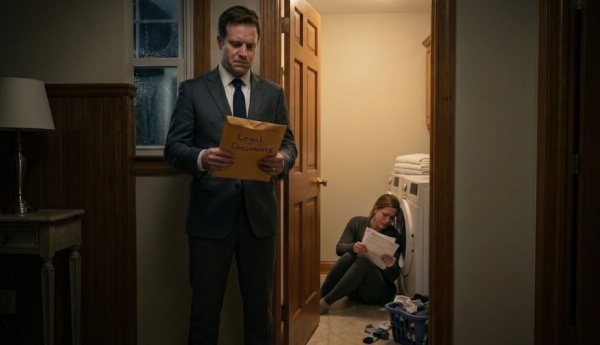
He Came Home With Divorce Papers—Then Heard His Wife Whispering an Apology to the Baby They Lost
Nathan walked into his Franklin, Tennessee home with divorce papers in his hand, ready to end a marriage he believed had already died in silence. He expected tears, anger, or the cold quiet that had filled their house for months, but instead he found Emily crying behind the laundry room door, whispering, “I’m sorry, baby. I’m so sorry I couldn’t keep you.” Before sunrise, the papers on the floor meant nothing compared to the medical documents in her trembling hands. She had suffered a miscarriage alone—and the diagnosis that followed was cancer.
Part 1: The Papers in His Hand
Nathan Whitaker sat in his truck outside his own house for eleven minutes before he found the courage to go inside.
The engine was off. The November air in Franklin, Tennessee, had already cooled enough to fog the windshield at the edges. In the passenger seat beside him lay a manila envelope from his attorney’s office, clean and flat and terrible in its simplicity.
Inside were divorce papers.
They were not filed yet. That detail mattered to Nathan in a way he had not expected. His attorney, Melissa Grant, had explained that he could take them home, read them again, sleep on it, and decide whether he wanted to move forward the next morning.
“You should be certain,” Melissa had said, sliding the envelope across her polished desk in downtown Nashville. “Not angry. Not exhausted. Certain.”
Nathan had nodded because men like him were good at nodding in offices.
Now, sitting in his driveway at 8:17 p.m., he was not sure whether he was certain or just tired enough to confuse numbness with decision.
The house in front of him was a two-story Craftsman on a quiet street lined with maple trees and porch lights. He and Emily had bought it five years earlier when they still talked about filling the extra bedrooms. There was a white porch swing Emily had begged for, a small herb garden she used to tend near the side steps, and a dent in the garage door from the week Nathan backed into it while arguing with a contractor on speakerphone.
From the outside, the house looked like the life they had once planned.
Inside, he knew, it had become something else.
Nathan was thirty-seven years old and worked as an operations manager for a regional logistics company based outside Nashville. His days were built around schedules, numbers, truck routes, inventory delays, and problems that could usually be solved by calling the right person loudly enough. He liked useful things. He trusted practical solutions.
Marriage had stopped feeling practical a long time ago.
Emily was thirty-five. She worked as an elementary school counselor in Williamson County, which meant she spent her days helping other people’s children name feelings that she herself had grown increasingly unwilling to say out loud. She was gentle in ways that once steadied him and later frustrated him. She could sit with a crying child for twenty minutes without rushing them, but she could not tell her own husband why she had been disappearing into silence for months.
At least, that was how Nathan had understood it.
The last year of their marriage had been defined by distance.
Not the loud kind.
No smashed plates. No affairs. No vicious screaming matches in the driveway for the neighbors to hear. Just the slow, exhausting disappearance of two people who still shared a mortgage, a Costco membership, and a bed but had stopped sharing the truth.
Emily came home from work drained and went upstairs before dinner. Nathan stayed late at the warehouse because being needed by employees felt easier than being unwanted at home. They spoke mostly about bills, groceries, house repairs, and whether the upstairs bathroom still smelled faintly like mildew.
They had tried therapy for four months.
The therapist’s name was Andrea, and her office had soft chairs, abstract art, and a box of tissues that Emily never touched. Nathan had gone in hoping someone would tell them exactly what to do. Emily had gone in looking pale and distant, answering questions with words that sounded responsible but never quite honest.
“I’m just overwhelmed,” she would say.
“With what?” Nathan would ask, trying not to sound impatient.
“Everything.”
Everything became the wall.
By September, they stopped going.
By October, Nathan moved into the guest room after a fight about nothing that had really been about everything. Emily did not ask him to come back. That silence had hurt more than any argument could have.
He began meeting with an attorney two weeks later.
Not because he hated Emily.
That would have been simpler.
He still loved her in some buried, exhausted part of himself, but love had become a room he no longer knew how to enter. He told himself divorce might be kinder than staying in a house where both of them looked like ghosts.
The envelope on the passenger seat seemed to agree with him.
Nathan picked it up.
His hand tightened around it.
He got out of the truck, walked up the front steps, and unlocked the door.
The house was dark except for the lamp in the living room and a thin line of light coming from the hallway near the laundry room. He expected to find Emily on the couch with a blanket and her laptop, or upstairs with the bedroom door closed. He had prepared himself for tears, anger, questions, maybe even that awful calm she had perfected.
He had not prepared for the sound.
A muffled sob.
Raw.
Broken.
Coming from behind the laundry room door.
Nathan froze in the entryway.
The envelope felt suddenly obscene in his hand.
He took one slow step forward.
Then another.
The laundry room was off the hallway between the kitchen and the garage. It was narrow, painted pale blue, with white cabinets, a stacked washer and dryer, and a small bench where Emily kept unmatched socks in a basket she always claimed she would sort “when life got less ridiculous.”
The door was mostly closed.
Through the gap, Nathan saw her.
Emily was sitting on the floor between the washer and the cabinets, knees pulled to her chest, one hand pressed against her mouth as if she were trying to keep the sound inside. Her hair had fallen loose around her face. A crumpled paper towel lay beside her. Her shoulders shook with the kind of crying Nathan had not heard from her since her father died.
His first instinct was to push open the door.
His second was to back away before she knew he had seen her.
Then Emily whispered something into the quiet room, and the words stopped him cold.
“I’m sorry, baby. I’m so sorry I couldn’t keep you.”
Nathan’s breath left him.
Baby.
For a moment, his mind refused to assemble the sentence.
He stood in the hallway with divorce papers in his hand while his wife cried alone on the laundry room floor, apologizing to someone who was not there.
Emily bent forward, pressing her forehead to her knees.
“I didn’t know,” she whispered. “I didn’t know until it was already gone.”
The envelope slipped from Nathan’s fingers and fell soundlessly onto the hallway rug.
He pushed the door open.
Emily startled so hard she hit her shoulder against the cabinet.
“Nathan.”
Her face changed immediately.
Fear.
Shame.
Panic.
Then that terrible controlled mask she had been wearing for months tried to settle over everything.
But it was too late.
He had heard.
“What baby?” he asked.
His voice sounded unfamiliar to him.
Emily stared at him.
Her lips parted, but no words came out.
“What baby, Emily?”
She looked past him and saw the manila envelope on the hallway floor.
Something in her face collapsed.
“Oh,” she said.
Just that.
Not accusation.
Not surprise.
A small sound of understanding, as if some final confirmation had arrived.
Nathan looked down at the envelope, then back at her.
The divorce papers no longer felt like a decision.
They felt like evidence of a crime he had almost committed without knowing the facts.
“Emily,” he said, softer now. “Tell me what happened.”
She shook her head.
“I can’t.”
“You can.”
“No.” Her voice broke. “Nathan, I really can’t.”
He crouched in the doorway, not touching her yet because everything about her looked fragile.
“Were you pregnant?”
The silence answered first.
Then she nodded once.
Barely.
Nathan sat back on his heels.
The hallway tilted.
“When?”
Emily closed her eyes.
“I found out three weeks ago.”
Three weeks.
Three weeks ago, he had been sleeping in the guest room.
Three weeks ago, he had told Melissa Grant he wanted to understand his options.
Three weeks ago, Emily had stood in the kitchen while he said, “I don’t know how much longer we can keep pretending this is a marriage,” and she had looked at the floor without defending them.
“You didn’t tell me,” he said.
It came out wounded, and he hated himself for it because she was the one on the floor.
Emily opened her eyes.
“They told me the pregnancy wasn’t viable last week.”
Nathan gripped the doorframe.
“They?”
She swallowed.
“The doctor.”
“What doctor?”
Her face went even paler.
That was when Nathan understood there was more.
The baby was not the whole secret.
It was only the doorway.
Emily reached toward the bench and picked up a folded stack of papers. Her hands trembled so badly the pages shifted against each other. She held them against her chest for a second before passing them to him.
Nathan took them.
At the top was the letterhead of Vanderbilt University Medical Center.
He saw Emily’s name.
A date.
Terms he did not immediately understand because his brain refused them.
Biopsy.
Malignant.
Oncology referral.
Recommended treatment plan.
Nathan read the first page twice.
Then a third time.
The words did not change.
He looked at his wife.
Emily’s face was wet, exhausted, and terrified.
“I have cancer,” she whispered.
The house went utterly still.
Somewhere in the kitchen, the refrigerator hummed. A car passed outside. The dryer gave one soft metallic click as it cooled.
Nathan held the divorce papers in the hallway behind him and the medical papers in his hands.
One represented the life he had decided to end.
The other revealed the life Emily had been trying to survive without him.
He sank onto the laundry room floor across from her.
For a long moment, neither of them spoke.
Then Nathan said the only thing he could.
“I’m here.”
Emily covered her face and cried harder.
And for the first time in nearly a year, Nathan moved toward his wife instead of away from her.
Part 2: The Secret She Had Been Carrying Alone
Nathan did not sleep that night.
Neither did Emily.
They moved from the laundry room to the kitchen because the floor had become too cold and the truth too large for such a small space. Nathan made tea because he did not know what else to do with his hands. Emily sat at the kitchen island wearing an old Vanderbilt sweatshirt, both palms wrapped around the mug as if warmth could keep her from falling apart.
The divorce papers stayed in the hallway for nearly an hour.
Nathan could see the envelope from where he stood.
Finally, he walked over, picked it up, and placed it face down on the kitchen counter.
Emily watched him do it.
“I guess I don’t have to ask what those are,” she said quietly.
Nathan looked at the envelope.
“No.”
She nodded as if she had expected this. Maybe she had. Maybe she had been living with more truth than he had realized.
“I wasn’t going to file tonight,” he said.
“That makes it better?”
“No.” He closed his eyes for a second. “No, it doesn’t.”
Emily looked down at her tea.
“I don’t blame you.”
That sentence made him feel worse.
“You should.”
She shook her head.
“Nathan, we’ve been miserable.”
The word was not sharp.
It was tired.
Miserable.
A word large enough to include both of them and still leave room for everything neither had said.
Nathan sat across from her.
“Tell me everything.”
Emily took a slow breath.
For the next hour, she did.
It had started with exhaustion.
Not normal teacher exhaustion, not counselor-after-a-hard-week exhaustion, but a kind of bone-deep fatigue that made her sit in her car after work for ten minutes before she could drive home. She blamed stress. Then she blamed the marriage. Then she blamed herself because women like Emily often do.
There had been pain she dismissed.
Then irregular bleeding she told herself was hormonal.
Then a faint positive pregnancy test in the upstairs bathroom at 6:30 on a Monday morning.
“I thought I was imagining it,” she said. “I took three tests.”
Nathan stared at her.
He imagined her standing alone in that bathroom, holding a plastic stick that changed everything, while he was downstairs packing his laptop bag for work.
“Why didn’t you tell me?”
Emily’s eyes filled again.
“Because you had slept in the guest room for two weeks.”
“That doesn’t mean—”
“I know.” She wiped at her cheek. “I know what you’re going to say. I know you would have wanted to know. But at the time, I thought telling you would feel like a trap.”
“A trap?”
“Like I was using a baby to pull you back into a marriage you didn’t want anymore.”
Nathan leaned back as if struck.
“I never said I didn’t want the marriage.”
“You stopped reaching for me.”
His mouth opened.
No answer came.
Because she was right.
He had stopped.
Not all at once. Not cruelly. But little by little, he had withdrawn his hand from every place it could have been refused. By the time he moved into the guest room, distance had become his last remaining dignity.
Emily continued.
“I made an appointment. I thought I had time to figure out how to tell you. I thought maybe after the first ultrasound…”
Her voice broke.
“There wasn’t a heartbeat.”
Nathan looked down at his hands.
The kitchen blurred.
“I’m sorry,” he said.
It was too small.
Every word was too small.
Emily nodded, crying silently now.
“They called it an early pregnancy loss. The doctor was kind. Everyone was kind. That almost made it worse.”
“When was that?”
“Last Tuesday.”
Last Tuesday, Nathan had texted her: Running late. Don’t wait up.
She had replied: Okay.
He remembered because he had been annoyed that she did not ask where he was.
He had been at a bar in Brentwood with two coworkers, complaining about how quiet his house had become.
While Emily had been losing their child alone.
Nathan pressed both hands over his face.
“I didn’t know.”
“I didn’t tell you.”
“But I should have known something was wrong.”
“Nathan—”
“I live in this house.”
She looked at him then, really looked at him.
“Do you?”
The question was soft.
It still found bone.
He lowered his hands.
Emily looked exhausted by the honesty, but she did not take it back.
“You come home,” she said. “You eat. You work. You sleep down the hall. But I don’t know if either of us has really lived here for months.”
Nathan had no defense.
The cancer diagnosis came through the tests that followed.
Additional scans. A biopsy. A call from the doctor asking Emily to come in rather than discuss everything by phone. The kind of call that tells you enough before you hear the words.
“It’s cervical cancer,” Emily said, voice trembling but clear. “They caught it earlier than they could have. The doctor said that matters. I’m meeting with the oncology team Monday morning to go through treatment options.”
Nathan gripped the edge of the counter.
Monday.
Three days away.
“You were going to go alone?”
She looked away.
“I was going to ask my sister.”
“Emily.”
“What was I supposed to do?” she asked, and now the calm cracked. “You came home every night looking like being in the same room with me cost you something. You moved out of our bedroom. You stopped asking me anything that wasn’t logistical. I thought you were already gone.”
Nathan stood abruptly, not because he was angry but because guilt had nowhere to go.
“I wasn’t gone.”
“You had divorce papers.”
He turned.
The envelope sat between them like a third person.
“Yes,” he said. “I did.”
Emily’s shoulders folded inward.
That was when he understood that this night was not going to be healed by panic or apology. His shock did not erase her loneliness. His guilt did not undo the months she had carried without him. His decision to stay in that moment did not magically make him trustworthy again.
He sat back down.
“You’re right,” he said.
She looked at him cautiously.
“I was leaving,” he continued. “Not because I stopped loving you completely. I don’t think that’s true. But because I thought we had become two people who were only hurting each other by staying.”
Emily stared into her tea.
“I thought that too sometimes.”
“But I should have talked to you before I got to an attorney.”
“And I should have told you before I got to an oncologist alone.”
The words hung there.
Hard.
Fair.
Nathan reached across the island slowly, giving her time to pull away.
She did not.
He placed his hand near hers, not on it.
“Can I come Monday?”
Emily looked at his hand.
Then at him.
“For the appointment?”
“Yes.”
She swallowed.
“I don’t know what this means for us.”
“I don’t either.”
“I can’t handle you staying out of pity.”
“I know.”
“I mean it.” Her voice strengthened. “If you stay because I’m sick, and then leave when I’m better or worse or too much, I can’t survive that version of kindness.”
Nathan nodded.
The sentence hurt because it deserved to.
“I’m not asking you to decide our marriage tonight,” he said. “I’m asking to be there Monday because you shouldn’t hear this alone.”
Emily looked at him for a long moment.
Then she nodded once.
“Okay.”
That was all.
Not forgiveness.
Not reconciliation.
Permission.
At 2:38 a.m., Nathan called his attorney’s office and left a voicemail.
“This is Nathan Whitaker. Do not file anything. I need to pause the divorce process. I’ll call Monday.”
Emily watched from the kitchen island.
He ended the call and placed the phone face down.
Then, without discussion, he picked up the manila envelope, opened a drawer by the stove, and put the papers inside.
Not destroyed.
Not denied.
Just paused.
A marriage cannot be saved by hiding divorce papers in a kitchen drawer.
But sometimes a pause is the first mercy people give each other.
That night, Nathan slept in the guest room because moving back into their bed would have pretended too much too soon.
Emily slept upstairs behind a closed door.
But before she went up, she paused in the hallway.
“Nathan?”
He turned.
“I was going to name the baby Grace if it was a girl.”
His throat closed.
“And if it was a boy?”
She gave the smallest, saddest smile.
“Samuel. After your grandfather.”
Nathan leaned against the wall after she went upstairs and cried without making a sound.
By sunrise, nothing was fixed.
But the truth had entered the house.
And truth, unlike silence, at least gave them somewhere to stand.
Part 3: The Appointment at Vanderbilt
Monday morning arrived cold and bright.
Nathan drove because Emily asked him to. Not because she needed him to, she clarified twice, but because parking at Vanderbilt University Medical Center was stressful and she did not want to waste whatever strength she had left on the garage. Nathan accepted the explanation and did not tell her that his hands had shaken while brushing his teeth.
They left Franklin at 7:15 a.m.
Traffic into Nashville was heavy along I-65, the usual slow crawl of commuters, school drop-offs, and people drinking coffee from travel mugs with the desperation of the employed. Emily sat in the passenger seat wearing black leggings, a gray sweater, and no makeup. She held a folder of medical papers on her lap with both hands.
The silence in the truck was not the old silence.
The old silence had been defensive.
This one was afraid.
Nathan wanted to say something comforting, but everything that came to mind sounded like a bumper sticker. You’re strong. We’ll get through this. Everything happens for a reason. He rejected that last one so violently he nearly changed lanes without signaling.
Nothing about this needed a reason.
It needed doctors, information, insurance approvals, treatment plans, and someone to sit beside Emily when the room got too bright.
So he said, “Do you want coffee after?”
Emily looked over.
“After the appointment?”
“Yeah.”
“I don’t know if I’ll want anything.”
“Then we won’t.”
She nodded.
A few minutes later, she said, “Thank you for not saying something inspirational.”
He almost smiled.
“I considered it.”
“I could tell.”
“I’m trying to be less annoying under pressure.”
“That would be new territory.”
The joke was weak.
They both held onto it anyway.
At Vanderbilt, Nathan dropped Emily at the entrance before parking. He watched her walk through the sliding doors alone and felt the full weight of the months he had missed. She looked small against the hospital’s glass and concrete, not because she was weak, but because hospitals have a way of making every person look like a child waiting for news.
He parked on the fourth level of the garage and found her in the waiting area ten minutes later.
She was sitting with her folder open, reading the same page without turning it.
Nathan sat beside her.
“Okay?” he asked.
“No.”
He nodded.
“Me neither.”
She looked at him, surprised.
Then back at the page.
The oncologist was Dr. Priya Shah, a gynecologic oncologist with calm eyes and direct language. She shook Emily’s hand first, then Nathan’s, and asked Emily who Nathan was.
“My husband,” Emily said.
The word landed strangely.
Not false.
Not fully safe.
But still legally and, in some wounded place, emotionally true.
Dr. Shah reviewed the diagnosis carefully. She explained what they knew, what they still needed to confirm, and what treatment options might look like depending on staging and additional imaging. She spoke plainly without being harsh, kindly without being vague.
Nathan appreciated that more than he could say.
He took notes because doing something helped him not fall apart.
MRI scheduling.
Bloodwork.
Treatment timeline.
Possible surgery.
Fertility implications.
Follow-up appointment.
When Dr. Shah mentioned fertility, Emily’s face went blank.
Nathan saw it happen.
She stopped blinking. Her hand tightened around the edge of the chair. The room seemed to narrow around the word.
Dr. Shah paused.
“I know you recently experienced a pregnancy loss,” she said gently. “I’m very sorry. We’ll talk through all options and make sure you have support for both the medical and emotional pieces of this.”
Emily nodded, but tears slipped down her face.
Nathan reached for her hand.
This time, she let him take it.
Her fingers were cold.
Dr. Shah gave them space, then continued with careful compassion. She did not promise what she could not promise. She did not take away fear with false certainty. She gave them a plan, and in that room, a plan felt like oxygen.
After the appointment, they sat in the truck without starting the engine.
Emily stared straight ahead.
“I hate that she was nice,” she said.
Nathan looked at her.
“I don’t know why. I just do.”
“I think because it makes it real.”
She nodded.
Then she started crying.
Not the restrained crying from the laundry room. Not the silent tears from the doctor’s office. This time, it came hard and sudden, the way grief does when the body stops negotiating with it.
Nathan unbuckled his seatbelt and turned toward her.
“I lost the baby,” she said through sobs. “And now I might lose the chance to ever have another one. And I know our marriage was falling apart, and I know maybe we shouldn’t even have been thinking about another child, but I wanted—”
She broke off.
Nathan’s own tears came then.
“I wanted it too,” he said.
Emily looked at him.
“You didn’t know.”
“I know. But I would have wanted it.”
She covered her face.
“I was so scared you’d think it was a burden.”
“No.”
“Or a trick.”
“No.”
“Or that you’d stay because of the baby and resent me.”
Nathan closed his eyes.
The worst part was that he understood why she had been afraid.
He had made the house feel unsafe for truth.
Not by cruelty.
By absence.
He had told himself he was giving her space when he was really protecting himself from rejection. He had waited for her to reach across a distance he kept widening.
“I’m sorry,” he said.
She shook her head.
“I’m tired of us apologizing and not changing.”
That sentence stayed with him.
They did get coffee after.
Not because either of them wanted it, but because neither wanted to go home yet. They stopped at a place near Hillsboro Village where college students studied under headphones and a barista called everyone “hon.” Nathan bought two coffees, a blueberry muffin Emily picked at, and a bottle of water because Dr. Shah said hydration mattered and Nathan was now clinging to instructions like scripture.
They sat by the window.
Emily looked outside at people walking past.
“I don’t know how to be married to you right now,” she said.
Nathan nodded slowly.
“I don’t know how to be your husband right now.”
Her face tightened.
He continued before she could misunderstand.
“But I want to learn how to be someone you can count on while we figure out what the marriage is.”
Emily studied him.
“That sounds like something Andrea would have charged us $180 to say.”
“She probably taught me the sentence.”
“She would be proud.”
“Maybe mildly surprised.”
Emily almost smiled.
Then she looked down at her coffee.
“I don’t want everyone to know.”
“Okay.”
“I mean it. I don’t want church people bringing casseroles with pity faces. I don’t want the school staff whispering. I don’t want your mother calling me every four hours.”
Nathan nodded.
“My mother’s casserole response is aggressive.”
“It is.”
“We’ll tell who you want, when you want.”
“I need my sister.”
“Of course.”
“And maybe Andrea.”
“Our therapist?”
“I think I need someone who is not you to help me sort out what is cancer and what is marriage and what is grief.”
Nathan absorbed that.
It was honest.
It did not flatter him.
That made it more trustworthy.
“I think that’s smart,” he said.
Emily looked at him carefully, as if waiting for defensiveness.
He gave her none.
By the time they drove back to Franklin, the sun had shifted lower, bright against the bare branches along the interstate. Nathan pulled into the driveway of the house that had almost become the place where their marriage formally ended.
He turned off the truck.
Neither moved.
Finally, Emily said, “I’m scared.”
Nathan looked at her.
“I am too.”
“I need you not to make promises because you’re scared.”
He nodded.
“Then I’ll make one promise I can keep.”
“What?”
“I’ll show up for the next thing.”
Emily’s eyes filled again, but she did not cry.
“The next appointment?”
“Yes. And whatever comes after that. One thing at a time.”
She looked at the house.
“One thing at a time,” she repeated.
That became the first rule.
Not forever.
Not fixed.
Not saved.
Just the next thing.
Part 4: The Marriage They Stopped Pretending About
The weeks that followed did not turn Nathan into a perfect husband.
Real life is less generous than that.
He still said the wrong thing sometimes. He overmanaged when he was scared. He tried to solve feelings with calendars, spreadsheets, and color-coded treatment schedules until Emily finally told him that cancer was not a warehouse delay.
He apologized.
Then he tried again.
Emily was not suddenly open either.
She had spent months closing doors inside herself, and they did not swing wide just because Nathan had finally noticed the lock. Some mornings she wanted him nearby. Some mornings every sound he made irritated her. Some evenings she cried in the shower and insisted she was fine until he stopped asking and simply sat on the bathroom floor outside the door.
They told Emily’s sister, Rachel, first.
Rachel lived in Murfreesboro, had three children, and possessed the protective energy of a woman who could organize a meal train, argue with an insurance company, and scare a grown man with one look. She came over the night after the Vanderbilt appointment with soup, clean pajamas, and a face that suggested Nathan was on probation with the entire female population of Tennessee.
He accepted that.
Rachel hugged Emily for a long time in the living room.
Then she turned to Nathan.
“You staying?”
The question was blunt.
Emily said, “Rachel.”
Nathan answered anyway.
“I’m showing up.”
Rachel stared at him.
“That wasn’t my question.”
“I know.”
Emily watched him.
Nathan continued, “I don’t know what our marriage will be when this is over. But I know I’m not leaving her to face this alone.”
Rachel held his gaze for a long second.
“Good start,” she said.
It was not forgiveness.
It was a provisional permit.
Nathan took it.
They also called Andrea, their former therapist.
The first session back was awful.
Not because Andrea was unkind, but because honesty after long silence can feel like surgery without anesthesia. Emily talked about the miscarriage. Nathan cried in a way he had not expected and felt embarrassed until Andrea handed him a tissue without making it theatrical.
Emily admitted she had been afraid to tell him she was pregnant because she thought he would see the baby as pressure.
Nathan admitted he had met with an attorney before having one last direct conversation because part of him had wanted the decision made by paperwork instead of vulnerability.
Andrea let the silence after that sit exactly as long as it needed to.
Then she said, “Both of you were trying to avoid being the one who wanted more.”
That sentence emptied the room.
Nathan looked at Emily.
Emily looked at the floor.
Because it was true.
He had wanted her to ask him to stay.
She had wanted him to say he did not want to go.
Instead, they had both performed acceptance like it was maturity.
Treatment began after additional testing confirmed the plan.
The details were medical, private, and exhausting. Some days were appointments, labs, insurance calls, medication schedules, and waiting rooms with televisions no one watched. Other days were deceptively normal: laundry, grocery runs, Nathan taking out the trash, Emily answering emails from school because she refused to abandon her students emotionally even while taking medical leave.
The school staff sent cards.
Emily cried over the cards.
Then complained that everyone used too many butterfly stickers.
Nathan learned new rhythms.
He learned which foods Emily could tolerate after treatment days. He learned that peppermint tea helped sometimes and sometimes made her gag. He learned that fatigue was not the same as sleepiness, that fear could make a person sharp, and that being helpful required asking instead of assuming.
He also learned how much labor Emily had carried in their marriage without naming it.
The birthdays.
The dentist appointments.
The gifts for his mother.
The school forms.
The grocery inventory stored inside her head.
The emotional temperature of the house.
The small invisible tasks that made life feel smooth enough for him not to notice someone was smoothing it.
One night in December, he found her sitting at the kitchen table with a notebook.
“What’s that?” he asked.
She hesitated.
“Our household stuff.”
He sat across from her.
“Bills?”
“Not just bills. Everything. Medical contacts, insurance logins, school things, house maintenance, passwords, emergency contacts. I realized if something happened to me, you wouldn’t know half of it.”
The sentence hit him harder than she intended.
Not because she was accusing him.
Because she was right.
“I should know,” he said.
“Yes,” she replied.
No softness.
No cruelty.
Just truth.
So she showed him.
Not all at once.
Over the next week, Nathan learned the architecture of the life he had been living in without fully managing. He learned how Emily tracked Cooper’s—no, they had no child; catch this. Need avoid wrong. They have no living kids, miscarriage. Continue with household maybe students. He learned her school leave contacts.
He learned the mortgage autopay details, the insurance portal, the pharmacy app, the name of the woman who checked on their cat when they traveled. He learned that Emily had been the one sending his mother flowers every Mother’s Day, even the year his mother criticized her sweet potato casserole. He learned that love often looks like administration until the person doing it stops.
“I didn’t know,” he said one evening.
Emily looked tired.
“You could have.”
That became another truth they did not rush past.
Their marriage had not broken because one person was bad and the other was good. It had broken because both had been lonely, both had been proud, and one of them had carried more of the invisible life while the other mistook stability for simplicity.
Nathan began staying in the primary bedroom again in January.
Not as a romantic gesture.
As a practical one at first, because Emily had a rough night after treatment and asked him not to be down the hall. He slept on top of the blanket beside her, fully clothed, waking every time she moved.
In the morning, she said, “You can sleep under the covers like a normal person.”
“I didn’t want to assume.”
She looked at him.
“Thank you.”
That was how closeness returned.
Not dramatically.
In inches.
A hand held during an appointment.
A blanket pulled up.
A pharmacy run.
A shared laugh over a terrible hospital cafeteria sandwich.
One evening, Emily sat on the couch under a quilt while Nathan folded laundry badly.
“You fold towels like a man making a legal argument,” she said.
“That sounds efficient.”
“It is not.”
She took the towel from him and showed him.
He watched her hands.
The same hands that had held pregnancy tests alone.
The same hands that had passed him oncology papers on the laundry room floor.
The same hands that now smoothed a towel into something neat because order still mattered to her, even when life had become frightening.
“I found the divorce papers,” she said quietly.
Nathan froze.
“I wasn’t looking,” she added. “I needed batteries from the drawer.”
He sat down beside the laundry basket.
“I forgot they were there.”
“No, you didn’t.”
He exhaled.
“No. I didn’t.”
She looked at him.
“What do you want to do with them?”
It was the question underneath everything.
Nathan thought carefully.
“I don’t want to file them.”
Her eyes searched his face.
“Because I’m sick?”
“No.”
“Because you feel guilty?”
“Partly,” he admitted. “But not only.”
She waited.
“I don’t want to file them because the marriage those papers were ending isn’t exactly the marriage we’re in now.”
Emily’s expression changed.
He continued.
“That doesn’t mean we’re okay. It doesn’t mean I think illness fixed us. It didn’t. But we’re telling the truth now. I don’t want to end something while we’re finally being honest inside it.”
Emily looked down at the quilt.
“I don’t know if I can trust that.”
“I know.”
“I want to.”
“I know that too.”
A long silence settled between them.
Then Emily said, “Maybe don’t throw them away.”
Nathan nodded slowly.
“Okay.”
“But maybe don’t keep them in the kitchen drawer.”
That made him laugh once, softly.
“Fair.”
They put the papers in a sealed box in the office closet.
Not as a threat.
As a record.
A reminder of how close they had come to ending without knowing the truth.
By February, Emily’s treatment had taken most of her physical strength but revealed a kind of internal steel Nathan had always known existed and somehow still underestimated. She cried, complained, rested, fought with insurance representatives, thanked nurses by name, and sent birthday cards to two of her students because she remembered they would be waiting for them.
Nathan watched her and felt love return not as a lightning strike but as recognition.
This was the woman he had married.
Not the easy version.
The real one.
Braver than she looked.
More tired than she admitted.
Still here.
One night, as they sat in bed with the lights off, Emily said, “I’m still mad at you.”
Nathan turned his head.
“I know.”
“For giving up.”
“I know.”
“And I’m mad at me for hiding.”
“I know.”
She was quiet.
Then she reached for his hand under the blanket.
“I’m also glad you came home before you filed.”
Nathan held her hand carefully.
“Me too.”
Outside, rain tapped softly against the windows.
Inside, the house felt wounded but inhabited.
For the first time in a long time, that felt like enough.
Part 5: Before Sunrise, and After
The morning that changed everything had technically happened months earlier.
Nathan still thought about it often.
The manila envelope in his hand.
The hallway light.
Emily behind the laundry room door.
One whispered sentence.
“I’m sorry, baby. I’m so sorry I couldn’t keep you.”
Before that night, he had believed his marriage was ending because love had worn out. After that night, he understood something more painful: love had not disappeared all at once. It had been buried under silence, fear, pride, exhaustion, and all the terrible things people do to protect themselves from asking for help.
That did not mean the marriage was magically saved.
Nathan had grown suspicious of the word saved.
Saved sounded final, clean, triumphant.
Their reality was messier.
Emily’s treatment continued into spring. Some days brought good news. Some days brought bloodwork results that required more questions. Some days they celebrated small victories, like a better appetite or a short walk around the neighborhood. Some days Emily slept for fourteen hours and woke furious that the world had continued without her permission.
Nathan learned not to turn every hard day into a speech about hope.
Hope, he discovered, did not always sound like inspiration.
Sometimes hope sounded like, “I changed the sheets.”
Sometimes it sounded like, “Your sister is coming at three.”
Sometimes it sounded like, “I handled the insurance call.”
Sometimes it sounded like nothing at all, just a man sitting beside his wife during chemo, holding her water bottle and not checking his email.
In April, Dr. Shah used the word “responding” in a tone that made Emily cry in the parking garage.
Nathan did not ask if they were happy tears or scared tears.
He had learned tears could be both.
They told a small circle of people about the cancer. Emily’s sister. Nathan’s mother, who surprised everyone by being less dramatic than expected and more useful than advertised. Two close friends from church. Emily’s principal, who protected her privacy with the intensity of someone guarding state secrets.
They did not announce it online.
They did not turn suffering into content.
Emily said, “I want prayers from people who know me, not curiosity from people who know my profile picture.”
Nathan respected that.
The miscarriage remained mostly private.
They named the baby Grace Samuel in the quiet of their own house, refusing to choose between the names Emily had carried alone. On a mild Saturday in May, they planted a dogwood tree in the backyard near the fence line where the afternoon sun fell gently. They did not hold a ceremony. They did not invite anyone.
Nathan dug the hole.
Emily placed her hand on the small trunk.
For a few minutes, neither spoke.
Then Emily said, “I needed somewhere for the love to go.”
Nathan nodded.
He understood.
Grief with nowhere to go becomes weather inside the body.
The dogwood gave it roots.
Their marriage changed slowly after that.
Not into the old thing.
Something new.
They returned to counseling with Andrea twice a month. They argued better, which sounded unimpressive until Nathan realized it might be the most important skill they had ever learned. They practiced saying the first true sentence before resentment wrote a speech.
“I feel alone.”
“I’m scared.”
“I need help.”
“I’m angry.”
“I don’t want advice yet.”
“I miss us.”
“I don’t know what to do.”
These sentences did not fix everything.
They did something better.
They kept the room open.
Nathan also changed his work schedule.
Not heroically. Not in a way that deserved applause. He simply stopped treating his job as the only place where his competence mattered. He delegated more. He came home earlier. He let other people solve problems he had once used to avoid feeling useless in his own house.
At first, it made him anxious.
Then it made him free.
Emily took medical leave, then gradually returned part-time to school when her doctors allowed it. The first day back, she came home exhausted and glowing. One of her students had made her a card with a rainbow, three hearts, and the words Miss Emily is brave spelled mostly correctly.
She stuck it on the refrigerator.
Nathan looked at it every morning.
In June, Emily asked him to bring down the sealed box from the office closet.
He knew which box she meant.
The divorce papers.
They sat at the kitchen table where they had told so many hard truths. The house was quiet. The dogwood outside had small green leaves now.
Emily opened the box.
The manila envelope was still inside.
She ran her fingers over it.
“I thought I would hate seeing these,” she said.
Nathan sat across from her.
“Do you?”
“A little.”
“I’m sorry.”
“I know.”
She looked up.
“But I also think we need to decide whether we’re still living with them in the house.”
Nathan understood.
The papers had been a pause.
But pauses cannot become permanent homes.
“I don’t want them,” he said.
Emily’s eyes filled.
“Are you sure?”
“No.”
She laughed through the tears.
He smiled.
“I’m not sure about everything,” he said. “I’m sure I don’t want these papers to be the plan.”
Emily nodded slowly.
“I don’t want them either.”
They did not burn them because Nathan had once worked with a man who set off a smoke alarm trying to burn tax documents in a sink, and Emily said they were not turning emotional closure into a fire department visit.
Instead, they shredded them.
Page by page.
It was less cinematic.
It was more satisfying.
The machine hummed steadily, turning legal language into thin white strips. Emily fed in the last page and exhaled like she had been holding her breath since November.
Afterward, Nathan took the shredded paper to the outside bin.
When he came back, Emily was standing by the kitchen window looking at the dogwood.
“I still don’t know what happens,” she said.
He stood beside her.
“Neither do I.”
“I could get sick again.”
“I know.”
“We might still struggle.”
“I know.”
“I’m not the same person I was before.”
“Good,” he said quietly. “I don’t think I am either.”
She leaned her head against his shoulder.
That was not an ending.
It was better.
It was a beginning that knew exactly what it had survived.
By late summer, Emily’s scans showed continued positive response. Her doctors were careful, which Nathan appreciated. No one used the word cured casually. No one promised forever. They gave them follow-up schedules, monitoring plans, and cautious optimism.
Cautious optimism became their family motto.
They printed nothing on a sign because Emily said that was “too Etsy even for Tennessee.”
But they lived by it.
One night in August, Nathan came home from work to find Emily on the porch swing with a blanket over her lap, watching a thunderstorm gather beyond the trees. He sat beside her without asking if she wanted company. She shifted to make room.
For a while, they listened to thunder.
Then she said, “Do you ever think about the person you were that night?”
He did not ask which night.
“Yes.”
“Do you hate him?”
Nathan thought about that.
“No,” he said finally. “But I don’t trust him.”
Emily nodded.
“I think about the person I was too. The one hiding in the laundry room.”
“Do you hate her?”
“No.” Her voice softened. “I wish she had known she didn’t have to be alone.”
Nathan reached for her hand.
“She knows now.”
Emily squeezed his fingers.
The rain began, tapping the porch roof above them.
The house behind them glowed warm through the windows. The herb garden had come back unevenly. The garage door still had the dent. The dogwood in the backyard bent slightly in the wind but held.
Their life did not look like the one they had planned when they bought the house.
The extra bedrooms were still empty.
The future was still uncertain.
But the house no longer felt like evidence of failure.
It felt like a place where two people had nearly disappeared from each other and then, painfully, imperfectly, started learning how to come back.
Nathan sometimes wondered what would have happened if he had arrived home twenty minutes later that night.
If Emily had finished crying.
If he had placed the divorce papers on the kitchen table before hearing her whisper to the baby they had lost.
If the truth had remained hidden one more day.
Maybe the papers would have been filed.
Maybe Emily would have gone to Vanderbilt with her sister.
Maybe Nathan would have spent years telling himself the divorce was sad but inevitable, never knowing how close he had been to missing the most important moment of his life.
He no longer believed timing was always kind.
But sometimes it was merciful.
A man came home with divorce papers, expecting the end.
He found his wife behind the laundry room door, carrying grief he had not known existed and a diagnosis she had been too afraid to share.
Before sunrise, Nathan discovered that the woman he was about to leave had been fighting for her life, mourning their child, and protecting him from a truth she thought he no longer wanted to carry.
He had almost walked away from her pain because he had mistaken silence for emptiness.
He would never make that mistake again.
Months later, Emily stood beside the dogwood tree in the backyard, one hand resting lightly on its trunk. Nathan watched from the porch as the evening light caught her face. She looked thinner than before, stronger than before, and more alive than anyone had a right to look after so much fear.
She turned and saw him watching.
“What?” she called.
Nathan shook his head.
“Nothing.”
But it was not nothing.
It was the opposite of nothing.
It was gratitude so large he could not fit it into words.
It was grief with roots.
It was love, not restored to what it had been, but rebuilt into something humbler and more honest.
It was a marriage that had almost ended in paperwork and instead survived by telling the truth.
That night, before bed, Emily found him standing in the hallway near the laundry room.
“You okay?” she asked.
He looked at the closed door.
“Yeah.”
She followed his gaze.
Then she reached for his hand.
For a moment, they stood there together in the hallway where everything had changed.
No speeches.
No promises they could not keep.
Just two people who had learned that sometimes the life you think is over is actually waiting behind a door, crying softly, hoping someone will finally hear.
And Nathan had heard.
This time, he stayed.
