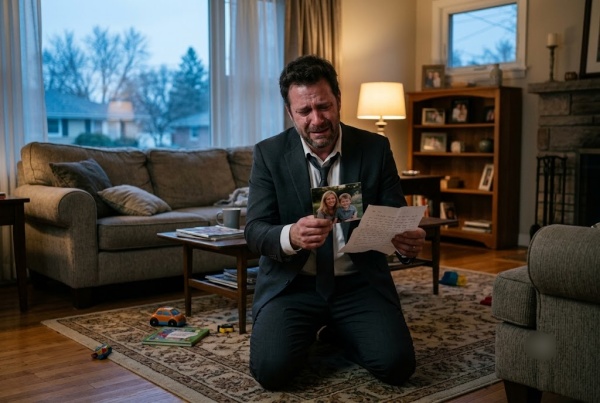
The scent of another woman followed me into our home, and the hotel key card in my pocket was proof of everything I’d done. I thought the hardest part would be facing my wife. I couldn’t have been more wrong. Claire wasn’t there. Neither was our little boy. The closets were half empty, the family photos had vanished, and one handwritten note lay on the marble counter. By the time I reached the final sentence, I realized I hadn’t just lost an argument… I’d lost the only family that had ever truly loved me.
Part 1: The Scent That Followed Me Home
The scent of another woman followed me into our home at 11:38 PM on a Thursday night in late October.
It was not perfume exactly. Perfume would have been easier to dismiss, easier to blame on a crowded elevator or a hostess brushing past me at dinner. This was warmer than perfume, more intimate than that — vanilla, expensive shampoo, a trace of body lotion, and the unmistakable quiet evidence of a room I should never have entered.
The hotel key card was still in my coat pocket.
I felt it there when I stepped through the front door of our house in Greenwich, Connecticut, a four-bedroom colonial with slate-blue shutters, a circular driveway, and a kitchen my wife had once called “the room where our real life happens.” The house was dark except for the pendant lights over the marble island. Usually, Claire left one lamp on in the living room when I came home late.
That night, she had left the kitchen lights on instead.
At first, I thought she was waiting for me.
My wife, Claire Whitman, had a way of waiting that never looked dramatic. She did not sit in shadows with a glass of wine like women in movies. She folded laundry. She packed our son’s lunch. She wiped down counters that were already clean and asked calm questions in a voice that made me feel more guilty than yelling ever could.
I took off my shoes in the mudroom because Claire hated street dirt on hardwood floors.
That small obedience almost made me laugh. I had betrayed my wife in a hotel room off Lexington Avenue, lied about a client dinner, ignored two calls from her, and still some cowardly, trained part of me remembered not to track dirt through the house. Men like to think they are complicated. Sometimes we are just pathetic in well-tailored coats.
“Claire?” I called.
No answer.
The house felt wrong immediately, but not empty in the way a house feels when someone has gone to bed. It felt intentionally quiet. It felt like a room after a decision has already been made.
I walked into the kitchen and stopped.
The first thing I noticed was the absence of the framed photo on the counter near the coffee maker. It had been there for four years — Claire holding our son, Noah, on the beach in Cape Cod, both of them squinting into the sun, his tiny hand caught in her hair. The frame was gone, leaving behind a clean rectangle in the thin film of dust I had never noticed before.
Then I looked toward the living room.
The gallery wall was bare.
Not entirely bare — the hooks remained, small silver marks against the warm white paint. But the photos were gone. Our wedding in Nantucket. Noah’s first birthday. The three of us at a pumpkin patch in Litchfield County. Claire laughing in a yellow raincoat outside a diner in Vermont. Gone.
My stomach tightened.
“Claire?” I said again, quieter this time.
Still nothing.
I went upstairs faster than I meant to. The hallway nightlight was on outside Noah’s room, shaped like a little moon. Claire bought it when he was two and afraid of the dark. I opened his door carefully, already imagining his small body asleep under the dinosaur blanket.
His bed was made.
The dinosaur blanket was gone.
So was the stuffed whale he slept with every night.
I stood there for several seconds, one hand still on the doorknob, trying to understand what my eyes were telling me. Noah was five. He could not sleep without that whale. Claire would never take it unless she knew he would need it somewhere else.
Somewhere else.
I walked to our bedroom.
The closet doors were open.
Claire’s side was half empty. Not destroyed, not ransacked, not dramatic. Half empty in the most terrifyingly organized way possible. Her winter coats were gone. Her work clothes were gone. Her running shoes were gone from the rack. The jewelry box on her dresser was gone, along with the framed ultrasound photo she had kept there even after we lost that baby three years ago.
My side of the closet looked untouched.
My suits hung in perfect rows. My shoes sat polished and aligned. My watches were still in the drawer. Nothing of mine had been harmed, moved, or punished.
That was when I started to understand.
Claire had not exploded.
Claire had planned.
I pulled out my phone and called her.
It went straight to voicemail.
I called again.
Voicemail.
I called a third time, and this time I heard my own breathing before the automated message began. I hung up before leaving anything. What could I say? Sorry I smell like another woman. Where did you take our son?
I went back downstairs because something about the kitchen lights had started to feel deliberate.
That was when I saw the note.
It lay in the center of the marble island, weighted under my wedding ring.
Not hers.
Mine.
I looked down at my left hand and realized, with a strange jolt of horror, that I had taken it off earlier that evening. Not at the hotel. Before. In the car, parked two blocks away, because the woman I met did not like seeing it. I had put it in the cup holder and, apparently, left it there.
Claire had found it.
Or maybe she had found everything else and the ring was only the final insult.
The note was written on thick cream stationery in Claire’s handwriting, the same neat, slightly slanted script she used for thank-you cards and grocery lists and the birthday letters she wrote Noah every year but saved for when he was older.
I did not want to read it.
I had to.
So I picked up the paper with hands that did not feel like mine.
Part 2: Before the Note
Before I tell you what Claire wrote, I need to tell you what kind of man I had become, because I did not wake up that Thursday intending to destroy my family.
That sounds like an excuse.
It is not.
It is worse than an excuse, because it means I had been destroying it slowly for years and still believed I was a decent husband because I paid the mortgage, attended school events when my calendar allowed, and said “I love you” with enough frequency to mistake habit for devotion.
My name is Evan Whitman. I was thirty-nine years old, a partner at a private equity firm in Manhattan, and the kind of man strangers described as successful before they described me as anything else. I wore navy suits, ordered black coffee, knew how to speak in clean numbers, and had built a career around finding weak points in companies and turning them into leverage.
Eventually, I started treating my marriage the same way.
Claire and I met in Boston when I was twenty-eight and still pretending ambition had not consumed me. She was a pediatric speech therapist finishing a fellowship at Mass General, and I was an associate at a consulting firm that believed eighty-hour weeks built character. We met at a friend’s Fourth of July cookout in Somerville, where she beat me at cornhole, corrected my pronunciation of “Worcester,” and laughed when I tried to pretend I had meant to lose.
She was not impressed by me.
That was the first thing I loved.
Claire had warm brown eyes, a quick mind, and the rare ability to listen without making the other person feel studied. Children loved her because she never spoke down to them. Adults loved her because she made sincerity look effortless. I loved her because when she looked at me, I felt like the version of myself I had always advertised but rarely earned.
We married three years later in Nantucket, on a windy September afternoon. My mother cried. Claire’s father gave a toast about building a home not out of walls, but out of mercy. At the time, I thought it was a beautiful line. Years later, I would understand that he had been giving me instructions.
I did not follow them.
For the first few years, we were happy in the ordinary, durable way people are happy when they are busy building a life and still believe time is abundant. We rented in Brooklyn Heights, ate takeout on the floor, fought over thermostat settings, and took Sunday walks along the promenade. Claire worked with children who had speech delays, came home exhausted, and still listened to me talk about deals I could not fully explain because confidentiality made my arrogance sound important.
Then I made partner.
The money changed first.
Then the schedule.
Then me.
We moved to Greenwich because I said we needed space before starting a family. Claire said she would miss the city but agreed because she thought marriage meant choosing together, and I made every decision sound like a joint one after I had already made it privately. The house was beautiful, expensive, and too large for two people, but I loved what it said about me.
Claire loved what it could become.
She painted the nursery pale green before Noah was born. She found an old rocking chair at an estate sale and had it refinished. She planted hydrangeas along the back fence. She learned which floorboards creaked and how long the oven took to preheat and where the afternoon light landed in the living room.
I kept working.
When Noah arrived, I cried in the hospital room and meant every tear. He was tiny, furious, red-faced, and perfect. Claire held him against her chest and looked at me with a tenderness I had not earned but accepted anyway.
For a while, I tried.
I came home early for bath time. I learned how to swaddle. I walked the hallway at 3 AM with Noah against my shoulder, whispering nonsense about the stock market because it was the only topic I could discuss while half-asleep. Claire would stand in the doorway, hair messy, eyes tired, and smile at us like I was doing something heroic.
I was not heroic.
I was being a father.
Somewhere along the way, I forgot the difference.
By the time Noah turned three, my presence had become a guest appearance in my own home. I missed preschool meetings, then doctor appointments, then Claire’s birthday dinner because a managing director flew in from Dallas unexpectedly. I sent gifts. I sent apologies. I sent flowers so often that Claire once looked at an arrangement of white roses and said, “They’re beautiful, Evan. But they don’t answer questions.”
I told her she was being unfair.
She was being lonely.
There is a difference.
The affair began in the most ordinary, cowardly way possible. Her name was Madeline Cross, thirty-one, a communications consultant brought in to help manage messaging around a portfolio company restructuring. She was sharp, pretty, and fluent in admiration. She laughed at things Claire would have challenged. She called my job “high-stakes” instead of “consuming.” She looked at my wedding ring and asked questions that made me feel tragic instead of selfish.
Nothing happened at first.
That is what men say when we want credit for the delay.
We had drinks after a late meeting. Then dinner. Then messages that were not technically inappropriate until they were. Then a hotel bar. Then a room.
I told myself it was separate from my real life.
That was the lie I needed most.
At home, Claire noticed everything but said less than I expected. She asked if I was unhappy. I said I was stressed. She asked if there was someone else. I looked my wife in the eye and said no.
That lie should have burned my mouth.
It did not.
By October, I had become efficient at betrayal. I used calendar blocks, deleted texts, paid cash when I thought of it, and used a hotel in Midtown East because it was close enough to my office to explain. I told myself I was protecting Claire from pain by hiding it.
In truth, I was protecting myself from consequences.
That Thursday, Madeline wore a black dress and said she hated that I always left before midnight. I told her things were complicated. She asked if I was ever going to choose. I said nothing, which was answer enough for both of us.
When I got home, I thought the hardest part would be facing my wife.
I could not have been more wrong.
The hardest part was discovering that Claire had stopped waiting to be faced.
Part 3: The Letter
The first line of Claire’s note was simple.
Evan,
I read it standing at the kitchen island, under lights she had chosen, in a house she had made warm despite my long effort to turn it into a showroom.
I know.
Two words.
No accusation. No explanation. No list of evidence. Just the quiet certainty of a woman who had moved past suspicion into fact.
I kept reading.
I know about Madeline. I know about the hotel on Lexington. I know about the dinners you called meetings and the meetings you never attended. I know you took off your wedding ring before seeing her tonight, because you left it in the car cup holder like our marriage was an inconvenience you could remove and put back on when useful.
My knees weakened.
I pulled out a barstool and sat down.
The hotel key card dug into my thigh through my pocket. I took it out and set it on the counter beside the note, as if placing it there could somehow separate it from me. It looked cheap under the kitchen lights. Thin plastic, black stripe, no moral weight except everything.
I am not writing this to ask why. I asked why for months, in different ways, and you answered with lies, irritation, flowers, and silence. That is enough of an answer.
I swallowed hard.
Claire had a way of writing exactly as she spoke when she was done trying to soften something for your comfort. Not cruel. Clear. That clarity had always attracted me. Now it was cutting through every story I had told myself.
Noah and I are safe. We are staying somewhere you will not come tonight. Do not try to find us. Do not call my parents, my sister, my friends, or the school. If you create a scene, I will document it. If you threaten me, I will document it. If you attempt to use Noah to reach me, I will document that too.
I looked toward the mudroom, half expecting to hear her keys.
Nothing.
Just the hum of the refrigerator and the distant tick of the hallway clock.
I have contacted an attorney. Her name is Dana Whitfield. All legal communication will go through her. You may email me about Noah’s immediate needs, but I will not discuss our marriage with you tonight or in front of our child.
There it was.
Attorney.
The word landed with a force I was not prepared for, though I should have been. Men like me believe we understand consequences because we negotiate them for a living. But consequences at work arrive in spreadsheets and signatures. Consequences at home arrive as a missing stuffed animal from a child’s bed.
I kept reading.
I did not empty our accounts. I did not damage your property. I did not throw your clothes into the yard, although I understand now why women in movies do it. I took what Noah and I need for the next few weeks, copies of important documents, and the photographs that belong to the life I built before you decided to treat it as optional.
My eyes moved to the blank gallery wall.
The photographs.
The life she built.
Not the life we built, because that was the part I had forfeited.
You have spent years confusing provision with love. You paid for the house, and I made it a home. You paid the tuition deposit, and I filled out the forms, bought the lunchbox, remembered pajama day, learned the other parents’ names, packed emergency clothes, and held our son when he cried because you missed the spring concert. You sent flowers after forgetting my birthday dinner. I put them in water because I still wanted to believe intention mattered.
I put my hand over my mouth.
The spring concert.
Noah had worn a paper sun around his neck and stood in the second row. Claire sent me a video because I was stuck in a board meeting that could have been moved. I watched the video in the back of a black car, texted so proud of him, and then forgot to mention it when I got home.
I remembered Noah asking the next morning, “Did you see my song?”
I remembered saying yes.
I remembered him asking, “But did you see me?”
I had laughed gently and told him of course.
Maybe that was when I started losing him.
Maybe Claire had been watching me lose him for longer than I knew.
Tonight is not the first night you betrayed me. It is only the first night you came home and found that I had stopped participating in the lie.
I read that sentence three times.
My phone buzzed.
Madeline.
I did not look at the message.
For the first time all night, I understood that she was not part of the central story. She had mattered because I had made her matter. But the damage in front of me was not really about her perfume or her hotel room or her laugh in a bar.
It was about every night Claire had eaten dinner alone.
Every morning she had explained my absence to Noah.
Every time I made my family smaller so my ego could feel larger.
The note continued.
Do not tell yourself this happened because of one mistake. A mistake is forgetting milk. A mistake is taking the wrong exit off I-95. This was a pattern. You made choices, protected those choices, lied about those choices, and expected me to absorb the cost quietly because I have always been good at keeping peace.
My chest hurt.
I wanted to argue with paper.
That is how far gone I was.
I wanted to say I loved her, that I was confused, that work had been intense, that Madeline meant nothing, that I never intended for things to get this far. But Claire had anticipated that too.
I know you may decide Madeline meant nothing. If that is true, it does not comfort me. It means you risked our family for nothing.
I sat very still.
Outside, a car passed slowly on the street.
The house remained unchanged around me, which felt impossible. The refrigerator still held Noah’s yogurt pouches. His rain boots still sat by the mudroom door, blue with little sharks on them. A crayon drawing was still taped to the side of the pantry — three stick figures under a giant orange sun.
Mommy.
Daddy.
Me.
The fourth line of the drawing, written by Claire because Noah had asked her to label it, said: HOME.
I looked back at the note.
I will not keep Noah from you. He loves you, and I will not punish him for your failures as my husband. But I will protect him from chaos, manipulation, and broken promises. If you say you will call, call. If you say you will come, come. If you cannot be consistent, do not make him pay for your need to feel forgiven.
That was when I cried.
Not loudly.
Not dramatically.
Just one sudden, humiliating collapse of control as tears hit the marble counter where Claire used to roll out Christmas cookie dough with Noah. I had imagined being caught as an argument. I had imagined anger, accusations, maybe a slammed door.
I had not imagined instructions on how not to hurt my son more than I already had.
The final paragraph was shorter than the rest.
I loved you with the most honest part of my life. I built a home around your absences and called it patience. I explained you to our child until I realized I was teaching him that love means waiting for someone who keeps choosing not to come. I will not teach him that anymore.
I could barely see the last sentence.
I wiped my eyes with the heel of my hand and forced myself to read it.
By the time you understand what you lost, Evan, please do not confuse grief with love. Love would have brought you home before tonight.
I stood there holding the note until the paper softened at the edges under my fingers.
Then I reached for my phone and called Claire again.
Voicemail.
This time, I left a message.
“Claire,” I said, and my voice broke on her name. “I’m sorry. I read your note. I’m so sorry. Please call me. Please let me know Noah is okay.”
I stopped.
Because she had already told me he was safe.
And because asking her to comfort me after what I had done was exactly the kind of selfishness that had brought us here.
So I said, “I’ll email about Noah. I won’t come looking. I’m sorry.”
Then I hung up.
It was the first decent thing I had done all night.
It was not nearly enough.
Part 4: The Morning After
I did not sleep.
I sat in the kitchen until dawn, reading Claire’s note over and over until the words stopped feeling like sentences and started feeling like a verdict. At 6:12 AM, the sky over Greenwich turned pale gray. The house looked almost normal in morning light, which made the absence inside it worse.
At 6:40, I opened my laptop and wrote an email.
Not a romantic email.
Not a defensive email.
Not one of those long, self-pitying confessions men write when they finally feel the consequences of what they have done and mistake emotional pain for moral growth.
Subject: Noah
Claire,
I received your note. I will respect what you asked. Please tell Noah I love him. If he is willing, I would like to speak with him tonight at whatever time you think is best. I will not discuss adult issues with him. I will wait for Dana Whitfield to contact me regarding legal matters.
Evan
I read it five times before sending it.
Every version I wanted to add — I love you, please come home, I made a terrible mistake, I can fix this — was about me. So I deleted those lines and sent the version that was only about Noah.
Claire replied at 8:03 AM.
No greeting.
No emotion.
Noah is safe. You may call at 7:00 PM. Keep the conversation focused on him. Please do not ask where we are staying. Dana will contact you today.
That was all.
I stared at the message with a strange mix of relief and devastation. Relief because she had answered. Devastation because she sounded like someone closing a gate.
At 9:15, my assistant called.
I had a 10 AM meeting in Midtown.
I told her I was sick.
That was technically true, though not in a way that deserved sympathy.
By 10:30, an email arrived from Dana Whitfield, attorney at law, with an office address in Stamford and language so calm it felt surgical. She represented Claire. All legal communication should go through counsel. I was advised not to dispose of marital assets, remove property, alter financial accounts, or contact Claire except regarding parenting logistics.
I read the email twice.
Then I called my own attorney.
His name was Robert Gaines, a family law attorney recommended by a colleague who had once described his divorce as “expensive but survivable.” Robert agreed to see me that afternoon. His office overlooked Long Island Sound, which felt cruelly peaceful given the circumstances.
I brought Claire’s note.
I do not know why.
Maybe I wanted Robert to tell me it was emotional, not legal. Maybe I wanted him to find some technical weakness in the thing that had morally dismantled me. He read it silently, set it down, and looked at me over his glasses.
“Is any of this untrue?” he asked.
I looked at the floor.
“No.”
“Did you use marital funds for the hotel or travel related to the affair?”
“Some dinners. The hotel last night was on my personal card.”
“Personal card funded from marital income?”
I closed my eyes.
“Yes.”
He nodded, not judgmentally. Professionally. That was somehow worse.
“Connecticut is an equitable distribution state,” he said. “The court has broad discretion. Infidelity may not decide everything, but misuse of marital funds, parenting behavior, credibility, and financial conduct can matter. Your first priority is not making this worse.”
“I want my family back,” I said.
Robert leaned back.
“That is not a legal strategy.”
The sentence landed hard because it was true.
“What is?” I asked.
“Consistency. Transparency. Full financial disclosure. No threats. No pressure. No showing up uninvited. No using your son as a messenger. No blaming your wife because she responded rationally to your misconduct.”
I hated how plainly he said it.
I needed to hear it.
At 7:00 PM, I called Noah.
Claire answered on speaker.
“Hi, Daddy,” he said softly.
Five years old, and already cautious.
“Hey, buddy,” I said. “How was school?”
“Fine.”
“What did you do?”
“Centers. And we had music.”
I pressed my thumb against the table.
Music.
The spring concert flashed through my mind.
“That sounds fun,” I said.
“Are you at home?” he asked.
I looked around the kitchen, at the empty spaces where photos used to be.
“Yes.”
“Where’s Mommy?”
“She’s with you.”
“Are you in trouble?”
The question broke something open in me.
I wanted to say no. I wanted to say grown-up problems. I wanted to say something gentle and vague. But Claire had told me not to create confusion, and Robert had told me consistency mattered, and some deeper part of me finally understood that children know more than adults admit.
“I made some bad choices,” I said carefully. “Mommy and I are working through grown-up things. But none of it is your fault, and I love you very much.”
He was quiet.
Then he said, “Did you forget us?”
I covered my eyes.
Claire did not rescue me.
She should not have had to.
“No,” I whispered. “But I did not show up the way I should have. I’m sorry, buddy.”
His breathing trembled.
“Can you still come to my soccer game?”
“When is it?”
“Saturday.”
I looked at the family calendar on the wall.
There it was.
Noah soccer — 10:30 AM — Binney Park.
I had not noticed it.
“I’ll be there,” I said.
Claire spoke for the first time.
“Evan.”
One word.
Warning.
Not cruel. Protective.
I understood immediately.
“If I say I’ll be there, I’ll be there,” I said. “I promise.”
After the call ended, I added the game to three calendars, set four alarms, and emailed my assistant that I was unavailable Saturday morning for any reason short of a medical emergency.
That felt like progress.
It was actually just the minimum.
Saturday arrived cold and bright.
I got to Binney Park at 9:55 AM, thirty-five minutes early, wearing jeans and a gray sweater because Claire always said I looked less like a consultant when I dressed like a normal person. I saw them arrive at 10:18. Claire wore a navy coat, her hair pulled back. Noah held her hand and carried his cleats in the other.
He saw me and froze.
Then he ran.
I knelt just in time for him to hit my chest.
He smelled like laundry detergent and cereal and little-boy shampoo. I held him and tried not to cry into his hair. Across the grass, Claire watched with an expression I could not read.
“Daddy, you came,” Noah said.
“I came,” I said.
He pulled back and studied my face.
“You look sad.”
“I am a little sad.”
“Because of grown-up choices?”
I nodded.
“Yes.”
He touched my cheek with his small gloved hand, and the forgiveness in that gesture nearly destroyed me because I had not earned it and children give it too freely.
Claire walked over.
“Game starts in ten,” she said.
Her voice was polite.
Not warm.
Not cold.
Polite is what remains when love has been injured too badly to stand up but dignity refuses to lie down beside it.
I wanted to say a thousand things to her.
I said, “Thank you for bringing him.”
She nodded once.
During the game, Noah scored no goals, chased the ball in the wrong direction twice, and waved at both of us every three minutes. I waved back every time. Claire did too. We stood six feet apart like strangers united by the same small sun.
Afterward, Noah asked if we could all get pancakes.
I looked at Claire.
She looked at Noah.
“Not today,” she said gently. “Daddy can walk with us to the car.”
Noah’s face fell.
I deserved that too.
At the car, he hugged me again and whispered, “Next time pancakes?”
I looked at Claire before answering.
“We’ll talk about it,” I said.
It was the first time in years I did not make a promise to make myself feel better.
Claire noticed.
That did not mean she softened.
It meant she noticed.
The divorce filing came two weeks later.
Not because of the soccer game.
Not despite it.
Because one on-time Saturday cannot outweigh years of absence and betrayal.
I signed the acknowledgment of service in Robert’s office and felt like a man watching his house burn from across the street while holding the match.
Part 5: What I Lost, What I Learned
The divorce took eleven months.
That is a clean sentence for a brutal process.
Eleven months of financial disclosure, parenting plans, mediation sessions, attorney emails, app-based custody communication, temporary orders, and learning the strange vocabulary of a life being divided. Parenting time. Marital estate. Equitable distribution. Holiday schedule. Right of first refusal. Separate property. Reimbursement claims.
At work, I became less impressive.
That is not humility. It is fact. My performance slipped. I missed the easy arrogance that had once made rooms feel manageable. When a junior associate asked whether I wanted to move a family-related appointment for an investor call, I heard Claire’s voice in my head and said no.
Some partners respected that.
Some did not.
I no longer cared as much as I once had, which was both growth and consequence.
Madeline disappeared from my life within three weeks of Claire leaving.
Not dramatically. Not cruelly. She simply stopped responding with the same urgency once my marriage became a real problem instead of a flattering complication. Our last conversation took place outside a coffee shop near Grand Central. She said she had never asked me to leave my wife.
She was right.
That made it worse, not better.
I had done this to my family without even being honestly chosen by someone else.
The court approved our final divorce agreement the following September.
Claire kept the house for two years so Noah could remain in the same school, with a structured buyout provision afterward. We divided assets fairly, which still felt like losing because I had confused ownership with control for most of my adult life. I paid child support and contributed to childcare, health insurance, school costs, and therapy.
Therapy was Claire’s condition before expanding my parenting time.
At first, I resented that.
Then I sat across from Dr. Samuel Pierce in an office in Stamford and spent six sessions trying to sound reasonable before he finally asked, “Do you want to look good, or do you want to get well?”
I laughed.
Then I cried.
Then I started telling the truth.
The truth was not that I had an affair because I was unloved.
I had been loved.
That was the tragedy.
I had been loved by a woman who packed lunches, remembered my mother’s birthday, saved articles about restaurants I might like, rubbed my shoulders when I came home tense, and kept making room for me in a life I kept treating like a waiting area. I had been loved by a child who ran toward me every time I appeared, even after I had trained him not to expect me.
The truth was that I liked being admired more than I liked being accountable.
Admiration asks nothing of you except performance.
Love asks you to become someone who can be trusted with another person’s heart on ordinary days, not just during speeches, vacations, and emergencies.
I had been good at performance.
I had failed at love.
Claire did not take me back.
People always ask that part, though not directly. They ask whether we’re “on good terms” or whether “there’s any chance.” They want the story to end with redemption wrapped in reconciliation, because that is easier to believe in than permanent consequences.
We are not enemies.
That is the grace she gave me.
We sit together at parent-teacher conferences. We stand near each other at soccer games. We have shared birthday parties where Noah blows out candles while both his parents sing. We exchange polite emails about dentist appointments, school forms, winter coats, and summer camp deposits.
Sometimes, when Noah runs ahead of us, Claire and I walk side by side for ten or fifteen seconds in the old rhythm, and my body remembers a life my choices ended.
She is different now.
Not colder.
Freer.
She went back to work part-time, then full-time, at a pediatric therapy clinic in Stamford. She took Noah to Maine that first summer after the divorce and sent me one photo of him holding a lobster roll with both hands, grinning like joy had not been permanently damaged by what I had done. She bought herself a small silver necklace with a tiny moon pendant, and Noah told me it was because “Mommy likes things that shine but don’t yell.”
I think about that a lot.
I moved into a two-bedroom apartment fifteen minutes away.
For the first month, it felt like punishment. Then it began to feel like honesty. There were no gallery walls pretending I was more present than I was. No marble island carrying the weight of conversations I had avoided. No oversized closet with suits arranged like evidence of importance.
On Wednesdays, Noah sleeps there.
He has dinosaur sheets, a shelf of books, and the stuffed whale Claire packed in his overnight bag the first time he came. I learned to make pancakes from scratch because one morning he asked if Mommy’s were better and I said probably, but I was willing to practice. Now pancakes are our thing.
Not because I deserve a thing.
Because children need love to become reliable, even after adults have failed.
A year after the divorce, I found Claire’s note in a file box.
I had kept it.
Not as proof against her.
As proof against the version of myself that likes to rewrite history when shame becomes inconvenient.
I read it again sitting at my small kitchen table while Noah slept in the next room. The words hurt differently then. Less like punishment. More like a map I had refused until after I was lost.
By the time you understand what you lost, Evan, please do not confuse grief with love. Love would have brought you home before tonight.
She was right.
Grief is loud.
Love is quieter.
Grief says, I can’t bear the consequences of losing you.
Love says, I will become safe for you even if you never come back.
That is what I work on now.
Not winning Claire back.
Not being forgiven on a timeline convenient to me.
Not turning regret into a performance impressive enough to erase harm.
I work on becoming a father who arrives. A co-parent who tells the truth. A man who understands that the cost of betrayal is not measured only in divorce settlements or lonely apartments or the humiliation of explaining your choices to an attorney.
The cost is a five-year-old asking, “Did you forget us?”
The cost is a woman removing family photos from a wall because looking at them became more painful than taking them down.
The cost is coming home with another woman’s scent on your coat and realizing the person who used to wash that coat, forgive that lateness, warm that kitchen, and explain you to your child has finally decided to stop.
If you are reading this and you are standing near the edge of the same cliff I stepped off — if there is a message you hide, a hotel you justify, a coworker you call “complicated,” a spouse at home becoming quieter by the week — listen to me.
You are not managing the damage.
You are creating it.
You are not protecting anyone by lying.
You are stealing the truth they need to make choices about their own life.
And if you think the hardest part will be getting caught, you are wrong.
The hardest part is walking into a home that still smells like your family and realizing they had to leave it to survive you.
Claire once told me that a home is not proven by who pays for it.
It is proven by who feels safe there.
For years, I thought I had given my family a beautiful home.
In the end, Claire had to take our son somewhere else to find one.
That is the sentence I live with.
That is the sentence that finally made me change.
