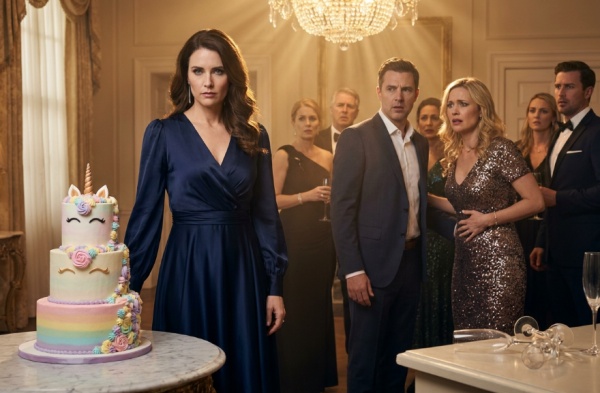
His Mistress Announced Her Pregnancy at My Daughter’s Birthday. My Husband Clapped for His Mistress’s Pregnancy Before Our Daughter Blew Out Her Candles.
She placed a hand on her stomach, smiled at our guests, and announced that she was carrying my husband’s baby. They expected me to fall apart in front of everyone, but they forgot my backyard cameras were already recording the moment they tried to rewrite….
Part 1: The Unicorn Party
My daughter’s eighth birthday party was supposed to smell like vanilla frosting, sidewalk chalk, and the bubble machine I had rented from a local party company in Austin. It was supposed to be about pastel balloons, glittery unicorn horns, and the moment Olivia closed her eyes to make a wish before blowing out her candles. It was not supposed to become the afternoon my husband’s mistress stood in my backyard, placed both hands over her stomach, and announced that she was carrying his baby.
My name is Lauren Harper, and until that Saturday in May, I still believed humiliation had limits. I knew my marriage was in trouble. I knew my husband, Mark, had become distant, defensive, and strangely careful with his phone, but I had not understood how bold cruelty could become when two people convinced themselves they were the main characters in everyone else’s life.
Mark and I lived in West Lake Hills, just outside Austin, Texas, in a limestone house with a long driveway, live oak trees, and a backyard big enough for children to run until their faces turned red. The house had belonged to my grandmother before she passed away, and she left it to me in a trust before Mark and I were even married. He loved telling people we “built a life there,” which was partly true, but the foundation had been laid by women in my family long before he arrived with his golf clubs and good smile.
We had one child, Olivia, who was eight years old and believed in magic only selectively. She no longer believed in Santa, because she said the logistics were “suspicious,” but she still believed birthdays had power if you made the right wish. For six months, she had talked about having a unicorn party with a real pony, rainbow cupcakes, and a cake with edible glitter.
So I gave it to her.
I ordered a three-tier cake from a bakery in South Austin for $275, which Mark called ridiculous until I reminded him he had spent more than that on one dinner with clients. I rented two ponies from a children’s party ranch in Dripping Springs, both dressed with soft braided ribbons and sparkly horn attachments that made them look patient rather than mythical. I hired a face painter, set up a lemonade station, and spent the night before stringing pastel lights across the patio.
There were twenty-two kids, twelve parents, two grandparents, and one woman who should never have been invited.
Her name was Madison Blake.
Madison worked for Harper Ridge, the outdoor equipment company my father started and I took over after his stroke. We sold custom camping gear, insulated coolers, and high-end hiking accessories to retailers across the Southwest. Mark joined the company five years into our marriage as director of operations, which I agreed to after he convinced me it would be “good for the family.”
That was the kind of phrase Mark used when he wanted something. Good for the family. Practical for the family. Strategic for the family. Somehow, what was good for the family almost always made him more powerful inside it.
Madison came into the company as a marketing contractor two years earlier. She was younger than me by almost a decade, with honey-blonde hair, white sneakers that were always spotless, and the kind of bright laugh that made men in conference rooms sit up straighter. She called everyone “babe” and claimed she was “just a girls’ girl,” which I eventually learned was something women sometimes said right before stepping over another woman’s life in heels.
At first, I liked her. Or I tried to. She was creative, quick, and good with social media campaigns. She helped us land a partnership with a boutique sporting goods chain in Colorado, and my father, who still came into the office twice a week with his cane, said she had “some real sparkle.”
Mark agreed too quickly.
After that, Madison appeared everywhere. At product shoots. At trade shows. At Friday happy hours. At company volunteer days where she wore branded T-shirts knotted at the waist and stood too close to Mark in every group photo.
When I asked Mark if anything was going on, he gave me that tired, offended look husbands give when they want their wives to feel ashamed for noticing the obvious.
“Lauren,” he said, “she’s twenty-nine. She works for us. Don’t make it weird.”
I remember thinking, very clearly, that I was not the one making it weird.
Still, I did not have proof at first. I had changes. Mark started going to Dallas for “vendor meetings” more often than necessary. He put a new passcode on his phone. He began showering as soon as he came home, even if he had supposedly spent the day in the office.
Then came the receipts.
A boutique hotel in San Antonio charged to the company card. Dinner for two at a rooftop restaurant he claimed was a team meal, though no team member could remember attending. A spa gift card coded as “client appreciation.” A weekend rental near Lake Travis listed under a marketing retreat that had never existed.
I did not confront him immediately because I had learned from my attorney, Denise Calloway, that timing mattered. Denise was not my divorce attorney yet, at least not officially. She had been our company counsel for years, a practical woman with silver hair, tortoiseshell glasses, and the ability to make foolish men regret speaking too quickly.
When I showed her the irregular charges, she did not gasp. She simply asked whether Mark had authorization to approve those expenses and whether Madison had submitted related invoices. Then she told me to preserve everything.
“Do not accuse until the documents can speak,” Denise said.
So I waited. I copied statements. I saved vendor confirmations. I pulled company email logs through proper administrative access because I owned the company and had policies in place for business records. I did not hack anything. I did not stalk anyone. I simply stopped looking away.
By the week of Olivia’s birthday, I knew enough to understand Mark had lied. I knew enough to know Madison was involved in more than marketing. But I still did not expect them to use my child’s birthday party as a stage.
That was my mistake.
Madison arrived at 2:17 p.m., wearing a pale pink sundress and carrying a gift bag that looked too elegant for an eight-year-old. Mark walked in behind her from the driveway, not beside me from the kitchen where he should have been helping with ice. He had told me he was picking up extra candles from Target, but apparently he had also picked up confidence.
Olivia ran past them chasing two classmates with a bubble wand, unaware that her own father had just walked into her birthday party beside the woman who was helping him break her home. Madison smiled at my daughter and said, “Happy birthday, princess,” as if she had any right to sound familiar. Olivia gave her a quick polite thank-you and kept running.
I stood near the patio table with a tray of fruit cups in my hands. Mark kissed my cheek in front of everyone, dry and performative. Madison looked at the gesture with a smile that told me she knew exactly what it was worth.
The party moved forward because mothers know how to keep a room moving even when their hearts are dropping through the floor. Children painted wooden unicorns. Parents drank iced tea and made small talk about summer camps. The ponies arrived, and Olivia screamed so happily that for ten minutes I almost forgot the adult ugliness standing near the lemonade.
Then Madison asked if she could “say something.”
It was 4:03 p.m. The cake was already on the table, candles unlit, Olivia standing behind it in a white unicorn headband with a silver horn. Her cheeks were flushed from running, and she had a smear of pink frosting on her wrist from sneaking a cupcake earlier.
Mark clapped his hands once and said, “Everyone, gather around.”
That was when I knew.
Not the details. Not the words. But I knew something was coming that had not been planned by me, the mother who had planned every inch of that day.
Madison stepped beside Mark. She held his hand.
A few parents looked confused. My sister, Emily, who was standing near the back door, went completely still. My father, seated under the shade of the oak tree, narrowed his eyes in the way he used to before firing a bad salesman.
Madison placed her free hand over her stomach. She smiled like she was standing in a field of flowers instead of in the middle of another woman’s backyard at a child’s birthday party.
“We know this is Olivia’s special day,” she said, “and we hope this adds even more love to the celebration. Mark and I are expecting a baby.”
The yard went silent.
For one second, even the bubble machine seemed to pause.
Then Mark clapped first.
He clapped first, like my daughter’s heartbreak was part of the entertainment. Like the announcement of his affair baby at her unicorn birthday party was a sweet surprise. Like the little girl standing behind the cake, still waiting to blow out her candles, had somehow agreed to become a supporting character in his new life.
Olivia looked at me.
Not at Mark. Not at Madison. At me.
Her face changed in a way I will never forget. Confusion first. Then embarrassment. Then a kind of understanding no eight-year-old should have to carry.
“Mom?” she whispered.
I walked to her immediately. I did not look at Mark. I did not look at Madison. I put one arm around my daughter’s shoulders and said, “This is still your birthday, sweetheart.”
Madison’s smile faltered.
She had expected me to cry. Maybe scream. Maybe leave the yard so she could step into my place beside Mark and let everyone admire her composure. But she had chosen the wrong stage and the wrong audience.
Because what she did not know was that my house had security cameras covering the front porch, driveway, kitchen entrance, and backyard patio. They had been installed after a package theft the previous fall, with small signs posted at the entrances for transparency. They recorded common areas, not bedrooms or private spaces, and every guest who entered passed the sign near the front gate.
What Mark did not know was that Denise had already scheduled a formal review of his company spending for Monday morning.
And what neither of them knew was that the property beneath their feet, the cameras capturing their performance, and the company paper trail behind their little love story had already chosen my side.
Part 2: The Announcement That Backfired
After Madison’s announcement, the first adult to move was my father. He stood slowly with one hand on his cane, the way old men do when age has taken speed but not authority. He did not speak right away, but Mark saw him stand and stopped clapping.
That silence did more than any shout could have.
My sister Emily stepped forward next. She was three years younger than me, a pediatric nurse, and the kind of woman who could smile at a toddler getting stitches but scare a grown man with one raised eyebrow. She walked to Olivia’s side and gently took the lighter from the cake table.
“Let’s do candles,” Emily said brightly. “This party has a birthday girl.”
Her voice saved the moment.
Parents exhaled. Children, who had sensed tension but not fully understood it, turned back toward the cake. My daughter stared at the candles while I held her hand under the table where no one could see.
Madison remained standing beside Mark, confused that no one had gathered around her stomach with happy tears. She looked at me, then at the parents, then back at Mark. Her performance had expected applause and received documentation.
Mark leaned toward me and said quietly, “Lauren, don’t make a scene.”
I looked at him then.
“I’m not the one who made one.”
His face tightened.
Emily lit the candles. Eight small flames flickered in the late Texas sun. Everyone sang “Happy Birthday,” though the first few lines came out weak and uncertain before the children took over with loud, off-key joy.
Olivia did not close her eyes before making a wish.
She blew out the candles quickly, almost like she wanted to finish before anyone could take the moment away again. When everyone clapped, she smiled because children are trained to smile when adults clap, but her eyes were shiny.
I cut the cake myself. My hands did not shake. That surprised me, because inside I felt like someone had dropped a glass jar full of bees into my chest.
Madison tried to approach Olivia with the elegant gift bag after cake. Olivia stepped behind me. That one small movement broke something in Mark’s face, though not enough to make him decent.
Madison said, “I just wanted to give her something special.”
I looked at the bag. “Not today.”
Her mouth opened slightly. “It’s from both of us.”
“Then definitely not today.”
A few parents heard that. I did not care.
Mark pulled me aside near the side gate, still in view of the patio camera. He kept his voice low, but the tension in his jaw made him look less like a man in love and more like a man realizing his plan had missed several important details.
“You embarrassed Madison,” he said.
That was the first thing he chose to say.
Not “I hurt Olivia.” Not “I should have told you privately.” Not “I am sorry I turned our child’s birthday into a public announcement of my betrayal.”
You embarrassed Madison.
I almost laughed. Instead, I said, “She announced your pregnancy at our daughter’s birthday party before Olivia blew out her candles.”
He flinched at the phrase “your pregnancy,” maybe because it made him sound less romantic and more responsible.
“We wanted to be honest,” he said.
“No,” I replied. “You wanted to control the story.”
His eyes flicked toward the yard, where guests were pretending not to notice us. “This was going to come out anyway.”
“Then it could have come out in a therapist’s office, an attorney’s office, or a private conversation with your child after you had behaved like a father.”
“Don’t weaponize Olivia.”
The audacity of that sentence nearly made me lose my breath.
I looked back at the cake table, where my daughter sat between Emily and two classmates, pushing frosting around her plate without eating. “You used her birthday as your announcement venue.”
Mark’s expression hardened. “You’re always so dramatic.”
That was his old line. Dramatic. Emotional. Overreacting. Words he used when he wanted the consequences of his choices to feel like my personality flaw.
But something had changed in me.
Maybe it changed when Olivia looked at me with that wounded question in her eyes. Maybe it changed when Mark clapped first. Maybe it had changed weeks earlier, when I started reading the expense reports and realized the man sleeping beside me had been spending company money to entertain his mistress.
I said, “You should leave.”
He blinked. “This is my house too.”
“No,” I said softly. “It isn’t.”
His face changed.
That was the first time he remembered what he usually preferred to forget: the house was not community property in the simple way he liked to imply at barbecues. My grandmother had left it to me in a trust before our marriage, and the mortgage-free deed had remained separate under Texas law, carefully documented by attorneys my grandmother trusted more than charm.
He had lived there. He had hosted there. He had bragged there.
But it had never belonged to him.
Mark looked toward my father, who was watching from under the oak tree. Then he looked at the cameras mounted discreetly along the patio roofline. For the first time all afternoon, uncertainty crossed his face.
Madison came up behind him, touching his arm. “Mark?”
I turned to her. “You should leave too.”
Her eyes widened. “Lauren, I know this is emotional, but this baby is part of Olivia’s life now.”
“No,” I said. “This baby is part of the adult situation you created. My daughter is eight. She will not be used to make you feel accepted.”
Madison’s face flushed.
Mark said, “You can’t talk to her like that.”
“I just did.”
He stared at me as though he had never met me before.
Maybe he hadn’t. Maybe the version of me he knew was the wife who handled payroll, packed school lunches, remembered birthdays, softened his rough edges in public, and gave him the benefit of the doubt because marriage was supposed to mean something. That version of me had not disappeared. She had simply stepped behind the mother who was now protecting her child.
Emily walked over before Mark could answer. “Olivia is asking for you,” she said to me. Then she looked at Mark. “Not you.”
Mark recoiled like she had slapped him, though no one had touched him.
That is how fragile some men are. They can humiliate a child in front of twenty families but act wounded when someone names the damage.
The party ended early but not abruptly. Parents gathered children, thanked me too warmly, avoided Mark’s eyes, and left with the careful politeness people use around a house fire. A few mothers hugged me at the gate without saying anything, which was the only kindness I could have handled.
Madison tried to leave through the front door with Mark, but my father stopped him near the driveway.
“Keys,” Dad said.
Mark frowned. “Excuse me?”
“To the office,” my father said. “Company key card. Vehicle fob. Anything that belongs to Harper Ridge.”
Mark laughed once. “You can’t be serious.”
My father leaned on his cane and looked at him with the calm disappointment of a man who had built something with his hands and watched another man treat it like an ATM.
“I have never been more serious.”
Mark looked at me. “Lauren, tell him to back off.”
I said nothing.
The front porch camera captured that too.
Eventually, Mark threw the key card onto the entry table and walked out with Madison. The gift bag remained on the floor by the door. Later, Emily opened it for me after Olivia went upstairs.
Inside was a silver picture frame engraved with the words “Big Sister.”
I sat down on the bottom step and stared at it.
That was when I finally cried.
Not loud. Not dramatically. Just enough for my body to admit what my face had refused all afternoon.
Emily sat beside me and put her arm around my shoulders. “Tell me you’re going to destroy him legally.”
I wiped my face. “I’m going to let him destroy himself legally.”
She nodded. “Healthier.”
Upstairs, Olivia’s bedroom door was closed. The unicorn balloons still floated in the hallway, their pastel ribbons curling in the air. Downstairs, the bubble machine sat silent on the patio, surrounded by paper plates, half-eaten cake, and the remains of a party Mark and Madison had tried to steal.
I looked toward the camera above the back door.
For once, I was grateful for every recorded second.
Part 3: The Paper Trail
The next morning was Sunday, and the house felt like it had a hangover. Pastel balloons drifted against the ceiling. The leftover unicorn cake sat in the refrigerator, too beautiful to eat and too expensive to throw away. Olivia stayed in her room until almost ten, then came downstairs wearing pajamas and the blank expression of a child trying to act normal for a parent’s sake.
I made pancakes because that was what I knew how to do with grief at 10 a.m.
Chocolate chip for her. Black coffee for me. Bacon too crispy because I forgot it in the skillet while staring out the window.
Olivia sat at the kitchen island and picked at her food.
“Is Dad having another baby?” she asked.
There are questions that make time slow down.
I turned off the stove and sat across from her. “That is what he and Madison said yesterday.”
“Is Madison his girlfriend?”
I swallowed. “Yes.”
“Was she his girlfriend before you stopped being married?”
“We are still legally married,” I said carefully. “But Dad made choices that hurt our marriage before yesterday.”
Olivia nodded in a way that made her look older than eight. “So he lied.”
I could have softened it. I could have said grown-up things are complicated, which they are. I could have said your father loves you, which was also true in some incomplete way.
But children who are lied to by adults need at least one adult willing to tell the truth in safe words.
“Yes,” I said. “He lied.”
Her eyes filled. “Did he clap because he was happy?”
I had to look away for half a second.
“I think Dad was thinking about himself,” I said. “That does not mean your feelings do not matter.”
She pushed a chocolate chip across her plate with her fork. “Everyone saw.”
“I know.”
“That was my birthday.”
“I know, baby.”
Then she cried. Finally. Not the quiet shine in her eyes from the day before, but real sobs that bent her forward in her chair. I went around the island and held her while she cried into my shirt, and whatever tiny hesitation I still had about protecting Mark’s reputation died right there.
After Olivia calmed down, I called her therapist. She had already been seeing Dr. Karen Fields since my father’s stroke, mostly to help her process fear and change. Dr. Fields agreed to see her Monday afternoon.
Then I called Denise.
She answered on the second ring. “I assume the party was not uneventful.”
“That is one way to put it.”
I told her everything. The announcement, the clapping, the “Big Sister” frame, the pressure to make Olivia accept it, the company key card. Denise listened without interrupting except once, when she asked whether cameras had captured the common areas.
“Yes,” I said. “Back patio, driveway, front porch, and kitchen entrance. They’ve been there for months. Signs are posted at the gate and front door.”
“Good,” Denise said. “Do not send the footage to anyone except counsel.”
That sentence mattered. There were people who would have posted the clip online by sunset. I understood the urge, because public humiliation makes public revenge feel tempting. But my daughter was in that video too, and her pain was not content.
Denise told me to bring my laptop, the company card statements, and all relevant approvals to her office Monday morning. She also told me not to let Mark back into the company systems.
“Already done,” I said.
After the party, while Emily stayed with Olivia, I had called our IT director, Javier. I told him Mark’s company access should be suspended pending review, which our employee handbook allowed when financial irregularities were under investigation. Javier did not ask many questions. Good IT directors hear enough in a tone.
By Monday at 9:00 a.m., Denise, Javier, our controller Maria, and I were in the conference room at Harper Ridge headquarters. The building was not glamorous. It sat in an industrial park north of Austin, between a cabinet supplier and a wholesale bakery that made the whole block smell like sugar before sunrise.
My father had started the company in a rented garage thirty years earlier. He built the first cooler prototype himself. When he had his stroke, I stepped in as CEO, and Mark had acted like he was rescuing me by joining operations.
The paper trail told a different story.
Maria projected the expense report on the screen. There were hotel charges labeled as vendor meetings with no vendor present. Meal receipts for two coded under client development. Travel reimbursements submitted by Madison for trips that matched Mark’s calendar but not any approved campaign.
Then there were invoices from Madison’s LLC.
Consulting strategy. Brand activation. Lifestyle placement. Event concepting.
Denise leaned forward. “Event concepting?”
Maria clicked another file. “This one is interesting.”
Madison’s LLC had billed Harper Ridge $4,800 for “family-centered lifestyle content planning” tied to a summer product launch. The invoice date was two weeks before Olivia’s party. The attached notes included references to “unicorn theme,” “organic family moment,” and “emotional transition narrative.”
I felt cold.
“Are you saying the company paid her to plan part of my daughter’s birthday party?”
Maria’s face tightened. “That is what the support document suggests.”
Javier added, “There are emails between Mark and Madison discussing backyard layout, guest visibility, and camera angles.”
Camera angles.
For a moment, I could not speak.
Denise took over. “Javier, preserve all emails and metadata according to litigation hold procedures. Maria, freeze reimbursements to Madison’s LLC and compile every payment from the last eighteen months. Lauren, do not respond emotionally to anything you see today.”
That last instruction came too late.
Because on the screen was an email from Madison to Mark sent three days before the party.
“If we do it before cake, everyone will have phones out. It’ll look joyful if Lauren behaves. If she doesn’t, that says everything.”
I stared at those words until they stopped being words and became something sharper.
They had planned it.
Not impulsively. Not in a moment of excitement. They had chosen the timing before my child blew out her candles because phones would be out and the optics would benefit them if I reacted badly.
Mark replied: “She won’t make a scene in front of Liv. That’s why it works.”
That was the sentence that changed my grief into evidence.
Denise printed it without comment.
By noon, we had enough to place Mark on administrative leave from the company and terminate Madison’s contract pending investigation. Denise prepared notices through proper channels, careful and professional, because the goal was not drama. The goal was to make sure every action could stand in daylight.
Mark called me thirty-one times that afternoon.
I did not answer.
He texted: “You locked me out of my email?”
Then: “Lauren, this is insane.”
Then: “You’re going to destroy the company over personal issues?”
I replied only once.
“Company counsel will contact you.”
He sent back: “You cold-hearted witch.”
I screenshotted it and forwarded it to Denise.
At 3:40 p.m., Madison emailed my company account from her personal address. The subject line was “Misunderstanding.”
She wrote that the pregnancy announcement had been meant as a gesture of inclusion. She claimed Olivia would eventually be grateful that they “honored her as the baby’s big sister from the beginning.” She said the company invoices were legitimate because family branding and lifestyle storytelling were part of her campaign work.
I forwarded that too.
Denise read it and said, “She is not as smart as she thinks.”
That evening, Mark came to the house.
I saw him on the camera before he rang the bell. He looked furious, pacing on the front porch, one hand in his hair. Olivia was upstairs doing homework with Emily, who had volunteered to stay another night.
I opened the door but kept the chain on.
Mark stared at the chain as if it personally offended him.
“We need to talk,” he said.
“No.”
“You can’t keep me out of my own family.”
“You turned our child’s birthday into a staged announcement and used company resources to support it.”
His mouth opened, then closed.
That was how I knew Denise had already sent the notices.
He lowered his voice. “Let me in.”
“No.”
“Lauren, don’t be stupid.”
I looked at him through the narrow opening. “The front porch camera is recording.”
He stepped back immediately.
That said more than any apology could have.
Part 4: The House That Remembered
The legal part did not move like it does in movies. There was no dramatic judge banging a gavel the next morning, no instant justice, no one dragged out of an office by security. Real consequences arrive through emails, hearings, HR reviews, attorney letters, and sleepless nights where you wonder how someone who once loved you learned to use your child as leverage.
Mark hired an attorney by Wednesday.
His first position was that I had overreacted to a “personal announcement.” His second was that the company investigation was retaliation. His third, once the emails surfaced, was that he had not understood Madison’s “creative language” in the campaign notes.
Denise enjoyed that one.
“Creative language,” she said, highlighting the phrase in the letter. “That’s what we’re calling planned humiliation now.”
My divorce attorney, Claire Benson, entered the picture that same week. Claire was a family law attorney in Austin with a calm voice and an expression that suggested she had heard every possible variation of betrayal. She read the emails, watched the party footage, and asked one question.
“Did Olivia see the ‘Big Sister’ frame?”
“No,” I said. “Emily opened it after Olivia went upstairs.”
“Good.”
That was the only good thing in the room.
Claire explained that Texas property and custody issues could be complicated, but certain facts mattered clearly. The house had been inherited and held separately. The company ownership structure favored me and my family trust. Mark’s conduct around Olivia’s birthday could become relevant in custody discussions, not because judges punish people for affairs alone, but because judgment involving a child matters.
“Do not say he can’t see her,” Claire told me. “Do not create unnecessary conflict. We will propose a temporary parenting schedule with boundaries.”
Boundaries. That word became the skeleton holding me upright.
Mark wanted to see Olivia on Thursday. Olivia said no.
Claire advised that an eight-year-old did not get to control custody, but her emotional distress mattered. So we offered a short supervised dinner at my sister’s house that weekend, without Madison, without baby discussion, and without gifts referencing the pregnancy.
Mark replied through his attorney that I was alienating his daughter.
Claire responded with the video still of Olivia standing behind her birthday cake while Madison made the announcement.
Mark accepted the dinner.
Olivia went because Dr. Fields helped prepare her, and because I told her she was allowed to have complicated feelings. She wore jeans, sneakers, and the unicorn necklace my father had given her. Before leaving, she asked, “Do I have to say congratulations?”
“No,” I said. “You have to be respectful. You do not have to pretend.”
She nodded. “Okay.”
Emily hosted the dinner, partly because she had a backyard Olivia loved and partly because Mark was less likely to act like a fool in front of her. He arrived alone, carrying flowers for Olivia, not baby-themed, not apology-themed, just yellow tulips because they were her favorite.
That was the first halfway decent thing he had done.
Emily later told me he cried when Olivia asked him why he clapped. Not dramatic crying. Quiet, ashamed tears.
He told her he was wrong. He said he should never have let Madison announce it at her party. He said adults had made bad choices and none of it was Olivia’s fault.
Olivia listened, then asked if Madison was going to come to her school events.
Mark said not unless Olivia was ready.
That answer mattered.
When Olivia came home, she looked exhausted but lighter. She put the tulips in a vase and asked if she could watch cartoons. I said yes, even though it was late, because some days require softer rules.
The company review continued.
Madison’s contract was terminated for cause after the investigation confirmed improper billing, conflict of interest issues, and misuse of campaign funds. Mark resigned from Harper Ridge before the board could vote on termination. He described it publicly as a transition to pursue new opportunities, which was the kind of phrase people use when the truth has teeth.
My father attended the board meeting in person.
He sat at the end of the table with his cane beside him and said very little. But when Mark’s resignation letter was read aloud, Dad looked at me and nodded once. It felt like a blessing and an apology, though he owed me neither.
The house cameras became important too, but not in the way people online might want. I did not post the footage. I did not send it to Madison’s family. I did not use it to create a viral moment.
Instead, Claire used selected clips privately in legal discussions to show context: Madison’s announcement before the candles, Mark clapping, Olivia’s reaction, Mark telling me not to make a scene, the later porch interaction where he changed tone once reminded of the camera.
The house had remembered what they wanted everyone to reinterpret.
That was enough.
One afternoon, about a month after the party, Madison sent a handwritten letter to the house. No return address, but I knew her handwriting from campaign notes. Claire told me to scan it before opening.
The letter was strange. Half apology, half self-defense.
Madison wrote that she had been “caught up in hope.” She said she thought Olivia would feel included. She said Mark told her I had accepted the end of the marriage privately but wanted to look hurt in public for sympathy.
I laughed when I read that line.
Not because it was funny, but because it was exactly the kind of lie Mark would tell. He had made me into a ghost in his new story before I had even left the room.
Madison ended with, “I never meant to hurt your daughter.”
I wanted to write back, Then why did you choose her birthday?
But Claire advised no direct response. So I gave the letter to her and said nothing.
Silence, I learned, is not always weakness. Sometimes silence is refusing to help someone edit their guilt into something more flattering.
Mark moved into an apartment near Barton Springs. Madison moved in with him briefly, then moved out after the company investigation affected her future contracts. I heard that from someone in the marketing community who tried to tell me more over coffee.
I stopped her.
“I don’t need updates on Madison,” I said.
And for the first time, I meant it.
Because the worst thing she did was not love my husband. It was believing that my child’s heart was an acceptable place to launch their public rebrand. Once I understood that, I no longer needed to study her. The facts had already told me enough.
Olivia turned nine the following year.
She asked for a small sleepover, no ponies, no big backyard party, no surprise announcements of any kind. Her words. She wanted pizza, cupcakes, movies, and five friends in sleeping bags on the living room floor.
I gave her exactly that.
Before bed, she asked if birthdays could become normal again.
I said, “Yes. Maybe different normal, but still good.”
She thought about that. “No unicorns, though.”
“No unicorns,” I promised.
Then she smiled. Really smiled.
That felt like a victory no court order could write.
Part 5: The Side That Chose Me
By the time the divorce was finalized, almost a year had passed since the unicorn party. I had learned that legal endings move slowly, but emotional endings happen in moments. Mine happened when Mark clapped before our daughter had even blown out her candles.
The settlement did not give me everything, because divorce is not a fairy tale with a clean moral scorecard. But it gave Olivia stability, gave me the house, protected my company, and created a custody schedule with boundaries around introductions, events, and communication. Mark received parenting time, financial terms, and the opportunity to rebuild trust with his daughter if he chose consistency over performance.
Madison had the baby in early winter, a little boy named Carter. Olivia learned about it from Mark during a therapy-supported conversation, not at a party, not through a social media post, and not from Madison wearing a soft smile in my backyard. She cried afterward, then asked if the baby had done anything wrong.
“No,” I said. “He is just a baby.”
She nodded. “Then I don’t hate him.”
That was my daughter. Hurt, but still fairer than the adults around her had been.
I never met Carter. I saw one photo by accident when Olivia came home with a drawing she had made at Mark’s apartment. In the corner was a small stick figure labeled “baby,” lying in what looked like a blue rectangle.
“Is that Carter?” I asked.
She nodded.
“How do you feel about him?”
She shrugged. “He’s loud. But he can’t help it.”
That answer held more grace than Mark and Madison had shown in the beginning.
Mark became more careful over time. Not perfect. Not transformed into a hero by regret. But careful. He attended Olivia’s school play without bringing Madison. He came to parent-teacher conferences. He learned to ask Olivia what she needed instead of telling her how she should feel.
Sometimes, when he picked her up, I could see the shame on his face as he glanced toward the backyard. The patio had been cleaned long ago. The balloons were gone. The camera remained.
I did not keep it there for him.
I kept it because the house was mine, and I liked knowing it watched over us.
Harper Ridge survived too. That mattered more than people outside the company understood. It was not just a business. It was my father’s decades of work, my mother’s unpaid bookkeeping in the early years, my own late nights learning supply chains, payroll, and retail contracts while pregnant with Olivia.
Mark had treated the company like a wallet and a stage.
After he left, the office felt lighter. People stopped lowering their voices when I walked by. Maria told me one afternoon that several employees had known “something was off” but did not know how to say it. Javier installed stronger approval systems. Denise updated our conflict-of-interest policies with the energy of a woman who had been waiting years for people to appreciate compliance.
We rebuilt.
Not dramatically. Not with speeches. With purchase orders, team meetings, clean invoices, and the quiet relief of no longer having Mark’s charm moving through the hallways like fog.
One day, my father came into my office holding a framed photo. It was from the company’s tenth anniversary, long before Mark and I married. Dad stood beside the first delivery truck, my mother beside him, me as a teenager in jeans and braces, holding a cardboard sign that said “Harper Ridge or Bust.”
“I thought you should have this,” he said.
I took it carefully. “Where did you find it?”
“In storage,” he said. “Behind some things that didn’t matter.”
I looked at the photo and felt my throat tighten.
Dad sat across from me. His speech had improved since the stroke, but he still chose words carefully, as if each one had to cross a bridge before reaching me.
“I should have seen him clearer,” he said.
“No,” I replied. “Mark fooled a lot of people.”
Dad shook his head. “Maybe. But you didn’t need us fooled with you.”
That almost broke me.
I walked around the desk and hugged him, careful of his shoulder, and for a moment I felt like a daughter again instead of a CEO, mother, plaintiff, and witness to my own humiliation.
The year after the party, Olivia asked if she could have a birthday picnic at Zilker Park. No theme. Just breakfast tacos, cupcakes, and kite flying. She invited eight friends, Emily, my father, and Mark for one hour in the afternoon.
I hesitated when she asked about Mark.
“Are you sure?” I said.
She nodded. “He can come after cake.”
After cake.
Children remember timing.
So Mark came after cake. He brought a kite shaped like a butterfly and a book about ocean animals. He did not bring Madison. He did not mention Carter. He did not try to turn the moment into proof that everything was healed.
Olivia accepted the gifts and said thank you. Then she ran back to her friends.
Mark stood beside me under the shade of a pecan tree, watching her laugh as her kite dipped and twisted in the wind.
“I’ll regret that party for the rest of my life,” he said quietly.
I looked at him. “Good.”
He flinched, but I did not soften it.
“Regret can either become self-pity or responsibility,” I said. “Choose carefully.”
He nodded. “I’m trying.”
“I know,” I said. “Olivia knows too.”
That was all I offered.
Forgiveness, if it came, would belong to Olivia in her own time and to me in mine. It would not be rushed because Mark finally understood the cost of the thing he had broken.
People sometimes ask what happened to Madison, as if she was the center of the story. She wasn’t. She was part of it, and she made choices that harmed my child, but the center of the story was never the mistress.
The center was an eight-year-old girl standing behind a unicorn cake while adults tried to steal her moment.
The center was a mother choosing calm when everyone expected collapse.
The center was a house that had been passed down through women who knew paperwork mattered. It was a company that kept records. It was cameras installed for ordinary safety that ended up preserving an extraordinary truth.
The day Mark and Madison announced her pregnancy, they believed they had chosen the perfect stage. My backyard was beautiful. The guests had phones. The cake was ready. The birthday girl was trapped in a moment where her mother would not dare react badly.
They were right about one thing.
I did not react badly.
I reacted legally.
I reacted carefully.
I reacted like a woman who understood that her daughter would one day ask not only what happened, but what I did after it happened.
I did not throw anyone out with screaming. I did not post the footage for strangers to judge. I did not call Madison names in front of my child or tell Olivia to hate a baby who had not chosen any of this.
I protected the house.
I protected the company.
I protected the little girl who had deserved candles before chaos.
That was the side the house chose. Not because walls have opinions, but because every document connected to that home told the truth Mark preferred to ignore. My grandmother’s trust. The deed. The security system records. The front porch camera that captured him surrendering the company key card after my father asked for it.
That was the side the cameras chose. Not because technology cares, but because cameras do not laugh at a child’s pain. They do not rewrite timing. They do not soften a clap into a misunderstanding or a staged announcement into spontaneous joy.
That was the side the company paper trail chose. Not because businesses have hearts, but because invoices, emails, and expense reports are often more honest than the people who create them. They showed planning. They showed misuse. They showed that Mark and Madison had tried to make my daughter’s birthday serve their narrative.
And that was the side I finally chose too.
My own.
On Olivia’s tenth birthday, she asked for a backyard movie night. That request surprised me. For two years, she had avoided big celebrations at home, and I never pushed. Healing has its own calendar, especially for children.
“Are you sure?” I asked.
She nodded. “I want the big screen by the oak tree. And popcorn. And no announcements.”
I smiled. “No announcements.”
We hung white sheets between two poles, rented a projector, and set out blankets on the grass. Emily brought cupcakes. My father came with a folding chair and a bag of gummy bears he pretended were for everyone, though Olivia knew better.
Mark came for the first thirty minutes, at Olivia’s invitation, and left before the movie started because that was what she requested. He hugged her, told her happy birthday, and did not look wounded when she said goodbye. That was growth, maybe. Or at least obedience to a boundary.
After he left, Olivia sat beside me on a blanket under the live oak tree. The opening credits started, and the kids settled into happy whispers. Fireflies blinked near the fence.
She leaned her head against my shoulder.
“This birthday feels better,” she said.
I kissed her hair. “I’m glad.”
“Mom?”
“Yeah?”
“Did you make a wish on my eighth birthday?”
The question caught me off guard. I thought back to that day: the cake, the silence, Madison’s hands over her stomach, Mark clapping, Olivia’s eyes searching mine.
“No,” I said. “I was too busy making sure you were okay.”
She slipped her hand into mine. “You did.”
For a moment, I could not see the movie screen clearly.
That was the ending I wanted. Not Mark ruined. Not Madison publicly shamed. Not some perfect revenge where everyone suffered exactly as much as they had made us suffer.
I wanted my daughter to feel safe in her own backyard again.
And she did.
The unicorn party became a story we did not tell often, but it no longer owned the house. The patio became a place for morning coffee. The oak tree became shade for movie nights. The kitchen became the room where Olivia learned to make scrambled eggs and spilled half of them onto the stove.
Life, stubborn and ordinary, kept returning.
Sometimes I still think about the moment Mark clapped. The sound of his hands coming together before anyone else moved. It used to replay in my mind like proof that I had been replaceable.
Now I hear it differently.
It was not the sound of him winning.
It was the sound of him revealing himself before the evidence had even finished gathering.
They thought I would cry, scream, or leave in shame. They thought my love for Olivia would keep me quiet in exactly the way they needed. They thought the birthday candles, the guests, the pastel balloons, and the little girl in the unicorn headband would trap me inside my own dignity.
They misunderstood dignity.
Dignity is not silence.
Dignity is knowing when not to give cruel people the performance they came to see.
So I held my daughter’s hand. I let her blow out her candles. I served cake to children who deserved sweetness more than scandal. Then I let the house, the cameras, the emails, the invoices, and the truth do what my screaming never could have done.
They chose the wrong backyard.
They chose the wrong birthday.
They chose the wrong mother.
