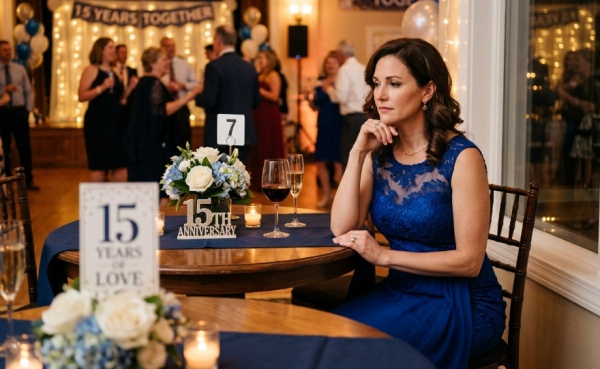
My Husband Brought His Young Mistress Home on Our Anniversary… On the morning of our fifteenth wedding anniversary, my husband showed up at our front door with another woman on his arm. She was young, nervous, and clearly convinced she was stepping into her new life. He smiled like he had already won, like the mansion, the money, and the company were all his to give away. But He Forgot One Thing….
Part 1: The Woman at My Door
On the morning of our fifteenth wedding anniversary, I opened the front door and found my husband standing there with his arm wrapped around a woman young enough to be his daughter.
I thought the betrayal would be the worst part.
It wasn’t.
The worst part was watching him smile as he brought her into the mansion I helped build, convinced he had already won. What he didn’t know was that every dollar, every share, and every piece of the empire he worshipped belonged to me on paper.
For a few seconds, I just stood there with my hand still wrapped around the brass doorknob. The morning sun poured across the marble entryway behind me, bouncing off the chandelier we had imported from Italy after our company’s first eight-figure year. Outside, my husband, Daniel Whitaker, stood on the front steps like a man arriving at a hotel he owned.
The woman beside him wore a cream-colored coat, oversized sunglasses, and the kind of smile people wear when they have been told a story only from one side. Her blonde hair fell in soft waves over her shoulders, and one of Daniel’s hands rested comfortably at her waist. She looked nervous, but not ashamed.
“Claire,” Daniel said, as if he were greeting a neighbor at a barbecue. “We need to talk.”
I looked at him, then at her, then back at him. Fifteen years of marriage had trained my face better than any acting class ever could. I did not cry, scream, or slam the door.
Instead, I stepped aside.
“Come in,” I said.
The woman blinked, clearly surprised. Daniel smiled wider, mistaking my composure for defeat. That had always been his favorite mistake.
He walked into our home first, his Italian loafers clicking against the white marble floor. She followed close beside him, carrying a designer purse that still had the stiff, careful shine of something recently purchased. I wondered if he had paid for it with the corporate card.
“This is Madison,” Daniel said.
Madison removed her sunglasses slowly. She was pretty in an uncomplicated way, the kind of pretty that looked expensive because someone else was paying for it. Her eyes darted around the foyer, taking in the sweeping staircase, the grand piano, the floor-to-ceiling windows overlooking five acres of manicured Virginia property.
“Hi,” she said softly. “I know this is awkward.”
I almost laughed.
Awkward was forgetting someone’s name at a fundraiser. Awkward was spilling red wine on a white couch. This was my husband bringing his girlfriend into our home on our wedding anniversary.
But I nodded politely.
“Madison,” I said. “How old are you?”
Daniel’s face tightened. “Claire.”
She hesitated. “Twenty-seven.”
Twenty-seven. Our oldest niece was twenty-four. Daniel was fifty-two.
I looked at Daniel again. “And why is Madison here?”
He straightened his shoulders. That was when I saw it: the performance. The careful posture, the rehearsed calm, the smug little lift at the corner of his mouth. He had planned this scene.
“We’re not going to drag this out,” he said. “I’m filing for divorce.”
The word hung in the foyer like smoke.
I folded my arms. “On our anniversary?”
“I didn’t choose the date to hurt you,” he said, which meant he absolutely had. “But things have been over between us for a long time.”
Madison looked down at her shoes.
Daniel continued, gaining confidence. “I’m in love with Madison. She’s moving in.”
That time, I did laugh. Not loudly. Just one quiet breath that escaped before I could stop it.
Daniel frowned. “This is still my house, Claire.”
“No,” I said. “It’s not.”
His eyes narrowed. “Don’t start.”
I looked past him at the oil portrait above the fireplace in the formal living room. It was a portrait of Daniel from seven years earlier, commissioned after Forbes ran that ridiculous profile calling him “the visionary behind Whitaker Capital.” I had allowed the article, the portrait, the myth, because myths were useful in business.
Especially when the truth was more powerful.
“You brought her here because you wanted me to feel small,” I said.
Daniel gave a tired sigh, the one he used in board meetings when he wanted everyone to know he considered himself the only adult in the room. “Claire, let’s be realistic. You never had the stomach for conflict. I’ll make sure you’re taken care of. You can keep the condo in Naples and maybe the lake house.”
Madison looked up at that, surprised by the casual mention of multiple properties.
I smiled.
“How generous.”
Daniel mistook that smile too. He always had. “I don’t want this to get ugly. But if you fight me, I promise you’ll regret it.”
There it was. The threat wrapped in silk.
I turned to Madison. “Did he tell you I signed a prenup?”
Her face changed.
Daniel snapped, “That’s none of her business.”
“So he did tell you,” I said. “Did he also tell you what it says?”
Madison looked at him. “Daniel?”
He waved a hand. “It’s standard. She gets what she came in with, I get what I built.”
I walked to the side table, picked up my coffee, and took one slow sip. It had gone cold. Somehow, that bothered me more than the girl in my foyer.
“What you built,” I repeated.
Daniel stepped closer. “Don’t embarrass yourself.”
I set the cup down. “That’s funny. I was about to say the same thing to you.”
His face hardened. “I know this is emotional for you.”
“No,” I said. “This is administrative.”
Madison’s eyes widened.
Daniel stared at me as if he had not heard correctly. “Administrative?”
“Yes. Like changing the alarm code. Canceling a credit card. Removing someone from a board seat.”
For the first time that morning, his confidence slipped.
I looked at the grandfather clock beside the staircase. It was 8:17 a.m. The housekeeper would not arrive until ten. The gardeners were out near the back lawn. The security cameras were recording every angle of this conversation.
Perfect.
“Daniel,” I said, “you should have waited until after breakfast.”
Part 2: The Empire With My Signature
Fifteen years earlier, Daniel had been handsome, charming, and broke in a way he considered temporary. I was thirty-six, recently promoted, and quietly wealthy from an inheritance my grandmother had placed in a family trust. My father used to say there were two kinds of men who wanted rich women: the honest ones who were terrified of the money, and the dangerous ones who were fascinated by it.
Daniel was fascinated.
I did not see it at first. Or maybe I did and chose to call it ambition.
We met at a charity auction in Georgetown, where he was wearing a rented tuxedo and telling a circle of donors about a real estate fund he was “launching.” The fund had no investors, no office, and no real structure, but Daniel spoke as if the skyline of Washington, D.C. had personally invited him to redesign it.
He made people believe in possibilities. That was his gift.
My gift was knowing where the bodies were buried in a balance sheet.
I had spent twelve years in corporate finance by then. I knew debt covenants, tax structures, capital calls, and how to read a contract closely enough to hear what it was trying not to say. Daniel could charm a room, but I could protect a company from the room.
When he asked me to dinner, I said yes. When he asked me to marry him eleven months later, I said yes too. But when he asked me to “keep things simple” and skip the prenup, I said absolutely not.
He laughed at first.
“Claire, do you really think I’d ever take anything from you?”
I remember looking across the restaurant table at him. There were candles between us, and he had ordered a $900 bottle of wine he could not afford. His smile was warm, but his eyes were measuring me.
“No,” I said. “And this document will make sure I never have to wonder.”
He signed it three weeks before the wedding. My attorney, Patricia Moore, drafted it so carefully that even Daniel’s lawyer complimented the work. Separate property remained separate. Assets purchased by my trust remained mine. Any business capitalized by trust funds belonged to the trust unless transferred by written agreement.
Daniel did not read the final version closely. He was too busy planning the honeymoon and telling people he was marrying the love of his life.
At first, maybe he was.
For the first five years, we were a team. I gave him seed capital through a trust-owned investment vehicle, not directly. He became the public face of Whitaker Capital, while I sat behind the structure as majority owner, chair of the holding company, and trustee of the entities that mattered.
That arrangement suited both of us.
Daniel liked being photographed. I liked being underestimated.
We bought distressed commercial properties after the recession, renovated them, and leased them to medical groups, law firms, and tech startups. We expanded into multifamily housing in North Carolina, then logistics warehouses in Pennsylvania, then senior living facilities in Florida. By year ten, Whitaker Capital had become a private investment firm with assets across seven states.
Daniel gave interviews. I negotiated financing.
Daniel cut ribbons. I reviewed risk.
Daniel shook hands with mayors. I knew which insurance policies, operating agreements, and voting rights kept the company from collapsing.
To the public, Daniel was the founder. On paper, he was the CEO of a management company with a generous salary, performance bonus, and the ego of a small monarchy. The actual assets belonged to Whitaker Holdings Trust.
My trust.
He never cared, because the world treated him like the owner.
We lived in a mansion outside McLean, Virginia, with six bedrooms, a wine cellar, a pool house, and a driveway long enough to make visitors feel impressed before they even parked. Daniel picked the house because it looked like success. I bought it because it was a good long-term asset.
The deed was in the trust’s name.
So were the cars, except for his vintage Porsche, which he insisted on owning personally. So was the boat he hated using but loved mentioning. So were the shares of every profitable subsidiary.
Daniel owned his watches, his clothes, his golf clubs, and the consequences of his choices.
Over the years, the marriage became less of a partnership and more of a brand. He liked having me beside him at galas because I made him look respectable. I liked having him in front of cameras because he absorbed attention like sunlight, leaving me free to work.
But somewhere along the way, admiration turned into resentment.
He started calling me “cold” when I asked questions. He called me “controlling” when I refused risky deals. He called me “paranoid” when I requested audits after a few expenses seemed unusually creative.
Then came the trips.
Austin for “investor dinners.” Miami for “development meetings.” Aspen for “private wealth retreats.” He always had explanations, receipts, and just enough impatience to discourage follow-up questions.
But I had built our life by noticing patterns.
The hotel upgrades. The duplicate dinner charges. The boutique purchases in sizes I did not wear. The sudden password changes. The way he turned his phone face down even when we were alone.
I did not confront him immediately.
That surprises people when I tell them later. They expect the wronged wife to throw a glass, kick him out, and burn his suits in the driveway. But women who build empires do not waste evidence for the pleasure of one dramatic moment.
I waited.
I consulted Patricia again, quietly. I reviewed the prenup, corporate documents, property records, and board agreements. I asked our forensic accountant to examine company expenses under the ordinary annual audit process.
Then I made changes.
Nothing illegal. Nothing hidden. Nothing vindictive.
Just prudent governance.
I removed Daniel’s unilateral spending authority. I required dual approval for transactions over $25,000. I transferred certain voting rights from one entity to another, exactly as permitted under the operating agreements he had signed years before without reading.
I updated the home security access list. I changed the guesthouse alarm code. I froze discretionary reimbursements pending review.
Daniel noticed only the reimbursements.
“Accounting is getting annoying,” he complained one night over dinner.
“Accounting is supposed to be annoying,” I said.
He rolled his eyes. “You’ve always loved making people jump through hoops.”
“No,” I said. “I love knowing where money goes.”
He looked at me for a little too long. “Maybe that’s why we stopped having fun.”
I remember putting down my fork. “Is that what you think marriage is supposed to be? Fun?”
“It’s supposed to feel alive,” he said.
I looked at the man I had loved, or maybe the man I had helped invent. “Then perhaps you should ask yourself why you need applause to feel alive.”
He left for Miami the next morning.
Madison’s name first appeared in an expense report six weeks later. Not directly, of course. Daniel was too practiced for that. But there was a luxury boutique in Bal Harbour, a restaurant reservation for two, and a private car service under the initials M.L.
Madison Lane.
Twenty-seven years old. Former marketing assistant at an event agency. Social media profile full of beach photos, inspirational quotes, and pictures taken from hotel balconies she could not afford.
I did not hate her.
That may also surprise people.
She was not the first young woman to believe an older, powerful man when he said his marriage was loveless and his wife was cruel. She was not the first person to confuse access with ownership. She was not even the first woman Daniel had tried to impress using things that belonged to me.
But she was the first one he brought to my front door.
That changed the tone.
Part 3: The Anniversary Performance
Daniel walked into the formal living room as if he expected me to offer coffee. Madison hovered near the doorway, clutching her purse with both hands. The anniversary flowers I had ordered for the dining room sat on the sideboard, white roses and blue hydrangeas arranged in a silver vase.
Fifteen years.
I had ordered them before I knew he planned to humiliate me before lunch.
Daniel glanced at the flowers and smiled. “That’s a little ironic.”
“Not really,” I said. “They’re from me.”
“To yourself?”
“Yes.”
Madison looked between us, confused.
I sat in the armchair by the fireplace. It was my favorite chair, deep navy velvet, positioned so I could see both the gardens and the front drive. Daniel remained standing, probably because sitting would make him feel less in control.
“I want this handled respectfully,” he said.
“Then you should have started respectfully.”
He ignored that. “Madison and I are going to stay in the guest wing for now.”
Madison’s head snapped toward him. Clearly, this was news to her.
“No,” I said.
Daniel’s jaw tightened. “You can’t just say no.”
“I can, actually. No.”
“This is my residence.”
“It is your marital residence,” I said. “Owned by a trust. Occupied under terms you are apparently unfamiliar with.”
His eyes flashed. “You think paperwork makes you untouchable?”
“No. I think paperwork makes things clear.”
Madison took one small step back.
Daniel noticed and softened his voice for her benefit. “Claire likes to intimidate people with legal jargon. It’s part of her personality.”
I smiled at Madison. “I prefer plain English. He cannot move you into this house.”
Daniel laughed. “You’re being ridiculous.”
“Am I?”
He pulled his phone from his pocket. “I’ll call my attorney.”
“Please do.”
That unsettled him more than anger would have.
He tapped the screen, paced toward the windows, then stopped when the call went to voicemail. It was Sunday morning. Even powerful men forget attorneys have families.
“Fine,” he said. “We’ll do this tomorrow.”
“No,” I said. “We’ll do it now.”
I picked up my phone from the table and sent a text to Patricia: He brought her to the house. Please join the call.
Within thirty seconds, my phone rang.
Daniel looked at it, then at me. “You had her waiting?”
“I had her available.”
I put the call on speaker.
“Good morning, Claire,” Patricia said, her voice calm and sharp as cut crystal. “Is Daniel present?”
Daniel’s face went pale with anger. “Patricia.”
“Good morning, Daniel. I understand there may be some confusion regarding occupancy, corporate authority, and marital property.”
Madison whispered, “Oh my God.”
Daniel covered the phone with his hand, though it was my phone. “Claire, stop this.”
I looked at him. “You brought an audience.”
He removed his hand.
Patricia continued. “Daniel, to be clear, the McLean property is owned by Whitaker Holdings Trust. You have no unilateral authority to invite a third party to reside there, particularly under circumstances that may create liability or security concerns.”
“This is insane,” Daniel snapped.
“It is documented,” Patricia replied.
He turned red. “I am the CEO of Whitaker Capital.”
“You are CEO of Whitaker Management Group,” Patricia said. “Your employment agreement is subject to termination by the board for cause, including misuse of company funds, breach of fiduciary duty, or conduct creating reputational harm.”
Madison stared at Daniel.
He looked as if Patricia had slapped him without touching him.
“Are you threatening me?” he said.
“No,” Patricia answered. “I’m clarifying exposure.”
I almost admired how gently she could bury a man.
Daniel pointed at me. “You planned this.”
“Yes,” I said.
The room went quiet.
He blinked. “Excuse me?”
“I planned for the possibility that you would confuse possession with ownership.”
Madison slowly lowered herself onto the edge of the sofa. Her face had lost color.
Daniel’s voice dropped. “Claire, be careful.”
“No, Daniel. You be careful. Because everything said in this room matters now.”
His eyes darted toward the ceiling corner. The camera.
For the first time that morning, he remembered the house was smarter than he was.
I turned to Madison. “Did Daniel tell you he was buying this house from me after the divorce?”
Her lips parted, but no words came out.
“Did he tell you he would make me leave?”
She looked at Daniel.
He snapped, “Don’t answer that.”
That was answer enough.
I nodded. “Did he tell you he owned the company?”
Madison swallowed. “He said he built it.”
“He helped build it,” I said. “There’s a difference.”
Daniel laughed bitterly. “You’re enjoying this.”
“No,” I said. “I enjoyed building a life with a man I trusted. This is cleanup.”
Patricia spoke again. “Claire, I recommend ending the in-person discussion. Daniel, if you intend to pursue divorce proceedings, please have your attorney contact me. Until then, no third-party occupancy, no removal of assets, no destruction of records, and no use of company funds for personal matters.”
Daniel grabbed Madison’s hand. “We’re leaving.”
But Madison did not move.
She looked at him, and something in her expression changed. Not love disappearing. Something more painful.
Belief cracking.
“You said she didn’t work,” Madison whispered.
I looked down at my hands.
Daniel froze.
“You told me she inherited everything and just sat at home,” Madison continued, her voice shaking. “You said you were the one who made the money.”
He yanked his hand away. “This is not the time.”
She stood. “You said she was unstable.”
There it was.
Not surprising. Still ugly.
I looked at Daniel. “Really?”
He glared at Madison now, all charm gone. “I said a lot of things because you kept asking questions.”
Madison flinched.
That was the moment I stopped seeing her as the woman at my door and started seeing her as the next person Daniel had lied to.
I stood. “Madison, would you like me to call you a car?”
Daniel barked, “She came with me.”
“I didn’t ask you.”
Madison’s eyes filled with tears, but she nodded. “Please.”
I called the car service we used for guests. Daniel watched, furious but trapped by the camera, the attorney on speaker, and the reality of his own carelessness.
While we waited, nobody spoke.
The grandfather clock ticked. The roses sat untouched. Somewhere outside, a leaf blower started near the south lawn, ordinary life continuing with breathtaking indifference.
When the black SUV pulled up twenty minutes later, Madison walked toward the door. Before leaving, she turned back to me.
“I’m sorry,” she said.
I believed her.
Daniel scoffed. “Madison.”
She did not look at him. “Don’t call me.”
Then she walked out of my house.
The door closed softly behind her.
Daniel and I were alone.
For the first time in years, there was no audience for him to charm.
Part 4: The Man Without a Stage
Daniel stood in the foyer, breathing hard through his nose. His face had settled into something colder than anger. It was the look of a man who had not lost everything yet, but had finally realized he could.
“You humiliated me,” he said.
I looked around the house. “Interesting choice of words.”
“You always have to win.”
“No,” I said. “I always have to protect myself.”
He laughed once, harshly. “From me?”
“Yes.”
The honesty landed between us.
For a moment, he looked almost wounded. Then pride rushed back in to save him from self-awareness.
“You think you’re so smart because your grandmother left you money,” he said. “Without me, you would have been just another rich woman afraid to take risks.”
I nodded slowly. “And without me, you would still be pitching imaginary funds in rented tuxedos.”
His eyes burned.
There was a time when I would have regretted saying that. A time when I would have softened the truth to preserve his dignity. But Daniel had brought a young woman to my door on our anniversary and smiled while doing it.
Some truths deserved daylight.
He stepped closer. “You can’t run the company without me.”
“I already do.”
“You don’t have relationships.”
“I have contracts.”
“You don’t have vision.”
“I have ownership.”
“You don’t have loyalty.”
That one almost made me laugh again.
“Daniel,” I said, “you arrived here with your girlfriend.”
His mouth opened, then closed.
I walked to the console table and picked up a folder. It was not thick. The most dangerous documents rarely are. Inside were copies of board notices, expense reviews, and a draft separation plan prepared weeks earlier.
He stared at it. “What is that?”
“The beginning of consequences.”
I handed him the first page.
He read the heading and went still.
Administrative Leave Pending Review.
His eyes shot up. “You can’t do this.”
“The board can.”
“You are the board.”
“Not entirely. But enough.”
He flipped through the pages, faster now. His hands shook slightly. He saw the reimbursement review, the hotel charges, the jewelry purchases, the unexplained consulting payments to an LLC registered in Delaware.
That one had surprised even me.
“Claire,” he said, voice changing. “That’s not what it looks like.”
“It never is.”
“I can explain.”
“I’m sure you can.”
He lowered the papers. “Some of those payments were business development.”
“Then you’ll provide documentation.”
His face hardened again. “You’re trying to ruin me.”
“No. I’m trying to determine whether you used company resources improperly.”
“This is my name on the building.”
I looked at him with something close to pity. “A name is not ownership.”
He sank into the chair across from me, suddenly looking older than fifty-two. Without the performance, without Madison, without employees waiting for his approval, Daniel seemed smaller. Still handsome, still polished, but hollowed out by panic.
I sat too.
For several minutes, neither of us spoke.
Then he said quietly, “I did love you.”
I looked at him.
Maybe he had. In his way. As much as a man like Daniel could love someone without confusing love with usefulness.
“I know,” I said.
That seemed to hurt him more than anger would have.
He leaned forward, elbows on his knees. “It wasn’t supposed to happen like this.”
“How was it supposed to happen?”
He stared at the floor. “I was going to talk to you. We were going to separate quietly. I thought maybe after a while you’d accept it.”
“And Madison moving into my house?”
He winced. “I got carried away.”
“No,” I said. “You got confident.”
He looked up, and for one brief second, I saw the young man from Georgetown. The one who believed every closed door was an insult. The one who wanted so badly to matter that he became addicted to mirrors.
“I thought you’d be devastated,” he admitted.
“I am.”
He looked confused.
I touched the arm of the chair, grounding myself. “I’m devastated that fifteen years ended this way. I’m devastated that you mistook my restraint for weakness. I’m devastated that I spent so long protecting a man who was busy turning me into the villain of his story.”
His eyes glistened, but no tears fell.
Daniel had always been too proud to cry when crying might have helped.
“I don’t want to go to war,” he said.
“Then don’t.”
“What do you want?”
There it was. The question he should have asked before showing up with Madison.
“I want a clean divorce,” I said. “I want full cooperation with the financial review. I want you out of this house by Friday. I want you to stop telling people I’m unstable, cold, or dependent on you. And I want you to understand that if you try to burn down what we built, you will be standing inside it too.”
He swallowed. “Where am I supposed to go?”
“The Four Seasons. Your brother’s house. The condo you insisted on buying personally in Arlington because you said a man needed one asset with his own name on it.”
He looked away.
I had forgotten nothing.
He rubbed both hands over his face. “The press will find out.”
“Probably not, if you behave.”
“And if I don’t?”
“Then the truth will become very well organized.”
He almost smiled at that, despite himself. “You always did love a spreadsheet.”
“I loved accuracy.”
His smile disappeared. “Did you ever love me?”
The question came so quietly that it almost broke me.
I thought about our early years, eating takeout on the floor of a half-renovated office because we could not afford proper furniture yet. I thought about him holding my hand at my mother’s funeral. I thought about dancing barefoot in the kitchen after our first major deal closed.
“Yes,” I said. “Very much.”
He nodded, and a single tear slipped down his cheek.
I did not comfort him.
Not because I was cruel, but because I had finally understood something: some people mistake your comfort for permission.
The next few days passed with the strange calm that follows a storm when the damage is not yet fully visible. Daniel moved into a hotel, telling his assistant he needed privacy. Patricia filed the necessary paperwork. The board placed him on temporary leave pending review.
Madison sent one message through social media.
I did not know the truth. I’m sorry. I hope you’re okay.
I stared at the message for a long time before replying.
I hope you are too.
That was all.
By Wednesday, Daniel’s attorney contacted Patricia. By Thursday, the review expanded. By Friday, Daniel returned to the house with a moving company and a face drained of arrogance.
I stayed in the library while he packed.
Every room carried evidence of our life together. The framed photo from Napa. The bronze sculpture he bought after our first $100 million year. The ridiculous cowboy hat from a Texas site visit where he had tried to blend in and failed spectacularly.
Objects are cruel that way.
They remember when people were better.
At 4:42 p.m., Daniel appeared in the library doorway. He was holding a small wooden box.
“I found this in my nightstand,” he said.
I recognized it immediately.
Inside were the cuff links I had given him on our wedding day. Silver, engraved with his initials. He had worn them to every major deal closing for ten years.
“Take them,” I said.
He shook his head. “I don’t deserve them.”
“No,” I said. “You don’t. But they’re yours.”
He stood there, ashamed enough to look human.
“Claire,” he said. “I’m sorry.”
I had imagined that apology a hundred times. In every fantasy, it gave me relief. In reality, it felt like receiving flowers after the funeral.
“I know,” I said.
He waited, maybe hoping for forgiveness.
I did not give it.
Not because forgiveness would never come, but because he wanted it too quickly. He wanted it before the consequences. He wanted it while the wound was still bleeding.
So I simply said, “Goodbye, Daniel.”
He nodded, placed the box in his coat pocket, and walked out.
From the window, I watched the moving truck roll down the driveway. For fifteen years, I had seen Daniel leave for meetings, flights, golf weekends, fundraisers, and affairs I had pretended not to understand. This time, he left with half a closet, three suitcases, and no key.
The mansion was silent after he was gone.
Not peaceful yet.
But honest.
Part 5: The House I Kept
Three months later, I stood in a ballroom in downtown Washington, D.C., wearing a black silk dress and no wedding ring. The annual Whitaker Capital investor dinner had been renamed the Whitaker Holdings Leadership Forum, which sounded less dramatic and far more accurate. The portrait of Daniel had been removed from the office lobby and replaced with a photograph of the first property we ever bought.
A tired brick building in Richmond with broken windows and good bones.
That felt more honest too.
The financial review had found enough problems to end Daniel’s role permanently, though not enough for the scandal people online would have invented if they had been invited to participate. Some improper expenses were reimbursed. Some consulting arrangements were terminated. Lawyers did what lawyers do: they turned chaos into documents, and documents into signatures.
The divorce was not final yet, but the shape of it was clear.
Daniel would leave with money. More than many people see in a lifetime. Less than he thought he deserved. Exactly what the prenup, employment agreements, and settlement negotiations allowed.
He fought at first.
Of course he did.
There were angry calls, midnight emails, accusations, dramatic claims about betrayal, and one embarrassing attempt to convince a board member that I had “manipulated” the company from behind the scenes. The board member, a retired judge from Maryland, reportedly replied, “Daniel, that is generally called leadership.”
I laughed when Patricia told me.
Not because any of it was funny, but because sometimes survival has a sense of humor.
Madison disappeared from his life within a week of that anniversary morning. I heard she moved to Colorado and took a job with an outdoor apparel company. I hoped she learned to distrust men who describe their wives as obstacles instead of people.
As for Daniel, he rented a luxury apartment in Arlington and started appearing at restaurants with men who still called him “a legend.” Maybe someday he would build something of his own. Maybe he would spend the rest of his life telling people I took what was his.
That no longer mattered to me.
What mattered was the speech I was about to give.
I stood backstage holding note cards I did not need. Beyond the curtain, two hundred investors, executives, attorneys, and community partners waited over plates of short ribs, roasted vegetables, and $18 salads pretending to be worth $46. The old Claire would have let someone else speak.
The new Claire understood visibility was not vanity when truth needed a witness.
My assistant, Naomi, touched my elbow. “You ready?”
I looked at the stage lights.
“No,” I said. “But I’m going.”
She smiled. “That’s usually enough.”
When my name was announced, the applause was polite at first, then warmer. People stood. Not everyone, but enough. I walked to the podium with my shoulders back and my hands steady.
For a moment, I saw Daniel in my mind as he had been on that morning. Smiling in my doorway. Convinced he had already won.
Then I looked at the room and began.
“Good evening. For many years, this company was publicly associated with one voice and one face. That was a choice, and at the time, it served a purpose. But companies, like people, eventually have to tell the truth about themselves.”
The room quieted.
I continued.
“Whitaker Holdings was built by many hands. Analysts who noticed what others missed. Property managers who answered calls at 2 a.m. Construction crews who worked through brutal summers. Attorneys, accountants, partners, tenants, and families who trusted us to do what we said we would do.”
I paused.
“It was also built by a woman who spent too many years believing that staying behind the curtain was the same thing as being strong.”
A few people shifted in their seats. Not uncomfortably. Attentively.
“I was wrong,” I said.
The words felt clean.
“Strength is not silence. Grace is not self-erasure. Privacy is valuable, but disappearing inside your own life is not the price of being respected.”
I saw Patricia seated near the front, her expression unreadable except for the smallest nod.
I kept going.
“This next chapter will be transparent, disciplined, and focused on long-term value. We will continue investing in communities where growth does not have to mean displacement, where housing can be profitable and humane, and where leadership is measured by responsibility, not volume.”
Applause rose, but I held up one hand gently.
“And on a personal note, because many of you have known me and my family for years, I will say only this: life can change in a single morning. Sometimes the doorbell rings, and the life you thought you were living ends before breakfast.”
A soft ripple moved through the room.
“But endings are not always losses. Sometimes they are audits. They show you what was real, what was borrowed, what was inflated, and what was yours all along.”
This time, the applause came stronger.
I looked across the ballroom and felt something loosen in my chest.
Not happiness exactly.
Freedom.
After the speech, people approached me carefully, as if I were either fragile or dangerous. A few women hugged me without asking for details. A few men congratulated me with the startled respect usually reserved for someone who had survived a plane landing in bad weather.
One older investor, Mr. Callahan, shook my hand and said, “I should’ve known you were the one running the place.”
I smiled. “Yes, you should have.”
He laughed, embarrassed but gracious.
Later that night, I returned home alone. The mansion looked different now, though nothing visible had changed. The same stone columns framed the entrance. The same gas lanterns glowed beside the front door. The same long driveway curved beneath the maple trees.
But the house no longer felt like a stage built for Daniel’s performance.
It felt like shelter.
Inside, I kicked off my heels in the foyer and stood barefoot on the marble. Three months earlier, Daniel had stood in that exact spot with Madison under his arm, believing he could introduce a new life into my home and assign me the role of discarded wife.
He had misunderstood the entire story.
I was not discarded.
I was released.
I walked into the kitchen, opened the refrigerator, and laughed when I saw the leftovers Naomi had insisted on sending home with me. Short ribs in a black catering container. Roasted vegetables. A tiny chocolate cake with gold flakes on top, because Washington events treat dessert like jewelry.
I ate the cake standing at the counter.
It tasted better than revenge.
Revenge, despite what people say, is exhausting. It keeps you tied to the person who hurt you. What I wanted was not revenge.
I wanted ownership of my own life.
Over the next year, I made changes slowly. I sold the boat. I donated half of Daniel’s custom suits, after confirming through attorneys that they were abandoned personal items. I turned the guest wing into offices for a foundation focused on financial education for women rebuilding after divorce, job loss, or family crisis.
The lake house went to my sister for the summer, because her kids loved it and houses should be full of laughter when possible.
The Naples condo sold above asking.
The mansion stayed.
People asked why I kept it. They assumed it held too many memories. They were right, but not all memories are poison.
That house had seen betrayal, yes. But it had also seen my mother’s last Christmas, my niece’s graduation party, late-night strategy sessions, quiet mornings with coffee, and the version of me who learned how to stop apologizing for being competent.
I would not surrender a home simply because Daniel had once mistaken it for his throne.
One Saturday morning, almost exactly a year after the anniversary, I opened the front door to accept a delivery. The air smelled like fresh-cut grass and rain on warm pavement. A young man in a FedEx uniform handed me a small package and asked for a signature.
As I signed, he glanced past me into the foyer.
“Beautiful house,” he said.
“Thank you,” I replied.
“Must be a lot to take care of.”
I looked back at the staircase, the sunlight, the flowers I now bought for myself every Friday.
“It is,” I said. “But it’s mine.”
After he left, I carried the package to the library. Inside was a framed copy of the first page of the revised company charter. Naomi had sent it with a note.
For your wall. No curtain this time.
I placed it on the mantel where Daniel’s portrait once hung.
Then I sat in my navy chair by the fireplace, the same chair from that morning, and watched the afternoon light move across the floor.
I thought about the woman who had opened the door a year earlier. She had been calm, yes, but calm like a glass held too tightly. She had thought dignity meant not shaking. She had thought winning meant keeping everything under control.
Now I knew better.
Dignity was telling the truth without begging anyone to believe it.
Winning was waking up in a house no one could use to make you feel small.
And peace was not the absence of betrayal. Peace was the morning after, and the morning after that, and every morning you chose not to let someone else’s cruelty become the most important thing about you.
Daniel had wanted to bring a younger woman into my home and turn me into a cautionary tale.
Instead, he became a footnote in mine.
The empire he worshipped never belonged to him.
But the life I saved belonged to me.
