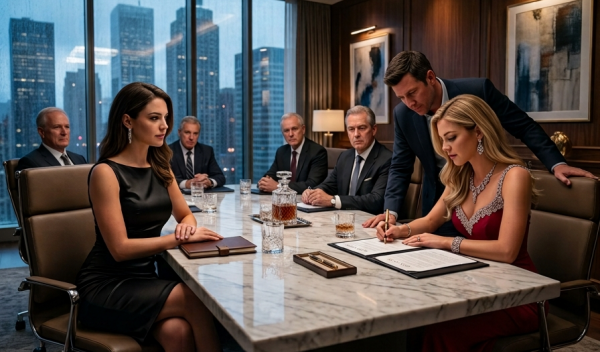
My husband’s Mistress sat in my chair at the conference table and opened a notebook titled “Our Assets” like my life had already been divided without me. My husband smiled beside her, confident that his father’s fortune, the family company, and the Nantucket house were about to become his new beginning with another woman. They thought I had come to watch them win. What they didn’t know was that my father-in-law had left behind one clause that would change everything before lunch.
Part 1 — The Chair She Thought Was Hers
His mistress sat in my chair at my father-in-law’s trust reading and opened a notebook titled “Our Assets.”
My husband smiled like I was already gone. She thought I had come to watch them divide my life in public, like I was some quiet, humiliated wife invited to witness my own replacement.
What she did not know was that the dead man had left behind one clause that would ruin them before lunch.
The conference room was on the thirty-second floor of a law office in downtown Boston, overlooking the harbor. It was the kind of room where people spoke softly because the furniture was expensive and the consequences were heavier than the table. Mahogany walls, leather chairs, bottled water, legal pads, and silence polished to a shine.
My father-in-law, Charles Whitcomb, had died twelve days earlier at eighty-one. He had built Whitcomb Maritime from three secondhand fishing boats into one of the most respected shipping and logistics companies on the East Coast. He was difficult, stubborn, brilliant, and the only person in my husband’s family who had ever seen me clearly.
My husband, Preston Whitcomb, walked in wearing a navy suit and false grief. His mistress, Tessa Blake, walked beside him in a cream coat and heels too delicate for a rainy Boston morning. She carried a leather notebook like she was arriving at a board meeting.
She did not look surprised to see me.
That was how I knew Preston had told her I would be there. He wanted an audience. He wanted me to see her sitting next to him, ready to inherit the life I had spent fourteen years helping him pretend he deserved.
Tessa placed her notebook on the table and smiled at me with practiced sympathy. “Maren,” she said softly. “I know today must be emotional.”
My name in her mouth felt like theft.
I looked at the chair she had taken. It was the chair beside Preston, the one where I had sat for every family meeting, every estate planning discussion, every hospital update during Charles’s final year. Tessa had claimed it as if seating arrangements could rewrite history.
Preston glanced at me and gave a little shrug. “There are other chairs.”
That was the moment I understood exactly how he had described me to her. Difficult. Outdated. Clinging. A wife in name only. A woman being gently escorted out of a family that had already moved on without her.
I chose the chair across from them.
It gave me a better view.
At the head of the table sat Eleanor Briggs, Charles’s attorney of nearly forty years. She was small, silver-haired, and terrifying in the way only old Boston lawyers can be terrifying. She wore pearls, a charcoal suit, and the expression of a woman who had never lost an argument to someone raising their voice.
Beside her were two associates, a trust officer from Beacon Harbor Bank, and Charles’s longtime CFO, Harold Kim. Harold had worked for the family company since before Preston was born. He looked at Tessa’s notebook, then at me, then down at his papers.
He knew something.
Preston leaned back in his chair and placed one hand over Tessa’s. It was not subtle. It was a performance, the kind of gesture meant to show the room that love had arrived and everyone else needed to adjust.
Tessa opened her notebook.
I saw the title again.
Our Assets.
She had color-coded tabs. Real Estate. Liquid Accounts. Company Equity. Nantucket House. Charitable Foundation. Personal Property.
I almost laughed.
Not because it was funny, but because the arrogance was so organized.
Charles had not even been buried long enough for the lilies on his grave to wilt, and she had already sorted his life into categories. She clicked her pen and looked at Eleanor like a student ready for extra credit.
Preston smiled at me then.
It was a small smile, but I knew it. I had seen it across dinner tables, charity galas, and courtship lies. It was the smile he used when he believed the room belonged to him.
“Maren,” he said, “I hope we can keep this civilized.”
Civilized.
That was a favorite word among people who behaved badly and wanted polite victims.
I folded my hands on the table. “That depends on what you mean by civilized.”
Tessa’s smile tightened. “We’re all adults here.”
“No,” Eleanor Briggs said, without looking up from her file. “We are not all relevant parties here.”
The room changed.
Tessa blinked. Preston sat straighter.
Eleanor finally looked at Tessa. “Ms. Blake, before we begin, I need to clarify your legal standing in this proceeding.”
Tessa’s pen stopped moving. “I’m here with Preston.”
“Yes,” Eleanor said. “I can see that.”
Preston cleared his throat. “Tessa is my partner.”
“You are still legally married to Mrs. Whitcomb,” Eleanor replied.
The sentence landed cleanly.
Tessa’s cheeks colored, but only slightly. “Preston and Maren are separated.”
“We are not legally separated,” I said.
Preston looked at me sharply.
He had not expected me to speak so soon. He had expected silence. He had counted on my grief, my embarrassment, my fear of family scandal.
But Charles had taught me something before he died.
He taught me that silence is useful only when it is collecting power.
Eleanor closed the folder in front of her. “This meeting concerns confidential trust administration, family company succession, and estate matters. Ms. Blake, unless all required parties consent to your presence, you may not remain for the full reading.”
Tessa looked at Preston.
Preston looked at me.
I looked at the notebook titled Our Assets.
“No,” I said. “I do not consent.”
For the first time that morning, Preston stopped smiling.
Part 2 — The Son Charles Never Trusted
I married Preston Whitcomb when I was thirty-one and still believed good manners meant good character.
He was handsome in the old New England way, with sandy hair, clean shirts, and a voice that made even bad decisions sound reasonable. He had grown up between Beacon Hill, Cape Cod, and private schools where boys learned how to apologize without admitting anything. People called him charming because wealthy men are rarely called manipulative until the money runs out.
I met him at a fundraiser for marine conservation at the Boston Athenaeum. I was working in nonprofit finance then, managing grants for coastal restoration projects. Preston told me he admired women who cared about the world beyond themselves.
That line worked because I did.
His father, Charles, did not like me at first. He thought I was too direct, too practical, too unimpressed by the Whitcomb name. At our first dinner, he asked what I wanted from his son.
I said, “Honesty would be a good start.”
Charles stared at me for three seconds, then laughed so loudly the waiter dropped a spoon.
After that, he respected me.
Preston and I married two years later at a small church in Newport, Rhode Island, with white hydrangeas, fog over the water, and a reception where half the guests looked like they owned sailboats. Charles danced with me once and told me, “You may be the first person in this family who reads contracts before signing them.”
“I work in finance,” I said.
“No,” he replied. “You work in reality. That is rarer.”
For the first few years, Preston seemed grateful for my reality. He had ideas, charm, social ease, and an effortless ability to make older men believe he understood business. What he did not have was discipline.
Charles knew it.
Preston had always wanted to be seen as the heir. He wanted the title, the office, the club memberships, the corner table at Grill 23, and the casual way people lowered their voices around power. But he did not want the work that made power survive.
I became the work.
I reviewed contracts he ignored. I corrected projections he exaggerated. I smoothed over vendor disputes, answered late-night calls from Harold Kim, and sat beside Charles during quarterly reviews when Preston arrived ten minutes late smelling faintly of expensive cologne and excuses.
The public story was different.
In public, Preston was the rising Whitcomb son. In magazine profiles, he spoke about honoring legacy and modernizing maritime logistics. At charity dinners, he thanked me as “my steady compass,” which sounded romantic until I realized a compass is something people use while going wherever they please.
Charles watched all of it.
He watched Preston interrupt me in meetings. He watched him accept praise for plans I had built. He watched him call my caution “anxiety” and my accuracy “negativity.”
One afternoon, after a disastrous board preparation session, Charles asked me to stay behind.
Preston had left early for what he called a client lunch. Charles waited until the elevator doors closed, then pushed a folder toward me across his desk. Inside were corrected financials, notes in his handwriting, and several questions I had raised that Preston had dismissed.
“You were right,” Charles said.
“I know.”
He smiled. “That is not a modest answer.”
“It was not a modest problem.”
That was the day our relationship changed.
Over the years, Charles began calling me directly. Not to bypass Preston, exactly, but to make sure someone in the family understood what was happening. When he was diagnosed with congestive heart failure, I became the person who organized medications, doctors, estate documents, and family meetings.
Preston visited when cameras were involved.
That is not fair, maybe. He visited other times too. But he did not like sickness. It made him impatient because illness does not applaud.
Tessa appeared two years before Charles died.
She was introduced as a brand consultant for Whitcomb Maritime’s “next-generation identity project.” She was younger than us by nearly twelve years, blond, polished, and fluent in the language of reinvention. Preston lit up around her in a way I had not seen in years.
At first, I blamed myself for noticing.
Women do that. We question our instincts because we have been taught that suspicion is uglier than betrayal.
Then came the texts.
Then the hotel receipts.
Then the weekend in Miami that Preston described as an industry conference, even though Harold quietly confirmed there had been no conference.
When I confronted Preston, he looked tired, not guilty. “Maren, we’ve been living separate lives for a long time.”
That was news to me.
Apparently, our marriage had been ending invisibly while I managed his father’s care, protected his company role, hosted Christmas dinners, and signed tax documents as his wife. I had missed the ceremony where my life was quietly downgraded.
“Does Tessa know we’re not separated?” I asked.
He looked away.
That was the answer.
I did not file for divorce immediately. Not because I wanted him back. By then, wanting him back felt like wanting to move back into a house after seeing termites in every wall.
I waited because Charles was dying.
He knew more than Preston realized.
One evening, three months before his death, Charles asked me to sit with him in the library of his house in Manchester-by-the-Sea. The windows faced the Atlantic, and the sky was the color of pewter. He looked smaller than he used to, wrapped in a navy cardigan, an oxygen tube beneath his nose.
“Maren,” he said, “my son is a fool.”
I looked at him. “Charles.”
“I did not say he was evil. I said he was a fool. There is a difference, though not always in the consequences.”
I said nothing.
He tapped a folder on the table beside him. “Preston thinks inheritance is arrival. It is not. It is responsibility, and he has mistaken access for ownership his entire life.”
My throat tightened. “He’s still your son.”
“Yes,” Charles said. “That is why I am leaving him enough to survive and not enough to destroy everything.”
I did not know what that meant then.
I would know before lunch on the day of the trust reading.
Part 3 — The Clause
Tessa was asked to wait in the lobby.
She did not go gracefully.
“This is absurd,” she said, closing her notebook with a sharp snap. “Preston has every right to have support here.”
Eleanor Briggs removed her glasses. “Support is not a legal category in this room.”
I loved her a little for that.
Preston stood. “If she leaves, I leave.”
Eleanor looked at him calmly. “That is your choice.”
He hesitated.
That hesitation told everyone what mattered most. Not Tessa. Not grief. Not dignity.
The money.
Tessa saw it too. Her face changed in the smallest possible way before she recovered and touched his sleeve. “It’s fine,” she said. “I’ll wait outside.”
She looked at me as she passed. “This won’t change anything.”
I almost answered.
Then I remembered Charles telling me that truth delivered too early becomes a warning. So I let her walk out with her notebook and her imaginary assets.
When the door closed, Eleanor began.
Charles’s trust was complicated, but Eleanor explained it with the precision of someone who had drafted every sentence to survive greedy relatives. The Manchester house would remain in a family property trust. Certain charitable gifts would go to marine education programs and a hospital in Boston.
Harold Kim received a personal bequest. So did Charles’s housekeeper, his driver, and a retired boat captain named Frank who had apparently saved his life in 1987.
Preston listened impatiently.
He cared about three things: the company, the liquid assets, and the Nantucket property.
Eleanor turned a page.
“Regarding Whitcomb Maritime Holdings,” she said, “Mr. Whitcomb’s controlling shares shall not pass outright to Preston Whitcomb.”
Preston sat up. “Excuse me?”
Eleanor continued. “The shares are to be held in the Whitcomb Stewardship Trust for a period of ten years, with voting authority vested in the appointed trust protector and corporate stewardship committee.”
His face reddened. “What committee?”
Harold finally looked up. “The one Charles established last year.”
“Last year?” Preston turned to me. “Did you know about this?”
I held his gaze. “Some of it.”
That was true.
Not all. Charles had not told me every detail. But he had told me enough to sit very still.
Eleanor read the next section.
“During the trust term, Preston Whitcomb shall receive income distributions sufficient for reasonable support, subject to review. However, he shall not possess authority to sell, pledge, transfer, encumber, or otherwise dispose of any company equity held in trust.”
Preston laughed once. “He can’t do that.”
“He did,” Eleanor said.
“My father promised me control.”
“No,” Harold said quietly. “He promised you a place in the company if you earned it.”
Preston looked like he might explode.
Eleanor continued before he could. “Further, the trust contains a conduct and conflict provision.”
The room became very quiet.
I watched Preston’s hands.
They had curled into fists on the table.
Eleanor read slowly.
“If any beneficiary, while legally married, materially misrepresents marital status for purposes of gaining access to trust information, company assets, family property, or succession benefits; or if any beneficiary attempts to involve an unauthorized romantic partner, advisor, or third party in confidential trust administration prior to legal dissolution of marriage; such beneficiary shall be deemed to have triggered a conflict review.”
Preston went pale.
Eleanor turned another page.
“Upon triggering such review, all discretionary distributions shall be suspended pending investigation, the beneficiary shall be removed from any interim corporate leadership consideration, and voting authority shall remain with the trust protector.”
I could hear the rain hitting the windows.
Preston’s voice dropped. “Who is the trust protector?”
Eleanor looked at me.
So did everyone else.
Then she said, “Maren Whitcomb.”
The silence that followed was not empty. It was full of everything Preston had misunderstood.
My husband stared at me as if I had become a stranger in the time it took Eleanor to read one sentence. Maybe I had. Or maybe he was finally seeing the woman I had been while he was busy explaining me away.
“You?” he said.
I did not answer.
Eleanor did. “Mr. Whitcomb appointed Maren Whitcomb as trust protector due to her demonstrated financial competence, fiduciary judgment, and long-term involvement in company continuity planning.”
Preston shook his head. “She’s my wife.”
“Yes,” Eleanor said. “That appears to be one of the reasons he trusted her.”
The sentence hit harder than anger would have.
Preston pushed back from the table. “This is insane. My father was sick. He wasn’t thinking clearly.”
Eleanor’s expression cooled. “Mr. Whitcomb executed the amendment nine months ago after two independent capacity evaluations.”
Harold added, “And after you attempted to use projected inheritance as collateral for a private development deal in Palm Beach.”
Preston looked at him sharply.
There it was.
The deal I had suspected but never fully confirmed. Tessa’s notebook had a tab for Real Estate. Now I understood why.
Eleanor opened another folder. “We have documentation indicating that you represented expected trust assets as available for your personal use. We also have communications suggesting Ms. Blake was informed she would have access to certain family properties after Mr. Whitcomb’s death.”
Preston’s mouth opened, but no words came.
I thought of Tessa in the lobby with her notebook. Our Assets. Nantucket House. Company Equity. Liquid Accounts.
She had not invented the fantasy alone.
Preston had sold it to her.
Eleanor folded her hands. “Because Ms. Blake was brought to this meeting and identified in related communications as a participant in post-death asset planning, the conflict review is now triggered.”
“Because she sat in a chair?” Preston snapped.
“No,” Eleanor said. “Because you brought a non-party into confidential trust administration while legally married, after representing trust property as available for a future life with her.”
The chair had only made it visible.
The clause had done the rest.
By 11:42 a.m., before the lunch carts had even arrived, Preston had lost discretionary access to the trust, any immediate path to control Whitcomb Maritime, and the illusion that his father had died naive.
Tessa had not ruined him by sitting in my chair.
She had simply helped him trigger the clause Charles had written for exactly that kind of arrogance.
Part 4 — The Lobby Lesson
Preston stormed out of the conference room first.
I stayed seated.
There are moments in life when chasing someone only dignifies their exit. I had spent fourteen years following Preston into rooms where he needed me to fix what he had broken. That morning, I let him walk alone.
Through the glass wall, I saw him in the lobby with Tessa. She stood quickly, notebook in hand, her expression eager at first. Then Preston said something, and the eagerness disappeared.
Even from inside the conference room, I could see the moment she realized the notebook was worthless.
Her mouth opened. She looked past him toward me. For the first time since I had known her, she did not look superior.
She looked afraid.
Eleanor gave me five minutes before asking if I wanted to continue. I nodded. There were still documents to review, duties to understand, and a company to protect. Grief could wait. Legal responsibility could not.
The rest of the reading confirmed what Charles had hinted months earlier.
I had no personal ownership of Preston’s inheritance, and I did not want it. That mattered. This was not a fairy tale where the wronged wife magically receives everything and the bad husband gets nothing.
Preston would receive income. He would be housed. He would not be destitute.
But he would not control the company. He would not sell the Nantucket house. He would not use Charles’s death as a down payment on a life with Tessa. He would not turn family assets into a reward for betrayal.
And if he challenged the clause without reasonable legal basis, the no-contest provision could reduce his benefits even further.
Charles had not been sentimental.
He had been prepared.
When the meeting ended, I stepped into the lobby with Eleanor beside me. Tessa was standing near the windows, arms folded, while Preston paced with his phone pressed to his ear. His voice was low and furious.
“This isn’t over,” he was saying. “I want every option.”
Eleanor paused. “Mr. Whitcomb, your attorney may contact our office.”
He lowered the phone. “You manipulated him,” he said to me.
I looked at him carefully. “Your father?”
“Yes.”
“Preston, the last time I tried to make your father do anything, he told me my generation confused feelings with strategy and then ate half a steak against medical advice.”
Harold Kim made a sound that might have been a cough.
Preston’s face twisted. “You think this is funny?”
“No,” I said. “I think it is exactly what he warned you about.”
Tessa stepped forward. “This is family business. Maybe you two should discuss it privately.”
I looked at her notebook.
“Which family?” I asked.
Her cheeks flushed.
Preston put a hand on her back, but it was different now. Less possessive. More panicked. Tessa seemed to feel the difference too.
“You made me look like a fool,” he said to me.
“No,” I replied. “You brought a woman with an ‘Our Assets’ notebook to your father’s trust reading. You handled that on your own.”
Tessa flinched.
Good.
Not because I wanted to hurt her. Because some truths need to be returned to the correct address.
Preston’s attorney called him back, and he turned away. Tessa stayed where she was, staring at me like she wanted to say something cruel but could no longer afford the confidence.
Finally, she said, “He told me you two were done.”
I believed her.
Not fully. Not generously. But enough.
“He told you what benefited him,” I said.
She looked down.
“And you believed what benefited you,” I added.
That part mattered too.
Her eyes lifted. For a second, anger returned. “You don’t know anything about us.”
“I know you made tabs for property that belonged to a dead man before his body was cold.”
The color left her face.
She clutched the notebook to her chest like it could protect her from herself.
Preston ended his call and came back. “We’re leaving.”
Tessa looked at him. “Where?”
He hesitated.
That was the first practical question of their new life.
The Nantucket house was unavailable. The company jet was corporate property. The Beacon Hill townhouse belonged to Charles’s trust. Preston’s personal apartment had been rented out because he had expected to move into larger circumstances after the reading.
Tessa had arrived that morning to divide a kingdom.
By noon, they were discussing hotel rooms.
I walked past them toward the elevator.
Preston called my name.
I turned.
For one moment, I saw the boy inside the man, furious that his father had finally said no from beyond the grave. I almost felt sorry for him.
Almost.
“You won’t get away with this,” he said.
I smiled sadly. “Preston, I’m not getting away with anything. I’m staying to clean up.”
The elevator doors opened.
Eleanor stepped in beside me. As the doors began to close, I saw Tessa whisper something to Preston, her face tight and frightened. He snapped back at her.
The partnership built on imaginary assets was already discovering real math.
Part 5 — What Charles Left Behind
The weeks after the trust reading were ugly in the way wealthy family disputes are ugly: quiet on the surface, vicious in the paperwork.
Preston hired an aggressive attorney from New York who sent a letter accusing me of undue influence, emotional manipulation, breach of loyalty, and several other phrases that sounded dramatic but did not survive evidence. Eleanor responded with medical capacity evaluations, correspondence, meeting notes, and years of company records showing my operational involvement.
Preston’s attorney became less aggressive after that.
Tessa disappeared from public view for a while. Her social media went private. The photos from Nantucket, Palm Beach, and the Whitcomb company gala vanished one by one.
I did not message her.
I did not need to.
The trust review moved forward. Preston’s attempted Palm Beach deal was examined. Several emails showed he had promised potential lenders that “post-estate liquidity” would support future ventures. One message to Tessa was especially clear.
After the reading, we’ll finally control the pieces. Maren won’t have the leverage to make noise.
He had been wrong about every part of that sentence.
The company board voted to remove Preston from interim succession consideration pending the trust conflict review. Harold Kim agreed to serve as acting CEO. I remained trust protector, which sounded grand but mostly meant meetings, documents, and making sure no one used Charles’s life work as a personal piggy bank.
It was not revenge.
It was exhausting.
People love stories where the betrayed wife wins in a single glorious moment. Real life is less cinematic. Winning often looks like reading legal memos at midnight, signing bank authorizations, answering auditors, and remembering to eat soup because grief and stress have made coffee feel like a food group.
I filed for divorce in Suffolk County three weeks after the reading.
Preston claimed I had abandoned the marriage emotionally. I almost admired the creativity. Apparently, managing his father’s decline, protecting his company role, and enduring his affair without public scandal counted as emotional absence.
My attorney, Julia Mercer, advised me not to laugh during mediation.
I mostly succeeded.
The prenuptial agreement protected my own assets, which were modest compared to the Whitcomb fortune but fully mine. I did not seek Charles’s money. I sought a fair division of marital property, documentation of dissipation, and protection from Preston’s debts connected to unauthorized deals.
He expected me to be vindictive.
I was precise.
Precision annoyed him more.
At our first mediation, Preston looked tired. Tessa was not there. I noticed immediately and hated that I noticed.
“Where’s your asset manager?” I asked before I could stop myself.
Julia gave me a look.
Preston’s jaw tightened. “Tessa and I are taking space.”
Of course they were.
Nothing tests eternal love like frozen distributions, hotel bills, and the sudden discovery that your future husband does not own the future he promised.
The divorce settled faster than expected. Preston did not have the leverage he thought he had. He kept enough to maintain dignity, if he chose to use it. I kept my freedom, my name, and my role in protecting Charles’s trust.
On the day the settlement was signed, Preston waited for me outside the courthouse.
Boston was cold and bright, the kind of winter day where the air feels honest because it hurts your face. He stood near the steps in a charcoal coat, looking older than he had at the trust reading. Less golden. Less certain.
“Maren,” he said.
I stopped.
“I didn’t think Dad would do that.”
“I know.”
“He trusted you more than me.”
I looked at him, and for once, there was no satisfaction in the truth.
“Yes,” I said.
That hurt him. I saw it.
“I was his son.”
“You still are,” I said. “That was why he left you support. But he didn’t leave you control because he knew you had confused inheritance with permission.”
He looked away.
For a moment, I remembered the man I married in Newport. The man who danced with me under white hydrangeas, who cried during his vows, who once brought me clam chowder when I had the flu and sat on the bathroom floor until I could eat. That man had existed.
So had this one.
Both truths could live in the same room.
“Did you know about the clause?” he asked.
“Not the exact wording.”
“But you knew he was changing things.”
I nodded.
Preston let out a breath that looked like smoke in the cold air. “Why didn’t you warn me?”
That was the question, finally.
I thought of all the times I had warned him. About contracts. About expenses. About Tessa. About his father. About reputation. About the difference between being loved and being managed.
“You stopped hearing me years ago,” I said.
He had no answer.
I walked away.
A year later, Whitcomb Maritime was stable. Harold remained CEO while the board conducted a formal search. The company expanded a scholarship program for children of dockworkers, one Charles had always wanted but never properly funded.
I helped make it happen.
That would have pleased him.
The Manchester house stayed in trust. I visited once in early fall to meet Eleanor and Harold about property maintenance. After the meeting, I walked alone through Charles’s library, where the Atlantic flashed blue-gray beyond the windows.
On his desk sat a framed photo I had never noticed before.
It was from a company anniversary dinner five years earlier. Charles stood between Preston and me. Preston was smiling at the camera. I was looking down at some document in my hand, probably correcting a number at the worst possible social moment.
Charles was looking at me.
Not proudly, exactly.
Knowingly.
I sat in his leather chair and cried for the first time since the trust reading.
Not for Preston. Not for Tessa. Not for the marriage that had ended long before I admitted it.
I cried for Charles, the difficult old man who had seen the disaster coming and left behind the closest thing he knew to protection. He had not saved me. I had saved myself. But he had made sure the truth had tools.
That mattered.
Months later, I heard Tessa had moved to Los Angeles and rebranded herself as a “luxury transition consultant.” Rachel, my best friend, sent me a screenshot of her website and wrote, “Apparently she still loves transitions.”
I deleted it.
Not because I forgave her.
Because I had better things to hold.
Preston moved to a smaller condo in Back Bay and took a consulting role far from Whitcomb Maritime. He still received trust support. He still wore nice suits. He still knew how to speak softly in rooms where people wanted to believe him.
But the rooms were smaller now.
And when people mentioned Charles Whitcomb’s legacy, they no longer looked automatically to Preston.
Sometimes they looked to me.
I never sat in the chair Tessa had taken that morning. Not in Eleanor’s conference room, not in memory. I did not need it back.
A chair is just furniture.
Power is knowing who owns the table.
That morning, Tessa thought she had taken my place because Preston had told her my place was available. Preston thought I had come to witness my erasure because he had mistaken my patience for surrender. Both of them thought Charles’s death would unlock a life they had already named Our Assets.
But Charles had understood his son.
He had understood me too.
The clause did not ruin them because it was cruel. It ruined them because it was accurate. It took the fantasy they had built in whispers, hotel rooms, and color-coded plans and placed it under fluorescent legal light.
By lunch, the mistress had no chair.
The husband had no control.
And I, the wife they thought was already gone, became the one person Charles trusted to protect what remained.
