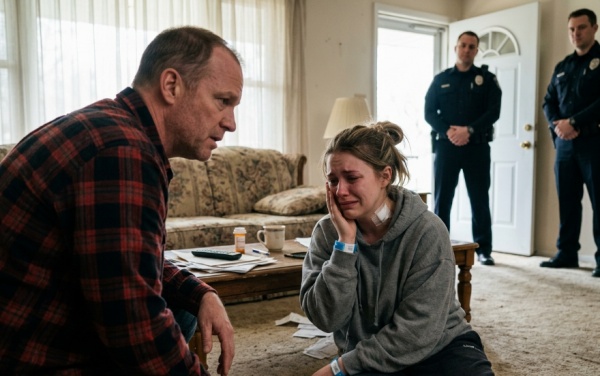
I Came Home From Surgery Barely Able to Stand—Then My Stepfather Told Me to “Start Earning My Keep”… I had just been discharged from the hospital after emergency surgery, still wearing my wristband and holding my medication bag, when my stepfather blocked the hallway and told me to stop acting weak. I tried to explain that my doctor had ordered me to rest, but he didn’t want to hear it. My mother stood frozen in the kitchen, too scared to speak. Then, just when I thought no one was coming to help me, three loud knocks hit the front door.
Part 1: The House I Was Afraid to Come Back To
I had just come home from surgery when my stepfather shouted from the kitchen, “Start earning your keep!”
The words hit me before the pain did. I was still standing in the front hallway of our small rented house in Columbus, Ohio, one hand pressed carefully against the bandage under my loose sweatshirt, the other holding a plastic hospital bag with my discharge papers and two bottles of medication inside. My knees were weak from the ride home, and the smell of fried onions from the kitchen made my stomach roll.
My mother, Linda, stood near the sink with a dish towel twisted in both hands. She looked at me, then at Gary, then back at the floor like she had spent years memorizing the safest place to put her eyes. She had picked me up from Riverside Methodist Hospital that morning after my emergency abdominal surgery, but Gary had insisted on driving us home because, as he said, “Gas isn’t free.”
I was twenty-four years old, old enough to know I should not still be living under a roof where I flinched at footsteps. But medical bills had a way of making freedom feel expensive. I worked full time at a daycare, took night classes at Columbus State, and had been saving every spare dollar to move into an apartment with my friend Tasha by the end of summer.
Then my body betrayed me.
The pain started as a dull ache on a Thursday afternoon while I was helping five-year-olds glue paper suns onto blue construction paper. By dinner, I was doubled over in the employee bathroom, sweating through my shirt. By midnight, I was in the emergency room, listening to a doctor say words like “rupture risk,” “immediate surgery,” and “you’re lucky you came in when you did.”
Lucky did not feel like the right word when I woke up with stitches, a swollen belly, and a nurse telling me I couldn’t lift anything heavier than a gallon of milk for several weeks. Lucky did not feel like the right word when I checked my phone and saw three missed calls from Gary, each voicemail angrier than the last. He wasn’t worried about me. He wanted to know whether I had called off work properly, because “people who lose jobs lose places to sleep.”
Now I was back in the house where I had spent most of my teenage years trying to become invisible.
Gary stood in the kitchen doorway wearing his gray work pants and a stained Ohio State sweatshirt. He was not a big man, but he carried himself like one, chest forward, chin raised, voice always ready to fill the room. He had married my mother when I was thirteen, after my father died from a heart attack so sudden that our lives split into before and after.
At first, Gary brought flowers and fixed the loose porch railing. He called me “kiddo” and said he admired how tough Mom and I were. By the second year, he controlled the grocery money, checked the mileage on Mom’s car, and decided I was “spoiled” because my dad had left a small life insurance payout that Mom used for bills.
When I was seventeen, I learned to keep cash inside an old paperback book. When I was nineteen, I learned not to argue in the kitchen because the neighbors could hear. When I was twenty-two, I promised myself I would be gone before I turned twenty-five.
I was close. So close that I could picture the apartment: mismatched furniture, secondhand dishes, a bedroom door I could close without someone pounding on it. Then surgery knocked me back into the same hallway, in the same house, with Gary looking at me like I had committed a crime by needing help.
“I’m still recovering,” I said carefully. “The doctor said I can’t work yet.”
Gary laughed once, hard and mean. “The doctor doesn’t pay rent here.”
My mother whispered, “Gary, she just got home.”
He spun toward her so fast she took a step back. “Don’t start with me, Linda. You think I’m made of money?”
The house was not his, not really. Mom’s name was on the lease. My paycheck helped with utilities, groceries, and sometimes Gary’s truck payment when he claimed work was slow at the auto shop. But in Gary’s mind, every dollar that entered the house belonged to him, and every person inside it owed him gratitude.
“I paid my part for this month,” I said. “And I’ll cover what I can when short-term disability comes through.”
That was the wrong thing to say.
His face changed. Not dramatically. Just enough that my stomach tightened before he moved. I had seen that look too many times, the quick narrowing of his eyes, the little lift of his upper lip, like anger was something he enjoyed tasting.
“Short-term disability,” he repeated. “Listen to you. Always looking for a handout.”
“It’s through my job,” I said. “I paid into it.”
“You paid into being lazy?”
I wanted to sit down. My abdomen throbbed, and the hallway seemed to tilt slightly under my feet. The discharge nurse had told me to rest, drink water, and avoid stress if possible, which would have been funny if I had not been so tired.
“I’m going to my room,” I said.
Gary stepped in front of me. “No, you’re going to listen.”
Mom’s eyes filled with tears. “Please, Gary. Not today.”
He ignored her. “I let you stay here after high school. I let you eat my food. I let you drive that car in the driveway.”
“My car,” I said before I could stop myself. “Dad’s car.”
The silence that followed was sharp.
Gary hated any mention of my father. He hated the old Honda Civic my dad had left me, hated the framed photo I kept on my dresser, hated that even after all these years, Mom still got quiet on my father’s birthday. Gary wanted history rewritten so that he had rescued us, and anyone who remembered otherwise was ungrateful.
His hand came up before I fully understood what he was doing.
The slap cracked across my face so hard I fell sideways against the hallway wall and then down to the floor. Pain flashed through my cheek, bright and humiliating, but the real terror came from the pull in my stitches as my body twisted. I gasped and curled one arm around my stomach, afraid something inside me had torn open.
Mom screamed my name.
Gary stood over me, breathing heavily. “Stop pretending you’re weak!”
I tried to push myself up, but my arms shook. The hospital bracelet was still around my wrist. My discharge papers had spilled across the floor, one sheet sliding beneath the umbrella stand by the door.
Then came a sound none of us expected.
A firm knock.
Three times.
Gary froze.
Another knock followed, louder this time, and a voice called through the front door, “Columbus Police Department. Open the door, please.”
For a second, no one moved.
Gary looked at me like I had somehow summoned them from the floor.
And maybe, in a way, I had.
Part 2: The Call Nobody Knew About
To understand why the police were at our door, you have to understand what happened two nights before my surgery.
I had not planned to tell anyone at the hospital about Gary. I had spent years telling myself that my family was complicated, not dangerous. That was the lie people like me use when the truth feels too heavy to carry.
The nurse assigned to me in the ER was named Beverly. She had silver hair pulled into a bun, reading glasses on a chain, and the kind of calm voice that made you want to confess things you had survived. When Gary called my phone for the fourth time while I was waiting for a CT scan, I declined it and tried to smile like everything was normal.
Beverly noticed anyway.
“Someone worried about you?” she asked.
“Something like that.”
The phone buzzed again. This time, a text preview lit up the screen.
If this hospital bill messes up my credit, don’t come back here.
Beverly saw it before I could turn the phone over.
She did not gasp. She did not lecture me. She only pulled the curtain closed and said, “Do you feel safe at home?”
I almost said yes. The word was sitting right there on my tongue, trained and ready. Instead, pain twisted through my abdomen so hard that I started crying, and once the tears came, I couldn’t make them stop.
“I don’t know,” I whispered.
That was the first honest answer I had given in years.
Beverly asked careful questions. Had he hit me before? Had he threatened me? Did he control money, transportation, or medication? Was there a safe place I could stay after discharge?
I answered in pieces. Not everything. Not at first. Shame has its own language, and mine came out broken.
Gary had shoved me into a doorframe once when I tried to stop him from taking Mom’s debit card. He had thrown my phone into the yard during an argument and told me to “walk to work if I wanted independence so bad.” He had never liked leaving marks where people could see, but he had mastered fear long before he raised his hand to my face.
My mother had been trapped longer than I had. Gary kept her paycheck in a joint account, monitored her calls, and reminded her that no landlord would rent to a woman with “bad nerves and no backbone.” He said things like that with a smile, especially when company was over.
Beverly listened, then asked if I wanted to speak with the hospital social worker.
I said no because the CT tech arrived, and because pain was easier than decision-making. But after the scan, when the doctor told me surgery could not wait, the social worker came anyway. Her name was Denise, and she had a clipboard, kind eyes, and no patience for Gary’s version of the world.
“Your medical information is private,” Denise told me. “You decide who gets updates.”
That sentence felt radical.
Gary had always acted like my life was community property inside our house. My paycheck, my schedule, my car, my medical issues, my grief—everything was something he had the right to inspect and criticize. Hearing a stranger say I had privacy made me feel like a door had opened somewhere.
I gave the hospital permission to update Mom but not Gary.
That caused the first explosion.
After surgery, while I was still groggy, Mom told me Gary had yelled at the nurses’ station because no one would tell him “what kind of bill this was going to be.” Security escorted him downstairs. He spent the rest of the night texting Mom that I was turning her against him.
Denise came back the next morning with a printed resource list. Domestic violence hotline. Legal aid. Emergency shelter options. Instructions for a civil protection order in Franklin County. She explained everything in practical terms, like she was describing how to change a tire.
I remember staring at the paper and thinking, this is for other people.
People on television. People with black eyes and dramatic court cases. People whose stories sounded serious enough to deserve help.
Denise seemed to know what I was thinking.
“Abuse doesn’t have to look one way to count,” she said. “And you don’t have to wait until it gets worse.”
I laughed weakly. “It always gets worse when people interfere.”
“Sometimes,” she said. “That’s why we plan.”
So we planned quietly.
Tasha agreed by text that I could stay at her apartment once I was medically stable enough to manage the stairs. My boss confirmed my short-term disability paperwork had been submitted. Denise helped me take photos of old bruises I had never deleted from my phone and save copies of threatening messages to a secure email account.
Then she asked whether I wanted a welfare check scheduled after discharge.
I hesitated.
A welfare check sounded dramatic. It sounded like patrol cars in front of the house and neighbors peeking through blinds. It sounded like Gary smiling at officers and telling them I was emotional from surgery, while I stood there looking unstable in sweatpants and hospital socks.
Denise did not push.
“You can say no,” she said. “But if you believe he may become aggressive when you return, police can be present or nearby. You can also call 911 yourself if something happens.”
I looked at my phone. Gary had sent another message.
When you get back, don’t think you’re lying around like some princess.
My stomach turned.
I thought of Mom. I thought of my stitches. I thought of the way Gary’s anger always grew when he sensed someone might escape.
“Can they come by after I get home?” I asked.
Denise nodded. “Yes.”
We set a window of time. She documented my concerns. I told Mom nothing because I was afraid she would accidentally warn him while trying to keep peace.
That was why, when I fell to the hallway floor two days later, the police were already on their way.
The officers arrived moments after Gary hit me not because justice is always fast, but because someone at the hospital had believed me before I fully believed myself. Because I had finally said, “I don’t know,” when asked if I was safe. Because a social worker with a clipboard had treated my fear like evidence instead of drama.
Gary didn’t know any of that.
All he knew was that three knocks had interrupted him.
And men like Gary hate being interrupted.
Part 3: The Door Opens
“Don’t say a word,” Gary hissed.
He pointed at me, still on the floor, as if I were a dog he had trained badly. My cheek burned, my abdomen pulsed, and my mother stood frozen between the kitchen and the hallway with both hands over her mouth. Outside, the officer knocked again.
“Columbus Police Department. We need to make contact.”
Gary smoothed his sweatshirt and ran one hand over his hair. The speed of his transformation made me feel sick. In less than five seconds, he stopped looking like the man who had just hit me and became the hardworking stepfather, the reasonable husband, the misunderstood homeowner.
He opened the door halfway. “Can I help you?”
Two officers stood on the porch, a man and a woman, both in dark uniforms with winter jackets zipped high against the March wind. Behind them, Mrs. Alvarez from next door stood on her own porch holding her phone, eyes wide. She quickly looked away when Gary glanced in her direction.
The female officer looked past him. “We received a request to check on someone at this residence. Is Emma Parker here?”
Gary laughed lightly. “She’s here, but this really isn’t necessary. She just had surgery, so she’s emotional.”
The officer did not smile. “We need to speak with her.”
“She’s resting.”
“I’m here,” I said.
My voice was small, but it carried.
Gary’s head turned slowly.
The officers pushed the door open wider, not aggressively, but with the authority of people who knew they had reason to enter. The female officer stepped inside first and saw me on the floor with hospital papers scattered around me. Her expression changed immediately.
“Ma’am, are you injured?”
Gary raised both hands. “She tripped. She’s on pain meds.”
“I’m not on pain meds right now,” I said. “He hit me.”
The room went silent.
It was the first time I had said it out loud while Gary was close enough to hear.
His face darkened. “You lying little—”
“Sir,” the male officer said sharply. “Step back.”
Gary looked offended, like he had been corrected in his own kingdom. “This is my house.”
“Step back,” the officer repeated.
For once, Gary did.
The female officer knelt beside me but did not touch me without asking. “My name is Officer Hernandez. Can you tell me what hurts?”
“My stomach,” I said. “I had surgery two days ago. And my face.”
She looked at my wristband, then at the discharge instructions on the floor. “Can you stand?”
“I don’t know.”
“We’ll get medics to check you.”
Gary scoffed from near the kitchen. “This is ridiculous. She’s making a scene because I told her she couldn’t freeload.”
Mom finally moved. “Gary, stop.”
Everyone looked at her.
Her voice shook, but she kept going. “You hit her. I saw you.”
Gary stared at my mother as if she had betrayed a sacred agreement. In a way, she had. For years, the agreement had been silence.
Officer Hernandez asked Mom to step into the living room with the male officer. Gary protested, then protested louder when they separated him from us. The more he talked, the less reasonable he sounded.
“She manipulates her mother,” he said. “She’s always been dramatic.”
“Sir, lower your voice.”
“I pay the bills here!”
“Sir.”
“She’s twenty-four years old and still acting like a child!”
The male officer’s tone hardened. “Enough.”
Through the open door, cold air moved into the hallway. I could hear the distant sound of traffic on Weber Road and a dog barking somewhere down the block. Everything ordinary continued outside while my life changed inside.
Paramedics arrived within minutes. One of them checked my blood pressure while the other looked at my surgical dressing and asked about pain. I was embarrassed by my own trembling, but Officer Hernandez stayed near me, blocking Gary from my line of sight.
“You’re doing fine,” she said quietly.
“I don’t feel fine.”
“You don’t have to.”
That almost made me cry again.
A red mark was rising across my cheek. The paramedic said it would likely bruise. My incision did not appear to be open, but because I had fallen and felt sharp pain, they recommended taking me back to the hospital to be safe.
Gary heard that and exploded.
“She is not running up another bill because she wants attention.”
Officer Hernandez stood. “Mr. Cole, you need to stop speaking.”
He pointed at me. “You think you can do this to me? You think you can bring cops into my house?”
The male officer moved between him and the rest of us. “Turn around.”
Gary blinked. “What?”
“Turn around and place your hands behind your back.”
My mother made a sound like a sob caught in her throat.
Gary looked stunned, then furious. “For what?”
“Domestic violence assault,” the officer said. “And we’ll discuss the rest at the station.”
The rest.
I did not understand what that meant until later.
At that moment, all I saw was Gary being handcuffed in the hallway where he had spent years making us afraid. He kept talking as they read him his rights, insisting I was lying, insisting my mother was confused, insisting the officers did not know who they were dealing with. Mrs. Alvarez watched from her porch as they led him outside.
For once, everyone knew exactly who they were dealing with.
Mom sank onto the bottom stair and covered her face. I wanted to comfort her, but I was on a stretcher by then, wrapped in a blanket, watching paramedics lift my hospital bag from the floor.
Officer Hernandez walked beside me as they rolled me toward the ambulance.
“Your neighbor also called 911,” she said. “She heard yelling and saw part of what happened through the front window.”
I closed my eyes.
Mrs. Alvarez had always waved when I took out the trash. Sometimes she brought over tamales at Christmas and told Gary he worked too hard, because that was the version of himself he performed outside. I wondered how long she had suspected the truth.
“Thank her for me,” I whispered.
“You can thank her yourself when you’re ready.”
As the ambulance doors closed, I saw my mother standing on the porch in her thin cardigan, arms wrapped around herself. She looked terrified. She also looked awake.
That was the only word for it.
Awake.
Part 4: What the Police Found
At the hospital, the doctors confirmed that my incision had not reopened. I had bruising, strained muscles, and a warning to avoid any further physical stress. The nurse cleaned the side of my face gently and told me the swelling would get worse before it got better.
Tasha arrived with a tote bag full of clothes, phone chargers, and the kind of rage only a best friend can carry properly.
“I’m going to say one thing,” she announced as she walked into the exam room. “Actually, I’m going to say several things, but I’ll start with this: you are not going back there tonight.”
I tried to smile. “Hi to you too.”
She hugged me carefully, like I was made of glass and dynamite. “I’m serious, Emma.”
“I know.”
“Good. Because my couch is ugly, but it is safe.”
That word again.
Safe.
I was starting to realize safety was not just the absence of yelling. It was being able to close your eyes without listening for a mood. It was taking medicine without someone counting the pills. It was needing help without being punished for it.
Officer Hernandez came to the hospital an hour later to take my statement. She explained the process slowly: the report, possible charges, the temporary protection order, victim services, the court hearing that might follow. She did not promise outcomes she could not control, which made me trust her more.
Then she told me why Gary had looked so shocked when the officer said “the rest.”
During the arrest, Gary had refused to provide identification from his wallet, so officers checked his name through their system. A warrant had been issued two counties over for failure to appear in a case involving theft from an employer. It turned out Gary had not been “slow at work.” He had been fired from the auto shop three weeks earlier and had hidden it from my mother.
That was only the beginning.
When Mom consented to officers retrieving my medication and essential items from the house, they noticed a stack of envelopes on Gary’s desk. Some were addressed to my mother. Some were addressed to me. A few had been opened and tucked beneath a folder labeled “household expenses.”
One was from my short-term disability insurance provider.
Gary had taken it from the mailbox.
My stomach went cold when Officer Hernandez told me. “Was there a check inside?”
“We’re still documenting everything,” she said. “But there may be financial crimes involved. Your mother is speaking with an advocate now.”
I thought of Gary shouting about freeloading while hiding mail connected to my income. I thought of him calling me lazy while trying to control the very money that would help me leave. The cruelty was not random. It had a system.
Mom came to the hospital just before visiting hours ended.
She looked ten years older than she had that morning. Her eyes were swollen, her hair was messy, and she held her purse against her chest like a shield. For a moment, neither of us spoke.
Then she said, “I’m sorry.”
I had imagined that apology for years. In some versions, I screamed. In others, I forgave her immediately because daughters are trained to comfort mothers even when mothers fail them. But sitting there in a hospital bed with a bruised cheek and fresh stitches, I felt something more complicated than anger.
“I needed you to stop him,” I said.
She nodded, tears spilling over. “I know.”
“I needed you to choose me.”
“I know.”
The words were small, but they were true.
She sat in the chair beside my bed. “I was afraid.”
“So was I.”
That sentence changed the room.
For years, Mom’s fear had been treated like the main weather system in our house. We all dressed for it, planned around it, protected it. My fear had been expected to stay quiet because hers was older.
But fear does not become more important just because it has lasted longer.
Mom reached for my hand, then stopped before touching me. “Can I?”
I nodded.
Her fingers were cold.
“The advocate said I can get help too,” she whispered. “Legal aid. Housing resources. They said I don’t have to let him come back.”
“You don’t.”
She looked at me like she wanted to believe it but didn’t know how. “The lease is in my name.”
“Then he doesn’t get to decide everything anymore.”
A tiny, broken laugh escaped her. “He’s going to be furious.”
“He already was.”
That made her cry harder.
Tasha drove me to her apartment that night after the hospital released me. She lived on the second floor of an old brick building near Clintonville, above a bakery that made the hallway smell like cinnamon in the mornings. She had already set up the couch with clean sheets, extra pillows, bottled water, crackers, and a little bell as a joke.
“If you ring that thing for anything except an emergency, I’m throwing it out the window,” she said.
I laughed, and it hurt, so I stopped.
The next few days passed in pieces. Pain medicine. Phone calls. Emails to my employer. A temporary protection order. A victim advocate named Marcy who explained that needing help did not mean I was weak or foolish or responsible for what happened.
Gary called from jail until the order stopped him. Then his sister called. Then a cousin I had met twice messaged me on Facebook saying I had “taken things too far” and “ruined a man’s life over a family argument.”
I blocked them all.
For years, I had been afraid of what people would think if they knew.
Then people knew, and the world did not end.
Some judged. Some gossiped. Some chose Gary because choosing the abuser is easier than admitting you laughed with one at barbecues. But others showed up with soup, rides, legal referrals, grocery cards, and quiet messages that said, “I believe you.”
Mrs. Alvarez sent tamales through Tasha with a note written in careful English.
You are brave. Your mother can call me anytime.
I cried over that note longer than I cried over the slap.
Part 5: Earning My Keep
The phrase “earning your keep” stayed with me for weeks.
Gary had used it like a weapon, as if my right to rest after surgery depended on my usefulness to him. He made love sound like rent and family sound like debt. But the more distance I got, the more I understood that I had been earning my place long before he appeared in our lives.
I earned it when I worked closing shifts at the daycare and still finished assignments at midnight. I earned it when I paid the electric bill without telling anyone because Mom was short that month. I earned it when I survived a house that taught me silence and still found a way to tell the truth.
Actually, no.
That was the old thinking.
I did not need to earn a place in my own life.
Three weeks after the arrest, I returned to court for the protection order hearing. My cheek had faded from purple to yellow by then, and I wore a navy cardigan because it made me feel steady. Tasha sat on one side of me, Mom on the other.
Gary appeared in a county-issued jumpsuit because of the outstanding warrant and new charges. He looked smaller than I remembered, which angered me at first. I wanted him to look like the monster from the hallway, not like an ordinary middle-aged man with thinning hair and tired eyes.
But maybe that was the point.
People who cause harm do not always look like monsters. Sometimes they look like neighbors, husbands, stepfathers, church volunteers, customers who say thank you to cashiers. Sometimes they save their worst selves for the people trapped behind closed doors.
When the judge asked me to speak, my hands trembled around the paper I had prepared.
I told the truth.
I talked about the surgery, the discharge instructions, the slap, the fall, the pain in my incision. I talked about the threats, the financial control, the stolen mail, and the years of fear that had trained me to minimize everything. I did not exaggerate. I did not need to.
Gary’s public defender asked whether I had ever argued with him before. I said yes. Families argue. Arguments do not justify assault.
He asked whether I contributed to household expenses. I said yes, and then I looked at Gary for the first time. “But even if I didn’t, he still wouldn’t have the right to hit me.”
The courtroom went very quiet.
The judge granted the protection order.
It was not magic. It did not erase the past or guarantee the future. But when the judge said Gary could not contact me, could not come near me, and could not return to the house while separate legal matters were pending, I felt a lock open inside my chest.
Mom filed for divorce two days later.
I will not pretend her leaving was simple. It wasn’t. She cried often, panicked over bank statements, and sometimes defended Gary out of habit before catching herself mid-sentence. Healing is messy when fear has been your language for years.
But she started therapy through a community program. She opened a new bank account. She changed the locks with help from Mrs. Alvarez’s nephew, who refused payment and said, “Just make sure he doesn’t get a key.”
I stayed with Tasha until I could walk without pain. She teased me, fed me, and reminded me not to apologize every time I needed something. When my short-term disability finally arrived, including the payment Gary had tried to intercept, I cried in the bakery downstairs because the deposit meant I could still move.
By May, I signed a lease on a tiny one-bedroom apartment in Worthington. It had beige carpet, a narrow kitchen, and a balcony barely big enough for one chair and a plant. To me, it looked like a palace.
The first night there, I slept on an air mattress because my furniture had not arrived yet. My dishes were still in boxes, and I ate microwave mac and cheese with a plastic fork. Rain tapped against the balcony railing, and the whole apartment smelled like cardboard and new paint.
No one shouted.
No one checked my phone.
No one told me rest was laziness.
I woke up the next morning to sunlight across the carpet and cried because peace felt so unfamiliar that my body did not know what to do with it.
Two months later, I returned to work at the daycare with medical clearance and a scar beneath my shirt that I was no longer ashamed of. The kids made me a welcome-back card covered in stickers, crooked hearts, and one drawing that appeared to be either a cat or a fire truck. My boss hugged me gently and said, “We’re glad you’re home.”
Home.
I used to think home was the place where your mail arrived, where your clothes hung in a closet, where your family knew how you took your coffee. Now I know home is the place where your body is not preparing for impact. Home is where you can be sick, tired, imperfect, and still treated like a person.
Gary eventually took a plea deal. The theft case from his old employer moved separately, and the mail issue added trouble he had not expected. I did not attend every hearing because I learned that justice does not require me to keep reopening my wounds for people who already have the facts.
Mom sold some jewelry Gary had given her and used the money for a security deposit on a smaller apartment. She invited me over for dinner one Sunday, just the two of us. We ate spaghetti at a folding table and talked about my classes, her therapy, and Mrs. Alvarez’s ongoing belief that everyone can be improved with enough food.
At one point, Mom set down her fork. “I know sorry doesn’t fix it.”
“No,” I said. “It doesn’t.”
She nodded, eyes wet. “But I am sorry.”
“I know.”
That was all I could give her then. It was honest, and honesty had become more valuable to me than pretending everything was fine. Maybe someday forgiveness would come easily. Maybe it wouldn’t.
Either way, I was done betraying myself to make other people comfortable.
In August, I finally took my father’s photo out of the old frame from my childhood bedroom and placed it on a bookshelf in my apartment. In the picture, he was wearing a Cleveland Guardians cap from back when the team still had its old name, grinning at a Fourth of July cookout with one arm around my shoulders. I was eight years old, sunburned and missing a front tooth.
For years, Gary made me feel like remembering my father was an act of disloyalty. But standing in my own living room, with my own keys on the counter and my own name on the lease, I realized grief had never been the thing trapping me. Fear had.
That night, I sat on my tiny balcony and watched cars pass below. Somewhere nearby, someone was grilling burgers. A dog barked, a siren wailed in the distance, and the summer air felt heavy and alive.
My phone buzzed with a text from Tasha.
You alive over there or did independence finally go to your head?
I smiled and typed back.
Alive. Very powerful. Currently deciding where to put a lamp.
She replied with a string of crown emojis.
I laughed out loud, alone on my balcony, and the sound startled me. Not because it was strange, but because it was free. There was no one to measure it, mock it, or tell me I was too loud.
Sometimes people ask why I didn’t leave sooner. They ask politely, usually, with soft voices and careful faces. I understand the question, but I no longer accept the judgment hiding beneath it.
Leaving is not a door you simply walk through. Sometimes it is a hospital nurse noticing a text message. Sometimes it is a social worker asking the right question. Sometimes it is a neighbor who hears yelling and decides it is not “none of her business.”
Sometimes it is police knocking at the exact moment you think no one is coming.
But before all of that, leaving is a sentence you finally say to yourself.
I am not safe here.
I deserve to be safe.
I had just come home from surgery when Gary told me to start earning my keep. He thought weakness was needing rest, needing help, needing protection. He thought strength was making people afraid.
He was wrong.
Strength was telling Officer Hernandez, “He hit me,” while I was still shaking on the floor. Strength was letting Tasha carry my bag without apologizing. Strength was watching my mother begin again without pretending the past had not happened.
And strength is the life I am building now, one quiet morning at a time.
I still have bills. I still have scars. I still jump sometimes when someone knocks too hard.
But every month, I pay my own rent with money no one steals. Every night, I lock a door that only I can open. Every morning, I wake up in a place where I do not have to earn kindness, rest, or safety.
That is not weakness.
That is freedom.
