He Walked Into the Ball With His Mistress—But His Fiancée Left With the Billionaire Everyone Wanted to Impress
Emily thought the worst part of the night would be standing alone at a glamorous New York charity ball. Then she saw her fiancé across the room, smiling with another woman on his arm like Emily was the secret, not the bride-to-be. Everyone expected her to stay quiet, protect his reputation, and swallow the humiliation. But one billionaire saw everything—and what he did next changed her life in front of the entire ballroom.
Part 1: The Woman He Thought Would Stay Quiet
Emily Carter had spent three hours getting ready for the Harrington Winter Ball, not because she wanted to impress anyone, but because she needed armor. In New York, people called a black satin gown “classic,” diamond earrings “tasteful,” and a woman’s silence “grace.” Emily had learned that in wealthy rooms, heartbreak was supposed to smile, hold champagne, and never raise its voice.
Her fiancé, Marcus Whitmore, had sent the car for her at exactly seven. Not a text saying she looked beautiful, not a call asking if she was nervous, just a driver in a black town car waiting outside her Brooklyn apartment. Three years ago, Marcus used to show up himself with coffee and flowers from the corner deli. Now he sent cars, apologies through assistants, and expensive gifts whenever guilt became inconvenient.
Emily looked at herself in the hallway mirror before leaving. She was thirty-two, a public school counselor, and still the kind of woman who believed love should feel like a home, not a negotiation. Her engagement ring glittered under the warm apartment light, a three-carat oval diamond Marcus had chosen with his mother, not with her. It was beautiful, cold, and heavier than it looked.
The Harrington Winter Ball was one of those New York events that appeared in society magazines every December. It raised money for youth arts programs, or at least that was what the invitation said in embossed silver letters. In reality, it was where hedge fund managers, old-money families, politicians, and celebrities gathered to be photographed caring about something. Marcus’s family had attended for twenty years, and this year, Emily was supposed to appear as the future Mrs. Whitmore.
The town car crawled through Manhattan traffic while snow fell lightly over Fifth Avenue. Emily watched couples hurry under umbrellas, laughing as the wind turned their cheeks red. She wondered when she and Marcus had stopped laughing like that. Maybe it happened slowly, the way winter takes a garden—one cold night at a time until everything green is gone.
Marcus had changed after his father retired and handed him control of Whitmore Development. Suddenly, every dinner became a meeting he needed to leave early. Every weekend became a golf trip with investors. Every conversation became a reminder that Emily did not understand “pressure at that level.”
But Emily understood pressure. She understood sitting with teenagers who had not eaten breakfast because rent came first. She understood parents crying in her office because they worked two jobs and still could not afford therapy for their children. She understood pressure that did not come with private drivers, corner offices, or $900 bottles of wine.
What she did not understand was why she kept defending Marcus.
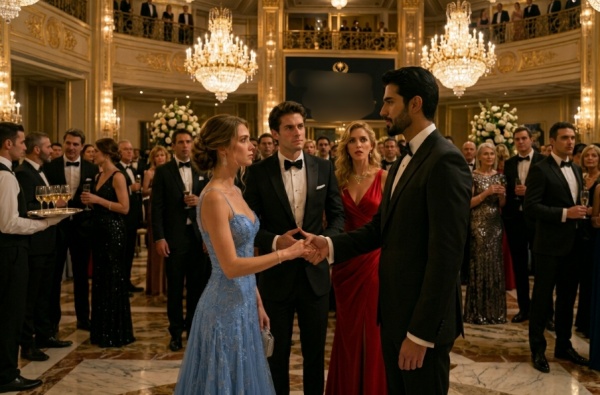
The Plaza Hotel glowed like a palace when Emily arrived. Cameras flashed beneath the awning, catching fur coats, tuxedos, red lips, silver hair, and practiced smiles. Inside, the ballroom was dripping in crystal chandeliers and white roses, with a live orchestra playing something soft enough to make wealthy people feel elegant. Emily stepped into the room alone.
For a moment, she allowed herself to believe Marcus might be waiting for her near the staircase. He would see her, remember who she was, and cross the floor like the man she had once loved. He would kiss her cheek and whisper, “You look incredible, Em.” She would forgive him for being distant, because forgiving Marcus had become a habit she confused with devotion.
Then she saw him.
Marcus stood near the champagne tower, laughing with a woman Emily recognized immediately. Vanessa Vale was twenty-seven, blonde in the glossy way women looked when they had money, time, and no trouble sleeping. She wore a red dress that clung to her body like a secret she wanted everyone to know. Her hand rested lightly on Marcus’s arm.
Emily stopped walking.
It was not the touch that broke her. It was the way Marcus leaned toward Vanessa, intimate and easy, as if the room belonged to them. It was the way he smiled at her, full and unguarded, the smile Emily had been begging to see for months. It was the way Vanessa looked at Emily when their eyes met—without shame, without surprise, almost with amusement.
Marcus finally noticed Emily and straightened. For one second, panic crossed his face. Then he smoothed it away and gave her the polished smile he used for investors, photographers, and lies. He walked toward her slowly, as if approaching a problem he intended to manage.
“Emily,” he said, kissing the air beside her cheek. “You made it.”
The words landed like a slap. You made it, as if she were an optional guest at her own life. Emily looked past him at Vanessa, who had not moved away from the champagne tower. The woman lifted her glass slightly, not in greeting, but in victory.
“Who is she?” Emily asked, though she already knew.
Marcus’s jaw tightened. “Not here.”
“Then where?” Emily said quietly. “Because you brought her here.”
His eyes flicked around the room, checking who might be watching. That was Marcus’s first concern, always. Not Emily’s heart, not his promise, not the humiliation crawling up her throat. Just the audience.
“Vanessa is a consultant,” he said.
Emily almost laughed. “Consultants usually don’t touch your sleeve like they own the suit.”
“Keep your voice down.”
There it was. The sentence women hear when men are more afraid of embarrassment than betrayal. Emily looked at the man who had proposed to her on a rainy afternoon in Central Park, who had cried when she said yes, who had promised she would never have to wonder where she stood. Now he was standing between her and his mistress, asking her to be polite.
Before Emily could answer, Vanessa appeared beside Marcus.
“Emily, right?” Vanessa said, smiling too brightly. “I’ve heard so much about you.”
Emily looked at Marcus. “That’s funny. I’ve heard nothing about you.”
A small silence formed around them. People nearby pretended not to listen, which in rooms like that meant they listened harder. Marcus’s face reddened, but Vanessa’s smile did not move. She was confident in a way that told Emily this was not the beginning of the affair; it was the public announcement.
Marcus took Emily’s elbow. “Let’s step outside.”
Emily gently removed his hand. “No.”
It was a small word, but it changed something in the air. Marcus blinked, surprised, as if he had forgotten she owned a voice. Vanessa’s eyes narrowed slightly. Around them, the orchestra continued playing, soft and indifferent.
Emily’s heart was pounding so hard she could feel it in her fingertips. She wanted to cry, scream, leave, disappear, do anything except stand there under chandelier light while strangers measured her pain. But something older and stronger rose inside her. It was the part of her that had survived being underestimated her whole life.
“You brought another woman to the ball,” Emily said. “At least have the courage to admit what she is.”
Marcus’s mouth tightened. “You’re being dramatic.”
“No,” Emily said. “I’m being accurate.”
Vanessa gave a soft laugh. “Marcus told me you were emotional.”
Emily turned to her. “And he told me he was faithful, so I guess he lies to both of us.”
The silence widened. Someone nearby coughed into a napkin. Marcus looked furious now, but Emily did not care. For the first time in months, she felt less like she was losing him and more like she was finding herself.
Then the ballroom doors opened again, and every conversation seemed to shift.
Nathaniel Whitaker had arrived.
Part 2: The Billionaire Who Saw Everything
Nathaniel Whitaker was not the loudest man in any room, which was why every room noticed him. At forty-one, he was one of the most successful technology investors in America, a self-made billionaire whose company had started in a rented garage outside Seattle and now occupied three glass towers in San Francisco. Forbes called him “ruthless,” The Wall Street Journal called him “disciplined,” and women’s magazines called him “impossible to get.” Nathan called himself tired.
He entered the ballroom in a black tuxedo, no entourage, no theatrical wave, just a quiet nod to the event chair. His hair was dark with a little silver at the temples, and his expression had the calm confidence of a man who had survived enough storms to stop fearing weather. People turned toward him instinctively. Not because he demanded attention, but because money at that level created gravity.
Emily knew who he was, of course. Everyone did. Nathan Whitaker had donated $50 million to rebuild community libraries across the country, funded scholarships for first-generation college students, and bought a failing children’s hospital in Chicago just to keep it open. He was also known for avoiding society events unless a cause truly mattered to him.
Marcus noticed him too. His posture changed immediately.
“Mr. Whitaker,” Marcus said under his breath. “I’ve been trying to get a meeting with him for six months.”
Emily stared at him. “That is what you’re thinking about right now?”
Marcus did not answer. His eyes were already tracking Nathan through the ballroom. Vanessa smoothed her hair and adjusted her shoulders. Emily almost admired the speed with which both of them forgot the emotional wreckage at their feet.
Nathan greeted donors politely but without lingering. When he reached the center of the ballroom, the event chair tapped a microphone and announced that the evening’s keynote benefactor had arrived. Applause followed, warm and eager. Nathan accepted it with a small smile, then looked across the room.
His eyes found Emily.
It was not a romantic gaze, not at first. It was observant, steady, and unsettlingly direct. Emily wondered what he had seen—her pale face, Marcus’s clenched jaw, Vanessa’s triumphant posture, the tiny circle of social disaster forming around them. Nathan’s expression changed almost imperceptibly. Then he began walking toward them.
Marcus stepped forward before Nathan could arrive. “Mr. Whitaker, Marcus Whitmore. Whitmore Development. We met briefly at the Hudson Urban Renewal dinner last spring.”
Nathan shook his hand. “I remember.”
Marcus beamed as if he had been knighted. “This is Vanessa Vale, one of our strategic consultants.”
Vanessa extended her hand with practiced charm. “Such an honor.”
Nathan nodded politely, then turned to Emily. “And you are?”
For the first time that night, Emily felt the room waiting for her answer.
“Emily Carter,” she said. “School counselor. Brooklyn.”
Nathan’s face softened. “Public school?”
“Yes.”
“Middle school or high school?”
“High school,” Emily said. “Mostly juniors and seniors.”
“That is not easy work.”
The sentence was simple, but it nearly undid her. Marcus had spent years making her career sound small at dinners like this. He introduced her as “working in education,” then changed the subject before anyone asked more. Nathan Whitaker, a man whose time was measured in millions, looked at her like the work mattered.
“It’s worth doing,” Emily said.
“I imagine it is.” Nathan glanced briefly at Marcus, then back at her. “Are you connected to tonight’s youth arts program?”
Emily hesitated. “Some of my students applied for the scholarships funded through this event.”
“How many were accepted?”
“Three,” Emily said. “Out of seventeen.”
Nathan frowned slightly. “Why only three?”
Marcus laughed lightly, trying to reenter the conversation. “Funding is always limited, unfortunately.”
Nathan did not look at him. “Was I asking you?”
The temperature around them dropped.
Marcus’s smile froze. Vanessa’s eyes widened. Emily stared at Nathan, stunned by the quiet precision of the rebuke. It had not been loud. It had not been cruel. It had simply rearranged the room.
Emily answered carefully. “The application process favors students with polished portfolios and recommendation letters from private instructors. My students are talented, but many don’t have access to professional coaching or materials. Some are working part-time jobs. Some are taking care of younger siblings.”
Nathan listened as if no one else existed. “And if the program were redesigned?”
“More students would have a real chance,” Emily said. “Talent is everywhere. Access isn’t.”
Nathan nodded. “That is the smartest thing I’ve heard tonight.”
Marcus chuckled, too loudly. “Emily is very passionate.”
Emily felt the old anger flare. Passionate was another word people used when they wanted to make a woman sound unreasonable. Nathan’s gaze moved to Marcus, calm and cold. “She is informed.”
Vanessa took a sip of champagne and looked away.
The event chair approached Nathan with the nervous urgency of someone handling a priceless object. “Mr. Whitaker, we’re ready for your remarks whenever you are.”
Nathan nodded. “In a moment.”
Then he looked at Emily again. “Would you be willing to speak with me after the program about the scholarship process?”
Marcus’s face lit with calculation. “We’d be delighted.”
Nathan’s expression did not change. “I asked Ms. Carter.”
Emily felt every eye on her. She could sense Marcus beside her, radiating warning. Vanessa’s perfume hung in the air like expensive smoke. For years, Emily had been trained by love, fear, and hope to make Marcus comfortable.
But Nathan had asked her.
“Yes,” she said. “I would.”
A small smile touched Nathan’s mouth. “Good.”
Then he walked to the stage.
The ballroom clapped again, but Emily barely heard it. Marcus leaned toward her, his voice low and sharp. “What do you think you’re doing?”
Emily did not look at him. “Answering a question.”
“You embarrassed me.”
She turned then. “No, Marcus. You embarrassed yourself. I just stopped covering for you.”
His face hardened. “Be careful.”
Emily almost smiled. There was a time when that tone would have frightened her into silence. Tonight, it sounded desperate. Vanessa touched Marcus’s arm again, and Emily saw something clearly for the first time. He did not love Vanessa more than he loved Emily. He loved being wanted by two women and accountable to neither.
Nathan stepped behind the podium. The ballroom quieted instantly.
He spoke about opportunity, public schools, and the moral failure of confusing privilege with merit. He talked about growing up in a two-bedroom house outside Tacoma, where his mother worked nights as a nurse and his father fixed trucks until his hands cracked in winter. He said talent could be lost not because children lacked discipline, but because adults built gates and called them standards. The room listened, some moved, some uncomfortable.
Then he paused.
“I came tonight prepared to announce a $10 million expansion of the Harrington Youth Arts Fund,” Nathan said. “But after a conversation I had a few minutes ago, I realize expansion is not enough. A broken door does not become fair because we allow more people to knock.”
Murmurs moved through the ballroom.
“So I am changing the structure,” he continued. “The Whitaker Foundation will commit $25 million over five years to create access-based arts scholarships for public school students across New York City. The program will cover materials, mentoring, transportation, application support, and family stipends where needed.”
Applause erupted.
Emily stood frozen.
“And,” Nathan said, raising one hand until the room quieted, “I would like the advisory board to be chaired by someone who understands these students better than anyone in this ballroom. Someone who spoke with clarity when others offered excuses.”
His eyes found Emily again.
“Ms. Emily Carter, if you are willing, I would like you to lead it.”
The applause stopped for half a heartbeat, then exploded louder than before.
Marcus turned white.
Vanessa’s mouth opened slightly.
Emily could not move. The chandelier light blurred, and for a terrifying second she thought she might cry in front of everyone after all. But this time, the tears were not from humiliation. They were from being seen.
Nathan stepped away from the podium and walked down from the stage. The crowd parted for him. He stopped in front of Emily and extended his hand, not like a rescuer, not like a prince in a fairy tale, but like a man offering respect.
“Will you accept?” he asked.
Emily looked at Marcus. His eyes were furious, pleading, and calculating all at once. She saw the question forming behind them: What will this cost me? Not what will this mean for her. Not how did I hurt her. Just cost.
Then she looked back at Nathan.
“Yes,” Emily said.
The applause rose again. Cameras flashed. Someone whispered, “That’s Marcus Whitmore’s fiancée.” Someone else whispered, “Not for long.”
Nathan held Emily’s hand just long enough to help steady her. Then, as the orchestra began the first formal dance of the evening, he tilted his head slightly.
“Ms. Carter,” he said, “would you do me the honor?”
Marcus took one step forward. “Actually, she’s here with me.”
Nathan looked at him. “No. She arrived alone.”
The words traveled through the ballroom like lightning.
Emily looked at Marcus one last time, then placed her hand in Nathan Whitaker’s.
And in front of everyone, the billionaire chose her.
Part 3: The Dance That Ended an Engagement
Nathan was a graceful dancer, but not showy. He guided Emily onto the polished marble floor as the orchestra played a slow waltz, and the crowd stepped back to watch. Emily was painfully aware of every camera, every whisper, every glance from people who had ignored her ten minutes earlier. She wanted to pull away and hide, but Nathan’s voice was steady.
“You can breathe,” he said softly.
Emily let out a shaky laugh. “Is it that obvious?”
“Only to someone paying attention.”
She looked up at him. “Why did you do that?”
“Offer you the position?”
“All of it.”
Nathan considered the question. “Because you were right. Because that program needs someone honest. And because I dislike watching cowards punish people for telling the truth.”
Emily felt heat rise in her cheeks. “You don’t know me.”
“No,” Nathan said. “But I know what it looks like when a person is trying very hard not to fall apart.”
That nearly broke her again. She looked away, focusing on the white roses surrounding the room, the candles flickering in tall glass cylinders, the waiters moving with trays of champagne. Everything was beautiful in the way expensive things could be beautiful—flawless on the surface, indifferent underneath. She wondered how many women had stood in rooms like this, smiling through betrayal because they had been taught dignity meant suffering quietly.
“I shouldn’t be dancing,” she said. “I should be leaving.”
“Do you want to leave?”
“Yes,” Emily whispered. Then, after a pause, “No. I don’t know.”
Nathan nodded. “Then finish the dance. Decide after.”
Across the ballroom, Marcus stood with Vanessa, but he was not looking at her. His eyes were locked on Emily and Nathan, and for the first time that night, Marcus looked like the one being humiliated. Vanessa whispered something in his ear. He did not respond.
Emily noticed and felt a strange sadness. Not jealousy, not victory, just sadness. She had loved Marcus once with the kind of faith that made ordinary days feel golden. She had imagined children with his eyes, Sunday mornings with pancakes, backyard barbecues in Connecticut, growing old with someone who remembered how she took her coffee. Now all those dreams felt like photographs from someone else’s life.
“Was she really his consultant?” Nathan asked.
Emily almost laughed. “No.”
“I’m sorry.”
“People keep saying that when they don’t know what else to say.”
“What would you rather hear?”
Emily thought for a moment. “That I’m not stupid for staying as long as I did.”
Nathan’s expression softened. “You’re not stupid. You were hopeful.”
The words settled over her like a warm coat. Hopeful. Not weak, not blind, not pathetic. Hopeful. She had stayed because she believed promises should matter, because she remembered the best version of Marcus and kept waiting for him to return.
When the song ended, the ballroom applauded again. Nathan stepped back and bowed slightly. Emily smiled despite herself, and a camera caught it—the moment the betrayed fiancée looked happier with a stranger than she had ever looked beside the man she was supposed to marry.
Marcus reached them before Emily could leave the floor.
“That was quite a performance,” he said.
Nathan’s eyes cooled. “Careful.”
Marcus ignored him and turned to Emily. “We need to talk. Now.”
“No,” Emily said.
His nostrils flared. “You don’t get to make a scene and then refuse a private conversation.”
“I didn’t make the scene. You brought her.”
Vanessa appeared behind him, arms crossed. “This is getting embarrassing.”
Emily looked at her calmly. “For you, I hope.”
Vanessa’s smile vanished.
Marcus stepped closer. “Emily, don’t do this. You’re upset. You’re letting him use you.”
Nathan’s jaw tightened, but he stayed silent. Emily appreciated that. He did not rescue her from answering. He simply stood there, letting her own voice fill the space.
“Use me?” Emily said. “You brought your mistress to a charity ball where I was expected to stand beside you as your fiancée. You introduced her to people while I arrived alone. Then when I asked for the truth, you told me to keep my voice down.”
Marcus’s face went red. “This isn’t the place.”
“That’s convenient,” Emily said. “Because every time I asked at home, you said you were too tired. Every time I asked over dinner, you said I was insecure. Every time I asked if there was someone else, you kissed my forehead and told me I needed to trust you.”
People nearby had stopped pretending not to listen.
Marcus lowered his voice. “If you walk out like this, don’t expect me to chase you.”
Emily looked at him, really looked at him. The expensive tuxedo, the perfect haircut, the angry eyes of a man who thought love was a contract with penalties. For years, the fear of losing him had shaped her choices. Now, standing in the ballroom with everyone watching, she realized the loss had already happened.
“You never chased me,” she said. “You just expected me to wait.”
Marcus opened his mouth, but nothing came out.
Emily slowly removed her engagement ring. It took effort because her fingers were trembling, but she managed. The diamond caught the chandelier light one last time before she placed it in Marcus’s palm. Gasps traveled through the crowd like wind through dry leaves.
“The wedding is off,” she said.
Vanessa looked stunned, as if she had wanted the man but not the consequences. Marcus stared at the ring in his hand. For a second, beneath his anger, Emily saw fear. Not heartbreak—fear of headlines, gossip, boardroom jokes, his mother’s disappointment, his father’s contempt.
“Emily,” he said, softer now. “Don’t be ridiculous.”
That word sealed it.
Ridiculous.
Not hurt. Not betrayed. Not brave. Ridiculous.
Emily picked up the small silver clutch she had left on a nearby cocktail table. “Goodbye, Marcus.”
She turned and walked toward the exit.
Nathan followed at a respectful distance, not touching her, not rushing her, simply making sure the crowd parted. Behind them, whispers grew louder. Someone’s phone camera flashed. Emily kept walking.
In the hotel lobby, the noise of the ballroom softened behind heavy doors. The Plaza’s marble floors gleamed under golden light, and outside, snow was still falling over Manhattan. Emily stopped near the coat check and finally exhaled. Her whole body shook.
Nathan stood a few feet away. “Would you like me to call you a car?”
“I have one.”
“Would you like me to wait until it arrives?”
Emily looked at him. The question was simple, and more respectful than anything Marcus had asked her in months. “Yes,” she said. “Thank you.”
They stood together in silence. A few guests passed through the lobby, pretending not to stare. Emily checked her phone and saw eleven missed calls from Marcus, three texts from his mother, and one message from her best friend, Jasmine: Girl, please tell me you are okay. The internet is already interneting.
Emily groaned. “Oh no.”
Nathan’s mouth curved slightly. “I’m afraid the ballroom had cameras.”
“I work with teenagers,” Emily said. “If this gets online, I’ll never hear the end of it.”
“You may hear worse from adults.”
“That’s comforting.”
“I’m not known for comforting lies.”
Despite everything, Emily laughed. It came out shaky but real. Nathan smiled, and for the first time, she noticed he had tired eyes. Not cold, not empty—tired, like someone who had given too much of himself to rooms that wanted more.
Her car arrived outside.
Nathan walked her to the door. “Ms. Carter, my office will contact you about the advisory board. But only if you still want the role tomorrow. Tonight, you owe no one a decision.”
Emily paused. “You announced it in front of five hundred people.”
“Yes,” Nathan said. “But public pressure should not become another cage.”
She looked at him for a long moment. “You really are different.”
“No,” he said. “I just know what cages look like.”
Before she could ask what he meant, the driver opened the door. Emily stepped into the car, gathering her gown carefully. Nathan leaned slightly toward the open door.
“For what it’s worth,” he said, “you were magnificent.”
The door closed before Emily could answer.
As the car pulled away from The Plaza, Emily finally cried. Not loudly, not dramatically, but with quiet, exhausted tears that blurred the lights of Fifth Avenue into gold. She cried for the woman who had waited too long. She cried for the wedding dress hanging in her closet. She cried because betrayal hurt, even when leaving was right.
But somewhere beneath the grief, something new was beginning.
Freedom did not feel like joy yet.
It felt like snow, cold air, and an empty ring finger.
Part 4: When the Truth Went Viral
By morning, Emily Carter was everywhere.
The first video appeared on TikTok before midnight, posted by a guest’s niece who had somehow been invited as a plus-one. The caption read: Billionaire chooses betrayed fiancée after her man brings mistress to charity ball. By breakfast, the clip had spread across Instagram, Facebook, X, and every gossip page that survived on rich people behaving badly in public. Emily watched from her couch in sweatpants, horrified, while Jasmine sat beside her eating cereal straight from the box.
“Well,” Jasmine said, scrolling through her phone, “on the bright side, America is rooting for you.”
Emily pulled a blanket over her head. “America needs a hobby.”
“America has one. It’s watching arrogant men get humbled in HD.”
Emily groaned. Her phone had not stopped vibrating. Reporters had called her school district. Former classmates had sent messages. Marcus had left a voicemail at 2:13 a.m. saying she had “misunderstood the situation,” which was impressive considering the situation had worn a red dress and held his arm.
Jasmine played one of the videos again despite Emily’s protest. There was Marcus saying, “Actually, she’s here with me,” and Nathan answering, “No. She arrived alone.” The comment section was a battlefield of applause emojis, broken heart emojis, and women sharing stories of men who had embarrassed them and expected silence. Emily felt exposed, but also strangely less alone.
At 9:00 a.m., Marcus’s mother called.
Emily considered ignoring it, then answered because some habits took longer to break.
“Emily,” Eleanor Whitmore said, her voice tight with controlled panic. “We need to discuss damage control.”
“Good morning to you too.”
“This is not the time for sarcasm. The family is being humiliated.”
Emily stared at the wall. “Your son brought his mistress to a public event.”
Eleanor sighed, as if Emily had mentioned bad weather. “Marcus made a mistake.”
“He made a series of choices.”
“Men under pressure sometimes seek validation in unfortunate places.”
Emily almost laughed. “Is that what we’re calling Vanessa?”
“Do not be vulgar.”
“I wasn’t.”
Eleanor’s tone sharpened. “You were supposed to be family.”
“I was supposed to be respected.”
There was a pause. Emily could picture Eleanor in her Upper East Side townhouse, perfectly dressed at breakfast, surrounded by fresh flowers and denial. The Whitmores treated scandal like a stain on silk: dab gently, never admit what spilled. Emily had spent years trying to be acceptable to them. Now she realized acceptable meant silent.
“If you release a joint statement,” Eleanor said, “we can frame this as a private misunderstanding.”
“No.”
“Emily, think carefully. Marcus can still forgive this public reaction.”
That sentence stunned her into silence.
Marcus could forgive her.
Jasmine, hearing enough from beside her, mouthed, Hang up.
Emily sat straighter. “Mrs. Whitmore, I hope Marcus finds whatever kind of life he deserves. But I am not issuing a statement to protect the reputation of a man who betrayed me. Please don’t call me again.”
She ended the call with trembling hands.
Jasmine raised her cereal box in salute. “There she is.”
Emily laughed weakly, then cried again. Healing, she was learning, did not arrive like a movie montage. It came in ridiculous waves. One minute she felt powerful. The next she remembered the wedding invitations stacked in a drawer and wanted to disappear.
By noon, Nathan Whitaker’s office emailed her. The message was professional, kind, and brief. It confirmed that the advisory position would be paid, independent, and structured around Emily’s availability. The salary made her blink three times: $185,000 a year, plus staff support, travel budget, and full authority to redesign the scholarship criteria.
Jasmine read over her shoulder and screamed.
Emily nearly dropped the laptop. “Stop!”
“Girl, that is not a job offer. That is divine intervention with benefits.”
“It’s too much.”
“It’s market rate for changing lives while rich people clap.”
Emily stared at the email. For years, Marcus had made her feel financially small. He paid for expensive dinners she did not request, then acted generous. He mentioned her teacher friends’ salaries with pity disguised as concern. He once told her, during an argument, that love was easier when one person could “carry the future.”
Now here was a future with her own name on it.
Emily replied that she would like to discuss the role.
Nathan called thirty minutes later.
“Ms. Carter,” he said. “How are you holding up?”
“That depends. Are we pretending I’m not a trending topic?”
“No. That would be insulting.”
“Then I’m mortified.”
“Understandable.”
“And angry.”
“Also understandable.”
“And interested in the position, though I’m worried people will think I got it because of a viral scandal.”
“You got it because you identified a structural flaw in under two minutes while everyone else was networking.”
Emily went quiet.
Nathan continued. “The scandal made people pay attention. It did not create your competence.”
She closed her eyes. “Thank you.”
They spoke for twenty minutes about the program. Nathan asked precise questions and listened carefully to every answer. He did not interrupt, did not explain her own field to her, and did not call her passionate. By the end of the call, Emily had agreed to meet his foundation team the following week.
Before hanging up, Nathan said, “One more thing. You may receive invitations, interviews, and offers from people who want to turn your pain into content. You don’t owe them your story.”
Emily looked at the paused video on Jasmine’s phone, her own face frozen under chandelier light. “It doesn’t feel like mine anymore.”
“It is,” Nathan said. “Even if other people are watching.”
After the call, Emily sat quietly.
Jasmine nudged her. “So?”
“So,” Emily said slowly, “I think I have a new job.”
“And no fiancé.”
“And no fiancé.”
They stared at each other, then burst into laughter. It was not because anything was funny exactly. It was because sometimes life collapsed so completely that laughter became the only sound strong enough to stand in the ruins.
That evening, Marcus came to her apartment.
Emily saw him through the peephole and almost did not open the door. He looked wrecked—tie loosened, hair messy, eyes red in a way that might have been from crying or not sleeping. In his hand was the engagement ring. Behind him, the hallway smelled faintly of cold air and expensive cologne.
She opened the door but left the chain on.
“Emily,” he said. “Please.”
“What do you want?”
“To talk.”
“You had months.”
He swallowed. “I ended it with Vanessa.”
Emily felt nothing. That surprised her. Yesterday, those words might have cracked open hope. Today, they landed like mail addressed to a house she no longer lived in.
“Congratulations,” she said.
His face tightened. “Don’t be cruel.”
“I’m not. I’m tired.”
Marcus held up the ring. “I made a terrible mistake.”
“You made it publicly because you thought I would absorb the shame privately.”
He looked down. “I panicked.”
“No,” Emily said. “You calculated wrong.”
The words hit him hard because they were true. Marcus had assumed Emily’s love would make her manageable. He had assumed Vanessa’s presence would force Emily to behave, because no woman wanted to appear jealous in a room full of strangers. He had assumed the rules favored him.
For a long time, they had.
“I still love you,” he whispered.
Emily’s throat tightened. It would have been easier if she could believe he was lying. But maybe Marcus did love her in his limited way. Maybe he loved her loyalty, her warmth, the way she made him feel like a better man without requiring him to become one. Maybe he loved the version of her who stayed.
“I loved you too,” she said. “That’s why this hurts.”
“Then give me a chance to fix it.”
“You can’t fix what you kept choosing to break.”
His eyes filled. “Is this because of Whitaker?”
Emily almost laughed. “Of course you’d think that.”
“He humiliated me.”
“No, Marcus. He noticed me. You humiliated yourself because you forgot I was someone worth noticing.”
Marcus stepped back as if she had struck him.
Emily removed the chain and opened the door wider, not to let him in, but to stand fully in front of him. “I hope you learn from this. I really do. But I am not going to be the classroom.”
She handed him a small velvet box from the entry table. Inside were the earrings Eleanor had given her for the engagement party, the spare key to Marcus’s apartment, and a folded receipt for the wedding venue deposit she had paid from her own savings.
“Take care of yourself,” Emily said.
Then she closed the door.
This time, when she cried, she did not sink to the floor.
She stood.
Part 5: The Choice That Changed Everything
Six months later, Emily stood in the auditorium of a public high school in Queens, watching a seventeen-year-old named Luis Rivera accept a scholarship for photography. His mother cried into both hands while his little sister filmed on a cracked iPhone. Luis had taken most of his portfolio pictures on the subway because he could not afford a studio, and his winning piece showed a construction worker asleep on the F train, steel-toed boots dusty, lunchbox on his lap. The image was honest, tender, and impossible to forget.
The new Whitaker-Carter Arts Access Fund had received more than four thousand applications in its first cycle. Emily had built the advisory board with teachers, counselors, working artists, parents, and former students. They changed the requirements, added neighborhood review panels, paid for materials, and provided transportation cards for applicants who needed them. By spring, the program had become one of the most talked-about education initiatives in New York.
Emily’s name appeared in newspapers now, but not as Marcus Whitmore’s betrayed fiancée. She was quoted as the founding director. She was invited to speak at conferences. She learned to sit at tables with donors and say, “That’s not enough,” without apologizing afterward.
Nathan was at the auditorium too, standing near the back wall to avoid drawing attention. He had kept his promise not to turn her story into a public romance. For months, he had been professional, respectful, and careful. He sent emails about budgets, attended meetings when necessary, and never once behaved as if rescuing her entitled him to her heart.
That was precisely why her heart had begun to trust him.
After the ceremony, Emily found him in the hallway near a bulletin board covered with student artwork.
“You tried to hide,” she said.
“I succeeded for almost four minutes.”
“That’s a personal record.”
Nathan smiled. “Luis’s photograph was remarkable.”
“He’s remarkable.”
“You were right about access.”
Emily leaned against the wall. “I enjoy hearing that.”
“I’ve noticed.”
They walked outside together into warm June air. New York in summer smelled like hot pavement, food trucks, and possibility. Students spilled down the steps in clusters, laughing and taking pictures with scholarship certificates. Emily watched them and felt something in her chest loosen.
“This is the first time in a long time,” she said, “that I feel like my life belongs to me.”
Nathan looked at her. “That is a good feeling.”
“It’s terrifying.”
“That too.”
They walked toward a coffee cart on the corner. Nathan ordered black coffee. Emily ordered iced coffee with oat milk, and when she reached for her wallet, Nathan stepped back instead of trying to pay. It was such a small thing. It meant more than roses.
“You remembered,” she said.
“That you dislike men turning payment into performance? Yes.”
Emily smiled. “You listen.”
“I try.”
They sat on a bench near the school courtyard. For a while, they watched a group of students attempt to take a jumping photo, failing six times and laughing harder each time. Emily thought of the Harrington Ball, the chandelier, the red dress, the ring in Marcus’s palm. That night felt both distant and close, like a scar that no longer hurt unless touched.
“I saw Marcus last week,” Nathan said.
Emily looked over. “You did?”
“At a development forum. He asked how you were.”
“What did you say?”
“That you were busy.”
Emily laughed. “That’s it?”
“I considered saying ‘magnificent,’ but it seemed unkind.”
She shook her head, smiling. “How did he look?”
Nathan took a sip of coffee. “Like a man learning that consequences have a long attention span.”
Emily looked down at her hands. Her ring finger was bare. She had once thought the absence would make her feel unfinished, but it did not. It made her feel light.
“I don’t hate him,” she said.
“That’s generous.”
“It’s not for him. Hate is heavy. I carried enough.”
Nathan nodded.
She looked at him then, really looked at him. He was still the man the world called powerful, but she knew other things now. He hated bananas, loved old bookstores, and called his mother every Sunday. He had panic attacks after his company went public because everyone wanted something from him and nobody asked if he was lonely. He funded libraries because one librarian in Tacoma had once let him stay after closing when his parents were fighting at home.
“You said that night you knew what cages looked like,” Emily said.
Nathan’s expression grew quiet. “I was married once.”
Emily stilled. He had mentioned an ex-wife, but never much more.
“She loved the idea of my success,” he said. “Then hated the reality of it. The travel, the pressure, the public attention. I wasn’t innocent. I worked too much. I disappeared into problems I could solve because I didn’t know what to do with the ones at home.”
“What happened?”
“She left with someone who had more time and fewer lawyers.”
Emily winced. “I’m sorry.”
“It was years ago. But it taught me something.” He looked at her. “Being chosen in public means nothing if someone abandons you in private.”
The words settled between them.
Emily thought about Marcus, who had proposed in public but neglected her in private. She thought about Nathan, who had chosen her publicly but then given her space privately. He had not rushed her grief, not competed with a ghost, not tried to become the hero of her story. He had simply been steady.
“I’m not ready to be someone’s headline,” she said.
“I’m not asking.”
“I know.” She smiled softly. “That’s why I’m still sitting here.”
Nathan looked at her, and something unguarded moved across his face. “Emily—”
Her phone rang before he could continue.
She glanced at the screen and froze.
It was Vanessa.
Emily stared at the name. Vanessa had messaged once after the scandal, a long apology Emily had not answered. Since then, nothing. Now the phone buzzed in her hand like a piece of the past refusing to stay buried.
“You don’t have to take it,” Nathan said.
“I know.”
But Emily answered.
Vanessa’s voice was smaller than Emily remembered. “Hi. I’m sorry to call.”
“What do you need?”
There was a pause. “I wanted to tell you Marcus and I are not together. We never really were, I guess. He told me your engagement was basically over. I believed him because it was easier than asking what kind of woman that made me.”
Emily closed her eyes.
Vanessa continued. “I’m not calling to ask for forgiveness. I just wanted to say you didn’t deserve what happened. And I’m sorry I helped him make you feel small.”
For a long moment, Emily said nothing. Part of her wanted to be sharp. Part of her wanted to hang up. But another part, the part that had spent months rebuilding herself, understood that pain passed from person to person when no one was brave enough to stop handing it over.
“Thank you for saying that,” Emily said.
Vanessa exhaled shakily. “Are you happy now?”
Emily looked at the students laughing on the steps, at the scholarship banners fluttering in the warm air, at Nathan sitting beside her without trying to own the moment.
“I’m getting there,” Emily said.
After she hung up, Nathan did not ask what Vanessa wanted. He waited.
Emily slipped the phone into her bag. “She apologized.”
“How do you feel?”
“Strange. Lighter, maybe.”
“Good.”
Emily smiled at him. “You always say very little.”
“I’ve found that people usually know what they feel if you don’t crowd them.”
“That sounds dangerously healthy.”
“I’m trying a new brand.”
She laughed, and he laughed too.
A breeze moved through the courtyard. Somewhere nearby, a car horn blared, someone shouted for a taxi, and the city continued being loud and alive. Emily realized that the great dramatic turning points of life were not always the moments with applause and cameras. Sometimes they were quiet benches, iced coffee, and deciding not to carry yesterday into tomorrow.
One year after the Harrington Ball, Emily returned to The Plaza.
This time, she arrived as the keynote speaker.
She wore a midnight-blue gown she bought herself, earrings borrowed from Jasmine, and no engagement ring. The ballroom looked the same—chandeliers, roses, champagne, marble floor—but Emily did not. She walked in with her shoulders relaxed and her head high, not as someone’s fiancée, not as a scandal, not as a woman waiting to be chosen. She walked in as herself.
Nathan arrived ten minutes later.
He did not enter beside her because they had agreed her night should belong to her. But when their eyes met across the room, he smiled in a way that made the noise soften. Emily smiled back. It was not a secret, exactly, but it was private, and that made it precious.
Marcus was there too.
Emily saw him near the back of the ballroom, older somehow, though only a year had passed. He stood alone, holding a glass of water, watching her with an expression she could not fully read. Regret, maybe. Respect, perhaps. Or simply the stunned awareness that some women do not fall apart when you lose them—they become impossible to reach.
He approached her before the speeches began.
“Emily,” he said.
“Marcus.”
“You look well.”
“I am.”
He nodded, swallowing. “I’ve wanted to apologize properly for a long time. Not to fix anything. Not to get anything. Just to say I was cruel, selfish, and cowardly. You deserved better from me.”
Emily studied him. The apology did not erase what he had done, but it did something. It placed the weight where it belonged. She no longer needed to hold it for him.
“Thank you,” she said.
He looked toward Nathan, then back at her. “Are you happy?”
Emily thought of the students, her work, her apartment full of books and plants, the Sundays she spent walking through Prospect Park, the man across the room who had never once asked her to shrink.
“Yes,” she said. “I am.”
Marcus’s face tightened, but he nodded. “Good. I mean that.”
For the first time, Emily believed him.
When she stepped onto the stage, the ballroom quieted. She looked out at donors, teachers, students, reporters, and families. She saw Nathan near the side wall, hands folded, eyes steady. She saw Jasmine in the front row, already crying. She saw Marcus in the back, listening.
Emily adjusted the microphone.
“A year ago,” she began, “I stood in this room believing the worst thing that could happen to me was being publicly embarrassed. I was wrong. The worst thing would have been letting embarrassment decide the rest of my life.”
The room went still.
“Many young people learn too early that opportunity belongs to someone else. They are told to work hard, but not given tools. Told to dream big, but not given transportation, time, safety, or support. Then when they struggle, the world calls it a lack of effort.”
She paused, feeling the truth of it move through her.
“The work we do now is simple in theory and difficult in practice. We open doors without asking children to prove they deserved a door in the first place. We invest in talent before it becomes polished enough to impress us. We stop confusing silence with gratitude.”
Applause rose, but Emily continued.
“I learned this year that being chosen by someone powerful can change a moment. But choosing yourself changes a life.”
This time, the applause did not stop quickly. It grew, filled the ballroom, and wrapped around her like thunder. Emily looked toward Nathan, and he stood with everyone else, clapping not like a billionaire, not like a rescuer, but like a man proud of the woman she had always been.
After the speech, as the orchestra began to play, Nathan approached her.
“Ms. Carter,” he said, echoing the first night, “would you do me the honor?”
Emily looked at his extended hand. One year ago, taking it had been an act of survival. Tonight, it was a choice made freely.
She placed her hand in his.
“Yes,” she said. “But only if you understand something.”
Nathan’s eyes warmed. “What’s that?”
“I’m not being rescued.”
“No,” he said. “You’re being asked to dance.”
So they danced.
Not because cameras watched, though they did.
Not because Marcus saw, though he did.
Not because the room whispered, though it did.
They danced because Emily Carter had finally learned the difference between being chosen and being valued. Marcus had chosen her when she was useful, quiet, and forgiving. Nathan valued her when she was wounded, brilliant, uncertain, and strong. But most importantly, Emily valued herself enough to know the difference.
Outside, snow began to fall again over New York City, soft and bright under the streetlights.
And this time, when Emily looked at the ballroom doors, she did not feel trapped inside a life someone else had built.
She felt like she could leave whenever she wanted.
She simply chose to stay.
