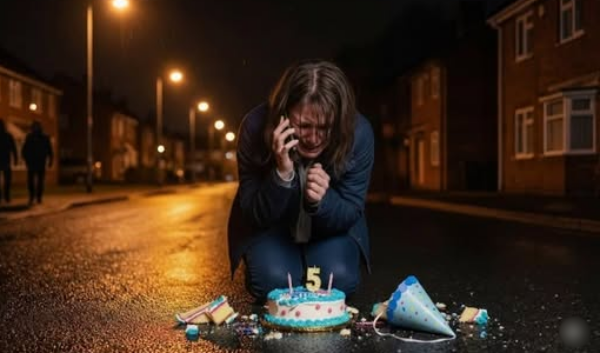
40 missed calls on our son’s 5th birthday and a final, heartbreaking text from my wife: ‘Please… our baby…’ Little did I know, while she was fighting to save him, I was ‘busy’ at a hotel with someone else, my phone turned off. Nothing could have prepared me for the devastating reality waiting for me the next morning.
PART 1 — The Birthday I Promised I Wouldn’t Miss
The rain wasn’t just falling that night.
It was punishing the pavement, slamming against the windows of our little blue house in the suburbs of Seattle, turning the driveway into a river and the streetlights into blurry yellow halos. Inside our kitchen, everything was warm, bright, and carefully decorated, the kind of home-made birthday scene that looked simple only because my wife had worked herself to exhaustion making it perfect.
It was our son’s fifth birthday.
The Big Five.
His name was Ethan Miller, and he had spent the entire week telling anyone who would listen that he was officially not a little kid anymore. He told the mail carrier. He told his preschool teacher. He told the cashier at Safeway. He told our golden retriever, Cooper, three times, just to make sure the dog understood the importance of the milestone.
My wife, Rachel, had turned our kitchen into a dinosaur jungle.
Green streamers curled from the ceiling. Paper palm leaves were taped to the cabinets. A plastic T. rex guarded the punch bowl. On the kitchen island sat a homemade chocolate cake with green frosting, candy rocks, and five dinosaur candles Ethan had chosen himself from Target.
There was also a brand-new bicycle hidden in the garage under a blue tarp.
Red frame.
Training wheels.
A silver bell.
I had promised Ethan I would be the one to roll it into the kitchen after cake.
That promise matters.
It matters more than anything I was doing that night.
My name is Nathan Miller, and for most of my adult life, I thought of myself as a decent man with a few flaws. That is how men like me survive our own reflection. We soften the language. We call selfishness stress. We call betrayal confusion. We call absence providing.
I was thirty-seven years old, married for eight years, and working as a senior account director for a commercial real estate firm in Bellevue, making about $125,000 a year before bonuses. Rachel was thirty-five and worked part-time as a pediatric occupational therapist while doing most of the invisible work that held our family together. She scheduled dentist appointments, remembered teacher conferences, bought birthday gifts, noticed when Ethan outgrew his rain boots, and somehow still made dinosaur cakes from scratch.
I told myself I was busy.
She was the one who was tired.
There is a difference.
That morning, before I left for work, Ethan ran down the hallway in dinosaur pajamas and launched himself into my legs.
“Daddy! You remember what today is?”
I scooped him up and pretended to think.
“Tuesday?”
He gasped like I had insulted his entire bloodline.
“No! It’s my birthday!”
“Oh, right,” I said. “The Big Five.”
His smile was so wide it nearly split his face.
“You’re lighting the candles, remember?”
“I remember.”
“And the bike?”
Rachel froze at the stove.
I looked at her, then back at Ethan.
“What bike?”
He narrowed his eyes.
“The secret bike.”
Rachel covered a smile with her coffee mug.
I kissed Ethan’s forehead and said, “I wouldn’t miss it for the world, buddy.”
That was the sentence.
That was the lie I gave him while holding him in my arms.
At 3:02 p.m., Rachel texted me a picture of Ethan standing beside the cake with both thumbs up.
He’s asking when you’ll be home. Don’t forget candles at 7.
I was sitting in my office, looking at a contract I had not really been reading. Across from me, on my desk, was another phone notification I should have ignored. A message from a woman named Vanessa Cole.
In my contacts, she was saved as V. Cole — Client.
She was not just a client.
That truth is simple now.
At the time, I wrapped it in layers. Vanessa worked with one of our development partners. She was smart, attractive, divorced, and very good at making my complaints sound like deep wounds instead of ordinary adult pressure. She listened when I talked about feeling invisible at home. She laughed at my jokes. She made me feel younger, more interesting, less like a husband with a mortgage and a five-year-old who left cracker crumbs in my car.
That is not an excuse.
It is only the kind of lie I told myself before the real lies began.
I texted Rachel back.
Big deadline, babe. Might be late, but I wouldn’t miss cake for the world. Give E a kiss for me.
Then I texted Vanessa.
Still on for tonight?
She answered immediately.
Suite is ready. You deserve one night where no one needs anything from you.
I read that message three times.
No one needs anything from you.
That was what I wanted to believe.
Not that my wife needed help.
Not that my son needed his father.
Not that I had made promises.
Just one night.
One selfish, stolen night where I could pretend my life had no consequences.
By 6:15 p.m., I was not at the office.
I was driving toward downtown Seattle in heavy rain, telling myself I would stay only an hour. I would meet Vanessa, end whatever this was, explain that it had gone too far, and still make it home in time for cake. That was the version I rehearsed as traffic crawled along I-5 and windshield wipers slapped back and forth like a metronome counting down my failure.
But I did not end it.
I checked into the Fairmont Olympic Hotel under my own name because arrogance is often just stupidity in a suit. Vanessa met me upstairs wearing a black dress and the kind of smile that made me feel chosen. There was champagne in an ice bucket, room service already ordered, and city lights blurred beyond the rain-streaked window.
At 7:04 p.m., Rachel called.
I looked at the phone.
Vanessa saw her name on the screen.
“She knows it’s his birthday,” I said, as if that explained anything.
Vanessa’s smile faded slightly.
“Do you need to take it?”
I should have said yes.
I should have grabbed my coat, run downstairs, driven home, walked into that kitchen soaked and ashamed but present. I should have lit the dinosaur candles. I should have watched my son’s face glow in the candlelight. I should have been his father.
Instead, I silenced the call.
“I’ll call her in five minutes,” I said.
Five minutes became ten.
Ten became champagne.
Champagne became excuses.
At 7:31 p.m., Rachel called again.
At 7:46 p.m., again.
At 8:03 p.m., she texted.
Nathan, candles are melting. Please call.
I stared at the message, guilt clawing up my throat.
Vanessa touched my arm.
“You’re here,” she said softly. “Be here.”
That sentence sounded like permission.
It was actually a warning.
I turned my phone face down.
By 8:27 p.m., I turned it off completely.
I told myself it was because I could not keep lying if I kept seeing Rachel’s name.
That was true.
But turning off the phone was also a choice.
A father’s phone should not be off on his child’s birthday.
A husband’s phone should not be off while his wife is waiting with a cake.
A decent man does not disappear and call it pressure.
But I was no longer acting like a decent man.
At home, Rachel waited.
I learned the details later, and they have never stopped punishing me.
Ethan sat at the kitchen table wearing a paper dinosaur crown, swinging his legs, trying not to cry. He kept looking toward the driveway every time headlights passed. Cooper lay under the table, confused by all the tension and hoping someone would drop cake.
“Maybe Daddy’s stuck in traffic,” Ethan said.
Rachel smiled for him.
“Maybe.”
At 8:45 p.m., she lit the candles herself.
The green wax had softened in the warm kitchen. One of the dinosaur candles leaned sideways, like even it could not hold itself together anymore. Rachel sang “Happy Birthday” alone, her voice trembling while Ethan stared at the empty chair where I should have been.
He made a wish so quietly she almost missed it.
“I wish Daddy was home.”
Then he blew out the candles.
That was my son’s fifth birthday.
That was the night I taught him that promises from his father could melt before the candles did.
PART 2 — The Fever After the Cake
By 10:30 p.m., Ethan was asleep.
Or trying to be.
Rachel cleaned the kitchen slowly after the birthday ended. She wrapped the cake, took down nothing, and left the bicycle hidden in the garage because she could not bear to roll it out without me. Later, she told me she stood in the doorway staring at the tarp for a long time, wondering how to explain disappointment to a five-year-old without teaching him to expect it.
Outside, the rain got heavier.
The kind of Seattle rain locals pretend does not bother them until it starts sounding personal.
Rachel checked her phone every few minutes.
No response.
No callback.
No little apology.
No explanation.
Just silence.
She called my office at 10:48 p.m., something she almost never did because she hated seeming like the anxious wife. The building security guard told her my floor had been empty since around 6:00 p.m.
That was when she knew.
Maybe not everything.
But enough.
She stood in our hallway holding the phone, listening to the rain, while our son slept down the hall beneath dinosaur sheets. She had every right to fall apart then. She did not. Mothers often postpone their own collapse because someone smaller still needs them whole.
At 11:06 p.m., Ethan cried out.
Rachel found him tangled in his blanket, cheeks flushed, hair damp with sweat. She placed her hand on his forehead and immediately pulled it back.
He was burning.
She grabbed the digital thermometer from the medicine cabinet.
102.4°F.
Not good, but not automatically catastrophic.
Ethan had run fevers before. Kids do. Rachel knew what to do. She gave him the proper dose of children’s acetaminophen according to the label and his weight, coaxed him to sip water, and sat beside him with one hand on his chest.
At 11:32 p.m., she called me.
Straight to voicemail.
“Nathan, Ethan has a fever. I know you’re not at the office. I don’t care about that right now. Please call me back.”
She waited.
No call.
At 11:49 p.m., his fever was 103.3°F.
He was shivering, but his skin was hot. His eyes looked glassy when he opened them. He complained that the light hurt, then cried because his head hurt, then tried to turn away from her.
Rachel called the nurse line.
They asked questions.
Age?
Symptoms?
Temperature?
Any rash?
Neck stiffness?
Breathing?
Hydration?
Rachel answered as best she could, trying to keep her voice calm while Ethan whimpered against the pillow.
The nurse advised monitoring closely and going to urgent care or the ER if symptoms worsened, especially given the headache, sensitivity to light, and rising fever. Rachel hung up and called me again.
Voicemail.
At 12:18 a.m., the thermometer read 104.1°F.
That number changed everything.
Ethan began to moan, a low sound Rachel had never heard from him before. His little body trembled violently. She tried to sit him up, but he seemed confused, not fully aware of where he was.
“Nathan, please,” she said into my voicemail at 12:21 a.m.. “His fever is over 104. I’m scared. Call me back.”
I did not call back.
I was in a hotel room twenty miles away with my phone off.
There are truths so ugly that even confession cannot soften them.
That is one of mine.
At 12:37 a.m., Rachel called again.
And again.
And again.
By the twentieth missed call, she was no longer angry.
By the thirtieth, she was terrified.
By the thirty-fifth, Ethan’s body went rigid.
His eyes rolled back.
His arms and legs began jerking.
Rachel screamed.
Later, doctors explained that fever can trigger seizures in children, and not every febrile seizure means the same thing. But in the moment, Rachel was not thinking clinically. She was watching our son’s small body seize in his bed while thunder shook the windows and his father’s phone went straight to voicemail.
She called 911.
The dispatcher stayed on the line, calm and professional. Rachel followed instructions, moved objects away from him, did not try to restrain him, watched his breathing, and cried so hard she could barely say our address. Paramedics were dispatched, but the storm had slowed response times across the area.
Then Ethan stopped jerking.
For a few seconds, he was limp.
His lips looked pale.
His breathing was wrong.
Rachel made a decision.
Maybe it was medically debatable. Maybe another person would have waited for the ambulance. Maybe someone calmer would have done something different. Rachel would later replay it a thousand times, but the ER doctor told her one thing clearly: getting him there quickly mattered.
She wrapped Ethan in a blanket, grabbed his insurance card, her phone, and her keys, and ran through the rain to the car.
She did not put on proper shoes.
She did not take a coat.
She did not lock the front door.
She drove with hazard lights on, both hands gripping the steering wheel, praying out loud while Ethan lay strapped in the back seat, semi-conscious and burning.
The hospital was Seattle Children’s, and the drive felt endless.
Rain hammered the windshield.
Tires hissed over standing water.
Traffic lights blurred.
Every few seconds, Rachel looked in the rearview mirror and said, “Stay with me, baby. Stay with Mommy.”
At 1:09 a.m., she called me again from the car.
Voicemail.
At 1:16 a.m., she sent a text.
Nathan, I’m taking Ethan to the ER. Something is very wrong. Please answer.
At 1:24 a.m., she called again.
Voicemail.
At 1:31 a.m., she pulled into the emergency entrance and ran inside carrying our son.
She was soaked to the bone.
Hair plastered to her face.
Pajama pants wet at the hems.
One sock on, one foot bare because she had lost a slipper somewhere between our porch and the car.
“My son,” she cried. “Please. He had a seizure. He has a high fever. He’s not acting right.”
A nurse took one look and moved fast.
Within seconds, Ethan was on a gurney. Staff surrounded him. A doctor asked questions while another nurse checked vitals. Someone said “pediatric emergency.” Someone else asked about meningitis symptoms. Rachel tried to answer, but her teeth were chattering so hard she could barely speak.
They moved Ethan behind double doors.
Rachel tried to follow.
A nurse gently stopped her.
“We’re going to take care of him. We need space to work.”
The doors closed.
Rachel stood in the fluorescent hallway dripping rainwater onto the hospital floor.
That was when she called me for the fortieth time.
The call failed.
My phone was off.
So she sent one final text.
Nathan… please… our baby is really sick. Help us.
Then her knees gave out.
Rachel collapsed against the wall and slid to the floor.
A nurse rushed to her.
Someone brought a blanket.
Someone checked her blood pressure.
Someone asked if there was anyone they could call.
Rachel looked at the phone in her hand and whispered, “His father.”
But his father was not answering.
PART 3 — The Morning My Phone Came Back to Life
I woke at 7:03 a.m. to the soft hum of hotel climate control.
For one disoriented second, I did not remember where I was.
Then I saw the cream-colored curtains, the room service tray, the champagne bottle in the ice bucket, and Vanessa asleep on the other side of the bed.
Guilt arrived before memory fully did.
Ethan’s birthday.
The cake.
The calls.
My phone.
I sat up so fast the sheet slipped to my waist.
Vanessa stirred.
“What time is it?” she murmured.
I did not answer.
My phone was on the nightstand, black and dead.
I plugged it into the charger.
The Apple logo appeared.
Then the notifications began.
Not one.
Not five.
A flood.
40 Missed Calls.
12 Voicemails.
Text after text after text.
Rachel.
Rachel.
Rachel.
The first few were about the birthday.
Nathan, he’s waiting. Please don’t do this.
Candles at 7:30. Where are you?
He’s asking for you.
Then the tone changed.
Ethan has a fever. Call me.
It’s 103.3. I’m calling the nurse line.
Nathan, please, it’s over 104.
He had a seizure. I’m calling 911.
My hands started shaking.
Then I saw the final message.
Nathan… please… our baby is really sick. Help us.
The room tilted.
I clicked the voicemail list with fingers that did not feel attached to me.
Rachel’s voice filled the room.
First controlled.
Then scared.
Then crying.
Then almost unrecognizable.
“Nathan, answer your phone. Ethan’s fever is really high.”
“Nathan, I know you’re not at the office. I don’t care. Please just call me.”
“Nathan, he had a seizure. Oh my God. I need you. Please.”
Then the last voicemail.
Only eight seconds.
Rain in the background.
Rachel sobbing.
“Please. Please. Please.”
I could not breathe.
Vanessa sat up behind me.
“Nathan? What happened?”
I was already pulling on my pants.
“My son is in the hospital.”
“Oh my God.”
She reached for my arm.
I jerked away.
Not because she had caused this alone.
She had not.
This was mine.
Every inch of it.
I left the hotel room without showering, without properly buttoning my shirt, without saying goodbye. I forgot one shoe and had to go back for it. That detail haunts me for its stupidity. My son was in the hospital, and I was stumbling around a luxury suite looking for a loafer.
The lobby was bright and calm.
People drank coffee.
A family posed near a Christmas tree.
The world continued behaving normally while mine collapsed.
I ran through the revolving doors into the rain and drove toward Seattle Children’s like a man trying to outrun the truth. I called Rachel over and over.
No answer.
I called again.
No answer.
I called the hospital, but privacy rules meant I received only limited information. They confirmed Ethan was there. They told me to come to the emergency department and bring identification. Their calmness terrified me more than panic would have.
The drive took twenty-seven minutes.
It felt like twenty-seven years.
I kept hearing Ethan’s voice.
You remember, Daddy?
You’re lighting the candles, remember?
I remembered.
That was the horror.
I had remembered and left anyway.
At the hospital, I ran to the front desk, still in last night’s suit, hair disheveled, face unshaven.
“My son. Ethan Miller. He’s five. He was brought in last night.”
The woman at the desk asked for my name and ID.
Her professionalism slowed me down just enough for shame to catch up.
A nurse led me through a set of doors and into a pediatric intensive care area where every sound seemed too loud and too soft at the same time. Monitors beeped. Shoes squeaked. Voices stayed calm in the way hospital voices do when fear is not useful.
Then I saw Rachel.
She was sitting in a plastic chair outside a room with glass walls.
Her hair was dry now but tangled. Someone had given her hospital socks and a sweatshirt. Her face looked pale, hollow, and older than it had the day before. She stared at the wall like she had used up every emotion and had nothing left but breathing.
“Rachel,” I said.
She did not turn.
I dropped to my knees beside her.
“Rachel, oh my God. Is he—?”
She flinched away before I touched her.
That small movement cut deeper than if she had screamed.
A doctor stepped out of Ethan’s room. He was maybe in his forties, tired-eyed, wearing blue scrubs and the expression of someone who had spent the night holding back worse outcomes.
“You’re Ethan’s father?” he asked.
“Yes. I’m Nathan. Is he okay?”
The doctor looked at Rachel.
Then at me.
“He’s stable right now,” he said. “He is very sick, but he’s responding to treatment.”
I almost collapsed from relief.
“What happened?”
“We’re treating him for bacterial meningitis. He arrived with a high fever, altered mental status, and a reported seizure. Your wife got him here quickly, which was important. Very important.”
Rachel’s face did not change.
The doctor continued.
“If she had waited much longer, this could have gone very differently.”
I covered my mouth.
The words came out broken.
“Can I see him?”
The doctor looked at Rachel again.
“This is a family matter, but medically, both parents can receive updates unless there are legal restrictions. However, stress around the child needs to be minimized. He needs calm.”
Rachel finally turned her head.
Her eyes were not angry.
That was worse.
They were empty.
“Nathan,” she said, her voice flat and rough, “where were you?”
I opened my mouth.
The lie was ready.
The phone died.
I fell asleep at the office.
The office was loud.
I had no signal.
Years of small lies had trained my mouth well.
But Rachel spoke before I could use it.
“I called your office,” she said. “Security said the building was empty by six.”
The hallway went silent.
Not literally.
The monitors still beeped.
Nurses still moved.
Somewhere a child cried.
But inside that little space between us, everything stopped.
I looked down.
Rachel stood slowly.
“I spent eight years building a life with you,” she said. “I stood beside you when you changed jobs, when money was tight, when you said you were exhausted, when you said you needed understanding. I gave you trust. I gave you a home. I gave you a son.”
“Rachel—”
“Last night, our son waited for you to light his birthday candles.”
My eyes filled.
“Please.”
“He made a wish that you would come home.”
That broke me.
But she was not finished.
“Then he got sick. Really sick. I called you forty times. I left voicemails. I drove him here in a storm while he was barely conscious in the back seat. I stood in this hospital alone while doctors worked on our child.”
“I’m sorry,” I whispered.
She looked at me as if the words had no meaning left.
“On the one night he needed his father, you made yourself unreachable.”
I could not defend myself.
There was no defense.
“It was a mistake,” I said, because ruined men reach for small words when large ones would destroy them.
Rachel’s mouth tightened.
“No, Nathan. Forgetting milk is a mistake. Taking the wrong exit is a mistake. Turning off your phone on your son’s birthday while you’re with another woman is a choice.”
The words landed one by one.
Another woman.
She knew enough.
Maybe not the name.
Maybe not the hotel.
Enough.
I sat back on my heels, crying openly now.
“Please let me fix this.”
She turned toward the glass window.
Inside, Ethan lay in a hospital bed, tiny under white blankets, wires and tubes attached to machines I did not understand. His dinosaur birthday crown was not there. His red bike was still hidden in our garage. His fifth birthday had become IV antibiotics, monitors, and his mother’s terror.
Rachel looked at him.
Then she looked back at me.
“You can be his father,” she said. “If he recovers, and thank God it looks like he will, you can show up for him every day for the rest of your life. But you are no longer my husband in any way that matters.”
I sobbed.
She did not comfort me.
That was the first consequence.
PART 4 — The Truth Costs More Than the Lie
Ethan spent four days in the hospital.
Four days of IV antibiotics, tests, cautious updates, and specialists explaining things in careful language that tried to be hopeful without making promises too early. He improved slowly. His fever came down. His eyes became clearer. He started asking for apple juice, then cartoons, then Cooper, then finally the question I deserved and dreaded.
“Daddy, why didn’t you come to my cake?”
He asked it on the third day.
His voice was small.
Rachel was sitting beside him, holding a cup with a straw.
I was standing near the foot of the bed, feeling like a visitor in my own child’s life.
I looked at Rachel.
She did not rescue me.
Good.
I moved closer to Ethan’s bed.
“I made a very bad choice, buddy,” I said, forcing myself not to hide behind work or traffic. “I promised I would be there, and I wasn’t. I’m so sorry.”
He looked at me with tired eyes.
“Mommy cried.”
“I know.”
“Were you at work?”
The room seemed to narrow.
Rachel looked down at her hands.
I had choices again.
Lie to a sick child.
Tell him an adult truth too heavy for five years old.
Or say something honest enough without making him carry what belonged to me.
“No,” I said quietly. “I wasn’t where I said I would be. That was wrong. But none of it was because of you. You did nothing wrong.”
He thought about that.
“Can we still do my bike?”
My throat closed.
“Yes,” I said. “When you’re home and feeling better, we’ll do your bike.”
He nodded.
Then he fell asleep.
Rachel walked out into the hallway, and I followed.
“Thank you,” I said.
“For what?”
“For not correcting me.”
She stared at me.
“I am not interested in humiliating you in front of our son. Do not mistake that for protection.”
I nodded.
“I won’t.”
But part of me still did not understand the full weight of what I had done.
Not yet.
The day after Ethan was discharged, Rachel’s sister, Megan, came over. She brought groceries, soup, laundry detergent, and the kind of rage family members carry when someone they love is too exhausted to hold it all herself.
I was in the living room assembling a humidifier when Megan walked in and looked at me as if I were something stuck to her shoe.
“You need to leave,” she said.
“Megan—”
“No. Rachel asked me to stay tonight. You need to pack a bag.”
“This is my house too.”
She smiled without warmth.
“Then call your lawyer and discuss property rights. But if you care about Ethan’s recovery and Rachel’s sanity, you’ll go somewhere else tonight.”
Rachel appeared behind her, holding Ethan’s medication schedule.
“I want you to stay at a hotel for now,” she said.
The word hotel landed like a blade.
I deserved that too.
“Rachel, please.”
“I need space. Ethan needs calm. I can’t heal him and manage your guilt at the same time.”
“I can sleep in the guest room.”
“No.”
I looked at her face and saw that this was not negotiable.
So I packed a bag.
Not the same hotel.
I chose a basic chain hotel near Northgate, which felt like an appropriate downgrade from the Fairmont. I sat on the edge of the bed that night staring at the blank TV screen while my phone remained fully charged beside me, volume on high.
It has never been turned off at night since.
The next morning, Rachel texted me a schedule.
Medication times.
Follow-up appointment.
Approved visiting windows.
Rules.
No unannounced visits.
No discussion of our marriage in front of Ethan.
No minimizing what happened.
No contact with Vanessa if I wanted any path toward civil co-parenting.
That was the first time she used the word co-parenting.
Not reconciliation.
Co-parenting.
I called Vanessa and ended it in less than three minutes.
Not because I had become noble overnight.
Because the fantasy had died the second my phone came back to life.
Vanessa cried.
Then got angry.
Then said, “You told me your marriage was basically over.”
I closed my eyes.
I had told her that.
Not in those exact words every time, but in enough ways to make betrayal sound like transition. I told her Rachel and I were “more like roommates.” I told her I felt unseen. I told her I stayed for Ethan. I left out birthdays, soup when I was sick, Rachel’s hand on my back during job stress, the ordinary loyalty I had been feeding on while calling myself starved.
“I lied,” I said.
Vanessa went silent.
“To her or to me?” she asked.
“Yes,” I said.
She hung up.
That was the last time we spoke.
Rachel met with a family law attorney the following week.
Her name was Alicia Grant, based in Seattle. Washington is a no-fault divorce state, and it is also a community property state. Rachel did not need to prove adultery to file. The court would care about parenting arrangements, assets, debts, child support, and Ethan’s best interests.
I learned this because I hired my own attorney after Alicia contacted me.
Nothing makes consequences feel real like legal letterhead.
Rachel did not file immediately.
For three months, we lived separated while Ethan recovered.
He did recover, though not instantly. There were follow-up appointments, hearing checks, physical monitoring, and many nights when Rachel barely slept because every cough sent fear through her body. He was resilient because children can be astonishing, but he was not unchanged. He became clingier. He asked where we were going. He cried when I left after visits.
I had damaged his sense of safety.
That may be the sentence I hate most.
Not my marriage.
Not my reputation.
My son’s safety.
I began therapy because my attorney suggested it would be helpful for parenting discussions, and because Rachel said she would not consider any conversation about the future unless I understood that “I’m sorry” was not a plan.
My therapist, Dr. Jordan Ellis, did not let me hide.
During our second session, I said, “I almost lost everything.”
He leaned back.
“You did lose a lot.”
“I mean Ethan could have—”
“I know what you mean. But be careful. If you only focus on the worst possible outcome, you may avoid taking responsibility for what actually happened.”
“What actually happened is terrible.”
“Yes,” he said. “Stay there.”
So I did.
I stayed with the birthday.
The unanswered calls.
The turned-off phone.
The hotel room.
The phrase “one night where no one needs anything from you.”
The truth that my child needed me and I had arranged my life so I could not be reached.
Rachel filed for divorce in May.
The petition cited irreconcilable differences.
Three clean words.
They did not mention the cake, the storm, the hospital hallway, or the fact that my wife had become a stranger to my touch while our son fought an infection behind glass. The law has its own language. It is useful. It is also brutally insufficient.
We mediated.
Rachel wanted primary residential custody, with a structured parenting plan and gradual overnights once Ethan’s therapist felt he was emotionally ready. I wanted more time than she initially offered. Alicia asked for documentation of my work schedule, travel, therapy participation, and reliability.
Reliability.
A word I once assumed applied to me.
Now it had to be proven in fifteen-minute increments.
I deserved that.
PART 5 — Every Birthday After
The divorce finalized a year later.
By then, Ethan was six.
He had started kindergarten. He still loved dinosaurs, though he had expanded into volcanoes and space rockets. His red bike, the one I missed revealing on his fifth birthday, had become slightly too small, but he rode it anyway because he said it was “fast like a raptor.”
Rachel kept the house.
I agreed to it.
I could have fought harder over equity, and my attorney explained my rights carefully. But every time I imagined forcing a sale, I saw Ethan’s hospital bracelet and Rachel standing barefoot in the ER. Some battles are legally available and morally empty.
I moved into a two-bedroom apartment in Kirkland, close enough to be useful, not so close that I could pretend nothing had changed.
The parenting plan was clear.
Weeknight dinner visits.
Alternating weekends.
Shared holidays, carefully scheduled.
Birthdays addressed in writing.
That last part was Rachel’s request.
No assumptions.
No “I thought.”
No “traffic was bad.”
No “something came up.”
Ethan’s sixth birthday was the first one after the hospital.
Rachel hosted it at a trampoline park in Lynnwood because Ethan wanted “jumping and pizza and no boring grown-up food.” I arrived thirty minutes early. Phone charged. Location shared. Gift wrapped. No excuses.
When Ethan saw me, he smiled but looked uncertain.
“Daddy, you came.”
Four words.
A child should not be surprised by his father’s presence.
I knelt and hugged him.
“I came.”
Rachel heard it.
Her face did not soften exactly, but something in her shoulders lowered.
Progress can be very small.
At the party, I lit the candles.
Ethan watched me carefully, as if making sure I did not vanish between the flame and the song. I sang louder than everyone. My voice cracked. Rachel looked away.
Afterward, in the parking lot, she said, “Thank you for being early.”
It was not forgiveness.
It was not affection.
It was acknowledgment.
I held onto it carefully.
Over time, we became better co-parents than spouses.
That sentence is both blessing and indictment.
Rachel rebuilt her life with a strength that made me proud and ashamed at the same time. She returned to full-time work. She repainted the kitchen pale yellow. She took Ethan camping with Megan and her kids. She stopped asking me where I had been and started asking only whether I had confirmed pickup.
Boundaries made her peaceful.
I had once mistaken her softness for dependence.
I will never make that mistake again.
Two years after the divorce, Rachel began dating someone named Tom, a high school science teacher with kind eyes and a terrible beard. I hated him for about ten minutes on principle. Then Ethan told me Tom helped him build a baking soda volcano and “didn’t even get mad when it exploded too big.”
So I hated him less.
Then I met him at a school event.
He shook my hand and said, “I know I’m not his dad. I’m just another adult who cares about him.”
That was exactly the right thing to say.
I went home and cried in my car.
Not because Tom had taken my place.
Because he had not.
My place was mine, and I had nearly abandoned it.
There is a difference between losing your family and losing the version where you were the center of it. I had lost the second. I was still working every day not to lose the first.
Ethan is nine now.
Healthy.
Funny.
Still a little anxious when plans change, though therapy helped. He likes soccer, graphic novels, and pancakes shaped like animals. He calls me out when I check my phone too much.
“Be here, Dad,” he says.
I put it down every time.
I deserve the reminder.
Every year on his birthday, I arrive early.
Every year, I bring the candles.
Rachel and I stand on opposite sides of whatever table holds the cake, and we sing to the boy we both love. Sometimes Tom is there. Sometimes Megan. Sometimes classmates and noise and balloons and chaos. Sometimes I catch Rachel’s eye across the room, and for one second we remember the same storm.
We do not speak of it in front of Ethan.
But we remember.
I have never asked Rachel to forgive me.
That surprises people.
They think apology must aim toward forgiveness, that remorse is incomplete unless it receives absolution. But some harm does not entitle you to closure from the person you harmed. Some apologies are not keys. They are receipts.
I have apologized many times.
To Rachel.
To Ethan, in age-appropriate ways as he has grown.
To myself, though that one took the longest because self-forgiveness without accountability is just another lie.
Rachel once told me, three years after the divorce, “I don’t hate you anymore.”
We were standing outside Ethan’s school after a parent-teacher conference.
I said, “Thank you.”
She nodded.
“That’s not the same as trusting you.”
“I know.”
“Good.”
Then she walked to her car.
I stood there feeling strangely grateful.
Not trusted.
Not forgiven.
But no longer hated.
It was more grace than I deserved.
I tell this story now not to make myself look redeemed.
Redemption is not something you declare in a Facebook post or a therapy session or a dramatic apology. Redemption is boring. It is showing up early. Paying support on time. Keeping your phone on. Telling the truth when a lie would be easier. Accepting that the people you hurt get to decide how close you are allowed to stand.
I also tell it because some men will read this and recognize themselves before the disaster.
The late nights.
The flattering messages.
The “client” saved under a harmless name.
The belief that you can keep one life polished while borrowing excitement from another.
The fantasy that your family will remain exactly where you left them while you step outside your vows.
Listen to me.
You are not managing two lives.
You are endangering one.
Maybe no medical emergency will happen. Maybe no hospital text will arrive. Maybe no child will seize in the back seat while your phone is off. But every betrayal still creates a version of you who is unavailable when the people you love need you most.
That is what I became.
Unavailable.
On my son’s fifth birthday, Rachel called me forty times.
She left twelve voicemails.
She sent one final text that still lives in my memory word for word.
Nathan… please… our baby is really sick. Help us.
I did not answer.
By the time I saw it, the damage was already done.
Ethan survived because his mother was brave, fast, and alone.
Our marriage did not survive because I had made myself absent long before that night.
The heart monitor in the ICU kept beeping while I sat on the floor outside my son’s room, each sound marking a truth I could no longer escape.
Beep.
He is alive.
Beep.
You were gone.
Beep.
She saved him.
Beep.
You lost her.
That sound has followed me for years.
I hope it follows me forever.
Not as punishment.
As a reminder.
A father’s presence is not proven by love spoken after the emergency.
It is proven by the phone you answer before one happens.
And a husband who turns his phone off to betray his family should not be surprised when, by morning, there is no family left waiting for him to come home.
