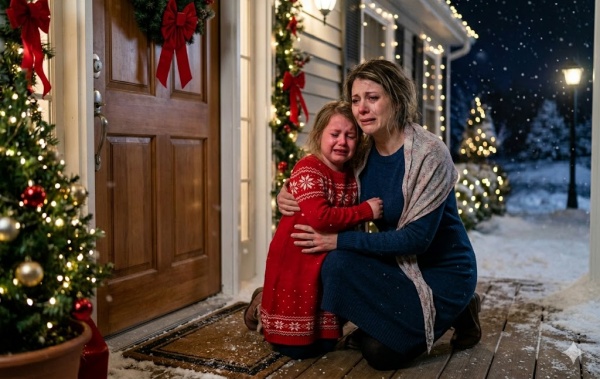
On Christmas Eve, my husband locked my daughter and me out of our own house so he could spend the night with his mistress. He told us to find somewhere else to sleep, even though snow was falling and our daughter was shivering on the porch. But karma caught up with him the very next morning.
Part 1: The Locked Door
On Christmas Eve, my husband locked the front door and refused to let my daughter and me inside so he could spend the night with his mistress.
It was seventeen degrees outside in suburban Chicago.
My daughter was twelve.
And the next morning, the woman he had chosen over us became the reason he lost everything he thought he controlled.
We had just come home from the candlelight service at St. Matthew’s, the same little church we had attended every Christmas Eve since my daughter, Lily, was old enough to hold a battery candle without trying to chew on it. Snow was falling in soft, silent sheets over our street, covering the lawns, the mailboxes, and the glowing reindeer our neighbor insisted on putting up every December. Lily was in the passenger seat beside me, humming “Silent Night” under her breath and holding a paper bag of cookies from the church basement.
“Mom,” she said, looking out at the houses, “do you think Dad remembered to put the cinnamon rolls out for tomorrow?”
I smiled even though something in my chest tightened.
“He probably did,” I said.
I wanted to believe that.
My husband, Mark Caldwell, had been distant for months. Late nights at work, sudden weekend calls, long showers with his phone on the counter, new cologne he claimed a client had given him. He had been impatient with me and strangely formal with Lily, like fatherhood had become a role he was tired of performing.
Still, it was Christmas Eve.
People are foolishly hopeful on Christmas Eve.
I pulled into our driveway at 9:42 p.m. Our two-story brick house looked warm from the outside, with white lights along the gutters and a wreath I had made myself hanging on the front door. The living room curtains were partly open, and I could see the Christmas tree glowing near the window.
Then I noticed a second car parked at the curb.
A white Mercedes I did not recognize.
Lily noticed it too. “Is someone here?”
“I’m not sure.”
I turned off the engine and reached for the gift bag in the back seat. Inside was the scarf Lily had bought for Mark with her own allowance from babysitting the neighbor’s dog. She had wrapped it badly and proudly, with too much tape and a bow that kept falling off.
We walked up the front steps together.
I entered the code on the smart lock.
Red light.
I tried again.
Red light.
I frowned.
“Maybe your fingers are cold,” Lily said.
I tried a third time, slower.
Red light.
Then my phone buzzed.
A notification from the home security app: Your access code has been disabled.
For a moment, I just stared at the screen.
Disabled.
Not expired.
Not incorrect.
Disabled.
I knocked on the door.
At first, nothing happened. Then I heard footsteps inside. Not hurried, not worried, not the footsteps of a husband surprised to see his wife and child locked outside in the snow.
The porch light switched on.
Mark opened the door only a few inches, with the chain still latched.
He was wearing jeans, a cashmere sweater, and the expression of a man annoyed that reality had interrupted his evening.
“Mark,” I said, trying to keep my voice calm. “Why is my code disabled?”
His eyes flicked to Lily, then back to me.
“You shouldn’t be here right now.”
The sentence was so absurd that my mind refused to process it.
“This is our home,” I said.
Lily stepped closer to me. “Dad?”
His face changed when she said that. For half a second, guilt moved across it. Then pride covered it like frost.
“Lily, sweetheart,” he said, “go wait in the car for a minute.”
“No,” I said immediately.
His jaw tightened. “Claire, don’t start.”
My name is Claire Caldwell. I had been married to Mark for fourteen years. In all that time, I had never heard him sound so cold while our daughter stood beside me in a winter coat, her cheeks pink from the wind.
Behind him, a woman laughed softly.
Not loudly.
Not accidentally.
Softly, like she wanted me to know she was there.
Lily heard it.
Her hand found mine.
I looked past Mark through the narrow opening. I could see a woman standing near the staircase in a red satin robe, holding a glass of wine. She was younger than me, maybe thirty, with dark hair falling over one shoulder and bare feet on the hardwood floor I had picked out during our renovation.
Our Christmas stockings hung behind her on the mantel.
Mine. Mark’s. Lily’s.
The woman looked at me and smiled.
Not nervously.
Comfortably.
“Mark,” I said quietly, “open the door.”
He lowered his voice. “Not tonight.”
“Your daughter is outside.”
“She can stay with you.”
“With me where?”
He sighed, as if I were being difficult. “Your sister’s. A hotel. I don’t care, Claire. I need space.”
Lily’s fingers tightened around mine.
I could feel her shaking, though I did not know if it was from the cold or from hearing her father say he did not care where she slept on Christmas Eve.
I kept my voice low because neighbors did not need to hear my child’s humiliation.
“You changed the locks?”
“I disabled your code temporarily.”
“That is changing the locks.”
“It’s my house too.”
“And Lily’s home.”
His eyes flashed. “Do not use her to manipulate me.”
Something inside me went very still.
When a man locks his child out in the snow and accuses her mother of manipulation, the marriage is already over. The only question left is how much dignity you can save on the way out.
The woman behind him stepped forward.
“Maybe you should just go,” she said.
Lily looked up at me, confused and wounded. “Mom, who is she?”
Mark closed his eyes briefly.
I did not answer. Not because I wanted to protect Mark. Because there are some truths a child should not learn on a front porch with snow melting into their boots.
I took out my phone and began recording, holding it low and steady.
Mark noticed.
His face hardened. “Are you serious?”
“Yes,” I said. “I want a record that you are refusing to let your minor daughter enter her home on Christmas Eve.”
He glanced toward the camera near the porch ceiling, then back at my phone.
The woman’s smile faded.
“Claire,” he warned.
“No,” I said. “You can speak clearly. Are you refusing to let Lily inside?”
He said nothing.
Lily whispered, “Dad, I’m cold.”
That should have ended it.
Any decent father would have opened the door so fast the chain would have rattled.
Mark looked at her, swallowed, and then said, “Go with your mother tonight. We’ll talk tomorrow.”
Lily stepped back as if he had pushed her.
He closed the door.
The lock clicked.
For a moment, the only sound was wind moving through the bare maple trees.
Then Lily started crying.
Not loudly. Not dramatically. Just the small, broken crying of a child trying to understand why the person who was supposed to protect her had chosen not to.
I wrapped my arms around her.
“Come on,” I whispered. “We’re going somewhere warm.”
I did not bang on the door.
I did not scream.
I did not give Mark the scene he could later describe as unstable.
I simply walked my daughter back to the car, buckled her in like she was little again, and drove away from the house where our Christmas tree still glowed in the window.
Part 2: The Neighbor Who Opened Her Door
I made it three houses down before I had to pull over.
My hands were shaking too hard to drive safely. Lily was crying into the sleeve of her coat, trying to be quiet because she had always been the kind of child who apologized for needing comfort. That hurt almost as much as the locked door.
Across the street, our neighbor, Mrs. Alvarez, opened her front door.
She was seventy-one, widowed, and the unofficial grandmother of our block. Every summer she overwatered her hydrangeas, every fall she baked pumpkin bread for everyone, and every winter she complained about Chicago weather as if personally betrayed by the Midwest.
She stepped onto her porch in slippers and a red cardigan.
“Claire?” she called. “Honey, are you okay?”
I tried to answer, but my voice failed.
That was enough.
Within two minutes, Lily and I were inside Mrs. Alvarez’s living room, wrapped in blankets while she made hot chocolate with too many marshmallows. Her house smelled like cinnamon, pine, and the tamales she made every Christmas Eve for her children and grandchildren. It was the warmest place I had ever been and the saddest.
Lily sat on the couch, staring at the mug in her hands.
Mrs. Alvarez looked at me once, then at Lily, and understood not to ask questions in front of her.
“Sweetheart,” she said to my daughter, “my granddaughter left a whole basket of fuzzy socks upstairs. Want to pick a pair?”
Lily nodded, grateful for something to do.
When she followed Mrs. Alvarez upstairs, I finally allowed myself to breathe.
My phone had seven missed calls from Mark.
Then a text.
You made your point. Stop being dramatic.
Another.
Do not involve the neighbors.
Another.
Claire, answer me.
I took screenshots of everything.
Then I called the police non-emergency line. I explained that my husband had disabled my access code and refused to allow our minor child into the home on a freezing night. I made clear there was no physical violence, no immediate threat, and that we were safe at a neighbor’s house.
The dispatcher was calm and kind.
An officer came by forty minutes later.
Officer Daniels stood in Mrs. Alvarez’s foyer with snow on their boots and listened while I explained what happened. I showed the video, the security notification, and Mark’s texts. Lily had fallen asleep on the couch by then, curled under a quilt with one hand still wrapped around her mug.
The officer’s expression changed when they saw her.
“I can’t settle property or divorce issues tonight,” Officer Daniels said carefully. “But I can document this and accompany you if you need essential medication or belongings from the house.”
“I don’t want to go back tonight,” I said.
That was the truth.
I did not trust myself to look at Mark through that door again while our daughter slept under another woman’s roof.
Officer Daniels nodded. “Then make sure you contact an attorney as soon as possible. Given that a minor child was locked out, document everything.”
“I will.”
They left a report number.
That number felt strange in my hand.
A marriage can survive many things in private: arguments, silence, disappointment, distance. But once there is a police report number, something changes. The pain becomes paper.
At midnight, Mrs. Alvarez brought me tea and sat beside me at the kitchen table.
“Do you want to tell me?” she asked.
I looked toward the living room, where Lily slept beneath the blinking lights of a tiny ceramic Christmas tree.
“He locked us out because another woman was there.”
Mrs. Alvarez closed her eyes.
For a long time, she said nothing.
Then she reached across the table and took my hand.
“Men can be fools,” she said. “But a man who humiliates his child has become something worse.”
I started crying then.
Quietly at first, then in a way that made my shoulders shake. Mrs. Alvarez did not tell me to be strong. She did not say everything happened for a reason. She just sat with me in the kitchen while Christmas arrived at midnight, and somewhere three houses away, my husband was spending it with the woman he had chosen.
At 12:18 a.m., I called my older brother, David.
He answered on the second ring.
“Merry Christmas,” he said sleepily.
I tried to speak and failed.
His voice changed immediately. “Claire, what happened?”
I told him.
Not everything. Just enough.
David was an attorney in Indianapolis, not a family lawyer, but he knew enough to become very quiet.
“Where are you?”
“Mrs. Alvarez’s.”
“Good. Stay there tonight.”
“Lily’s asleep.”
“Good.”
“I don’t know what to do.”
“Yes, you do,” he said gently. “You just don’t want to know it on Christmas.”
That broke me again.
Because he was right.
I had spent months explaining Mark away. Stress. Work. Midlife crisis. Burnout. Maybe depression. Maybe my fault. Maybe our fault.
But there was no explanation soft enough for a locked door.
David told me to call a family law attorney first thing in the morning. He told me not to go back alone. He told me not to post anything online, not to threaten Mark, not to argue by text except about Lily and essential logistics.
“Document. Protect Lily. Stay calm,” he said.
“I don’t feel calm.”
“You don’t have to feel calm to act wisely.”
After we hung up, I opened the home security app again.
Mark had removed my access entirely.
Then, at 12:37 a.m., he changed the system name from Caldwell Family Home to Mark’s Home.
I stared at the screen.
Mark’s Home.
That was when I remembered the deed.
When we bought the house eight years earlier, most of the down payment had come from money my late mother left me. Because of that, and because Mark had poor credit from a failed business venture he never liked discussing, the mortgage and deed were in my name alone. Mark contributed to household expenses, yes, but legally the house was not his kingdom.
It was mine.
He had locked me out of my own house.
I did not smile.
I did not feel victorious.
I felt tired, cold, and older than I had that morning.
But for the first time all night, I felt the ground under my feet again.
Mark thought locking a door made him powerful.
He had forgotten who held the keys on paper.
Part 3: The Woman in the Red Robe
At 6:11 a.m. on Christmas morning, my phone rang from an unknown number.
I woke up in Mrs. Alvarez’s guest room with Lily asleep beside me. She had crawled into the bed around 3 a.m., shaking from a nightmare she could not remember. I had held her until she slept again, one hand on her back like I used to when she was five.
The unknown number called again.
Then a text came through.
This is Brooke. I’m the woman from your house. Please answer.
I stared at the screen.
Brooke.
So the red robe had a name.
I slipped out of bed and went into the hallway, closing the door softly behind me. Mrs. Alvarez was already awake downstairs, because women of a certain generation seem physically unable to sleep past sunrise on Christmas.
I answered the call.
For a second, neither of us spoke.
Then Brooke said, “I didn’t know.”
Her voice was shaking.
I leaned against the hallway wall. “You didn’t know what?”
“I didn’t know you were still living there. I didn’t know about your daughter being locked out. He told me you were at your sister’s for Christmas and that the separation was mutual.”
I closed my eyes.
There it was.
The oldest story in the world.
A married man turning his wife into a ghost before she has even left the house.
“He told you we were separated?”
“Yes.”
“And you believed him?”
A pause.
“I wanted to.”
That answer was more honest than I expected.
Brooke took a shaky breath. “I came downstairs this morning and saw a little pink backpack by the mudroom door. Then I saw the stockings. Your daughter’s stocking had a school photo tucked into it. I asked him why her things were still there.”
“What did he say?”
“He said you were dramatic and using her against him.”
I looked down the hallway toward the room where Lily slept.
My voice went cold. “He locked her outside in the snow.”
“I know that now.”
“How?”
“He got a call from the police station about the report number. He was furious. Then he started yelling about you making him look bad. Not about her being cold. Not about whether she was okay. Just about how it looked.”
I said nothing.
Brooke continued, and now she was crying.
“I’m leaving. I called a rideshare. But before I go, you need to know something.”
My grip tightened on the phone.
“What?”
“He gave me a bracelet last night. Diamond tennis bracelet. He said it was my Christmas gift. I found the receipt on the dresser this morning.”
I waited.
“It was charged to Caldwell Interiors.”
My stomach dropped.
Caldwell Interiors was my design firm.
I had founded it six years before Mark quit his corporate sales job and joined as “business development director.” He loved the title. He loved client dinners, luxury showrooms, and being introduced as my partner.
But I owned the company.
He did not.
“How much?” I asked.
“Eighteen thousand dollars.”
I closed my eyes.
Brooke whispered, “There’s more. I saw invoices on his laptop. Hotel charges, jewelry, dinners. He told me they were personal, but they’re not. At least, the cards don’t look personal.”
I walked downstairs slowly.
Mrs. Alvarez looked up from the stove, where she was warming tortillas and eggs. I must have looked strange because her expression sharpened.
Brooke said, “I’m sorry. I know that doesn’t fix anything.”
“No,” I said. “It doesn’t.”
“I can leave the bracelet and the receipt on the kitchen counter.”
“Do that.”
“And I can email you what I saw.”
“Do that too.”
Another pause.
Then she said, “Your daughter’s scarf is under the tree. The one she wrapped. Mark opened it last night after you left.”
I stopped moving.
“He opened Lily’s gift?”
“Yes.”
I could hear Brooke crying now. “He laughed because the wrapping was messy. I thought it was a joke, but then this morning I saw the tag. It said, ‘To Dad, from Lily.’”
The hallway blurred.
That hurt more than the bracelet.
More than the red robe.
More than the locked door.
Lily had saved for that scarf. She had asked me three times if he would like it. She had wrapped it herself and told me not to fix it because “Dad will know I did it.”
Mark had opened it without her.
Then laughed.
I sat at Mrs. Alvarez’s kitchen table before my legs could fail me.
“Leave the receipt,” I said. “And the bracelet.”
“I will.”
“One more thing.”
“Yes?”
“Do not let him know you are helping me.”
Brooke gave a sad little laugh. “He already knows I’m not staying.”
When I arrived at the house at 8:04 a.m., I was not alone.
Officer Daniels met me there to accompany me while I retrieved essential belongings. Mrs. Alvarez came too, standing like a five-foot-two guardian angel in a wool coat and bright red lipstick. Lily stayed behind with Mrs. Alvarez’s granddaughter, watching cartoons and pretending not to care.
Mark opened the door looking like a man who had slept badly.
Brooke was gone.
The white Mercedes was gone.
The house smelled like coffee, expensive perfume, and the cinnamon rolls Lily had asked about the night before. They sat burned on the kitchen counter, still in the pan. I do not know why that detail made me want to cry, but it did.
Mark looked past me at Officer Daniels.
“Really?” he said. “You brought police to my house?”
Officer Daniels remained calm. “We’re here to keep the peace while Ms. Caldwell retrieves items for herself and the child.”
“The child?” Mark snapped. “You mean my daughter.”
I looked at him.
“You remembered.”
His face reddened.
Mrs. Alvarez made a sound under her breath in Spanish that I was glad Mark did not understand.
I walked upstairs and packed Lily’s medication, school laptop, winter boots, favorite pajamas, and the stuffed rabbit she still pretended not to sleep with. I packed my work laptop, passport, financial records, and the folder with the house documents. I did not touch Mark’s things.
On the kitchen island sat the diamond bracelet.
Beside it was the receipt.
Beside that was a handwritten note from Brooke.
Claire,
I believed a story I should have questioned. I am sorry. I know that may mean nothing, but I hope the proof helps you protect your daughter.
Brooke
Under the note was a printed screenshot of Mark’s company card transaction.
I folded everything into my bag.
Mark saw the bracelet and reached for it.
Officer Daniels spoke immediately.
“Sir, I would avoid touching items currently being documented in a dispute.”
Mark froze.
It was the first time I had seen someone stop him with one sentence.
He glared at me. “You turned her against me too?”
“No,” I said. “You showed her who you were before I had to.”
His mouth opened, but nothing useful came out.
That was the unexpected outcome of Christmas morning.
Not that Brooke apologized.
Not that she left.
Not even that she handed me evidence.
The unexpected outcome was that the woman Mark brought into our home to replace me became the first person to open the door he had locked.
Part 4: The House That Was Never His
By noon on Christmas Day, Lily and I were at my sister Rachel’s house in Oak Park.
Rachel had driven in from Indiana at sunrise after David called her, arriving with two duffel bags, a thermos of coffee, and the kind of anger only a protective older sister can carry without saying a word. Her husband, Ben, made pancakes while their kids gave Lily space in the gentle way children sometimes understand better than adults.
Lily ate three bites, then pushed her plate away.
“Did Dad ask about me?” she said.
The kitchen went silent.
I sat beside her and chose my words carefully.
“He knows you’re safe.”
“That’s not what I asked.”
I took her hand. “No, sweetheart. Not yet.”
She nodded like she had expected that answer and hated being right.
“I don’t want to go home if she was there,” she whispered.
“She’s gone.”
“Is Dad gone?”
“Not yet.”
Her eyes filled with tears. “Why does he get to stay?”
That question was harder.
Because children understand justice emotionally, but adults have to move through systems. Houses, marriages, custody, business accounts—none of them untangle just because the truth is obvious. The law has steps, and steps feel cruelly slow when your child is hurting.
“We’re going to handle it properly,” I said.
“I hate properly.”
“I know.”
“I want him to feel how cold it was.”
I pulled her into my arms.
That sentence scared me, not because it was wrong, but because it was honest. Children learn anger quickly when adults make pain too large for them to carry. My job was not to shame her anger. It was to keep it from becoming the place she lived.
That afternoon, I spoke with a family law attorney named Melissa Grant.
She was direct, experienced, and completely unimpressed by Mark’s behavior. I sent her the police report number, the security app notification, Mark’s texts, Brooke’s note, the receipt, and the video from the porch.
Melissa’s response was brief.
“This is serious.”
Two days later, she filed for divorce and requested temporary orders regarding occupancy, parenting time, finances, and access to the home. She did not promise miracles. Good attorneys do not. But she told me the documentation mattered.
Meanwhile, my accountant reviewed Caldwell Interiors’ accounts.
The first report arrived before New Year’s.
It was worse than I expected.
Mark had charged hotels, restaurants, gifts, and travel to the company for months, coding them as client development or vendor relations. Some charges may have been legitimate, but many had no supporting documentation. The bracelet was only the most insulting because it had ended up on my kitchen counter like a confession wrapped in diamonds.
I placed Mark on administrative leave from the company.
That sounds cleaner than it felt.
In reality, he called me twenty-three times, left angry voicemails, emailed staff claiming there had been a misunderstanding, and told two clients that I was “emotionally unstable after a private family issue.” One of those clients forwarded the email to me with a note: Claire, I thought you should see this. We support you.
Support can arrive in small, unexpected envelopes.
Brooke sent a formal statement through Melissa.
She confirmed Mark told her we were separated, that I would not be home Christmas Eve, and that he had not disclosed our daughter would be locked out or denied access. She also provided copies of texts where Mark described the house as “mine now” and referred to Lily and me as “temporary complications.”
Temporary complications.
I read that phrase once and closed the laptop.
Some words are too ugly to keep looking at.
The temporary court hearing happened in early January.
Mark arrived wearing a navy suit and the wounded expression of a man who had spent two weeks telling himself he was the victim. He tried to explain that the lockout was a misunderstanding, that I had overreacted, that Lily was never in danger because “Claire had a car,” and that marital conflict should not be used to restrict a father.
The judge listened.
Then Melissa presented the timeline.
Church service.
Disabled access code.
Seventeen-degree weather.
Minor child present.
Video recording.
Text messages.
Police report.
Evidence of another adult staying in the home.
Company funds used for personal expenses.
Mark’s attorney tried to make it sound messy and mutual.
The facts refused to cooperate.
The judge granted me temporary exclusive use of the home, ordered Mark to leave by a specific date, established temporary parenting provisions centered on Lily’s well-being, and instructed both of us not to discuss adult conflict with her. Financial restraints were put in place. Company matters were handled separately, but the message was clear.
Mark had locked us out for one night.
Now he had to move out legally.
When I returned to the house with Lily a week later, she stood in the foyer for a long time.
The Christmas tree was still up, dry and drooping. The stockings still hung on the mantel. The scarf she had wrapped for Mark was lying on the side table, folded badly, as if someone had tried to undo shame after the fact.
Lily picked it up.
For a moment, I thought she might cry.
Instead, she carried it to the donation box near the door.
“Someone else can be warm,” she said.
I nodded because my throat was too tight to speak.
We took down the tree together that night. Not joyfully, not sadly, but carefully. We wrapped ornaments in tissue paper, packed away lights, and threw out the burned cinnamon rolls still sitting in the pan like evidence from another life.
Then Lily asked if we could order pizza.
It was January, and it felt like the first real Christmas meal we had eaten.
Part 5: The Morning After, One Year Later
Divorce did not make the pain disappear.
It organized it.
There were parenting schedules, therapy appointments, financial disclosures, business audits, attorney emails, and the strange grief of learning that someone can be alive and still become a person you mourn. Mark did not become kinder immediately. Consequences rarely transform people overnight, especially people who believe consequences are insults.
At first, he blamed me.
Then he blamed Brooke.
Then he blamed stress, alcohol, childhood wounds, work pressure, and the “toxic expectations of modern marriage.” He blamed everything except the man who stood behind a chained door while his daughter shivered on the porch.
Lily went to therapy every Thursday.
Some weeks she talked about Mark. Some weeks she talked about school, friends, math tests, and how unfair it was that I would not let her get a second dog. Healing does not always look dramatic. Sometimes it looks like a child laughing again at the dinner table and then suddenly crying because a Christmas commercial came on.
Mark’s visits with Lily were cautious at first.
She refused overnight visits for months, and the temporary arrangement respected that through the court process and professional guidance. Eventually, she agreed to short dinners in public places. Mark brought gifts at first, and Lily left most of them in the car.
One evening, she came home from dinner and said, “Dad apologized.”
I was washing dishes.
I turned off the water.
“What did he say?”
“He said he was sorry for letting adult problems affect me.”
I dried my hands slowly. “How did that feel?”
“Like a sentence a lawyer helped him write.”
I almost smiled, but did not.
“What did you say?”
“I said, ‘You didn’t let adult problems affect me. You locked me outside.’”
I closed my eyes.
“And then?”
“He cried.”
I looked at her carefully.
“How did that feel?”
She shrugged. “Weird. I didn’t like it. But I also didn’t feel bad enough to comfort him.”
I walked over and hugged her.
“That’s okay.”
She leaned against me.
“Mom?”
“Yes?”
“Am I mean if I don’t forgive him yet?”
“No,” I said. “Forgiveness is not a bill someone else can demand you pay on their schedule.”
She nodded into my shoulder.
That became one of the lessons of that year.
We learned that boundaries feel harsh only to people who benefited from you having none. We learned that a home is not made safe by locks, but by the people allowed inside. We learned that a father’s title does not matter as much as what a child feels when they hear his footsteps.
Caldwell Interiors survived.
Better than survived, actually.
Without Mark’s expensive “client development,” our margins improved within six months. My team became calmer. Clients noticed. I promoted my operations manager, Priya, who had quietly been doing half of Mark’s job for years and none of his self-promotion.
Brooke never became my friend.
This is not that kind of story.
But she did cooperate when asked, returned the bracelet through her attorney, and sent one final email months later. She wrote that she had believed a lie because it made her feel chosen, and that watching Mark talk about his daughter as an inconvenience had changed something in her.
I replied with two sentences.
Thank you for telling the truth. I hope you build a life that does not require another woman’s pain to feel valuable.
She did not write back.
That was fine.
Not every apology needs a relationship attached to it.
The divorce finalized eleven months after Christmas Eve.
I kept the house.
Mark kept his retirement accounts, his car, and enough dignity to start over if he ever decided dignity required honesty. He no longer worked at Caldwell Interiors. He took a sales job with a commercial furniture company downtown, where I assume he told people the divorce was complicated.
Most divorces are.
But some moments are simple.
A door was locked.
A child was outside.
A choice was made.
The first Christmas after that night, Lily and I almost skipped decorating.
I told myself it was because we were busy. Caldwell Interiors had three major projects finishing in December, Lily had finals, and the dog we did not plan to adopt but somehow adopted anyway had chewed through a string of lights. The truth was that I was afraid.
Afraid the tree would hurt.
Afraid the stockings would hurt.
Afraid Lily would remember standing on the porch with snow in her hair and ask questions I could not fix.
Then, two weeks before Christmas, she came downstairs carrying the ornament box.
“We’re not letting him have Christmas,” she said.
So we decorated.
We put up white lights outside. We bought a fresh tree from a lot beside a grocery store. We hung stockings on the mantel, including one for the dog, who had done absolutely nothing to deserve gifts but received them anyway.
On Christmas Eve, we went back to St. Matthew’s.
Lily held the candle more carefully than she had as a child, her face golden in the soft light. During “Silent Night,” she slipped her hand into mine. I squeezed it once.
When we drove home, snow was falling again.
My chest tightened as we turned onto our street.
Lily noticed.
“Mom,” she said, “it’s okay.”
I looked at her.
She was thirteen now. Taller, sharper, less innocent in ways I wished I could undo. But she was also stronger, not because pain made her better, but because she had learned she could survive something that should never have happened.
We pulled into the driveway.
The wreath was on the door.
The porch light was on.
For a second, neither of us moved.
Then Lily said, “Can I do the code?”
I handed her the keys too.
“Both,” I said.
She smiled a little.
She entered the code.
Green light.
The lock opened.
Such a small sound.
Such a holy one.
Inside, the house was warm. The tree glowed in the living room. Cinnamon rolls waited in the refrigerator for morning, unburned and unclaimed by anyone who did not deserve them.
Lily hung up her coat and looked around.
Then she turned to me and said, “It feels different.”
“Bad different?”
She thought about it.
“No. Ours different.”
I smiled.
“Ours different is good.”
The next morning, Christmas Day, we woke late.
No drama.
No police report.
No strange car at the curb.
No woman in a red robe.
Just coffee, cinnamon rolls, the dog stealing wrapping paper, and Lily laughing so hard she fell sideways on the couch. Around noon, Mrs. Alvarez came over with tamales, and Rachel’s family arrived with too many desserts.
At 3:14 p.m., Mark texted Lily.
Merry Christmas. I love you.
She showed me the message.
“What do I say?” she asked.
“What do you want to say?”
She thought for a long time.
Then she typed:
Merry Christmas. I’m okay.
She did not write “I love you.”
Not yet.
Maybe someday.
Maybe not.
That was hers to decide.
Later, after everyone left and the house settled into the soft mess of wrapping paper and half-empty mugs, Lily and I sat by the tree. The dog snored at our feet. Snow tapped lightly against the windows.
“Mom,” Lily said, “do you ever think about that night?”
“Yes.”
“Me too.”
I waited.
She leaned her head on my shoulder.
“I used to think the worst part was Dad locking the door.”
“What do you think now?”
She looked at the tree.
“The worst part was thinking we had nowhere to go.”
I closed my eyes.
Then she added, “But we did.”
I wrapped an arm around her.
“Yes,” I said. “We did.”
And that was the truth I kept.
Mark had locked us out because he believed a door could decide who belonged. He believed his desire mattered more than his daughter’s safety, his pride more than his marriage, his temporary pleasure more than the home we had built. He thought Christmas Eve would end with me humiliated and him in control.
Instead, the next morning exposed everything.
The mistress left.
The evidence surfaced.
The house returned to its rightful owner.
The daughter he treated as an inconvenience became the one person whose forgiveness he could not buy, rush, or demand.
And me?
I stopped begging for entry into a life where love had become conditional.
I built a safer one.
A warmer one.
A quieter one.
One year later, when the lock turned green and my daughter opened our front door herself, I finally understood the unexpected outcome of that Christmas morning.
It was not revenge.
It was not even justice, though justice came in pieces.
It was the simple, powerful truth that the door he locked on us became the door we learned to open without him.
