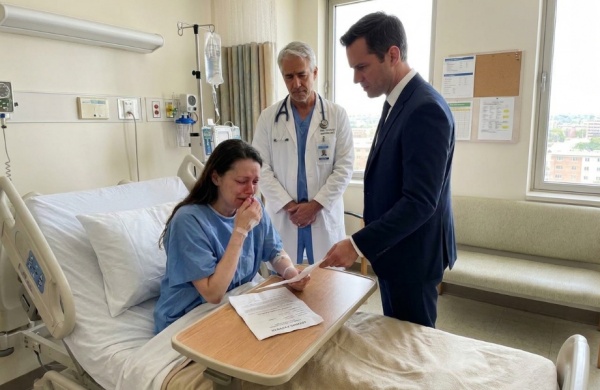
Seven minutes after hearing that I had “cancer,” my husband decided to divorce me. He thought that money, fame, and a team of lawyers would let him take everything while I focused on survival. But he was mistaken…
Part 1: Seven Minutes
Seven minutes after hearing the news that his wife might have cancer, my husband asked me for a divorce.
I was still holding the folder from Memorial Sloan Kettering, the edges of the paper cutting into my palm because I had gripped it too tightly in the elevator. My biopsy results were inside, along with words I had only ever heard in whispered conversations and hospital dramas. Suspicious mass. Further testing required. Possible malignancy.
My husband, Preston Hale, did not ask if I was scared.
He did not take my hand. He did not offer to cancel his meetings, call my mother, or sit beside me until the floor stopped moving under my feet. He looked at his watch, sighed, and said, “Claire, this is an incredibly inopportune time.”
That was the word he used.
Inopportune.
Not tragic. Not frightening. Not unfair. Inopportune, as if my body had failed to check his calendar before betraying me.
We were standing in the living room of our penthouse on the Upper East Side, forty-one floors above Manhattan. The city glittered beneath us in cold silver lines, taxis moving like tiny sparks along Park Avenue. Preston had bought the apartment for $28 million and liked to say the view was “proof that ambition pays rent in the sky.”
He was a billionaire by thirty-nine, the founder of a luxury technology company that made security systems for people rich enough to fear other rich people. His face had been on Forbes, Bloomberg, and the side of a building in Times Square during his company’s IPO week. Strangers called him visionary.
I called him my husband.
At least, I still did that morning.
We had been married for nine years, though marriage to Preston sometimes felt less like a partnership and more like being acquired by a larger corporation. There were lawyers, schedules, public appearances, nondisclosure agreements, security teams, charity galas, and houses I did not feel allowed to relax in. There was a penthouse in New York, a beach house in Southampton, a ski chalet in Aspen, and an estate in Connecticut with eight bedrooms and a rose garden nobody had time to smell.
People assumed I married him for money.
That always made me laugh privately, because when I met Preston, he was not yet Preston Hale, billionaire. He was a brilliant, exhausted software founder living on vending machine coffee and borrowed confidence. I was Claire Whitmore, the daughter of a real estate attorney and a nurse, working in nonprofit development and driving a ten-year-old Subaru with a dent in the passenger door.
The first office for his company was in a converted warehouse in Brooklyn.
The first check that saved it came from my family.
Not all of it, of course. Preston would never admit that out loud. Billionaires prefer origin stories where they rise alone from nothing, already wearing good shoes.
But the truth was messier.
My father had helped structure the early investment documents. My mother had cooked meals for Preston’s tiny team when they were working eighteen-hour days. I had introduced him to donors, investors, and two of the people who later became board members.
I had also signed over the use of a piece of property in Connecticut that belonged to my grandmother’s trust, because Preston needed collateral during a brutal funding round. He had cried that night, sitting at my kitchen table, promising he would never forget what I had done. I believed him.
That was before I learned that some people remember favors only long enough to benefit from them.
The morning of the diagnosis, I had gone to the hospital alone because Preston had a television interview about his company’s expansion into Europe. He promised he would meet me afterward if the appointment “turned serious.” I remember sitting under fluorescent lights in a paper gown, staring at a poster about early detection while my phone buzzed with Google alerts about his interview.
The doctor was kind.
That made it worse.
Kind doctors make bad news feel more real because they do not rush it. Dr. Patel sat across from me, hands folded, and explained that the initial findings were concerning but not final. There would be more tests, more imaging, and likely surgery depending on the next results.
I heard every word and none of them.
My mind got stuck on the same thought: I have to tell Preston.
Not because I thought he would fix it. Not even because I thought he would comfort me well. I thought he had the right to know because we were married, and marriage, at least in my imagination, still meant carrying bad news across the room to the person who had promised to stand there.
When I came home, he was already waiting.
Not worried.
Waiting.
He stood near the marble fireplace in a charcoal suit, phone in one hand, his expression sharp with irritation. His assistant, Maren, had texted him that I had left the hospital early and canceled a lunch meeting with donors. That was how Preston learned things about my life: through staff.
“What did they say?” he asked.
I held out the folder.
He did not take it.
“They found something,” I said. “It may be cancer.”
For seven minutes, I believed I was still inside a marriage.
He asked two practical questions. What kind? How certain? What treatment? I answered as best I could, though the truth was that I did not know enough yet.
Then he looked toward the windows, as if the skyline might advise him.
“Claire,” he said, “this is an incredibly inopportune time.”
I blinked.
He continued before I could speak. “The acquisition talks are delicate. The foundation launch is in three weeks. If this becomes public, it creates questions about stability, about the family, about long-term planning.”
The family.
There were no children. Preston had postponed that conversation every year until my desire for motherhood became something I folded away like a dress that no longer fit. He said children would come when the company stabilized, then when the IPO closed, then when international expansion finished.
There was always another milestone standing between me and the life I thought we were building.
“I’m not thinking about publicity right now,” I said.
“I understand.”
He did not.
“I’m thinking about whether I’m going to need surgery,” I said. “Whether I’m going to be sick. Whether I’m going to survive this.”
He flinched, but not with compassion. He flinched because the word survive was too dramatic for the room he controlled.
Then he said it.
“I think we should separate.”
At first, I thought I had misunderstood him.
“Separate?” I repeated.
His voice became softer, the way it did when he was preparing to be cruel but wanted credit for restraint. “We’ve both known this marriage has been strained for a long time.”
I stared at him, still holding the medical folder.
“Are you asking me for a divorce?”
He exhaled like I had forced him into honesty.
“Yes.”
The city outside kept moving.
Somewhere below us, people were walking dogs, buying coffee, honking at delivery vans, complaining about the weather. My world had split open, and Manhattan had the audacity to continue being Manhattan.
I looked at my husband, the man who had once slept on my apartment floor because he could not afford a hotel during investor meetings. The man who had used my father’s conference room for free. The man who had stood beside me at our wedding in Maine and promised, in front of one hundred and eighty people, that sickness and health were not optional clauses.
“Seven minutes,” I said quietly.
He frowned. “What?”
“It took you seven minutes.”
His jaw tightened. “Don’t turn this into something theatrical.”
That was Preston’s favorite word for other people’s pain.
Theatrical.
If something embarrassed him, it was theatrical. If someone cried in public, theatrical. If I asked for tenderness when he was busy, theatrical.
I placed the folder on the coffee table.
“I need to sit down,” I said.
He looked relieved, probably because sitting down seemed reasonable and quiet. Preston loved quiet women in crisis. They made better photographs.
“I’ll have Daniel contact your attorney,” he said. “We can keep this clean.”
Daniel Mercer was Preston’s personal lawyer, a man with white hair, perfect teeth, and the moral warmth of a locked filing cabinet.
“My attorney?” I asked.
“You’ll need representation.”
“You already planned this.”
He did not answer.
That was answer enough.
I sat on the sofa, not because he had broken me, but because my knees were no longer certain they wanted to participate in the rest of the conversation. Preston picked up his phone and began typing. His wife might have cancer, and he was already scheduling her exit.
That was when something inside me became very still.
Not dead.
Still.
There is a difference.
Part 2: The Quiet Wife
For the next three weeks, Preston treated my illness like a public relations problem and our divorce like a hostile merger.
He moved into the guest suite at the Connecticut estate, telling staff he needed space to work during “a difficult personal transition.” He did not accompany me to follow-up appointments. He sent flowers once, white lilies that made the penthouse smell like a funeral home.
The card said: Wishing you strength.
Not love.
Strength.
I threw the flowers away before they opened.
My final diagnosis came after additional testing. It was early-stage thyroid cancer, serious enough to change my life but treatable enough that everyone kept telling me I was “lucky.” I learned quickly that people use the word lucky when they do not know what else to do with your fear.
The surgeon explained the treatment plan.
Surgery. Recovery. Follow-up scans. Medication likely for the rest of my life. A long road, but not the road I had imagined when I first heard the word cancer.
I wanted to feel relieved.
Instead, I felt abandoned with better statistics.
Preston’s legal team moved fast. Too fast. Within days, Daniel Mercer sent a draft separation proposal that read less like the end of a marriage and more like a wealthy man trying to erase an inconvenient witness.
Preston wanted the penthouse.
Preston wanted the Southampton house.
Preston wanted the Aspen chalet.
Preston wanted controlling rights over the Connecticut estate, claiming he had invested millions into renovations.
He also wanted me to sign a broad confidentiality agreement, agree to limited spousal support, waive claims to certain business assets, and acknowledge that most of our shared lifestyle had been funded exclusively by his “separate entrepreneurial efforts.”
I read that phrase six times.
Separate entrepreneurial efforts.
The first office had been found through my contact. The first bridge loan had been guaranteed with family collateral. The early investor dinner had been hosted by my parents in their home in Westchester, where my mother served roast chicken and my father explained risk to men who later bragged that they discovered Preston.
But now the story had been cleaned.
No wife.
No in-laws.
No borrowed rooms.
No trust property.
Just Preston, genius alone in a spotlight of his own making.
My lawyer, Nora Kaplan, laughed when she read the proposal.
Not because it was funny.
Because it was insulting.
Nora was sixty-one, sharp-eyed, and known in Manhattan divorce circles as the woman powerful men hired against until they learned to fear her. She wore black suits, drank tea without sugar, and never raised her voice because she did not have to.
“He thinks you’re too sick to fight,” she said.
I sat across from her in a conference room overlooking Madison Avenue, a scarf around my neck even though surgery had not happened yet. My body already felt like public property, discussed by doctors, lawyers, and a husband who wanted me removed before my vulnerability lowered his brand value.
“He thinks I’ll sign,” I said.
Nora removed her glasses. “Will you?”
“No.”
It was the first answer that had felt like mine in weeks.
She smiled slightly. “Good.”
Then she asked me a question that changed everything.
“Claire, where are the original property documents for the Connecticut estate?”
“In my father’s files, I think.”
“And the trust?”
“My grandmother’s trust still owns part of the land under a family structure. Preston’s company paid for renovations, but the original deed was never fully transferred to him.”
Nora leaned back.
“Did his attorney know that?”
“I assumed so.”
“Never assume a billionaire’s lawyer knows what the billionaire prefers to forget.”
That afternoon, I called my father.
Edward Whitmore was seventy-two, retired from law but not from suspicion. He had never fully trusted Preston, though he had been polite enough to make peace possible. When I told him what Preston was demanding, there was a long silence.
Then Dad said, “Come home.”
So I did.
I drove myself to Westchester in a black Range Rover that Preston had technically bought but I had registered in both our names because I handled details he considered beneath him. The July heat shimmered off the highway. My phone buzzed three times with messages from Preston, none of which asked how I felt.
At my parents’ house, my mother opened the door before I knocked.
She was a retired oncology nurse, which meant she understood fear too well to decorate it. She hugged me gently, careful near my neck, and whispered, “You don’t have to be brave in this house.”
That was when I cried.
Not when the doctor spoke.
Not when Preston asked for the divorce.
Not when the lawyers began circling.
I cried in my mother’s kitchen because she put soup on the stove and called me baby.
That night, my father brought out the old files.
Boxes of them.
Trust documents, deeds, correspondence, loan guarantees, renovation agreements, early business memos, handwritten notes, emails printed because my father had never trusted clouds. Preston used to mock him for printing everything. Now those pages sat on the dining room table like quiet little witnesses.
We found the original Connecticut deed first.
The estate sat on forty-two acres in Litchfield County. Preston had bragged about it in magazines as “our family retreat,” though he had gradually referred to it as his estate after the IPO. The main house had been renovated with his money, yes, but the underlying land belonged to a Whitmore family trust, with restricted transfer provisions my father had insisted on keeping.
Then we found the collateral documents.
During Preston’s second funding crisis, the trust had allowed limited use of the land value to secure temporary financing. Preston had signed acknowledgments stating that the arrangement did not grant him ownership interest. His signature appeared on every page.
I touched the ink with my fingertip.
He knew.
Of course he knew.
The next folder contained emails between Preston and Daniel Mercer from years earlier. My father had been copied on some of them. In one message, Daniel warned Preston that the Connecticut property could not be claimed as marital property in the way Preston wanted because of the trust structure.
Preston had replied: Understood. We’ll revisit when optics are better.
Optics.
There it was again.
A marriage translated into strategy.
My father read the email twice, then looked at me. “He’s counting on you not remembering.”
“He’s counting on me being sick.”
My mother stood at the sink, hands flat on the counter.
For the first time in my life, I saw my gentle mother look dangerous.
Not violent. Not loud. Dangerous in the way only a woman who has watched patients fight for their lives can become when someone treats illness as an opportunity.
“We’re going to make copies,” she said.
And we did.
For three days, while Preston’s team sent increasingly polished legal threats, my family and I gathered records. Deeds. Trust agreements. Emails. Wire confirmations. Early investor documents. Photographs from those first dinners, where Preston stood in my parents’ dining room wearing a cheap suit and a grateful smile.
I found an old note in one box.
It was from Preston, written after my family helped secure the bridge loan.
Claire, I will spend the rest of my life proving I deserved your faith in me.
I sat with that note for a long time.
Then I placed it in the evidence folder.
Part 3: The House He Demanded
Preston demanded the Connecticut estate on a Thursday morning.
He did not do it personally at first. Men like Preston prefer cruelty with letterhead. Daniel Mercer sent a formal proposal stating that Preston was prepared to “resolve matters amicably” if I agreed to vacate any claim to the estate, the penthouse, and certain investment interests connected to the company’s pre-IPO growth.
Nora read the letter in silence.
Then she said, “He’s overreaching.”
I had learned by then that when Nora said overreaching, she meant legally foolish and personally arrogant. She tapped the Connecticut paragraph with one red fingernail. “This is the pressure point. Why does he want that property so badly?”
“Status,” I said. “He loves that house.”
“No,” Nora said. “He loves all the houses. Why this one?”
The answer came two days later.
My father found it in an old municipal planning file and a recent corporate disclosure. Preston had quietly planned to use part of the Connecticut estate as the site of a private executive retreat connected to his foundation and security company. The land was beautiful, secluded, and close enough to New York for billionaires to helicopter in without calling it inconvenience.
The project had a name.
Hale House.
Not Whitmore.
Not ours.
Hale House.
He had already promised access to donors, executives, and a former senator on the foundation board. He had commissioned architectural renderings. He had let reporters believe the property was fully his to develop.
If he lost control of the estate, he did not just lose a house.
He lost a story.
Preston could survive divorce. Rich men often do. He could survive gossip, settlements, even public sympathy for a sick wife if handled carefully.
But he could not survive looking careless.
Careless men lose investor confidence.
The first mediation took place in a private law office in Midtown with frosted glass doors and coffee that tasted expensive but sad. I wore a navy dress with a high collar to cover the healing incision from my surgery. My voice was still weaker than usual, and I hated that Preston might mistake that for surrender.
He arrived with Daniel, two associates, and a younger public relations consultant who looked like she had been hired to make cruelty trend softly.
Preston looked flawless.
Of course he did.
He wore a dark suit, a pale blue tie, and the expression of a man inconvenienced by human emotion. When he saw the faint swelling at my throat, his eyes flickered away. He still had not asked how surgery went.
“Claire,” he said.
“Preston.”
That was all.
We sat across from each other at a long table while lawyers spoke in clean, bloodless language. Marital assets. Separate property. Interim support. Confidentiality. Equity claims. Residential access.
At one point, Daniel said, “Mr. Hale is willing to be generous, given Mrs. Hale’s current circumstances.”
Nora smiled.
It was not a warm smile.
“Ms. Whitmore,” she said.
Daniel paused. “Excuse me?”
“My client is using Whitmore professionally and personally now.”
Preston’s jaw tightened almost imperceptibly.
Small victories matter when your life has been reduced to documents.
Daniel continued, “Mr. Hale is prepared to allow Ms. Whitmore continued medical coverage through the applicable legal period and a reasonable housing allowance.”
Allow.
That word settled over the table like dust.
I looked at Preston then. Really looked at him. He was the same man who once practiced investor pitches in my old apartment mirror while I sat cross-legged on the floor eating takeout noodles. The same man who had kissed my forehead after our wedding and said, “We’re unstoppable now.”
Now he wanted credit for not cutting off my health insurance while I recovered from cancer surgery.
Nora opened a folder.
“Before we discuss Mr. Hale’s generosity,” she said, “we need to address the Connecticut property.”
Daniel sighed lightly. “The estate was significantly improved during the marriage with Mr. Hale’s funds.”
“The improvements may be evaluated,” Nora said. “The land is held by the Whitmore Family Trust. Mr. Hale signed multiple acknowledgments confirming no ownership interest in the underlying property.”
Daniel’s expression did not change, but one of his associates stopped typing.
Nora slid copies across the table.
Preston looked at them.
For the first time since the diagnosis, I saw uncertainty pass through his face.
“That’s not the full context,” he said.
“It is the signed context,” Nora replied.
Daniel picked up the papers, scanned them, and said nothing.
Nora opened another folder. “We also have correspondence from your office confirming the same legal position eight years ago.”
She slid the email across.
Daniel read it.
His face tightened.
Preston turned toward him sharply enough that the PR consultant noticed.
“You had that?” Preston asked me.
“My father prints things,” I said.
For a second, something almost human crossed his face.
Not regret.
Annoyance.
He was annoyed that ordinary paper had survived his revision of history.
Daniel requested a break.
Preston stood too fast, buttoning his jacket with one hand. His team followed him into a side room, the door closing behind them. Nora leaned back in her chair and looked at me.
“How are you feeling?”
It was the first honest question anyone had asked in that room.
“Tired,” I said.
“Good. Tired people don’t waste energy performing.”
I almost laughed, but my throat hurt.
Twenty minutes later, Preston returned alone.
That surprised me.
He sat across from me while the lawyers remained outside, though Nora stayed in the room because I had no intention of being privately managed by my husband ever again.
“Claire,” he said quietly, “this doesn’t need to become ugly.”
“It became ugly seven minutes after my diagnosis.”
His eyes hardened. “That’s not fair.”
“No,” I said. “It wasn’t.”
He glanced at Nora, then back at me. “You know what that estate means for the foundation.”
“I know what my family’s land means to you.”
“I invested millions into that property.”
“You invested in a house built on land you knew you did not own.”
His mouth tightened.
There was the man beneath the magazine covers. Not visionary. Not genius. Just a person furious that a woman he underestimated had read the documents.
“You’re being vindictive,” he said.
I touched the scarf at my throat.
“I had cancer surgery twelve days ago,” I said. “I am in a conference room because you decided my illness was the perfect time to take everything you thought I wouldn’t have the strength to defend. Do not confuse my refusal to disappear with vindictiveness.”
For once, Preston had no immediate answer.
Nora wrote something on her legal pad.
I hoped it was expensive.
Part 4: The Truth Waiting for Him
The truth did not arrive all at once.
It arrived in boxes.
It arrived in emails forwarded from my father’s old account. It arrived in bank records, handwritten notes, and meeting minutes from the early days of Preston’s company. It arrived in the testimony of people he had forgotten because they were no longer useful.
The former CFO remembered my family’s guarantee.
The first outside investor remembered dinner at my parents’ house.
The old landlord remembered discounting rent because I had negotiated the lease personally.
The most damaging truth came from Preston’s former assistant, Amanda Lyle.
Amanda had worked for him during the funding crisis years and left shortly after our wedding. She now lived in Portland, Oregon, ran operations for a nonprofit, and had no interest in protecting Preston’s legend. When Nora contacted her, Amanda sent a short reply.
I wondered when someone would ask.
Amanda had kept emails.
A lot of them.
Some were about ordinary things: scheduling, investor meetings, travel. Others showed Preston discussing how to “manage Claire’s family contributions” so they would not appear central in future fundraising materials. One message to Daniel read: The Whitmore connection was useful early, but long-term we need the origin story cleaner.
Cleaner.
That word made me put the laptop down.
My illness had not changed Preston. It had revealed a method he had been using for years. Remove the people who helped. Polish the story. Own the room.
Amanda also provided an internal memo from before our wedding, discussing whether the Connecticut estate could eventually be positioned as part of Preston’s personal philanthropic legacy. A note in the margin, written by Preston himself, said: Need Claire aligned or legally neutral.
Legally neutral.
That was what I had been in my own marriage.
Not beloved.
Not partner.
Aligned or neutral.
Nora used the documents carefully. She did not leak them. She did not threaten tabloids. She did what good lawyers do: she made the truth heavy enough that the other side had to carry it.
Preston’s team shifted tone.
The next proposal was less insulting. The one after that was almost reasonable. By the fourth meeting, the word generous disappeared entirely, replaced by phrases like equitable resolution and mutual recognition of separate interests.
I enjoyed that.
Quietly.
My health improved slowly. My voice returned in pieces, stronger some days than others. I learned to take medication every morning and wait before drinking coffee, which felt like a small daily insult after everything else.
Cancer did not make me saintly.
It made me impatient with nonsense.
People sent messages saying I was brave. I appreciated them, but bravery was not what it looked like from the inside. From the inside, it felt like being terrified and still answering emails because deadlines did not care.
Preston tried once to visit me at my parents’ house.
My mother answered the door.
I watched from the stairs, wrapped in a cardigan, while he stood on the porch holding a paper bag from my favorite bakery in the city. It was such a familiar performance that for one painful second, I almost saw the man I married.
“I brought Claire those almond croissants she likes,” he said.
My mother did not take the bag.
“She is resting.”
“I’d like to see my wife.”
My mother’s voice stayed calm. “You asked not to have one.”
He flinched.
“I made mistakes,” he said.
“Yes,” she replied. “And now you’re meeting them.”
He looked past her and saw me on the stairs.
For a moment, we simply stared at each other through the quiet house.
Then he said, “Claire, can we talk?”
I walked down halfway, keeping one hand on the railing because fatigue still came without warning.
“You can talk to Nora.”
His face changed. “After everything we’ve been through?”
That was the astonishing thing about Preston. He could stand on my parents’ porch, after trying to strip me of property while I recovered from surgery, and still speak as if I were the one betraying history.
“Yes,” I said. “After everything.”
He lowered the bakery bag.
“I was scared,” he said.
That stopped me.
Not because I believed it excused him, but because it was the first true thing he had offered without decoration.
“Of my diagnosis?” I asked.
He looked down. “Of what it would do to the company. To the foundation. To everything we built.”
Everything we built.
There it was again, almost truth.
“We,” I said softly.
He looked up.
“You only say we when you need shelter,” I said. “When there’s credit, it’s you. When there’s risk, it’s us.”
My mother turned slightly, and I could feel her listening with her whole body.
Preston’s eyes reddened, but I knew him too well to trust tears on schedule.
“I don’t want to be your enemy,” he said.
“You should have thought of that before treating my survival like a timing issue.”
He left the croissants on the porch.
My mother threw them away.
By autumn, the settlement discussions had changed entirely. I kept my personal assets, my family’s trust property remained protected, and Preston withdrew his claim to control the Connecticut estate. The penthouse would be sold, with proceeds divided according to the prenup and documented contributions.
The Southampton house went to him.
I did not care.
I had never liked the way the neighbors pretended not to compete over hedges.
The Aspen chalet became a negotiated asset, eventually sold to a private buyer who probably owned three other mountains. My portion of the proceeds went into an account my father helped me structure, not because I was helpless, but because I had learned that protection is not weakness. Protection is wisdom with paperwork.
The foundation quietly relocated its planned retreat.
Hale House disappeared from the website.
No announcement. No scandal. Just gone.
That was enough.
But Preston still had one last performance left.
At the final settlement meeting, he arrived thinner, less polished, without the PR consultant. Daniel was there, but quieter now. Nora sat beside me with a stack of documents and the calm expression of a woman who had already won before anyone signed.
Preston looked at me across the table.
“I loved you,” he said.
The room went still.
Nora did not move.
I looked at him, searching for the version of myself that would have broken open for those words. She was not there anymore. Maybe she had left in the seven minutes after my diagnosis, or maybe she had been leaving slowly for years.
“I know,” I said.
His face changed, hopeful and wounded.
“That’s part of why this was so cruel,” I added.
He looked down.
For once, he did not argue.
We signed.
Part 5: What I Kept
The divorce was finalized on a cold morning in February.
New York had turned gray in that particular way that makes even expensive buildings look tired. I walked out of Nora’s office wearing a wool coat, a soft scarf, and boots that pinched because I had bought them during a moment of post-surgery optimism. The city smelled like coffee, exhaust, and wet concrete.
I was no longer Mrs. Hale.
That name had once opened doors. It had gotten me the best table, the easiest appointment, the careful smile from people who wanted proximity to Preston’s money. Losing it felt less like falling than setting down luggage I had carried too long.
My follow-up scans were clean.
Not forever clean, because doctors do not hand out forever. But clean enough for breath. Clean enough for dinner plans. Clean enough to look at a calendar without seeing only medical appointments.
My mother cried when I told her.
My father pretended not to.
We sold the Manhattan penthouse that spring. I went once to collect the few things I still wanted: a painting from a small gallery in Brooklyn, my grandmother’s silver tray, three boxes of books, and the blue mug I had used before Preston decided all kitchenware should match. The apartment echoed after the movers left.
Preston was not there.
That helped.
I stood by the window one last time, looking down at Park Avenue. For years, I thought living that high meant I had risen. Now I understood that height and freedom are not the same thing.
The Connecticut estate stayed in my family.
We did not turn it into a billionaire retreat. We did not brand it, monetize it, or invite donors to admire themselves under chandeliers. My mother planted lavender near the back steps, and my father repaired the old stone wall with a local mason who charged fairly and talked too much about baseball.
I moved into the guest cottage that summer.
It had creaky floors, uneven Wi-Fi, and windows that looked out over the meadow. In the mornings, deer came close to the fence, and I drank coffee after taking my medication exactly the way the doctor instructed. My life became smaller in square footage and larger in peace.
People expected me to become bitter.
I understood why.
A husband had heard the word cancer and chosen divorce. He had tried to use illness as leverage, lawyers as weapons, and money as fog. He had mistaken silence for surrender because silence had worked for him in every boardroom he had ever entered.
But bitterness requires daily rent.
I had already paid enough.
Instead, I became precise.
I learned the difference between privacy and secrecy. Privacy is choosing who deserves access to your heart. Secrecy is hiding what would reveal someone’s harm.
I learned that money can buy excellent lawyers, but it cannot make a false deed true.
I learned that illness changes the volume of life. Some things become unbearably loud: kindness, fatigue, fear, a phone call from your mother. Other things become quiet almost instantly: status, gossip, rooms full of people pretending power is the same as character.
Preston appeared in the news occasionally.
His company survived. Men like him often do. The foundation launched later than planned, with a different retreat location and a carefully worded mission statement about resilience.
I did not read the articles.
Not fully.
Once, a magazine described him as “intensely private after a difficult personal year.” I laughed so hard my tea almost spilled. Difficult personal year was one way to describe trying to take your recovering wife’s family property and losing the paper war.
Nora sent me a screenshot with one sentence.
Restraint is sometimes more satisfying than revenge.
She was right.
I never posted the documents. I never gave interviews. I never stood in front of cameras explaining how the billionaire visionary had needed his sick wife’s family records to remind him what he did not own.
I did not need strangers to punish him.
The truth had already done its work.
One afternoon in September, almost a year after the diagnosis, I hosted dinner at the estate for the people who had carried me through the worst of it. My parents came. Nora came, bringing a bottle of red wine and refusing to call it a celebration until the second glass. Amanda flew in from Portland, nervous at first, then laughing with my mother over how terrible Preston had been at remembering staff birthdays.
We ate outside under string lights.
There was roasted chicken, grilled corn, salad from the farm stand, and a peach cobbler my mother insisted was medicinal. The air smelled like cut grass and woodsmoke. Somewhere beyond the meadow, crickets sang like they had been hired for atmosphere.
At the end of dinner, my father raised his glass.
“To Claire,” he said. “Who kept the deeds.”
Everyone laughed.
I smiled, but my throat tightened.
Because I had kept more than deeds.
I had kept my name.
I had kept my family’s land.
I had kept the records, the truth, and the part of myself Preston had tried to train into silence.
Most importantly, I had kept my life.
Later that night, after everyone left, I walked alone through the rose garden. The moon was bright enough to silver the path. I touched the faint scar at my throat, the one I once tried to hide with scarves and high collars.
I did not hate it anymore.
It reminded me that my body had warned me. My marriage had warned me too. I had ignored one set of symptoms for years because the house was beautiful, the invitations were engraved, and everyone kept telling me I was lucky.
Lucky to be chosen.
Lucky to be wealthy.
Lucky to live in rooms other people photographed.
But luck is not love.
Luxury is not loyalty.
And a man’s public greatness does not excuse private cruelty.
Seven minutes after hearing the news that I might have cancer, my husband decided to divorce me. He thought the diagnosis would make me weak enough to sign away my future. He thought money, fame, and a team of lawyers would allow him to take everything while I focused on survival.
He was wrong.
By the time he demanded the house and property, I had the deeds.
By the time he rewrote our history, I had the records.
By the time he mistook my silence for weakness, I had already found my voice again.
And when it was finally over, I did not walk away with everything he owned.
I walked away with everything he could never buy.
