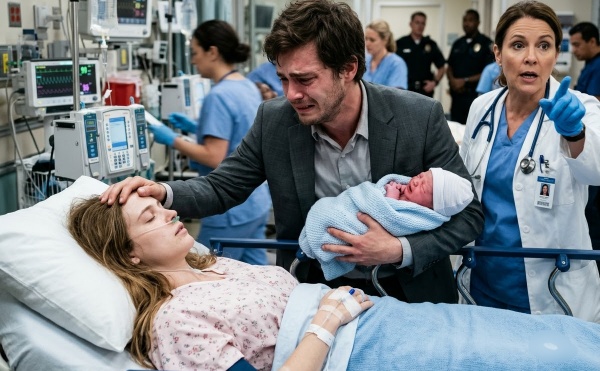
I came home with groceries, expecting to find my wife and our newborn asleep. But when neither of them responded, I called 911 and watched as paramedics rushed them to the hospital. The doctor asked me a few questions, then suddenly ordered someone to call the police and fire department. What they discovered at our house changed the way I would hear silence forever.
Part 1: The House Was Too Quiet
My son was seven days old when I came home and found him seriously ill beside his unconscious mother.
At first, I thought they were asleep. Nora was lying on the living room couch, and Owen was beside her in his bassinet. The television was on low, a blanket had slipped onto the floor, and the bottle I had prepared that morning was still sitting on the coffee table.
I put the grocery bags down and said, “I got the good bagels.”
Neither of them moved.
The house was quieter than it had been in a week. Since bringing Owen home, Nora and I had learned to sleep in fragments, eat with one hand, and celebrate every successful feeding as if we had won a championship. Silence was rare enough that, for one foolish second, I thought I had arrived during a miracle nap.
Then I saw Nora’s phone on the rug. Its screen was lit, but the call she had apparently tried to make had never connected. Her fingers were a few inches away from it.
“Nora?”
I crossed the room and touched her shoulder. Her skin felt warm, but she did not respond. I called her name again, louder this time, and turned toward Owen.
His eyes were closed, and he seemed unusually still. I had left him fussing less than an hour earlier, his tiny face scrunched in protest because he hated having his diaper changed. Now I could not wake him the way I normally could.
I called 911 with hands that barely seemed attached to me. The dispatcher asked for our address, what had happened, and whether Nora and Owen were breathing. I answered as best I could while following her instructions.
“We’re sending help,” she said. “Stay on the line with me.”
Our duplex stood on a quiet street outside Pittsburgh, with a narrow porch and a maple tree that dropped leaves into the gutters every fall. We had rented the place six months earlier because it was close to Nora’s mother and had a second bedroom for the baby. The landlord had described it as an old house with new updates, a phrase I had repeated to our friends as though it guaranteed something.
I heard the sirens before I saw the ambulance. Two paramedics came through the front door carrying equipment, followed by another responder who asked me questions while they assessed Nora and Owen. I told them my wife had complained of a headache that morning, but we had both assumed it came from exhaustion.
A paramedic lifted Owen carefully and began checking him. Another worked beside Nora, speaking to her even though she could not answer. Someone asked whether either of them had been sick, taken medication, or fallen, and I said no to everything I knew.
“What happened before you left?” one of them asked.
“Nora said she felt tired. She’d been up most of the night with the baby.”
“Did she say anything else?”
“She said her head hurt. I told her to lie down while I got groceries.”
I heard myself say the words and felt a terrible certainty that I should have known more. But the paramedic did not stop to assign blame. He asked which hospital Nora preferred and explained that both she and Owen needed urgent care.
I rode in the ambulance while my neighbor, Mrs. Alvarez, promised to lock the house and call Nora’s mother. The paramedics monitored my wife and son during the drive. I sat facing them, gripping the edge of the seat, unable to do anything useful.
Nora opened her eyes briefly as we pulled into the hospital. She looked confused and tried to speak, but I could not understand what she said. I leaned toward her and told her Owen was with us.
The emergency department separated them for assessment, though the rooms were close enough that I could hear people moving between them. A nurse asked me to provide Owen’s birth date, weight, and feeding history. I knew the answers, but fear made each one feel like a question from an examination I had forgotten to study for.
A physician named Dr. Lena Park examined Nora and then spoke with the team caring for Owen. She asked me when each of them had last seemed normal and whether anyone else had been in the house. I told her I had been out for groceries and that the people next door shared the other half of the building.
“Has anyone else had headaches or felt unusually tired?” she asked.
I remembered Mrs. Alvarez mentioning that she had been dizzy the day before. I remembered my own headache on the previous evening, the one I had blamed on a week without sleep. I told Dr. Park both things.
She turned to the nurse beside her. “We need to consider carbon monoxide exposure.”
I had heard of carbon monoxide, but in that moment it was only a phrase. Dr. Park explained that it was a poisonous gas that could not be seen or smelled, and that people in the same building might be exposed without realizing it. The team was already treating Nora and Owen while arranging the tests and monitoring they needed.
“Could it be in our house?” I asked.
“It’s possible. We need emergency responders to check, especially because other people may still be there.”
She looked toward the nurses’ station and raised her voice. “Call 911. We need the fire department and police at that address now.”
My first thought was that I had done something wrong. My second was Mrs. Alvarez, who had gone back into her side of the duplex after promising to lock our door. I grabbed my phone and called her, but Dr. Park gently took it from my hand when she saw how badly I was shaking.
“Tell them she may be inside,” she said to the nurse making the emergency call. “And tell them there are two connected units.”
A few minutes later, my phone rang. It was Mrs. Alvarez, coughing and frightened, calling from the sidewalk. Firefighters had arrived and told everyone to leave the building.
“They said not to go back in,” she told me. “Evan, what’s happening?”
I looked through the glass toward the room where Nora lay surrounded by people trying to help her. I could not answer Mrs. Alvarez because I still did not know. All I knew was that something in our home might have made my wife and my seven-day-old son terribly sick.
Then a firefighter came on the line. His voice was calm, but the words made my stomach drop.
“Sir, we’re getting elevated carbon monoxide readings inside the building. We’re checking both units and making sure everyone is out.”
I had left the house to buy bagels. While I was gone, something I could not see or smell had nearly taken my family from me.
Part 2: The Alarm That Never Sounded
Nora woke up enough to ask for Owen shortly after midnight.
A nurse explained that he was being cared for nearby and that the doctors would update her as soon as they could. Nora tried to sit up, then closed her eyes when the room seemed to move. I took her hand and told her he was not alone.
“What happened?” she asked.
“We think there was carbon monoxide in the house.”
She looked at me as if I had named a country she had never heard of. “The alarm didn’t go off.”
That was what I had been thinking since the firefighter called. There was a small white alarm in the hallway outside our bedroom. I had passed it every day while carrying laundry, baby blankets, and grocery bags, and I had never once imagined that it might not protect us.
Dr. Park explained that the hospital team was treating Nora and Owen with oxygen and monitoring them closely. Their blood tests and the information from the house supported the concern about carbon monoxide exposure. She was careful not to promise a particular outcome, especially for a newborn who needed close observation.
I asked whether I had been exposed too. She said I should be evaluated because I had spent time in the building, even though I felt better than Nora. A nurse took me to another room while I protested that my wife and son needed me.
“They also need you to be safe,” she said.
The tests and assessment showed that I had likely been exposed as well, though I was less affected. I had been out of the house longer, and the doctors explained that the amount of exposure and each person’s response could differ. I received care and was told what symptoms to report.
Nora’s mother, Diane, arrived at the hospital carrying Owen’s diaper bag and wearing slippers beneath her raincoat. She had driven straight from her house after Mrs. Alvarez called her. When she saw Nora awake, she held her daughter’s face between her hands and cried without making a sound.
“Where’s the baby?” she asked.
“With the doctors,” I said. “They’re watching him.”
Diane looked at me, waiting for the confidence I usually tried to provide. I had none to offer. I told her exactly what the doctors had said and stopped before I invented reassurance they had not given us.
Owen was admitted for close monitoring. He was so small in the hospital bassinet that every blanket seemed too large for him. A nurse showed us where we could sit and explained what the equipment was doing without making us feel foolish for asking twice.
I stood beside him and remembered the first time I had held him seven days earlier. He had opened one eye, frowned at the ceiling, and wrapped his hand around my finger. I had believed that bringing him home meant the most frightening part was over.
Around two in the morning, a police officer came to speak with me. He was not there to arrest anyone, and he did not accuse me of hurting my family. He wanted to know who had access to the property, whether there had been recent maintenance, and whether anyone had reported problems with appliances or alarms.
“Our landlord sent someone last month,” I said. “They were checking the hot water.”
“Do you know the company?”
“I have the messages on my phone.”
He asked me to preserve them and not return to the house until the fire department and other appropriate professionals said it was safe. I showed him the landlord’s name and the dates I remembered. He wrote everything down, thanked me, and said investigators would determine what had happened.
When he left, I opened the message thread myself. Three weeks before Owen was born, I had told our landlord, Martin Bell, that the hot water sometimes stopped during showers. He replied that he would send a technician and that the problem was probably minor.
A technician came two days later. I had been at work, but Nora was home and let him into the basement. That evening, she told me he had spent less than half an hour there and said everything was fine.
I had not asked for a report. We were assembling a crib, washing tiny clothes, and trying to decide whether we needed a changing table. The technician’s visit had seemed like one more item crossed off a long list.
I searched my email for the alarm instructions the landlord had sent when we moved in. There was a message saying the property had smoke alarms and carbon monoxide alarms, but it did not list their locations or ages. I had tested the smoke alarm once after burning toast; I had never checked the other device carefully.
At sunrise, a fire official called with an update. The responders had found elevated carbon monoxide in the building and identified a problem associated with a fuel-burning appliance and its venting. The equipment had been shut down, and the building would remain off-limits until qualified professionals addressed the hazards.
“What about the alarm?” I asked.
He said investigators were still examining the devices and the building. One alarm had not provided the warning we needed, but he did not yet know why. He cautioned me not to draw conclusions before the inspection was complete.
That afternoon, Martin called. He sounded shaken, and he asked how Nora and Owen were doing. Then he said the technician had checked everything recently and that he could not understand how this had happened.
“I don’t know either,” I said.
“Maybe the alarm battery died. Those things happen.”
“Maybe,” I replied. “The investigators are looking at it.”
There was a pause. “You don’t think I knew there was a problem, do you?”
At that point, I did not know what to think. I knew only that my wife and son were in a hospital, Mrs. Alvarez had also needed medical attention, and a house we had believed was safe had become a place we could not enter. I told Martin I would share any records I had with the people investigating.
After the call, I sat beside Nora’s bed. She was awake, though tired, and Diane had gone downstairs for coffee. I told her what the fire official had said.
Nora stared at the blanket over her legs. “I remember trying to feed Owen,” she said. “He was sleepy, and I thought he’d wake up in a minute. Then my head started hurting so badly that I couldn’t think.”
“You reached for your phone.”
“I think so.” She looked at me, frightened. “I remember seeing him in the bassinet, and I remember thinking I needed help. After that, I don’t remember anything until the ambulance.”
I wanted to tell her it was over. The building had been evacuated, the doctors were treating them, and the immediate danger had passed. But Owen was still being monitored, and I could not offer certainty just because she needed it.
Instead, I pulled my chair closer. “You’re here,” I said. “He’s here. We’re going to take this one step at a time.”
That evening, the officer called again. He asked me to send copies of the messages with Martin and the technician’s company. Then he said something that made me sit up straight.
“Mr. Bell gave us a maintenance record showing an inspection last month,” he said. “We’re checking the details. Did you or your wife receive a copy at the time?”
“No,” I said.
“Do you remember the name of the technician who visited?”
I looked through the messages. Martin had written only that “a man from the company” would come by. The officer thanked me and ended the call.
I stared at the phone. Until then, I had assumed the frightening part of the story was finding Nora and Owen. I had not yet understood that the questions about our house were only beginning.
Part 3: The Inspection That May Never Have Happened
Two days later, Owen was alert enough to object loudly to a nurse changing his diaper.
It was the first time his cry sounded like the one I remembered from home. Nora laughed and cried at the same time, and the nurse smiled as if she had seen parents react that way before. We did not take the sound as proof that every worry was gone, but it felt like a door opening.
The doctors continued to monitor him and explained the follow-up care they wanted after discharge. Nora’s condition was improving too, though she was exhausted and still processing what had happened. We asked questions, wrote down the answers, and asked some of them again when fear made the first answers disappear.
Diane brought us clean clothes and a photograph of Owen taken the day he was born. In it, Nora was holding him against her chest while I leaned awkwardly into the frame. All three of us looked surprised to be there.
“You’re going to have a hundred more photographs,” Diane said.
I wanted to believe her with the uncomplicated confidence I had before the ambulance. Instead, I thanked her and tucked the picture into the pocket of my jacket. I carried it there for weeks.
The police asked to speak with Nora when she felt well enough. An officer visited her room and explained that the investigation was still in its early stages. He wanted her account of the maintenance visit and any concerns she had raised with the landlord.
Nora remembered letting a man into the basement. He wore a work shirt with a company name on it and carried a small bag. She had offered him coffee, but he said he would not be long.
“Did he tell you what he checked?” the officer asked.
“He said the hot water should be fine.” Nora paused. “I asked about the alarm in the hallway because it had made a short noise the week before.”
“What did he say?”
“He looked at it and told me it was probably a battery warning. He said the landlord would take care of it.”
The officer wrote that down. Nora had texted Martin afterward, and he had replied, Thanks. I’ll check on it. Neither of us had followed up when we did not hear more.
I wanted to tell the officer that we had been busy, that Nora was heavily pregnant and I was working extra shifts, that the alarm had not made the sound again. All of that was true. None of it changed the fact that I had read the message and assumed someone else would handle it.
A few days later, the fire official shared the preliminary findings. The alarm outside our bedroom was old and was not functioning as it should have. The investigation was still examining the appliance problem, the maintenance history, and whether other alarms had been installed and placed appropriately.
He did not say the landlord had intentionally endangered us. He did not say the technician had caused the problem. He said qualified investigators were gathering records and that conclusions would follow the evidence.
That caution frustrated me at first. I wanted a person to point to, someone whose name could carry the weight of what I had seen on our living room floor. But Nora was the one who reminded me that an accusation would not make Owen stronger or bring us answers faster.
“We need them to get it right,” she said.
Martin called again while I was sitting in the hospital cafeteria. This time he sounded less frightened and more defensive. He said he had a receipt showing that a maintenance company had visited the property before Owen was born.
“I’ve always taken care of that place,” he said. “I don’t want anyone suggesting otherwise.”
“The investigators will review the records,” I replied.
“I’m just saying, accidents happen.”
I looked down at the untouched sandwich on my tray. I did not know whether the word accident was accurate, and I was not ready to argue about it. I told Martin we would communicate about housing and records in writing.
Nora and Owen were discharged on different days. Nora went first, with instructions for her own follow-up and a warning to seek care if concerning symptoms returned. She refused to leave the hospital until she had spent another hour beside Owen, reading him a children’s book Diane had bought in the gift shop.
We stayed with Diane because the duplex was still closed. She turned her dining room into a temporary nursery and put a small lamp beside the couch for nighttime feedings. The house was crowded, but every room contained someone who knew how to ask whether another person needed help.
When Owen came home, Diane made soup and insisted that Nora sleep while she washed bottles. I carried our son around the living room, stopping every few minutes to make sure he was breathing comfortably. I knew the habit would make it difficult for anyone to rest, but I could not stop watching him.
One evening, Nora found me beside his bassinet at three in the morning. I was holding my phone with the flashlight on, checking his face. She stood in the doorway with a blanket around her shoulders.
“Evan,” she said softly, “he’s okay right now.”
“I know.”
“You’ve said that four times tonight, and you’re still checking.”
I sat down in the chair beside the bassinet. “I keep thinking about what would have happened if the grocery store line had been longer.”
Nora crossed the room and sat beside me. “I keep thinking about what would have happened if I’d asked you to stay.”
We looked at each other in the dim light. Both versions of the story ended somewhere we did not want to go. Neither changed the fact that we had asked for help and that help had arrived.
A week after the incident, the officer called with an update. He said the records showed a maintenance visit had occurred, but the document Martin had provided described a broader safety inspection than the technician’s own work notes appeared to show. Investigators were following up with the company and the people involved.
“Does that mean the record was falsified?” I asked.
“It means there’s a discrepancy we need to understand,” he said. “I can’t tell you more than that yet.”
After the call, I found the message Nora had sent Martin about the alarm. Beneath it was his reply: I’ll check on it. I read those four words until Nora took the phone from my hand.
“We can give them the records,” she said. “We don’t have to solve the case tonight.”
She was right. But I still wondered why Martin had been so quick to tell us the alarm’s failure was simply something that happened. I also wondered how many times people had trusted the same kind of reassurance because they were busy living their lives.
Part 4: The Questions Nobody Wanted to Answer
We did not return to the duplex.
The landlord arranged for repairs, and the building eventually underwent further inspection, but Nora and I could not imagine bringing Owen back to the living room where I had found them. We spoke with a tenant attorney before making decisions about the lease and our belongings. She advised us to document our expenses, keep copies of communications, and avoid assuming that every question about responsibility had already been answered.
We needed clothes, Owen’s medical records, and the small box of family photographs Nora had placed in the bedroom closet. We asked when it would be safe to retrieve them. The property manager coordinated a time after professionals had addressed the immediate hazards and the appropriate officials permitted entry.
Nora decided not to come. She said she could not yet bear to stand in the doorway, and I did not ask her to prove otherwise. My brother, Daniel, went with me.
The house looked exactly as it had when the ambulance left. A grocery bag still sat near the kitchen counter, and one of the bagels had gone hard inside the paper. Owen’s blanket lay folded over the arm of the couch, where a neighbor must have placed it after the emergency.
I picked up the bag and threw the food away. The ordinary motion made me angry in a way I did not expect. I had wanted the house to look different, to carry some visible mark of what had happened there.
Daniel found the box of photographs while I collected clothes. In Owen’s room, the mobile we had hung above the crib moved slightly when I opened the door. It played a few soft notes, and I had to sit down on the floor.
We had spent a Saturday choosing that mobile. Nora wanted the one with stars, and I wanted the one with little woodland animals. We bought the stars because she said our son could learn about raccoons when he was old enough to see them in the backyard.
Daniel sat beside me without speaking. He had spent years solving problems by finding the right tool, making the right call, or driving to wherever someone needed him. That afternoon, he seemed to understand there was nothing he could fix with his hands.
“I should have checked the alarm,” I said.
“You didn’t know it wasn’t working.”
“I knew Nora had mentioned it.”
“You also knew the landlord said he’d check it.” Daniel looked toward the hallway. “You can wish you’d done something differently without deciding you caused this.”
I wanted to believe him, but guilt had become a habit. It gave me the illusion that there had been a simple choice I could identify and reverse. The truth was harder: we had depended on several layers of safety, and more than one had failed us.
The investigation continued while we searched for a new place to live. The fire department’s findings, maintenance records, and interviews were reviewed by the appropriate authorities. Our attorney requested records separately and reminded us that a civil claim and a criminal investigation were different processes.
Martin’s insurance representative contacted us about medical bills and temporary housing. Our attorney handled those conversations because we were too tired to understand every form and deadline. I was grateful for the help, though I hated how quickly our family’s worst night became a stack of paperwork.
A month later, the officer told us that the investigation had found evidence of inaccurate maintenance documentation. The records described work that investigators could not verify as completed, and the company’s internal notes did not match the report Martin had provided. The matter had been referred for further review.
“Will someone be charged?” I asked.
“That decision hasn’t been made,” he said. “The evidence needs to be reviewed, and I can’t predict the outcome.”
I thanked him. After the call, I felt both relief and disappointment. The discrepancy mattered, but it was not the clean ending I had imagined during the long nights at Diane’s house.
Nora listened while I repeated what the officer had said. Then she asked whether Mrs. Alvarez had found another place to stay. I had been so focused on our own appointments that I had not called her in several days.
Mrs. Alvarez was staying with her daughter. She told me she was feeling better and had been attending the follow-up appointments her doctors recommended. She also admitted that she had been nervous about sleeping, afraid she might not wake up if something else went wrong.
“I keep listening for alarms,” she said.
“Me too.”
We talked for nearly an hour. She told me about her grandchildren and the tomato plants she had left behind. I told her Owen had begun making a squeaky noise after he ate, which Diane insisted was adorable and I insisted sounded like a tiny hinge.
When I hung up, I realized the duplex had contained more than our family’s story. Mrs. Alvarez had trusted the building too. Her life had also been interrupted by something neither of us could see.
In September, we found a small rental house closer to Nora’s mother. Before signing, we asked about the heating equipment, maintenance records, and working smoke and carbon monoxide alarms. The property manager answered our questions and arranged for us to review the safety information with a qualified professional.
I checked the alarms after we moved in, following the manufacturer’s instructions. I also put reminders on my calendar to test them and follow the recommended maintenance and replacement schedule. I knew a reminder could not guarantee safety, but it was something practical I could do instead of replaying the grocery store line.
The first night in the new house, Owen slept for nearly four hours. Nora woke before he did and stood in the doorway of his room. I found her there with her arms folded across her chest.
“I thought I heard him stop,” she whispered.
We listened together. A moment later, he made the squeaky sound Diane loved. Nora let out a breath, and I put my arm around her.
Neither of us slept much after that. We did not tell each other to stop worrying or insist that everything was normal. We sat at the kitchen table until dawn, learning that feeling safe again might take longer than finding a safe place to live.
Part 5: The Sound I Needed to Hear
The review of the maintenance records continued into the following year.
Eventually, the company acknowledged problems with its documentation, and the parties involved addressed the matter through their respective legal processes. Our attorney explained each development without promising that any outcome would feel satisfying. Some questions could be answered on paper; others would remain in our memories.
We also resolved our civil claim after months of discussions involving medical expenses, temporary housing, and the disruption to our lives. The agreement did not make us wealthy or erase what had happened. It helped cover documented costs and allowed us to stop measuring every decision against a bill on the kitchen counter.
I used to imagine that justice would arrive as a single moment. I pictured someone standing in a courtroom, saying exactly what went wrong, followed by a feeling of relief so complete that Nora and I would finally sleep. Real life did not arrange itself that neatly.
The medical follow-ups mattered more to us than any dramatic speech. Owen’s doctors monitored his development and answered our questions about what they could and could not predict. We learned to bring a notebook, listen carefully, and celebrate the ordinary milestones instead of treating each one as a final verdict.
When he rolled over, Diane cheered so loudly that he startled himself. When he began reaching for a stuffed rabbit, Nora took a photograph and sent it to everyone in the family. When he laughed for the first time, I played the recording so often that my brother asked whether I had any other music.
Nora had her own recovery. Some days she felt strong and impatient to return to the life she had expected after Owen’s birth. On other days, a headache or an unusually quiet room brought the fear back before she could reason with it.
Her doctor helped her understand which symptoms needed attention and where to seek care. She also began speaking with a counselor about the night she remembered only in fragments. I went to a few sessions myself, because I had discovered that checking on Owen every ten minutes was not the same as protecting him.
One afternoon, I told the counselor about the grocery bags. I described the bagels, the spilled blanket, and the way I had said, “I got the good ones,” before I understood anything was wrong. I expected him to tell me I should have noticed Nora’s headache sooner.
Instead, he asked what I had done when I realized there was an emergency. I told him I had called 911 and followed the dispatcher’s instructions. He asked whether I could make room for that fact alongside the things I wished had happened differently.
It took time. I had been holding on to guilt because it felt like a way to stay alert. Slowly, I began to understand that paying attention to the present did not require punishing myself for every imagined version of the past.
Dr. Park sent a note after one of Owen’s follow-up appointments. It was short and professional, thanking us for the update and saying she was glad to hear he was progressing. Nora put it on the refrigerator beside a photograph of him wearing a hat shaped like a bear.
I thought often about the moment Dr. Park had raised her voice. At the time, I heard the word police and feared that someone was about to blame me. Later, I understood she had been thinking about the people still inside the building, including Mrs. Alvarez.
She had not waited for every answer before asking for emergency responders. She had treated the information she had as a reason to protect anyone who might still be in danger. That decision mattered to more people than the three of us.
When Owen was nearly one, Mrs. Alvarez came to visit. She brought a small tomato plant for our porch and a stuffed dog that was almost as large as he was. He grabbed the dog’s ear and refused to let go.
We drank coffee while Owen crawled across the living room. Mrs. Alvarez told us she had found a new apartment and had checked the alarms with her daughter when she moved in. She said it casually, but I noticed the way Nora nodded.
Before she left, Mrs. Alvarez stood by Owen’s play mat and watched him pull himself up against the couch. “He doesn’t know how many people were worried about him,” she said.
“No,” I replied. “I hope he never has to understand it the way we did.”
On his first birthday, we held a small party in Diane’s backyard. There were paper plates, a cake with blue frosting, and a handful of relatives who had been waiting a year to celebrate without looking over their shoulders. Owen put both hands into the cake before anyone finished singing.
Nora laughed so hard she had to sit down. I took a photograph of her holding our son, frosting on both of their faces and sunlight in her hair. It became my favorite picture, though it was not as carefully framed as the one from the day he was born.
After everyone left, I carried Owen inside for a bath. He was tired and complained loudly about having the frosting washed from his hands. The sound filled the bathroom, and Nora called from the hallway to ask whether he was all right.
“He’s furious,” I said.
“Good,” she replied. “That means he has energy.”
Later, after he was asleep, Nora and I sat on the porch. The tomato plant had begun to grow, and the street was quiet except for a dog barking somewhere down the block. I could hear Owen’s monitor through the open window.
“Do you ever think about that night?” I asked.
“Every day,” she said. “Not all day anymore. But every day.”
I told her I still remembered the sound of the alarm that never came. Then I corrected myself: what I remembered was the silence, and everything I had believed that silence meant. I had thought a quiet house was a safe house.
Nora reached for my hand. “We know more now.”
We did. We knew that carbon monoxide could not be seen or smelled, that a working alarm was an important warning, and that symptoms affecting several people in the same building needed urgent attention. We also knew that when responders told us to leave, the safest choice was to stay out until qualified professionals said otherwise.
But the lesson I carried most deeply was not about a device on a wall. It was about the people who answered: the dispatcher who kept me focused, the paramedics who cared for my family, the doctor who thought of our neighbor, and the people who helped us rebuild when we could not go home.
Inside the house, Owen made a small noise through the monitor. Nora and I both turned toward it, then smiled at each other. A year earlier, that sound would have sent me running.
I stood, opened the door, and went to check on him anyway. He was asleep on his back, one hand curled beside his face, breathing softly in the room we had made for him. I watched him for a moment, then returned to the porch and sat beside my wife.
For the first time in a long while, the quiet felt peaceful.
