My Mother-in-Law Gave My Husband’s Mistress a Gold Bracelet at Our Divorce Dinner. I almost stayed silent—until I saw the dent and the little star my mother had left on that bracelet years before she died. What happened next made the whole room reconsider what they had just celebrated.
PART I — THE GIFT
My mother-in-law placed a gold bracelet on my husband’s mistress at our divorce dinner, and his family applauded as if I had never belonged at their table.
My husband smiled like a man who had already won. He had no idea that the bracelet on her wrist would turn that evening into something his family would remember very differently.
The worst part was not watching another woman take my place. It was recognizing the small, uneven star engraved beside the clasp—a mark I had watched my mother make with her own hands.
My name is Nora Bennett. I was thirty-nine that November, a museum collections manager in San Diego, and five weeks away from finalizing my divorce from Owen Bennett. We had been married for twelve years, long enough for his family to call me “one of us” and apparently not long enough for them to mean it.
The dinner was held at a private room in a restaurant overlooking the harbor. White linen covered the tables, candles burned inside glass hurricanes, and beyond the windows, boats moved through the dark water. From a distance, it could have been an anniversary dinner.
Owen’s mother, Diane, called it a “family transition dinner.” She said we had all been through a difficult year and deserved an evening of grace before the divorce was final. My younger sister, Leah, called it something less printable when I told her about the invitation.
“Why would you go?” she asked. “They can transition without you.”
“I know.”
“Then don’t.”
I should have listened to her. But Owen’s grandmother, Rose, had called me herself and asked if I would come. At eighty-six, she had been the one person in that family who never made affection feel conditional.
“I don’t expect you to stay long,” Rose told me. “I just want to see you before everyone starts pretending you were never here.”
That was a painfully accurate description of what was already happening. Diane had removed our wedding photo from the mantel months before I moved out. Owen’s sister had stopped inviting me to birthdays, and his cousins had begun using Brooke’s name in family group messages that still included me.
Brooke Lawson was the woman Owen had started seeing while we were still married. She was thirty-four, worked in luxury real estate, and had first appeared in our lives as a friend of his sister’s. Owen insisted nothing had happened until after our separation, though I had seen enough messages and hotel charges to know that was not true.
By the time I arrived at the restaurant, Brooke was seated beside Owen. She wore a dark green dress and the cautious smile of someone determined to seem gracious while occupying a chair that used to be mine. Owen stood when he saw me, as though good manners could undo poor character.
“Nora,” he said. “I’m glad you came.”
“I’m here for Rose.”
His smile tightened, but he pulled out the chair across from him anyway. I thanked him without sitting until Rose reached for my hand from the next seat.
For the first half hour, everyone behaved. We discussed the weather, Rose’s garden, and a cousin’s new job in Sacramento. Diane asked about the museum, using the bright voice she reserved for conversations she wanted other people to overhear.
Then dessert arrived.
Diane rose with a small cream-colored box in her hands. Her face took on the solemn, pleased expression she used when giving speeches at charity luncheons. I felt Owen straighten across the table.
“I know this year has brought changes,” Diane began. “But I believe a family should welcome the people who help it move forward.”
Rose’s hand went still beside her coffee cup.
Diane turned to Brooke. “You’ve brought so much happiness back into Owen’s life.”
Brooke glanced at me, then at her plate. For one brief second, I thought she might decline whatever was coming. Instead, she stood.
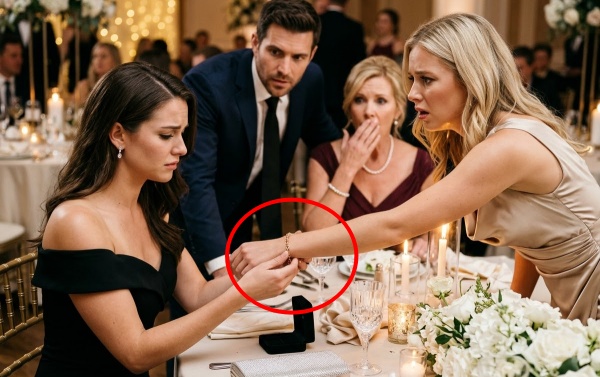
Diane opened the box and lifted out a wide gold bracelet. Its surface caught the candlelight, throwing a soft glow across her fingers. She slipped it around Brooke’s wrist and fastened the clasp.
The room broke into applause.
Owen’s sister clapped first. His father followed, then two cousins and an uncle at the end of the table. Owen smiled at Brooke with unmistakable pride.
I did not move.
I knew that bracelet.
My mother had worn it on every important day of my childhood. On my high school graduation day, she had used it to tap gently against the back of my hand when I was too nervous to eat breakfast. Years later, when I got my museum job, she had held out her wrist and joked that it was her “special-occasion armor.”
There was a shallow dent near one edge from the time she dropped it on our kitchen floor. Beside the clasp was the tiny star she had engraved herself after taking a metalworking class in her fifties. No two bracelets in the world had those marks in those places.
My mother, Evelyn, had died nine months earlier.
Three weeks before she died, she gave the bracelet to me.
Diane was still talking. “I found this beautiful piece through Owen. It felt right to give Brooke something lasting.”
Through Owen.
I looked across the table at him. He was watching Brooke turn her wrist, admiring the gold against her skin.
He had taken the bracelet from the cedar box I left in the house when we separated. Then he had handed it to his mother without knowing what it was—or without bothering to ask.
The applause faded. Someone raised a glass, and Brooke murmured a thank-you.
Rose leaned toward me. “Nora?”
I heard the concern in her voice, but I could not answer yet. I was staring at the bracelet my mother had given me for a future she would not live to see, fastened to the wrist of the woman my husband had brought to celebrate the end of our marriage.
Owen noticed my expression at last.
“What?” he asked quietly.
I looked at him, then at his mother. “Where did you get that bracelet?”
Diane’s smile remained in place. “As I said, Owen found it for me.”
“Where did he get it?”
Owen gave a short laugh. “Nora, not tonight.”
Brooke lowered her wrist.
I stood, though I had not decided to. “That bracelet belonged to my mother.”
No one applauded then.
PART II — WHAT MY MOTHER LEFT ME
The last time I had seen the bracelet, it was inside a small cedar box in the upstairs closet of the house Owen and I once shared. Beneath it was the note my mother had written when she gave it to me.
You don’t have to earn a place in a room where you are loved.
She wrote that because she knew more about my marriage than I had been willing to admit. Mom never told me to leave Owen. She simply listened when I called after another dinner at which Diane had praised my cooking, then explained how she would have made everything differently.
My mother was a public school art teacher in Oceanside for thirty-one years. She drove an aging Honda Civic, saved grocery coupons in an envelope, and believed the proper response to a difficult week was soup and a long walk. The bracelet was one of the few expensive things she owned.
She had bought it years before I was born with money she earned painting storefront signs during a summer break. It was solid gold, beautifully made, and more elaborate than anything else in her jewelry box. She wore it without treating it as too precious for ordinary life.
When I was seven, I asked why she wore it while painting the kitchen.
“Because it’s mine,” she said. “I don’t have to wait for somebody else to decide today is special.”
After she died, I could barely open her boxes. I handled the necessary paperwork and donated her teaching supplies to an arts program, but I kept the cedar box beside my bed. Some nights I opened it just to see the indentation where the bracelet rested.
Then my marriage ended.
Owen and I had spent years pulling apart so gradually that neither of us could name the day it began. My mother’s illness made the distance impossible to ignore. During her final months, I spent my evenings driving up Interstate 5 to help her, while Owen complained that I was never home and said Diane felt neglected because I had missed Sunday dinners.
After the funeral, I tried to explain how lonely I felt. Owen told me he was lonely too. I thought we were beginning an honest conversation, but he had already been exchanging messages with Brooke for months.
I found out because a restaurant receipt appeared in our shared account on a night he told me he was working late. I asked him about it. He said it was a client dinner, then admitted Brooke had been there, then said I was making an innocent friendship sound ugly.
Three weeks later, I found messages that were not innocent. By then, arguing over the exact day his affair began felt like standing in a flooded house debating the first drop of rain. I moved into a short-term apartment and hired an attorney.
The move happened quickly. I took my clothes, work files, photographs, and Mom’s handwritten recipes. I left larger boxes in the upstairs closet because Owen and I had agreed, through our attorneys, on a later date for me to collect them.
The cedar box was among them.
I had packed it inside a larger carton labeled NORA — PERSONAL / MOM. I remembered sealing the carton with blue tape because Leah had run out of clear packing tape halfway through helping me. When I returned for the scheduled pickup three weeks later, the carton was missing.
Owen said he had put several boxes in storage and would check. A week later, he said he had found most of them but not that one. His attorney’s email described it as “a box of miscellaneous personal effects.”
There was nothing miscellaneous about it to me.
I sent an inventory listing the cedar box, Mom’s bracelet, a few family photographs, and her letters. Owen’s attorney replied that Owen had no knowledge of the bracelet. My attorney, Priya Shah, advised me to keep the correspondence and continue documenting what was missing while we worked through the property issues.
I did not know Owen had already found the box.
At the dinner table, Diane stared at me with irritation rather than recognition. “Nora, I understand this is awkward, but there is no need to make an accusation over a gift.”
“I’m not guessing,” I said. “My mother owned that bracelet.”
Owen leaned forward. “It was in a box of things you left behind.”
The words were out before he could stop them.
Rose turned toward him. Brooke did too.
“You told my attorney you didn’t know where the box was,” I said.
“I said I didn’t know where all your boxes were.” His voice sharpened. “That bracelet was in our house. You left it.”
“I left it for a scheduled pickup. You knew that.”
Diane looked between us. “Owen told me it was an old bracelet he found while clearing out the house. I had it polished.”
I pulled my phone from my purse and opened a photograph. Mom was standing beside me at my college graduation, her arm around my shoulders, the bracelet visible on her wrist. I enlarged the image and placed the phone on the table.
“Same dent,” I said. “Same clasp. The small star is on the inside.”
Brooke held her wrist closer to her face. She turned the bracelet slowly until she found it.
“Oh,” she said.
It was one small sound in a very quiet room.
Owen reached for the phone. I moved it away.
“I have more photographs,” I said. “And the appraisal Mom had done before she gave it to me. Owen also has the written inventory I sent after the box disappeared.”
His father, Martin, set down his glass. “Owen, did you know it was Evelyn’s?”
“No,” Owen said quickly. “I thought it was something Nora didn’t want.”
“You knew I wanted the box,” I said.
“That doesn’t mean I knew what was inside it.”
It might even have been true. That was what hurt: he did not have to know its history to know it was mine. He had taken something from a box with my name on it and decided its meaning was his to assign.
Brooke began fumbling with the clasp. “I’m taking it off.”
Diane reached for her hand. “You don’t need to respond to this in the middle of dinner.”
Brooke pulled away. “It’s her mother’s bracelet.”
For the first time all evening, Diane had no prepared answer.
PART III — THE ROOM CHANGES
Brooke could not open the clasp with one hand. Her fingers shook, making the small catch harder to lift. Rose reached across the table.
“Let me, dear.”
Brooke let her.
Rose had known my mother. They had talked for nearly an hour at my wedding, comparing the frustrations of raising children who thought politeness and honesty were interchangeable. Rose unfastened the bracelet and held it in her palm.
She looked at the little star.
“Evelyn made that,” she said.
I nodded.
“She showed me at your birthday dinner,” Rose continued. “She said she was afraid her hand wasn’t steady enough, but you would know it was hers.”
The room blurred.
I had forgotten Rose was there that night. I remembered Mom arriving with a lopsided cake and laughing because she had put the candles on backward. I remembered Owen leaving early for a work call.
Rose handed me the bracelet.
I closed my fingers around it, feeling the familiar weight settle against my skin. For a moment, I wanted to leave without another word. I had what I came to realize I had lost.
But Owen was already trying to make the rest of the story smaller.
“This is a misunderstanding,” he told the table. “I found a piece of jewelry in the house and gave it to Mom. I didn’t know it was some important heirloom.”
“You told your attorney you couldn’t find the box,” Rose said.
Owen looked at her. “Grandma, please.”
“No. I heard you.”
Diane folded her napkin in precise quarters. “There’s no reason for this to become a family spectacle.”
“You stood up and gave the speech,” I said. “I didn’t bring it to the table.”
Brooke had sat back down. She was staring at the pale mark the bracelet had left on her wrist, as though she could still feel it there.
“I didn’t know,” she told me.
“I believe you.”
Her eyes lifted, surprised.
I did believe her. Whatever Brooke had known about Owen and me when their relationship began, she had not known whose bracelet she was receiving. Diane had presented it as a welcome gift; Brooke had accepted it in front of the family.
That did not make us friends. It simply meant I had no reason to blame her for this particular act.
Martin turned to Owen. “Where’s the rest of the box?”
“I don’t know,” Owen said.
“You found the bracelet inside it.”
“I put some things in the garage. I’d have to look.”
That was the moment I stopped treating dinner as a conversation. There were letters in that box I had not read since my mother died. There were photographs of my grandparents and a small silver pendant Mom wore when she taught.
I put the bracelet carefully in my purse.
“I’ll have Priya contact your attorney tomorrow,” I said. “I want the whole box returned.”
Owen’s mouth tightened. “Of course you’re turning this into another legal fight.”
“You already made it part of the divorce when you told your attorney it was missing.”
For several seconds, we looked at each other across the table. I had loved him once, and I could still see traces of the man I had loved. But the person sitting there seemed more upset about being contradicted before his family than about what he had done.
Diane rose again, less gracefully this time. “I think it would be best if we ended the evening.”
Rose remained seated. “The evening ended when you handed Brooke Evelyn’s bracelet.”
Diane looked wounded. “I had no idea.”
“I know,” Rose said. “That’s the trouble. None of you thought to ask.”
I said goodbye to Rose in the hallway outside the private dining room. She held both my hands and apologized, though she had done nothing wrong. Then she told me to call when I got home.
Leah was waiting in my apartment with takeout when I arrived. I had texted only, You were right. I’m coming home. She took one look at my face, set down the cartons, and hugged me.
I told her what happened while we sat on the kitchen floor, because neither of us thought to move to the table. When I showed her the bracelet, she touched the dent with her thumb.
“Mom dropped it the day we painted the kitchen yellow,” she said.
“You remember?”
“She blamed the dog. We didn’t have a dog.”
We laughed. Then we cried.
Leah turned the bracelet over and found the star. “Did you tell them about the engraving?”
I shook my head.
Three weeks before Mom died, she had taken the bracelet to a jeweler and had a short line added to the inside. I had seen it when she gave it to me, but I had not looked at it since. Under the kitchen light, Leah and I read it together.
For Nora. You were always enough. Love, Mom.
Owen’s family had applauded while my mother’s last message to me rested against Brooke’s wrist.
I did not tell Leah that thought immediately. I could not make it through the words.
Instead, I put the bracelet down between us and let my sister hold my hand.
PART IV — WHAT WAS IN THE BOX
Priya called the next morning at eight.
She listened without interrupting while I described the dinner, then asked me to send her the photographs and to write down everyone present while my memory was fresh. I forwarded the original inventory email and the response from Owen’s attorney saying he had no knowledge of the bracelet.
“Do you have the bracelet with you now?” she asked.
“Yes. Brooke gave it back at dinner.”
“Good. Keep it somewhere secure, and don’t have it altered or repaired. We’ll ask for the remaining items in writing.”
“Can he say it became his because I left it at the house?”
“He can say many things,” Priya replied. “That doesn’t make them persuasive. You identified it as your inherited property and arranged a pickup. We’ll deal with the facts we can document.”
I appreciated that she did not promise me a dramatic courtroom victory. Lawyers who care about their clients tend to be careful with certainty. Priya cared enough to be precise.
An appraiser had documented the bracelet’s condition before Mom gave it to me. The written report included photographs of the dent and star, along with a valuation of $18,400 for insurance purposes. Mom had insisted on getting it appraised after the jeweler added the inscription, because she wanted me to have a record.
At the time, I thought she was being overly practical.
Now I wished she were alive so I could tell her she had been right and ask her to stop being right about everything else.
Two days after the dinner, Owen’s attorney responded. The message said Owen had “inadvertently included an item belonging to Nora among property he was sorting” and that he was searching for the remaining contents of the box. It did not address why he had earlier claimed not to know where it was.
Priya sent a concise reply asking for the complete box, its contents, and an inventory of anything removed. She also asked that Owen preserve any relevant messages about the bracelet. The language was formal, but I knew exactly what it meant: the story he told at dinner was not going to disappear just because he wished it would.
By Friday, Diane had begun calling.
I let the first call go to voicemail.
“Nora, I want you to know I would never have given Brooke something that belonged to your mother if I had known. I thought Owen had bought it at an estate sale. Please call me.”
An estate sale.
At dinner, she had said Owen found it while clearing out the house. By Friday, the explanation had changed.
Her second voicemail was shorter. “This has been very upsetting for the family. Rose is angry with everyone, and Brooke won’t return my calls. I hope we can resolve it privately.”
I saved both messages and sent them to Priya.
That evening, Brooke emailed me directly. She wrote that Owen had told her the bracelet was a vintage piece his mother had chosen for her, and that she had not known he took it from my belongings. She apologized for accepting it and said she would provide that information to the attorneys if needed.
I stared at the email for a long time before answering.
Thank you for returning it at dinner. I believe you didn’t know where it came from. For now, please direct anything else about the bracelet through our attorneys.
I did not thank her for the apology. I did not wish her well. I wrote what I could honestly write.
A week later, Owen’s attorney notified Priya that he had located the cedar box in his garage. He offered to deliver it to her office. Priya asked that it be left closed so I could check the contents against my inventory.
Leah came with me when I picked it up.
The blue tape was gone, but NORA — PERSONAL / MOM remained written across the carton in my handwriting. Inside, the cedar box had a scrape along one corner. Mom’s letters were bundled with a ribbon, and the photographs were there, though out of order.
The silver pendant was missing.
So was the small folded note Mom had placed beneath the bracelet.
I checked twice, then a third time while Leah read the inventory aloud. The pendant had little resale value. The note had none at all, except to me.
Priya requested both items.
Owen’s response came the following week. He said he did not remember seeing the pendant. He said he may have thrown away some “packing paper” when he opened the cedar box.
The folded note had apparently been packing paper to him.
For two days, I was angrier about that than I was about the bracelet. I had photographed the note when Mom gave it to me, and I still had the image on my phone. But I could never hold the paper she had held again.
That was the part no settlement could replace.
The legal process continued in its unromantic way. Priya and Owen’s attorney exchanged documents, disputed values, and worked through the remaining property division. The bracelet’s return was recorded in writing, and the missing pendant became one item among many in negotiations.
Owen wanted me to agree that the bracelet incident was an innocent mistake. Priya told his attorney I would not characterize it that way. We could state the documented facts without agreeing on what was in his head.
A month after the dinner, I saw Rose for lunch.
We met at a quiet café in La Jolla. She arrived with a cane she disliked using and a bag of lemons from the tree in her yard. Over soup, she told me Owen had apologized to her.
“He says he’s ashamed,” she said.
“Maybe he is.”
“He asked me to tell you that.”
I stirred my soup. “He has my email address.”
Rose nodded. “That’s what I told him.”
Before we left, she put her hand over mine. “I should have said more when they started treating you like you had already left.”
“You said enough that night.”
“I said it after they hurt you.”
I looked at this woman who had been kinder to me than people twice her age and shook my head. “You’re allowed to have been late, Rose. You showed up.”
She squeezed my hand.
That evening, Diane emailed a final apology. It was longer than her voicemails and, for once, did not mention how upset the family was. She said she had made the dinner cruel by presenting Brooke’s welcome as a replacement for my place in their lives.
I did not know whether she fully understood what she had done. I still don’t.
I replied with two sentences.
I appreciate your acknowledgment. I need space and won’t be discussing the dinner further.
Then I went outside and watered the plants Mom had given me, one of which had stubbornly survived a year in a pot too small for it.
PART V — A PLACE AT THE TABLE
My divorce was finalized the following spring.
There was no grand reversal in which Owen lost everything because he gave away a bracelet. The property issues were resolved through agreements our attorneys negotiated, and the missing pendant’s value was included in that process. The note remained gone.
That is the part stories sometimes leave out. A person can be forced to account for an object and still be unable to return what they destroyed by treating it carelessly. I got the bracelet back, but I could not get the afternoon my mother wrote that note back onto a piece of paper.
For a while, I kept the bracelet in its cedar box.
I was afraid to wear it. I worried about scratching it, losing it, or having someone ask where I got it while I was standing in a grocery line, unable to explain why an ordinary question hurt.
Then, in May, Leah invited me to her daughter’s middle school art show.
My niece, Sophie, had spent weeks making a ceramic bowl with uneven blue stripes. She called it “ocean-inspired,” though Leah said Sophie had discovered the paint was blue only after pouring it. Mom would have loved it.
I opened the cedar box before leaving.
The bracelet lay where I had placed it, its gold catching the late afternoon sun. I picked it up, turned it over, and read the engraving again.
For Nora. You were always enough. Love, Mom.
I fastened it around my wrist.
At the school, Sophie spotted it immediately. She knew it from Mom’s photographs and from the stories Leah and I told when we missed her.
“Grandma Evelyn’s bracelet,” she said.
“Yeah.”
Sophie took my hand to inspect the little star. “Did she really carve that herself?”
“She did. She said it looked like a confused bug.”
Sophie studied it seriously. “It looks like a star that’s moving.”
I thought Mom would have liked that better.
Later, we went for pizza—Leah, Sophie, her younger brother, and me. We squeezed into a booth and argued about whether pineapple belonged on food that called itself pizza. Nobody made a speech about family.
Nobody had to.
Over the following months, my life filled with small, unphotographed things. I took a Saturday ceramics class and made a mug too heavy to lift comfortably. I finally replaced the dying basil plant on my windowsill. I went to work, came home, called Leah, and learned what my evenings felt like without waiting for Owen to decide whether he wanted to spend them with me.
People asked whether I hated Brooke.
I didn’t. I could be honest about her part in the affair without holding her responsible for every choice Owen made. At the dinner, when she learned the bracelet was my mother’s, she took it off.
People asked whether I forgave Diane.
I did not have a simple answer. Her apology mattered more than another defense would have. It did not make me want to return to her table.
And people asked whether I believed Owen had truly forgotten where the bracelet came from.
I believed he never learned. He saw a gold bracelet in a box marked with my name and did not think the name mattered enough to ask. He gave it away, told one story to his mother and another to his attorney, then called the result a misunderstanding when I recognized it.
That was what ended any temptation I had to rewrite our marriage kindly. Owen had not known my mother’s bracelet because he had stopped paying attention to the things I loved. When I told him where to find the box, he treated it as an inconvenience. When I asked for it back, he said it was missing.
At dinner, Diane said Brooke helped Owen move forward. She put Mom’s bracelet on Brooke’s wrist, and the family applauded. For a few seconds, they looked happy in the certainty that my place at their table had been cleared.
Then I saw the star.
I spoke up, and Brooke returned the bracelet. Rose remembered my mother. Owen had to answer for the box he said he could not find. The evening he had expected to celebrate a clean new beginning became an evening his family finally saw what it had cost.
I wish Mom could have known I spoke up.
Perhaps she already did. When she gave me the bracelet, she had written that I did not have to earn a place in a room where I was loved. She could not have known exactly how much I would need to hear it.
The inscription was different.
You were always enough.
On hard days, I still think about that restaurant. I remember the applause and the way I sat still while everyone else raised their hands. Then I look down at my wrist.
I wear the bracelet now—to work, to the grocery store, to Sophie’s school events. It has another small scratch near the clasp, one I made while carrying a box of museum records. I thought about getting it polished, then decided not to.
Mom would have worn it anyway.
And so do I.
