My Wife Whispered “I Saw You Sleeping With Her” and Vanished Into the Boston Night — Four Years Later, I Found the Twin Sons She Never Told Me About
PART I — THE WHISPER
My wife whispered, “I saw you sleeping with her,” and then disappeared.
Four years later, I found the twin sons she had never told me about.
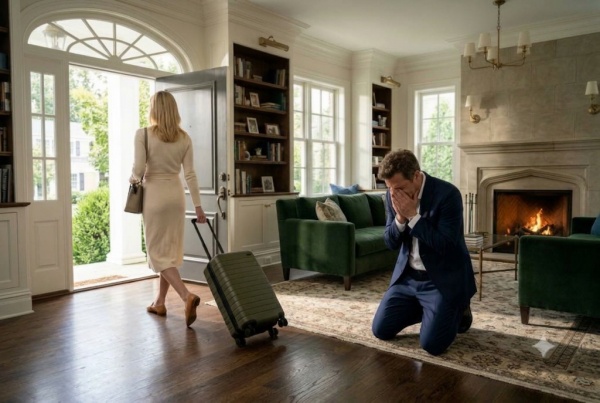
My name is Nathan Whitaker, and for a long time I believed the worst night of my life was the night my wife walked out of our brownstone in Boston with no suitcase, no warning, and no explanation beyond those six words. I was wrong. The worst night was the one that came before it — the night I was too drunk, too arrogant, and too sure of my own innocence to understand that what my wife had seen would look exactly like betrayal.
We had been married for three years then.
Her name was Elise.
Elise Whitaker had the kind of quiet beauty people noticed after they had already left the room, as if her presence followed them instead of announcing itself. She was a pediatric speech therapist at Boston Children’s Hospital, thirty years old, soft-spoken with strangers, devastatingly direct with the people she loved. She had dark brown hair she twisted into a knot when she was concentrating, gray-green eyes, and a habit of pressing her thumb against her wedding ring when she was thinking.
I noticed those things because I loved her.
I did not notice enough because I was young and building a company and convinced that love could survive neglect as long as it was technically still present.
At thirty-four, I was the co-founder of Whitaker & Sloan, a medical software startup based in Cambridge that designed scheduling and compliance tools for outpatient clinics. We were not billionaires. We were not famous. But we had just closed a twenty-two-million-dollar Series B round, and in the strange ecosystem of Boston startups, that was enough for people to start treating me like I had become someone else.
The truth is, I had started treating myself that way too.
I worked seventy-hour weeks. I took calls during dinner. I postponed weekend plans with Elise because a hospital network in Chicago wanted a demo or because an investor from Menlo Park was flying in and expected my attention. I told myself I was doing it for us, for the house we wanted someday, for the children we had talked about having when things “settled down.”
Things never settle down when ambition is the person setting the schedule.
The woman Elise saw me with was named Marissa Vale.
She was a venture consultant attached to one of our investors, twenty-nine, sharp, confident, and skilled at making every conversation feel more intimate than it was. Marissa had the polished ease of someone who understood proximity to money and power better than she understood boundaries. She flirted with everyone, and I had told myself that meant it meant nothing when she flirted with me.
That was another lie I told myself because it was convenient.
The night everything broke was the night of our Series B celebration at a private dining room in the Seaport District, overlooking Boston Harbor. There were investors, founders, engineers, partners, spouses, and enough champagne to make responsible adults behave like people they would judge in daylight. Elise wore a simple black dress and silver earrings I had bought her for our second anniversary.
She looked beautiful.
I told her so once, quickly, between two conversations with investors.
By midnight, Elise had gone home.
At least, I thought she had.
She had texted me at 11:43 p.m.: I’m tired. Taking a Lyft home. Please don’t be too late.
I replied at 12:07 a.m.: Soon. Love you.
I did not leave soon.
That is one of the facts I have had to live with.
I stayed because people were still talking. I stayed because I liked the attention. I stayed because Marissa was sitting beside me at the bar after the dinner ended, laughing at things I said as if I were funnier than I was, touching my sleeve when she spoke, ordering another drink when I should have been getting into a car home to my wife.
At some point, I remember standing.
At some point after that, I remember Marissa saying I looked pale.
At some point after that, everything became fragmented.
I woke up at 3:18 a.m. in a hotel room two floors above the event space, fully clothed except for my suit jacket, lying on top of the bed. My shoes were still on. My tie was loosened. My head felt like someone had poured concrete into it.
Marissa was asleep beside me.
She was also fully clothed.
There was no evidence, physical or otherwise, that anything had happened beyond two intoxicated people passing out in the same room. But there was also no version of that scene that could be explained in a way that did not sound like the cheapest kind of lie.
I sat up so fast the room spun.
“Marissa,” I said.
She opened her eyes, looked confused, then alarmed.
“What happened?” she asked.
“I don’t know.”
“What do you mean, you don’t know?”
“I mean I don’t know.”
She looked down at herself, then at me.
We were both dressed.
That should have helped.
It did not.
My phone had fourteen missed calls from Elise.
Six texts.
The first one, at 1:12 a.m.: Where are you?
The second, at 1:31 a.m.: Nathan, answer me.
The third, at 2:04 a.m.: I came back to the hotel. I saw you.
The fourth, at 2:06 a.m.: Don’t come home tonight.
The fifth, at 2:19 a.m.: I can’t breathe.
The sixth, at 2:41 a.m.: You promised me you were different.
I called her immediately.
She did not answer.
I left the hotel at 3:35 a.m., nauseated with panic and shame. I took an Uber home to Back Bay, rehearsing explanations that sounded weak even inside my own head. Nothing happened. We were drunk. I passed out. It looked bad. I know it looked bad. I should have left earlier. I should never have been in that room.
All of it was true.
None of it sounded like truth.
When I walked into our brownstone at 3:58 a.m., Elise was sitting on the bottom step of the staircase in one of my old Harvard sweatshirts, her hair loose around her shoulders, her face pale in the dark hallway.
She looked very calm.
That terrified me more than yelling would have.
“Elise,” I said.
She stood.
“I saw you sleeping with her,” she whispered.
“No,” I said immediately. “No, it wasn’t—”
She flinched.
Not dramatically.
Just enough for me to see that my first instinct had not been to ask what she had seen, or to tell her I was sorry, but to deny.
That flinch has stayed with me longer than anything else.
“I came back because I forgot my wrap,” she said. “I saw you at the bar with her. Then I saw her take your key card. I followed you upstairs because I thought I was being paranoid.”
“Elise—”
“I opened the door,” she said. “It wasn’t locked all the way. You were in bed with her.”
“Fully clothed,” I said, and hated myself the second the words left my mouth.
Her face changed.
That was when I lost her.
Not when she saw me in the room.
When I tried to make it smaller.
She looked down at her wedding ring and pressed her thumb against it, the way she always did when she was thinking. Then she looked at me with an expression I did not recognize because I had never seen it directed at me before.
It was not hatred.
It was grief deciding to become distance.
“I’m pregnant,” she said.
I stopped breathing.
“What?”
“I found out yesterday morning,” she said. “I was going to tell you after the dinner.”
I took one step toward her.
She took one step back.
“Elise, please.”
She shook her head once.
“I can’t do this with you tonight.”
“I didn’t sleep with her.”
“I saw you.”
“Nothing happened.”
“I saw enough.”
Then she walked past me, opened the front door, and stepped into the cold Boston night wearing my sweatshirt, leggings, and no coat.
I followed her onto the sidewalk.
“Elise, wait. Please. Where are you going?”
She turned back once.
There were tears on her face now.
“To breathe,” she said.
Then she got into a rideshare that was already waiting at the curb.
I did not know then that she had ordered it before I got home.
I did not know she had already packed her passport, her medical records, her laptop, and the ultrasound appointment confirmation she had hidden in a folder on her phone.
I did not know that the child she had just told me about was not one child.
I did not know that when that car pulled away from our brownstone, it was taking my wife and my sons out of my life for four years.
PART II — THE DISAPPEARANCE
At first, I thought Elise would come back by morning.
That sounds absurd now, but panic makes arrogant men stupid in very specific ways. I believed the truth would save me because I knew I had not crossed the line everyone assumed I had crossed. I did not yet understand that truth without trust arrives too late to do its job.
I called her thirty-seven times before sunrise.
I left nine voicemails.
By 8:00 a.m., her phone went straight to voicemail.
At 9:15, I called her best friend, Caroline Metz, a nurse practitioner in Brookline who had been Elise’s maid of honor. Caroline answered, listened to me say Elise was gone, and said in a voice so cold it made my stomach drop, “Do not call me again unless it’s through an attorney.”
“Caroline, I need to know she’s safe.”
“She is safe.”
“Where is she?”
“She does not want you to know that.”
“She’s my wife.”
“And you should think very carefully about why she no longer feels safe being reachable to you.”
Then Caroline hung up.
That sentence destroyed me because it contained an accusation I could not easily defend against. I had never hit Elise. I had never threatened her. I had never controlled her money or isolated her from friends. But safety is not only the absence of violence. Sometimes safety is the absence of the person who has just broken your sense of reality.
I learned that slowly.
At noon, I went to Boston Children’s Hospital.
Elise had taken personal leave.
No one would tell me where she was.
By Monday, I had filed a missing person report with the Boston Police Department. An officer came to the brownstone, took down the details, and asked whether Elise had left voluntarily. I said yes and no and then realized how useless that sounded.
“She left after an argument,” I said.
“Did she indicate she was in danger?”
“No.”
“Is there any evidence of foul play?”
“No.”
“Is she an adult?”
“Yes.”
The officer was professional but clear. Adults are allowed to leave. Adults are allowed not to disclose their location to spouses. If she was confirmed safe, there was very little law enforcement could do.
She was confirmed safe two days later.
A detective called me and said Elise had contacted authorities through an attorney. She was safe. She did not wish to disclose her location. She requested no contact except through legal counsel.
Legal counsel.
Those two words made the marriage feel suddenly institutional, as if the love we had built had been taken from our home and placed in a filing cabinet.
Her attorney contacted me the following week.
Her name was Judith Kaplan, a family law attorney in Massachusetts with a reputation for representing women who needed clean, quiet exits from complicated marriages. She informed me that Elise was requesting a legal separation, that she would communicate only through counsel, and that she was asking me not to contact her directly.
I hired my own attorney, Alan Pierce, because that is what you do when the person you love becomes legally unreachable.
For three months, all I knew was that Elise was pregnant and somewhere safe.
I did not know where.
I did not know how she was feeling.
I did not know whether she had morning sickness, whether she was scared, whether she went to appointments alone, whether she still wore her ring, whether she missed me at all.
I deserved not knowing.
That is a painful sentence to write, but it is true.
During those months, I also investigated what had happened at the hotel because I believed proof would matter. The hotel hallway camera showed Marissa supporting me toward the elevator because I was visibly impaired. Bar receipts showed I had consumed more than I remembered. A bartender told my attorney that I had seemed “out of it” shortly after a venture partner bought a round of whiskey for the table.
Nothing suggested a crime.
Nothing suggested a conspiracy.
Nothing suggested anything except irresponsibility, alcohol, bad judgment, and a sequence of decisions that made innocence look indistinguishable from guilt.
Marissa gave a sworn statement that we had not had sex.
She said I had become dizzy, she had helped me upstairs using the room key provided as part of the event block, and she had fallen asleep in a chair before waking up on the bed sometime later. She said she understood how it looked and that she was sorry.
I wanted that statement to fix everything.
It fixed nothing.
Because Elise did not leave because a court of law could prove adultery.
She left because her husband came home at four in the morning after she found him in a hotel room with another woman, and his first response was to argue the technicalities of betrayal.
Four months after she disappeared, Judith Kaplan served me with divorce papers.
The petition cited irretrievable breakdown of the marriage.
Massachusetts is a no-fault divorce state, and the papers were clean, restrained, almost bloodless. There were no dramatic accusations. No public claims. No attempt to destroy me professionally. Just the efficient legal language of a woman cutting the thread.
I signed nothing for two weeks.
Alan told me refusing to engage would not save the marriage.
I knew that.
I still could not make my hand move.
When I finally responded, I asked for mediation.
Elise agreed through counsel.
We mediated in separate rooms.
I never saw her.
That was the part that broke something permanent in me. We were in the same downtown Boston office suite, maybe forty feet apart, separated by frosted glass, lawyers, and everything I had failed to protect. I sat in one conference room with Alan while Judith walked back and forth carrying offers from the woman who had once fallen asleep with her head on my shoulder during snowstorms.
The pregnancy was not addressed the way I expected.
When Alan asked about the child, Judith said Elise had experienced significant stress and was not prepared to discuss co-parenting until after the birth. She stated that paternity was not being disputed “at this time,” but that medical privacy would be respected. I asked for updates. Elise declined.
I asked whether I could attend the birth.
Elise declined.
I asked whether I could know the due date.
Elise declined.
Every decline was delivered in Judith’s calm voice.
Every decline was legal.
Every decline was a consequence.
The divorce became final nine months after the night at the hotel.
By then, I knew almost nothing.
I did not know whether the baby had been born.
I did not know whether it was a boy or a girl.
I did not know the name.
Alan told me that if a child had been born during the marriage or within the relevant legal window, there were processes to establish paternity and parental rights. He advised me to pursue them. He was right legally.
But I was drowning emotionally, and I made the worst decision of my life after the hotel.
I waited.
Not because I did not care.
Because I told myself Elise would contact me when she was ready. Because I told myself pushing legally would confirm every fear she had about me using money and attorneys to overpower her. Because I told myself patience was respect.
Some of that was true.
Some of it was cowardice dressed as sensitivity.
Months became a year.
A year became two.
I sent birthday cards to Judith Kaplan’s office every November, not knowing whether I was sending them for a child whose birthday was actually in November. They were returned unopened the first year. The second year, they were not returned. I took that as hope because desperate men turn silence into prophecy.
I dated no one.
I sold my stake in Whitaker & Sloan after we were acquired by a national healthcare technology company for $186 million. My share made me wealthy enough not to work for a while, which turned out to be terrible for me. Work had been my excuse, my identity, my shield. Without it, I was just a man in a Back Bay brownstone listening to the absence of a family he had never met.
I went to therapy.
At first, I went because Alan suggested it would look responsible if custody ever became an issue. That is an ugly reason to begin therapy, but sometimes ugly doors still open into useful rooms. My therapist, Dr. Helen Marks, did not let me hide behind technical innocence.
“Did you have sex with Marissa?” she asked in our third session.
“No.”
“Did you betray your wife?”
I started to answer quickly.
Then I stopped.
“Yes,” I said.
That was the beginning of becoming someone who might deserve the truth one day, even if the truth never came.
PART III — FOUR YEARS LATER
Four years after Elise disappeared, I saw her at Logan Airport.
It was a Friday afternoon in late October, the kind of gray Boston day where the sky and the harbor seem to be made of the same cold metal. I was flying back from Chicago after a consulting meeting I had taken mostly because Dr. Marks said rebuilding a life required leaving my house for reasons other than groceries and regret.
My flight landed at Terminal B at 3:40 p.m.
I saw Elise near baggage claim at 3:58.
At first, my mind refused to understand what my eyes were seeing.
She was standing beside carousel six wearing a camel coat and dark jeans, her hair shorter than it had been, tucked behind one ear. She looked older in the way people look older after they have survived something and chosen not to advertise the cost. She was holding a small blue backpack shaped like a dinosaur.
Then two little boys ran toward her.
They were maybe three and a half.
Same dark hair.
Same gray-green eyes.
Same quick, serious expressions.
One of them had my mother’s dimple.
The other had my exact way of frowning when concentrating.
The world narrowed so violently that I had to grip the handle of my suitcase.
“Elise,” I said.
She turned.
For one second, her face opened completely.
Shock.
Fear.
Grief.
Then she closed it.
“Nathan.”
The boys stopped beside her, each taking one of her hands.
The one with the dimple looked at me with open curiosity.
The other hid slightly behind her coat.
I looked at them.
I knew before anyone said a word.
The body recognizes its own blood with a cruelty the mind cannot prepare for.
“Are they…” I could not finish.
Elise swallowed.
“Nathan, this is not the place.”
“Are they mine?”
Her eyes filled with tears.
The boy with the dimple looked up at her.
“Mommy?”
Mommy.
The word hit me in the chest so hard I almost stepped back.
Elise crouched immediately, her composure shifting into maternal steadiness.
“It’s okay, sweetheart,” she said. “This is someone Mommy used to know.”
Someone Mommy used to know.
I deserved that.
I hated that I deserved that.
A woman approached from the carousel carrying two booster seats stacked awkwardly on a luggage cart. She was in her late thirties, with Elise’s eyes and a protective expression that told me immediately she was family.
“Elise?” the woman said.
Then she saw me.
Her face hardened.
“Is this him?”
Elise stood.
“Diane, please.”
Diane.
Her older sister from Vermont. I had met her twice before the wedding. She had not liked me much then. From the look on her face now, time had not improved her opinion.
“Nathan,” Elise said quietly, “you need to leave.”
“No.”
Diane stepped forward.
“Excuse me?”
I looked at Elise, not Diane.
“I have spent four years not knowing whether I had a child,” I said. “Now I’m standing in Logan Airport looking at two boys who look like me, and you’re telling me to leave?”
Elise’s jaw trembled.
“I am telling you not to do this in front of them.”
That stopped me.
Because she was right.
Whatever had happened between us, whatever she had withheld, whatever I had lost, the boys were standing there holding dinosaur backpacks and looking at adults whose emotional history was far too large for an airport baggage claim.
I took a breath.
“What are their names?” I asked.
Elise hesitated.
Then she said, “Owen and Miles.”
Owen and Miles.
My sons had names.
I repeated them silently because I did not trust my voice.
The dimpled one — Owen, somehow I knew — looked at me again.
“Are you sad?” he asked.
The question nearly ended me.
“Yes,” I said carefully. “But not because of you.”
Elise closed her eyes.
Diane looked away.
I took out my phone with shaking hands.
“I’m not going to make a scene,” I said. “I’m not going to follow you. But I need your attorney’s current contact information. If you won’t give me yours, give me hers.”
Elise looked at me for a long moment.
Then she gave me Judith Kaplan’s email address.
I typed it into my phone.
“Thank you,” I said.
She nodded once.
Diane gathered the luggage. Elise took the boys’ hands. They started walking toward the exit.
I stood there and watched my sons walk away from me for the first time.
It was not the first time they had walked away.
It was only the first time I knew their names while it happened.
That night, I emailed Alan Pierce.
Subject line: I found them.
He called me nine minutes later.
I told him everything.
He listened without interrupting.
When I finished, he said, “Nathan, we need to proceed carefully.”
“I know.”
“You have rights if you are the biological father.”
“I know.”
“But the court will focus on the best interests of the children, not your grief.”
“I know.”
“Do you?”
I looked across my living room at a framed photo from my wedding day that I had never been able to put away.
“No,” I said. “But I’m trying to.”
Alan was quiet for a moment.
“That’s a better answer,” he said.
The next week, he contacted Judith Kaplan.
Judith responded within two days.
The boys were mine.
Owen James Bennett and Miles Thomas Bennett.
Bennett.
Elise had taken back her maiden name after the divorce, and the boys had hers. Legally, emotionally, practically, they had been hers from the beginning. I had been absent not only from their lives but from the language of their lives.
Judith’s email was clear.
Elise had not pursued child support. She had not requested financial assistance. She had not placed my name on the birth certificates because paternity had not been legally established at the time of birth. She was willing to participate in court-supervised mediation regarding paternity, parenting time, and child support, provided any introduction to the children was gradual and guided by a child therapist.
I read the email six times.
Then I called Dr. Marks.
“I found them,” I said.
“I know,” she said. “You left me a voicemail at 2:00 a.m.”
“I have twin sons.”
“Yes.”
“I missed everything.”
There was a pause.
“Yes,” she said. “You did.”
I wanted comfort.
She gave me truth.
That is why I kept going back.
PART IV — THE MEDIATION
The first mediation took place in a family services office in Cambridge, not far from the life Elise and I had once shared.
I arrived twenty minutes early and spent seventeen of those minutes sitting in my parked car trying to breathe normally. I had worn a navy sweater instead of a suit because Dr. Marks had told me not to arrive looking like I was there to acquire a company. I had brought nothing except a notebook and the humility I had spent four years building too late.
Elise arrived exactly on time.
She wore a cream sweater and black pants, and she looked like she had slept poorly. I wondered how many nights she had slept poorly because of me. Then I wondered how many nights she had slept poorly because of the boys, fevers, nightmares, teething, all the ordinary parental hardships I had not been there to share.
“Elise,” I said.
“Nathan.”
We did not hug.
We did not shake hands.
We sat on opposite sides of a conference table with our attorneys and a mediator named Karen Holt, who had twenty years of experience in high-conflict custody matters and the calmest voice I had ever heard.
Karen began with ground rules.
The children’s well-being would be the center of all discussions. No one would use the children to punish the other parent. No one would rush introductions. No one would rewrite history to make themselves more comfortable.
Then she asked Elise to speak first.
Elise folded her hands on the table.
“I know Nathan is angry,” she said. “He has a right to be. I also know I made decisions that kept him from his children. I am not here to pretend otherwise.”
I looked at her.
She did not look away.
“When I left,” she continued, “I believed my marriage was over. I believed Nathan had betrayed me, and I believed that if I stayed in Boston, he would be able to talk me out of trusting what I had seen. I was pregnant, terrified, and humiliated.”
Her voice shook on that last word.
“I went to my sister’s house in Vermont. Two weeks later, I learned I was carrying twins. I had hyperemesis during the first trimester. I was in and out of the hospital for fluids. Diane took leave from work to help me.”
I had not known any of this.
Each sentence was a door to a room where I should have been standing.
“I thought about contacting Nathan,” she said. “Many times. Then I would remember the hotel room and the way he said ‘fully clothed’ like that made it all right, and I couldn’t do it.”
I closed my eyes.
Alan put one hand lightly on the table near me, a silent warning to stay grounded.
Elise continued.
“The boys were born at thirty-five weeks at a hospital in Burlington. Owen spent nine days in the NICU. Miles spent twelve. They were tiny and perfect and I was so scared I could barely eat.”
My throat closed.
“I should have told you,” she said, looking at me now. “Not because you had earned it. Because they had. That is the part I have had to live with.”
The room was silent.
Karen turned to me.
“Nathan?”
I had prepared things to say.
They all disappeared.
“I did not sleep with Marissa,” I said.
Elise’s face tightened.
“I know,” she said.
The air left my lungs.
“What?”
“I know,” she repeated. “Caroline told me about the sworn statement two years ago. Judith confirmed it.”
“You knew?”
“Yes.”
“For two years?”
Her eyes filled.
“Yes.”
The anger came fast, hot, almost blinding.
“You knew I didn’t do it and you still kept them from me?”
Alan said, “Nathan.”
But I was already standing.
“You knew?”
Elise flinched, and that stopped me more effectively than Alan could have.
I sat back down.
“I’m sorry,” I said, shaking. “I’m sorry. I’m not trying to scare you.”
“I know,” Elise said softly. “But that is why I needed this to be mediated.”
I nodded, ashamed.
Karen waited.
Elise wiped her eyes.
“I knew you had not had sex with her,” she said. “I did not know what to do with that information. Because by then the boys were almost two, and I had built their entire world around stability. I was ashamed. I was afraid you would hate me. I was afraid you would take them. I was afraid that telling the truth would destroy the only safe life I had managed to build.”
“I would never take them from you,” I said.
“You don’t know what you would have done,” she said. “You were angry at the airport after five minutes. Imagine two years ago.”
I wanted to deny it.
I could not.
Because two years ago, I had still been more wounded than accountable. Two years ago, I might have walked into court demanding everything I had missed, as if custody could reimburse grief. Two years ago, I might have made my sons’ lives into the battleground for my pain.
“I’m not that man anymore,” I said.
“I hope not,” she said.
That was fair.
The legal process began formally after that.
A Massachusetts Probate and Family Court judge ordered genetic testing, though no one truly disputed the result. The test confirmed with 99.99 percent probability that I was Owen and Miles’s biological father. The court established paternity, ordered temporary child support based on Massachusetts guidelines, and approved a gradual reunification plan recommended by a child psychologist named Dr. Amanda Reyes.
I paid retroactive support into an account for the boys after negotiation.
Elise had not asked for it.
I insisted.
Not because money fixed absence.
Because pretending four years of financial responsibility had not existed would have been one more lie.
The reunification plan was painfully slow.
First, Elise would tell the boys about me using language Dr. Reyes helped her choose. Not “your father abandoned you.” Not “your father was kept from you.” Just the truth made safe for four-year-old hearts: they had a dad named Nathan who had not been part of their lives before, and now the adults were working together so they could know him.
Then they would see photos.
Then short video calls.
Then a supervised meeting at Dr. Reyes’s office.
I hated the slowness.
I also understood it was mercy.
Children are not property to be returned.
They are people to be approached carefully.
My first video call with Owen and Miles lasted eleven minutes.
Owen did most of the talking.
Miles held a stuffed whale and said almost nothing.
Owen asked whether I liked pancakes, dinosaurs, and snow.
I said yes to all three.
Miles whispered something to Elise.
She smiled.
“Miles wants to know if you have a house.”
“I do,” I said. “It has too many stairs and not enough toys.”
Owen laughed.
Miles almost smiled.
After the call ended, I cried so hard I had to sit on the bathroom floor.
Not because it had gone badly.
Because it had gone well enough to make real what I had lost.
PART V — THE FIRST SATURDAY
I met my sons in person on a Saturday morning in January.
There was snow on the ground in Cambridge, six inches of it piled along sidewalks and parked cars, the kind of snow that makes the whole city feel temporarily forgiven. Dr. Reyes’s office had a playroom with soft rugs, wooden blocks, picture books, and a child-sized table with four tiny chairs.
I arrived early again.
This time, I brought two small gifts approved by Dr. Reyes: a dinosaur book for Owen and a stuffed blue whale for Miles, because he had held one during our video calls.
Elise arrived with them at 10:00 a.m.
Owen walked in first, bold and curious.
Miles stayed close to Elise’s leg.
I crouched because Dr. Reyes had told me not to loom.
“Hi, Owen. Hi, Miles. I’m Nathan.”
Owen studied me.
“Mommy says you’re our dad.”
I swallowed.
“Yes,” I said. “I am.”
“Where were you?”
There it was.
The question I had feared.
The question I deserved.
I looked at Elise.
Her face was pale, but she did not rescue me.
Good.
Adults had done enough hiding.
“I didn’t know how to find you,” I said carefully. “And the grown-ups had some big mistakes to fix. But I’m here now, and I’m going to keep showing up.”
Owen considered that.
“Do you like Legos?”
“Yes.”
“Can you build a dragon?”
“I can try.”
He handed me a box of blocks.
That was how fatherhood began for me.
Not with a hospital bracelet.
Not with first steps.
Not with midnight feedings or first words or tiny fingers wrapped around mine in the newborn dark.
With a four-year-old handing me blocks and giving me a job.
Miles did not speak to me for the first twenty minutes.
He watched.
He assessed.
Then, while Owen was explaining that dragons needed “serious wings,” Miles walked over and placed the stuffed whale I had brought beside my knee.
Not in my hand.
Beside my knee.
A deposit of possibility.
“His name is Blue,” Miles said.
“The whale?”
He nodded.
“That’s a good name.”
He nodded again, as if I had passed a small test.
Elise sat across the room beside Dr. Reyes, watching with tears she did not wipe away.
I did not ask to hold the boys.
I did not ask for too much.
At the end of the hour, Owen gave me a high-five.
Miles waved from behind Elise’s coat.
I went home and wrote down every detail because I was terrified memory would steal from me too.
The next months were a lesson in humility.
Supervised visits became longer. Then semi-supervised. Then Saturday mornings at a children’s museum with Elise nearby but not hovering. Then lunch at a diner where Owen spilled chocolate milk on my jeans and Miles laughed so suddenly and brightly that Elise and I both froze.
Because his laugh sounded like mine.
There are griefs that arrive disguised as gifts.
That was one of them.
Elise and I learned to co-parent in cautious increments.
We used a court-approved parenting app at first, because direct texting felt too intimate and too dangerous. We documented pickup times, medical appointments, preschool updates, allergy medication, favorite snacks, nap regressions, library books, winter boots. The practical details became a bridge safer than emotion.
Eventually, we started speaking at exchanges.
Five minutes.
Then ten.
Then one afternoon in April, after the boys ran into preschool, Elise stood beside her car and said, “Owen asked last night why we don’t all live together.”
I felt the old wound open.
“What did you say?”
“I told him families can look different. And that he has two parents who love him.”
“Thank you.”
She nodded.
Then she said, “I’m sorry, Nathan.”
Not for the first time legally.
Not through attorneys.
Not in the controlled language of mediation.
Just there, in a preschool parking lot in Somerville, with minivans idling and parents carrying lunchboxes past us.
“I’m sorry I kept them from you.”
I looked at her.
The apology I had wanted for months, years, did not feel the way I expected. It did not erase anything. It did not give me back first steps or NICU nights or the first time they said “Mommy.” But it landed somewhere honest.
“I’m sorry I made it possible for you to believe leaving was the only safe choice,” I said.
She looked down.
“We made a ruin,” she said.
“Yes.”
“And they grew in the middle of it.”
I watched Owen through the preschool window, showing Miles something in his cubby.
“Yes,” I said. “They did.”
By summer, the court approved unsupervised parenting time.
Every other Saturday became every other weekend. Then one midweek dinner. Then shared holidays, carefully structured and reviewed by attorneys until eventually they became ordinary enough not to require legal language.
My house changed first.
Stair gates.
Twin beds.
Plastic cups.
Dinosaur sheets for Owen.
Whale sheets for Miles.
A drawer of pajamas. A shelf of picture books. Two booster seats in my SUV. Goldfish crackers ground permanently into the back seat like a sacred inconvenience.
My life changed after.
I learned the difference between Owen’s tired tantrum and Miles’s overwhelmed silence. I learned that Owen wanted stories with voices and Miles wanted the same book three times. I learned that children forgive differently than adults — not because they understand more, but because they live so fully in the present that showing up today matters more to them than explaining yesterday.
Elise and I did not get back together.
People expect that ending.
They want the whisper, the disappearance, the twins, the airport, and then some cinematic reunion where love proves stronger than damage. But real life is less interested in symmetry than stories are.
Elise and I became something harder and, in some ways, more honorable.
We became honest.
We became parents who could sit beside each other at a preschool Thanksgiving lunch and pass napkins without flinching. We became the two people in the front row of a holiday concert when Miles forgot the words and Owen sang too loudly to compensate. We became co-signers on permission slips, co-managers of fevers, co-witnesses to childhood.
There were still hard days.
There were still moments when grief rose up unexpectedly — a baby photo I had never seen, a story Elise told casually about Owen’s first steps, Miles asking why I was not in the pictures from when they were tiny. We answered carefully. We told the truth in pieces their hearts could carry.
When the boys turned five, we had one birthday party.
Together.
At a park in Brookline with cupcakes, balloons, and twelve preschoolers running in circles like tiny, lawless citizens. Elise’s sister Diane came. She still did not like me much, but she handed me a stack of paper plates and said, “You’re doing better than I expected.”
From Diane, that was practically a blessing.
After the candles, Owen climbed into my lap without thinking.
Miles leaned against my side.
Elise saw it from across the picnic table.
For a second, her face did something I remembered from our marriage — softened, then guarded itself. I did not chase it. Some doors should not be forced open just because you recognize the room behind them.
That night, after I dropped the boys at Elise’s house, Owen hugged me hard.
“See you Wednesday, Dad,” he said.
Dad.
Not Nathan.
Dad.
Miles gave me Blue the whale to “borrow until dinner day,” which I understood by then was an act of enormous trust.
I drove home through Boston with a stuffed whale buckled into the passenger seat because Miles had insisted Blue needed to be safe.
At a red light on Beacon Street, I started laughing.
Then I started crying.
Both were true.
That is the thing I have learned about life after damage: the good does not cancel the grief, and the grief does not cancel the good. They sit beside each other, inconvenient and inseparable, like two boys in booster seats arguing over whether whales could beat dinosaurs in a race.
Four years earlier, my wife whispered that she had seen me sleeping with another woman, and then she disappeared.
For a long time, I thought the story was about whether I had done the thing she believed I had done.
It was not.
It was about trust.
It was about arrogance.
It was about the way one careless night can become a legal file, a locked door, a missed birth, a pair of sons learning to walk without you.
It was also about the possibility that people can become more than the worst night of their lives, but only if they stop defending themselves long enough to understand the harm.
I never got those four years back.
Elise never got back the marriage she thought she had.
Owen and Miles never got the simple beginning they deserved.
But we built something from the wreckage that did not require pretending the wreckage was not there.
A family, not the one we planned.
A truth, not the one I wanted.
A fatherhood that began late but became real because two little boys kept handing me blocks and books and stuffed whales and chances.
Sometimes, after they fall asleep at my house, I stand in the hallway between their rooms and listen to them breathe.
Owen sprawled sideways under dinosaur sheets.
Miles curled around Blue under a blanket covered in whales.
And I think about the night Elise stood in our hallway in my old Harvard sweatshirt, one hand pressed to her wedding ring, carrying two lives neither of us understood yet.
I wish I had listened better.
I wish I had gone home earlier.
I wish my first words had been I’m sorry instead of fully clothed.
But wishes are not parenting.
Showing up is.
So I show up.
Every Wednesday.
Every other weekend.
Every school event.
Every fever.
Every Lego dragon.
Every whale rescue.
Every ordinary, miraculous moment I am allowed to have now.
And when Owen asks me sometimes why I look sad when I’m happy, I tell him the simplest truth I know.
“Because I missed some things,” I say. “And I’m really glad I’m here now.”
He usually accepts that.
Children often understand honest answers better than adults do.
Then he hands me another block.
And I keep building.
