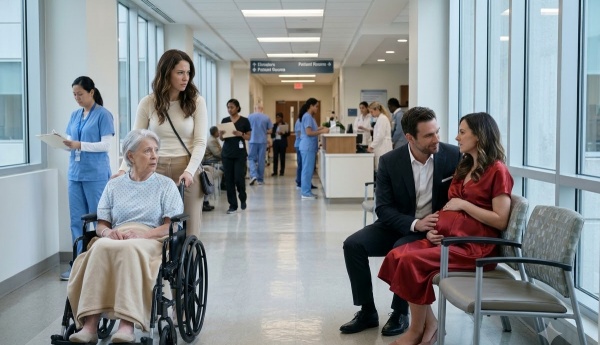
I Slept Beside My Mother-in-Law’s Hospital Bed — While My Husband Was Downstairs With His Pregnant Mistress
For four nights, I slept in a stiff hospital recliner beside my mother-in-law, holding her hand, talking to nurses, and convincing myself I was doing what family does. What I didn’t know was that three floors below, my husband was walking into the VIP maternity wing with a heavily pregnant woman he had told everyone was his future. One morning, I went downstairs for coffee and heard his laugh before I saw his face. That walk revealed a second life, a fake story about our marriage, and a betrayal far worse than the affair itself.
PART I — THE FOURTH NIGHT
While I spent four nights sleeping beside my mother-in-law’s hospital bed, my husband was bringing his heavily pregnant mistress into the VIP maternity wing of the same hospital.
That is the kind of sentence people think belongs in a movie, not in a real woman’s life.
But real betrayal does not always happen in dark hotel rooms or through lipstick on a collar. Sometimes it happens under fluorescent hospital lights, between vending machines, nurse call buttons, and family members praising you for being “such a good daughter-in-law” while they know your husband is downstairs building another family.
My name is Lauren Mitchell. I was thirty-eight years old, a high school guidance counselor in Charlotte, North Carolina, and until that week, I believed my marriage to Daniel Mitchell was tired but salvageable. We had been married for eleven years, owned a four-bedroom house in Matthews, had a golden retriever named Cooper, and lived the kind of middle-class suburban life that looked stable from the outside because the lawn was mowed and the Christmas lights went up on time.
Daniel was forty-one and worked as a regional sales director for a medical device company. He traveled across the Carolinas, Georgia, and Tennessee, which meant our marriage had grown used to absences. At first, I thought that was the strain between us: hotel rooms, airport delays, late calls, quarterly targets, my own exhaustion from working with teenagers in crisis all day.
We had tried for children for years.
Three miscarriages.
Two failed rounds of IVF.
One doctor in Raleigh who looked at me with professional sympathy and said my ovarian reserve numbers were “not encouraging.” I still remember nodding like a reasonable adult while feeling as if my entire body had been reduced to a disappointing lab report.
Daniel had cried with me after the first miscarriage.
He held me after the second.
By the third, he became quiet.
Not cruel, exactly.
Just distant in the way people become when grief stops being shared and starts becoming a room they avoid.
His mother, Patricia Mitchell, never forgave my body for not giving her grandchildren.
She did not say it plainly at first.
Patricia was too southern for direct cruelty when a casserole and a raised eyebrow could do the work. She said things like, “Some women are just meant to pour themselves into their careers,” or, “Adoption is beautiful, of course, but there’s nothing like blood.” Once, at Easter brunch, she placed her hand over mine and said, “I pray Daniel still gets to know fatherhood one day.”
Still.
As if I had stolen it from him.
As if my grief was an obstacle to his destiny.
Daniel told me to ignore her.
“She’s old-fashioned,” he said.
“She’s sixty-seven,” I replied. “That is not old enough to be medieval.”
He laughed, kissed my forehead, and changed the subject.
That was Daniel’s gift.
Not solving.
Not confronting.
Redirecting.
By the time Patricia was admitted to St. Catherine’s Medical Center with complications from pneumonia and a heart arrhythmia, our marriage had been cold for months. Not openly hostile. Worse. Polite. Functional. We discussed groceries, Cooper’s vet appointment, the water heater, the neighbor’s tree, and whether we needed to replace the gutters before hurricane season.
We did not discuss children anymore.
We did not discuss the guest room I could no longer enter because it had once been painted pale yellow after the first positive pregnancy test.
We did not discuss the way Daniel took calls in the garage.
When Patricia got sick, I went into caretaker mode automatically. I knew how hospitals worked because I had spent years sitting with my father through cancer treatments before he died. I knew which nurses were overworked, how to read monitors without pretending I understood everything, and why it mattered to keep lip balm, phone chargers, and clean socks within reach.
Daniel was in Atlanta when Patricia was admitted.
At least that was what he told me.
“Can you stay with Mom tonight?” he asked over the phone, voice tight with worry. “I’m trying to get an earlier flight, but everything’s a mess.”
“Of course,” I said.
And I meant it.
Patricia might have wounded me over the years, but she was still my husband’s mother. She was frightened, pale, and struggling to breathe through a nasal cannula when I arrived at St. Catherine’s. No one deserves to be alone like that.
The first night, I slept in a vinyl recliner that squeaked whenever I moved. The second night, I learned which nurses preferred coffee and which one would sneak me an extra blanket if I asked after midnight. The third night, Patricia woke from a feverish dream and clutched my wrist, whispering Daniel’s name.
“He’s coming,” I told her.
She looked at me with watery blue eyes.
“You’re a good girl, Lauren.”
It was the kindest thing she had said to me in years.
I hated that it mattered.
Daniel finally arrived on the third afternoon with a duffel bag, red eyes, and the smell of airport soap clinging to him. He hugged me in the hallway outside Patricia’s room and held on a little too long.
“Thank you,” he whispered. “I don’t know what I’d do without you.”
At the time, I believed he meant it.
That is one of betrayal’s ugliest tricks. It does not erase the tender moments. It poisons them retroactively.
He stayed for two hours.
Then his phone buzzed.
He checked the screen, frowned, and stepped away.
When he came back, he said, “That was work. There’s an issue with the Atlanta account. I may have to handle some calls tonight.”
I was too tired to question him.
By the fourth night, Patricia had improved enough that the doctors were discussing discharge within forty-eight hours. Her oxygen levels were better. Her appetite was returning. She had complained about the hospital meatloaf, which the nurse said was a positive clinical sign.
Daniel said he would stay the night.
“You should go home,” he told me. “Shower. Sleep in a real bed.”
I almost accepted.
Then Patricia reached for my hand.
“Could Lauren stay one more night?” she asked. “She knows where everything is.”
Daniel smiled tightly.
“Sure, Mom.”
So I stayed.
He left at 8:15 p.m., claiming he needed to run home, check on Cooper, and grab clean clothes.
At 9:03 p.m., I texted him.
Can you bring my gray hoodie when you come back? Room is freezing.
He replied at 9:21.
Of course. Be back soon.
He did not come back.
At 11:40, he texted again.
Mom asleep? Work call running long. Might stay home and come early. Love you.
I stared at the words.
Love you.
I typed Love you too because that is what married people do even when the words feel like a habit instead of a heartbeat.
The next morning, Patricia was still asleep when the sun came up pale behind the hospital blinds. My neck ached from the recliner, my mouth tasted like bad coffee, and my hair had reached a level of defeat that no dry shampoo could rescue.
At 6:32 a.m., I decided to take a walk.
Just ten minutes.
I wanted fresh coffee from the lobby café instead of the machine sludge from the nurses’ station. I wanted to move my legs. I wanted to be someone other than the woman in yesterday’s sweater sitting beside a bedpan and a heart monitor.
I kissed Patricia’s forehead even though she had been cruel to me for years.
Then I stepped into the hallway.
The hospital was quiet in that early morning way, half-asleep but never fully still. A custodian polished the floor near the elevators. A resident hurried past with a granola bar in her mouth. Somewhere a baby cried faintly, the sound rising through the building like proof that life kept arriving whether people were ready or not.
I took the elevator down to the first floor.
The café line was longer than expected, so I wandered toward the newer wing of the hospital, following signs for the atrium.
That was how I saw the sign.
MATERNITY SERVICES — LEVEL 2
Under it, smaller lettering read:
Private Labor & Delivery Suites | Family Waiting Lounge | VIP Maternity Wing
VIP maternity.
I remember thinking how strange it was that childbirth could have tiers, as if babies arrived differently depending on how much your insurance or bank account could impress a billing department.
I was about to turn back when I heard Daniel’s laugh.
Not a sound like his laugh.
Daniel’s laugh.
I knew it the way you know a song from two notes.
It came from down the corridor near a set of glass double doors. Warm, relaxed, low. The laugh he used at backyard cookouts when men complimented his smoker or at church when people told him he was “one of the good ones.”
I froze.
My first thought was stupid.
Maybe he came back and parked on this level.
Maybe he was talking to a colleague.
Maybe grief and exhaustion had made my brain misfire.
Then the glass doors opened.
Daniel stepped out.
He was wearing yesterday’s shirt, sleeves rolled up, hair slightly messy, eyes soft with a kind of happiness I had not seen on his face in years.
Beside him was a young woman in a loose cream maternity dress.
Very pregnant.
Not a little pregnant.
Not maybe pregnant.
Eight or nine months pregnant, one hand resting beneath her belly as she walked slowly.
Daniel held her other hand.
Behind them came a nurse pushing a small wheelchair, smiling politely. The woman laughed at something Daniel said, leaned her head briefly against his shoulder, and he kissed her temple with a tenderness so familiar it almost made my knees fail.
I stood twenty feet away holding an empty coffee cup.
Daniel saw me.
The color drained from his face so fast he looked ill.
The pregnant woman followed his stare.
Her smile faded.
For a moment, no one moved.
No alarms sounded.
No dramatic music swelled.
A hospital volunteer walked past carrying a vase of flowers.
Somewhere upstairs, Patricia was probably waking and asking for ice chips.
Daniel opened his mouth.
“Lauren.”
That was all he said.
My name.
As if saying it could fold the world back into place.
I looked at his hand wrapped around hers.
Then at her belly.
Then back at him.
And in that moment, I understood two things.
My husband was having a baby.
And everyone had made sure I was the last to know.
PART II — THE WOMAN DOWNSTAIRS
The pregnant woman’s name was Emily Harper.
I learned that later.
In the hallway, she was just the woman carrying the baby my husband had wanted so badly that he had apparently found another body to provide it.
She looked younger than me, maybe thirty-two. Blonde hair in a loose braid. No makeup except mascara. Her face was soft and tired in the way very pregnant women look when their bodies have become public property and every step requires negotiation.
She was not glamorous.
That somehow made it worse.
If she had looked cruel or smug, I could have hated her immediately and neatly. Instead, she looked confused, then frightened, then wounded in a way that told me Daniel had lied to more than one woman.
“Daniel?” she whispered.
His eyes flicked between us.
“Lauren, this isn’t—”
I held up one hand.
“If you say this isn’t what it looks like, I will scream loudly enough to get security.”
His mouth snapped shut.
The nurse behind them shifted uncomfortably.
“Mr. Mitchell, should I give you a moment?”
Mr. Mitchell.
Of course.
I looked at Emily.
“Do you know who I am?”
She looked at Daniel first.
That answered part of it.
Then she looked back at me.
“You’re his ex-wife?”
The words hit me harder than the sight of them together.
Ex-wife.
Daniel closed his eyes.
I laughed once.
Not because anything was funny.
Because my body could not decide between rage and collapse, so it chose a sound.
“I am his current wife,” I said.
Emily’s hand moved protectively over her belly.
“No.”
It was small.
Broken.
Daniel said, “Emily, I can explain.”
She stepped away from him.
“Tell me she’s lying.”
He did not.
The nurse quietly backed up and said, “I’ll be at the desk if you need anything.”
That woman had seen enough hospital family drama to know when medical training ended and legal depositions began.
Emily stared at Daniel.
“You told me the divorce was final.”
“Emily—”
“You showed me papers.”
My skin went cold.
Papers.
I looked at him.
“What papers?”
He rubbed both hands over his face.
“Not here.”
I almost smiled.
Men like Daniel always believe location is the problem.
Not the lie.
Not the second life.
Not the woman upstairs caring for his mother while he held hands with the mother of his child three floors below.
The location.
Emily’s eyes filled with tears.
“You said she left you because she didn’t want kids anymore.”
I felt that sentence physically.
Like a shove.
“Is that what he told you?”
Emily looked at me, horrified.
“He said after the miscarriages, you blamed him and moved out. He said the marriage was over except for paperwork.”
My mouth went dry.
Daniel had not merely betrayed me.
He had rewritten my grief into abandonment.
He had taken the most painful years of my life and turned them into a story that made him available, sympathetic, and noble.
I wanted to slap him.
I did not.
Not because he deserved restraint.
Because I was in a hospital, beside a pregnant woman, and I refused to become the scene he could later use against me.
“How long?” I asked.
Daniel said nothing.
Emily answered.
“Almost eighteen months.”
Eighteen months.
I thought of the work trips.
The sudden late meetings.
The weekends he said Patricia needed help with her gutters.
The phone calls he took in the garage.
And then another thought rose, colder than the first.
“Does your mother know?”
Daniel’s face changed.
There it was.
The worst betrayal had just opened its door.
Emily looked between us.
“His mother?”
My voice sounded distant to my own ears.
“Patricia. The woman I’ve been sleeping beside upstairs for four nights while he was here with you.”
Emily’s face went white.
“She’s here?”
“Yes. Pneumonia and heart complications. Room 514.”
Emily turned to Daniel.
“You said she was at home recovering.”
Daniel whispered, “I was trying to protect everyone.”
That was when something inside me snapped cleanly.
“Protect?” I repeated. “You left me upstairs taking care of your mother while you brought your pregnant girlfriend into the VIP maternity wing downstairs.”
A man in scrubs glanced our way and quickly kept walking.
Daniel lowered his voice.
“Lauren, please.”
“No.”
“Mom is sick.”
“She is also apparently informed.”
He looked away.
That was answer enough.
Emily pressed one hand against the wall, breathing slowly.
“Emily?” Daniel reached toward her.
“Don’t touch me.”
For a moment, she and I were not enemies.
We were two women standing on opposite sides of the same lie, both realizing the bridge between us had been built out of our pain.
A contraction of some emotion crossed her face. Not physical pain, I don’t think. Shock. Humiliation. Fear. Maybe all three.
I took a breath.
“Are you in labor?”
She blinked.
“No. Routine appointment. High-risk monitoring. The baby’s measuring large, and my blood pressure has been up.”
Even betrayed, I heard the counselor in myself respond to the vulnerability.
“Do you have someone you can call?”
She nodded slowly.
“My sister.”
“Call her.”
Daniel looked at me sharply.
“Lauren—”
I turned to him.
“You no longer get to manage women’s access to the truth.”
Emily pulled out her phone with shaking hands.
I stepped back because she deserved privacy, even if my husband had given neither of us any.
Daniel moved toward me.
“Can we talk somewhere else?”
“No.”
“I know I hurt you.”
That sentence was far too small for the hallway.
“You don’t know anything yet.”
His jaw tightened.
“There’s no need to threaten me.”
“I haven’t started.”
His eyes narrowed.
That was the first flash of the Daniel few people saw. Not the charming salesman. Not the dutiful son. Not the church volunteer who grilled hamburgers at youth fundraisers.
The man who resented being exposed.
“You need to calm down,” he said.
I almost laughed again.
There are phrases that should come with warning labels.
Calm down is one of them.
I looked at him carefully.
“I am calm enough to know you need to leave me alone for the next hour. I am calm enough to know I need an attorney. I am calm enough to know there may be forged divorce papers involved. And I am calm enough to know I should not discuss another word of this without documentation.”
The color drained further from his face.
Good.
Emily was crying quietly into the phone now.
“Yes, I’m at St. Catherine’s. No, I’m okay. I just need you to come. Please.”
I turned away.
Not because I forgave her.
Because I could not bear to watch another woman’s life collapse in real time while the man responsible stood there hoping to contain the damage.
I walked to the elevator.
Daniel followed.
“Lauren, wait.”
I hit the button.
“Do not follow me upstairs.”
“My mother is upstairs.”
“Yes. And for four nights, so was your wife.”
The elevator opened.
I stepped inside.
Daniel put his hand on the door to stop it.
His voice dropped.
“You don’t understand the situation with Mom.”
The doors tried to close against his hand.
I looked at him.
“Then I guess she can explain it herself.”
He removed his hand.
The doors shut between us.
As the elevator rose, my reflection stared back from the metal doors.
Messy hair.
No makeup.
Yesterday’s cardigan.
Hospital wristband for visitor access still around my wrist.
A woman who had spent years believing infertility was the wound that damaged her marriage, only to discover her husband had used that wound as cover.
When the elevator reached the fifth floor, I stood there for several seconds before stepping out.
Patricia was awake when I returned.
She was sitting up slightly, sipping water, looking better than she had in days.
“You were gone a while,” she said.
I placed the empty coffee cup on the counter.
“I took a walk.”
She frowned.
“You look pale.”
I pulled the visitor chair close to her bed.
“Patricia,” I said, keeping my voice steady, “did you know Daniel has a pregnant girlfriend downstairs?”
Her hand froze around the plastic cup.
And there it was.
Not surprise.
Not confusion.
Fear.
The worst betrayal was not the woman carrying his baby.
It was the sick woman in the bed who had let me hold her hand while guarding the secret that broke my life.
PART III — THE MOTHER WHO CHOSE BLOOD
Patricia set the cup down too carefully.
That was how I knew.
Guilt makes people either clumsy or precise. Patricia had always been precise.
“Lauren,” she said softly, “you need to understand—”
“No.”
She blinked.
“You don’t know what I was going to say.”
“Yes, I do. You were going to explain why this was painful for everyone, why Daniel was confused, why the baby changed things, why you were put in an impossible position, and why somehow the woman who didn’t know her husband had another family should be gracious.”
Patricia’s mouth tightened.
“I am very ill.”
“You are recovering.”
“That is a cruel thing to say.”
“What’s cruel is letting me sleep in that chair for four nights while you knew your son was downstairs with his pregnant mistress.”
She flinched at the word.
“Emily is not some loose woman.”
“I didn’t call her one.”
“She loves him.”
I stared at her.
“So did I.”
For the first time, Patricia looked away.
Machines hummed softly beside her bed. A nurse laughed somewhere down the hall. Outside the window, Charlotte was waking under a pale blue sky as if my life had not just been divided into before and after.
“How long have you known?” I asked.
Patricia folded her hands on the blanket.
“Since last spring.”
Last spring.
A year.
My voice almost failed.
“You knew for a year.”
“I suspected before that. Daniel finally told me when Emily became pregnant.”
“And you said nothing.”
“He was going to tell you.”
“When? At the baby’s graduation?”
Her eyes flashed.
“That sarcasm will not help.”
“Neither did your silence.”
Patricia inhaled slowly.
“I didn’t want this for you.”
That sentence came close to sounding kind.
Then she continued.
“But once there was a child, I had to think about my grandbaby.”
My grandbaby.
There it was.
The altar at which everything else had been sacrificed.
I sat back.
“All these years,” I said quietly, “you blamed me.”
She closed her eyes.
“I didn’t blame you.”
“Yes, you did. Maybe not in those exact words, but every comment about blood, every prayer that Daniel would know fatherhood, every little reminder that I hadn’t given this family what it wanted. You blamed me.”
Her face trembled.
“I wanted a grandchild.”
“I wanted a child too.”
The room went still.
It was astonishing how often people forgot that.
Infertility had turned me, in Patricia’s mind, from grieving woman to locked door. She had stood outside that door demanding access to a nursery I could not create.
“I lost three pregnancies,” I said. “Three. And every time, I had to sit across from you at holidays while you talked about God’s plan like mine involved disappointing everyone.”
Her eyes filled with tears.
“I didn’t know how much it hurt you.”
“You didn’t ask.”
Patricia pressed her lips together.
For a moment, she looked very old.
Then she said the sentence that ended whatever remained between us.
“Daniel deserved a chance to be a father.”
I stood.
Not dramatically.
Not quickly.
Just stood, because if I stayed seated, I might absorb the blow as if it were reasonable.
“And I deserved a husband who didn’t lie.”
She looked up at me.
“I told him to handle it properly.”
I laughed under my breath.
“You knew about her, knew about the baby, and let me take care of you in this hospital while they were downstairs. But you told him to handle it properly. That must have been exhausting for you.”
“Lauren—”
“No. You don’t get to use my name like we’re close.”
Tears spilled down her cheeks now.
A year earlier, those tears might have weakened me.
Now they felt like another form of pressure.
“Please don’t abandon Daniel,” she said.
I stared at her.
“Abandon?”
“He’s made mistakes, but this family can still—”
“There is no this family.”
“The baby is innocent.”
“Yes. And so was I.”
That silenced her.
I picked up my purse from the chair, then the tote bag full of items I had brought for her: lotion, clean slippers, crossword books, a soft shawl because hospital blankets irritated her skin.
I placed the shawl on the bed.
“You can keep that.”
Her face crumpled.
“I’m scared.”
I paused.
That landed somewhere in me, despite everything.
Because she was scared.
She was a sick woman in a hospital bed, facing age, dependency, and the consequences of choosing blood over decency.
But compassion did not require self-sacrifice.
“I’ll tell the nurse Daniel is available for your care decisions,” I said. “I am no longer the person you call.”
I walked out before she could answer.
At the nurses’ station, I asked for Patricia’s primary nurse and explained calmly that I was leaving and that her son should be contacted for updates.
The nurse looked surprised.
“You’ve been here all week.”
“I know.”
“Are you okay, honey?”
The gentleness almost undid me.
“No,” I said. “But I will be.”
I took the elevator down to the parking garage.
My phone had seventeen missed calls by then.
Daniel.
Daniel.
Daniel.
One voicemail from Patricia’s room phone.
One text from Daniel:
Please don’t make decisions while emotional.
I stood beside my car and laughed so hard I started crying.
Then I called my sister, Rachel, in Greenville, South Carolina.
She answered with chaos in the background: kids arguing, a dog barking, morning life in full swing.
“Hey, what’s up?”
“I need you,” I said.
Everything behind her went quiet.
“What happened?”
“Daniel has a pregnant girlfriend. His mother knew. I found them in the maternity wing.”
Rachel did not ask if I was sure.
She did not ask what I had done wrong.
She said, “Where are you?”
“Hospital parking deck.”
“Do not drive yet. Sit in the car. Lock the doors. I’m coming.”
“You’re two hours away.”
“Then I’ll be there in two hours.”
That was family.
Not blood pretending betrayal was complicated.
Family.
While I waited, I called an attorney whose name a teacher friend had once mentioned during her divorce. Marissa Cole, family law, SouthPark office, terrifyingly organized.
Her assistant scheduled an emergency consultation for that afternoon.
Then I called my principal and said I needed personal leave.
Then I opened my banking app.
Daniel and I had joint accounts.
Mortgage.
Savings.
Household bills.
A small investment account.
Nothing looked dramatically wrong at first glance. But I knew better now. Betrayal rarely announces itself as SECRET BABY FUND in a transaction line.
I downloaded statements.
Three months.
Six months.
One year.
My hands shook, but I kept going.
By the time Rachel arrived, I had filled a notes app with dates, charges, hotel names, medical center payments, and one recurring transfer to something called HHC Wellness Services.
Rachel pulled into the space beside me, got out, and opened my passenger door.
She was forty-two, five-foot-three, and had the moral energy of a hurricane in yoga pants.
I handed her my phone.
She read silently.
Then she looked toward the hospital elevators.
“Do you want me to go upstairs and say anything that may affect my employment background checks?”
Despite everything, I smiled.
“No.”
“Good. Growth.”
Then I broke.
Not delicately.
Not like women in movies.
I sobbed in a parking garage while my sister held me against her shoulder and strangers pretended not to see because that is sometimes the kindest thing strangers can do.
After a while, Rachel said, “You’re coming home with me tonight.”
“I need clothes.”
“We’ll get clothes.”
“I need Cooper.”
“We’ll get Cooper.”
“I need documents.”
“We’ll get those too.”
“What if Daniel is there?”
Rachel’s expression hardened.
“Then he can watch two women carry boxes.”
PART IV — THE PAPERS HE SHOWED HER
Daniel was not home when we arrived in Matthews.
Cooper lost his mind with joy and then concern, because dogs can detect heartbreak even when humans are still drafting explanations.
Rachel moved through my house like a tactical unit.
“Passport?”
“Office safe.”
“Marriage certificate?”
“Top drawer, file cabinet.”
“Tax returns?”
“Daniel handles—”
She stopped and looked at me.
I corrected myself.
“Daniel handled. Office closet, blue binder.”
We gathered documents, medication, clothes, my grandmother’s jewelry, an external hard drive, and Cooper’s food.
In Daniel’s nightstand, I found a small velvet box.
For one horrible second, I thought it was jewelry for Emily.
It was not.
Inside was my old wedding band.
The one I stopped wearing after the third miscarriage because my fingers had swollen from fertility medications and then because putting it back on felt like forcing hope over scar tissue.
I had thought it was in my jewelry box.
Daniel had kept it.
I did not know whether that meant he was sentimental or possessive.
Maybe both.
I took it.
In his desk drawer, beneath warranty papers for the dishwasher, Rachel found the first real document.
A printed agreement.
Not legal.
Not notarized.
Not even well drafted.
It was titled:
Private Separation Understanding
My name was at the bottom.
My signature was not.
But someone had typed my initials beside several paragraphs.
The agreement stated that Daniel and I had “mutually separated emotionally and physically” in January of the previous year, that I “did not wish to pursue parenthood further,” and that both parties were “free to form independent romantic partnerships pending formal divorce.”
I stared at it.
“This is what he showed her,” I said.
Rachel read over my shoulder.
“This looks like something a man made in Microsoft Word after three bourbons.”
“It has my name on it.”
“It does not have your signature.”
“He used it anyway.”
My stomach turned.
Emily had said he showed her papers.
This was one.
There were more.
An email draft printed from Daniel’s personal account, apparently never sent, addressed to Emily:
Lauren and I have kept things quiet for family reasons. She is a private person and asked that I not discuss details. I promise I would never start a future with you if I were still truly married in any meaningful way.
Truly married in any meaningful way.
I leaned against the desk.
Rachel muttered something about burying him legally, then apologized to Jesus under her breath.
At Marissa Cole’s office that afternoon, I sat across from a woman in a navy suit who listened without interruption while I explained the hospital, Emily, Patricia, the fake separation document, and the financial transfers.
Marissa took notes in a yellow legal pad with handwriting so neat it seemed judgmental.
When I finished, she said, “First, I’m sorry. Second, do not communicate with him except in writing unless absolutely necessary. Third, North Carolina allows both no-fault divorce after separation and certain fault-based claims that may be relevant. We need to discuss options carefully.”
“Can I file immediately?”
“To divorce in North Carolina, spouses generally must live separate and apart for one year before the divorce is finalized. But we can address support, property, possession of the home, and other issues before that. We can also examine whether marital funds were spent on the affair.”
“What about the fake document?”
“That concerns me. If he represented to another person that you agreed to a separation you never agreed to, and used a document implying consent, we preserve it. Do not alter it. We may need handwriting, metadata, emails, everything.”
“And his mother?”
Marissa paused.
“Emotionally relevant. Possibly factually relevant. Legally, our focus is your husband unless she participated in financial misconduct or defamation. But her knowledge may matter in building timelines.”
I nodded.
I had expected that.
Law is not designed to punish every betrayal.
Only certain ones.
That is why healing cannot depend on court.
That evening, after settling into Rachel’s guest room, I received a text from an unknown number.
This is Emily. I got your number from Daniel’s phone before I left the hospital. I’m sorry if that crosses a line. I need to know if the separation paper he showed me was real.
I stared at the message for a long time.
Rachel sat beside me on the bed.
“What do you want to do?”
“I don’t know.”
“You don’t owe her anything.”
“I know.”
But something in me remembered her face in the hospital hallway.
Not triumphant.
Destroyed.
I forwarded the message to Marissa and asked whether I could respond. She advised keeping it brief, factual, and non-accusatory.
So I wrote:
Emily, I did not sign or agree to any private separation document. Daniel and I were living together as husband and wife until today. I’m sorry you were misled. For legal reasons, I need future communication to go through attorneys if possible. Please take care of yourself and the baby.
She replied ten minutes later.
Thank you. I’m so sorry.
I believed her.
That did not make us friends.
It did make us something other than enemies.
Over the next few weeks, Daniel unraveled in stages.
First came pleading.
I was going to tell you.
I never stopped loving you.
I was broken after the miscarriages.
Then justification.
You pulled away too.
You didn’t want to talk about adoption.
Mom pressured me, and I didn’t know how to handle it.
Then anger.
You’re making me look like a monster.
Emily won’t talk to me.
My mother is devastated.
That last one almost made me throw my phone across the room.
Patricia was devastated.
How inconvenient that the woman she had helped erase had developed feelings about it.
Marissa sent formal correspondence. Daniel retained his own attorney. We established a separation date. I remained with Rachel at first, then moved into a rental townhouse back in Charlotte because I needed to return to work and I refused to let Daniel own my city.
The financial records showed hotel stays, restaurant charges, medical expenses, and rent assistance tied to Emily. Some funds came from Daniel’s separate credit card. Some came from marital accounts. Some were reimbursed through vague work expenses that raised questions I did not yet know how far to pursue.
Daniel’s employer eventually became aware.
Not from me.
From his own carelessness with expense reports.
A charge at a boutique hotel in Asheville had been submitted as a client entertainment expense on a weekend Emily’s prenatal photos were taken nearby. His company opened an internal review.
He blamed stress.
Men always find abstract nouns when evidence gets specific.
Patricia was discharged to a rehabilitation facility.
She called me once.
I let it go to voicemail.
Her message was weak and tearful.
“Lauren, I know you hate me. I can’t defend what Daniel did. I only wanted to hold my grandchild before I die. That doesn’t make it right. I’m sorry.”
I listened twice.
Then I deleted it.
Not because apology is meaningless.
Because an apology offered after exposure is not the same as choosing truth when it costs something.
A month later, Emily gave birth to a healthy baby girl.
I found out because Daniel texted me:
She’s here. 8 lbs 3 oz. I know this is complicated, but I wanted you to hear it from me.
I sat at my kitchen table staring at the message.
The baby was real.
A person.
Not evidence.
Not betrayal.
A child.
I cried then, but not the way I expected.
I cried for myself, for the babies I lost, for Emily, for that little girl, even for Daniel in some faraway corner of my heart that still remembered the man who once held my hand in a fertility clinic parking lot and whispered, “We’ll be okay.”
We were not okay.
But the baby had arrived anyway.
I did not respond to Daniel.
Instead, I took Cooper for a walk around the block, breathing through the ache until the sky turned pink over the rooftops.
PART V — THE ROOM I NEVER ENTERED AGAIN
People ask, in different ways, whether I regret leaving so quickly.
They rarely phrase it that bluntly.
They say, “Could counseling have helped?” or, “Was there any chance to rebuild?” or, “Do you think grief made him do something he wouldn’t have done otherwise?”
Those questions usually come from people who are still trying to believe betrayal is understandable if you arrange enough pain around it.
Here is what I know.
Grief may explain why Daniel felt lonely.
It may explain why he pulled away.
It may explain why Emily’s pregnancy felt to him like proof that life had chosen him again after years of loss.
But grief did not forge a separation document.
Grief did not tell another woman I had abandoned him.
Grief did not let me sleep beside his mother’s hospital bed while he attended appointments downstairs.
Grief did not make Patricia hold my hand and call me a good girl while knowing her grandchild was being monitored three floors below.
Those were choices.
Many of them.
Repeated.
Organized.
Protected.
In the months after I left, my life became smaller before it became better.
I moved into a two-bedroom rental near Dilworth with Cooper, rented furniture, and boxes labeled in Rachel’s handwriting because she believed labeling was a spiritual practice. I returned to work and sat with students who thought heartbreak at seventeen would kill them, while privately understanding that adults are just teenagers with mortgages when love breaks badly enough.
I learned which friends could sit with discomfort.
Some people disappeared because my situation made marriage look less safe.
Some wanted dramatic details, then lost interest when the story became paperwork.
Some surprised me.
Our neighbor, Mr. Alvarez, brought Cooper homemade dog treats and said, “I always liked you better,” then immediately looked horrified at himself and apologized. I laughed for the first time in weeks.
Emily and I communicated only through attorneys once her declaration became part of the record. She confirmed Daniel had shown her the fake separation document. She confirmed Patricia knew of the pregnancy. She confirmed family members had visited her, brought gifts, and discussed the baby as Daniel’s “fresh start.”
Fresh start.
That phrase appeared in a text from Patricia to Emily.
This baby is Daniel’s fresh start. I’m sorry Lauren couldn’t be part of the future he deserved.
When Marissa showed me that one, I excused myself to the restroom and locked the door.
Not because I was surprised.
Because seeing cruelty in writing gives it bones.
I gripped the sink and stared at myself in the mirror.
For years, I had thought Patricia’s comments were old-fashioned, careless, maybe grief-driven. But there it was: a full theology of replacement. I had failed at producing the future, so someone else had been appointed.
When I returned to the conference room, Marissa asked if I needed a break.
“No,” I said. “Put it in the file.”
Daniel eventually asked to meet.
Marissa advised against it at first, then agreed if we met in a public place and kept it brief. I chose a coffee shop in South End on a Tuesday afternoon.
He looked exhausted.
Fatherhood, scandal, work trouble, and legal bills had carved lines into his face. For a moment, I felt the old reflex to comfort him. Then I remembered that reflex had nearly cost me my dignity.
“Thank you for coming,” he said.
“I’m here for closure, not negotiation.”
He nodded.
“I know.”
We sat across from each other with untouched coffee between us.
He said he was sorry.
He said he had been broken after the miscarriages.
He said Emily made him feel like he could breathe.
He said he told himself our marriage was over because facing the truth made him feel like a coward.
“You were a coward,” I said.
He lowered his head.
“I know.”
That surprised me.
Not enough to soften anything.
But enough to keep me seated.
“Did you love her?” I asked.
He looked out the window.
“I thought I did. Maybe I loved what she represented.”
“A baby.”
“A future.”
I swallowed.
“I was your future too.”
His eyes filled.
“I know.”
“No, Daniel. I need you to hear me. I was not the waiting room between your real family and you. I was your wife.”
He cried then.
Quietly.
I had seen Daniel cry before: at funerals, during losses, once during a movie he denied moved him. But this was different. This looked less like grief and more like comprehension arriving too late to be useful.
“Did your mother tell you not to tell me?” I asked.
He wiped his face.
“She told me to wait until after the baby was born.”
I closed my eyes.
“Why?”
“She said the stress could hurt Emily or the baby. She said you would fall apart. She said if I handled the divorce after, everyone would have what they needed.”
Everyone.
Except me.
“And you agreed?”
“I wanted to.”
At least that was honest.
“I’m going to say something,” I told him. “And I want you not to answer.”
He nodded.
“You used my infertility as a permission structure. You used my grief to make yourself sympathetic. You used my care for your mother to keep me physically upstairs while your other life existed downstairs. Whatever happens legally, whatever happens with Emily, whatever kind of father you become, you need to understand that this was not one mistake. It was a system.”
He looked like he might speak.
I raised a hand.
“Don’t.”
He closed his mouth.
I stood.
“That is the last conversation we will have without attorneys.”
As I walked away, I felt nothing dramatic.
No triumph.
No movie-ending power.
Just a door closing quietly.
Sometimes that is enough.
A year passed.
North Carolina’s required separation period moved slowly, then suddenly was behind me. The divorce was finalized on a rainy Thursday morning. I wore navy, signed papers, and walked out of the courthouse with Rachel beside me holding an umbrella and a paper bag of biscuits because she believed carbohydrates were appropriate for all legal milestones.
“What now?” she asked.
I looked at the rain moving across the courthouse steps.
“Now I go to work.”
And I did.
That evening, I went home to Cooper, ordered Thai food, and painted the second bedroom.
Not yellow.
Sage green.
Not a nursery.
Not a shrine.
A room.
Mine to decide.
Months later, Patricia died.
Daniel emailed me instead of texting.
Mom passed this morning. I thought you should know.
I sat with that message longer than I expected.
Patricia had hurt me deeply.
She had also been a person: proud, frightened, limited, shaped by beliefs about blood and legacy that made her confuse a baby with absolution.
I did not attend the funeral.
I sent flowers with a simple card:
Wishing peace to those who loved her. — Lauren
That was all I had to give.
Emily eventually moved closer to her sister in Winston-Salem. I heard through attorneys that she and Daniel were working out custody. I hoped their daughter was loved well. I hoped she grew up surrounded by adults who told the truth sooner than her father had learned to.
As for me, I rebuilt slowly.
Not in a glamorous way.
There was no dramatic reinvention montage.
I paid bills.
I went to therapy.
I took Cooper to the greenway.
I visited Rachel and let my nieces braid my hair badly.
I bought new sheets because the old ones belonged to a life that had ended while I was too busy keeping someone else’s mother comfortable.
Eventually, I stopped flinching when I passed St. Catherine’s.
Then, one afternoon, a student of mine asked if I would write her a recommendation letter for nursing school. She wanted to work in labor and delivery because, she said, “Even when things are hard, that’s where life starts.”
I smiled.
It hurt a little.
But not the way it used to.
“That’s a beautiful reason,” I told her.
After she left my office, I sat for a moment and thought about that hospital.
The fifth-floor room where Patricia held my hand.
The second-floor maternity wing where Emily held her belly.
The elevator between them carrying me from one truth to another.
For a long time, I believed that morning walk destroyed my life.
It did not.
It destroyed the version of my life that required me not to know.
There is a difference.
The woman I was before that walk thought loyalty meant staying beside a hospital bed because family needed her. The woman I became understands that loyalty without honesty is just labor someone else benefits from.
Daniel thought I would remain upstairs.
Patricia thought blood mattered more than truth.
Emily thought she was building a future with a divorced man.
And I thought my marriage was wounded but real.
We were all wrong about something.
But I was the one who walked out with the truth.
Not cleanly.
Not painlessly.
Not without grief.
But with my name, my sanity, my dog, my sister, my work, and the hard-earned knowledge that being unable to carry a child did not make me less of a woman.
It made me a woman who had survived losses no one else had the right to weaponize.
The worst betrayal was not the woman carrying Daniel’s baby.
It was not even the baby shower I later learned Patricia hosted while I was at a teacher conference.
The worst betrayal was that they used my compassion as camouflage.
They counted on me being kind.
They counted on me being tired.
They counted on me staying upstairs.
But one morning, I got up.
I took a walk.
And three floors below the room where I had been keeping watch over their secret, I finally found the life they had hidden from me.
Then I chose mine.
