My Husband Let His Mistress Try On My Wedding Dress. She Smiled in My Wedding Dress Like She Was the Bride. My husband thought calling me “bitter” would make me stay quiet. His mistress thought wearing my wedding dress meant she had already won. They both forgot one thing…
Part 1: The Woman in My Dress
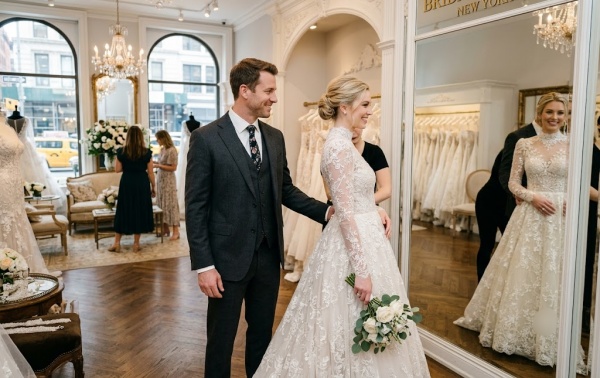
His mistress stood in my wedding dress, smiling at my husband in the mirror like I was the guest and she was the bride.
For a moment, I could not move. The entire bridal salon seemed to narrow around that reflection: her glossy blonde hair pinned loosely at the nape of her neck, my husband’s hand resting at her waist, and the ivory lace sleeves my mother had cried over twelve years earlier. The dress fit her badly in the shoulders, but she wore my life like she had every right to zip herself into it.
Mark saw me first.
His face changed in the mirror before he turned around. The softness he had been giving her disappeared, replaced by that familiar expression he used whenever he wanted me to feel unreasonable. Half guilt, half irritation, all arrogance.
“Rachel,” he said, as if I had interrupted a business lunch instead of walked in on his girlfriend wearing my wedding gown.
The woman beside him turned slowly. Her name was Elise Parker, though for months I only knew her as “the marketing consultant.” She looked at me through the mirror, not directly at first, as if the glass gave her distance from what she had done.
Then she smiled.
Not nervously. Not apologetically.
She smiled like a woman who believed she had already won.
I stood at the entrance of the fitting room area, still holding my appointment card between two fingers. The card was cream-colored, embossed with the salon’s name in gold: Maribel Bridal Atelier, Oak Street, Chicago. Beneath it, in neat black lettering, was my name.
Rachel Whitman.
Appointment: Saturday, 11:00 a.m.
Gown restoration final fitting.
Client-owned garment.
Client-owned.
That phrase would matter later.
At that moment, all I could see was my dress.
It was not just fabric. It was not just lace, silk, buttons, and a train that had once swept across the marble floor of St. James Chapel on Michigan Avenue. It was my mother’s hands smoothing the veil over my hair three months before her cancer came back. It was my father blinking too quickly when he saw me in the doorway. It was the last truly happy photograph of my family before everything began to change.
And Elise was standing in it.
Mark stepped toward me, palms slightly raised. “Don’t make a scene.”
That was the first thing he said.
Not I’m sorry.
Not this isn’t what it looks like.
Not Rachel, I can explain.
Just: Don’t make a scene.
Behind me, a consultant named Brittany froze beside a rack of sample gowns. Her eyes went from me to Elise to Mark, then back to the appointment card in my hand. Two other customers in the main salon went quiet, sensing the kind of private disaster people pretend not to watch while watching every second.
Elise lifted the skirt slightly and looked down at the lace. “It really is beautiful,” she said softly.
I stared at her.
She continued, “I can see why you kept it.”
Something inside me went very still.
Mark exhaled hard. “Rachel, listen. Elise and I came here to talk about options. That’s all.”
“Options?” I repeated.
He glanced at the consultant, then lowered his voice. “For the ceremony.”
“The ceremony,” I said.
Elise’s smile faded by one inch. “Mark told me you weren’t attached to it anymore.”
I almost laughed. The sound caught in my throat and turned into something sharper. “He told you I wasn’t attached to my wedding dress?”
Mark stepped closer. “You haven’t worn it in twelve years.”
“That is usually how wedding dresses work, Mark.”
His jaw tightened. “We’re trying to be practical.”
Practical.
That word landed harder than I expected. For months, Mark had used practical as a weapon. It was practical for him to sleep in the guest room because “we needed space.” It was practical for him to spend long nights at the office because his firm was “restructuring.” It was practical for us to delay counseling because “forcing emotions on a schedule never works.”
Apparently, it was also practical to bring his mistress to my bridal salon and let her try on my gown.
I looked at Elise. “Take it off.”
Her eyes flicked toward Mark.
That small glance told me everything. She had entered this room believing he had the authority to give her permission. She had believed my dress belonged to him as much as it belonged to me, because men like Mark were very good at making women feel chosen with things they did not own.
“Elise,” I said, keeping my voice even, “take off my dress.”
Mark’s face hardened. “Don’t talk to her like that.”
I turned to him slowly. “You brought her here.”
“I was going to tell you.”
“When? After she walked down an aisle in it?”
His eyes flashed. “You don’t have to be bitter because the dress deserved a happier story.”
The room went silent.
Even Brittany stopped breathing.
The dress deserved a happier story.
I felt the words move through me like cold water. My marriage, my grief, my mother, my vows, my years of trying to keep a household together while Mark slowly replaced me with someone younger and easier to impress — all of it reduced to a sad story the dress needed to escape.
Elise looked down, but not with shame. More like discomfort that the line had been said out loud.
I looked at the ceiling.
There, above the hallway leading to the fitting rooms, was a small black dome security camera.
Then I looked at the front desk.
Another camera.
Then at the corner near the mirrors.
A third.
Maribel Bridal Atelier was a high-end salon that stocked gowns costing anywhere from $4,000 to $18,000. They had cameras for insurance, theft, liability, and the kind of customers who occasionally confused luxury with ownership. I knew that because Maribel herself had mentioned it when I dropped off the gown eight weeks earlier.
“Everything is monitored,” she had said, lightly patting the garment bag. “We treat client-owned gowns like museum pieces.”
At the time, I had smiled.
Now, standing ten feet from my husband and his mistress, I understood that sentence differently.
Elise thought I had walked in too late to stop them.
Mark thought humiliation would make me quiet.
Neither of them knew the appointment card still had my name on it.
And neither of them seemed to remember that the salon cameras had been recording from the moment they entered.
Part 2: The Dress My Mother Chose
I bought that dress twelve years earlier with my mother on a rainy April afternoon.
Back then, I was twenty-eight, still convinced love could be measured by effort. Mark and I had been engaged for six months. He was a litigation associate at a downtown law firm, ambitious in a way I mistook for strength, and I was teaching fourth grade at a public elementary school on the North Side.
We were not rich. Not even close.
Mark had student loans, I drove a used Honda Civic, and our first apartment had radiators that hissed like angry cats all winter. But we were happy in the simple, exhausted way young couples can be happy when they think struggling together proves something noble.
My mother insisted on buying my dress.
“Every bride should have one thing she doesn’t have to compromise on,” she told me.
I told her that was ridiculous. The dress I liked was $6,800 before alterations, which was more than I had ever spent on anything that was not a car or tuition. My mother ignored me and wrote the check with the calm authority of a woman who had already made up her mind.
“It’s not for the wedding,” she said when I cried in the dressing room. “It’s for the memory.”
She was right.
The dress had long lace sleeves, a fitted bodice, and a soft A-line skirt that moved like water when I walked. It was elegant without being flashy, classic without feeling old. When I stepped onto the pedestal, my mother covered her mouth with one hand.
“Oh, Rachel,” she whispered. “That’s the one.”
For years after the wedding, the gown stayed preserved in a box at the top of our hall closet. I took it out only once, on our fifth anniversary, after too much wine and nostalgia. Mark laughed when I held it against myself over sweatpants.
“You still look like a bride,” he said then.
I believed him.
By our tenth anniversary, things had already begun to shift.
Mark had made partner at his firm. We had moved from our small condo into a brick house in Evanston with a fenced backyard and a mortgage that made me nervous. I had left teaching to coordinate literacy programs for a nonprofit, partly because the pay was slightly better and partly because Mark said he was tired of me coming home emotionally drained.
At first, I thought success would make him relax.
Instead, it made him harder to reach.
He started caring about things he used to mock: watches, steakhouse memberships, country club invitations, the right wine to bring to a senior partner’s lake house in Wisconsin. He began correcting me in public. Small things at first — how I told a story, how I pronounced a donor’s name, whether my dress was “too schoolteacher” for a firm dinner.
When I objected, he called me sensitive.
When I got quiet, he called me distant.
That is how some marriages die: not with one betrayal, but with a thousand tiny edits to who you are allowed to be.
Elise appeared during the eleventh year.
She was hired by Mark’s firm to help with branding and client events. She was thirty-two, divorced once, and had a social media presence full of rooftop cocktails, charity luncheons, and captions about feminine energy. The first time Mark mentioned her, he rolled his eyes and called her “a lot.”
Three months later, he was quoting her business advice at dinner.
Six months later, he was texting her during movie night.
Eight months later, he told me I was imagining things.
“You always need a villain,” he said one evening when I asked why Elise had sent him a heart emoji at 11:48 p.m.
“I’m asking a question.”
“You’re interrogating me.”
“I’m your wife.”
“And I feel like I’m on trial in my own house.”
That was Mark’s gift. He could turn any accusation into evidence of your cruelty for making it.
I tried counseling. He attended three sessions and then said the therapist was biased because she kept asking him to answer direct questions. I tried patience. I tried being more fun, less critical, more available, less needy. I tried shrinking my hurt into shapes he might find acceptable.
Then my father died.
The funeral was in January, bitterly cold, with snow piled against the cemetery roads. Mark stood beside me at the graveside and held my hand just firmly enough for other people to see. That night, after everyone left our house, he said he had an early flight to New York for a client meeting.
He went to Miami with Elise.
I found out because the hotel charged our shared American Express card by mistake.
When I confronted him, he did not deny it.
He sat across from me at our kitchen island, wearing the cashmere sweater I had given him for Christmas, and said, “I didn’t plan for this to happen.”
That was when I stopped asking whether he had cheated and started asking how long he had been lying.
Three weeks later, he moved into a corporate apartment downtown “temporarily.” He said he needed space. He said divorce was “on the table” but did not file. He said we should not rush decisions.
Later, I learned why.
He wanted the house sold first. He wanted certain accounts shifted. He wanted time to manage the story so our friends, his partners, and his family would believe our marriage had ended before Elise began.
But there was one thing he did not expect.
I took my wedding dress to Maribel Bridal Atelier.
Not because I wanted him back.
Not because I was planning some desperate vow renewal.
I took it there because after my father died, I found a letter from my mother tucked inside an old jewelry box. She had written it before my wedding and never given it to me. In it, she said she hoped I would keep the dress not as proof that life stayed perfect, but as proof that I had once walked toward the future with an open heart.
I cried for an hour after reading that.
Then I decided to have the gown restored.
I wanted to preserve it properly, maybe redesign a small piece of the lace into something for a future daughter, niece, or godchild. Maybe I wanted to reclaim it from a marriage that had become smaller than the woman who wore it. Maybe I just wanted one beautiful thing from my old life not to belong to the wreckage.
Maribel understood.
She was in her late fifties, elegant, direct, and originally from San Antonio. She had owned the salon for twenty-three years and had the kind of presence that made brides stop spiraling. When I brought in the dress, she ran her fingers gently over the lace.
“Beautiful workmanship,” she said. “And yours?”
“Yes.”
“Good,” she said. “Then we treat her with respect.”
I signed paperwork confirming the gown was my personal property. I paid a $1,200 restoration deposit with my own debit card. I scheduled the final fitting for Saturday at 11:00 a.m.
The appointment card went into my purse.
Eight weeks later, I walked into the salon and found Elise wearing the dress.
Part 3: The Cameras Saw What They Thought No One Would
Maribel arrived from the back office within two minutes.
I had never seen her angry before. Not loudly angry. Her voice stayed smooth, her posture perfect, but her eyes had gone flat in a way that made even Mark pause.
“Mr. Whitman,” she said. “Ms. Parker. Please step away from the mirrors.”
Mark tried his professional voice. “Maribel, there seems to be a misunderstanding.”
“No,” she said. “There seems to be an unauthorized fitting of a client-owned gown.”
Elise’s hands tightened around the skirt. “Mark said it was his wife’s dress.”
“It is,” Maribel replied. “And his wife is standing right there.”
Elise flushed.
For the first time, she looked directly at me. “I didn’t know you still wanted it.”
I stared at her. “That is not how property works.”
Mark sighed like I was being embarrassing. “Rachel, come on. It’s a dress.”
Brittany gasped softly.
Maribel turned her head toward him. “It is a privately owned garment under contract with this salon. It is also a restored heirloom with documented condition reports. You were not authorized to touch it.”
He blinked, clearly unprepared for legal language from a woman in pearl earrings and kitten heels.
“I’m her husband,” he said.
Maribel did not move. “That does not make you the client.”
There are sentences that arrive like rescue.
That was one of them.
Elise looked suddenly uncertain. “Can someone help me out of it?”
“No,” Maribel said sharply, then softened her tone without softening the meaning. “Brittany will assist you carefully. Slowly. If there is any damage, it will be documented.”
Elise disappeared behind the fitting room curtain with Brittany. I heard fabric rustle, then quiet whispers. Mark and I remained in the hallway, surrounded by mirrors reflecting versions of us I did not recognize.
He looked annoyed, not ashamed.
“You’re enjoying this,” he said.
“Enjoying what?”
“Making everyone uncomfortable.”
I looked around the salon, at the consultants pretending not to listen, at the brides in sample gowns standing frozen near pedestals. “You brought your girlfriend into a bridal salon to try on my wedding dress, and you think I’m making people uncomfortable?”
His mouth tightened. “We were going to pay for alterations.”
I laughed then. I could not help it. “How generous.”
“You weren’t using it.”
“It was being restored.”
“For what, Rachel? Some shrine to our failed marriage?”
My face went hot, but my voice stayed low. “For me.”
He scoffed. “You can’t keep everything locked in the past forever.”
“You’re right,” I said. “Which is why I’m letting you go.”
For a second, something flickered across his face. Surprise, maybe. Or irritation that I had said the line before he could.
Elise stepped out wearing her own clothes, a cream sweater dress and nude heels. Without my gown, she looked smaller. Still beautiful, but less like destiny and more like a woman who had been caught trespassing inside someone else’s memories.
Brittany carried the gown out on a padded hanger.
Maribel inspected it in silence. She checked the zipper, sleeves, hem, buttons, bodice, and train. When she reached the left side seam, her expression changed.
“Brittany,” she said quietly, “please photograph this.”
My stomach dropped.
“What?” I asked.
Maribel lifted the fabric carefully. Near the waist, the lace overlay had pulled away from the seam. It was not dramatic. Not the kind of damage a casual observer would notice. But I noticed because that lace had been hand-appliquéd before my wedding.
Elise whispered, “It was tight when she zipped it.”
No one spoke.
Then Elise added, too quickly, “I told Mark I didn’t want to force it.”
I turned to him.
Mark looked at the dress, then at me. “It can be fixed.”
That was the moment whatever remained of my grief hardened into clarity.
“It will be fixed,” I said. “And you will pay for it.”
He rolled his eyes. “Fine.”
“No,” Maribel said. “Not fine. We will document the damage. Ms. Whitman will receive a written report, and if she chooses, we will provide relevant security footage to her attorney.”
Mark’s expression changed.
There it was.
The first crack.
“Security footage?” he asked.
Maribel looked toward the ceiling camera. “Yes.”
Elise went pale.
Mark recovered quickly, but not completely. “You record customers changing?”
“Absolutely not,” Maribel said. “There are no cameras inside private dressing rooms. There are cameras in the public salon areas, front desk, hallway, and mirror area, as disclosed by signage at the entrance and in our client paperwork.”
I remembered the small sign near the front door. For your safety and security, public areas are monitored by video surveillance.
Mark had walked right past it.
So had Elise.
Maribel continued, “The footage will show who entered, what was requested, who handled the garment, and who stood in the fitting area with it.”
Mark stepped closer to her. “I don’t consent to being recorded.”
Maribel did not blink. “You entered a monitored business with posted notice.”
I could almost see his lawyer brain racing. Illinois had strict rules about audio recording, but security video in a business with posted notice was a different matter. More importantly, this was not about public shaming. This was about proof of unauthorized access and property damage.
He knew it.
That was why he went quiet.
Elise reached for her purse. “I think we should leave.”
I looked at her. “You don’t get to leave with the story you came in here wearing.”
Her eyes filled, but whether from shame or anger, I could not tell.
“I didn’t know,” she said.
“You knew enough.”
Mark snapped, “Stop attacking her.”
I smiled sadly. “Still protecting the dress thief?”
Elise flinched. Mark’s face darkened.
Maribel stepped between us before he could answer. “Mr. Whitman, Ms. Parker, I’m going to ask you both to leave the salon now. Any further communication should go through Ms. Whitman or her counsel.”
“My counsel?” I repeated.
Maribel looked at me gently. “If you don’t have one, I can give you names.”
It was the first kind thing anyone had said since I walked in.
Mark grabbed his coat. Elise followed him toward the door, but before she left, she turned back. Her voice was small now.
“Rachel, I’m sorry about the dress.”
Not the affair.
Not the humiliation.
Not standing in front of my husband in the lace my mother had chosen.
The dress.
I looked at her for a long moment. “No, you’re sorry there are cameras.”
She left without answering.
After the door closed behind them, the salon seemed to exhale.
The bride near the pedestal started crying. Her mother put an arm around her. Brittany disappeared into the back room and returned with bottled water and tissues, though I had not cried yet.
Maribel led me into her office.
It smelled faintly of coffee, fresh flowers, and expensive fabric. She closed the door, sat across from me, and placed the appointment card on the desk between us as if it were evidence in court.
“Tell me what you want to do,” she said.
“I don’t know.”
“That’s okay. Then we start with what we can document.”
She printed the contract. She printed the payment receipt. She printed the condition report from the day I dropped off the gown. She had Brittany photograph the new damage from multiple angles beside a measuring tape. She saved the security footage in a restricted file and told me she would release it only to me, my attorney, or pursuant to lawful request.
“Do not post it online,” she said.
“I wasn’t going to.”
“Good. People think exposure feels like power. In legal matters, restraint is power.”
That sentence stayed with me.
By the time I left the salon, my dress was back in its garment bag, damaged but safe. The Chicago air was cold enough to sting my cheeks. I stood on Oak Street, surrounded by boutiques, lunch reservations, and people carrying shopping bags like the world had not just tilted sideways.
Then I called my sister.
Megan answered on the second ring. “Hey, you okay?”
“No,” I said. “But I need a divorce attorney.”
She was silent for half a second.
Then she said, “I’m already putting on shoes.”
Part 4: The Story He Could Not Control
Mark’s first text came twenty-six minutes later.
You’re blowing this out of proportion.
I sat in Megan’s passenger seat outside a coffee shop in Lincoln Park, staring at the screen. My sister looked over and said, “Do not answer that with emotion.”
“I wasn’t planning to.”
“You were gripping the phone like you wanted to crack it in half.”
“That’s different.”
She took the phone gently from my hand. “We are going to drink coffee, call a lawyer, and let him panic in silence.”
Megan had always been more direct than me. She was a nurse at Northwestern Memorial and had the emotional tolerance of someone who had seen people behave badly in waiting rooms. During my marriage, she had tried to be supportive without saying I told you so.
Now her restraint was gone.
By the time we ordered coffee, Mark had sent three more messages.
It wasn’t what it looked like.
Elise feels awful.
You know I never meant to hurt your mother’s memory.
That last one almost got a response from me.
Megan saw my face and shook her head. “No.”
“He mentioned my mother.”
“Of course he did. He knows where the bruise is.”
So I did not answer.
Instead, I called Caroline Meyers, a divorce attorney recommended by Maribel. Her office was in the Loop, and she offered me a consultation Monday morning. When I briefly explained what had happened, she paused, then said, “Save every message. Do not threaten. Do not negotiate. Do not agree to anything verbally.”
“Can I ask him to pay for the damage?”
“Yes,” she said. “But let me review the documents first.”
Documents.
That word again.
For the rest of the weekend, Mark changed strategies every few hours.
Saturday afternoon, he was dismissive. He said I was acting theatrical. He said the dress was “marital property,” which Caroline later told me was not necessarily accurate, especially because it had been a gift from my mother to me before marriage and restored using my separate funds.
Saturday night, he was sentimental. He sent a photo from our wedding day, the two of us laughing outside the chapel while flower petals stuck in my hair.
Remember when we were happy? he wrote.
I stared at the photo longer than I should have.
Then I saved it to a folder labeled Legal and put my phone facedown.
Sunday morning, Elise texted me from an unknown number.
Rachel, I truly did not understand the emotional significance of the dress. Mark said you had agreed he could repurpose it since the marriage was ending. I’m sorry for my part in the pain.
Repurpose.
As if my mother’s gift were an old dining table.
I forwarded the message to Caroline’s office.
By Sunday evening, Mark had become angry.
If you try to drag my name through the mud, I will make this divorce very difficult for you.
There he was.
Not the charming husband from our wedding photos. Not the wounded man who claimed he had “found happiness unexpectedly.” The real Mark, the one who believed kindness was useful only until control required something sharper.
I took a screenshot.
Then I slept for six full hours for the first time in months.
Monday morning, Caroline reviewed the documents in her conference room. She was in her early forties, with dark hair, a navy suit, and the calm voice of someone who did not confuse drama with importance.
When I finished telling the story, she leaned back slightly.
“Well,” she said, “he has made several poor decisions.”
Megan, who had insisted on coming with me, muttered, “That’s one way to put it.”
Caroline reviewed the salon contract, payment records, appointment card, restoration report, and text messages. Then she made a list on a yellow legal pad.
“First, the gown. We’ll treat that as your separate property unless he wants to spend money arguing about a dress his girlfriend damaged on camera.”
I nodded.
“Second, the footage. We do not publish it. We preserve it.”
“Why?”
“Because public humiliation can complicate legal proceedings. Evidence is useful when it’s controlled.”
I thought of Maribel saying almost the same thing.
“Third,” Caroline continued, “we file for divorce and request temporary orders regarding access to the home, financial accounts, and personal property. If he has removed or attempted to control your belongings, we address that.”
“He hasn’t removed anything else that I know of.”
“Good. We still inventory.”
She looked at me then, not as a lawyer but as a woman who had seen clients confuse revenge with recovery.
“Rachel, I know you’re hurt. You have every right to be. But our goal is not to punish him emotionally. Our goal is to protect your assets, your dignity, and your future.”
I swallowed hard. “I understand.”
“Good,” she said. “Then let him be the messy one.”
That became the plan.
Let him be the messy one.
Mark hated it.
He expected tears, late-night calls, public posts, maybe a dramatic confrontation at his office. He expected the version of me he had spent years training: the woman who over-explained, apologized for tone, and tried to prove she was fair even while being treated unfairly.
Instead, he got emails from Caroline.
He got itemized documentation.
He got a formal request to reimburse the full cost of repairs, updated preservation, attorney review of the gown incident, and any additional valuation required due to damage to a documented heirloom garment.
The estimate came to $2,850.
Mark called that “absurd.”
Maribel sent the itemized restoration quote.
He stopped calling it absurd.
Then came the house.
I had moved into Megan’s guest room temporarily because I could not stand sleeping under the same roof where Mark had once told me Elise was “just someone who understood professional pressure.” Caroline arranged for me to return with Megan and a neutral third party to collect personal belongings while Mark was at work.
He did not like that either.
You’re making me look dangerous, he texted.
I replied only once, under Caroline’s guidance.
This arrangement is for clarity and to avoid conflict. Please direct further communication to counsel.
That sentence made him furious.
But fury sent to a lawyer looks different from fury sent to a wife. It looks smaller. Less powerful. More expensive.
Two weeks after the salon incident, Mark’s story began to collapse socially.
Not because I posted the footage.
I did not.
It collapsed because Elise did what mistresses often do when they realize the man who promised them a beautiful beginning has handed them a legal mess instead.
She told people her version first.
According to mutual acquaintances, Elise claimed Mark had said I was emotionally unstable, that I had abandoned the dress, that I had agreed he could use it symbolically for their future ceremony once the divorce was final. Unfortunately for Mark, her attempt to protect herself made him look worse.
Because everyone asked the same question.
Why was he planning a future ceremony before filing for divorce?
His partners asked too.
Law firms do not enjoy personal scandals when clients are involved, especially when there are words like unauthorized, property damage, and security footage floating around. Mark was not fired, but he was quietly removed from two high-profile client teams “until things settled.”
Things did not settle.
A month later, Caroline received notice that Mark wanted mediation.
“He’s ready to be practical,” his attorney wrote.
I laughed when Caroline read that line.
Practical had become Mark’s favorite word for losing control.
Mediation took place in a downtown office with gray walls, bad coffee, and a view of the Chicago River. Mark arrived in a charcoal suit, looking tired and annoyed. He did not bring Elise.
I wore a black dress, pearl earrings, and my mother’s watch.
For the first hour, we discussed accounts, home equity, retirement funds, and temporary support. It was painfully ordinary. Numbers on spreadsheets. Dates. Signatures. The mathematics of a marriage ending.
Then his attorney brought up the dress.
“My client is willing to contribute a reasonable amount toward repairs,” he said.
Caroline looked at him. “He will pay the full documented cost.”
Mark leaned forward. “Rachel, this is insane. It was an accident.”
I met his eyes across the table. “Walking into the salon was not an accident. Asking for my gown was not an accident. Letting her try it on was not an accident. Damaging it was just the part you didn’t plan.”
His attorney whispered something.
Mark ignored him. “You’re acting like I destroyed your life.”
“No,” I said. “You tried to rewrite it without permission.”
For once, he had no immediate answer.
The mediator, a retired judge with reading glasses hanging from a chain, cleared her throat. “Mr. Whitman, given the documentation and video evidence, reimbursement appears to be the most efficient resolution.”
Mark looked at me with pure resentment.
Then he agreed.
That should have felt victorious.
Instead, I felt tired.
Because money could repair lace.
It could not repair the moment I saw another woman smiling in my mother’s gift.
Part 5: A Happier Story
The dress came home four months later.
Maribel called me personally when it was ready. I had been dreading the appointment, afraid that seeing it again would drag me back into the salon hallway, Elise at the mirror, Mark’s voice telling me not to be bitter. But when I walked into Maribel Bridal Atelier, the air felt different.
Quieter.
Kinder.
The gown waited in a private room, displayed on a dress form beneath soft lighting. The lace had been repaired so carefully I could not find the torn seam until Maribel showed me where it had been. The sleeves were smooth, the bodice clean, the train restored.
“She’s herself again,” Maribel said.
I blinked quickly.
“Yes,” I whispered. “She is.”
Maribel gave me time alone with it.
I stood in front of the gown for several minutes, studying the dress I had once worn toward Mark with absolute faith. For a long time, I thought the dress had become tragic because the marriage failed. Then I thought it had become contaminated because Elise wore it.
But standing there, I finally understood something.
The dress had never belonged to the marriage.
It had belonged to me.
It had belonged to my mother’s love, my father’s tears, my young hope, my courage to begin. Mark had been part of the day, yes. But he was not the whole memory. He did not get to own the story just because he betrayed the ending.
When Maribel returned, I asked a question I had been carrying for weeks.
“Can it be redesigned?”
Her eyes softened. “Into what?”
“Not another wedding dress.”
“Good,” she said. “That would be too easy.”
I smiled.
Together, we decided to preserve most of the gown but remove a small section of inner lace from the train — a place invisible from the outside. Maribel would use it to create three handkerchiefs: one for me, one for Megan, and one to save for my niece, Lily, who had been five when my mother died and barely remembered her.
“Are you sure?” Maribel asked.
“Yes,” I said. “I want something we can hold.”
Six weeks later, she mailed them in a white box tied with ribbon.
I cried when I opened it.
Not because of Mark.
Because of my mother.
The divorce was finalized nine months after the salon incident. The final agreement was not dramatic. Mark kept certain investments and his downtown apartment lease. I kept the Evanston house for eighteen months before selling it on my own timeline, not his.
He reimbursed the dress repairs in full.
He also agreed, through attorneys, not to use, display, copy, or publish any images of the gown or salon footage. Caroline called that “unusual but satisfying.” I called it peace.
Elise and Mark did not last.
I learned that from three different people who all insisted they were telling me only because they thought I should know. Apparently, the romance struggled under the weight of depositions, legal invoices, and the discovery that being chosen by a married man is less glamorous when he arrives with paperwork.
I did not celebrate.
That surprised me.
For months, I had imagined Elise suffering some grand humiliation. I pictured her crying in a bathroom, losing friends, realizing she had been lied to. But by the time their relationship ended, I had used up my appetite for watching other people break.
Elise sent me one email after the divorce.
Rachel,
I know I have no right to ask for your forgiveness. What happened at the salon was wrong. I believed Mark’s version because it made me feel special, and I ignored the parts that should have made me ashamed. I am sorry for wearing your dress and for helping him hurt you.
I read it twice.
Then I closed my laptop.
A week later, I replied with three sentences.
I hope you learn from what happened. I hope you never let someone else’s lies make you cruel. I am moving on and do not want further contact.
Then I blocked her.
Not out of hatred.
Out of boundaries.
Mark called once after everything was final. I almost let it go to voicemail, but curiosity got the better of me. His voice sounded older, or maybe I had finally stopped hearing it through the filter of who he used to be.
“I heard you sold the house,” he said.
“Yes.”
“That must have been hard.”
“It was.”
He paused. “Rachel, I’m sorry.”
I looked around my new apartment in Lakeview. It was smaller than the house, but the windows faced west, and in the evenings, sunlight poured across the hardwood floors like honey. A stack of books sat beside the couch. Fresh flowers stood on the kitchen table because I bought them for myself every Friday.
“What are you sorry for?” I asked.
He sighed. “Everything.”
I almost laughed, but not kindly. “That’s usually what people say when they don’t want to list the details.”
Silence.
Then he said, “I’m sorry for the affair. I’m sorry for lying. I’m sorry for taking Elise to the salon. I’m sorry for letting her put on the dress. And I’m sorry for saying it deserved a happier story.”
That last sentence landed softly.
Not enough to heal everything.
Enough to mark the truth.
“Thank you,” I said.
“Do you forgive me?”
I looked toward the window, where the city lights were beginning to flicker on.
“No,” I said. “But I don’t need to punish you anymore.”
He was quiet for a long time.
“I guess that’s something,” he said.
“It is.”
After we hung up, I made tea in the small kitchen I had chosen alone. I thought I might cry. Instead, I felt strangely light, as if some invisible string had finally been cut.
One year after the salon incident, Megan invited me to Lily’s school concert.
It was December, bitterly cold, the kind of Chicago night that makes everyone walk fast with shoulders hunched. Lily was in sixth grade by then, all elbows, braces, and dramatic opinions about everything. She played flute in the school band and waved at us from the stage with the confidence of someone who had not yet learned to be embarrassed by love.
Megan had the lace handkerchief in her coat pocket.
“I carry it when I need Mom,” she told me.
I touched mine in my purse. “Me too.”
During the concert, while fifty middle schoolers bravely attacked “Jingle Bell Rock,” I felt something settle inside me. Life had not become the story I expected. I was forty-one, divorced, living in an apartment, rebuilding finances, and learning how to sleep in a bed where no one’s silence punished me.
And yet I was okay.
Not perfect.
Not untouched.
Okay.
Afterward, Lily hugged me and asked if we could get hot chocolate. We went to a diner nearby, the kind with laminated menus and waitresses who call everyone honey. Megan ordered fries for the table. Lily talked nonstop about band drama, science homework, and a girl named Ava who apparently thought she was “the boss of the flute section.”
I laughed so hard I nearly spilled my coffee.
That was the happier story.
Not another wedding.
Not a revenge fantasy.
Not Mark begging on the courthouse steps or Elise publicly exposed for strangers to judge.
The happier story was ordinary. It was hot chocolate with my sister and niece. It was a repaired dress resting safely in archival tissue. It was my mother’s lace folded in my purse. It was my name on my own lease, my own bank account, my own Friday flowers.
The dress deserved a happier story, Mark had said.
He was right about that.
He was only wrong about who got to write it.
Months later, Maribel asked if she could display a small anonymous note from me in the salon’s private fitting area. Not my name, not the details, just something future brides might read when they felt overwhelmed by the pressure to make everything perfect.
I wrote it on cream stationery.
A dress is not proof that love will last forever. It is proof that, for one brave moment, you believed in joy. If the story changes, that does not make the joy foolish. It only means you are allowed to write another ending.
Maribel framed it beside the mirror.
She sent me a photo.
I stared at it for a long time.
Then I saved it, not in the Legal folder, but in a new one labeled Mine.
I still have the wedding dress. It is preserved in a box at the top of my closet, not hidden, not worshipped, simply kept. Sometimes people ask why I did not sell it, donate it, or destroy it after everything that happened.
The answer is simple.
Because I refuse to let betrayal decide what I am allowed to keep.
Mark got to leave the marriage. Elise got to leave the scandal. The lawyers got their fees, the house got sold, the salon repaired the lace, and life moved forward the way life always does, with bills, weather, groceries, birthdays, and traffic on Lake Shore Drive.
But the dress stayed mine.
So did the memory of my mother’s face when she first saw me wearing it.
So did the moment I stood in that salon, humiliated but not helpless, holding an appointment card with my name on it.
For a while, I thought the cameras saved me.
They helped, certainly. They proved what happened. They turned gaslighting into evidence and arrogance into liability.
But they were not what saved me.
I saved me.
I saved myself when I did not scream. I saved myself when I called a lawyer instead of writing a furious post. I saved myself when I let documents speak louder than pain. I saved myself when I stopped trying to convince a man who had already rewritten me as bitter that I was worthy of respect.
And if there is one thing I know now, it is this:
Sometimes people will stand in front of a mirror wearing what belongs to you, smiling like possession is the same as victory.
Let them smile.
Let the cameras roll.
Let them believe you arrived too late.
Then take back your name, your story, and every beautiful thing they thought they could steal.
