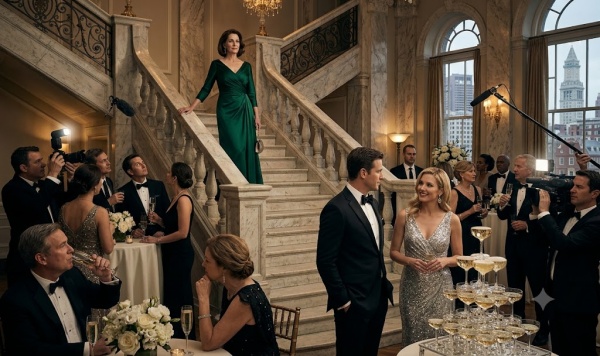
My Husband Brought His Mistress to My Charity Gala. My husband stood beside his mistress like she belonged there, while she quietly told me I could “watch from the stairs.” Then he raised a glass and called her the woman who brought light back into his life. What neither of them knew was that every microphone, every camera, and every moment of that gala had already been arranged by me.
Part 1: The Woman on the Stairs
His mistress stood beside my husband at my foundation gala and told me I could watch from the stairs.
Not loudly, of course. Women like Celeste Monroe never raised their voices when cruelty could be delivered with a smile. She leaned close enough for me to smell her perfume, something expensive and sharp, and said, “Evelyn, tonight is really about the future. Maybe it would be more graceful if you let Grant handle the room.”
I looked past her shoulder at the ballroom I had booked eighteen months earlier. The chandeliers glowed over forty round tables dressed in ivory linens, gold chargers, and centerpieces of white hydrangeas. Four hundred donors, doctors, attorneys, CEOs, city officials, and old-money philanthropists filled the room, all waiting for the annual Whitmore Hope Foundation gala to begin.
My gala.
My foundation.
My life’s work.
Grant stood beside Celeste with one hand resting lightly at the small of her back. It was the same hand that had signed our mortgage papers, held mine during fertility treatments, and squeezed my shoulder at press conferences when reporters praised him for supporting “his wife’s mission.” Now it rested on another woman as if I were a staff member who had wandered into the wrong hallway.
I had known about Celeste for six months.
I knew about the suite at the Langham Hotel in Boston. I knew about the Cartier bracelet he bought her using what he thought was a private business account. I knew about the emails where she called me “the grieving queen” and joked that my foundation would look better with “younger energy at the front.”
What they did not know was that knowing had changed me.
When I first discovered the affair, I cried in the laundry room with a towel pressed against my mouth so our housekeeper, Rosa, wouldn’t hear me. Then I cried in my parked car outside a CVS on Beacon Street while people walked by carrying paper bags full of ordinary things. Then, after three days of humiliation so complete it felt physical, I stopped crying.
That was when I called a lawyer.
Not a divorce lawyer at first, though I eventually called one of those too. I called Meredith Shaw, a nonprofit governance attorney who had once helped our foundation update its bylaws after we expanded into three states. Her first words after I explained everything were, “Evelyn, do not react emotionally in public.”
“I’m not sure I have another setting right now,” I told her.
“You do,” she said. “You’re the founder of a twenty-eight-million-dollar charitable foundation. Start acting like the room is already yours.”
So I did.
For months, I watched. I documented. I smiled through breakfast while Grant scrolled on his phone and told me he had early meetings. I nodded when Celeste appeared at committee luncheons, suddenly “consulting” on donor engagement despite having no experience beyond marrying well, divorcing better, and knowing which rooms rewarded confidence more than competence.
By the night of the gala, they believed I was broken.
That was their first mistake.
The Whitmore Hope Foundation began ten years earlier, after my younger sister, Hannah, died from complications that might have been avoided if she had received proper follow-up care. She was thirty-one, uninsured between jobs, and too proud to tell me how sick she was until it was too late. After her funeral, I used my inheritance from our father to start a small fund that helped low-income women access medical screenings, transportation, and emergency assistance.
In the beginning, the foundation operated out of my dining room.
I wrote thank-you notes by hand. I drove donated winter coats across Massachusetts in the back of my Subaru. I sat with women in hospital waiting rooms because sometimes the difference between despair and survival is one person refusing to let you sit alone.
Grant joined later.
At first, I thought his involvement was love. He had a background in corporate finance, and he helped structure donor funds, investment policies, and reporting systems. He charmed board members, shook hands at galas, and learned how to say “Evelyn’s vision” in a way that made people think he was noble for standing beside me.
For years, I believed we were partners.
Then the foundation grew.
So did Grant’s appetite for applause.
By our tenth annual gala, the foundation had offices in Boston, Providence, and Hartford. We had funded mobile clinics, domestic stability grants, postpartum support programs, and legal aid partnerships. Our annual gala became one of the biggest charity events in Boston, the kind of night where photographers stood near the step-and-repeat and donors pretended not to enjoy being recognized.
Grant loved that part.
He loved the tuxedos, the speeches, the silent auction, the whispered introductions to people whose names appeared on hospital wings and university buildings. He loved when strangers assumed the foundation belonged to both of us equally. He especially loved when they assumed he was the brain behind it.
I let him enjoy it because I was busy doing the work.
That was my mistake.
The gala was held at the Fairmont Copley Plaza, in a ballroom with gilded balconies and ceilings high enough to make everyone feel richer than they were. The hotel staff moved with quiet precision, carrying trays of champagne and sparkling cider through clusters of guests. A twelve-piece jazz ensemble played near the stage, their music soft enough for conversation but polished enough to remind everyone they were at an event where money mattered.
The champagne fountain stood near the center of the reception area.
Celeste had insisted on it.
“It creates drama,” she had said during the planning meeting, smiling at Grant. “People love a visual moment.”
I remembered folding my hands on the conference table and saying, “As long as it doesn’t interfere with the program flow.”
She had laughed. “Evelyn, not everything has to be so serious.”
Grant had touched her wrist under the table.
I saw it.
He saw me see it.
Neither of them moved.
That night, as guests arrived beneath the warm glow of chandeliers, Celeste wore a silver gown that looked designed to catch every camera flash. She had positioned herself beside Grant at the entrance to the ballroom, greeting donors as if she were the hostess. People glanced between us with the awkward politeness of Americans trapped in a scandal they were too well-dressed to acknowledge.
“Evelyn,” she said again, her smile tightening. “The stairs give you a perfect view.”
I looked at Grant.
He did not meet my eyes.
That hurt more than I expected. Not because I still wanted him, but because some part of me had hoped he would at least have the decency to be ashamed. Instead, he adjusted his cuff links and said, “Let’s not make this uncomfortable.”
I almost laughed.
“Grant,” I said softly, “you brought your mistress to my foundation gala.”
Celeste’s smile flickered.
Grant’s jaw tightened. “This is not the time.”
“No,” I said. “It really isn’t.”
Then I stepped aside and let them walk into the ballroom first.
They thought I was retreating.
They thought the stairs were a punishment.
They did not understand that from the stairs, I could see everything.
Part 2: The Foundation Was Never His
Grant Whitmore had always believed presentation was the same as power.
He had been born into a family where people used last names like currency. His grandfather owned textile mills, his father managed commercial real estate, and Grant grew up in a brick house in Wellesley where no one ever discussed money directly because everyone understood there was enough. He had the posture of a man who had never needed to introduce himself twice.
When we married, people called me lucky.
I was thirty-two, a public health advocate with a grieving heart and a half-formed foundation. Grant was handsome, connected, and patient in public. At our wedding, his mother told me I was “exactly the kind of woman who could give him purpose.”
I took it as a compliment then.
Now I understand it was a warning.
For the first few years, our marriage had tenderness in it. We cooked on Sunday nights, badly but with enthusiasm. We drove to Maine in the summer and stayed at a small inn where Grant pretended to enjoy lobster shacks even though he hated eating with his hands.
He made me laugh.
That is the hardest part to admit. Betrayal becomes easier to explain if the person was always a villain. Grant was not always cruel. Sometimes, he was gentle enough to make his later selfishness feel like a second person had taken over his body.
But success changed him, or maybe success simply gave him permission to become who he had always wanted to be.
The foundation’s first major gala raised $180,000. I cried in the hotel bathroom after the final count came in because it meant we could fund a mobile screening van for another year. Grant found me there, kissed my forehead, and said, “You did it.”
By the fifth gala, we raised $3.4 million.
Grant said, “We did it.”
By the eighth, he was telling reporters, “Our foundation has always believed in scalable impact.”
Our foundation.
I did not correct him. I told myself marriage was not a courtroom, that keeping score would make me small. I was too focused on the women writing us letters about rent assistance, cancer screenings, emergency housing, and childcare grants.
Then Celeste arrived.
She entered through a donor circle called the Beacon Society, a group of wealthy supporters who pledged at least $50,000 annually. Celeste had recently divorced a hedge fund manager and was trying to reinvent herself as a philanthropist. She was pretty in the polished Boston way, with glossy brown hair, expensive restraint, and a talent for making questions sound like compliments.
At her first luncheon, she told me, “Your story is so moving. It’s incredible how you turned personal tragedy into a brand.”
“A mission,” I corrected.
She smiled. “Of course.”
Grant found her charming.
I found her exhausting.
Within three months, she was on the gala advisory committee. Within four, she was texting Grant about sponsorship strategy at midnight. Within five, she stopped pretending the texts were about sponsorship strategy.
I discovered the affair by accident, though later I realized Providence had been less accidental than exhaustion.
Grant left his iPad in the kitchen one morning while he showered. A message appeared on the screen, bright and casual. Can’t wait for tonight. I’ll wear the blue dress you like.
My stomach dropped.
I did not open it. I did not need to. The preview was enough to turn the air around me cold.
When Grant came downstairs, freshly shaved and smelling like cedar cologne, I asked, “Who’s wearing the blue dress?”
He froze for less than one second.
Then he lied.
A donor dinner. A joke. Nothing. You’re stressed. You always assume the worst when gala season starts.
I watched his mouth move and understood, with terrible clarity, that this was not the first lie. It was only the first one I had caught.
After that, the truth became visible everywhere.
Receipts. Hotel charges. Deleted calendar entries. A second phone he kept in the locked drawer of his study. His sudden interest in “modernizing” the foundation’s public image, which apparently required Celeste to attend every major donor meeting in dresses that made older men forget what they were objecting to.
For a while, I thought it was only an affair.
Then Meredith found the documents.
Grant had quietly been speaking with three board members about restructuring the foundation after the gala. His plan was elegant, in the way predatory things can be elegant. He wanted to create a new executive office, install himself as president, move me into a ceremonial founder role, and bring Celeste in as “Chief Advancement Strategist.”
The language was insulting enough to be funny.
But it was also dangerous.
Under Massachusetts nonprofit rules and our own bylaws, the board had authority over leadership structure. Grant could not simply steal the foundation, but he could influence the right people. He could exploit donor fatigue, whisper that I was emotionally fragile, and present himself as the steady hand needed for national expansion.
“He’s not just leaving you,” Meredith said when she laid the documents across her desk. “He’s trying to inherit your credibility while you’re still alive.”
I stared at the papers until the words blurred.
“What do I do?”
“You stop thinking like a betrayed wife,” she said. “Start thinking like a founder with fiduciary responsibilities.”
That sentence saved me.
Over the next few months, I built my case quietly.
We reviewed the bylaws. We audited donor-restricted funds. We traced unauthorized consulting payments to Celeste through a marketing vendor she had recommended. We found that Grant had used foundation staff time to prepare materials for a separate nonprofit entity he planned to launch after “transitioning” me out.
That mattered.
In a marriage, betrayal is personal.
In a nonprofit, misuse of funds is governance.
By September, I had enough to act. But Meredith advised waiting until the gala, not for revenge, but for protection. The gala was when the full board, major donors, auditors, and press would all be in the same place. If Grant tried to publicly reposition himself that night, we would have witnesses.
“He will overreach,” Meredith said.
“How can you be so sure?”
“Because men like Grant mistake silence for surrender.”
She was right.
Two weeks before the gala, Grant told me he wanted to revise the program.
“We need to project unity,” he said, standing in our kitchen with a glass of Scotch.
“Unity?”
“The foundation needs confidence. Donors are nervous about leadership gaps.”
“What leadership gaps?”
He looked at me with practiced concern. “Evelyn, you’ve seemed tired.”
“My husband is having an affair with a committee member,” I said. “Tired seems reasonable.”
His face hardened. “I was hoping we could be adults.”
I smiled then, not because anything was funny, but because I finally understood the performance. To Grant, being an adult meant letting him harm me without consequences. It meant swallowing humiliation so no one else had to feel awkward.
“What changes do you want?” I asked.
He relaxed, thinking he had won.
He wanted to open the donor toast. He wanted Celeste acknowledged for her “visionary contributions.” He wanted me to speak later, after the funding video, when guests would be checking their phones and thinking about dessert.
I said, “Fine.”
His relief was almost tender.
That was his second mistake.
Because I had already rewritten the entire night.
The hotel contract was in my name as founder and board chair. The production company answered to me. The donor video had been replaced. The pledge cards had been redesigned. The champagne fountain, Celeste’s beloved visual moment, had been moved precisely four feet to the left so the cameras would frame the stage, the board table, and the legal witnesses seated in the front row.
The ballroom was not just decorated.
It was arranged.
Grant believed he would use the gala to introduce Celeste as the future.
I intended to use it to show everyone the truth.
Part 3: The Toast
By 7:30 p.m., the ballroom doors opened.
Guests flowed inside in waves of black tuxedos, evening gowns, diamond earrings, and polite laughter. The air smelled of roses, champagne, and the faint metallic heat of professional lighting. Servers moved between tables with salads of baby arugula, roasted pears, and goat cheese, because gala food is always designed to look elegant while leaving everyone hungry.
I stood on the staircase landing and watched Grant work the room.
He was brilliant at it. That was one of the reasons the betrayal cut so deep. He remembered names, asked about grandchildren, laughed at the right moments, and made every donor feel like their check had personally saved humanity.
Celeste floated beside him like a campaign wife.
She touched elbows. She complimented gowns. She told one hospital CEO that Grant had been “carrying so much behind the scenes.” I saw the CEO glance toward me with sympathy, and I wondered what version of my story Celeste had told.
Probably the fragile widow version.
Except I was not a widow, and Grant was not dead.
He was very much alive, standing under a chandelier, preparing to bury me politely.
At table one sat the foundation’s board. Meredith was there, though most people assumed she was simply another donor in a black dress. Beside her sat Harold Kim, our outside auditor, and Nina Patel, the board secretary who had quietly provided me copies of the meeting notes Grant tried to keep informal.
At table two sat three major donors who had pledged a combined $9 million toward our new women’s health initiative.
At table three sat a reporter from the Boston Globe.
Grant had invited her.
That was his third mistake.
At 8:05, the jazz band faded out, and the ballroom lights dimmed. A hush moved through the room. Grant stepped onto the stage before the emcee could introduce him.
I saw Meredith lift one eyebrow.
Grant took the microphone with the confidence of a man who believed permission was implied by his presence. “Good evening, everyone,” he said, his voice warm and smooth. “Welcome to the tenth annual Whitmore Hope Foundation gala.”
Applause rose.
He smiled, waiting just long enough.
“Tonight is about light,” he continued. “It’s about the people who bring light into dark places, the people who remind us that hope is not just a word. It is a choice.”
I stood still on the stairs.
Celeste watched me from the edge of the stage. Her smile was small, triumphant. She believed she had placed me exactly where I belonged.
Grant gestured toward the champagne fountain. “Before we begin the formal program, I’d like to raise a glass.”
Servers moved quickly through the room, distributing champagne and sparkling cider. The fountain shimmered beneath the lights, tiers of pale gold liquid cascading in a perfect theatrical display. Guests lifted flutes, smiling, ready for generosity wrapped in drama.
Grant took his glass from Celeste.
Then he turned toward her.
“And personally,” he said, “I want to thank the woman who brought light back into my life.”
The room changed.
It was subtle at first. A shifting in chairs. A stillness around table one. The sudden silence of people realizing they were not witnessing an ordinary toast.
Celeste lowered her lashes in a performance of humility.
Grant raised his glass higher. “Celeste Monroe has reminded me, and many of us, that institutions must evolve. That courage sometimes means embracing new beginnings.”
Several people looked at me.
I did not move.
Grant continued, growing bolder in the silence. “The foundation is entering a new chapter. A brighter chapter. One built not only on the pain of the past, but on the promise of what comes next.”
There it was.
Not just the affair.
The takeover.
He smiled at Celeste like she was salvation in silver satin.
I waited until the applause began awkwardly, scattered and uncertain. Then I started down the stairs.
Every head turned.
The sound of my heels against marble was clearer than it should have been. One step. Then another. I felt four hundred people watching, measuring my face for tears, rage, collapse.
They found none.
When I reached the stage, the emcee looked terrified. Grant’s expression tightened. Celeste went pale beneath her makeup.
I held out my hand for the microphone.
Grant hesitated.
That hesitation told the room more than any speech could have.
Finally, because cameras were pointed at him, he gave it to me.
“Thank you, Grant,” I said.
My voice was calm.
That surprised even me.
I turned to the room. “Good evening. For those of you who know me, thank you for being here. For those of you who are new to this foundation, I’m Evelyn Whitmore, founder and current board chair of the Whitmore Hope Foundation.”
Current.
The word landed softly, but I saw board members straighten.
“Ten years ago, I started this foundation after losing my sister Hannah,” I continued. “She was not a brand. She was not a stepping stone. She was a woman who needed help and did not receive it in time.”
The room was utterly silent.
I glanced at Celeste. “So tonight, before we speak about new beginnings, I think we should remember why this work exists.”
Behind me, the projection screen came alive.
Not with the video Grant expected.
The first image was Hannah at twenty-seven, laughing in a Red Sox cap, her cheeks pink from cold. Then came footage from our first mobile clinic, volunteers in winter coats, women stepping into heated vans for screenings. Then letters appeared, read aloud by women whose voices filled the ballroom.
Because of your transportation grant, I made it to chemo.
Because of your emergency fund, my kids and I had a safe place to sleep.
Because someone answered the phone, I stayed alive long enough to ask for help.
By the second minute, people were crying.
By the fourth, donors were reaching for pledge cards.
By the sixth, Celeste looked like she wanted to disappear.
The video ended with a simple title card: Ten years. 42,000 women served. The mission belongs to them.
Applause erupted, not polished gala applause, but the real kind that swells from somewhere below etiquette. People stood. The sound filled the ballroom and rolled up into the chandeliers.
Grant clapped because he had no choice.
I waited.
When the applause faded, I said, “Tonight, we also owe our donors transparency.”
Grant’s face drained.
Meredith stood from table one.
“As board chair,” I continued, “I have a responsibility to protect this foundation, its staff, its beneficiaries, and every restricted dollar entrusted to us. Over the past several months, concerns were brought to my attention regarding unauthorized strategic planning, conflicts of interest, and the inappropriate use of foundation resources.”
A murmur moved through the room.
I did not look at Grant.
“This matter has been reviewed with counsel and our outside auditor. A special board meeting was held this afternoon in accordance with our bylaws. Effective immediately, Grant Whitmore has been removed from any advisory or operational role connected to the foundation.”
The room went still again, but this silence was different.
It was not shock.
It was judgment.
Grant stepped toward me. “Evelyn.”
I lifted one hand, stopping him without touching him.
“This is not a personal announcement,” I said. “It is a governance announcement. The foundation’s work will continue under the leadership of our existing executive team, with full oversight from the board and independent financial review.”
The Boston Globe reporter was writing quickly.
Celeste whispered something to Grant. He did not answer.
Then I delivered the line Meredith and I had debated for three days.
“Any individual who was presented tonight, formally or informally, as part of the foundation’s future leadership does not hold, and will not hold, a position with this organization.”
Celeste’s mouth opened.
No sound came out.
I turned back to the donors. “If anyone has questions about tonight’s governance actions, our board secretary and counsel will be available after the program. But I ask that we not allow one person’s choices to distract from the four hundred women currently waiting for services we can fund tonight.”
That was when Mrs. Abigail Pierce stood.
She was eighty-two, worth more money than several banks, and had once made a state senator cry during a hospital board meeting. She lifted her champagne flute toward me.
“To the work,” she said.
Then one by one, the room stood.
“To the work,” someone repeated.
Soon, the entire ballroom was saying it.
Grant looked around as if the walls had betrayed him.
But the walls had never belonged to him.
Neither had the night.
Part 4: What Humiliation Looks Like from the Other Side
People imagine public humiliation as loud.
They picture shouting, thrown drinks, mascara running down someone’s face. But real humiliation, the kind that changes the temperature of a room, can be almost silent. It looks like a man in a $4,000 tuxedo realizing no one is coming to rescue him from the truth.
Grant followed me offstage as the dinner service resumed with mechanical precision.
“Evelyn,” he said through his teeth. “We need to talk.”
“No,” Meredith said, appearing beside me. “You need to speak with your attorney.”
His eyes flashed. “This is between my wife and me.”
“Not anymore,” Meredith replied.
Celeste stood a few feet away, clutching her silver evening bag with both hands. For the first time since I had known her, she looked young. Not young in age, but young in the way people look when they finally understand that confidence is not the same as safety.
“You planned this,” Grant said to me.
“Yes.”
The honesty startled him.
“You set me up.”
“No,” I said. “I gave you a microphone. You chose what to say into it.”
His face twisted. “After everything I did for this foundation?”
That sentence almost broke my calm.
Not because it hurt, but because it revealed the depth of his delusion. He truly believed that helping me build something entitled him to own it. He thought support was an investment, and betrayal was merely a withdrawal.
“You were paid consulting fees approved by the board for specific financial services,” I said. “You were acknowledged publicly for years. You were thanked more times than you deserved.”
Celeste flinched.
Grant lowered his voice. “Do you know what this will do to my reputation?”
I looked at him for a long moment.
“That question,” I said, “is why it had to happen.”
Behind us, the auctioneer took the stage. The first item was a weekend at a Martha’s Vineyard cottage donated by one of our supporters. People began bidding in bright, determined voices, almost aggressively generous.
The gala did not collapse.
That was another thing Grant had miscalculated. He believed scandal would ruin the foundation because he believed the foundation was held together by his charm. In reality, it was held together by nurses, social workers, volunteers, donors, lawyers, accountants, and women who had survived worse than one vain man with a microphone.
By dessert, we had raised $6.8 million.
By the end of the paddle raise, we crossed $9 million.
By midnight, with matching pledges confirmed, the total was $12.4 million.
The largest gala result in our history.
Grant left before the final count was announced.
Celeste left five minutes after him.
They did not leave together.
I noticed.
So did everyone else.
I stayed until the last donor was thanked, the last photographer packed up, and the last staff member had been hugged. My feet ached so badly I had to remove my heels in the empty ballroom. The champagne fountain had been turned off, its theatrical cascade reduced to still liquid in glass tiers.
I stood beside it and finally allowed myself to breathe.
Rosa, who had insisted on volunteering at check-in, found me there around 12:30 a.m.
“You did good,” she said.
I laughed softly. “I think you mean well.”
“No,” she said, handing me my coat. “I mean good.”
Outside, Boston was cold and shining. The hotel doors opened onto Copley Square, where cars moved through the night and the city looked indifferent to personal disasters. I had lived long enough to know that was both cruel and comforting.
My phone had 117 unread messages.
Some were from friends. Some were from donors. Several were from board members who had suddenly discovered deep loyalty to governance procedures.
Grant had sent twelve.
The first was furious.
The second was threatening.
By the ninth, he was apologizing.
By the twelfth, he wrote: Please don’t destroy me.
I stared at the message in the back of the car.
Then I turned off my phone.
The next morning, the story appeared online.
The headline was more restrained than it could have been: Whitmore Hope Foundation Announces Governance Changes During Record-Breaking Gala.
The article mentioned “visible tension” between Grant and foundation leadership. It noted that he had been removed following an internal review of conflicts of interest. It did not call Celeste his mistress, because reputable newspapers do not print gossip without documentation.
Facebook did that part.
By noon, society pages, donor circles, and private group chats were full of speculation. Photos of Grant raising his glass beside Celeste spread faster than the official statement. Someone posted a video clip of my speech, and within hours, strangers were commenting things like “class act,” “this is how you handle betrayal,” and “protect the mission at all costs.”
I did not read most of it.
Public approval is not healing. It is noise with better lighting.
At 2:00 p.m., I met with my divorce attorney, Caroline Briggs, in an office overlooking the Charles River. Caroline wore navy suits, spoke in complete sentences, and had the emotional warmth of a locked filing cabinet, which was exactly what I needed.
“Based on what you’ve told me,” she said, “we proceed carefully. Massachusetts is an equitable distribution state, not automatically fifty-fifty. We’ll separate marital assets from foundation assets, review financial misconduct, and address reputational issues only where they affect settlement.”
I nodded.
“Do not post about him,” she continued. “Do not respond to Celeste. Do not make accusations online. Let the documents speak.”
“I’m tired of documents,” I said.
“I know. But documents age better than rage.”
That became my rule.
Documents over rage.
For the next several weeks, Grant tried every version of himself.
First came the angry version. He accused me of humiliating him, ruining his career, and weaponizing the foundation. Through his attorney, he claimed the board action had been retaliatory due to marital conflict.
Meredith responded with meeting minutes, financial reviews, emails, invoices, and signed conflict-of-interest policies.
Then came the sentimental version. He left a voicemail saying he missed our old kitchen, our Sunday mornings, the way I used to read in bed with one hand resting on his leg.
I deleted it after saving a copy for Caroline.
Then came the victim version. Mutual friends told me he was “in a dark place” and that maybe I could show compassion by softening the foundation’s public statement.
I asked them if they had read the audit summary.
They had not.
People prefer feelings when facts make them uncomfortable.
Celeste disappeared from Boston’s charity circuit almost immediately. Her Instagram went private. Her name was removed from the gala advisory committee page. Someone told me she had gone to Palm Beach to “recover from stress,” which sounded expensive and medically vague.
I did not contact her.
But she contacted me.
Three weeks after the gala, a handwritten letter arrived at my office. The envelope was cream-colored, the handwriting elegant. I almost threw it away, but Meredith suggested we scan it first.
Evelyn,
I know you must hate me. I believed Grant when he said your marriage was over in every way except legally. I believed him when he said the foundation needed him. I see now that I wanted to believe those things because they made me feel chosen instead of guilty.
I stopped reading for a moment.
Then I continued.
What happened at the gala was humiliating, but maybe it was also deserved. I am not asking forgiveness. I only want you to know that he lied to me too.
I folded the letter and placed it in a drawer.
For a long time, I sat at my desk, looking through the window at the city below. Part of me wanted to hate her purely. It would have been simpler. But adulthood has a way of complicating even the people who hurt us.
Celeste had made choices.
So had Grant.
So had I, when I ignored small disrespect because correcting it felt inconvenient.
That did not make me responsible for their betrayal. But it did make me responsible for my future.
And I was determined not to spend it standing on stairs where someone else told me to watch.
Part 5: The Room I Built for Myself
The divorce took eleven months.
That is one of the truths people rarely include in dramatic stories. The big public moment may happen in one night, but the paperwork afterward has its own slow cruelty. Betrayal may explode like fireworks, but legal separation moves like winter.
Grant fought, then stalled, then negotiated.
He wanted the Beacon Hill townhouse. I let him have it in exchange for liquid assets and a clean separation from all foundation-related interests. He wanted to keep certain art pieces we had bought together in Santa Fe. I kept Hannah’s portrait, my grandmother’s dining table, and the old Subaru I could have replaced years earlier but never did.
People thought I would want everything.
I only wanted what was mine.
The foundation underwent a full independent audit. The findings were serious but contained, thanks to early intervention and staff members who had been braver than I realized. No donor-restricted funds had been permanently diverted, and every questionable expense was repaid as part of Grant’s settlement with the foundation.
We issued a public report.
Clear. Factual. Boring in the way integrity often is.
Donors appreciated boring.
The year after the gala, donations increased by twenty-three percent. We opened two new mobile clinics, expanded mental health partnerships, and created the Hannah Pierce Emergency Care Fund after Abigail Pierce gave us a $15 million endowment. At the ribbon-cutting, she patted my hand and said, “Scandal is temporary. Competence is deliciously durable.”
I laughed for the first time in weeks.
Grant moved to New York for a consulting job that sounded impressive and meant very little. I heard he dated a woman in publishing, then someone in private equity, then no one for a while. His mother sent me a Christmas card that said, “I hope peace finds you,” which was the closest she ever came to apologizing for asking whether I had “pushed him too hard.”
Celeste eventually married a widowed orthopedic surgeon in Florida.
I know this because someone sent me the announcement, as people do when they mistake information for kindness. In the photo, she wore pale blue and stood on a beach at sunset. She looked softer than I remembered.
I wished her no harm.
That surprised me.
But the opposite of love is not always hate. Sometimes it is simply release.
A year after the gala, the foundation held its eleventh annual event at the same hotel.
People asked if I wanted a different venue. Meredith suggested that returning to the ballroom might invite unnecessary memories. Even Rosa said, “Maybe somewhere with less drama.”
But I wanted that room.
Not because I needed to prove anything to Grant, Celeste, or the donors. I wanted to stand where I had once been told to watch from the stairs and feel nothing but ownership of my own two feet. So we booked the Fairmont again.
This time, there was no champagne fountain.
Instead, we placed a wall of handwritten notes from women served by the foundation. Guests stopped before dinner to read them, some with hands pressed to their hearts, others quietly wiping their eyes. The visual moment Celeste had wanted was replaced by something better: proof.
I wore a deep green gown and my sister’s pearl earrings.
Before the program began, I stood on the staircase landing again. The ballroom glowed below me, filled with conversation, music, and movement. For a second, the past tried to rise.
I saw Celeste’s silver dress.
I heard Grant’s voice: the woman who brought light back into my life.
I felt the old humiliation waiting like a ghost.
Then Rosa appeared beside me with a clipboard and said, “You coming down, boss?”
I smiled.
“Yes,” I said. “I am.”
The speech that night was shorter than the one before. I thanked donors, staff, volunteers, clinicians, legal partners, and the women who trusted us during the hardest moments of their lives. I did not mention Grant.
That was its own victory.
After dinner, a young woman named Marisol took the stage. She had received support from the foundation two years earlier after leaving an unsafe home with her two children. Now she was finishing nursing school.
“I used to think help meant weakness,” she told the room. “But the Whitmore Hope Foundation taught me that help can be a bridge. Someone built it before I knew how to cross.”
I cried then.
Not dramatically. Not beautifully. Just enough to remind myself I was still human beneath all the composure people admired.
At the end of the night, we raised $14.1 million.
Another record.
But the number was not what stayed with me.
What stayed with me was a woman in her sixties who stopped me near the coat check and said, “My daughter used your transportation program during radiation. She’s here tonight because of it.”
Her daughter stood beside her, smiling shyly in a navy dress.
I took both their hands.
That was the moment I understood the full shape of what Grant had tried to steal. It was not a title, a donor list, or a stage. It was trust. It was the invisible thread between suffering and relief.
No affair could touch that.
No mistress could replace that.
No husband could claim it because he once stood nearby while I built it.
Months later, after the divorce was final, I moved into a brownstone in the South End. It was smaller than the Beacon Hill townhouse, but warmer. The floors creaked, the kitchen got morning light, and there was a little balcony where I grew basil badly and drank coffee in silence.
Silence became my luxury.
At first, I did not know what to do with evenings that did not require managing Grant’s moods. I kept expecting criticism to enter the room. I would choose dinner, a movie, even a paint color, and brace myself for someone to tell me I was being impractical, emotional, or too serious.
No one did.
Freedom, I learned, can feel lonely before it feels good.
Then slowly, it became beautiful.
I started taking long walks along the Esplanade. I went to movies alone and discovered I liked not sharing popcorn. I hosted Sunday dinners for friends who had quietly loved me through the scandal without demanding details as payment.
One evening, Meredith came over with Thai takeout and a bottle of California pinot noir.
“You look different,” she said.
“Older?”
“Less available for nonsense.”
I laughed. “That may be the nicest thing anyone has ever said to me.”
We ate pad thai from cardboard containers at my kitchen island. Rain tapped against the windows, and the city lights blurred beyond the glass. For the first time in years, I felt no need to perform peace.
I simply had it.
Grant called once after the divorce.
I almost didn’t answer, but curiosity won. His voice sounded smaller than I remembered. He told me he had been in therapy, which I hoped was true and not another performance.
“I’m sorry,” he said.
I looked around my kitchen, at the basil plant refusing to thrive, at the stack of foundation reports on the counter, at the life I had built from the wreckage.
“I know,” I said.
“I don’t expect forgiveness.”
“Good,” I replied, not cruelly.
He gave a sad little laugh. “You always did know how to be precise.”
“No,” I said. “I learned.”
There was a long pause.
“Do you hate me?” he asked.
I thought about it.
For months, hatred had felt like strength. It sharpened my mornings and carried me through meetings, depositions, and donor calls. But hatred is heavy when you have to carry it alone.
“No,” I said finally. “I don’t trust you. I don’t respect what you did. But I don’t hate you anymore.”
“That’s something, I guess.”
“It’s enough.”
After we hung up, I sat still for a while.
Then I went out onto the balcony with a mug of tea and watched Boston settle into evening. Somewhere below, a couple argued softly while walking a dog. A cyclist cursed at a cab. Life continued, ordinary and impossible.
I thought about the night of the gala.
For a long time, people remembered it as the night Grant embarrassed me. Then, after the video spread, they remembered it as the night I exposed him. But neither version was quite right.
The truth was quieter.
It was the night I stopped asking people who hurt me for permission to stand in rooms I had built.
That is what I would tell any woman who finds herself on the stairs while someone else stands under the lights pretending to own her life.
Do not confuse humiliation with defeat.
Sometimes they put you on the stairs because they think distance makes you powerless. They forget that stairs give you a view. They forget that from above, you can see the exits, the cameras, the allies, the cowards, the pattern of the whole room.
They forget that silence can be strategy.
I did not destroy Grant that night.
He did that himself with a microphone, a mistress, and the arrogance to believe four hundred people would mistake betrayal for leadership. All I did was tell the truth in a room prepared to hear it.
And yes, the champagne fountain, the ballroom, and the night itself were under my control.
But not because I wanted revenge.
Because for the first time in my marriage, I understood something Grant never did.
Power is not the person holding the glass.
Power is the woman who knows exactly when to let them raise it.
