My Husband Spent $100,000 on His Mistress’s Luxury Birth — While Our Daughter Was Fighting for Her Life
At 2:17 in the morning, I was sitting beside my daughter’s ICU bed when a $100,000 charge appeared on our business account. It wasn’t for her hospital care, her medicine, or the doctors trying to save her life. It was for my husband’s mistress and her luxury birth suite in Beverly Hills. He thought no one would question him—until a velvet box arrived and exposed exactly what kind of man he had become.
Part 1: The ICU and the $100,000 Birth Suite
My husband spent $100,000 on his mistress’s luxury birth while his daughter fought for her life in the ICU.
He thought he was a king.
Then a delivery man handed him a velvet box.
And that was the moment his comeuppance finally caught up with him.
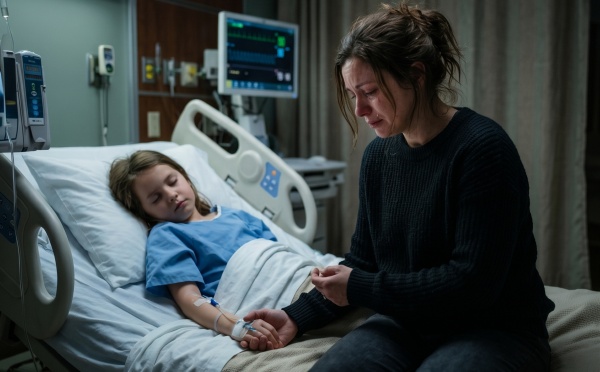
At 2:17 in the morning, I was sitting beside my daughter’s hospital bed at Children’s Hospital Los Angeles, listening to the steady beeping of machines I had learned to both hate and depend on. My thirteen-year-old daughter, Ava, looked impossibly small beneath the white blankets. Her hair was braided to one side because a nurse named Carmen had done it gently while I stepped into the hallway to cry.
Ava had been in the ICU for six days after complications from a severe infection that had moved faster than anyone expected. One day she had been complaining about stomach pain after soccer practice. Two days later, I was signing consent forms with shaking hands while doctors spoke in careful, urgent voices.
My husband, Nolan Bennett, was supposed to be there.
Instead, he was at The Crescent Pavilion in Beverly Hills, a private luxury maternity center attached to a boutique hospital where rich people paid extra so childbirth could look like a magazine spread. I knew because the charge appeared on our joint business account at 11:43 p.m. The amount was so large I thought it had to be a mistake.
$100,000.
Not $1,000. Not $10,000.
One hundred thousand dollars.
The description read: Crescent Pavilion Executive Birth Experience — Premium Suite Deposit and Concierge Package.
I stared at the banking app until the numbers blurred. Around me, the ICU hummed softly with the sounds of nurses, monitors, wheels, and whispered prayers from other parents sitting in the worst night of their lives. Ava’s fingers twitched in her sleep, and I gently wrapped my hand around hers.
Nolan had told me he was “handling an investor emergency” downtown.
He said he would come to the hospital as soon as he could.
He said that three days in a row.
My phone buzzed again at 2:24 a.m. For one wild second, I thought it might be Nolan finally asking about his daughter. Instead, it was a text from an unknown number with a Beverly Hills area code.
The message contained a photo.
A woman lay in a cream-colored hospital bed wearing silk pajamas and a full face of makeup. Behind her were fresh orchids, gold balloons, a marble bassinet, and a tray of sparkling cider in crystal glasses. Nolan stood beside her in a navy cashmere sweater, smiling like he had personally invented fatherhood.
The caption underneath read: Your husband says real men show up for their sons.
I did not scream.
I did not throw my phone.
I did not wake the sleeping child fighting for her life beside me.
I simply sat there in the blue hospital light and felt something inside me go cold.
The woman in the photo was named Sienna Cole. She was twenty-nine, a lifestyle influencer with soft blonde waves, a tiny dog, and an Instagram feed full of expensive hotels, neutral outfits, and captions about feminine energy. Nolan was forty-six, married for seventeen years, and father to a daughter who still kept the stuffed giraffe he bought her when she was four.
Their baby, apparently, was a boy.
That explained the caption.
Real men show up for their sons.
I looked at Ava’s pale face and felt a kind of anger I had never known before. Not loud anger. Not reckless anger. Something deeper and more disciplined. The kind of anger that does not burn the house down because it already knows where the deed is kept.
I saved the photo.
Then I saved the banking screenshot.
Then I forwarded both to myself, my attorney, and the forensic accountant our company used every year for audits.
At 2:41 a.m., Nolan finally texted.
Still tied up. How’s Ava?
I looked at the photo of him standing beside another woman’s hospital bed.
Then I looked at our daughter.
I typed back one sentence.
She is still waiting for her father.
Three dots appeared.
They disappeared.
No answer came.
That was when I understood the truth fully. Nolan had not just betrayed me as a wife. He had betrayed Ava as a father. Whatever came next would not be about jealousy, heartbreak, or another woman.
It would be about protecting my child from the man who had decided she was less important than his image.
Part 2: The Man Who Loved Applause
People loved Nolan Bennett.
That was part of the problem.
He was the kind of man who made strangers feel chosen after a five-minute conversation. He remembered names, favorite drinks, kids’ colleges, golf handicaps, and which donors liked to be praised publicly versus privately. He had a talent for making people believe he was generous, even when he was spending someone else’s money.
I met him at a charity dinner in Santa Monica when I was thirty-one and he was thirty. I had just opened my second pediatric therapy clinic in Pasadena, and Nolan was working in medical device sales. He told me my work was inspiring, asked intelligent questions, and listened with the kind of focus that felt rare.
Back then, I thought attention meant depth.
I did not yet understand that some people look directly at you only because they are studying what you can give them.
My name is Maren Bennett, though I kept my professional name, Maren Walsh, for the company. Walsh Pediatric Wellness began as one clinic with three therapy rooms, secondhand furniture, and parents who paid me in checks, credit cards, and sometimes tears. Over the years, it grew into a network of family therapy centers across Southern California.
We helped children with developmental delays, mobility challenges, speech needs, trauma recovery, and long-term care plans. We worked with insurance companies, school districts, hospitals, and families who were exhausted before they even reached our front desk. It was not glamorous work, but it mattered.
Nolan joined the company after our fifth wedding anniversary.
At first, I thought he wanted to help.
He said he was tired of “selling devices to executives who cared more about margins than patients.” He said he wanted to use his relationships to grow something meaningful. He said family should build together.
So I gave him a title.
Chief Development Officer.
He was good at raising money, charming donors, negotiating sponsorships, and standing on stages in tailored suits while telling emotional stories about our mission. He was less good at operations, budgets, compliance, payroll, or anything requiring humility. But I allowed him to become the public face of the company because the public face was useful.
I ran the clinics.
He ran the applause.
By our tenth anniversary, Nolan had become addicted to being seen as a visionary. He gave interviews about “our mission” and “our expansion strategy,” though he could not name half the therapists who kept the company alive. He loved ribbon-cuttings, donor dinners, and award ceremonies where people called him generous.
Ava used to be proud of him.
When she was little, she would dress up for company events and sit at a front table, clapping hard whenever Nolan walked onstage. She thought her father was a hero because everyone told her he was. I let her believe it because children deserve to admire their parents before life teaches them complexity.
But Nolan changed as the company grew.
Or maybe success only revealed what had always been there.
He began staying out later after events. He bought watches that cost more than my first car. He leased a black Range Rover, then complained that the upgraded model had a better interior. He started calling ordinary life “small.”
Soccer games were small.
Family dinners were small.
Hospital visits for Ava’s chronic health issues were small, unless a donor was watching.
The affair with Sienna began at a fundraising gala in West Hollywood. She had been hired by a sponsor to create social media content around the event. Nolan liked influencers because they turned attention into currency, and Nolan understood attention better than love.
Sienna posted a photo with him that night.
The caption read: Some men are born to lead.
I remember seeing it and feeling something tighten in my chest.
When I asked him about her, he laughed.
“Maren, she’s twenty-nine and lives on almond milk and brand deals. Don’t be ridiculous.”
A year later, she was giving birth to his son in a luxury suite paid for with company funds while our daughter lay in the ICU.
That is the thing about ridiculous fears.
Sometimes they are not ridiculous.
Sometimes they are early.
The morning after I received the photo, my attorney, Elise Carter, arrived at the hospital with coffee, a laptop, and the expression of a woman who had already decided not to waste anyone’s time. Elise had handled our company contracts for eight years. She wore simple suits, spoke softly, and made powerful men nervous without raising her voice.
She hugged me first.
Then she asked how Ava was.
Only after that did she open her laptop.
“That charge is a problem,” she said.
“Because it’s personal?”
“Because it appears personal, large, unauthorized, and connected to someone with no business relationship to the company,” Elise replied. “We need records before making conclusions, but yes, it is serious.”
I looked through the ICU window at the nurses checking Ava’s IV lines.
“Can he take money from the company like that?”
“Not legally, if the governing documents say what I remember they say.”
“They do,” I said.
Elise nodded. “Then we proceed carefully.”
Carefully was her favorite word.
It became mine too.
I wanted to drive to Beverly Hills, walk into that luxury suite, and ask Nolan how it felt to hold one child while abandoning another. I wanted to ask Sienna if her silk pajamas came with a conscience. I wanted to say all the ugly things grief puts in your mouth when you are tired enough to become someone else.
But Ava needed me calm.
So I stayed calm.
I signed medical updates. I spoke to doctors. I brushed Ava’s hair when she woke for short periods and whispered that I was right there. I did not tell her where her father was.
At 10:16 a.m., Nolan called.
I stepped into the hallway before answering.
“Maren,” he said, sounding irritated rather than guilty. “What kind of text was that last night?”
I leaned against the wall. “Where are you?”
“Downtown.”
“Try again.”
A pause.
Then a sigh.
“I don’t have time for this.”
“Our daughter is in the ICU.”
“And I am handling a complicated situation.”
I closed my eyes. “Is his name complicated?”
Silence.
There it was.
The first crack in the king’s crown.
Part 3: The Son He Chose
Nolan arrived at the hospital that afternoon wearing the same navy sweater from the photo.
I noticed because betrayal makes your memory cruelly precise.
He walked into Ava’s ICU room carrying a stuffed bear from the gift shop, tags still hanging from one ear. He looked tired, but not like a father who had been sleeping in hospital chairs. He looked like a man annoyed that two families had scheduled emergencies at the same time.
Ava opened her eyes when she heard his voice.
“Dad?” she whispered.
Nolan’s face softened instantly. That was the hardest part. He did love her in some part of himself. The tragedy was that his love became unreliable whenever it competed with his ego.
“Hey, kiddo,” he said, leaning over her bed. “You scared us.”
Us.
I nearly laughed.
Ava gave him a weak smile. “You came.”
Those two words almost broke me.
Not because she was happy.
Because she had doubted it.
Nolan stayed for twenty-two minutes.
I know because I watched the clock.
He asked two questions about her care, misunderstood both answers, then checked his phone six times. When Ava drifted back to sleep, he stepped into the hallway and motioned for me to follow. Elise was waiting near the nurses’ station, pretending to read an email.
Nolan saw her and frowned.
“Why is Elise here?”
“Because you charged a six-figure personal expense to a company account.”
His jaw tightened. “This is not the place.”
“No,” I said. “The luxury birth suite was not the place.”
His eyes flashed. “Lower your voice.”
“My voice is low.”
“You’re emotional.”
“Our daughter is in intensive care.”
“And I came, didn’t I?”
I looked at him for a long moment.
Twenty-two minutes.
That was what his fatherhood had become.
He moved closer, speaking softly enough that others would not hear. “Sienna had the baby early. There were complications. I had to be there.”
I felt my stomach turn. “And Ava?”
“She has doctors.”
“So did Sienna.”
His expression changed. “That’s my son.”
The words landed like a slap.
Not because a son did not matter.
A baby is innocent. A child should never be blamed for adult betrayal.
But the way Nolan said it made everything clear. He did not say “my child.” He said “my son,” like the word itself had crowned him. Like after thirteen years of raising a daughter, he had finally been given the heir he thought he deserved.
I stepped back before I said something I could not take back.
Elise stepped forward instead.
“Nolan,” she said, “you need counsel.”
He laughed. “I need counsel?”
“Yes.”
“For what? Having a child?”
“For potential misuse of company funds and related fiduciary concerns.”
His face reddened. “This is my company.”
“No,” I said.
He turned to me.
“It is not your company,” I continued. “It has never been your company.”
The hallway seemed to quiet.
Nolan’s public smile disappeared.
“You wouldn’t have half those donors without me,” he said.
“And you wouldn’t have a title without me.”
Elise gently touched my arm, not to silence me, but to remind me that restraint was strategy.
Nolan noticed and smirked. “There she is. The lawyer wife.”
“No,” I said. “The mother.”
That finally stopped him.
For a second, shame crossed his face.
Then his phone buzzed.
He looked down.
I saw the name before he turned the screen away.
Sienna.
He answered it.
Right there.
In the ICU hallway.
“Hey,” he said softly. “Is he okay?”
I stared at him, and something inside me that had been bending for years finally snapped into place.
Not broke.
Aligned.
I walked back into Ava’s room and sat beside my daughter. Nolan could explain himself to attorneys, accountants, donors, and whoever else needed documentation. I was done begging him to recognize the people already in front of him.
That evening, Ava’s condition worsened.
The doctors warned me there could be a difficult night ahead. I signed another consent form while my hand trembled so badly the nurse placed her hand over mine. Elise stayed until midnight, then left only because I promised to call if anything changed.
Nolan did not come back.
At 1:08 a.m., Sienna posted a photo online.
A newborn baby wrapped in a blue blanket.
The caption read: Welcome to the world, Kingston James Bennett. Daddy already treats us like royalty.
Royalty.
Kingston.
Daddy.
I stared at the post for exactly five seconds before closing the app.
Then I blocked Sienna.
Not because I was afraid of seeing more.
Because my daughter was fighting to live, and I refused to let another woman’s performance take one more second from her.
At 3:36 a.m., Ava opened her eyes.
“Mom,” she whispered.
“I’m here.”
“Is Dad mad at me?”
The question stole the air from my lungs.
I stood and leaned over her bed, careful not to disturb the tubes or wires. “No, sweetheart. None of this is your fault.”
“He left.”
I swallowed hard. “Adults make choices. Sometimes they make terrible ones.”
Her eyes filled with tears. “Did he choose the baby?”
I wanted to lie.
I wanted to wrap her in a soft story about misunderstandings, emergencies, stress, and complicated adult things. But Ava was thirteen, not a fool. Children in hospital beds hear more than adults think.
So I told her the safest truth I could.
“He made choices that hurt us,” I said. “But you are not less loved because he failed to show it.”
She closed her eyes, and one tear slid down her temple.
I wiped it away.
That was the moment I stopped thinking of divorce as an option.
It became a duty.
Part 4: The Velvet Box Arrives
Ava survived the night.
By morning, her numbers stabilized, and one of the doctors smiled for the first time in days. It was a small smile, cautious and tired, but it felt like sunrise. I went into the restroom, locked the door, and cried into a paper towel because hope can be just as overwhelming as fear.
Nolan texted at 9:02 a.m.
Any updates?
I stared at the message.
Not “How is Ava?”
Not “Can I come?”
Not “I’m sorry.”
Just updates, as if his daughter were a quarterly report.
I did not answer.
Elise advised all communication go through writing unless it involved Ava’s medical care. She also told me the accountant had already found more questionable charges. Luxury gifts, private car services, designer baby items, a Beverly Hills jeweler, and multiple payments coded as “donor relations” with no donor attached.
The jeweler charge was $48,000.
That one confused me.
Until later.
Three days after Kingston’s birth, Nolan hosted a private brunch at The Crescent Pavilion for Sienna, her mother, two friends, a photographer, and apparently anyone willing to pretend the situation was beautiful. I know because one of Nolan’s assistants, a woman named Priya who had worked for me for six years, called Elise in tears.
“He asked me to arrange flowers under the company account,” Priya said. “I told him I needed written approval. He said he was the approval.”
He always did love sounding official.
Elise told Priya to send everything in writing and take no action outside policy. Priya did exactly that. Good employees are often the first people powerful men underestimate.
The brunch happened anyway.
Nolan paid for it personally, or thought he did.
By then, Elise had already requested emergency review of company account access. The bank froze certain cards pending authorization. Our board scheduled a special meeting. Nolan did not know yet, because men like him often mistake silence for surrender.
At 11:47 a.m., while Sienna posed with white roses and a sleeping newborn beneath a gold balloon arch, a delivery man arrived at The Crescent Pavilion.
He wore a dark green courier jacket and carried a small black bag.
Inside that bag was a velvet box.
Nolan, according to three people who later described it, smiled when he saw it. He had been waiting for the delivery. He even joked, “A king has to honor his queen.”
Sienna’s friends laughed.
The photographer lifted her camera.
The courier asked Nolan to sign.
Nolan signed with the dramatic confidence of a man who believed every room existed to admire him.
Then he opened the velvet box.
Inside was not the diamond necklace he had ordered for Sienna.
Inside was his wedding ring.
The same platinum band I had removed in the ICU bathroom and sent by secure courier to his name at the place he had chosen over his daughter.
Under the ring was a folded note on heavy cream paper.
It said:
Nolan,
You left this marriage the moment you chose luxury over our child. The rest will be handled through counsel.
Maren
But that was not all.
Beneath the note was a second envelope.
This one was from the jeweler.
It stated that the $48,000 necklace purchase had been placed on hold after the payment source was flagged and the account authorization was withdrawn. The item would not be released. Any further questions should be directed to the billing department.
The photographer lowered her camera.
Sienna’s mother reportedly gasped.
Nolan went white.
For the first time in years, the room did not clap for him.
Sienna reached for the note, but Nolan snatched it back.
“What is this?” she asked.
He closed the velvet box so hard the ring rattled inside.
“It’s nothing.”
But everyone knew it was not nothing.
It was the sound of the crown slipping.
Fifteen minutes later, Nolan called me eleven times.
I did not answer.
He left one voicemail.
“Maren, this is cruel. You embarrassed me in front of everyone. We need to talk like adults.”
I listened to it once while sitting beside Ava, who was awake and eating ice chips.
Then I deleted it.
Cruel.
That was the word he used for a ring in a box.
Not for a daughter asking whether her father had chosen the baby.
Not for a wife discovering $100,000 missing from a company account.
Not for a man smiling in another woman’s luxury suite while his child lay in an ICU bed across town.
Cruel was what happened when consequences found him in public.
The board meeting took place the next day over video. Nolan joined from his Range Rover, which told me everything I needed to know about his priorities. He wore sunglasses at first, then removed them when our board chair, Diane Mercer, asked him to show basic respect.
Diane was sixty-eight, a former hospital executive, and one of the few people Nolan had never successfully charmed.
Elise presented the preliminary findings.
Unauthorized personal expenses.
Misclassification of charges.
Potential breach of fiduciary duty.
Improper use of staff resources.
Failure to disclose a conflict that could expose the company to reputational and financial risk.
Nolan tried to interrupt six times.
Diane stopped him every time.
When he finally spoke, he gave the performance of his life. He talked about stress, family complexity, donor relationships, a newborn child, and how growth required flexibility. He even said the luxury maternity suite was connected to “brand relationship development.”
Diane removed her glasses.
“Nolan,” she said, “a champagne brunch for your mistress is not pediatric care.”
Nobody spoke.
Not one person.
Nolan’s face turned a shade of red I had never seen before.
By the end of the meeting, he was placed on administrative leave pending full investigation. His company cards were deactivated. His email access was limited. Staff were instructed not to process any personal requests from him.
The king had lost the castle keys.
But the real comeuppance was still coming.
Part 5: What He Lost
Ava left the ICU nine days after the velvet box arrived.
She was not fully healed. Recovery would take time, therapy, medication, follow-up appointments, and patience she did not always have. But she was alive, alert, and annoyed that the hospital food was “emotionally disrespectful,” which was the first sentence that made me laugh in almost two weeks.
Nolan visited twice before she was discharged.
Both visits were awkward.
Ava was polite in the careful way children become polite when adults disappoint them too deeply. She said hello, answered questions, and turned the conversation back to her nurses, her school friends, or Daisy, our golden retriever. She did not ask him to stay.
That hurt him.
I could see it.
But pain is not the same as accountability.
On the day we brought Ava home, Nolan asked if he could ride with us.
Ava looked at me first.
That told me the answer.
“I think we need space,” I said.
Nolan’s jaw tightened, but he nodded. He was learning that hospital hallways were not stages. There were no donors nearby, no cameras, no applause, and no easy way to turn abandonment into a branding opportunity.
At home, I settled Ava into the downstairs guest room because stairs were too much at first. Her friends had decorated the walls with handmade posters, soccer team photos, and one giant sign that said WELCOME HOME, AVA — YOU OWE US A MOVIE NIGHT. Ava cried when she saw it, then pretended she had allergies.
For the first time in weeks, the house felt like a place where life might return.
Then the legal process began.
Elise filed for divorce in Los Angeles County, requesting temporary orders regarding finances, custody arrangements, and protection of business assets. The company investigation continued separately. I did not post about it, did not gossip, did not leak documents, and did not give anyone the satisfaction of watching me fall apart online.
Nolan did enough talking for both of us.
He told people I had become vindictive.
He told people Elise was manipulating me.
He told people the board had overreacted.
He told people he was “being punished for becoming a father again.”
That last one traveled back to me through three different friends, one donor, and a therapist who had known our family for years. I did not respond. Some lies collapse faster when you stop holding them up with arguments.
The final audit report was not kind to him.
It did not accuse him of every terrible thing people might have imagined, and that mattered. Real life is not a courtroom drama where every villain leaves fingerprints on every wall. But it found enough misuse, poor judgment, and unauthorized spending to end his role permanently.
Nolan resigned before the board could vote to remove him.
That was how he described it.
Resigned.
In truth, he was given a choice between leaving quietly or being removed publicly. He chose the option that let him pretend he still had control. Men like Nolan cling to wording when substance is gone.
The settlement required repayment of specific personal charges, including the Crescent Pavilion package, luxury gifts, private transportation, and event expenses. Some of the money came from the sale of his Range Rover. More came from liquidating investments he had considered untouchable.
The $48,000 necklace was never delivered.
Sienna did not stay with him.
That surprised people, but it did not surprise me.
A relationship built on fantasy rarely survives invoices.
When the money froze, the attention changed. When the company title disappeared, the “visionary” became a middle-aged man with legal bills, a newborn, a furious wife, and a reputation no longer protected by my silence. Sienna eventually hired her own attorney to establish appropriate support for Kingston.
I respected that.
The baby was innocent.
Ava knew she had a half-brother before I wanted her to know, because teenagers hear everything adults try to whisper. One afternoon, while we were folding laundry together, she asked me if Kingston was a bad thing. I stopped matching socks and sat beside her on the couch.
“No,” I said. “He is a baby. He didn’t make any of these choices.”
She nodded slowly.
“Do I have to meet him?”
“Not unless you want to, and not until you’re ready.”
“What if I’m never ready?”
“Then we respect that too.”
She leaned against my shoulder.
After a long silence, she whispered, “I don’t hate him. I just hate that Dad made me feel replaceable.”
I closed my eyes.
There are sentences a child should never have to say.
“You were never replaceable,” I told her. “Not for one second.”
Nolan tried to repair things with Ava too quickly.
He sent expensive gifts. Noise-canceling headphones. A new laptop. A signed jersey from a soccer player she liked. Ava thanked him by text and left the gifts unopened in the corner of the room.
One day, she asked if we could donate them.
I said yes.
We gave them to a local family support center connected to the hospital. Ava carried the boxes herself, moving slowly but determinedly. On the drive home, she looked out the window and said, “I think gifts are easier than apologies.”
I gripped the steering wheel.
“Yes,” I said. “They are.”
The divorce finalized eleven months after the ICU night.
By then, Ava was back in school part-time, then full-time. She had scars, both visible and invisible, but she also had friends, therapy, soccer practice modified by her doctor, and a sarcasm sharp enough to reassure me she was still herself. Healing did not arrive like a miracle. It arrived like physical therapy: slowly, painfully, one stubborn step at a time.
Nolan received structured visitation, financial obligations, and no role in my company.
He left the courthouse wearing a gray suit and the exhausted look of a man who had spent a year discovering the difference between admiration and respect. Admiration had followed him everywhere when he was powerful. Respect did not survive the audit.
Outside the courthouse, he asked to speak to me.
Elise stood nearby but did not interrupt.
Nolan looked older. Not dramatically, but enough. The clean lines of his face had softened, and the confidence he used to wear like cologne had thinned.
“I made mistakes,” he said.
It was the kind of sentence people use when they want forgiveness without naming harm.
“Yes,” I replied.
“I loved Ava.”
I looked at him. “Love is not only something you feel. It is something you show up for.”
His eyes reddened.
“I know that now.”
I wanted that to satisfy me.
It did not.
Maybe because he knew it now, after our daughter had already learned the cost of his absence. Maybe because consequences had taught him what compassion should have. Maybe because some apologies arrive after the person who needed them has already learned to live without them.
“What do you want from me, Nolan?”
He looked down at his hands.
On his left hand, there was no wedding ring.
The velvet box had returned it to him, and as far as I knew, he had never worn it again.
“I don’t know,” he said.
For once, I believed him.
I nodded. “Then figure that out before you ask Ava for anything.”
He did not argue.
That was new.
A year later, Walsh Pediatric Wellness opened a new family recovery wing in Pasadena. We named it the Ava Bennett Family Resilience Center, with Ava’s permission and only after she rolled her eyes and said, “Fine, but don’t make the logo cheesy.” The center helped families navigating long hospital stays, therapy transitions, insurance battles, and the emotional wreckage that follows a medical crisis.
At the opening, Ava stood beside me in a blue dress and white sneakers.
She was taller than she had been before the ICU. Stronger too, though not in the way people mean when they say children are resilient. Children should not have to be resilient because adults failed them, but when they are, the least we can do is honor it honestly.
I gave a short speech.
I thanked the doctors, nurses, therapists, donors, staff, and families who made the center possible. I did not mention Nolan by name. His absence had already spoken loudly enough.
After the ribbon-cutting, a delivery arrived.
For one strange second, my stomach tightened when I saw the courier carrying a small velvet box.
Ava saw my face and whispered, “Mom?”
“I’m fine,” I said, though my heart had already traveled backward in time.
The courier handed the box to Ava, not me.
Inside was a simple silver necklace with a tiny engraved star.
The card was from Carmen, the ICU nurse who had braided Ava’s hair.
It read:
For the girl who kept shining in the darkest room.
Ava cried.
I cried.
Half the staff cried because pediatric healthcare workers spend their lives being professional until kindness catches them off guard.
That night, after everyone left, Ava and I went home and ordered takeout from our favorite Thai restaurant. We ate pad see ew and mango sticky rice at the kitchen island in sweatpants. Daisy slept under Ava’s stool, waiting for noodles that never came.
My phone buzzed once.
A message from Nolan.
I saw the article about the center. Ava looked beautiful. You did a good thing.
I showed Ava the message because secrets had already done enough damage in our family.
She read it and handed the phone back.
“You can say thank you,” she said.
So I did.
Thank you. She worked hard to get there.
He replied ten minutes later.
I know. I wish I had been better.
Ava did not ask what he said.
I did not volunteer it.
Some truths belong to their own timing.
Later, after Ava went to bed, I sat alone in the living room with the house quiet around me. I thought about the first velvet box, the one that had found Nolan in a luxury suite while he played king beside another woman’s bed. I thought about the ring inside, the note, the failed necklace, the silence after applause disappeared.
People think comeuppance means destruction.
Sometimes it does.
But more often, it means a person finally has to live in the truth they created.
Nolan did not lose everything. He still had a son, a chance to become a better father, and enough money to live more comfortably than most people. But he lost the myth. He lost the room that always clapped. He lost the wife who protected his image and the daughter who once believed his arrival meant safety.
And I lost something too.
I lost the marriage I thought I had.
I lost the illusion that a charming man was the same as a good one.
I lost the habit of explaining away pain just because someone else was good at looking sorry.
But I kept Ava.
I kept the company I built.
I kept my name, my work, my home, and the quiet knowledge that I had not become cruel just because I stopped being convenient.
The night Nolan chose a $100,000 luxury birth over his daughter’s ICU room, he thought he was proving he was a king.
In the end, all he proved was that crowns are easy to buy when someone else is paying.
But character cannot be purchased.
Fatherhood cannot be staged.
And when the velvet box finally opened, it did not destroy him.
It simply showed everyone what he had already become.
