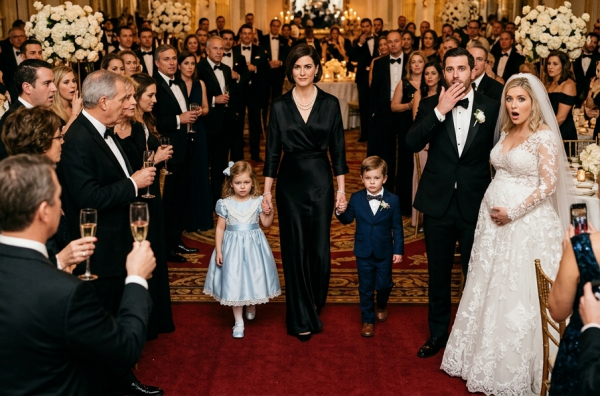
My ex-husband’s family Called Me Barren — Until I Brought My Children to His Wedding… The Harrington family invited me to Mark’s wedding because they wanted Chicago society to see the woman they believed had failed their bloodline. His pregnant influencer bride was being celebrated as the mother of the first Harrington heir.
But when I entered the ballroom with my three-year-old twins, the champagne stopped halfway to his mother’s lips. They did not know the $50 million family trust had already recognized my children before the wedding music even started.
Part 1: The Invitation
The Harrington family invited me to Mark’s wedding because they wanted Chicago society to see the woman they believed had failed their bloodline.
That was the only reason.
Not kindness.
Not closure.
Not maturity.
They wanted spectacle dressed as civility. They wanted me seated near the back of a gold-lit ballroom while the city’s donors, lawyers, bankers, museum board members, and old-money widows watched my ex-husband marry the woman who was already carrying what everyone kept calling the first Harrington heir.
My name is Elena Whitaker.
For seven years, I was Elena Harrington, wife of Mark Harrington III, daughter-in-law to one of the most socially protected families in Chicago, Illinois. The Harringtons owned commercial real estate, a private investment office, three lake houses, a foundation named after Mark’s grandfather, and a kind of influence people rarely write down because written influence can be subpoenaed.
They also owned a family trust worth approximately $50 million.
Technically, no one “owned” it.
That was the point of a trust.
But everyone in Chicago who mattered knew the Harrington Legacy Trust existed, and everyone in the Harrington family behaved as though proximity to it was a measure of human value.
When I married Mark, his mother, Victoria Harrington, kissed both my cheeks outside Fourth Presbyterian Church on Michigan Avenue and said, “Welcome to the family, darling.”
Three years later, after the second failed fertility treatment, she stopped calling me darling.
By year five, she rarely used my name at all.
At Sunday dinners in Lake Forest, she spoke around me as if I were a chair that had disappointed her. She discussed family continuity, legacy, responsibility, and the tragedy of “modern women waiting too long,” even though I was thirty-two when Mark and I started trying for a child.
She never said barren at first.
Women like Victoria do not use cruel words early.
They use silkier ones.
“Difficult.”
“Unfortunate.”
“Delayed.”
“Medically complicated.”
Then, after enough white wine, she used the real one.
Barren.
She said it at a fundraiser for the Art Institute of Chicago, standing near a marble column with a glass of sauvignon blanc in her hand, speaking to a woman who had known my mother for twenty years.
“Poor Mark,” Victoria said. “He has been so patient. But a family like ours cannot simply end because one woman is barren.”
I heard her.
She knew I heard her.
That was the point.
I filed for divorce six months later.
Not just because of the word.
Because Mark did not defend me.
He stood beside his mother that night in a tuxedo, eyes fixed on the floor, and said nothing while the woman who raised him reduced me to a failed vessel in front of half of Chicago.
Later in the car, I asked, “Are you going to say anything?”
He gripped the steering wheel.
“She was upset.”
“So was I.”
“She wants grandchildren.”
“So did I.”
He exhaled like my pain was another obligation he had inherited.
“Elena, don’t make this harder than it already is.”
That sentence ended something in me.
Not all at once.
But enough.
The divorce was quiet, expensive, and cold.
The Harrington attorneys behaved as though I had tried to steal the skyline. My attorney, Rebecca Sloan, handled them with the calm aggression of a woman who had seen too many wealthy families confuse money with morality. We had a prenuptial agreement, drafted before the wedding, protecting premarital assets and family trusts.
I did not fight for the trust.
It was not mine.
I did not fight for Harrington money beyond what was fair under Illinois law and our agreement.
I fought for my dignity.
That was harder to quantify.
By the time the divorce was final, Mark had already become “close” with Sabrina Vale, a lifestyle influencer from Miami who had moved to Chicago after signing a brand partnership with a luxury wellness company backed by Harrington Capital.
Sabrina was twenty-nine, glowing, strategic, and beautiful in a way designed for front-facing cameras. She posted green juices, Pilates reformers, Italian vacations, designer maternity dresses, and captions about becoming “the woman God meant me to be.”
She also posted Mark’s hand on her stomach less than nine months after our divorce decree.
The caption read:
Baby Harrington arriving this spring. Our little legacy.
Little legacy.
That phrase was everywhere within a week.
Victoria shared the post through the Harrington Foundation account by mistake, then deleted it, then pretended she had not. Mark’s cousin’s wife commented with three blue hearts. Sabrina’s followers called her “the queen who healed the bloodline,” which was such an absurd sentence that I laughed until I cried in my kitchen.
People assumed I was devastated.
They were only partly right.
I had been devastated years earlier, month by month, hormone shot by hormone shot, negative test by negative test, apology by apology from doctors who had no reason to apologize. By the time Sabrina announced her pregnancy, my grief had already moved into a different room.
Because the Harringtons did not know something.
Mark did not know something either.
Three months after the divorce, I became a mother.
To twins.
A boy and a girl.
Their names were Luca James Whitaker and Mila Rose Whitaker.
They were born through gestational surrogacy after embryos created during my marriage to Mark were transferred with full legal compliance, court approval, and written consent documents already executed before our marriage fell apart.
That sounds neat.
It was not neat.
Nothing involving fertility, divorce, frozen embryos, family law, grief, and rich people’s egos is neat.
But it was legal.
It was documented.
It was private.
And most importantly, it was mine.
Mark had signed the embryo disposition agreements years earlier during our third IVF cycle. At the time, neither of us imagined divorce. Neither of us imagined his mother’s cruelty would become family policy. Neither of us imagined he would later claim he had “moved on” from the idea of children with me.
But signatures matter.
Especially when wealthy men forget they made them.
After the divorce, when I chose to proceed using embryos that were legally available to me under the agreement, Rebecca brought in a reproductive law specialist, Dana Morris, to make sure every step complied with Illinois law and applicable medical requirements.
The surrogate, Grace Nolan, was a married nurse from Oak Park with two children of her own and the emotional steadiness of a person who had seen actual emergencies. She gave me the greatest gift of my life, and I will never reduce her role to a plot twist.
Mark was notified through counsel.
That part matters.
He did not answer.
His attorney responded that Mr. Harrington “did not wish to participate in any speculative proceedings regarding potential future children.” The phrase was so cold I kept the letter in a folder labeled Things Cowards Put in Writing.
When the pregnancy was confirmed, he was notified again.
No response.
When Grace passed the first trimester, legal parentage proceedings continued.
When the twins were born, Mark was notified once more.
Still nothing.
No call.
No flowers.
No inquiry.
No demand.
No acknowledgment.
Nothing.
So I raised Luca and Mila with my name, my home, my family, and the legal recognition their lives deserved. Mark’s name appeared where the court and documentation required it, but emotionally, practically, and morally, he was absent by choice.
For three years, I kept them out of Harrington society.
Not hidden.
Protected.
There is a difference.
Then the wedding invitation arrived.
Heavy cream cardstock.
Black engraved lettering.
Gold edge.
Mr. and Mrs. Charles Harrington request the honor of your presence at the marriage of their son, Mark Charles Harrington III, to Sabrina Elise Vale.
At the bottom, in Victoria’s handwriting, was a note.
Elena, we hope you will join us. It is time for everyone to move forward gracefully.
Gracefully.
That word made me laugh.
Then I turned the card over and saw the assigned reply code for the wedding website. Someone had placed me at Table 32, beside distant acquaintances and former family friends who would smile with pity while Sabrina walked in glowing and pregnant.
They wanted me present as contrast.
The failed wife beside the fertile bride.
The barren woman watching the heir arrive.
The old story, staged under chandeliers.
I looked across my kitchen at Luca and Mila, who were sitting at their little table coloring dinosaurs purple and green.
Luca had Mark’s gray-blue eyes.
Mila had the Harrington dimple in her left cheek.
The same dimple Victoria always said appeared only in “true Harrington children.”
I picked up the RSVP card.
Then I smiled.
Not cruelly.
Calmly.
If the Harringtons wanted Chicago society to see me, then Chicago society would see me.
All of me.
Including the children they had pretended did not exist.
Part 2: The Years They Called Me Empty
Before I entered that ballroom with my twins, I had spent years being treated like a room that failed to produce an heirloom.
Mark and I met at a charity gala for Lurie Children’s Hospital. I was working in nonprofit development then, managing donor relationships and grant strategies. Mark was on the junior board, though “junior” in Chicago society mostly meant adults under forty with family foundations and expensive tailoring.
He was handsome, polite, and surprisingly shy when not surrounded by his family.
He asked me about my work before telling me about his.
That impressed me.
Most men in those rooms waited exactly eight seconds before explaining their importance.
Mark listened.
At least, I believed he did.
We dated for eighteen months. He took me to dinner in Lincoln Park, walked with me along the lakefront, sent flowers to my office, and introduced me to his family at a Christmas party in Lake Forest where the tree was fourteen feet tall and the ornaments looked insured.
Victoria studied me like a property appraisal.
“You’re from Evanston?” she asked.
“Yes.”
“And your father was a professor?”
“He still is.”
“How lovely.”
Lovely, in her mouth, meant modest.
Mark squeezed my hand under the table that night.
I thought it meant he was protecting me.
Later, I learned it meant he hoped I would endure things quietly so he would not have to challenge anyone.
We married at The Drake Hotel in a ballroom filled with white orchids, silver candelabras, and people my parents recognized from newspaper society pages. My mother cried from happiness. My father cried because he feared I was entering a world that smiled while measuring bone structure and bank accounts.
He was not wrong.
For the first year, the Harringtons treated me like a successful acquisition.
I looked appropriate in photographs.
I understood etiquette.
I could speak intelligently about philanthropy, public schools, donor fatigue, early childhood literacy, and museum funding.
Victoria praised me in public.
“Mark chose beautifully,” she would say.
I mistook that for affection.
It was branding.
Then came the question.
“When are you two going to start a family?”
At first it was playful.
Then frequent.
Then pointed.
When I told Mark I wanted to try, he smiled and said, “My mother will finally exhale.”
I laughed.
I did not yet understand how much of our marriage had been built around Victoria’s lungs.
After eight months with no pregnancy, my OB suggested basic testing.
After fourteen months, a reproductive endocrinologist entered our lives.
After two years, fertility became a calendar, a medical file, and a private language of numbers.
Follicle count.
AMH.
Motility.
Transfer date.
Beta test.
Chemical pregnancy.
Failed implantation.
Embryo grading.
Insurance denial.
Out-of-pocket cost.
Mark attended appointments in the beginning.
He held my hand during blood draws.
He joked awkwardly with nurses.
He injected medication into my stomach twice, then said he hated hurting me and asked if I could do it myself.
So I did.
That became the pattern.
He hated seeing pain.
I handled it.
Victoria found ways to discuss grandchildren at every family event.
At Thanksgiving, she told a story about Mark as a baby and ended with, “Some women are simply born to be mothers.”
At Easter, she gifted me a pale yellow baby blanket “for whenever hope becomes practical.”
At a summer party in Winnetka, I overheard her telling a cousin, “Elena is trying everything, poor thing. Modern medicine can only do so much.”
Poor thing.
That phrase became a cage.
I was pitied publicly and blamed privately.
Mark became quieter.
He said he did not blame me, which sounded kind until I realized he was still naming me as the location of failure.
“Our problem,” I said once after a failed transfer.
“Of course,” he replied.
But he did not look at me.
The third IVF cycle produced four viable embryos.
Two were transferred.
Neither implanted.
Two remained frozen.
I remember staring at the lab report, feeling absurdly protective of cells in a clinic freezer. They were potential, not children. I knew the difference. But they represented the last version of motherhood that still had Mark and me in the same sentence.
We signed updated embryo disposition documents because the clinic required them.
The forms addressed divorce, death, nonpayment, abandonment, transfer rights, and consent. Mark barely read them. He was late for a meeting and irritated by the legal language.
“You’re the contracts person now?” he joked.
“I work in development, not law.”
“You read everything like a lawyer.”
“My father taught me signatures matter.”
He signed.
So did I.
Years later, those signatures would matter more than his memory.
After the last failed transfer, I broke.
Not dramatically.
Quietly.
I stopped going to baby showers.
I muted pregnancy announcements.
I cried in grocery store aisles when toddlers reached for cereal.
I avoided the nursery section at Target as if it were a crime scene.
Mark responded by working later.
Victoria responded by suggesting a different clinic in New York, then one in Los Angeles, then a specialist in Colorado she had heard about from “a very prominent family.”
Nobody asked if my body, mind, or marriage could survive another round.
They asked what else could be tried.
When I said I needed a break, Victoria looked at me across her dining room table and said, “Breaks are luxuries for women with time.”
I was thirty-six.
Not ancient.
Not done.
But in her world, my value was depreciating.
Mark said nothing.
Again.
That night, I slept in the guest room.
He did not come after me.
The marriage ended slowly after that.
Separate bedrooms during “busy weeks.”
Separate vacations disguised as scheduling issues.
Separate grief.
Then came Sabrina.
At first, I knew her only as a face on social media. She attended a Harrington wellness fundraiser and posted herself beside Victoria with the caption, Chicago women are elegance goals. Victoria reposted it. I remember being irritated by the phrase and then irritated with myself for caring.
Mark mentioned her a month later.
“Sabrina is doing some brand work with the foundation.”
“Influencer work?”
“Digital strategy.”
“Of course.”
He frowned.
“You sound judgmental.”
“I sound tired.”
Sabrina was everything the Harringtons wished I had become after pain.
Bright.
Fertile-looking, though I hate that phrase.
Public.
Admiring.
She praised Victoria online. She tagged the foundation. She wore Harrington-approved designers and spoke about “legacy families preserving culture.” She understood the family myth immediately and fed it better than I ever could.
By the time Mark and I separated, I suspected he was emotionally involved with her.
By the time the divorce was final, I stopped needing proof.
Six months later, she was pregnant.
And I, the barren ex-wife, was holding two sleeping newborns whose existence the Harringtons had decided was inconvenient to their story.
Part 3: The Trust Recognizes the Twins
The Harrington Legacy Trust was created by Mark’s grandfather, Charles Harrington Sr., in 1989.
Charles was many things: ruthless developer, disciplined investor, difficult father, generous donor, and a man with enough legal sense to hire attorneys better than his sons. The trust was designed to benefit his lineal descendants, with distributions for education, healthcare, housing assistance, and eventual staged access depending on age and conditions.
It was not controlled by Victoria.
That was the first beautiful detail.
The second was that the trust defined eligible descendants based on legal parentage, not family approval, social acknowledgment, or Victoria’s emotional comfort.
When Luca and Mila were born, Dana and Rebecca advised me to submit the required documentation to the trustee. I hesitated for weeks. Part of me wanted nothing from the Harringtons, not a dollar, not a birthday card, not a monogrammed blanket delivered with cold obligation.
Rebecca listened carefully, then said, “This is not about you wanting their money. This is about your children’s legal rights.”
“They don’t even acknowledge them.”
“The trust does not require applause.”
The trustee was Northern Lakes Fiduciary Services, a private trust company based in Chicago. Their office was in a glass building near the river, the kind with quiet carpet, abstract art, and conference rooms named after trees.
I arrived with Dana, Rebecca, and a folder thick enough to make the receptionist sit straighter.
Birth certificates.
Court orders.
Embryo consent documents.
Clinic records.
Surrogacy agreement.
Parentage judgment.
Notices sent to Mark’s counsel.
Proof of delivery.
Genetic documentation where legally appropriate.
Everything.
The trust officer, Margaret Chen, reviewed the documents with the careful neutrality of a woman trained not to react when rich families become complicated.
She asked precise questions.
Dana answered.
Rebecca clarified.
I sat with my hands folded, thinking of Luca and Mila at home with my mother, both of them asleep in matching yellow onesies.
At the end of the meeting, Margaret said, “Based on the documents provided, the trustees will complete their review. If the children meet the definition of qualified descendants under the trust instrument, they will be recognized accordingly.”
“If?” I asked.
“Procedure,” she said gently.
Three weeks later, the letter arrived.
Re: Harrington Legacy Trust — Recognition of Luca James Whitaker and Mila Rose Whitaker as Qualified Beneficiaries
I read it at my kitchen counter while both babies slept in bouncy seats near the window.
Then I read it again.
Then I sat on the floor and cried.
Not because of the money.
Because a legal document had done what their own father refused to do.
It recognized that my children existed.
The trust established education accounts immediately. Healthcare-related provisions became available through trustee approval. Future distributions would follow the trust terms. Everything would be administered formally, carefully, and with the kind of privacy old money worships when privacy benefits them.
Mark was notified.
Victoria was notified indirectly through family channels because the trustee had to update certain beneficiary schedules.
The first Harrington response came not from Mark, but from his father, Charles Harrington Jr.
He called Rebecca.
Not me.
Men like Charles preferred lawyers because lawyers created distance from shame.
Rebecca summarized the call afterward.
“He wanted to know if there was a misunderstanding.”
“There isn’t.”
“I told him that.”
“What else?”
“He asked whether this could remain confidential.”
I laughed once.
“Now they care about privacy?”
Rebecca’s expression softened.
“Elena, families like this only call something private after they lose control of it.”
Victoria sent no message.
Mark sent no message.
But within a month, Sabrina stopped using the phrase first Harrington heir online.
Her followers noticed.
Someone asked in the comments, Wait, isn’t this Mark’s first baby?
The comment disappeared.
Still, the public family narrative continued.
Sabrina’s pregnancy became society theater.
A baby shower at the Peninsula Chicago.
A maternity shoot near Lake Michigan.
A nursery reveal featuring cream wallpaper, antique rocking horses, and a caption about “welcoming the next chapter of the Harrington legacy.”
Victoria appeared in photos with one hand on Sabrina’s belly and a smile sharp enough to cut ribbon.
No one mentioned Luca and Mila.
That hurt less than it might have.
Because by then, the twins were crawling.
Luca had a laugh that sounded like hiccups.
Mila refused pureed peas with courtroom-level conviction.
They were not concepts anymore.
They were sticky hands, night feedings, pediatric appointments, tiny socks disappearing in the dryer, and two small bodies reaching for me at once when I came home from work.
They were real.
The Harringtons were performance.
When the wedding invitation arrived, Rebecca told me not to go.
“Nothing good comes from letting cruel people stage your pain,” she said.
“I know.”
“Then why are you considering it?”
I watched Mila stack blocks while Luca tried to eat one.
“Because they invited me to be humiliated.”
“And?”
“And I’m tired of cooperating.”
Rebecca sighed.
“Elena.”
“I won’t make a scene.”
“That is exactly what people say before making a scene.”
“I mean it. No shouting. No accusations. No confrontation. I’ll attend as invited.”
“With toddlers?”
“With my children.”
She looked at me for a long moment.
Then she said, “If you go, keep everything calm. Do not interfere with the ceremony. Do not block anything. Do not speak publicly about legal matters unless necessary. And for the love of God, do not let anyone bait you.”
“I won’t.”
“You will want to.”
“Definitely.”
She almost smiled.
“What about security?”
“The wedding is at the Langham. There will be plenty.”
“Good. Bring your parents. Bring your brother. Do not arrive alone.”
So I did.
My father, Dr. Samuel Whitaker, retired history professor, agreed instantly.
My mother, Marisol Whitaker, asked what the children should wear.
My brother, Adrian, said, “I’ve been waiting three years to watch rich people choke politely.”
“Adrian.”
“What? I’ll wear a suit.”
The week before the wedding, Margaret Chen from Northern Lakes Fiduciary called.
That was unusual.
Trust officers do not call for social updates.
“Elena,” she said, “I wanted to inform you that trustees have completed the annual beneficiary schedule update. Luca and Mila’s status is fully reflected in the current records.”
“Okay.”
“There may be family awareness around that update.”
I understood.
The Harringtons had likely received formal documentation before the wedding.
“How much awareness?” I asked.
Margaret paused.
“I cannot discuss communications with other parties beyond what is appropriate. But I can confirm your children’s recognition is not provisional.”
Not provisional.
Those words settled into me like armor.
The wedding was three days later.
Part 4: The Ballroom Goes Quiet
The wedding took place at The Langham Chicago, in a ballroom filled with white flowers, mirrored tables, gold chairs, and enough champagne to float a small yacht.
Sabrina had chosen a winter-white theme despite it being June.
Influencers love seasonal confusion when lighting is favorable.
The ceremony had already happened at a chapel earlier that afternoon. I was invited only to the reception, which told me exactly what role they intended for me. They wanted me visible during the celebration, not present for vows. They wanted comparison without complication.
I wore a black silk dress.
Not funeral black.
Elegant black.
Luca wore a navy suit with tiny brown loafers he kept trying to remove. Mila wore a pale blue dress with a satin bow and white Mary Janes. Her hair curled around her face in soft dark rings, and every time she smiled, the Harrington dimple appeared.
My parents walked beside me.
Adrian carried the diaper bag like security detail.
We entered at 7:12 p.m.
The ballroom was already full.
A string quartet played near the windows overlooking the Chicago River. Waiters moved through the crowd with trays of champagne. Women in designer gowns leaned toward each other beneath chandeliers, performing intimacy in diamonds.
At first, nobody noticed us.
Then a woman near the escort card table froze.
I recognized her as Anne Wexler, one of Victoria’s closest friends.
Her eyes went from my face to Luca.
Then to Mila.
Then back to me.
Her champagne glass paused halfway to her mouth.
I saw the exact moment she understood.
Or thought she did.
“Elena?” she said.
“Anne.”
Her gaze dropped again.
“These are…”
“My children,” I said.
Luca chose that moment to wave.
“Hi.”
Anne’s mouth opened.
No sound came out.
Adrian leaned toward me.
“Worth parking downtown.”
“Behave.”
“I am behaving internally.”
We moved deeper into the ballroom.
The silence spread.
Not complete silence.
Worse.
A ripple.
Conversation thinning in layers.
Eyes turning.
Phones lowering.
Heads tilting.
Someone whispered, “Twins?”
Someone else said, “How old?”
Another voice, sharper, said, “They look like Mark.”
Yes.
They did.
Not entirely.
They had my olive skin and dark hair.
But Luca’s eyes were Harrington gray-blue, and Mila’s dimple was a family signature no amount of denial could photoshop out of reality.
Then Victoria saw us.
She stood near the head table wearing champagne satin, diamond earrings, and a mother-of-the-groom smile that collapsed so quickly I almost felt sorry for the photographer trying to capture candids.
Her glass stopped halfway to her lips.
Exactly as I had imagined.
For three years, Victoria Harrington had allowed Chicago society to believe I had failed her bloodline. She had celebrated Sabrina as the woman restoring it. She had erased my children with silence.
Now my daughter waved at her.
Not knowing.
Not understanding.
Just generous.
Victoria did not wave back.
Mark stood beside Sabrina near the floral arch used for photos. He wore a black tuxedo, one hand at Sabrina’s back. Sabrina was visibly pregnant, glowing under professional makeup, smiling at a guest when she noticed the shift in the room.
Then she followed everyone’s gaze.
Her smile faltered.
Mark turned.
He saw me first.
Then the children.
His face went blank.
Not shocked exactly.
He had been legally notified.
He knew they existed.
But knowing in documents is different from seeing your three-year-old son standing beneath a chandelier with your eyes and a juice box.
Luca looked at him curiously.
Mila leaned against my leg.
“Mommy,” she whispered, “too many people.”
“I know, sweetheart.”
Mark took one step forward.
Victoria moved faster.
For a woman in heels and satin, she crossed the room like a guided missile.
“Elena,” she said.
Her voice was quiet, but tight.
“Victoria.”
“What are you doing?”
I held up the invitation slightly.
“Attending.”
Her eyes flashed.
“You brought them here?”
“They were invited as my family.”
“They were not named.”
“Neither was my handbag.”
Adrian made a choking sound behind me.
Victoria’s face reddened.
“This is inappropriate.”
I looked around the ballroom.
“Inappropriate was inviting me here to watch your family pretend my children do not exist.”
A few nearby guests heard.
Good.
Not shouted.
Not a scene.
Just audible enough for truth to stand upright.
Victoria lowered her voice.
“You need to leave.”
“No.”
Her eyes widened.
For years, she had mistaken my politeness for obedience.
“No?” she repeated.
“No,” I said. “We will greet the couple, offer congratulations, and sit at our assigned table unless hotel security or the hosts formally remove us. If you choose that option, please understand there will be witnesses.”
Her nostrils flared.
“You always were calculating.”
“No, Victoria. I learned from professionals.”
Mark arrived before she could answer.
He looked at Luca.
Then Mila.
Then me.
“Elena,” he said.
“Mark.”
His mouth moved slightly before any words came.
Sabrina appeared beside him, one hand resting protectively on her belly.
She looked from the twins to Mark.
“Are these…” she began.
Mark did not answer.
That was answer enough.
Sabrina’s face drained beneath the makeup.
“You told me it wasn’t real.”
The sentence was not meant for me.
But I heard it.
So did Victoria.
So did half the front section of the ballroom.
Mark closed his eyes briefly.
“Sabrina, not now.”
I almost laughed.
Men like Mark always want timing after they spend years creating emergencies.
Sabrina stared at him.
“You said she was trying to use old embryos to get money.”
My father made a sound behind me.
My mother touched his arm.
I felt anger rise, clean and hot.
Not for myself.
For Luca and Mila, standing there too young to understand that adults were discussing their existence like a financial strategy.
I stepped closer to Mark, lowering my voice.
“Do not ever frame our children as a scheme again.”
He swallowed.
“I didn’t mean—”
“You meant enough.”
Victoria recovered quickly.
“This is a private family matter.”
I looked at her.
“No. The trust matter is private. Their humanity is not.”
That sentence landed.
Especially with the word trust.
People nearby heard it.
Their eyes sharpened.
Old money may ignore tears, but it never ignores trusts.
Sabrina looked at Victoria.
“What trust?”
Victoria’s face went still.
Mark said, “We should talk later.”
Sabrina pulled her hand from his arm.
“Before or after everyone keeps staring at me?”
Mila tugged my dress.
“Mommy, I want snack.”
That brought me back to what mattered.
“Of course.”
I looked at Mark one last time.
“Congratulations on your marriage.”
Then, to Sabrina, because she was pregnant and looked suddenly much younger than her social media captions, I said, “I hope your baby is healthy.”
Her expression changed.
Pain, confusion, anger, fear.
All of it.
“Thank you,” she whispered.
Victoria looked furious that basic decency had entered the room without permission.
We walked to Table 32.
The table placement had been designed as insult.
Now it became theater seating.
Guests kept glancing over. Some smiled awkwardly. Others pretended not to stare and failed. Luca ate crackers. Mila asked why the flowers were “too big.” My mother calmly cut their chicken into tiny pieces while my father sat upright with the expression of a professor waiting for a student to finish a weak argument.
Adrian leaned back in his chair.
“I give the marriage six months.”
“Stop.”
“Fine. Seven.”
During the speeches, Victoria did not mention heirs.
That was new.
Mark’s father, Charles, gave a short toast about commitment, family, and the future. His hands shook slightly when he lifted his glass. He looked once toward our table, then away.
Sabrina’s maid of honor called her “the mother of the next chapter.”
Not first.
Next.
Progress, I suppose.
When the first dance began, Mark looked over Sabrina’s shoulder toward our table.
Luca was asleep against my mother.
Mila was coloring on the back of a menu.
I met Mark’s eyes.
For the first time since our divorce, I saw regret that was not about reputation.
It did not move me.
Not much.
Regret is not a father.
Recognition is not love.
A dance floor full of witnesses does not change three years of silence.
We left before cake.
At the exit, Victoria intercepted me one last time.
“You enjoyed this,” she said.
I adjusted Mila on my hip.
“No.”
“You expect me to believe that?”
“I expected you to behave better, and look where that got us.”
Her eyes glistened.
Whether from rage or grief, I could not tell.
“You should have told us.”
I stared at her.
“You were told.”
“Not like this.”
“No,” I said. “Not in a way you could control.”
That was the truth.
And it was why she hated it.
Part 5: The Heirs They Could Not Erase
The wedding story spread through Chicago before brunch the next morning.
It did not go viral online, at least not publicly. The Harringtons were too skilled at suppressing visible scandal, and I was too careful to feed it. But among the circles that mattered to them, the news moved faster than any post.
Elena arrived.
With twins.
Mark’s twins.
Recognized by the trust.
Sabrina didn’t know.
Victoria nearly dropped her champagne.
By Monday, Rebecca had three voicemails from Harrington counsel.
By Tuesday, Northern Lakes Fiduciary Services issued a formal reminder to all relevant parties that beneficiary information was confidential and trust administration would continue according to the instrument. That was Margaret Chen’s polite way of telling everyone to stop panicking in writing.
Mark called me Wednesday.
I did not answer.
He texted:
We need to talk about the children.
For three years, there had been no children in his messages.
Now there were.
I replied through the co-parenting communication platform Rebecca had already recommended we establish if Mark ever decided reality applied to him.
Any communication regarding Luca and Mila should be in writing. If you wish to discuss parentage, parenting time, or related matters, please have your attorney contact Rebecca.
He replied:
Don’t make this legal.
I laughed out loud.
The man whose family had ignored court documents now feared law because law had stopped flattering him.
I did not respond.
Sabrina gave birth four months later to a healthy baby boy named Asher Charles Harrington.
I heard through Rebecca, not gossip. The trust added him as a beneficiary once proper documentation was submitted. That was how it should be. Children do not deserve punishment for adult lies.
I sent no gift.
I sent no message.
But privately, I hoped he was loved well.
Sabrina and Mark’s marriage did not last long.
Not six months, as Adrian predicted.
Fourteen.
The official reason was “irreconcilable differences.” The unofficial reason, according to Chicago’s whisper machinery, was that Sabrina could not forgive being used as a public fertility trophy while Mark concealed the existence of older children who had already been legally recognized.
I did not celebrate.
A woman can benefit from truth without rejoicing in another woman’s humiliation.
Sabrina had played her part in my erasure, yes.
But she had also been lied to in ways designed to make her compliant.
Two things can be true.
Mark requested mediation regarding Luca and Mila when they were almost four.
I went because Rebecca advised that courts prefer parents who act reasonably, and because my children deserved clarity more than I deserved avoidance.
The first mediation session took place in a downtown office with neutral art and terrible coffee.
Mark arrived alone.
No Victoria.
No Charles.
No Sabrina.
Just Mark, looking older, thinner, and less certain than the man who once let his mother call me barren.
When he saw photos of Luca and Mila in the file, his face changed.
I hated that change.
Because part of me had wanted him to remain fully awful. Fully awful men are easier to keep outside the gates. Regretful men complicate the emotional landscape.
“They look like us,” he said softly.
“No,” I said. “They look like themselves.”
He nodded.
“I deserved that.”
“You deserved worse.”
“I know.”
The mediator, Sandra Lowell, gently redirected us to practical issues.
Legal parentage.
Parenting time.
Decision-making.
Child support where applicable.
Trust coordination.
Privacy.
Introductions to extended family.
Therapy recommendations.
Because Mark had been absent by choice for years, there would be no sudden weekends, no dramatic “Daddy” reveal, no Harrington family photo shoot staged on Lake Michigan. If he wanted to know them, he would begin slowly, with a child therapist involved.
Mark agreed.
That surprised me.
Then he said, “My mother wants to meet them.”
“No.”
The word came out before Rebecca could speak.
Mark flinched.
“I understand why you feel that way.”
“No, you don’t. Your mother turned my infertility into a social diagnosis and my children into an inconvenience. She does not get access because biology became embarrassing.”
His eyes dropped.
“You’re right.”
Again, surprising.
“She can write a letter,” Rebecca said. “It will be reviewed. No promises.”
Victoria wrote one.
It arrived three weeks later through counsel.
Handwritten.
Cream stationery.
Of course.
Elena,
There is no graceful way to apologize for cruelty that was once mistaken for concern. I judged you by what I believed you could not give us, and in doing so, I failed to see what you were surviving. I also failed to recognize Luca and Mila when I was informed of their existence because acknowledging them required me to face the harm I had done. That was cowardice, not confusion.
I do not ask forgiveness. I ask only that someday, if you believe it would not harm them, I might be allowed to know my grandchildren in whatever limited way you decide.
Victoria Harrington
I read it three times.
Then I cried.
Not because I forgave her.
Because even late truth can shake the walls of old pain.
I did not let her meet them immediately.
Apologies are not keys.
But I kept the letter.
Six months later, after Mark had begun supervised therapeutic introductions and shown consistency, the therapist suggested that extended family could be considered carefully if it served the children. Not the Harrington reputation. Not Victoria’s guilt. The children.
Victoria met Luca and Mila at a park in Lincoln Park on a bright Saturday morning.
No photographers.
No designer gifts.
No monogrammed nonsense.
She brought two books.
One about trains for Luca.
One about a stubborn rabbit for Mila.
She wore simple clothes and looked nervous in a way I had never seen before.
Mila hid behind my leg.
Luca asked if she had snacks.
Victoria looked at me helplessly.
“Do you have snacks?” I asked.
She opened her purse and pulled out organic crackers.
Adrian, who had insisted on coming, whispered, “Growth.”
I elbowed him.
The meeting lasted thirty minutes.
Victoria cried in her car afterward.
I know because I saw her through the windshield.
I felt many things.
Pity was one.
Satisfaction was another.
But the strongest was distance.
Her grief was hers to carry.
My job was not to manage it anymore.
Over the next two years, Mark became a limited but consistent presence.
He was not suddenly Father of the Year.
He did not deserve a medal for showing up after absence.
But he learned.
He attended therapy.
He respected schedules.
He stopped referring to the twins as “the children” and learned their actual preferences.
Luca loved trains, blueberries, and asking impossible questions about elevators.
Mila loved drawing, pancakes, and correcting adults who called her shy.
Mark discovered fatherhood not as legacy, but as repetition.
Snack bags.
Car seats.
Flu shots.
Bedtime books.
Apologizing when late.
Showing up again.
One afternoon, after a supervised visit had transitioned to a longer outing, Mark returned the twins to my house in Evanston. Luca ran inside with a toy train. Mila handed me a leaf she claimed was “important.”
Mark lingered on the porch.
“I need to say something,” he said.
I waited.
“My mother called you barren,” he said. “But I made it possible for her to keep saying it.”
The words hit harder than I expected.
He continued.
“I let silence protect me. I let you carry the shame because challenging her would have cost me comfort. Then when the twins were born, I stayed away because admitting they existed meant admitting what I had done to you.”
I looked at him for a long moment.
“Yes.”
“I’m sorry, Elena.”
“I believe you’re sorry.”
His eyes lifted.
“But that doesn’t rewrite anything,” I said.
“I know.”
“I hope you do.”
He nodded.
“I’m trying.”
Trying mattered.
It did not erase.
But it mattered for Luca and Mila.
The Harrington Legacy Trust continued doing exactly what legal instruments do best: ignoring emotion and following terms. Education accounts grew. Healthcare reimbursements were processed. Annual reports arrived. Luca, Mila, and Asher were listed as beneficiaries according to the trust language.
Not first.
Not second.
Not legitimate by approval.
Recognized.
That word still means something to me.
Chicago society eventually moved on.
It always does.
There were new scandals, new divorces, new foundation fights, new engagements, new babies, new whispered judgments at tables where women smiled with their teeth. The night I brought my twins to Mark’s wedding became a story people told less often, then rarely, then only when someone mentioned Victoria’s face.
But for me, it became a line in my life.
Before, I had been the woman they called barren.
After, I was the mother who walked into the room with proof that they had never known the whole story.
Luca and Mila are seven now.
They know Mark as their father, though not the center of their world. They know Victoria as Grandma V, a woman who brings books and still sometimes looks at them like she is trying to apologize without words. They know Asher as their little brother, which is complicated but sweet in the way children often make adult messes simpler than they deserve.
Sabrina and I are not friends.
But we are civil.
At Asher’s fifth birthday, she pulled me aside near the backyard fence and said, “I’m sorry for what I believed about you.”
I looked at her.
“What did you believe?”
“That you were bitter. That you were trying to take something from Mark.” She swallowed. “That I was giving the family what you couldn’t.”
The old pain stirred.
Then settled.
“You were told a story that made you feel chosen,” I said.
Her eyes filled.
“Yes.”
“I know what that feels like.”
That was all.
No dramatic forgiveness.
No sisterhood forged in betrayal.
Just two women standing outside a children’s birthday party, recognizing the machinery that had used both of us differently.
Victoria eventually asked me why I came to the wedding.
We were at Luca and Mila’s school concert, sitting two seats apart in a crowded auditorium smelling of crayons and winter coats.
I considered lying.
Then decided she had earned the discomfort of truth.
“Because you invited me to be proof of my own failure,” I said quietly. “I brought proof that I was not.”
She closed her eyes.
“I deserved that.”
“Yes.”
The children began singing before she could say more.
Mila sang loudly.
Luca forgot half the words and waved at everyone.
Victoria cried silently through the entire song.
I let her.
People sometimes say I “showed them.”
They mean it as praise.
But that is not exactly what happened.
I did not bring Luca and Mila to the wedding to use them as weapons. Children should never be weapons. I brought them because I was tired of protecting adults from the truth of their existence.
I brought them because the Harringtons had built a public story around my supposed emptiness.
And because my children deserved to enter any room connected to their own family history without being treated like secrets.
There were legal documents before there was drama.
There were court orders before there were chandeliers.
There was trust recognition before champagne paused halfway to Victoria’s lips.
That is the part I always emphasize when women ask me about it now.
Do things legally.
Quietly.
Correctly.
Let paperwork stand before you do.
Do not let cruel families rush you into emotional reactions that make you look unstable. Do not fight inheritance battles on social media. Do not let shame convince you to abandon rights that belong to your children.
And never assume the loudest family story is the true one.
For years, the Harringtons called me barren.
They said I failed the bloodline.
They said Mark deserved an heir.
They said Sabrina was carrying the first.
Then I walked into that ballroom with Luca holding my left hand and Mila holding my right, both of them alive, legal, recognized, and beautifully indifferent to society’s opinion.
The champagne stopped.
The whispers started.
The trust had already spoken.
And for the first time in years, I did not feel the need to defend my worth.
I simply stood there as a mother.
Not barren.
Not failed.
Not erased.
A mother.
And that was enough to change the entire room.
