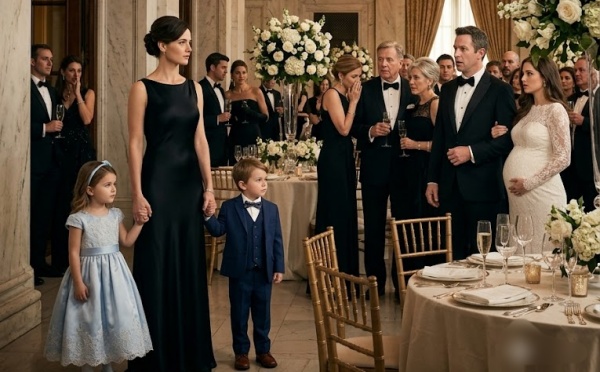
Five years after my ex-husband called me a barren failure, his family invited me to his luxury Chicago wedding so they could watch me sit quietly while another woman carried his “first heir.” They expected me to arrive alone, ashamed, and forgotten. Instead, I walked in holding the hands of my three-year-old twins—the children conceived from the embryos he had legally signed away. By the time the reception began, his perfect family story was already falling apart.
Part 1: The Invitation
Five years after Mark Harrington called me a barren failure, his mother invited me to his wedding.
The invitation arrived on thick ivory cardstock, embossed in gold, wrapped in tissue paper that smelled faintly of expensive perfume. It was addressed to Mrs. Ava Bennett, my maiden name restored, as if the Harrington family had finally learned how to spell the woman they once erased. Inside, beneath a crest that did not belong to them but that they loved using anyway, were the words:
Mark Edward Harrington and Sloane Avery Whitcomb request the pleasure of your company…
I read it twice at my kitchen island in Evanston while my three-year-old twins were arguing over whether dinosaurs could eat pancakes. The morning sun came through the windows, catching syrup on my daughter’s chin and the tiny curl falling over my son’s forehead. Behind them, Lake Michigan glimmered blue and cold beyond the trees.
The wedding would be held at the Chicago Cultural Center, followed by a reception at the Palmer House. Black tie. Six o’clock. Saturday in June.
At the bottom, in Mark’s mother’s perfect handwriting, was a note.
Ava, we hope enough time has passed for everyone to celebrate with grace.
Grace.
That was the word wealthy people used when they wanted the wounded to behave beautifully for the comfort of those who wounded them.
My daughter, Lily, held up a pancake shaped vaguely like Illinois.
“Mommy, is this a state?” she asked.
“It’s trying to be,” I said.
My son, Noah, leaned over his plate. “Can I eat Chicago?”
“Only after breakfast.”
They giggled, and for a moment the invitation became just paper.
Then my phone buzzed.
A text from my former sister-in-law, Caroline.
Did you get it?
I stared at the message.
Caroline Harrington had never liked me, not really. She had tolerated me when I was useful, smiled at me in photographs, and once told me that “some women just aren’t built for legacy” after my third failed IVF transfer. She married into a banking family and believed cruelty was acceptable if said softly over champagne.
I did not answer.
Another message appeared.
You should come. It would show you’ve moved on.
Then a third.
Sloane really wants peace. And honestly, it might be good for you to see Mark happy.
There it was.
Not peace.
Performance.
They wanted me there as proof that I had been defeated politely.
The story they told Chicago society was simple: Mark Harrington, heir to one of the city’s oldest private equity families, had survived a tragic first marriage to a woman who could not give him children. Now he was marrying Sloane Whitcomb, a twenty-eight-year-old lifestyle influencer with two million followers, a perfect smile, and a pregnancy announcement already featured in three glossy magazines.
Sloane was carrying “the first Harrington heir.”
That was what the caption said under their engagement photo.
A new chapter for one of Chicago’s most celebrated families.
I had read those words in the checkout line at Whole Foods with Lily asleep in the cart and Noah holding a banana like a microphone.
I did not cry.
By then, I had already learned that public lies only hurt if you still need strangers to know the truth.
But the invitation changed something.
It was not enough for them that I had disappeared from their galas, charity boards, and Lake Forest brunches. It was not enough that I had rebuilt a quiet life, changed my name, and raised my children outside their gilded reach. They wanted me to sit in a ballroom full of Chicago’s wealthiest people while Mark placed a wedding ring on another woman’s hand and proved, once and for all, that I had been the defective chapter.
They wanted me to watch their bloodline continue without me.
What they did not know was that their bloodline was eating pancakes at my kitchen island.
Lily Harrington Bennett had Mark’s gray eyes and my stubborn chin.
Noah Harrington Bennett had Mark’s smile, though I forgave him for it every morning.
They were three years old, conceived from the embryos Mark had signed away in the final month of our marriage, when he was too angry, too careless, and too confident that I would never use them. He had signed the clinic release, the divorce addendum, and the parental waiver after his attorney told him it would protect him from future support claims.
He thought he was throwing away medical waste.
I knew he was signing away my last chance at motherhood.
After our divorce, I moved to California for a year, completed the legal process exactly as required, and transferred the embryos under the agreement Mark had barely read. A court order clarified parentage, decision-making authority, and financial responsibility. The documents were private, sealed, and clean.
Nine months later, Lily and Noah were born in San Diego at 2:14 and 2:19 in the morning.
Mark never knew.
Not because I broke the law.
Because he had signed away the right to be told.
The Harrington family trust, however, was a different matter.
The trust had been created by Mark’s grandfather, Edward Harrington II, a cold but meticulous man who believed bloodlines mattered more than feelings. It held roughly fifty million dollars in assets, including stock, commercial property, and investment income. The language was old-fashioned and brutal: distributions were reserved for biological descendants of Edward Harrington II, verified by lawful proof, with protections for minors.
When Lily and Noah were six months old, my attorney submitted sealed documentation to the trustee.
Birth certificates. Genetic testing. Court orders. Embryo consent agreements. Chain of custody from the fertility clinic.
The trustee recognized them before they could sit up without falling over.
Mark’s unborn baby with Sloane might be loved, celebrated, photographed, and hashtagged.
But Lily and Noah had already been legally recognized by the trust as Harrington descendants.
The first heirs had been eating Cheerios in my living room for three years.
I folded the invitation and placed it beside my coffee mug.
My best friend, Maya, called at 8:03.
“I know that silence,” she said when I answered. “What happened?”
“They invited me to Mark’s wedding.”
Maya went quiet.
Maya Patel was a pediatric surgeon, my college roommate, and the only person who had seen me at my lowest without trying to make my grief more convenient. She was there the night Mark told me I had failed him as a wife. She was there when I signed the divorce papers with swollen eyes and shaking hands.
And she was there when the twins were born, cutting their hospital bracelets too carefully because her hands were trembling.
“Please tell me you’re not going,” she said.
I looked at Lily and Noah, now building a tower out of napkins and banana slices.
“I don’t know.”
“Ava.”
“They invited me to humiliate me.”
“Yes. That is why we do not reward them with attendance.”
I picked up the invitation again. “What if humiliation only works when the person being humiliated agrees to be ashamed?”
Maya sighed. “That sounds like something women say right before making me wear Spanx and attend a hostile social event.”
I smiled for the first time all morning.
“I’m calling Julian,” I said.
Julian Ross was my attorney, and he had been guiding the trust matter since the twins were infants. Calm, precise, impossible to intimidate, he had once made a Harrington family lawyer apologize using only three sentences and a raised eyebrow. If I went to that wedding, I would not go recklessly.
I would go documented.
By noon, Julian had reviewed the invitation, the trust correspondence, and the recent filings from the trustee. His advice was measured.
“You are allowed to attend a public social event to which you were invited,” he said. “You are not required to disclose anything.”
“But if they say something?”
“Do not argue. Do not threaten. Do not create a scene. If the children attend, they attend as your children. If questions arise, we respond through counsel.”
“Can they challenge the trust recognition?”
“They can try.”
“And?”
“And they will discover that signing documents without reading them remains a poor life strategy.”
I almost laughed.
“What would you do?” I asked.
Julian paused. “Personally or legally?”
“Both.”
“Legally, I would carry copies of nothing and say less than feels satisfying. Personally, I would not let anyone call my children impossible.”
That settled something in me.
The wedding was two weeks away.
I did not RSVP immediately.
Instead, I watched my children nap that afternoon, both curled sideways in their little beds, Noah’s hand hanging off the mattress, Lily’s stuffed rabbit tucked under her arm. They did not know about bloodlines, trusts, society pages, or the word Mark once used to reduce me to a broken body. They knew juice boxes, bedtime songs, sidewalk chalk, and the way I kissed both of their foreheads before turning off the light.
They were not revenge.
They were not evidence.
They were my children.
That was the only reason I hesitated.
Then, that evening, Caroline texted again.
Just so you know, Sloane is planning a family legacy table with baby photos. It might be emotional for you, but maybe healing too.
Healing.
Always offered by the people holding the knife.
I typed one reply.
We’ll attend. Three seats, please.
A minute later, Caroline answered.
Three?
I looked toward the playroom, where Lily and Noah were laughing at something only twins understood.
Then I smiled.
Yes. Three.
Part 2: What Mark Signed Away
Mark Harrington had once wanted children more than anything.
Or so I believed.
When we married, he talked about sons in tiny navy blazers and daughters learning to skate at Millennium Park in winter. He imagined family Christmas cards on the staircase of his parents’ Lake Forest estate, summers at their house in Harbor Country, and a nursery painted in tasteful neutrals because “Harrington babies don’t need cartoon animals on the walls.”
I was foolish enough to think that meant he wanted a family.
What he wanted was continuation.
There is a difference.
Our first year of marriage was elegant on the outside and quietly lonely within. Mark worked long hours at Harrington Capital, attended dinners with men who measured worth by market cycles, and expected me to become the kind of wife who could make conversation with donors while remembering which judge had a son at Northwestern. I tried.
I tried very hard.
When I did not get pregnant after a year, Mark was concerned.
After two years, he became impatient.
After three, he became cruel.
Fertility treatment turned our marriage into a calendar of injections, appointments, lab calls, and heartbreak. I learned to inject hormones into my own stomach while standing under the bathroom lights at 6 a.m. I learned that hope could arrive in a phone call and die in the next one.
Mark came to the first few appointments.
Then he got busy.
His mother, Eleanor Harrington, sent me articles about diet, stress, acupuncture, and “womb-centered mindfulness,” though she had never used the word womb in my presence before. Caroline sent a baby blanket after my second failed transfer with a note that read, For when it finally happens.
I put it in a closet and cried until I threw up.
After the fourth failed transfer, Mark stopped touching me.
After the fifth, he stopped pretending.
The night everything ended, we were in the library of our Gold Coast townhouse. Snow pressed against the windows, and the fireplace was burning because Mark liked the atmosphere more than the warmth. I had just told him our last transfer had failed.
He poured bourbon into a crystal glass and did not look at me.
“I can’t keep doing this,” he said.
I sat on the sofa with a heating pad pressed to my stomach. “Doing what?”
“Living in a house built around failure.”
The words entered me slowly.
“What does that mean?”
He turned then, and his face held no tenderness. Only exhaustion sharpened into blame.
“It means I need a wife who can give me a family.”
I remember the sound of the fire.
A log collapsing.
A small bright crack.
“I am your wife,” I said.
He looked at me with something worse than hatred.
Pity.
“You were.”
That was the night I understood that some marriages do not end when someone leaves. They end when someone stops seeing you as fully human.
The divorce moved fast because Mark wanted it fast.
He offered money, furniture, a clean statement, and the chance to “avoid unpleasant discovery.” In exchange, he wanted silence, finality, and no future obligations related to fertility treatment. His lawyer drafted the embryo disposition agreement as part of the settlement.
There were eight frozen embryos.
Four were not viable after additional testing.
Four remained.
I still remember sitting across from Mark in the conference room while attorneys spoke in polished, bloodless language about “stored genetic material” and “post-dissolution reproductive use.” My heart beat so hard I could feel it in my throat.
Mark barely looked at the papers.
His attorney explained that if he consented to release decision-making authority to me, I would assume all responsibility. He would waive parental claims, custody rights, support obligations, and involvement. The clinic required additional notarized forms and counseling confirmations.
Mark signed before the attorney finished the second paragraph.
I stared at him.
“Do you understand what you’re signing?” I asked.
He looked annoyed. “I understand I’m done.”
That was the last sentence he spoke to me as my husband.
Two months later, our divorce was final.
Six months later, I was pregnant.
With twins.
The pregnancy was not easy. I was thirty-five, emotionally wrecked, and living in a furnished apartment in San Diego because I needed to be somewhere Mark’s name did not open every door. I vomited for fourteen weeks, cried in grocery store aisles, and slept with my hands on my belly as if sheer will could keep both babies safe.
Maya flew out twice.
My older neighbor, Mrs. Alvarez, brought soup and scolded me for assembling cribs alone. A nurse named Jenna taught me how to breathe through panic during an ultrasound when one baby hid behind the other and I became convinced the world was ending.
But the babies grew.
Lily arrived first, screaming.
Noah arrived five minutes later, quieter, blinking at the room like he had questions.
I gave them my last name.
Bennett.
Not because I wanted to erase where they came from biologically, but because I wanted the first word attached to them to be mine.
For three years, I kept my life small and beautiful.
We moved back to Illinois when the twins were eighteen months old, but not to Chicago society. Evanston was close enough to specialists, museums, good schools, and Maya, but far enough from the Harrington orbit that I could buy milk without seeing someone who knew my marriage as gossip.
I freelanced as a consultant for nonprofit arts organizations.
I made enough.
The trust made more.
At first, I resisted involving the Harrington trust at all. I did not want their money touching my children. I did not want Mark’s family near them. I did not want anyone to think I had used the embryos for access to wealth.
Julian changed my mind.
“The trust is not a gift from Mark,” he said. “It is a legal structure created before these children existed. If they qualify, then declining recognition does not protect them. It only protects the adults who would prefer they remain invisible.”
So we filed privately.
The trustee, a formal man named Charles Davenport, requested everything.
We provided it.
DNA reports confirmed Lily and Noah were biological descendants of Edward Harrington II through Mark. The clinic documents showed lawful transfer and use of embryos under Mark’s signed consent. The court orders showed I was the sole legal parent and guardian, with no support obligation from Mark under the agreement.
The trust committee recognized Lily and Noah as beneficiaries.
Their shares would be protected until adulthood, managed separately, and disclosed only as required.
Mark was notified through his counsel that potential biological descendants had been recognized.
According to Julian, his attorney acknowledged receipt.
According to everyone else, Mark either ignored it, buried it, or assumed it did not matter.
That was Mark’s talent.
He could make facts disappear simply by refusing to emotionally process them.
Then Sloane entered the picture.
Sloane Whitcomb was what Chicago society called “modern old money,” meaning her family had enough status to be invited places and enough Instagram followers to monetize the invitation. She wore cream dresses, posted skincare routines, filmed charity galas, and referred to pregnancy as “the most sacred brand collaboration with God.” People adored her because she made privilege look soft.
Her relationship with Mark went public eight months before the wedding.
Their pregnancy announcement came four months later.
The caption read:
Baby Harrington arriving this fall. The first little heir to a legacy we’re honored to continue.
That word again.
First.
I did not correct it.
Not then.
Children are not press releases.
But when the invitation arrived, I understood that Mark’s family intended to make their lie a ceremony.
They wanted me in the room while they crowned Sloane’s unborn baby as the miracle I had failed to provide.
They wanted applause over my supposed emptiness.
So I made plans.
Not revenge plans.
Protection plans.
The week before the wedding, I took Lily and Noah shopping for formal clothes. Lily chose a pale blue dress with tiny embroidered flowers. Noah chose a navy suit and announced he looked like “a tiny judge.” I bought them both comfortable shoes because no family legacy was worth toddler blisters.
Maya came over the night before the wedding with takeout, emergency snacks, and an expression of deep disapproval.
“I still think this is insane,” she said, folding fruit snacks into my clutch.
“It might be.”
“You realize they’re going to stare.”
“I know.”
“They may say things.”
“I know.”
“What if Mark tries to approach the twins?”
I looked toward the living room, where Lily and Noah were watching a cartoon under the same blanket.
“He can look,” I said. “He cannot claim.”
Maya softened. “Ava.”
“He signed away everything that mattered when he thought there would never be consequences.”
She sat beside me on the couch.
“And you?” she asked. “Are you ready to see him?”
I thought about Mark in the library, bourbon in hand, calling our life failure. I thought about the conference room, his signature, the way he did not even ask what names I had imagined for the embryos we created. I thought about the years he let the world believe I was barren while our children learned to walk.
“No,” I said honestly. “But I’m ready for him to see them.”
Part 3: The Wedding at the Cultural Center
The Chicago Cultural Center looked almost unreal that evening.
Its grand staircase glowed under soft golden light, marble columns rising like something from another century. Guests in black tie moved through the building with champagne flutes and expensive confidence. Above us, the Tiffany dome shimmered in blue, green, and gold, catching every whisper.
Lily held my left hand.
Noah held my right.
For one brief moment, I considered turning around.
Then Noah looked up at the ceiling and gasped. “Mommy, is this a castle?”
“Kind of,” I said.
Lily whispered, “Are we allowed to touch anything?”
“Absolutely not.”
She nodded solemnly, as if this confirmed the building’s importance.
I wore a black silk gown, simple and sleeveless, with my hair pinned low. No dramatic jewels. No red lipstick. Nothing that would let them accuse me of arriving for spectacle.
The spectacle was walking beside me in tiny formal shoes.
At the registration table, a young woman with a headset looked at her list.
“Name?”
“Ava Bennett.”
Her smile froze.
Just a little.
She looked down, then back up at me, then at the twins.
“Of course,” she said too brightly. “You’re seated at table nineteen.”
Of course I was.
The far table. The exile table. The place where former wives, distant cousins, and people who no longer fit the story were placed behind floral arrangements and rented palms.
That was fine.
I had not come for the view.
We entered the reception area before the ceremony, where guests mingled under chandeliers and a string quartet played something soft and expensive. Conversations slowed as we walked in. Heads turned.
Recognition moved through the room like wind across water.
Some people knew me from years ago.
Some knew only the story.
Some looked at my children and began doing math.
The Harrington family stood near a massive arrangement of white roses.
Mark was there.
He wore a black tuxedo, hair slightly silver at the temples now, posture perfect, smile practiced. Beside him stood Sloane in a pre-ceremony ivory gown that skimmed her pregnant belly beautifully. She looked radiant, and for a moment, I felt no anger toward her.
She was not the one who called me broken.
She was simply standing in the story Mark sold her.
Eleanor Harrington saw me first.
Mark’s mother was dressed in champagne silk and pearls, her silver hair swept into a smooth knot. She looked at me with the cool satisfaction of a woman expecting a defeated guest. Then her eyes dropped to Lily and Noah.
Her face changed.
Not dramatically.
Women like Eleanor Harrington train their faces from birth.
But her champagne flute stopped halfway to her mouth.
Caroline turned next.
Her lips parted.
Then Mark looked.
For five years, I had imagined this moment more times than I liked admitting. I imagined him shocked, ashamed, furious, maybe even moved. Reality was stranger.
He looked at Lily first.
Then Noah.
Then at me.
His face drained of color so completely that Sloane touched his arm.
“Mark?” she said.
He did not answer.
Noah leaned against my leg. “Mommy, that man is staring.”
I squeezed his hand. “Some people forget their manners.”
Lily looked up. “Should I wave?”
“No, sweetheart.”
Mark took one step forward.
Eleanor caught his sleeve.
It was a small movement, but I saw it.
So did half the room.
Mark lowered his voice. “Ava.”
The sound of my name from his mouth after all those years felt like a door opening in a house I no longer lived in.
“Mark,” I said.
His eyes flicked back to the children.
Sloane looked from him to me, then to the twins. Confusion moved across her perfect face, followed by something sharper. Influencers understand optics quickly. Wives understand them faster.
Caroline forced a laugh. “Ava. What a surprise. You brought… guests.”
“My children,” I said.
The words landed clearly.
My children.
Not explanations.
Not secrets.
Not claims.
Children.
Eleanor recovered first. “How lovely. We didn’t realize you had remarried.”
“I didn’t.”
The silence after that was almost delicate.
Sloane’s hand moved to her belly.
Mark whispered, “How old are they?”
Noah answered before I could.
“I’m three and a half,” he said proudly. “But Lily says half doesn’t count until birthday cake.”
Lily sighed. “Because it doesn’t.”
A few guests nearby smiled despite themselves.
Mark looked like the floor had shifted beneath him.
Three and a half.
Old enough to count backward.
Old enough to understand they were born long before Sloane’s pregnancy.
Old enough to become impossible to ignore.
Eleanor leaned closer, voice low. “Ava, perhaps we should speak privately.”
“No, thank you.”
“This is not the place.”
“You invited us.”
Her eyes sharpened.
“I invited you.”
“Yes,” I said. “And I requested three seats.”
Caroline’s face reddened. “You didn’t say they were children.”
“You didn’t ask.”
Mark was still staring at Noah.
Of the twins, Noah resembled him more openly. Same gray eyes, same dimple, same way of studying a room before deciding whether to trust it. Lily looked like me until she turned her head, and then the Harrington jawline appeared like a family secret.
Sloane stepped slightly away from Mark.
“Mark,” she said softly, “do you know these children?”
He swallowed.
“No,” he said.
It was technically true.
But not the truth.
I looked at him then, really looked, and saw the panic behind the tuxedo. He was not thinking like a father. He was thinking like a man whose public narrative had just developed witnesses under four feet tall.
Before anyone could say more, Julian appeared beside me.
He wore a dark suit, a blue tie, and the expression of a lawyer who had expected exactly this temperature.
“Good evening,” he said pleasantly.
Mark’s eyes narrowed. “Julian.”
“Mark.”
Eleanor stiffened. “Why is he here?”
“I was invited by Ms. Bennett,” Julian said. “As a guest.”
That was generous.
He was there as armor.
A coordinator appeared near the doorway, visibly panicked. “The ceremony will begin in ten minutes.”
The string quartet shifted songs.
Guests pretended not to listen while listening with their whole bodies.
I looked down at the twins. “We’re going to find our seats.”
Mark stepped forward again. “Ava, wait.”
Julian moved half an inch.
That was enough.
Mark stopped.
I smiled politely. “Congratulations.”
Then I walked away with my children.
At table nineteen, Maya was already seated.
She had somehow obtained champagne and chicken tenders.
“Okay,” she whispered as I sat. “I take back every objection. That was horrifying and magnificent.”
“Please don’t say magnificent.”
“Noah called him rude. I may frame the memory.”
The ceremony began beneath the dome.
Sloane walked down the aisle smiling, but the smile trembled around the edges. Mark stood at the front, facing her, but his eyes moved twice toward the far side of the room where Lily sat coloring quietly on a program. Noah had fallen asleep against Maya’s arm because family revelations were apparently less interesting than missing nap time.
The vows were beautiful.
Of course they were.
People who build public lives know how to choose words.
Mark promised honesty, devotion, and legacy.
At that, Maya made a sound into her napkin.
I did not laugh.
I watched Sloane place a ring on his finger and wondered whether she knew she was marrying a man who could rewrite a woman’s pain into a branding opportunity. Maybe she did. Maybe she didn’t. Maybe love had made her as selective as it once made me.
When the officiant pronounced them married, the room applauded.
I clapped too.
Softly.
Not for Mark.
For the end of one performance and the beginning of the next.
At the reception, the Harringtons tried to regain control.
They placed Sloane and Mark near the center of the ballroom beneath a floral arch. Photographers circled them. Guests drank champagne and reassured one another that nothing unusual had happened, which is how unusual events become permanent gossip.
Then the legacy slideshow began.
I had not known there would be one.
A large screen descended behind the band. The room darkened slightly. Music swelled. Photographs appeared: Edward Harrington II in a black-and-white portrait, Mark’s father at Harvard, Mark as a boy in sailing clothes, Mark receiving awards, Mark and Sloane at charity events, Sloane holding a tiny pair of baby shoes.
Then came the caption:
The Harrington Legacy Continues This Fall.
Around me, the room clapped.
At the head table, Eleanor smiled with relief.
Mark did not.
He was looking at Lily.
My daughter had stood up beside her chair to see the screen. The blue flowers on her dress caught the light. She tilted her head, studying the photos of a family that had unknowingly spent years pretending she did not exist.
Then she turned to me.
“Mommy,” she whispered, “that man looks like Noah.”
The applause faded in my ears.
I bent down and kissed her hair.
“Yes,” I said softly. “A little.”
Across the room, Mark heard her.
I know he did because his face changed again.
Not with anger this time.
With recognition.
And recognition, I discovered, can be more devastating than shock.
Part 4: The Trust Comes to the Table
The confrontation happened during dinner.
Not loudly.
Not at first.
We had just been served filet mignon and asparagus when Charles Davenport, the trustee, entered the ballroom.
He was not on the guest list.
I recognized him immediately: tall, gray-haired, wearing a conservative suit and the grave expression of a man who considered weddings inconvenient but contracts sacred. He spoke briefly to a hotel manager, then to Julian, then walked toward the Harrington table.
Eleanor saw him and stiffened.
Mark followed her gaze.
His face darkened.
Maya leaned toward me. “Please tell me that’s someone important.”
“That’s the trustee.”
Her eyes widened. “Oh, I love this wedding.”
“Stop.”
“I’m trying. I’m failing.”
Charles did not approach me first. That was important. He approached Mark, Eleanor, and Mark’s father, Robert, who had been quiet all evening in the way powerful men are quiet when they hope women will handle the unpleasantness.
From across the ballroom, I could not hear the words.
But I saw the paper.
One envelope.
Then another.
Robert opened his first. Eleanor leaned in. Mark refused to take his until Charles said something that made his jaw clench. Finally, he accepted it.
Sloane watched from beside him, pale beneath her makeup.
The band continued playing soft jazz.
Waiters continued pouring wine.
Chicago’s wealthiest people continued pretending not to witness the collapse of a family myth between the salad plates and dessert forks.
Then Eleanor stood.
She walked toward our table with the kind of calm that announces danger.
Julian stood before she arrived.
“Mrs. Harrington,” he said.
“I want to speak with Ava.”
“She is seated with her children.”
Her eyes flicked toward Lily and Noah.
They were sharing a roll and paying no attention.
“Privately,” Eleanor said.
“No,” I replied.
She looked at me then, and for the first time that evening, the polish cracked.
“What have you done?”
The question was so absurd that I almost smiled.
“What have I done?” I repeated.
“You brought them here.”
“You invited me here.”
“You know what I mean.”
“I do,” I said. “But I’m not going to help you make my children sound like misconduct.”
Her mouth tightened.
Mark appeared behind her.
Sloane followed a few steps back, one hand on her belly, her expression no longer radiant but alert. Caroline hovered nearby, desperate to be involved but terrified to speak.
Mark placed his envelope on the table.
“What is this?” he demanded.
Julian answered before I could. “A trustee notice.”
“I can read.”
“That is wonderful progress.”
Maya choked on her water.
Mark ignored her. “Why is the trust recognizing them?”
Lily looked up. “Mommy, why is he mad?”
Before I could answer, Julian spoke calmly.
“Mr. Harrington, lower your voice.”
Mark looked at the children, then back at me.
His voice dropped, but the anger did not. “You used the embryos.”
I placed my napkin on the table.
“Yes.”
“You had no right.”
Julian’s face became very still.
“That is incorrect.”
Mark’s eyes flashed. “I signed under pressure.”
I looked at him then.
Really looked.
Five years of silence sat between us like a third person at the table.
“You signed because you wanted to be done,” I said. “Those were your words.”
His face tightened.
Sloane whispered, “Embryos?”
Eleanor closed her eyes.
That told me Sloane had not known.
Not really.
Maybe she had heard vague references to fertility treatment and a difficult divorce. Maybe Mark had told her we had “tried everything” and failed. Maybe he had left out the four remaining embryos because inconvenient possibilities did not fit the story of her miracle heir.
Sloane looked at him. “Mark.”
He did not answer.
Charles Davenport approached our table, perhaps sensing the need for institutional gravity before family emotion turned legally expensive.
“Ms. Bennett,” he said politely.
“Mr. Davenport.”
He nodded toward the twins. “The children are beautiful.”
“Thank you.”
Mark snapped, “Do not speak about my family like this is settled.”
Charles turned to him with professional patience.
“Mr. Harrington, the matter was settled years ago. The trust received sufficient documentation, including genetic verification and court orders. Beneficiary status was recognized under the terms of the instrument.”
“They are not—”
He stopped.
Because Lily was looking at him.
There are words adults say easily until children become their audience.
Charles continued. “The notices tonight were procedural, triggered by public representations regarding succession and beneficiary expectations that conflict with established trust records.”
Translation: the Harringtons had spent the night publicly calling Sloane’s unborn child the first heir, and the trust did not enjoy inaccurate claims that could affect legal expectations.
Robert Harrington finally joined them.
He looked older than I remembered, though perhaps he had always been old and I had been too young to notice. His tuxedo fit perfectly. His expression did not.
“Ava,” he said. “Why did you never tell us?”
I almost laughed.
“You mean when Mark called me a failure? When your wife suggested I was damaging the family line? When your daughter told me some women weren’t built for legacy? Which of those felt like an invitation?”
Robert looked away.
Eleanor whispered, “We were grieving too.”
“No,” I said. “You were disappointed. There is a difference.”
The table went silent.
Sloane’s eyes filled with tears, but she did not cry. I respected that more than I expected. She looked at Lily, then Noah, then at Mark.
“You knew this was possible?” she asked him.
Mark rubbed his forehead. “It was complicated.”
“No,” I said softly. “It was paperwork.”
Sloane flinched.
Not because I meant to hurt her.
Because paperwork is often where romance goes to die.
Caroline found her voice then. “This is cruel, Ava.”
I turned to her. “Cruel was inviting me here to sit under a slideshow about the first Harrington heir when you thought I had none.”
Her face reddened.
“Cruel was sending texts about healing while planning humiliation over dessert.”
She looked down.
“Cruel was calling children impossible because you did not know they existed.”
No one answered.
No one could.
Mark sat down heavily in the empty chair beside our table. He looked at Noah, who was busy removing carrots from his plate with surgical focus. Then he looked at Lily, who had decided the adults were boring and returned to coloring.
Their innocence did not soften the situation.
It made it unbearable.
“What are their names?” he asked.
The question almost broke me.
Not because it was tender.
Because it came three and a half years too late.
I could have refused.
Maybe I should have.
But Lily looked up then, proud and clear.
“I’m Lily,” she said. “That’s Noah. He doesn’t like carrots.”
Noah nodded solemnly. “They’re suspicious.”
Maya made a strangled sound.
For one impossible second, Mark smiled.
A small, involuntary smile.
Then it vanished beneath everything he had done.
Sloane stepped back from him.
Eleanor noticed.
So did Mark.
“Sloane,” he said.
She shook her head slightly. “Not here.”
“Please.”
“Not here,” she repeated.
That was the first wise thing anyone in the Harrington family had said all night.
Charles placed a final envelope in front of Julian.
“For your records,” he said.
Then he nodded to me and left the ballroom as quietly as he had entered.
But quiet exits can leave loud consequences.
By dessert, half the room knew.
By the cake cutting, all of it did.
No one said “barren” again.
No one said “first heir.”
No one asked why I was at table nineteen.
When Mark and Sloane took the floor for their first dance, the applause was polite but thinner than before. Sloane smiled for the photographers, but her eyes were wet. Mark held her carefully, like a man who had just realized the floor beneath him was glass.
Lily fell asleep in my lap before the speeches.
Noah curled up against Maya.
I looked at my children, warm and heavy with trust, and felt no triumph.
Only relief.
The truth had entered the room.
It did not need to shout.
Part 5: What They Couldn’t Take Back
The next morning, Chicago woke up hungry.
Not for breakfast.
For gossip.
By 9 a.m., two society blogs had posted vague references to “unexpected family developments” at the Harrington-Whitcomb wedding. By noon, someone had leaked that Mark’s ex-wife had arrived with children. By evening, Sloane’s pregnancy announcement captions had been quietly edited across social media.
The word first disappeared.
I did not comment.
Julian advised silence, and for once, silence felt satisfying rather than forced. The Harringtons could explain their own contradictions. I had spent enough years being translated by people who disliked the truth.
Mark emailed Julian that afternoon requesting a private meeting.
Julian declined.
Mark then requested information about the twins.
Julian responded that any communication regarding Lily and Noah would proceed through counsel and in accordance with existing legal orders.
Mark did not like that.
Men who sign away doors are often shocked when they later find them locked.
Three days after the wedding, Sloane sent me a message through her publicist first, then through Julian after being told that was inappropriate. Her note was short.
I did not know. I am sorry for the way the wedding was used. I hope your children are protected from all of this.
I believed her.
Not completely.
But enough.
I asked Julian to send one sentence back:
Thank you. Please keep them out of any public statements.
She did.
That was more grace than the Harringtons had shown me in five years.
Mark’s family, however, began unraveling in predictable ways.
Eleanor wanted to challenge the trust recognition immediately. Robert wanted to handle the matter privately. Caroline wanted to know whether her own children’s future distributions would be reduced, which answered any lingering question about her priorities.
The trustee stood firm.
The documents were valid.
The recognition had already occurred.
The trust did not care that the timing was socially inconvenient.
Two weeks after the wedding, Mark appeared outside my house.
He did not come to the door, probably because Julian’s warning letter had been clear. He stood across the street near a black SUV, hands in his pockets, looking at the small brick house where my children’s bikes lay tipped over in the driveway. I saw him through the front window while Lily and Noah built a pillow fort in the living room.
My heart did something old and unwelcome.
Not love.
Memory.
I stepped onto the porch and closed the door behind me.
Mark crossed the street slowly.
He looked less polished than at the wedding. No tuxedo, no family crest, no audience. Just a man in a gray sweater standing beneath a maple tree with the face of someone who had spent days discovering the past had legal teeth.
“You shouldn’t be here,” I said.
“I know.”
“Then leave.”
He looked toward the house. Through the window, Lily’s laughter burst bright and clear.
His eyes closed briefly.
“I didn’t know,” he said.
I folded my arms. “You didn’t ask.”
“I thought the embryos were gone.”
“No. You thought I was too broken to use them.”
He flinched.
Good.
Some truths should hurt the person who created them.
“I was angry,” he said.
“You were cruel.”
“I was grieving.”
“You were embarrassed.”
His jaw tightened, then relaxed.
Maybe therapy had taught him not to fight every accurate sentence.
“I told myself it was your choice,” he said. “Keeping the treatments going. Holding on. I told myself I was allowed to move on.”
“You were allowed to move on,” I said. “You were not allowed to rewrite me as defective so you could feel noble.”
He looked down.
Cars passed behind him. Somewhere down the block, a dog barked. Inside, Noah shouted something about dragons.
Mark swallowed. “Are they happy?”
The question surprised me.
“Yes.”
“Healthy?”
“Yes.”
“Do they know about me?”
“They know families can be complicated. They know they were very wanted. They know they are loved.”
He nodded, eyes shining now.
“I want to know them,” he said.
There it was.
The sentence I had feared since the wedding.
I looked at the man who had once signed away four embryos with a bored flick of a pen. I looked at the biological father of my children, the ex-husband who had let society call me barren while our twins grew in secret safety. I looked at the stranger who had laughed at my emptiness before discovering it had never belonged to him to define.
“No,” I said.
His face crumpled. “Ava.”
“No.”
“They’re my children.”
“No,” I said carefully. “They are biologically connected to you. They are my children.”
“That’s not fair.”
“Neither was signing them away because you thought they would never become real.”
His eyes filled. “I made a mistake.”
“Yes.”
“I didn’t understand.”
“You understood enough to hire a lawyer.”
He looked away.
That was the thing about Mark. Even his regrets wanted soft lighting.
I took a breath.
“I am not saying never because I want to punish you,” I said. “I am saying no because they are three years old, and you are a stranger who became interested only after a ballroom full of people saw their faces.”
“That’s not true.”
“Then prove it by respecting the boundary.”
He looked toward the house again.
Lily appeared in the window wearing a blanket over her shoulders like a cape. She saw us and waved because she waved at delivery drivers, neighbors, squirrels, and once a traffic cone.
Mark lifted his hand halfway.
Then stopped.
To his credit, he did not wave back.
Maybe he finally understood that not every opening belongs to him.
“I’m sorry,” he said.
“I know.”
“Do you?”
“Yes,” I said. “But apology is not parenthood.”
He wiped his face quickly, embarrassed by his own tears.
“I loved you once,” he said.
“I know that too.”
His eyes met mine.
“And then you loved what I was supposed to produce more than you loved me.”
He had no answer.
After a moment, he nodded, turned, and walked back to his SUV.
I watched him leave.
Then I went inside and made peanut butter sandwiches shaped like stars because Lily had requested “fancy lunch” and Noah had declared triangles too common.
Life resumed.
That was the quiet miracle.
Not the trust. Not the wedding. Not the gasp when Mark saw his children beneath the Tiffany dome.
The miracle was that after all of it, the twins still needed snacks, naps, clean socks, and bedtime stories. They did not care about wealth, bloodlines, or legal instruments drafted by dead men with too much money. They cared whether I remembered to do the dragon voice.
I did.
Months passed.
The Harrington trust matter remained stable. Julian handled letters. Charles Davenport handled distributions. Sloane gave birth to a baby girl in October, and her announcement simply said:
Welcome to the world, Grace. You are loved beyond measure.
No heir.
No first.
No legacy.
Just a baby.
I respected that.
Mark stayed away, though he sent one letter through counsel every few months asking whether a future, therapist-guided introduction might someday be considered. I did not say yes. I did not say never. I said we would revisit when the children were older, if it served them and not him.
That was the only standard that mattered.
The following spring, the trustee held a required annual meeting in a private conference room downtown. I attended as the twins’ guardian. Eleanor Harrington attended with Robert. Caroline came too, stiff and unhappy in beige.
Mark was there.
Sloane was not.
The meeting was dry, full of investment updates, distribution rules, tax planning, and beneficiary protections. Lily and Noah were not present because they had better things to do, like preschool and arguing about glitter glue. Their names appeared in the documents, official and undeniable.
Lily Bennett.
Noah Bennett.
Recognized beneficiaries.
Protected minors.
Biological descendants.
Eleanor stared at their names for a long time.
After the meeting, she approached me near the elevator.
For once, she looked tired instead of regal.
“Ava,” she said.
I waited.
“I was unkind to you.”
It was not the apology I deserved.
But it was the first accurate sentence she had ever offered.
“Yes,” I said.
She swallowed. “I thought if Mark had a child with someone else, it would prove the problem was never with our family.”
I looked at her.
“There it is,” I said softly.
Her eyes filled, but she did not look away.
“I am sorry,” she said.
This time, it sounded like it cost her something.
I nodded once. “Thank you.”
Caroline stood behind her, arms crossed, saying nothing.
Some people grow.
Some people simply witness growth and resent the lighting.
In the elevator down, Mark stood beside me in silence.
As we reached the lobby, he said, “They have your last name.”
“Yes.”
“I’m glad.”
I turned to him, surprised.
He looked older now. Not ruined. Just altered.
“They should,” he said. “You’re the one who wanted them before they existed.”
For a moment, the air between us softened.
Not enough to heal.
Enough to breathe.
“Thank you,” I said.
He nodded and walked away.
That evening, I picked up Lily and Noah from preschool. Lily ran toward me with paint on her sleeve, and Noah carried a paper crown that had clearly survived a crisis. They both talked at once all the way to the car.
At home, we ate spaghetti, spilled milk, took baths, negotiated pajamas, and read three books even though I said two.
After they fell asleep, I sat on the edge of Noah’s bed, then Lily’s, touching their hair lightly in the dark.
I thought about the wedding.
The invitation meant to mock me.
The ballroom meant to showcase my replacement.
The slideshow declaring a first heir while the real first heirs colored at the exile table.
I thought about Mark’s face when he saw them, Eleanor’s frozen champagne flute, Caroline’s silence, Sloane’s realization, and the trustee entering like consequences in a gray suit.
For years, I believed the worst thing Mark took from me was dignity.
I was wrong.
Dignity can grow back.
The worst thing he tried to take was the truth of who I was.
He wanted me remembered as the barren wife. The failed chapter. The woman who could not continue a family line.
But my children existed before his new vows.
Their names were written before the wedding music started.
And the fifty-million-dollar trust had recognized them long before Chicago society learned how wrong it had been.
Mark’s family invited me to watch another woman carry the future they thought I could not give them.
Instead, I arrived holding the hands of the future they had already signed away.
I did not shout.
I did not ruin the wedding.
I did not need to.
The truth walked in beside me, wearing tiny formal shoes.
