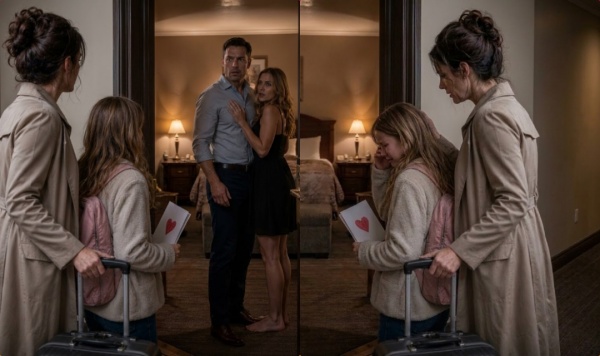
My Daughter Made the Perfect Birthday Card for Her Dad — But When We Flew to Chicago to Surprise Him, a woman’s voice came from behind the door, and my daughter’s smile disappeared
Ava spent three nights making the perfect card for her father’s birthday, carefully hiding it in her math folder so he wouldn’t see it during their video calls. She believed we were flying to Chicago to remind him how much he was loved. But the moment we reached his hotel room, I knew something was wrong. Then a woman’s voice came from behind the door, and my daughter’s smile disappeared.
PART 1: The Card Ava Hid in Her Math Folder
Ava believed her father was the kind of man who deserved handmade cards.
Not store-bought ones with glitter already glued on. Not the funny kind that played music when you opened them. Handmade cards, the kind that required markers spread across the kitchen table, tiny paper scraps stuck to your socks, and a child’s serious concentration at 9 p.m. on a school night.
She was eight years old, with two missing front teeth, hair that never stayed in a ponytail, and a heart that still believed love worked if you tried hard enough.
For three nights, she sat at our kitchen table in Charlotte, North Carolina, making the perfect birthday card for her dad.
Her father, Daniel Mercer, was turning thirty-nine.
He had been traveling for work more and more that year, flying to Chicago, Boston, Dallas, and Denver for client meetings that always seemed urgent. Daniel worked as a senior sales director for a medical software company, the kind of job that came with airport lounges, hotel points, and a phone that never stopped buzzing.
To Ava, that made him important.
To me, it made him absent.
My name is Rachel Mercer, and for nine years I had been Daniel’s wife. For eight of those years, I had also been the person who explained his absences to our daughter in the softest language possible.
Daddy’s flight got delayed.
Daddy’s meeting ran late.
Daddy wishes he could be here.
Daddy loves you so much.
I said those words so often they became a second language in our house.
Ava believed every one of them.
That was why she wanted the card to be perfect.
On the first night, she drew our family on the front: Daniel, Ava, me, and our golden retriever, Milo, standing under a huge yellow sun. Daniel was drawn taller than everyone else, wearing a blue tie and holding a briefcase. Ava drew herself holding his hand.
On the second night, she added stickers.
Stars.
Hearts.
A tiny airplane sticker because, as she said, “Daddy is always flying, so this way he can fly home faster.”
That sentence nearly broke me.
I was standing by the sink rinsing a cereal bowl when she said it, and I had to turn the water on louder so she would not hear the change in my breathing.
On the third night, she wrote the message inside.
She asked me how to spell favorite.
Then she asked me how to spell promise.
Then she hunched over the card for twenty minutes, her tongue pressed against the corner of her mouth, writing carefully in purple marker.
When she was done, she held it against her chest so I could not peek.
“It’s private,” she said.
“Private from me too?”
She nodded solemnly.
“Only Daddy can read it first.”
“Okay,” I said.
She slid it into her math folder, behind a worksheet about fractions, because Daniel sometimes asked to see her homework during their video calls. She said if she hid it in her desk, she might forget it. If she put it in her backpack, it would be safe.
The next night, during Daniel’s FaceTime call from Chicago, she nearly gave herself away.
“Daddy,” she said, bouncing on her knees on the couch, “are you going to be busy on your birthday?”
Daniel smiled from his hotel room. Behind him was a beige wall, a framed abstract print, and a lamp with a shade that made his face look tired and yellow.
“Probably a little bit, kiddo. I’ve got client meetings all day.”
“All day?”
“Most of it.”
“What about dinner?”
“We’ll see. Maybe room service.”
Ava’s eyes widened with sympathy.
“On your birthday?”
He laughed.
“Don’t worry about me. We’ll celebrate when I get home.”
I watched him through the phone screen.
He looked good. Too good, maybe. Fresh haircut, white dress shirt, no tie, the faint outline of the watch I had bought him for our fifth anniversary. He looked like a man who slept alone in expensive hotels and missed his family politely.
I wanted to believe that.
I really did.
Ava leaned closer to the screen.
“What hotel are you at?”
Daniel blinked.
“Why?”
“I just want to know.”
“The Langford,” he said after a beat. “Downtown.”
I looked up.
Daniel’s eyes flicked toward me through the screen.
I felt it then.
A small, sharp shift.
Not proof.
Not even suspicion, exactly.
But a change in the air.
“The Langford?” I asked.
He smiled too quickly.
“Yeah. Company booked it. Nice place.”
“You usually stay at the Westbridge when you’re in Chicago.”
“Rates were high this week.”
“Right.”
Ava interrupted before the silence could grow teeth.
“Daddy, do you like surprises?”
Daniel laughed again.
“Depends on the surprise.”
“I like surprises,” Ava said. “Good ones.”
He smiled at her, and for one moment, I saw the man I married. The man who cried when she was born. The man who once drove forty-five minutes at midnight to buy infant gas drops because Ava would not stop screaming and I was crying harder than she was.
“I like good surprises too,” he said.
Ava beamed.
After the call ended, she ran upstairs to brush her teeth, humming.
I stayed on the couch with Daniel’s hotel name still glowing in my mind like a warning light.
The Langford.
I knew that hotel.
Not personally, but through Daniel’s expense reports. The company used approved hotels, and The Langford was not usually one of them. It was a boutique hotel near the Chicago River, the kind of place couples booked for anniversary weekends, not sales directors needing efficient corporate rates.
I told myself not to be paranoid.
That was what I had been doing for months.
Explaining.
Correcting.
Soothing myself.
Daniel had been distant, yes. He had missed Ava’s spring concert because of a “last-minute client dinner.” He had forgotten our anniversary until the next morning, then sent flowers so expensive they felt like an apology without the inconvenience of conversation.
He had changed his phone passcode.
He had started taking calls in the garage.
He had bought new cologne in Atlanta and said the airline lost his old toiletry bag.
All the little signs were there.
But signs are cruel because each one can be explained if you are desperate enough.
And I was desperate.
Not desperate to keep Daniel at any cost.
Desperate not to make Ava’s world collapse unless I was absolutely sure.
That is a different kind of fear.
It is one thing to wonder if your husband is lying to you.
It is another to look at your daughter’s handmade birthday card and know the truth might hurt her more than it hurts you.
The next morning, Ava came downstairs wearing her favorite denim jacket and carrying her backpack.
“Mom,” she said, “what if we went to Chicago?”
I froze with a coffee mug halfway to my mouth.
“What?”
“For Daddy’s birthday. We could surprise him. Like in movies.”
“Ava…”
“We could fly. I have money.”
She ran to the entry table and grabbed her unicorn wallet. Inside were $18, three quarters, a Chuck E. Cheese token, and a folded receipt she thought looked important.
I smiled because I had to.
“That might not cover airfare.”
“I can use my birthday money from Grandma.”
“Sweetheart, Daddy is working.”
“But he said he likes good surprises.”
I looked at her face.
Hope is dangerous on a child.
It makes adults want to lie.
“We’ll think about it,” I said.
Ava heard yes hiding inside we’ll think about it, because children are excellent lawyers when they want something.
All day at work, I could not focus.
I worked remotely as a project manager for a healthcare marketing firm, which meant my job required color-coded timelines, client calls, and pretending that a spreadsheet could not see the state of your marriage. I answered emails. I joined meetings. I approved copy. But my mind stayed in Chicago, outside a hotel room I had never seen.
At noon, I checked flights.
Charlotte to Chicago O’Hare.
Two seats.
Leaving the next afternoon.
Returning Sunday.
The price was ridiculous for short notice, nearly $940 total.
I stared at the screen for ten minutes.
Then I booked it.
Not because I wanted to trap Daniel.
At least, that is what I told myself.
I booked it because Ava wanted to surprise her father.
Because maybe I was wrong.
Because maybe we would knock on his hotel room door, he would open it wearing sweatpants and a surprised smile, and Ava would run into his arms with the card she had spent three nights making.
Maybe he would cry.
Maybe I would feel ashamed for doubting him.
Maybe our family would get one good memory from a year full of distance.
That was the version I packed for.
But deep down, I also packed for the other one.
I did not tell Daniel we were coming.
I told Ava it had to be a secret.
She took this responsibility with the seriousness of a spy entrusted with national security.
She packed the card in her math folder, then put the folder in the front pocket of her backpack. She checked it six times before bed. At 5:30 a.m., she appeared in my doorway fully dressed, whispering, “Operation Birthday is today.”
I laughed.
Then I cried in the shower where she could not hear me.
Our flight landed at O’Hare International Airport just after 2 p.m. on Daniel’s birthday.
Ava pressed her face to the window during descent, gasping at Lake Michigan, the skyline, the tiny cars on the expressway.
“Chicago looks like a Lego city,” she said.
“It kind of does.”
“Do you think Daddy will be so surprised he falls over?”
“I hope not.”
She giggled.
We took a taxi downtown because I did not want to manage the train with luggage, Ava’s backpack, and the growing knot in my stomach. The driver talked about traffic on the Kennedy Expressway, the Cubs, and how downtown hotels charged too much for parking. Ava asked him if he had ever been surprised on his birthday.
He said, “Once. My wife got me a grill. Best day of my life.”
Ava took that as a good sign.
By the time we reached The Langford, the city had turned gray and windy. The hotel lobby smelled like expensive candles and fresh flowers. A young woman at the front desk smiled at Ava like children rarely entered that polished space.
“Checking in?” she asked.
“No,” I said. “We’re here to surprise my husband. Daniel Mercer. He’s a guest.”
The woman’s smile became professionally careful.
“I can’t give out room numbers, but if you’d like, I can call up.”
My stomach tightened.
Ava looked at me.
“I know his room,” she whispered proudly.
I looked down.
“What?”
“He told me when he showed me his view on FaceTime. Room 1712. I remembered because seventeen minus twelve is five, and I’m almost nine.”
The front desk clerk heard.
Her expression flickered.
I should have stopped right there.
I should have called Daniel from the lobby. I should have protected Ava from a door that might open onto the truth. I should have listened to every warning bell ringing inside me.
But hope is stubborn.
And fear sometimes disguises itself as politeness.
So I took Ava’s hand and walked toward the elevators.
On the ride up to the seventeenth floor, Ava pulled the card from her backpack.
The envelope was homemade too, folded from construction paper and sealed with a heart sticker. On the front, in careful purple marker, she had written:
To Daddy Do Not Open Until Your Birthday
She held it like treasure.
The elevator doors opened onto a quiet hallway with soft carpet and gold numbers on dark wooden doors.
1712 was halfway down.
Ava skipped the first few steps, then slowed.
“Should I knock?” she whispered.
I swallowed.
“Go ahead.”
She knocked three times.
No answer.
She looked back at me.
“Maybe he’s in the shower.”
She knocked again, louder.
From inside the room came a muffled sound.
A woman’s laugh.
Ava’s smile faltered.
Then a voice called from behind the door.
“Daniel, did you order something?”
Not a hotel employee.
Not a TV.
A woman.
A real woman, casual and close enough to call my husband by his first name from inside his hotel room.
Ava turned to me.
Her face had changed.
It was the smallest change, but I saw it happen.
The brightness left first.
Then the confusion came.
Then something like fear.
“Mom?” she whispered.
The door opened.
Daniel stood there in jeans and a white T-shirt, barefoot, holding a hotel towel in one hand.
Behind him, a woman in a navy silk blouse stood near the window.
Her name, I would later learn, was Meredith Sloan.
But in that moment, she was just the woman who watched my daughter’s birthday card slip from her hands and fall flat onto the hallway carpet.
PART 2: Room 1712
For three seconds, nobody moved.
Daniel stared at us.
I stared at him.
Ava stared at the woman behind him.
The woman stared at Ava’s card on the floor.
It was strange what my mind noticed first.
Not Daniel’s bare feet.
Not the unmade bed visible behind him.
Not the wine glasses on the small table by the window.
I noticed the birthday cupcakes.
A small white bakery box sat open on the desk, with two cupcakes inside. One had a candle already used, a curl of blackened wick sticking from the frosting. Chocolate frosting. Daniel’s favorite.
Ava had wanted to buy cupcakes at the airport, but I told her we could get something downtown.
Someone else already had.
“Rachel,” Daniel said.
My name sounded like an accident.
Ava bent down slowly and picked up the card.
Her fingers shook a little.
“Daddy?” she asked.
Daniel looked at her, and his face collapsed into panic.
“Ava. What are you doing here?”
That was the wrong question.
Children know when they have brought joy into a room.
They also know when adults wish they had not arrived.
Ava hugged the card to her chest.
“We came for your birthday.”
Daniel swallowed.
The woman behind him stepped forward.
“I should go.”
I looked at her.
“Yes,” I said.
Daniel turned sharply.
“Meredith—”
“No,” she said quietly. “I should go.”
She grabbed a purse from the chair. Her eyes moved to Ava again, and for one moment I saw shame, real shame, but it came too late to matter. She slipped past Daniel into the hallway, keeping as much distance from us as possible.
Ava pressed herself against my side.
Meredith walked quickly toward the elevators, heels quiet on the carpet.
The door to room 1712 stayed open.
Inside, Daniel’s laptop was on the desk. His suitcase was open. A black dress hung over the back of a chair. The bathroom mirror was fogged.
No explanation could survive that room.
Daniel stepped into the hallway and pulled the door halfway closed behind him.
“Rachel, listen to me.”
I looked down at Ava.
Her eyes were fixed on his face.
Not crying yet.
That was worse.
Children sometimes freeze before grief catches up.
“Not here,” I said.
“Please, just let me explain.”
Ava’s voice was tiny.
“Is she your friend?”
Daniel closed his eyes.
“Ava—”
“Is she?”
I waited.
I needed him to answer her.
Not me.
Her.
Daniel knelt slowly, like he was approaching a frightened animal.
“She’s someone I work with,” he said.
Ava looked at the door.
“In your room?”
His mouth opened.
Nothing came out.
That silence did more damage than any confession.
Ava stepped backward until her backpack bumped against my leg.
“I want to go home,” she whispered.
Daniel reached for her.
She flinched.
It was small.
Barely visible.
But Daniel saw it.
His hand stopped in midair.
“Ava, sweetheart…”
“Don’t,” I said.
My voice was calm, but something in Daniel’s face changed when he heard it.
Maybe because I had never spoken to him that way before.
Not loudly.
Not angrily.
Just final.
He stood.
“Rachel, don’t do this in front of her.”
I almost laughed.
He had opened a hotel door to our daughter while another woman stood behind him, but I was the one doing something in front of her.
“Ava and I are leaving,” I said.
“You can’t just fly here and walk away.”
“I can.”
“We need to talk.”
“We will. Through a therapist, a lawyer, or both. But not in this hallway while our daughter is trying to understand why her father lied.”
His face went pale.
Ava looked up at me.
“Daddy lied?”
I hated him then.
Not because of Meredith.
Because he had made me the interpreter of his betrayal.
I crouched in front of Ava, ignoring the ache in my knees.
“Sweetheart, grown-up problems are not your fault. You did nothing wrong. You came here with love.”
Her chin trembled.
“But he didn’t want us.”
Daniel made a sound like someone punched him.
“No, Ava. That’s not true. I always want you.”
She looked at him with the careful seriousness of a child trying to solve a math problem that kept changing.
“Then why did you look scared when you saw me?”
Daniel’s eyes filled.
He had no answer.
Again.
I stood and took Ava’s hand.
“We’re going downstairs.”
Daniel followed us to the elevator.
“Rachel, please. Let me come with you.”
“No.”
“She’s my daughter too.”
“Yes. And you can speak to her when she is ready and when you can do it without asking her to comfort you.”
“I’m not asking her to comfort me.”
“You will.”
The elevator doors opened.
A couple stepped out, laughing about dinner reservations, then grew quiet when they saw our faces.
Ava stepped inside first.
I followed.
Daniel stood outside the elevator, one hand against the doorframe.
“I love you,” he said to Ava.
She looked at the card in her hands.
Then she tucked it back into her math folder.
The elevator doors closed before she answered.
She never did.
In the lobby, Ava walked like she was asleep.
The front desk clerk glanced at us and looked away quickly. She knew. Maybe not all of it, but enough. Adults always know enough when a child exits an elevator holding a handmade card like a broken wing.
I booked a room at a different hotel two blocks away because there were no flights back to Charlotte that night that made sense. The new hotel was less elegant, more businesslike, with bright lights and a small market near the front desk selling overpriced snacks and toothbrushes.
Ava did not speak during check-in.
In the room, she set her backpack on the chair and climbed onto the bed without taking off her shoes.
I sat beside her.
“Do you want to talk?”
She shook her head.
“Do you want to call Grandma?”
Another shake.
“Do you want Milo?”
Her face crumpled.
Milo was back home with our neighbor.
That was when she started crying.
Not loudly.
Not dramatically.
She curled into herself with both hands over her mouth, like she was trying to keep the sound inside.
I pulled her into my arms.
“I’m sorry,” I whispered.
She sobbed harder.
“I made it perfect.”
“I know.”
“I used the good stickers.”
“I know, baby.”
“He didn’t even open it.”
My eyes burned.
“No, he didn’t.”
“Was it because it wasn’t good?”
I held her shoulders and moved back so she could see my face.
“No. Listen to me, Ava. This is very important. What happened today had nothing to do with your card. It had nothing to do with how much you love your dad. It had nothing to do with you not being good enough.”
“But if he loved me—”
“He does love you,” I said, because despite everything, I believed that part was true. “But he made choices that hurt us. Adults can love people and still make very wrong choices.”
She wiped her nose on her sleeve.
“That doesn’t make sense.”
“I know.”
“I don’t want to give him the card.”
“You don’t have to.”
She looked at the backpack.
“I don’t want to throw it away either.”
“Then we’ll keep it safe until you decide.”
She nodded.
Then she cried herself to sleep in her clothes, one hand still holding the strap of her backpack.
I sat beside her in the dark hotel room, listening to Chicago traffic below.
Daniel called seventeen times.
I did not answer.
He texted.
Please tell me where you are.
Rachel, I need to know Ava is okay.
This is not what you think.
I made a mistake.
Don’t punish me by keeping my daughter from me.
That last text changed something in me.
Because even then, he framed himself as the injured party.
Not Ava.
Not me.
Him.
I took screenshots of every message and put my phone facedown.
Then I opened my laptop and searched for family law attorneys in Charlotte.
At 1:12 a.m., while my daughter slept beside me with swollen eyes, I sent an email to a woman named Lydia Grant, whose website said she specialized in custody, divorce, and high-conflict family transitions.
The subject line was simple.
Consultation request — urgent but safe
I did not sleep.
At 6:30 a.m., Ava woke up and asked if Daddy was still in Chicago.
“Yes,” I said.
“Are we still in Chicago?”
“Yes.”
“Can we go home now?”
“Yes.”
She nodded.
Then, after a long silence, she whispered, “Mom?”
“Yeah?”
“Can I change my last name to yours?”
I closed my eyes.
Not because I was shocked.
Because grief had found language too big for an eight-year-old mouth.
“We don’t have to decide anything today,” I said.
“But can I?”
I brushed hair from her face.
“One day, if that is still something you want, we can talk about it.”
She nodded again.
Then she climbed into my lap like she was much younger than eight.
I held her until the city outside turned fully morning.
PART 3: What Daniel Tried to Explain
Daniel was waiting at our gate at O’Hare.
I should have known he would be.
A man like Daniel did not accept being denied access. Not because he was dangerous in the obvious sense. He had never hit me. He had never threatened me. He had never broken things.
His control was softer.
Polished.
Reasonable.
Wrapped in concern.
He stood near the boarding area in a navy sweater, hair still damp from a shower, looking like a husband in a sad movie who had made a terrible mistake and just needed one conversation to fix everything.
Ava saw him before I did.
Her hand tightened around mine.
“I don’t want to talk to him,” she whispered.
“Okay.”
Daniel approached slowly.
“Rachel.”
“Not here.”
He looked at Ava.
“Hi, Bug.”
She stared at the floor.
The nickname landed between them like something that had expired.
He swallowed.
“I know you’re upset.”
Ava said nothing.
Daniel crouched.
“I need you to know I love you more than anything.”
She looked up then.
“More than her?”
His face went white.
I saw people nearby glance over.
Daniel lowered his voice.
“Ava, that’s not…”
She interrupted.
“More than lying?”
The question hit him harder than anger would have.
“Ava, sweetheart, grown-up relationships are complicated.”
Her eyes filled again.
“My card wasn’t complicated.”
Daniel’s mouth trembled.
I stepped between them.
“That’s enough.”
He looked at me, desperate.
“Rachel, please. Let me fly back with you.”
“No.”
“You can’t stop me from being on a plane.”
“No, but you’re not sitting with us.”
“I already booked the flight.”
Of course he had.
I looked at his phone in his hand.
“Then change your seat or I will ask the gate agent for assistance. Ava has clearly said she does not want to talk right now.”
He straightened.
“You’re making me look like a monster.”
“You did that when you opened the door.”
His eyes flashed.
Then he remembered the audience and softened his face.
“Please don’t do this.”
“I am protecting her.”
“From me?”
“Yes. From your need to explain before she has had time to feel.”
That sentence came from somewhere deep.
Maybe from every year I had pushed my own feelings aside so Daniel could keep moving comfortably through our life.
The gate agent announced boarding.
I handed her our passes and quietly said, “My daughter is upset and we need space from the man behind us. He is her father, but she does not want contact during the flight.”
The agent’s face changed immediately.
“Understood.”
No drama.
No judgment.
Just help.
Daniel did not sit near us.
I do not know whether he changed his seat or whether the gate agent handled it. Ava and I sat together near the wing. She leaned against the window and watched Chicago shrink beneath us.
Halfway through the flight, she pulled the math folder from her backpack.
For a moment, I thought she wanted to look at the card.
Instead, she opened her homework.
Fractions.
She stared at the page for ten minutes without writing anything.
Then she whispered, “One half means something is broken into two parts, right?”
“Yes.”
“Can families be like that?”
I took a breath.
“Sometimes families change shape.”
“That’s not what I asked.”
No, it wasn’t.
“Yes,” I said softly. “Sometimes families break into two parts.”
She nodded.
Then she wrote the answer to number one.
When we landed in Charlotte, my mother was waiting by baggage claim.
Elaine Porter was sixty-one, a retired elementary school principal with short silver hair and a spine made of tempered steel. I had called her from the hotel that morning and told her the minimum: Daniel had been unfaithful, Ava had seen enough to understand, and we needed help.
Mom did not ask for details over the phone.
She simply said, “I’ll be at the airport.”
When Ava saw her, she ran.
Mom dropped to one knee and caught her.
Neither of them said anything for a long time.
Daniel texted before we reached the parking garage.
We need to talk tonight. I’m coming home.
I replied with the calmest sentence I could manage.
Ava and I need space tonight. Please stay elsewhere and contact me by text only about immediate parenting logistics.
He responded in seconds.
You don’t get to kick me out of my own house.
I stared at the message.
Mom glanced at my face.
“What did he say?”
I showed her.
She took my phone, typed nothing, and handed it back.
“Do not argue. Call the attorney.”
So I did.
Lydia Grant called me back at 4:15 p.m.
Her voice was steady, direct, and kind in a way that did not waste time.
“Are you and your daughter safe?”
“Yes.”
“Has he threatened you?”
“No.”
“Any weapons in the home?”
“No.”
“Any history of violence?”
“No.”
“Good. Then we focus on boundaries, documentation, and temporary stability. You cannot unlawfully keep him from marital property without a court order, but you can request space. If he comes and refuses to leave or escalates, you call law enforcement. Do not argue at the door.”
“What do I tell Ava?”
“The truth, in age-appropriate language. No details about the affair beyond what she already saw. Reassure her repeatedly that this is not her fault. Do not use her as a messenger. Do not ask her to choose sides.”
“I wouldn’t.”
“I know. But grief makes people sloppy. We are going to keep you from being sloppy.”
I liked her immediately.
That night, Daniel came home anyway.
His headlights swept across the living room curtains at 8:07 p.m. Ava was upstairs with my mother, watching a movie at low volume. I stood in the kitchen with my phone in my hand, heart hammering.
Daniel let himself in.
He looked around as if expecting to find evidence of my betrayal against him.
“Where is she?”
“Upstairs.”
“I want to see her.”
“She does not want to talk tonight.”
“She’s eight. She doesn’t get to make that decision.”
I felt my fear harden into something cleaner.
“She gets to have feelings. And tonight, her feelings are that she does not want to talk.”
Daniel dropped his overnight bag by the door.
“This is insane. I made a mistake, Rachel. I didn’t abandon my family.”
I stared at him.
“You had another woman in your hotel room on your birthday while your daughter flew across the country to surprise you with a handmade card.”
His face twisted.
“I know how it looks.”
“It looks like what happened.”
“You don’t understand the context.”
“Then give me one that changes what Ava saw.”
He opened his mouth.
Closed it.
There it was again.
The silence.
He sat at the kitchen island and rubbed his face.
“Meredith and I… it started as work. Then things got complicated.”
“No. Things got dishonest.”
He looked up sharply.
“You think I wanted this?”
“I no longer care what you wanted. I care what you chose.”
His eyes filled.
“I love Ava.”
“I know.”
“I love you too.”
I felt nothing when he said it.
That scared me more than anger.
“Love did not stop you.”
He looked toward the stairs.
“Can I at least give her a hug?”
“No.”
His expression hardened.
“You’re turning her against me.”
I stepped back, because Lydia’s voice was in my head.
Do not argue at the door.
Do not escalate.
Document.
“I’m ending this conversation. You can sleep in the guest room tonight if you remain calm, or you can stay elsewhere. Tomorrow we will discuss logistics by text.”
“I’m not a visitor in my own house.”
“No. You’re a father whose daughter is hurt and a husband whose wife is done pretending.”
That landed.
He stared at me for a long time.
Then he picked up his bag.
“I’ll go to a hotel.”
Of course he would.
Hotels had become his natural habitat.
Before he left, he said quietly, “This doesn’t have to end us.”
I looked at the stairs, where my mother was protecting Ava from the sound of adult failure.
“It already changed us,” I said. “We’ll find out what that means.”
After he left, I locked the door.
Then I sat on the kitchen floor and cried into a dish towel so Ava would not hear.
My mother found me there.
She sat beside me without speaking.
After a while, I said, “She made him a card.”
“I know.”
“She spent three nights on it.”
“I know.”
“How do I fix that?”
Mom took my hand.
“You don’t fix what he broke by pretending it isn’t broken.”
That was the first honest comfort anyone gave me.
Not everything can be fixed.
Some things have to be carried differently.
PART 4: The Birthday Card He Never Got to Read
For the next two weeks, Ava kept the card in her backpack.
She did not give it to Daniel.
She did not throw it away.
She carried it to school every day like a private injury.
Her teacher, Mrs. Hanley, called me on the third day.
“Ava seems distracted,” she said gently. “She cried during independent reading but said she didn’t want to talk. Is everything okay at home?”
I closed my eyes.
“No. Her father and I are having serious marital problems, and she witnessed something painful.”
“I’m so sorry.”
“We’re getting support.”
“I’ll keep an eye on her. Would you like the school counselor to check in?”
“Yes, please.”
That was one of the first things I learned.
When a child is hurting, secrecy can become another burden.
Privacy is healthy.
Silence is not.
I told only the people who needed to know: her teacher, the school counselor, my mother, Lydia, and eventually a child therapist named Dr. Marissa Chen. I did not post vague quotes online. I did not call Daniel’s company. I did not message Meredith.
I wanted to.
But I did not.
Because rage feels powerful until it creates receipts.
Lydia helped me understand the legal basics in North Carolina. We would need to separate for a year before a divorce could be finalized. Custody and child support could be addressed before then. Marital misconduct might matter in some financial contexts, but the priority was Ava’s stability, not theatrical punishment.
“Judges do not like parents who use children as weapons,” Lydia said. “So we won’t. We build a calm record. We focus on parenting, finances, and boundaries.”
Calm record.
That phrase became my anchor.
Daniel wanted immediate forgiveness.
Then immediate access.
Then immediate reassurance that Ava would “get over it.”
When he realized none of those were available on demand, he shifted into charm.
He sent flowers to the house.
Ava saw them on the porch and asked, “Are those for me?”
The card said they were for both of us.
I threw them away after she went to bed.
Not because flowers are evil.
Because apologies delivered by florist are often just avoidance with petals.
Daniel bought Ava a $300 American Girl doll she had wanted for Christmas.
She looked at the box for a long time and said, “Is this because he feels bad?”
“Yes,” I said carefully. “He may be trying to show he cares.”
“Can I keep it?”
“That’s up to you.”
“Will it hurt his feelings if I don’t?”
“It is not your job to manage his feelings.”
She looked relieved.
“I don’t want it right now.”
So we put the doll in the hall closet.
A week later, Daniel asked about it during a scheduled video call.
Ava shrugged.
“I didn’t open it.”
His face fell.
“Oh. I thought you really wanted that one.”
“I did.”
“Then why didn’t you open it?”
She looked at me.
I stayed silent.
Dr. Chen had told me not to rescue Daniel from Ava’s honest answers.
Ava turned back to the screen.
“Because I’m still mad at you.”
Daniel swallowed.
“That’s okay.”
Ava squinted at him.
“Is it?”
“Yes. You’re allowed to be mad.”
That was the first decent thing he said after Chicago.
I wrote it down later, because Lydia told me to document problems, but Dr. Chen reminded me not to erase progress.
Both mattered.
Daniel moved into a short-term rental apartment in SouthPark, fifteen minutes from our house. We agreed to a temporary parenting schedule that started slowly: dinners twice a week, then one overnight after Ava had several therapy sessions and said she felt ready.
He hated that I involved therapists and attorneys.
He said it made our family feel like a case file.
I said, “You made our daughter feel like a surprise guest in your secret life. We are using professionals because love alone did not keep her safe from your choices.”
He had no answer.
As weeks passed, the story of Chicago became less sharp around the edges but heavier in the middle.
Ava asked questions in pieces.
Usually at bedtime.
Sometimes in the car.
Once in the cereal aisle at Harris Teeter, while holding a box of Cinnamon Toast Crunch.
“Did Daddy kiss her?”
I stopped pushing the cart.
“I don’t know exactly what happened in that room.”
“But probably?”
I crouched beside her.
“Probably, yes.”
She put the cereal back.
“Was she prettier than you?”
The question hit me like a slap.
I took both her hands.
“No. This was not about prettier. It was not about better. It was not about you or me being less than someone else.”
“Then why?”
“Because your dad made a selfish choice.”
“More than one?”
“Yes.”
She nodded.
Then she picked the cereal back up.
“Can we still get this?”
Children grieve like that.
A devastating question.
Then cereal.
Their hearts protect themselves in small intervals.
One month after Chicago, Daniel asked if he could read the birthday card.
He sent the request by text.
If Ava is willing, I’d like to see the card she made. I know I don’t deserve it, but I don’t want her to think it didn’t matter.
I read that message several times.
Then I showed it to Dr. Chen during Ava’s next session.
Dr. Chen turned to Ava.
“How do you feel about Dad asking to read the card?”
Ava sat cross-legged on the rug, twisting a bracelet around her wrist.
“I don’t know.”
“That’s okay.”
“I wanted him to read it before.”
“And now?”
“Now it feels embarrassing.”
“What feels embarrassing?”
Ava looked at me.
“That I loved him that much.”
I had to look away.
Dr. Chen’s voice stayed gentle.
“Loving your dad is not embarrassing.”
“But he was with her.”
“That was his wrong choice. Your love was not wrong.”
Ava wiped one eye.
“I don’t want him to read it.”
“Then you can say no.”
“Will that be mean?”
“No,” Dr. Chen said. “That will be a boundary.”
Ava liked that word.
Boundary.
She practiced it.
“Boundary,” she said again, like she was testing the strength of it.
That night, she asked for the card.
I brought her backpack from the mudroom.
She pulled out the math folder, opened it, and removed the construction paper envelope.
The heart sticker was bent at one corner.
She stared at it for a long time.
“Can you read it?” she asked.
“Are you sure?”
She nodded.
I opened the envelope carefully.
Inside was the card.
On the front, the sun smiled over our crayon family.
Inside, in purple marker, Ava had written:
Dear Daddy, Happy Birthday. I miss you when you go on airplanes. Sometimes I pretend the moon is your airplane light coming home. You are my favorite dad because you are my only dad, but also because you make pancakes shaped like Mickey Mouse. I hope this year you promise to come home more. I love you bigger than Chicago. Love, Ava
I could not speak.
Ava watched my face.
“Is it bad?”
“No,” I whispered. “It’s beautiful.”
“Don’t give it to him.”
“I won’t.”
“Can we put it somewhere?”
“Yes.”
“Somewhere safe but not in my backpack.”
So I found a small memory box in my closet, the one where I kept her hospital bracelet, first haircut curl, and preschool handprint turkey. Ava placed the card inside herself.
Then she closed the lid.
“It can live there,” she said.
“For now?”
“For now.”
Daniel did not read the card.
Not then.
Maybe not ever.
Some gifts expire when mishandled.
PART 5: The Family That Changed Shape
Six months after Chicago, Ava asked to visit her father for a full weekend.
Not because everything was healed.
Because healing is not a straight road.
It loops.
It pauses.
It sometimes asks for pancakes.
Daniel had been consistent for months. He went to therapy. He attended co-parenting counseling with me. He showed up on time, stopped pushing Ava to forgive him, and learned to say, “I understand why that hurt you,” instead of, “That wasn’t my intention.”
That sentence shift mattered.
Adults love intention because it keeps them innocent.
Children care about impact because they live inside it.
Ava began to trust him in small ways.
She let him come to her soccer games.
She laughed when he tripped over Milo in the driveway.
She accepted the American Girl doll eventually, though she named it Boundary, which made my mother laugh so hard she had to sit down.
Daniel asked if that was “a little pointed.”
I said, “It’s cheaper than therapy.”
He did not laugh, but he did not argue.
Meredith disappeared from the story in practical terms.
Daniel told me the affair had ended after Chicago, and I believed him only because Lydia helped me verify enough financial and logistical details to feel confident. Meredith sent one email to my work account two months after the incident, apologizing for “her role in the pain caused.”
I did not respond.
Not every apology deserves access.
My marriage to Daniel did not survive.
There was a time when that sentence would have felt like failure.
Now it feels like weather.
A fact.
A storm came through. It damaged the structure. We inspected what remained and discovered the foundation had been cracked longer than we wanted to admit.
In North Carolina, we had to live separate and apart for one year before filing for absolute divorce. That waiting period felt strange at first, like being emotionally divorced but legally tethered. But it also gave Ava time to adjust before the final paperwork arrived.
Daniel and I signed a custody agreement that gave us shared legal custody and a structured physical custody schedule. It was not perfect, but it was stable. He paid child support based on our incomes and the parenting schedule, and we agreed on rules for introducing future partners.
Ava’s therapist helped us create language for our family.
“Mom’s house.”
“Dad’s apartment.”
“Two homes.”
“Same kid.”
Ava liked that last one.
Same kid.
She wrote it on a sticky note and put it above her desk.
One year after Chicago, almost to the day, Daniel asked if we could meet at Freedom Park after Ava’s soccer practice.
Ava was with my mother getting ice cream, so Daniel and I sat on a bench near the lake while joggers passed and toddlers threw bread at ducks despite the signs saying not to.
He looked different.
Not physically, exactly.
Less shiny.
Less rehearsed.
“I found a photo from that birthday,” he said.
My chest tightened.
“What photo?”
“The one Ava sent me the week before. With glitter on her cheek. She said she was making something secret.”
I remembered.
“I deleted it back then,” he said. “Not intentionally. I was clearing storage. But it came back in a cloud memory.”
I said nothing.
He looked out at the water.
“I don’t think I understood until recently that she didn’t just catch me cheating. She caught me not being who she thought I was.”
That sentence was the closest he had come to the center of it.
“Yes,” I said.
His eyes filled.
“I hate myself for that.”
“Don’t make that her responsibility.”
“I won’t.”
“Don’t make it mine either.”
He nodded.
“I know.”
We sat in silence.
Then he asked, “Did she ever throw away the card?”
“No.”
He looked at me.
“She kept it?”
“Yes.”
“Can I see it?”
I shook my head.
“That’s Ava’s decision.”
“Has she ever talked about it?”
“Some.”
“Does she hate me?”
“No.”
He exhaled like he had been holding the question for a year.
“But she remembers,” I said.
He closed his eyes.
“She should.”
That was new too.
Not asking to be rescued from memory.
Not asking us to soften the truth for him.
Just accepting that some consequences live in other people.
When our divorce became final, Ava did not cry.
She asked if anything would change that week.
I said no, not really.
“Will my last name change?”
“Not unless you want that one day.”
“Will Dad still come to soccer?”
“Yes.”
“Will you still both come to my school stuff?”
“Yes, if we can.”
“Will I still get two birthdays?”
I smiled.
“Probably.”
She considered this.
“Okay.”
Then she asked for mac and cheese.
Again, children grieve and adapt in ways that humble adults.
Two months after the divorce, Ava opened the memory box.
I was folding laundry in my room when she came in carrying the card.
She had grown taller. Her front teeth had come in. Her hair was still impossible, but now she insisted on brushing it herself, which meant it looked like a compromise between independence and wind damage.
“I think I want Dad to read it,” she said.
I set down a towel.
“Are you sure?”
“Yes.”
“What made you decide?”
She shrugged.
“I don’t want to carry it anymore.”
That was reason enough.
The next Saturday, Daniel came to pick her up for the weekend. Ava stood in the entryway holding the card in both hands.
Daniel saw it and froze.
“Is that…?”
She nodded.
“You can read it. But you can’t keep it.”
His voice was rough.
“Okay.”
“And you can’t cry so much that I have to make you feel better.”
He swallowed.
“I’ll try.”
She handed it to him.
Daniel opened the card carefully, like it might break.
As he read, his face changed.
I had seen Daniel cry before.
At our wedding.
When Ava was born.
During the final episode of a show he pretended not to care about.
But this was different.
This was not sentimental crying.
This was the face of a man meeting the exact shape of what he had damaged.
Ava watched him closely.
When he finished, he wiped his face with his sleeve.
“I’m sorry,” he said.
She crossed her arms.
“For what?”
Good girl, I thought.
Not because I wanted her hardened.
Because I wanted her clear.
Daniel knelt in front of her.
“I’m sorry I lied. I’m sorry I hurt you. I’m sorry you came all the way to Chicago to love me and I made you feel unwanted. That was my fault, not yours. Your card was beautiful, and I should have been the kind of dad who deserved it that day.”
Ava looked at him for a long time.
Then she said, “You can have a hug, but not a big one.”
He nodded.
“I’ll take whatever kind you want to give.”
She stepped forward and hugged him briefly.
Not the old running jump into his arms.
Not yet.
Maybe not ever.
But real.
When she pulled back, she took the card from his hand and gave it to me.
“Put it back in the box,” she said.
I did.
That evening, after Daniel drove away with Ava for the weekend, I sat alone in the quiet house.
Milo rested his head on my knee.
The house felt different without Ava. Too clean. Too still. But not empty in the old way.
I thought about the woman I had been in the hallway outside room 1712.
The woman standing beside her daughter while a hotel door opened onto the truth.
I used to replay that moment and think of everything I should have done differently.
I should have called first.
I should have stopped in the lobby.
I should have protected Ava from seeing it.
But therapy taught me something I am still learning to accept.
I did not create Daniel’s lie by discovering it.
Ava did not break her father by loving him at the wrong time.
The wrong belonged to the person who built a secret life and forgot that real people might knock on the door.
That is the part betrayed people struggle with most.
We blame ourselves for the moment the truth appears because it feels easier than accepting we were living beside a lie for longer than we knew.
But the truth is not the injury.
The lie is.
The truth is the moment the wound becomes visible enough to treat.
Ava is ten now.
She is funny, skeptical, kind, and much better at fractions than she was that year. She still loves handmade cards, though she gives them more selectively now. On Daniel’s last birthday, she bought him a card from Target with a cartoon dog on the front and wrote only four sentences inside.
He told me later it was perfect.
Maybe it was.
Not because it looked like the old card.
Because it was honest.
Daniel has become a better father than he was husband.
That sentence is complicated, but true.
He shows up. He listens more. He apologizes without rushing the ending. He does not introduce anyone new to Ava without discussion, and he no longer treats parenting like something that can be rescheduled around flights and client dinners.
As for me, I built a life I did not expect.
I sold the house Daniel and I bought together and moved into a smaller one ten minutes from Ava’s school. I painted the kitchen cabinets blue because Daniel always preferred white. I planted hydrangeas by the porch, badly at first, then better after watching several YouTube videos and accepting that plants, like people, need different amounts of light to survive.
I kept my job.
I kept Milo.
I kept my mother close.
I kept a copy of every legal agreement in a folder Lydia told me to label something boring, so it would not feel like my life had become paperwork. I labeled it Household Documents. Inside were custody schedules, insurance forms, school contacts, and proof that order can be rebuilt from chaos.
Sometimes Ava asks about Chicago.
Less often now.
When she does, I answer the question she asks and no more.
“Were you scared?”
“Yes.”
“Were you mad?”
“Yes.”
“Did Dad love me then?”
“Yes. But he was making choices that didn’t show love well.”
“Do you still hate Meredith?”
“I don’t spend time thinking about her.”
That answer is true now.
It took time.
The last time Ava asked about the birthday card, we were driving home from soccer. She was in the back seat eating fries from a drive-thru bag, cleats muddy, hair stuck to her forehead.
“Mom?”
“Yeah?”
“Do you think I was dumb for making that card?”
I looked at her in the rearview mirror.
“No. I think you were loving.”
She chewed quietly.
“Is loving dumb sometimes?”
“No,” I said. “But sometimes we love people before we know all the facts.”
She thought about that.
“Would you still let me make cards?”
“Always.”
“Even if people don’t deserve them?”
“You get to decide who receives your love. And if someone mishandles it, that does not make the love embarrassing. It means they were careless with something valuable.”
She nodded.
Then she said, “Can we get ice cream?”
“Yes.”
“Even though we had fries?”
“Especially because we had fries.”
She smiled.
In that smile, I saw the child from the hotel hallway.
And I saw the older girl she was becoming.
Not untouched.
Not unchanged.
But still capable of joy.
That is what I wanted most.
Not revenge.
Not for Daniel to suffer forever.
Not for Meredith to disappear into shame.
I wanted my daughter to keep the part of herself that believed handmade things mattered.
I wanted her to learn boundaries without losing tenderness.
I wanted her to know that love should not require hiding pain in a math folder.
The card still lives in the memory box.
Ava knows where it is.
Sometimes I see her open the box, look inside, and close it again. She does not cry anymore. She simply checks that it is still there, like a museum piece from a country she once lived in.
Maybe one day she will throw it away.
Maybe one day she will keep it for reasons I cannot predict.
That choice belongs to her.
But I know what that card means to me.
It is proof that my daughter arrived in Chicago with love.
It is proof that Daniel’s betrayal did not begin with her and did not belong to her.
It is proof that the smallest hands can carry the biggest heartbreak and still open again.
People think the worst moment was hearing Meredith’s voice behind the hotel door.
It was not.
The worst moment was watching Ava’s smile disappear before she understood why.
The best moment came much later, quietly, without drama.
It came when she learned that her smile could return without pretending nothing happened.
That is the kind of healing no one claps for.
No courtroom scene.
No public revenge.
No perfect ending tied with a bow.
Just a girl growing older.
A mother telling the truth carefully.
A father learning that love is not proven by words during video calls, but by what you do when no one is watching.
And a handmade birthday card, folded in a memory box, waiting until the child who made it was ready to decide what it meant.
That is our family now.
Changed shape.
Still real.
Still learning.
Still here.
