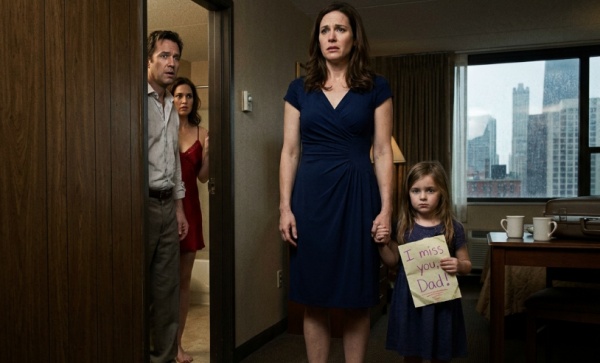
My Daughter and I Flew to Chicago to Surprise My Husband—But the Hotel Room Door Opened to a Truth That Changed Everything…
My daughter carried a handmade birthday card all the way from Denver to Chicago because she believed her dad would cry when he saw us. She had drawn our family holding hands under a bright yellow sun, as if love could still look that simple. But when my husband opened his hotel room door, the look on his face was not joy—it was fear. And before I could protect her, our daughter saw the woman standing behind him.
Part 1: The Handmade Card
My daughter flew to Chicago carrying a handmade card because she thought her father would cry when he saw us.
She had drawn all three of us on the front in colored pencil: me in a blue dress, her in her favorite purple sneakers, and her father standing between us with arms stretched wide like he was holding the whole family together. Above our heads, in uneven glitter letters, she had written, “We Miss You, Daddy!”
I watched her hold that card against her chest as our plane descended over Lake Michigan, and I told myself I was doing the right thing.
My husband, Daniel, had been working in Chicago for nearly three months. He was a senior project manager for a construction consulting firm based in Denver, and the Chicago contract was supposed to be temporary. Four nights a week, he stayed in a hotel downtown, flew home late Fridays, and left again before sunrise on Mondays.
At first, I tried to be understanding.
People in America talk a lot about “doing what you have to do for your family.” Long hours, airports, missed dinners, hotel rooms, video calls from conference rooms—these things were framed as sacrifice. Daniel said this project could lead to a promotion, maybe even enough money for us to finally remodel the kitchen and start saving seriously for our daughter’s college fund.
So I smiled through lonely weeknights.
I packed his suitcase with clean shirts. I slipped protein bars into the front pocket because he always forgot to eat breakfast. I told our nine-year-old daughter, Ava, that Daddy was working hard because he loved us.
But somewhere around the second month, love started sounding like a bad excuse.
Daniel stopped calling before bed. Then he stopped answering when Ava called after school. He said he was in meetings, then client dinners, then “just exhausted.” His voice changed too—not completely, but enough for a wife to notice.
It became lighter when he talked to someone in the background.
Colder when he talked to me.
One Tuesday night, Ava sat at the kitchen table in our house outside Denver, poking macaroni and cheese with her fork. She had barely touched dinner. Her hair was still damp from swim practice, and she was wearing one of Daniel’s old college sweatshirts because she missed him.
“Mom,” she said quietly, “does Dad still like being home?”
The question hit me harder than any accusation could have.
I forced myself to stay calm. “Of course he does, sweetheart. Why would you ask that?”
She shrugged. “When he’s here, he looks at his phone a lot. And when he leaves, he doesn’t seem sad anymore.”
I looked down at my plate.
There are moments in marriage when you realize the child has seen what you were trying to hide from yourself. I had been telling Ava that Daniel was tired, stressed, under pressure, doing his best. But children do not need proof the way adults do.
They feel the weather in a house.
That night, after Ava went to bed, I sat alone in the kitchen and scrolled through airline prices. A weekend ticket from Denver to Chicago was not cheap, especially with only a few days’ notice. But Daniel’s birthday was coming up, and Ava had been begging to surprise him.
“He’ll be so happy,” she had said. “Maybe he’ll cry.”
I wanted to believe that.
I wanted to believe the distance had made him forget us temporarily, not replace us. I wanted to believe that if we walked into his hotel lobby with a handmade card and Ava’s hopeful smile, something in him would wake up. Maybe he would see what he had been neglecting.
Maybe he would remember that he was loved.
So I booked the flights.
I told Daniel nothing.
On Saturday morning, Ava and I arrived at Denver International Airport before sunrise. She wore her purple sneakers, a denim jacket covered in tiny pins, and a backpack stuffed with snacks, a stuffed fox named Maple, and the birthday card wrapped carefully in tissue paper. She bounced beside me in the security line, too excited to stand still.
“Do you think Dad will be in his hotel room when we get there?” she asked.
“I think so,” I said.
“What if he’s at breakfast?”
“Then we’ll wait.”
“What if he cries?”
I smiled, though my stomach felt tight. “Then you’ll have to give him a big hug.”
Ava grinned.
That grin carried me all the way to Chicago.
When our plane landed at O’Hare, the sky was gray and low, the kind of Midwestern winter sky that makes every building look serious. We took a rideshare toward downtown, passing brown brick neighborhoods, train tracks, frozen patches of grass, and traffic that moved like it had nowhere important to be. Ava pressed her face to the window.
“Is that Lake Michigan?” she asked when we saw a flash of steel-blue water between buildings.
“Yes.”
“It looks like an ocean.”
“People here say that too.”
She smiled and pulled the card from her backpack for the fifth time, checking that the glitter letters had not smudged. I watched her smooth the paper with both hands, and guilt rose in my throat. I had not told her about the fear that had been living under my ribs for weeks.
The strange perfume smell on Daniel’s scarf.
The hotel charge on a weekend he told me he was flying home but never did because of a “client emergency.”
The woman’s laugh I heard once before he muted himself on FaceTime.
I had no proof. Not real proof. Just a hundred tiny cuts that made the shape of a wound.
Our driver dropped us in front of Daniel’s hotel near the Chicago River. It was one of those polished business hotels with revolving doors, brass lighting, and a lobby full of people in wool coats pulling rolling suitcases. Ava looked up at the tall glass entrance like we had arrived at a palace.
“Fancy,” she whispered.
“It is.”
“Dad said his room has a view.”
“He did.”
Inside, the lobby smelled like coffee, leather, and expensive candles. A fireplace flickered near a seating area where two men in suits typed on laptops. The front desk clerk smiled politely when I gave Daniel’s name and said we were there to surprise him.
Her fingers moved across the keyboard.
Then her smile changed.
Not disappeared. Just tightened.
“I’m sorry,” she said. “I can’t provide a guest’s room number without permission.”
“I understand,” I said quickly. “I’m his wife. I have ID.”
She gave me an apologetic look that told me company policy was stronger than my marriage certificate. “I can call the room for you.”
Ava tugged my sleeve. “But then it won’t be a surprise.”
The clerk’s eyes softened. “I can leave a message asking him to come down.”
I hesitated.
That was when I saw Daniel’s leather overnight bag.
It sat near a column by the elevators.
I knew that bag because I had bought it for him last Christmas. Dark brown, scuffed on one corner from a trip to Phoenix, with a small luggage tag Ava had decorated with a smiley face sticker. My heart kicked once, hard.
He was here.
Or he had been here.
Ava saw it too. “Mom! That’s Dad’s bag!”
Before I could stop her, she ran toward the elevators.
“Ava, wait.”
She stopped but pointed excitedly. “He’s upstairs!”
The front desk clerk looked from Ava to me, then toward the elevators. Something in her expression suggested she knew more than she was allowed to say. “Ma’am,” she said gently, “you may want to call him.”
I should have listened.
Instead, I thanked her, took Ava’s hand, and stepped toward the elevators with a paper card, a hopeful child, and the terrible feeling that our surprise was about to become something else entirely.
Part 2: Room 1712
We found out his room number by accident.
Or maybe the truth wanted to be found.
As Ava and I stood near the elevator bank, a hotel employee came through pushing a cart stacked with towels. Another guest walked past us while talking loudly into his phone. At the same moment, one elevator opened and a man stepped out holding a small white envelope.
“Housekeeping said 1712 checked out late?” he asked the employee.
The employee shook his head. “No, Mr. Parker in 1712 extended another night.”
Parker.
Our last name.
Ava squeezed my hand. “That’s Dad!”
The employee glanced at us, realizing too late that he had said something he probably should not have said. I gave him a small, harmless smile, the kind women learn to use when they do not want anyone to see the alarm rising behind their eyes.
“Thank you,” I said, though he had not meant to help.
We stepped into the elevator.
Ava bounced on her toes as the numbers climbed. “Seventeen is lucky.”
“Is it?”
“It is today.”
I looked at her bright face and prayed she was right.
The hallway on the seventeenth floor was quiet, carpeted in gray and blue, with framed black-and-white photos of Chicago bridges lining the walls. Ava walked ahead of me, counting the numbers. When we reached 1712, she stopped and pulled the card from her backpack.
“Should I knock?” she whispered.
My mouth was dry. “Yes.”
She knocked three times.
Nothing.
She knocked again, louder. “Daddy?”
Silence.
Then movement.
A muffled sound. A drawer closing. Footsteps.
The door opened.
Daniel stood there in jeans and a white T-shirt, his hair damp like he had just showered. For one brief second, his face did exactly what Ava had dreamed it would do. His eyes widened, his mouth opened, and emotion rushed into his expression.
But it was not joy.
It was fear.
“Ava?” he said.
“Surprise!” she shouted, lifting the card.
He stared at her, then at me.
I had known Daniel for fourteen years. I knew his tired face, his proud face, his angry face, his fake polite smile for neighbors he did not like. But I had never seen him look the way he looked in that doorway.
Like a man caught between two lives.
Ava threw her arms around him before he could speak. “Happy birthday weekend! We came to surprise you!”
Daniel hugged her stiffly at first. Then he closed his eyes and held her tighter.
For a moment, I almost let myself breathe.
Maybe I had been wrong. Maybe he was just shocked. Maybe the distance, the silence, the strange charges, the missed calls—maybe all of it had explanations that did not involve betrayal.
Then I saw the red scarf on the chair behind him.
It was not mine.
The hotel room was visible over his shoulder: a king bed half-made, two coffee cups on the desk, a black dress hanging from the closet door, and a pair of women’s boots near the window.
My entire body went cold.
Daniel saw my eyes move.
He stepped into the hallway quickly, pulling the door partly closed behind him. Too quickly.
“Emily,” he said in a low voice, “what are you doing here?”
I looked at him.
Not “I’m so happy to see you.”
Not “You flew all this way?”
Not “Come in.”
What are you doing here?
Ava pulled back, still smiling. “We came for your birthday! Mom said you’d be surprised.”
Daniel swallowed. “I am surprised.”
She held out the card. “I made this on Wednesday, but I had to hide it in my math folder so you wouldn’t see it on FaceTime.”
He took the card with shaking hands.
I watched him look down at the glitter letters, at the three stick figures standing together under a yellow sun. His eyes filled with tears. Ava saw it and beamed.
“I knew you’d cry,” she said.
Daniel covered his mouth.
For one dangerous second, I wanted to hit pause on the universe. I wanted to freeze him there as a father receiving love he had not earned, before our daughter learned what kind of tears those were. I wanted to protect Ava from the woman’s boots, the black dress, the second coffee cup.
But the door behind Daniel opened wider.
A woman’s voice said, “Dan? Is everything okay?”
Ava turned.
The woman appeared behind him wearing a hotel robe.
She was maybe thirty-five, with dark hair pulled into a messy bun and the kind of calm, pretty face that made me understand immediately why he had lied so carefully. She stopped when she saw us. Her expression changed from confusion to horror.
Daniel closed his eyes.
Ava looked from the woman to Daniel, then to me.
“Mom?” she whispered.
The hallway tilted.
The woman backed up. “I’m sorry. I didn’t know—”
“You didn’t know he had a wife?” I asked, my voice surprisingly steady.
She looked at Daniel. “You said you were separated.”
There it was.
The classic sentence.
Separated.
Technically, emotionally, practically, basically. Men like Daniel loved that word because it could mean whatever they needed it to mean in the moment. To the woman in the hotel room, it meant available. To me, it meant he was lying.
Ava’s face crumpled. “Daddy?”
Daniel crouched in front of her. “Ava, sweetheart, this is grown-up stuff.”
She stepped back from him.
“No,” she said.
One small word, but it cut through the hallway.
“Ava,” he tried again.
“You said you missed us,” she whispered. “You said you loved our family.”
“I do.”
“Then why is she here?”
The woman in the robe looked like she wanted to disappear.
I took Ava’s hand. “We’re leaving.”
Daniel stood quickly. “Emily, wait. Please.”
“No.”
“We need to talk.”
“Not here.”
He looked panicked. “Just give me a minute.”
I looked past him into the hotel room again. Two coffee cups. A dress. Boots. A life he had built inside a lie while I helped Ava glue paper hearts onto his birthday card.
“No,” I said. “You have had months.”
I turned toward the elevator, pulling Ava gently beside me. She did not cry at first. She just held my hand too tightly, her little fingers digging into my palm.
Behind us, Daniel said, “Ava, please don’t go like this.”
She stopped.
Slowly, she turned around.
“Why did you lie about loving our family?” she asked.
The question landed so hard that even the woman in the room began to cry.
Daniel broke then.
He cried in a way I had not seen since his father died. Shoulders shaking, face twisted, one hand still holding the birthday card. But those tears came too late and for the wrong reason. He was not crying because he had hurt us.
He was crying because Ava had finally seen him.
And once a child sees the truth, no amount of adult explanation can make it invisible again.
Part 3: Chicago Felt Colder After That
We did not go back to Denver that day.
The next flight we could afford was Sunday morning, and I was too shaken to think clearly enough to change everything immediately. So I booked a small hotel room in River North with two double beds, a view of an alley, and a bathroom fan that sounded like a lawn mower.
Ava sat on one bed, still wearing her backpack.
She had not spoken since the elevator.
I ordered grilled cheese and tomato soup from room service because it was the only thing on the kids’ menu she normally liked. When it arrived, she stared at it like it belonged to someone else. I sat beside her, unsure whether to talk or let silence do what silence needed to do.
“Is Dad bad?” she asked finally.
My heart clenched.
This was the terrible responsibility of motherhood after betrayal: telling the truth without poisoning the child. I wanted to say yes. I wanted to say he had been selfish, cowardly, careless with the two people who trusted him most.
But Ava was half him.
If I made him a monster, some part of her might wonder what that made her.
“Your dad made a very hurtful choice,” I said carefully. “More than one. But people are not only one thing.”
She looked at me with red eyes. “He lied.”
“Yes.”
“To me too.”
“Yes.”
Her lower lip trembled. “I made him a card.”
“I know.”
“He didn’t deserve it.”
I swallowed hard. “Maybe not. But the card says something about your heart, not his choices.”
She looked down at her hands.
For a while, rain tapped against the window. Below us, Chicago traffic moved in streaks of white and red, and somewhere in the distance a siren wailed. The city felt huge and indifferent, like it had seen thousands of broken families pass through its hotels and airports.
My phone buzzed again.
Daniel.
I had ignored twelve calls already.
Then a text came through.
Please tell me where you are. I need to explain.
A second later:
Ava shouldn’t have seen that.
I stared at the message until the words blurred.
Ava should not have seen that.
Not: I should not have done that.
Not: I should not have lied.
Not: I should have protected my daughter.
Just regret that the curtain had opened at the wrong time.
I turned my phone face down.
Around 7 p.m., Ava asked if she could call her grandmother. Daniel’s mother, Linda, lived in Arizona and adored Ava in the fierce, slightly overwhelming way grandmothers sometimes do. I hesitated because I did not know what Daniel had told his family.
But Ava needed someone besides me.
So I called Linda.
She answered on the second ring. “Emily! Are you with Daniel? Did the surprise work?”
I closed my eyes.
Ava looked at me.
“No,” I said quietly. “It didn’t.”
There was a pause. “What happened?”
I stepped into the bathroom and spoke in a low voice, giving only the facts. We flew to Chicago. We went to his hotel. A woman was in his room. Ava saw her. Ava was devastated.
Linda was silent for so long I thought the call had dropped.
Then she said, “Put my granddaughter on the phone.”
Her voice had changed.
It was no longer cheerful Linda who sent birthday checks and asked about school plays. It was the voice of a mother who had raised a son and was furious at the man he had become. I handed Ava the phone.
“Grandma?” Ava whispered.
I sat on the edge of the tub and listened as Linda talked softly to her. I could not hear every word, but I heard enough.
“You did nothing wrong.”
“Adults are responsible for adult choices.”
“Your daddy loves you, but love is not an excuse to lie.”
That last sentence made tears finally spill down my face.
Because I had needed someone to say it too.
Later that night, after Ava fell asleep clutching Maple the fox, there was a knock on our hotel room door.
I froze.
Another knock.
“Emily,” Daniel said from the hallway. “Please. I know you’re in there.”
My whole body went hot with anger.
I opened the door only as far as the chain lock allowed.
Daniel stood there in the same jeans and T-shirt, now under a wool coat. His eyes were swollen. He looked miserable, but misery is not the same as remorse.
“How did you find us?” I asked.
“I called around.”
“That is not okay.”
“I was worried.”
“You were worried after you created the situation.”
He flinched. “Can I talk to Ava?”
“She’s asleep.”
“Then can I talk to you?”
“No.”
“Emily, please. Her name is Madison. She’s not—”
I laughed once, sharp and quiet. “Do not tell me her name like that helps.”
He rubbed his face. “I told her we were separated.”
“We are not.”
“I know.”
“Did you forget?”
“No.”
“Then you lied.”
His eyes filled again. “I didn’t plan for it to happen.”
That sentence exhausted me.
Affairs were always described like weather by the people who had them. It happened. It got complicated. Feelings developed. Lines blurred. As if nobody booked the hotel room, sent the text, removed the wedding ring, or decided which truth to hide from which woman.
“You planned enough,” I said.
He leaned closer to the door. “I still love you.”
I looked at him through the narrow opening.
For years, those words had been home. He said them when he kissed me goodbye, when we hung up the phone, when Ava was born and I was too tired to keep my eyes open. He said them in grocery store aisles and airport drop-off lanes.
Now they sounded like a man trying a key in a lock he had already broken.
“You love comfort,” I said. “You love being forgiven. You love having a family waiting for you and someone else admiring you in another city. But do not stand in this hallway and call that love.”
He looked down.
“I made a terrible mistake,” he whispered.
“No, Daniel. A mistake is booking the wrong flight. You built a second life in Chicago and let your daughter fly into it holding construction paper.”
His face twisted.
Behind me, Ava stirred in bed. “Mom?”
Daniel’s head snapped up.
I turned. “It’s okay, honey. Go back to sleep.”
She sat up, saw the door, and went pale.
“Is Daddy there?”
Daniel spoke before I could stop him. “Ava, sweetheart, I’m sorry.”
She stared at the gap in the door.
“Did you love her?” she asked.
The hallway went silent.
Daniel closed his eyes. “It’s complicated.”
Ava’s face hardened in a way I had never seen on a nine-year-old.
“That means yes,” she said.
Then she lay back down and turned away.
I looked at Daniel. “Leave.”
He opened his mouth.
“Now.”
For once, he listened.
I closed the door, locked it, and sat beside Ava until she fell asleep again. She did not cry. That worried me more than if she had. Her small back faced me under the hotel blanket, still and rigid.
I realized then that Daniel had not only broken my trust.
He had changed the way our daughter understood love.
And that was something no apology could repair overnight.
Part 4: What Waited for Us Back Home
When we landed in Denver the next morning, the mountains were hidden behind clouds.
Ava slept most of the flight with her head against my arm. I spent the two hours staring at the seatback in front of me, replaying everything. The hotel door. The robe. The card in Daniel’s shaking hand. Ava’s voice asking why he had lied.
I used to think betrayal would feel like fire.
It felt more like paperwork.
By Monday morning, I had called a family law attorney, changed passwords, moved money into a separate account, and scheduled an appointment with Ava’s school counselor. I did not do these things because I was calm. I did them because panic needed a job.
Daniel flew home Monday night.
He texted before leaving Chicago.
Can I come home and talk?
I replied:
You may come by tomorrow at 6 p.m. to speak with me in the kitchen. Ava will be at my sister’s house. Do not come tonight.
He did not like that.
He sent a paragraph about how I was shutting him out, how he deserved to see his daughter, how we should not make emotional decisions. I read it twice, then sent it to my attorney. She responded with one sentence:
Do not argue with someone who benefits from confusing you.
So I did not argue.
On Tuesday evening, Daniel arrived wearing the navy sweater I used to love. His suitcase was not with him. That told me he knew better than to assume he could stay.
He stood in our entryway looking around like the house had changed.
It had not.
The same family photos hung on the walls. Ava’s rain boots sat by the door. The kitchen smelled faintly of lemon cleaner and the chicken soup I had made because cooking kept me from screaming.
But something had changed.
Me.
“Where’s Ava?” he asked.
“With my sister.”
His face fell. “I wanted to see her.”
“She does not want to see you tonight.”
“She’s nine. She doesn’t know what she wants.”
I stared at him. “She knows she does not want to look at you right now.”
He removed his coat slowly. “Emily, I know you’re angry.”
“Don’t shrink this into anger.”
“What do you want me to call it?”
“Reality.”
We sat at the kitchen table where Ava had done homework, where Daniel and I had once planned vacations, where birthday candles had melted into store-bought cakes. I placed a yellow legal pad in front of me because I knew if I did not stay organized, grief would swallow the conversation.
Daniel looked at the pad. “Are you taking notes?”
“Yes.”
“That feels cold.”
“So did seeing another woman in your hotel room.”
He looked away.
I asked questions. Direct questions. When did it start? How long had he been lying? Did Madison know he was married? Had he used family money? Had he brought her to places Ava might see online? Had he exposed our family to any financial, legal, or health risks?
He answered some things.
Dodged others.
Madison worked for a subcontractor involved with the Chicago project. They met at a client dinner. It “became emotional” before it became physical. He had told her our marriage was “functionally over,” which was news to the woman still doing his laundry and helping his daughter count down days until he came home.
He admitted using his corporate card for some dinners and personal card for others.
He admitted he had taken Madison to the Art Institute, the riverwalk, a steakhouse, and once to a boutique hotel when he told me his flight was canceled. He admitted he had considered asking for a separation after the Chicago project ended, but he “didn’t know how.”
I wrote that down.
“You didn’t know how to tell your wife the truth,” I said, “but you knew how to maintain a relationship in another state.”
He covered his face with his hands.
“I hate myself,” he said.
I felt nothing when he said it.
That scared me.
Not because I wanted to comfort him, but because I realized the part of me that used to rush toward his pain had gone quiet. Maybe it was tired. Maybe it had finally understood that his pain did not erase mine.
At 7:15, my sister Rachel brought Ava home.
Not my attorney Rachel. My actual sister, Rachel, who had the personality of a locked gate when someone hurt her family. Ava came in holding Rachel’s hand, her backpack slung over one shoulder.
Daniel stood immediately.
“Hi, peanut,” he said softly.
Ava did not smile.
“Hi.”
He knelt. “Can I hug you?”
She looked at me.
I said, “You can choose.”
Ava looked back at him. “No, thank you.”
The words were polite.
That made them worse.
Daniel nodded, tears already forming. “Okay. That’s okay.”
Ava sat at the table across from him. Her legs dangled above the floor, purple sneakers not quite touching the rug. She looked smaller than she had in Chicago, but also older. That was another thing I hated him for.
He had made her older.
“I’m sorry,” Daniel said. “I lied, and I hurt you and Mom. You did not deserve that.”
Ava stared at the table.
“Do you love Madison?” she asked.
Daniel looked at me, then back at her. “I thought I did.”
“That’s not an answer.”
Rachel made a quiet sound behind me, almost a laugh, but not the happy kind.
Daniel swallowed. “I had feelings for her. But I love you.”
Ava’s eyes filled. “I didn’t ask if you love me. I asked if you love her.”
He looked trapped, but this time the trap was truth.
“I don’t know anymore,” he said.
Ava nodded slowly. “Then you should figure that out somewhere else.”
The room went completely still.
Daniel looked like she had slapped him.
But she had not been cruel. She had simply said what I had not yet allowed myself to say.
Somewhere else.
Not in this house. Not at our table. Not under the same roof as the child whose heart he had cracked open in a hotel hallway.
Daniel left twenty minutes later.
He cried in the driveway before getting into his rental car. Ava watched from the living room window, expression unreadable. I stood behind her, close enough that she could lean back if she needed me.
She did.
I wrapped my arms around her.
“Mom,” she whispered, “are we going to be okay?”
I looked at Daniel’s taillights disappearing down the street.
Then I looked at our reflection in the dark window: a mother and daughter, tired and shaken, but still standing.
“Yes,” I said. “Not all at once. But yes.”
Part 5: The Card Stayed in Chicago
Daniel moved into a short-term apartment two weeks later.
He said he needed space to think. I did not point out that he had already taken plenty of space in Chicago. By then, I had learned that not every obvious truth needed to be spoken. Some truths were heavy enough sitting in the room on their own.
Ava started seeing the school counselor every Thursday.
At first, she hated it. She said she did not want to talk to “a feelings teacher.” But after the counselor gave her a notebook and told her she could write things she did not want to say out loud, Ava began carrying it everywhere.
One evening, I found her at the kitchen table writing with fierce concentration.
“Homework?” I asked.
“No.”
“Do you want to talk about it?”
“No.”
Then, after a pause, she added, “Maybe later.”
I learned to accept “maybe later” as a gift.
Daniel tried hard in the beginning. He called every night at seven, though Ava often refused to answer. He showed up on time for school pickup. He asked me what snacks she liked, what her current reading level was, whether she still hated mushrooms, what size snow boots she wore.
The questions hurt.
Not because they were bad questions, but because a father living in the same family should have known the answers already.
Still, I answered when it helped Ava.
Size four boots. Goldfish crackers, not cheese puffs. She liked fantasy novels now. She still hated mushrooms, unless they were chopped too small for her to detect, which I did not recommend testing during a fragile emotional period.
He listened.
That was new.
Madison disappeared from the story the way people often do when fantasy becomes real life. Daniel said she ended things after we came to Chicago. She told him she could not trust someone who had lied so completely to everyone involved.
I almost respected her for that.
Almost.
But I did not spend much time thinking about Madison. That surprised me. At first, I thought she would haunt me, that I would compare myself to her, search for her online, wonder what she had that I lacked. But the longer I sat with the truth, the more I realized Madison was not the center of my pain.
Daniel was.
He had made the vows. He had taken the flights. He had answered our daughter’s calls from another woman’s apartment and said he missed bedtime stories. He had let us board a plane with love in our hands and walk straight into the truth he was hiding.
I did not file for divorce immediately.
That may disappoint some people.
Online, everyone likes strong women to make fast decisions. Leave him. Block him. Take everything. Never look back. But real life is not a comment section, and marriage is not a light switch.
There were finances to understand, a child to protect, a mortgage, health insurance, family histories, school routines, and twelve years of shared life tangled like Christmas lights in a box.
So I moved carefully.
I spoke with an attorney. I met with a therapist. I documented expenses. I asked Daniel to communicate through email about logistics. I stopped managing his emotions. When he texted, I miss us, I did not reply. When he wrote, I hate coming home to an empty apartment, I answered only the part about Ava’s science fair schedule.
In April, Daniel asked if we could attend marriage counseling.
I agreed to one session.
Not because I had decided to stay, but because I wanted a safe room where someone else could witness the truth. The therapist’s office was in a brick building with a waiting room full of plants and soft chairs. Daniel sat beside me twisting his wedding ring.
He still wore it.
I had taken mine off and placed it in a small ceramic dish on my dresser.
The therapist asked Daniel what he wanted.
He cried. He said he wanted his family back. He said he had been selfish and weak. He said Chicago felt unreal, like a separate life, and then Ava’s face in the hotel hallway made everything real at once.
The therapist asked me what I wanted.
I looked at Daniel.
Then I told the truth.
“I want my daughter to believe love is safe again,” I said. “I want to stop wondering which version of my husband is speaking. I want peace more than I want the marriage.”
Daniel closed his eyes.
That was the first time I saw him understand that regret was not a time machine.
We did three more sessions.
In the last one, Daniel admitted he had not only been unhappy in the marriage. He had been unhappy with himself and used Madison, work, and distance to become a person who did not have to face his own failures. It was the most honest thing he had said since Chicago.
I appreciated it.
But appreciation is not reconciliation.
By summer, we agreed to separate formally.
Ava handled it better than I expected and worse than I hoped. Some days she was cheerful, planning how to decorate her room at Daniel’s apartment. Other days she snapped at him for small things, then cried afterward because anger made her feel guilty.
I told her the same thing every time.
“You are allowed to have big feelings. You are not responsible for fixing the adults.”
One Saturday in June, Daniel took Ava to Navy Pier during a scheduled trip back to Chicago for final project meetings. I hated the idea of her returning to that city, but she wanted to go. She said she did not want Chicago to belong only to “the bad memory.”
So Daniel took her to the Ferris wheel, bought her popcorn, walked with her by the lake, and sent me photos only after asking her permission.
That mattered.
In one photo, Ava stood in front of Lake Michigan, hair blowing across her face, smiling cautiously. Not a full smile, but a real one. Behind her, the water stretched wide and blue under a clear sky.
When she came home, she handed me a small magnet shaped like the Chicago skyline.
“For the fridge,” she said.
“Are you sure?”
She nodded. “I don’t want to hate a whole city.”
I hugged her so tightly she complained she could not breathe.
Months passed.
Our house changed slowly. I painted my bedroom a soft gray-green. Ava and I planted basil, tomatoes, and marigolds in the backyard. We started Friday movie nights, Sunday pancake mornings, and a rule that nobody had to pretend to be okay at the dinner table.
Sometimes we talked about Daniel.
Sometimes we did not.
He became more consistent. Not perfect. Not redeemed in some dramatic movie way. But present. He learned Ava’s school schedule, attended parent-teacher conferences, and remembered that she needed a plain bagel before soccer because anything heavier made her stomach hurt.
Trust did not return like lightning.
It returned like pennies in a jar.
Small. Slow. Countable.
One evening in October, almost a year after the Chicago trip, Ava asked me what happened to the birthday card.
We were folding laundry in the living room. A fall candle burned on the coffee table, and rain tapped softly against the windows. I paused with one of her hoodies in my hands.
“I don’t know,” I said honestly. “Your dad had it when we left.”
She nodded.
“I used to wish I could take it back,” she said.
“I understand.”
“But now I think maybe he needed to keep it.”
I looked at her. “Why?”
“So he remembers what he almost threw away.”
I sat very still.
Children can say things that adults spend years in therapy trying to understand.
Later that night, after Ava went to bed, I texted Daniel.
Ava asked about the card. Do you still have it?
He did not answer for nearly an hour.
Then he sent a photo.
The card was propped on a small shelf in his apartment beside a framed picture of Ava at the Grand Canyon. The glitter letters were a little bent. One corner looked worn. But there it was: three stick figures under a yellow sun, still holding hands in a version of life that no longer existed.
His message came after the photo.
I keep it where I can see it every day. Not because I deserve it. Because I need to remember.
I stared at the screen for a long time.
Then I showed Ava the next morning.
She looked at the photo silently.
“Good,” she said.
That was all.
People ask sometimes if I forgave him.
They ask because people like endings tied neatly with ribbon. They want to know whether we got divorced, whether we got back together, whether Daniel changed, whether Ava forgave him, whether I ever spoke to Madison. They want a lesson simple enough to share over coffee.
But real healing is not simple.
Daniel and I did divorce eventually, quietly and legally and without destroying each other more than we already had. We agreed on shared custody, child support, school decisions, holidays, medical care, and rules about introducing new partners. The legal process was painful, but it was also clarifying.
A marriage can end.
A family has to transform.
Daniel remained Ava’s father. I remained her safe place. And slowly, painfully, we learned to build a different kind of family from the pieces left behind.
Not the family Ava drew on the card.
But a real one.
A family where adults told the truth. A family where a child did not have to carry secrets. A family where love was measured not by dramatic apologies but by showing up, telling the truth, and doing the next right thing.
Sometimes I still think about that hotel hallway in Chicago.
I think about the gray carpet, the black dress on the closet door, the woman’s shocked face, Daniel’s tears, and Ava’s small voice asking why he had lied. For a long time, that memory felt like a knife. Now it feels more like a scar.
Still there.
No longer bleeding.
If I could go back, would I cancel the trip?
I have asked myself that more times than I can count.
Part of me wishes Ava had never seen what she saw. Part of me wishes I had discovered the truth alone, quietly, without a child holding glitter paper in the hallway of a downtown Chicago hotel. But another part of me knows that secrets grow in darkness, and Daniel’s secret had already reached into our home.
It was already affecting Ava.
She already felt him leaving, even before we boarded that plane.
The trip did not break our family.
The lie did.
And the truth, as painful as it was, gave us the first honest day we had lived in months.
Ava is eleven now.
She still loves purple sneakers, though she has upgraded to a cooler brand I apparently “wouldn’t understand.” She reads fantasy novels thicker than bricks, makes pancakes without blueberries, and keeps a notebook full of private thoughts. She sees Daniel every other weekend and some weekdays, and their relationship is better than it was.
Not because he cried.
Because he changed his behavior.
As for me, I am not the woman who walked into that hotel full of fear and hope. I no longer confuse silence with peace or distance with sacrifice. I no longer teach my daughter that love means waiting quietly while someone decides whether to value you.
I teach her that love is honest.
Love is responsible.
Love does not ask children to carry adult lies.
And sometimes, love means booking the flight, opening the door, seeing the truth, and choosing yourself on the way out.
That day in Chicago, my daughter thought her father would cry because we surprised him.
He did cry.
But not when he saw us.
He cried when the truth finally stood in front of him wearing purple sneakers, holding a handmade card, and asking the question I had been too afraid to ask out loud.
“Why did you lie about loving our family?”
He never gave an answer good enough.
Maybe there isn’t one.
But Ava and I found our answer anyway.
We flew home. We told the truth. We rebuilt our lives.
And somewhere in a small apartment, a bent little card still sits on a shelf—not as a symbol of the family we lost, but as a reminder of the moment a lie ended, and our real story began.
