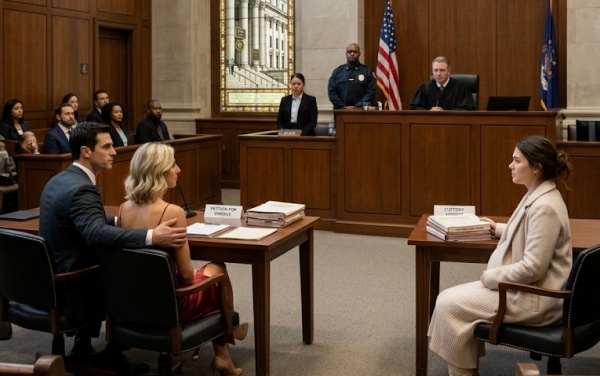
I was thirty-two weeks pregnant when my husband arrived at the courthouse with another woman on his arm and a bottle of champagne ready to celebrate. He expected me to accept his settlement and walk away without asking questions. Instead, I carried a document that could challenge everything he had told me about our company. The words that mattered most were in his own handwriting.
Part 1: The Courthouse Steps
On the morning of our divorce, my billionaire husband brought his mistress to the courthouse, where she carried champagne to celebrate while I stood there thirty-two weeks pregnant with his child. He expected me to accept his settlement and surrender everything he wanted, but one document in my hands was about to threaten the control he believed he had. And the most shocking part was that the truth he feared had been written in his own handwriting years earlier.
The courthouse in downtown Boston was crowded that Tuesday. People hurried through the entrance with folders under their arms, shaking rain from their coats and checking their phones before security. I stood beneath the overhang with my attorney, trying to keep my balance in shoes that had fit perfectly a month earlier.
My name is Julia Mercer. For eleven years, I was married to Adrian Mercer, the founder and chief executive of a technology company called HarborGrid. The business had made him a billionaire on paper, at least according to the financial magazines that liked to put his face on their covers.
In those photographs, Adrian always wore the same expression: calm, confident, and slightly amused, as though he had already solved a problem everyone else was still struggling to understand. That morning, he wore a charcoal suit and held an umbrella over the woman beside him. Her name was Brooke Ellis, and she was twenty-nine years old.
Brooke worked in communications for HarborGrid before she and Adrian began their relationship. I had met her at company events, where she was usually the person making sure reporters had the right credentials and executives knew when to step onstage. She had once helped me find a quiet room during a charity dinner when I was feeling sick.
She carried a small gift bag with a bottle of champagne inside. I could see the gold foil above the tissue paper, and a ribbon tied around the neck bounced against the bottle as she walked. She looked cheerful until she noticed my stomach.
Adrian had told her I would be at the courthouse. I could only assume he had also told her how far along I was, since the due date had appeared in the same legal filings as the financial information. Still, she seemed surprised by the sight of me standing there with one hand resting beneath my coat.
“Julia,” Adrian said, as if we had run into each other at the grocery store. “You look well.”
“I’m tired,” I replied. “Let’s not pretend otherwise.”
His eyes moved to the folder in my hand. It was plain blue, the kind sold in packs of five at an office supply store. Inside were copies of a document he had not seen in more than a decade.
My attorney, Nadine Walsh, greeted him politely and asked whether his lawyer had arrived. Adrian checked his watch and said Graham was parking the car. Brooke shifted the champagne bag behind her leg.
“We weren’t planning to open it here,” she said.
I looked at her. “That’s a relief.”
Her cheeks reddened, and for a moment I almost regretted the remark. Then I remembered the settlement proposal Adrian had sent me the previous Friday. It asked me to leave our home within thirty days, accept a payment he described as generous, and agree to broad confidentiality provisions before we had resolved several financial questions.
Most painfully, the proposal treated our unborn daughter as another item to be managed through carefully worded schedules. It was an opening proposal, not a court order, and Nadine had reminded me that I did not have to accept it. But reading it had shown me how thoroughly Adrian expected me to give up the right to ask questions.
The woman carrying champagne was not the reason our marriage had ended. By the time I learned about Brooke, Adrian and I had been living in separate parts of the same enormous house for months. She was proof of a distance that had already become impossible to ignore.
We had tried counseling, and I had asked him more than once whether he wanted to remain married. He always said he did, then disappeared into meetings and weekend trips he described as unavoidable. When I told him I was pregnant, he hugged me and said the right things, but something in his face stayed guarded.
Two weeks later, I found a message from Brooke on the tablet Adrian had left in the kitchen. It appeared on the screen while I was looking up a recipe, and I did not have to open an account or search through his private messages to see it. The words were unmistakably intimate, and the notification preview included plans for a weekend he had told me he would spend with investors.
When I confronted him, he admitted the relationship. He said he and Brooke had become close while working together and that he had intended to tell me after we had made a decision about our marriage. I asked how long he had been waiting for the right moment, and he had no answer that made the months of silence easier to understand.
By the time we separated, he had already moved most of his personal belongings into an apartment overlooking the harbor. I remained in the house temporarily, surrounded by furniture chosen by a designer and rooms we had rarely used. At night, I sat in the nursery we had barely started and wondered whether our daughter would someday hear the whole story.
Graham arrived carrying a leather briefcase and a paper cup of coffee. He greeted Nadine, nodded at me, and asked Adrian if they could speak privately before going inside. The two men walked a few steps away, leaving Brooke and me beneath the overhang.
“I didn’t know about the champagne until last night,” she said.
I looked at the bag. “You’re holding it.”
“I know. I should have left it in the car.”
There wasn’t much I could say to that. Brooke had made choices that hurt me, but she was not responsible for Adrian’s settlement proposal or the document in my folder. I turned toward the courthouse doors as Nadine checked the time.
Inside, we passed through security and took the elevator to the floor where our hearing was scheduled. The bottle had to remain outside the courtroom, and Brooke left it with someone waiting in the hallway. Adrian kissed her cheek before following Graham through the door.
He expected the hearing to be the end of the financial negotiations. His lawyers had pressed for a quick agreement, and the draft settlement assumed I would accept his description of the assets. What he did not know was that I had spent the weekend in my late father’s storage unit, opening boxes we had both forgotten.
One box contained old invoices, a broken desk lamp, and a spiral notebook with a cracked green cover. I almost put it aside because I thought it held recipes. Then I opened it and saw Adrian’s handwriting across the first page.
At the top, he had written the name of the company we started before HarborGrid existed.
Beneath it was a list of owners.
My name was on that list.
Part 2: Before the Billion
Twelve years earlier, Adrian and I lived in a one-bedroom apartment above a dry cleaner in Somerville. The heating pipes clanged all night, and the kitchen was so narrow that we had to take turns opening the refrigerator. We owned a secondhand couch, a folding table, and a car that required a firm kick to close the passenger door.
Adrian was an engineer with a talent for explaining complicated systems to people who didn’t think they understood them. I worked as an operations analyst for a regional property company, where I spent my days looking at maintenance records and trying to find patterns. We were not wealthy, but we were convinced that if we worked hard enough, we could build something together.
The idea that became HarborGrid began after a heavy spring storm flooded the basement of an apartment building my company managed. The damage was expensive, but what bothered me most was that several warning signs had been recorded separately and never connected. A maintenance worker had reported a faulty pump, a tenant had complained about water near a drain, and a sensor had sent an alert no one saw until the next morning.
At dinner, I told Adrian there should be a simple way to bring those warnings into one place. He grabbed a napkin and began sketching a system that could collect information from building equipment. I pointed out that it would also need to show managers which alerts were urgent and which could wait.
For months, we worked after our regular jobs. Adrian built an early prototype, and I mapped out how a property manager might use it during a chaotic day. We interviewed friends in maintenance and facilities management, asking what information they needed before a small problem became an expensive one.
My father, a retired electrician, let us use the garage behind his house in Quincy. He cleared a workbench, ran an extension cord, and gave Adrian a battered green notebook for keeping track of ideas. Dad liked notebooks because, as he often said, a computer could lose power but a page usually stayed where you left it.
Adrian wrote everything in that notebook. There were diagrams, phone numbers, lists of equipment, and reminders to buy more coffee. On one page, between a sketch of a sensor and a grocery list, he wrote the ownership agreement we had discussed.
The early company was called Northline Systems. Adrian wrote that it would issue 10,000 shares: 9,000 to him and 1,000 to me. Beneath the numbers, he wrote, Julia earns her share through product design, operations work, and the money she puts in. This is ours to build.
He signed his name and dated the entry. I signed beneath him, and my father added his name as a witness because he was sitting at the workbench when we wrote it. We were not trying to draft a sophisticated legal document; we were trying to record what we believed we had agreed to.
A few months later, we incorporated Northline with help from a local attorney. We signed formal documents, opened a business bank account, and began issuing invoices. I remembered signing several pages that day, though I had not seen the full corporate file in years.
Our wedding came the following spring. Before we married, Adrian’s attorney suggested a prenuptial agreement because the business had begun attracting attention from investors. I had my own attorney review it, and we negotiated a version that addressed certain existing and future assets.
At the time, I understood that agreement as a way to distinguish what each of us owned, not as a promise to pretend I had never contributed to the company. Whether it affected any particular interest would depend on the actual language and the surrounding records. I had learned enough from Nadine not to assume that the notebook alone would decide the question.
For the first three years, I worked inside the business. I designed workflows, spoke with early customers, and helped turn maintenance reports into a product that people could use without an engineering degree. Adrian led the technical team and raised money, and together we hired people who were better than we were at the things we had been trying to do ourselves.
When my father became ill, I stepped back from my full-time role. I continued consulting for the company for a while, then focused on helping my mother care for him. Adrian told me the business would always be there when I was ready to return.
After Dad died, HarborGrid grew quickly. Northline changed its name, raised more money, and hired a professional management team. There were new offices, new shareholders, and financial documents I signed when our advisers said they needed them.
I knew the company had become valuable, but Adrian increasingly handled the details with accountants and attorneys. When I asked about my original interest, he told me the early paperwork had been reorganized and that our financial life was shared anyway. I accepted that answer for too long because I trusted him and because every conversation about ownership seemed to end with another binder I didn’t know how to read.
After we separated, Nadine requested information about HarborGrid and the relevant ownership records. Adrian’s initial financial disclosures listed his interests but did not identify a separate holding in my name. His proposed settlement treated the company as his asset and offered me a payment in exchange for resolving the financial claims between us.
“I can’t tell you what the notebook proves by itself,” Nadine said when I brought it to her. “But it gives us a specific agreement to investigate.”
She asked where I had found it and whether anyone else had handled it. I told her about Dad’s storage unit and the box of papers Mom had put there after selling his workshop equipment. We photographed each page, made copies, and stored the original carefully.
Then Nadine asked the question I had been avoiding.
“Do you have any records from when Northline was incorporated?”
I had a few old folders in the garage: tax returns, bank statements, and a photograph of the original team standing outside Dad’s workshop. I also remembered that Dad used to keep copies of anything involving money in a metal filing cabinet. If the cabinet had survived the move into storage, it might contain more than the notebook.
That Saturday, Hannah—my younger sister—drove me back to the storage unit. She carried the heavier boxes while I sat on a folding chair and sorted through papers. We found old warranties, utility bills, and a stack of Dad’s terrible attempts at woodworking plans.
At the bottom of the filing cabinet was a manila envelope labeled Northline—originals and copies. Inside were incorporation papers, an early bank statement, and a copy of a stock ledger. The ledger listed 9,000 shares issued to Adrian and 1,000 issued to me.
There was also a copy of a certificate bearing my name. I didn’t know whether later transactions had changed what I owned or whether the certificate had been replaced during the company’s restructuring. But for the first time, I had more than a memory of a promise made at a workbench.
Nadine reviewed the documents with a business attorney who understood corporate records. They explained that the notebook and ledger were important evidence, but that we needed the later records to trace what happened to the shares. Additional shares may have been issued, ownership percentages may have changed, and any transfer or cancellation would need to be examined.
I asked whether finding the ledger meant Adrian had hidden something deliberately. Nadine said it was too early to reach that conclusion. The omission could have several explanations, and we needed documents before making accusations.
On Monday afternoon, she sent a formal request to Adrian’s legal team for the relevant corporate records. She included copies of the notebook page and the early ledger. We expected a response, but we did not expect the one that arrived just before midnight.
It was an email from Graham, marked urgent.
Please preserve all documents in their current condition. Mr. Mercer disputes your interpretation of the materials and requests that Ms. Mercer refrain from contacting HarborGrid personnel directly.
I read it twice, then sent it to Nadine. A minute later, my phone lit up with a message from Adrian.
Where did you find that notebook?
Part 3: The Settlement
I didn’t answer Adrian’s message that night. Nadine had advised me to let the attorneys handle requests for documents, and I was too tired to have a careful conversation with him. At thirty-two weeks pregnant, I had learned that exhaustion could make even a simple decision feel impossible.
The next morning, Adrian called while I was eating toast at the kitchen counter. He sounded less confident than he had at the courthouse. He asked again where I had found the notebook.
“In Dad’s storage unit,” I said.
“I thought that was gone.”
“Why?”
“There was a flood in the old office years ago. Some of the early records were damaged, and I assumed the notebook was with them.”
I thought about the shelves of papers in Dad’s garage. He had kept every receipt for every tool he ever bought, along with birthday cards from people no one in the family could remember. If Adrian had mentioned losing the notebook years earlier, I might have known where to look.
“You wrote down our agreement,” I said.
“We wrote down an idea. A lot changed after that.”
“I know things changed. That’s why our attorneys are asking for the records.”
He sighed. “Julia, I’m trying to make sure you and the baby are taken care of.”
The phrase had appeared in several versions of the settlement proposal. It sounded generous until I remembered that Adrian had used it to describe an arrangement in which I would accept his numbers without seeing all the information behind them. Being taken care of was not the same as being treated as someone entitled to understand her own finances.
“I can take care of myself,” I said. “I need the records.”
He asked whether I remembered signing documents when the company was restructured. I said I remembered signing papers but did not know what every document had done to my original shares. If there was a valid transfer, I wanted to see it; if there was an error, I wanted it corrected.
“Those papers are old,” he said. “Some of the people involved don’t even work for the company anymore.”
“That doesn’t mean the records don’t matter.”
After the call, I sat in the nursery with a stack of folded baby clothes. The room had been painted a soft green before Adrian moved out, and the crib still needed to be assembled. On the dresser was a framed picture of Dad holding me as a baby.
I told him, aloud, that I wished he had labeled every box in his storage unit as carefully as he labeled his tools. Then I laughed at myself, because he would have insisted that he had done exactly that. The laugh turned into tears before I could stop it.
Nadine called that afternoon with an update. Adrian’s lawyers had agreed to produce a first set of corporate records, though they disputed my claim and reserved the right to challenge how the documents were interpreted. The business attorney would review them once they arrived.
We postponed any decision about the settlement. The hearing that morning had not ended our divorce or forced me to sign anything; the court set another date and instructed both sides to continue exchanging required information. Adrian’s expectation of a quick conclusion had collided with questions that could not be answered in a hallway.
Brooke contacted me the next day. She sent a brief message saying she was sorry for bringing the champagne and asking whether I would speak to her. I nearly ignored it, but there was something in her wording that made me curious.
There may be information about the company that you should ask your attorney to request, she wrote.
I forwarded the message to Nadine before responding. She advised me not to seek confidential company information from Brooke directly and suggested that any relevant materials be handled through the attorneys. I wrote back thanking Brooke and giving her Nadine’s contact information.
Brooke called Nadine the following morning. According to Nadine, she said she had once been present during a discussion about an early shareholder list. She did not know the legal significance, but she remembered Adrian asking an executive to “make sure Julia’s old certificate was dealt with.”
That phrase could mean several things. A certificate might have been replaced, canceled after a valid transaction, or flagged for another reason. Nadine added the relevant records to our requests rather than treating Brooke’s memory as proof of wrongdoing.
I wondered why Brooke had decided to say anything. A week earlier, she had stood beside Adrian with champagne in her hand, ready to celebrate the end of my marriage. Now she had offered information that could make his negotiations more difficult.
She sent me another message that evening. He told me you had no connection to the company other than being his wife. I believed him, and I’m sorry I repeated it to people.
I stared at the screen. I had spent years declining public credit because Adrian was the face of the business and I didn’t enjoy interviews. Somewhere along the way, silence had made it easier for others to believe I had never been part of the work at all.
The first packet of records arrived on Thursday. It included the original incorporation documents, copies of early board minutes, and several versions of the stock ledger. I did not read them alone; Nadine and the business attorney sat with me and explained what each set of pages appeared to show.
The initial records supported the issuance of 1,000 shares to me and 9,000 to Adrian. A later financing added 2,000 shares for investors, which meant my original 1,000 shares would represent a smaller percentage of the total if they remained outstanding. There were other corporate events to review, so the attorneys cautioned me not to calculate the final value from those early numbers alone.
One document caught Nadine’s attention. It was a proposed transfer form, prepared several years earlier, that would have moved my shares into an entity associated with Adrian. The copy in the packet had a line for my signature, but the line was blank.
“Is there a signed version?” Nadine asked.
The business attorney checked the index and found no signed copy in the materials produced so far. There was, however, an internal spreadsheet listing the transfer as completed. We could not tell from that spreadsheet whether the company had another document, relied on a different transaction, or made a recordkeeping error.
Nadine requested the underlying documents and an explanation. Graham responded that his client was reviewing the matter and would provide additional information. The court date drew closer, and the shape of the settlement changed.
Adrian sent a revised proposal with a larger payment. It still asked me to release claims related to HarborGrid and agree to confidentiality terms. Nadine and I reviewed it carefully, but without the missing records, I could not know what I was being asked to give up.
I declined the proposal. Adrian called that evening, frustrated that I would not accept an amount he described as more than enough for a comfortable life. I asked him whether he understood why the amount was not the only issue.
“You think I’m trying to cheat you,” he said.
“I think you want me to sign before I understand what I own.”
“I built that company.”
“We built the beginning of it together. Other people helped build it after that, and I’m asking you not to erase my part.”
He was quiet. Then he said he had spent twelve years carrying the pressure of the company, while I had stepped away. I told him stepping away from daily work did not automatically answer what happened to shares issued years earlier.
Before we ended the call, he said something that stayed with me.
“Dad’s notebook wasn’t supposed to come into this.”
I asked what he meant. He said he meant only that it was old and informal. But after we hung up, I opened the photograph of the page again and looked at his words: This is ours to build.
He had not written mine. He had not written until Julia has to leave the office. Whatever the later documents showed, the person who had once believed in our partnership had put that belief on paper.
Part 4: What the Records Showed
The additional records arrived in several batches over the next two weeks. The business attorney compared them against the early ledger, the proposed transfer form, and the company’s later financing documents. I learned more about share classes and corporate reorganizations than I had ever expected to know.
There were signed documents authorizing new investment, amendments to the company’s governing papers, and records of a later restructuring. Some signatures were mine, and I remembered the meetings where I had provided them. Others required closer review because the copies were incomplete or referred to schedules that had not yet been produced.
The attorneys did not find a signed version of the proposed transfer form in the material initially provided. They also found an earlier email from a company administrator asking whether the transfer had been completed. Adrian had replied, Julia and I will take care of it when things settle down.
The following month, the administrator updated a spreadsheet to reflect the transfer. The reason for that update was not clear from the records we had. Nadine requested the administrator’s notes and any later documents that explained the change.
Adrian’s team responded that they were continuing to search. They also produced a memorandum from an outside adviser discussing several possible ways to reorganize the early shares. The memorandum described options, not a completed transaction.
No one could responsibly tell me that a missing document proved a deliberate act. But the records did show that the history was more complicated than Adrian’s settlement proposal had suggested. The company had treated my interest in different ways at different times, and the parties needed to resolve what that meant.
Meanwhile, my daughter began making her presence known at inconvenient hours. She seemed particularly active whenever I finally got comfortable enough to sleep. One night, after an especially determined series of kicks, I sat up and told her that we would discuss boundaries once she was old enough to understand the concept.
At my next prenatal appointment, my doctor said the pregnancy was progressing and reminded me to call if I had any concerning symptoms. I asked Hannah to join me for future visits because she had become very good at remembering questions when my mind went blank. She took notes in a small purple notebook and asked whether I had packed a hospital bag.
“I still have time,” I said.
“You also said that about assembling the crib.”
The crib was assembled the following weekend. Hannah read the instructions while I sorted screws into little bowls. We argued about which side panel went where, then discovered we had been holding the diagram upside down.
Afterward, we sat on the nursery floor eating takeout noodles. Hannah asked what I would do if the settlement meant I no longer had to worry about money. I told her the truth: I would probably still worry about money, just in a different way.
“I’d also like to work again,” I said. “Not because I have to, but because I miss making things useful.”
“You could do that now.”
“I know. I just need to figure out what my life looks like first.”
She looked around the room at the crib, the folded blankets, and the half-finished mobile hanging from a shelf. “It looks a little unfinished,” she said. “That doesn’t mean it isn’t yours.”
Adrian asked to meet me at a café near my doctor’s office. Nadine knew about the meeting, and I made it clear that I would not negotiate or sign anything without her. Adrian said he wanted to talk about the baby.
He arrived carrying a small paper bag. Inside was a pair of knitted socks, pale yellow with tiny white buttons. He said his mother had found them while cleaning a drawer and wanted our daughter to have them.
I thanked him. His mother had been kind to me throughout the separation, careful not to pretend she could solve the conflict between us. She had called to ask how I was feeling, not to deliver messages on Adrian’s behalf.
“I want to be there when she’s born,” Adrian said.
I took a sip of water. We had discussed his involvement before, but never in detail. I told him that decisions about who would be present during delivery would depend on my comfort, medical circumstances, and the guidance of my care team.
“I do want you to know her,” I said. “But we need a parenting plan that puts her needs first, not another agreement drafted to make one of us feel in control.”
He nodded, though I could tell he didn’t like the word control. He said he had been afraid that the divorce would mean losing the chance to be a father. I reminded him that my refusal to accept his financial proposal was not the same as a decision to exclude him from our daughter’s life.
For a while, we talked about names. We had chosen Eleanor months earlier, after my grandmother, and I still loved it. Adrian said he did too, and for the first time in weeks we agreed on something without negotiating the meaning behind it.
Then he asked about the company.
“I didn’t set out to take anything from you,” he said.
“Then help us understand what happened.”
He stared at the table. “I believed the transfer had been completed. I signed so many documents during the restructuring, and the advisers told me the cap table was clean.”
“Did you ask me whether I had signed it?”
“No.”
“Did you ask the company to check when I raised the question?”
He admitted he hadn’t, at least not until Nadine’s request. He said he had relied on the records presented to him and assumed the matter had been handled. Whether that was carelessness, convenience, or something else, I knew I could not decide it for him.
“You could have listened,” I said.
“I know.”
It was the first time he had said those words without adding an explanation. I wanted to believe they mattered, but I had learned to look for what came next. An acknowledgment was a beginning, not a substitute for producing the missing records.
Two days later, Graham sent Nadine a message. An additional review had located company correspondence indicating that the proposed transfer had never been finalized. The company’s counsel wanted to reconcile the records, and Adrian’s team was willing to discuss a temporary agreement preserving the disputed position while the review continued.
Nadine explained what that meant. It did not decide the final ownership question or assign a value to the shares. It could, however, reduce the risk of further changes while everyone examined the documents.
The parties negotiated the wording, and the agreement was submitted through the appropriate process. I signed only after Nadine and the business attorney explained it to me. Adrian signed too, though I imagined it was not the document he had expected to sign when he arrived at the courthouse with Brooke.
That evening, Brooke sent one final message. She said she and Adrian had ended their relationship and that she was leaving HarborGrid for another job. She apologized again, this time without asking me to respond.
I wished her well and put my phone down. Her departure did not change what Adrian and I needed to resolve. It also did not make her responsible for repairing the damage between us.
Three weeks later, while I was folding a blanket in the nursery, I felt a sudden pain that made me stop. It might have been nothing, but I called my doctor’s office rather than guessing. The nurse asked a series of questions and told me to come in for evaluation.
Hannah drove me to the hospital. On the way, I called Adrian and told him where we were going. His voice changed immediately, and he said he would meet us there.
Part 5: What I Kept
At the hospital, the staff checked me and monitored the baby. After several hours, my care team explained that they wanted to keep me for observation. I focused on following their instructions rather than trying to predict what would happen next.
Hannah sat beside the bed with her purple notebook. Adrian arrived carrying the hospital bag I had finally packed and left by the front door. He set it down quietly and asked whether I wanted him to stay.
“Yes,” I said. “For now.”
The three of us waited through a long afternoon. Hannah called our mother, Adrian answered messages from his office, and I tried to rest between conversations with the nurses. At one point, I looked up and saw Adrian reading the list of things I had packed as though it were a complicated contract.
“You forgot the charger,” he said.
“It’s in the side pocket.”
He checked, found it, and smiled. It was a small, familiar moment, and for a second I remembered how easily we had once shared a room. Then a nurse came in, and the moment passed.
Eleanor was born the following day, earlier than we had expected. Her medical team examined her and explained what care she needed, speaking to us in calm, clear terms. She spent time under observation before we were able to bring her home.
I held her against my chest and studied her face. She had a tiny crease between her eyebrows, as though she was already considering a difficult question. When she wrapped her hand around my finger, every document and argument in my life seemed to move farther away.
Adrian stood beside the bed and asked whether he could hold her. I handed her to him, and he settled into the chair with a look of concentration I had seen only a few times in our marriage. He did not make a speech or promise to fix everything.
“She’s here,” he said.
“Yes,” I replied. “She is.”
We did not reunite after Eleanor was born. A child did not erase the choices that had ended our marriage, and neither of us suggested that she should. But we began the difficult work of becoming parents who could communicate without turning every conversation into a continuation of our divorce.
For the first few weeks, Adrian visited at times we agreed upon. He learned how to prepare a bottle, change a diaper, and hold Eleanor in the position that seemed to settle her when she was restless. Sometimes he got it wrong, and I had to remind myself that learning was allowed.
Hannah helped me establish a routine. She brought groceries, washed dishes, and once arrived to find me asleep on the couch with a burp cloth over my shoulder. Instead of waking me, she made tea and waited until I opened my eyes.
The legal work continued in the background. Nadine and the business attorney reviewed the company’s reconciliation, while Adrian’s representatives provided additional records and explanations. We did not need to agree on every motive in order to resolve the financial questions.
The company ultimately acknowledged that the proposed transfer of my early shares had not been completed in the manner its records had suggested. Its counsel worked with the relevant parties to correct the corporate records, subject to the governing documents and later transactions. The correction did not give me control of HarborGrid, but it recognized that my interest had not simply vanished because someone had stopped looking for it.
The value was less straightforward. HarborGrid was privately held, and the number in a magazine did not mean there was a pile of cash waiting in a bank account. There were restrictions, valuation questions, and competing opinions about what a sale or settlement might reasonably reflect.
Independent professionals reviewed the information available to both sides. The negotiations took months, not days, and several early offers were rejected. I learned to ask questions when I didn’t understand a number rather than nodding because everyone else seemed ready to move on.
Eventually, Adrian and I reached a written settlement with advice from our respective attorneys. It addressed the disputed ownership interest, other financial matters, and the terms under which I would receive payment over time. The final amount was substantial enough to give Eleanor and me security, but it was reached through negotiation rather than a simple calculation from the company’s headline valuation.
Our parenting arrangements were handled separately, with the understanding that they could be revisited as Eleanor grew and her needs changed. We agreed on a schedule for her early months and a way to communicate about medical appointments and other important decisions. Neither of us got to treat her as leverage in a financial dispute.
The divorce became final later that year. There was no champagne at the courthouse and no audience waiting to see who had won. Nadine and I walked outside, where the air smelled like rain, and I called Hannah to tell her it was done.
“Do you want to celebrate?” she asked.
“I want to go home and take a nap.”
“That can be a celebration.”
I moved into a smaller house near Mom and Hannah. It had a kitchen with enough room for a table, a backyard with an old maple tree, and a front step where I could sit while Eleanor slept in her stroller. For the first time in years, I chose the furniture because I liked it, not because it suited a room designed to impress visitors.
I also went back to work, though not at HarborGrid. I began advising a small organization that helped older property owners understand maintenance and repair options. The work reminded me of the conversations that had sparked the first idea in Dad’s garage: people trying to solve practical problems before those problems became emergencies.
One afternoon, a young project manager asked how I had learned to turn messy information into a clear plan. I told her about years of listening to maintenance workers, tenants, engineers, and people who knew where a building tended to leak. She asked whether I had always been confident in my ideas.
“No,” I said. “But I learned that uncertainty doesn’t mean you have nothing to contribute.”
Eleanor grew into a child who loved puddles and refused to wear matching socks. Adrian took her to the aquarium on his weekends, and she came home with detailed reports about fish that looked “surprised.” We exchanged photographs and updates, and when we disagreed, we tried to remember that the person most affected was too young to join the conversation.
On her second birthday, we held a small party in my backyard. Mom brought a lemon cake, Hannah hung paper decorations from the maple tree, and Adrian arrived carrying a gift wrapped in paper covered with whales. Eleanor cared more about the box than the toy inside it.
After everyone sang, Adrian helped her blow out the candles. I stood nearby with a camera, and he looked up at me before I took the photograph. There was no longing in the moment, only the shared recognition that our daughter would one day want to see who had been there.
Later, while I was putting away plates, he handed me an envelope. Inside was a copy of one of the first customer invoices from Northline, along with a photograph of our original team outside Dad’s garage. Adrian had written a short note on the back.
You were there from the beginning. I’m sorry I stopped saying it.
I read the note twice. It did not change the past, and it did not explain every choice he had made. But I believed he meant it, and I put the photograph on my desk.
That night, after Eleanor was asleep, I opened the green notebook again. The page was worn at the edges, and Dad’s witness signature slanted upward because he had written it while standing. Adrian’s words were still there, in the handwriting I had once known as well as my own.
This is ours to build.
For years, I had thought the most important thing in that sentence was the company. I understood it differently now. We had built a business, a marriage, and eventually a family that did not survive in the form we expected.
I closed the notebook and placed it back in its box. The document had helped me ask questions I should never have been afraid to ask, but it had not given me my worth. That had been mine long before Adrian wrote my name on a page.
From Eleanor’s room came the soft sound of her turning in her sleep. I went to check on her, pulled the blanket back where it belonged, and stood beside the crib for a moment. Then I switched off the hall light and walked into a home where I no longer had to ask whether I belonged.
