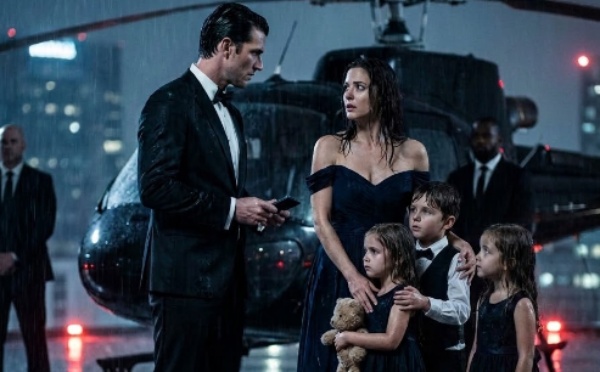
I Was About to Propose to Another Woman—Then I Saw My Ex-Wife in the Rain With Three Children Who Had My Face
I had a diamond ring in my pocket and a perfect proposal waiting across town when I spotted my ex-wife standing outside an urgent care clinic in the pouring rain. Beside her were three little children with my eyes, my hair, and names we had once chosen together before our marriage fell apart. For five years, I believed she had betrayed me and walked away without looking back. But one question in the rain—“Are they mine?”—uncovered the lie that had stolen my family before I ever knew I had one.
PART 1 — The Ring in My Pocket
Something inside me died the moment I saw my ex-wife standing in the pouring rain with three little children who looked exactly like me.
I had a diamond ring in my pocket.
Another woman was waiting for my proposal.
And until that exact second, I had absolutely no idea that my entire life had been built on a lie.
It was a Friday evening in Seattle, the kind of wet, gray November night where the rain didn’t fall so much as surround you. I was standing under the awning outside The Fairmont Olympic Hotel, checking my watch every thirty seconds and trying to calm my nerves. In less than an hour, I was supposed to ask Meredith Langley to marry me.
Meredith was upstairs in a suite with her sister, getting ready for what she believed was a formal work dinner.
She was wrong.
I had rented out a private dining room at Canlis, arranged white roses, hired a violinist, and asked the staff to bring champagne after dessert. In my coat pocket was a platinum ring with a two-carat oval diamond, tucked inside a black velvet box I had opened and closed at least fifty times that week.
At thirty-eight years old, I was finally ready to believe in marriage again.
That was what I told myself.
Five years earlier, my first marriage had ended so suddenly and so bitterly that I walked away from it convinced I had escaped something toxic. My ex-wife, Emily Carter, had disappeared from my life after our divorce with the same quiet finality she had used during our last months together. No dramatic calls. No public accusations. No messy social media posts.
Just silence.
I had taken that silence as proof that I was right about her.
Cold.
Distant.
Impossible to reach.
The woman who had once laughed at my terrible jokes in a tiny apartment in Tacoma became the woman who signed divorce papers without looking me in the eyes.
At least, that was the story I believed.
Until I saw her across the street.
She was standing near the curb outside a small urgent care clinic, struggling with a broken umbrella while three children huddled close to her legs. Rain soaked the shoulders of her beige coat. Her hair, darker than I remembered, clung to her cheeks. She looked thinner, tired, and somehow softer around the edges.
But the children were what stopped my heart.
The oldest boy looked about four.
Maybe five.
He had my dark hair.
My ears.
My exact serious expression, the one my mother used to call “the little old man face” when I was a kid.
Beside him stood a little girl in yellow rain boots, no older than three, with Emily’s mouth and my gray-green eyes. She was clutching a stuffed rabbit to her chest, its ears limp and soaked. The smallest child was in Emily’s arms, bundled in a navy jacket, his face pressed against her shoulder.
When he turned his head, I nearly dropped the ring box through the lining of my coat.
He had my father’s dimple.
Not my dimple.
My father’s.
The one on the left cheek, deep only when startled or close to crying.
For a moment, the street disappeared.
The traffic noise faded.
The rain became distant.
All I could see were three small faces carrying pieces of mine.
Emily shifted the toddler higher on her hip and bent toward the older boy, saying something I couldn’t hear through the rain. He nodded solemnly and reached for his sister’s hand. Then Emily looked up, probably searching for a rideshare or a taxi.
Her eyes landed on me.
She froze.
So did I.
Five years vanished.
I was twenty-nine again, standing in our kitchen while she cried and begged me to listen.
I was thirty-three again, signing papers my mother said were necessary.
I was thirty-eight, with a ring in my pocket for another woman, staring at three children who should not exist.
Not according to what I had been told.
Not according to the version of my life I had been living.
Emily’s face changed in a way I couldn’t read.
Fear.
Shock.
Pain.
Then something worse.
Resignation.
Like she had always known this moment might come and had spent years dreading it.
I stepped off the curb without checking traffic.
A horn blared.
A cyclist cursed at me.
I barely heard him.
“Emily?”
My voice cracked on her name.
The oldest boy turned toward me.
His eyes widened.
My eyes.
God help me.
My eyes.
Emily tightened her arm around the toddler.
“Daniel,” she said.
Just my name.
Not hello.
Not how are you.
Not what are you doing here.
Daniel.
The little girl pressed closer to her mother’s leg.
“Mommy?” she whispered.
Mommy.
My ex-wife was a mother.
I knew that, technically, people could become parents after divorce. Emily could have remarried. She could have had children with someone else. She could have built an entire life after me, just as I believed I had built one after her.
But those children did not look like someone else.
They looked like me.
My stomach turned cold.
“Are they…” I stopped.
The question was too large to fit in my mouth.
Emily’s eyes filled immediately.
That was my answer before she spoke.
“Daniel, not here.”
The rain beat against the sidewalk between us.
The toddler began to fuss.
The older boy looked from Emily to me with sharp little concern, the kind children develop when they’ve learned adult emotions can change the weather.
I swallowed.
“Emily.”
“Not here,” she repeated, firmer this time. “They’re wet. Noah has a fever. I need to get them home.”
Noah.
I looked at the toddler.
Noah.
A name I had once suggested for a son.
Years ago.
Back when Emily and I used to lie in bed on Sunday mornings and make lists of names for children we hoped to have someday.
A son named Noah.
A daughter named Lily.
Another boy maybe named Caleb, after my grandfather.
The old memory hit me like a physical blow.
“What are their names?” I asked.
Emily closed her eyes briefly.
The little girl answered before she could.
“I’m Lily,” she said, barely above a whisper.
My knees nearly gave out.
Lily.
The older boy straightened. “I’m Caleb.”
Emily looked like she might be sick.
Caleb.
Lily.
Noah.
Three names from a life I had mourned without understanding it was still alive somewhere without me.
A black SUV pulled up to the curb. The rideshare sticker glowed faintly in the windshield. Emily reached for the rear door, but I stepped closer.
“Emily, please.”
She looked at me then, really looked at me, and I saw something I had not allowed myself to remember.
She was afraid of me.
No.
Not of me exactly.
Of what I could do now that I knew.
That realization cut deeper than the children’s faces.
“I need to get them home,” she said again. “Please.”
The driver rolled down his window. “Emily?”
“Yes,” she called.
I stood helplessly as she buckled the children in. Caleb climbed into a booster seat. Lily crawled beside him. Noah whimpered as Emily strapped him into the rear-facing car seat, pressing a kiss to his damp forehead.
They moved like a family.
A family that had routines.
A family that had existed without me.
When Emily closed the door, I touched the top of the car without thinking.
“Tell me one thing,” I said.
Her jaw trembled.
“What?”
“Are they mine?”
Rain slid down her face, or maybe tears did.
She looked through the window at the three children, then back at me.
“Yes,” she said.
One word.
That was all it took.
The version of my life I had built collapsed silently inside me.
The SUV pulled away.
I stood in the rain long after it disappeared into traffic.
My phone buzzed in my coat.
Meredith.
Are you almost ready? My sister is acting weird. Should I be suspicious?
The ring box pressed against my ribs like a stone.
I stared at the message.
Then at the street where my ex-wife had vanished with my children.
My children.
I typed with numb fingers.
Something happened. I’m so sorry. I need to cancel tonight.
Three dots appeared immediately.
Then:
Cancel what? Daniel, what’s going on?
I closed my eyes.
How do you tell one woman waiting for a proposal that you just discovered you are the father of three children with another woman?
How do you explain that you left a marriage because everyone told you your wife had betrayed you, only to find out the truth had been standing in the rain wearing yellow boots and your eyes?
I didn’t know.
So I did the only honest thing I had done in years.
I walked away from the life I was about to enter and went looking for the truth about the one I had abandoned.
PART 2 — The Marriage I Thought I Understood
Emily and I were married for four years before the divorce, but I loved her long before I became her husband.
We met at a community college photography class in Tacoma when I was twenty-six and trying to convince myself that taking one creative class after work made me less boring. I worked then as a junior analyst for a logistics company near the port. Emily was a part-time preschool aide, saving money to finish her degree in early childhood education.
She sat two seats ahead of me with a thrift-store camera and a green notebook full of perfect handwriting.
I noticed her laugh first.
Not because it was loud.
Because it was surprised, like joy always caught her off guard.
Our first conversation was about a bad photo I had taken of a ferry terminal at sunset. She leaned over, studied it seriously, and said, “It’s almost good, which is sometimes more frustrating than terrible.” I laughed so hard I forgot to be offended.
By the end of the semester, I was in love.
Emily was not the kind of woman who entered a room demanding attention. She was quiet until she felt safe, funny in a dry way, and stubborn about things that mattered. She remembered small details: how I took my coffee, which knee hurt when it rained, that my mother’s birthday made me tense because nothing I bought was ever right.
My mother, Patricia, did not like Emily.
She said Emily was sweet but “limited.”
That was her word.
Limited.
Limited education.
Limited family background.
Limited ambition.
My father had died when I was nineteen, and my mother had raised me with grief sharpened into control. She loved me fiercely, but her love came with plans. She wanted me in a better job, better neighborhood, better circles, and eventually with a woman who would “match my potential.”
Emily, in Patricia’s view, did not match.
That should have mattered less to me.
It mattered too much.
When I proposed to Emily on a cold beach near Point Defiance, she cried before I finished the sentence. The ring was modest, bought after three months of saving and one humiliating conversation with a jeweler who kept steering me toward financing. Emily looked at it like I had handed her the moon.
Our wedding was small.
Fifty people.
A church hall.
Costco flowers.
My mother wore navy and disappointment.
Emily’s parents had died when she was in college, so her older aunt walked her down the aisle. At the reception, Emily danced barefoot because her shoes hurt. I remember thinking no rich, polished, perfect woman could ever make me feel the way Emily did in that church hall, laughing with her hair coming loose.
For two years, we were happy.
Not Instagram happy.
Real happy.
The kind built from rent payments, frozen pizza, inside jokes, and a shared bank account that never had quite enough in it. We moved into a small rented house in Puyallup with a sagging porch and a kitchen window that looked out over blackberry bushes.
Emily planted herbs in mismatched pots.
I took a better job in Seattle and started commuting.
My mother started visiting more often.
That was when the first cracks appeared.
Patricia never criticized Emily directly when I was watching. She was smarter than that. She asked questions that sounded helpful and left bruises anyway.
“Are you still working at the preschool, dear?”
“Have you thought about finishing your degree before having children?”
“Daniel is under so much pressure. I hope you’re making home peaceful for him.”
Emily tried.
God, she tried.
She brought flowers when my mother hosted dinner. She sent birthday cards. She made Patricia’s favorite lemon cake three times before admitting she hated lemon cake. My mother responded with cool thanks and small corrections.
I told Emily to ignore it.
That was cowardice disguised as advice.
When Emily became pregnant the first time, we were stunned and overjoyed. It happened sooner than planned, but not unwanted. She told me with a tiny pair of baby socks placed in my lunch bag. I cried in my car before going into work.
We lost that baby at ten weeks.
I will not describe it in detail because some grief does not need decoration.
Emily blamed herself.
I told her not to.
Then I went back to work too soon because grief made me useless and work made me praised.
My mother came over with soup and said, “Maybe this was nature’s way of telling you both to wait until you’re more stable.”
Emily heard her from the hallway.
I did not defend her strongly enough.
A year later, Emily wanted to try again.
I wanted to as well, but I was scared.
My career had started moving quickly. I had been promoted twice. My mother kept reminding me that one wrong financial move could trap us. Emily began talking about fertility tracking, prenatal vitamins, and baby names again.
I began coming home late.
Not because I was cheating.
Because I was avoiding the weight of wanting something I feared losing again.
That distance created space.
My mother filled it.
She started suggesting Emily was unhappy. That Emily resented my success. That Emily wanted a baby to “secure” the marriage. I denied it at first, but repetition is poison taken in small doses.
Then came the photograph.
My mother showed it to me three weeks before everything ended.
It was a photo of Emily sitting in a café with a man I did not know. His hand was on the table near hers. They were leaning close. The angle made it look intimate.
“Daniel,” my mother said softly, “I didn’t want to show you this.”
But she did.
Of course she did.
She said a friend had seen Emily downtown.
She said she had tried not to assume.
She said there had been other signs.
I confronted Emily that night like a prosecutor instead of a husband.
She looked genuinely confused.
Then hurt.
Then angry.
The man was Aaron Mills, she said, a coworker from the preschool whose wife had just left him. He had asked for advice about child custody resources because Emily knew someone who had gone through family court. They met in public for coffee. That was all.
I wanted to believe her.
I almost did.
Then my mother produced more.
A hotel receipt charged to a credit card Emily and I barely used.
A message printed from an unknown number that said, I can’t stop thinking about you.
A claim from one of my mother’s friends that Emily had been seen getting into Aaron’s car.
Emily denied everything.
She cried until she could barely speak.
She begged me to look at dates, details, accounts.
But I was young, wounded, proud, and surrounded by a mother who kept whispering that I deserved loyalty.
So I left.
I moved into my mother’s guest room “temporarily.”
Emily called.
I ignored her.
She came to the house once, pale and shaking, asking to speak to me alone.
My mother refused to let her in.
I watched from the upstairs window.
That image has haunted me since the night in the rain.
Emily standing on my mother’s front porch, one hand pressed over her stomach, crying in the cold.
At the time, I thought she was performing.
Now I know she was pregnant.
The divorce happened fast.
Too fast.
My mother recommended an attorney. I signed things I barely read. Emily did not fight the divorce the way I expected, and I used that against her in my mind.
“She knows she’s guilty,” my mother said.
I believed her.
Emily sent me one letter after the papers were filed.
I never opened it.
My mother said it arrived at a bad time and that reading it would only reopen wounds. She offered to keep it until I was ready. I never asked for it again.
That was five years ago.
Five years of believing Emily betrayed me.
Five years of letting my mother’s certainty become my own.
Five years of building a life on the idea that I had been the wronged husband.
Then came the rain.
Three children.
My names.
My face.
And one word from Emily that split the past open.
Yes.
PART 3 — The Lie Starts to Bleed
That night, I did not go to Canlis.
I did not propose to Meredith.
I did not go home either.
I sat in my car in a parking garage near Pike Place Market while rain drummed against the windshield and my phone filled with messages.
Meredith called eight times.
My mother called twice.
Emily did not call at all.
That hurt in a way I had no right to feel.
At 9:14 p.m., I finally called Meredith.
She answered immediately.
“Daniel, where are you? What happened? Are you hurt?”
Her voice was terrified, not angry.
That made everything worse.
Meredith was good.
She did not deserve to be standing in the blast radius of a truth that existed before I met her.
“I’m not hurt,” I said. “But something happened tonight. Something serious.”
“Okay,” she said slowly. “Tell me.”
I closed my eyes.
“I saw Emily.”
Silence.
My ex-wife’s name had never been a comfortable topic between us. Meredith knew I had been divorced. She knew the sanitized version: young marriage, betrayal, painful ending. She knew enough to pity me and not enough to question me.
“And?” she asked.
“She had children with her.”
Another pause.
“Daniel.”
“They look like me.”
The line went quiet.
I heard her inhale.
“How many?”
“Three.”
“Oh my God.”
“I asked her if they were mine.”
Meredith’s voice was barely above a whisper.
“What did she say?”
“Yes.”
I heard something break in her silence.
Not dramatically.
Quietly.
Like a glass set down too hard.
“Were you going to propose tonight?” she asked.
The question came out calm.
Too calm.
I opened my coat and pulled out the ring box.
“I was.”
She exhaled shakily.
“I thought so.”
“I’m sorry.”
“I know.”
“I didn’t know.”
“I believe you,” she said.
That mercy hurt more than accusation.
“But you need to know now,” she continued. “And I cannot be the woman waiting in the hotel room while you find out whether you have three children with your ex-wife.”
“I know.”
“I’m going to my sister’s.”
“Meredith—”
“No,” she said gently. “Don’t make me comfort you right now. I care about you. But I need to protect myself too.”
She was right.
I hated that she was right.
After we hung up, I drove to my mother’s house.
Patricia still lived in the same Tudor-style home in Queen Anne, full of polished wood, framed family photos, and furniture no one sat on comfortably. She opened the door in a cream sweater and pearl earrings, looking annoyed until she saw my face.
“What happened?”
I stepped inside.
“I saw Emily.”
My mother’s expression shifted.
Just slightly.
If I had not been watching, I might have missed it.
“Emily?” she repeated.
“Yes.”
“How unfortunate.”
“She had three children with her.”
My mother went still.
Not confused.
Still.
That was the first real crack.
I stared at her.
“You knew.”
She looked away.
My pulse thundered in my ears.
“Mom.”
She walked toward the living room. “You’re upset. Sit down.”
“I asked her if they were mine.”
My mother stopped beside the fireplace.
I could see her reflection in the dark window, pale and rigid.
“She said yes,” I continued. “Three children. Caleb, Lily, and Noah.”
Her shoulders dropped almost imperceptibly.
Not surprise.
Defeat.
I felt sick.
“You knew,” I said again.
Patricia turned around slowly.
“I knew she claimed to be pregnant.”
Claimed.
The word lit a fuse inside me.
“Claimed?”
“She was desperate, Daniel.”
“She was pregnant.”
“At the time, I had no way to know that.”
“You had no way to know? Did she tell me?”
My mother pressed her lips together.
I remembered the letter.
The unopened letter.
“Where is it?” I asked.
“What?”
“The letter Emily sent me.”
“That was years ago.”
“Where is it?”
“Daniel, don’t do this tonight.”
“Where is the letter?”
Her eyes hardened.
“I protected you.”
The room seemed to tilt.
From the outside, that sentence might sound loving.
But children of controlling parents know the danger of it.
I protected you means I made decisions you would not have made if you had the truth.
I stepped closer.
“What did you do?”
“She was going to trap you.”
“She was my wife.”
“She humiliated you.”
“Did she?”
Patricia blinked.
I said it again, softer and more dangerous.
“Did she?”
My mother looked toward the mantel, where a photo of me from law school graduation sat in a silver frame, even though I had never gone to law school. That was Patricia’s habit—displaying versions of me she wished existed. In that photo, I was standing beside a friend at his graduation, but she had cropped him out.
“She was not right for you,” she said.
The answer was so far from my question that it answered everything.
I sat down because my legs had weakened.
“The photo,” I said. “The hotel receipt. The messages. Were they real?”
My mother did not respond.
I laughed once.
It sounded nothing like laughter.
“Were they real?”
“The man in the café was real.”
“That’s not what I asked.”
“She was meeting another man behind your back.”
“For coffee.”
“You don’t know that.”
“You made sure I didn’t know anything.”
Her eyes flashed.
“She would have ruined your life.”
I stood.
“No. You did.”
She flinched then.
Good.
I had never spoken to my mother that way in my life.
“You had a wife,” she said sharply. “A wife who was dragging you down. You were exhausted, unfocused, drowning in her needs. I saw what she was doing to you.”
“She was grieving.”
“So were you.”
“Yes,” I said. “And instead of helping us, you broke us.”
My mother’s face trembled, but whether from guilt or rage, I could not tell.
“She came here,” I said. “After I left. I saw her from the window. Was she pregnant then?”
Patricia looked away.
“She said she was.”
“And you didn’t tell me.”
“She could have been lying.”
“She was standing on your porch with my children inside her.”
“Child,” my mother snapped. “At the time, it was one child.”
I froze.
One child.
At the time.
The room went silent.
My mother realized what she had admitted.
“You knew enough to count,” I whispered.
Her mouth opened, then closed.
I backed away from her.
“Where is the letter?”
“I don’t know.”
“Find it.”
“Daniel—”
“Find it.”
She stared at me, perhaps seeing for the first time that the son she had managed for decades was no longer asking permission.
After several minutes, she went upstairs.
I stood in her living room surrounded by photos of myself, none of Emily, none of our wedding, none of the years she had carefully erased.
When Patricia returned, she held a shoebox.
Inside were old envelopes, cards, medical forms, and one cream-colored envelope with my name written in Emily’s handwriting.
My hands shook when I opened it.
The letter was dated five years earlier.
Daniel,
I don’t know if you’ll read this, but I need you to know the truth from me at least once.
I did not have an affair. Aaron was a friend from work, and I can prove that if you’ll let me. I don’t know where the hotel receipt came from. I don’t know who sent those messages. Please, please look at the dates.
I am pregnant.
I found out two days before you left. I tried to tell you when I came to your mother’s house, but she wouldn’t let me speak to you. I don’t want to use this baby to force you back. I just want you to know.
I still love you. I am scared. I need you to hear me before this becomes something we can’t undo.
Emily
I read it once.
Then again.
Then a third time.
The ink had blurred in places, probably from her tears.
Or mine now.
I looked at my mother.
She had hidden the letter.
She had hidden my child.
And after that first child, somehow, there were two more.
My voice was barely audible.
“How are there three?”
My mother looked confused despite herself.
“I don’t know.”
But I did.
Or at least, I understood enough to feel the ground vanish.
Emily had been pregnant when I left.
With triplets.
My children had been born into a life where I was not absent by accident.
I had been removed.
And I had helped by refusing to look.
PART 4 — Meeting the Children
It took me two days to find the courage to contact Emily.
Not because I did not want to.
Because I had no right to demand anything.
I had believed lies about her. I had ignored her calls. I had let my mother shut her out. I had built a life where her pain was explained as guilt because that made me feel less responsible.
Now I wanted answers.
But answers are not owed to the person who abandoned the question.
I found her number through an old email thread I had never deleted. My thumb hovered over the call button for nearly a minute before I finally sent a text.
Emily, it’s Daniel. I know I have no right to ask for anything. But I found your letter. I know my mother kept it from me. I am so sorry. If you are willing, I’d like to talk. Only when and how you feel comfortable.
She did not answer for six hours.
I deserved every minute.
When her reply came, I was sitting at my kitchen table with coffee I had not touched.
I can meet Tuesday at 10. Public place. Not with the kids.
Then:
Do not contact them. Do not come to my home.
I replied immediately.
I understand. Thank you.
We met at a coffee shop in Ballard with big windows and people typing on laptops like ordinary life had not become unbearable.
Emily arrived wearing a dark green coat, her hair pulled back, no makeup except maybe mascara. She looked older than the woman I remembered, but not broken. That unsettled me. Some selfish part of me had imagined her life frozen at the point where I left, as if my absence had paused her.
It had not.
She had survived.
She sat across from me without removing her coat.
“Say what you need to say,” she said.
I had prepared a speech.
It vanished.
“I’m sorry.”
Her face did not change.
“I know that is not enough,” I added.
“No,” she said. “It isn’t.”
I nodded.
“I found the letter.”
“I assumed you never read it.”
“My mother kept it.”
“I know.”
That surprised me.
Emily looked at her hands.
“She told me you read it and didn’t believe me.”
I closed my eyes.
Of course she did.
“She told you that?”
“Yes.”
“I never saw it until Saturday.”
Emily’s mouth tightened.
For the first time, I saw fresh pain break through old scar tissue.
“I needed you,” she said quietly. “I was pregnant with triplets, Daniel. I was terrified. I had no parents. I was vomiting every day, dizzy, trying to work, trying to prove I hadn’t cheated while your attorney sent papers like I was disposable.”
“I didn’t know they were triplets.”
“I tried to tell you.”
“I know.”
“No,” she said, her voice sharpening. “You know now. There is a difference.”
I took that because it was true.
She told me the pregnancy became high-risk by the second trimester. She developed blood pressure complications. She had to stop working earlier than planned. Her aunt moved in for three months, and after the babies were born at thirty-four weeks, all three spent time in the NICU.
Caleb first.
Lily two minutes later.
Noah last.
Noah had breathing trouble.
I gripped my coffee cup so hard my knuckles hurt.
“Did you put me on the birth certificates?” I asked.
Emily’s expression closed.
“No.”
I flinched.
“I didn’t know what else to do,” she said. “You were divorcing me. Your mother said you wanted nothing to do with the baby. Then there were three babies, and I had to make decisions in a hospital room without you.”
“Did you ever…” I stopped.
“Did I ever try again?” she asked.
I nodded.
“Once. When they were six months old. I sent photos.”
My breath caught.
“To my mother?”
“To you. Certified mail to your mother’s address because that was the only address I had after you moved. It was returned unopened.”
I looked away.
Shame has a physical taste.
Bitter.
Metallic.
Permanent.
“I would have come,” I whispered.
Emily’s eyes flashed.
“But you didn’t.”
“I didn’t know.”
“You didn’t want to know,” she said. “That’s the part you have to live with.”
The sentence landed exactly where it should.
Between excuse and accountability.
I had not created every lie.
But I had accepted them because they protected me from harder truths.
“What happens now?” I asked.
Emily leaned back.
“That depends on what you want and what you’re willing to do properly.”
“Properly?”
“Yes. Not emotionally. Not by showing up in the rain and asking children questions they don’t understand. Not by making promises because you feel guilty. Properly.”
I nodded.
“I want to know them.”
Her eyes filled then, though she did not cry.
“They are not a redemption project.”
“I know.”
“They are children. Caleb is cautious. Lily is sensitive. Noah has asthma and gets scared around loud men. They have a life.”
“I don’t want to disrupt it.”
“You will disrupt it,” she said. “The question is whether you do it carefully or selfishly.”
So we did it carefully.
Emily insisted we begin with attorneys and a family therapist.
At first, that hurt my pride.
Then I realized my pride had already cost enough.
I hired my own attorney, Marcus Reed, who specialized in family law. He explained that because I was not legally established as the father, we would need to address parentage through appropriate legal channels in Washington State. DNA testing could confirm biological paternity, but legal rights and responsibilities would be handled through court processes or agreements focused on the children’s best interests.
“Do not rush this,” Marcus told me. “You’re not walking into a movie scene. You’re walking into the lives of three children who do not know you.”
The DNA test confirmed what the rain had already told me.
99.99%.
Caleb, Lily, and Noah were my biological children.
I sat in my car outside the lab and sobbed so hard a passing woman knocked on my window to ask if I needed help.
I did need help.
Just not the kind she could give.
Telling Meredith was almost as hard as meeting Emily.
She had moved back to her own apartment and returned the few things she kept at my place. We met at a quiet park near Green Lake because she said she did not want to cry in a restaurant.
I told her the DNA results.
She listened with tears in her eyes.
“I love you,” she said. “But I can’t marry a man who just found out he has three children and an ex-wife whose life was destroyed by his family.”
“I understand.”
“I don’t think you’re a bad man, Daniel.”
I looked down.
“I’m not sure that helps.”
“It shouldn’t,” she said gently. “Not yet.”
She handed me back the ring box.
“I hope you become the father they deserved all along.”
Then she walked away.
I stood there holding another life that no longer belonged to me.
The first time I met the children was in a therapist’s office in Fremont, three months after the rainy night.
Not as “Dad.”
Not even as “father.”
As Daniel, an old friend of their mother’s.
That was what the therapist recommended.
Emily sat beside them on a couch. Caleb watched me carefully, his small hand gripping the edge of his jacket. Lily hid behind Emily’s arm but peeked at me with my own eyes. Noah sat on the carpet with toy dinosaurs, occasionally coughing into his sleeve.
I had bought gifts, but the therapist told me not to bring them in first.
“Connection before objects,” she said.
So I sat on the floor.
Not too close.
I introduced myself.
Caleb asked, “Do you know our mom?”
I looked at Emily.
She nodded slightly.
“Yes,” I said. “A long time ago.”
Lily whispered, “Were you nice?”
The question broke something open in the room.
Emily closed her eyes.
I answered honestly.
“Not always.”
Caleb frowned.
“Are you nice now?”
“I’m trying to be.”
He considered that.
Then handed me a blue dinosaur.
“That one is the dad,” he said.
I took it with both hands.
“Thank you.”
It was a plastic toy.
It felt like a verdict.
And maybe a possibility.
PART 5 — Becoming Worth the Truth
Fatherhood did not arrive with one emotional meeting and a clean ending.
It arrived in supervised visits, legal paperwork, child support calculations, therapy sessions, and three small people who did not owe me affection.
That was one of the first things I had to learn.
Children are not obligated to heal the adults who failed them.
Emily and I established legal parentage through the court process. My name was added legally after agreements were reached, but not before careful discussion about the children’s emotional stability. Child support was calculated based on income and needs. A gradual parenting plan was created, beginning with short visits in neutral settings and expanding only as the children adjusted.
I paid back support into a fund for the children.
Emily did not ask for sympathy about the years she had managed alone.
She asked for dental bills, preschool costs, asthma medication, winter coats, and college savings contributions.
That was the difference between guilt and responsibility.
Guilt wanted to cry in front of her.
Responsibility paid invoices on time.
At first, Caleb did not like me.
He was polite because he had Emily’s manners, but he watched everything. If I moved too fast, he stiffened. If Emily left the room, he tracked the doorway until she came back. He had become the little man of the house before he knew what that meant.
One afternoon, at a supervised visit in a children’s museum, he asked me, “Why did you leave Mommy?”
The therapist looked at me.
Emily went still.
I wanted to blame my mother.
I wanted to say I didn’t know.
I wanted to make the answer smaller.
Instead, I said, “I believed something that wasn’t true, and I hurt your mom very badly. That was my mistake.”
Caleb stared at me.
“Did you say sorry?”
“Yes.”
“Did it fix it?”
“No.”
He nodded like that made sense.
Children understand consequences better than adults sometimes.
Lily warmed first.
She loved drawing and insisted I sit beside her while she made endless pictures of houses with rainbow roofs. One day she drew five stick figures: Emily, Caleb, Lily, Noah, and me standing slightly apart. I had no hair in the picture and one very long arm.
“Is that me?” I asked.
She nodded.
“Why am I over there?”
“Because you’re new.”
I swallowed.
“That’s fair.”
She added a yellow sun above my head.
Not acceptance.
Not yet.
But maybe weather.
Noah was the hardest.
He was smaller than the other two, more fragile physically, with asthma that worsened in cold weather. He wanted Emily constantly and cried if visits changed routine. The first time he fell asleep against my chest, six months after I met him, I did not move for forty-three minutes even though my leg went numb.
Emily took a photo.
She sent it to me later without comment.
I saved it in three places.
My relationship with my mother did not survive intact.
For months, she insisted she had acted out of love. She said Emily would have trapped me, that I was rewriting history, that those children were being used to punish her. She demanded to meet them once she realized I was becoming serious about legal parentage.
I said no.
Not never.
No for now.
“You can’t keep my grandchildren from me,” she said.
I felt the old pull of obedience.
Then I thought of Emily on the porch.
The unopened letter.
The returned photos.
The years.
“I’m not keeping them from you,” I said. “I’m protecting them from the person who kept them from me.”
She slapped me.
Not hard enough to injure.
Hard enough to end an era.
I left her house and did not return for eight months.
During that time, I went to therapy.
At first, I went because Marcus suggested the court would view it positively if I was serious about entering the children’s lives responsibly. Then I stayed because I began to understand how much of my adulthood had been shaped by my mother’s fear disguised as devotion.
That did not excuse me.
It explained the machinery.
I still had to own the damage.
Emily and I did not get back together.
People always want that ending.
The man discovers the truth, repents, fights for his family, and the woman who survived alone for five years welcomes him home because biology and regret make a good final chapter.
Real life is not that simple.
Emily had built a life without me because she had to.
She had become strong in ways I had no right to benefit from romantically. She had dated once or twice, though nothing serious. She had friends, routines, favorite parks, pediatricians, parent-teacher conferences, bedtime systems, emergency inhaler plans, and children who trusted her completely.
I was not entitled to return to the center.
I was fortunate to be allowed near the edge.
About a year after the rainy night, Emily and I sat on a bench at Gas Works Park while the children ran through the grass with a kite I had assembled badly. Lily shouted instructions. Caleb pretended not to enjoy himself. Noah laughed so hard he coughed, and Emily automatically reached for the inhaler in her bag.
I noticed.
A year earlier, I would not have.
“I’m sorry,” I said quietly.
Emily kept her eyes on the children.
“You’ve said that.”
“I know.”
“Is this a new sorry or the old one again?”
I almost smiled.
Then I answered honestly.
“A different one.”
She looked at me.
“I’m sorry I made you prove pain before I believed you. I’m sorry I let my mother become louder than my wife. I’m sorry I missed birthdays, fevers, first steps, NICU nights, and all the ordinary Tuesdays you carried alone. I’m sorry that even now, the kids have to adjust to a truth they never asked for.”
Emily looked away.
Her eyes shone.
“That one is better,” she said.
It was not forgiveness.
But it was truth received.
That was enough for that day.
Two years have passed since I saw Emily in the rain.
Caleb, Lily, and Noah are seven now.
Triplets, obviously, though strangers always think Caleb is older because he carries himself like a tiny building inspector. Lily has lost two front teeth and believes glitter improves every object. Noah still has asthma, still loves dinosaurs, and now sometimes reaches for my hand in parking lots without thinking.
They call me Daniel most of the time.
Sometimes Dad slips out.
The first time Caleb said it, he was frustrated tying his shoe.
“Dad, it won’t—”
He stopped immediately.
So did I.
His face went red.
I forced myself to stay calm.
“That lace is tricky,” I said.
He looked relieved.
We did not discuss it.
Later, in my car, I cried so hard I had to pull over.
Emily and I co-parent with careful boundaries.
We use a shared calendar. We communicate in writing when needed. We attend school meetings together and sit three seats apart at gymnastics recitals. We do not pretend the past is gone. We also do not make the children carry it.
My mother has met them twice.
Only after writing Emily a letter that took responsibility without excuses, completing therapy, and agreeing to Emily’s boundaries. The meetings were supervised by me and brief. Patricia cried after they left, but I no longer organize my life around her tears.
Meredith is married now.
I saw the announcement online.
She married a kind-looking man named Aaron, ironically, who owns a bakery in Portland. In the photo, she looked peaceful. I sent no message. Some apologies are selfish if they interrupt a healing that has nothing to do with you.
As for the ring, I sold it.
The money went into college accounts for the kids.
It felt right.
A diamond bought for a future that could not happen became a small contribution to the futures I should have been building all along.
Sometimes I think about that Friday night outside the Fairmont.
If the rain had been lighter, maybe I wouldn’t have looked across the street.
If Meredith had been downstairs earlier, maybe we would have already left.
If Noah had not had a fever, maybe Emily would not have been at that urgent care clinic.
If the rideshare had arrived faster, I might have missed them entirely.
Life is terrifying that way.
Entire truths can depend on a red light, a fever, a broken umbrella.
I think about the man I was standing under that awning, nervous about a proposal, proud of the ring in my pocket, convinced my painful past was behind me.
He thought he was ready to start over.
He did not know he had never finished telling the truth about the beginning.
That night, I saw my ex-wife in the pouring rain with three children who looked exactly like me.
I thought something inside me died.
Maybe it did.
The version of me who believed comfort over evidence died.
The son who mistook control for love died.
The man who thought not knowing absolved him died.
What lived after that was not automatically better.
He had to become better.
Slowly.
Imperfectly.
Through court dates, therapy bills, bedtime routines, school pickups, apologies without rewards, and three children who taught him that being a father is not a feeling you discover in the rain.
It is a responsibility you choose every day after.
I still keep a copy of Emily’s letter.
Not because I enjoy punishing myself.
Because I need to remember how easily truth can be buried when silence benefits the wrong people.
The letter is folded in a drawer beside three school photos.
Caleb with his serious eyes.
Lily with glitter on her cheek.
Noah with that dimple.
My children.
Not the children I was ready for.
Not the children I deserved.
The children who existed anyway.
The children whose mother protected them when I failed to.
The children who now know me not as the man who vanished, but as the man who came back carefully enough to stay.
That is all I can ask for.
And it is more than I deserve.
