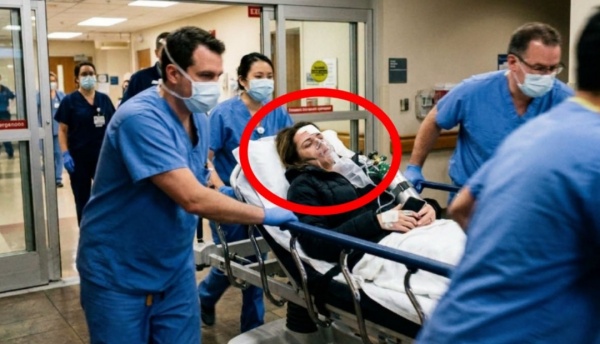
I Texted My Husband From the Wreckage. My Last Text Before Losing Consciousness Was to Him. He Ignored Me All Night. Eight Hours Later, He Read It in Another Woman’s Bed—Then Came Home to Find the Truth Waiting.
PART I — THE TEXT AT 6:42 P.M.
The last text I sent before I lost consciousness on the highway was to my husband.
It was only six words.
“Daniel, please answer. I’m scared.”
I sent it at 6:42 p.m. on a rainy Thursday evening, sitting behind the wheel of my white Subaru Outback on the shoulder of I-95 outside Richmond, Virginia, with my hazard lights blinking and my left hand pressed against my ribs because every breath felt like glass moving inside my chest.
My name is Emily Harper. I was thirty-six years old then, an elementary school counselor in Alexandria, married for eleven years to Daniel Harper, a commercial real estate broker who had built his entire personality around being unreachable whenever being reachable mattered most.
That sounds bitter now.
At the time, I would have called it generous.
Daniel was “busy.” Daniel was “under pressure.” Daniel had “clients who expected responsiveness.” I had spent years explaining his absence to myself in language that made it sound temporary, professional, and excusable.
That Thursday, I was driving back from Raleigh, North Carolina, where I had spent three days helping my younger sister, Megan, after her surgery. The plan was simple: leave Raleigh by 2:00 p.m., reach Alexandria by 6:30 or 7:00, pick up Thai food on the way home, and spend the weekend recovering from a week that had stretched me thin.
Daniel knew my schedule.
I had texted him before leaving Raleigh.
On the road. Rain’s getting bad. Should be home around 7. Love you.
He replied twenty minutes later.
Drive safe. Big client dinner tonight. Might be late.
I remember staring at that message at a gas station near Henderson, trying not to feel disappointed. It was our anniversary weekend, not the actual date, but the weekend we had chosen because our real anniversary had fallen on a Tuesday crowded with work obligations. I had booked dinner for Saturday at a place in Old Town Alexandria that Daniel claimed he wanted to try.
A big client dinner on Thursday should not have mattered.
But something about his wording did.
For months, Daniel had been lying to me about a woman named Vanessa Cole.
He insisted she was just a former client. Then just a networking contact. Then just someone who happened to be at the same industry events. Every version became smaller and more innocent the more frequently her name appeared in the margins of our life.
I first noticed her because Daniel started stepping out to take calls.
Then because his phone began sleeping face down.
Then because a charge appeared on our shared credit card from a boutique hotel bar in Arlington on a night he told me he was stuck in traffic after a showing.
When I asked him, he sighed the way men sigh when they want to make a woman feel childish for noticing patterns.
“Emily, Vanessa is married,” he said.
As if marriage had ever stopped anyone determined to betray one.
By the time I drove north on I-95 that rainy evening, I already suspected Daniel was not at a client dinner. But suspicion is a private kind of misery. It does not stop rain from falling, headlights from blurring, or tractor-trailers from throwing sheets of water across your windshield.
Around 6:25 p.m., traffic slowed near Ashland.
A dark pickup swerved ahead of me, braking hard. I hit my brakes too, but my tires slid across standing water, and the world suddenly became horn blasts, headlights, and the sickening feeling of losing control.
My car spun once.
Then something slammed into the passenger side.
The impact sounded less like a crash than a building collapsing.
The Subaru lurched across the shoulder and struck the guardrail. My airbag exploded. My phone flew somewhere near my feet. For a few seconds, there was only the hiss of rain and the hot chemical smell of the airbag filling the cabin.
I did not understand I was hurt at first.
That is the strange mercy of shock.
I remember touching my forehead and seeing blood on my fingers. I remember trying to move my right leg and realizing the pain arrived too fast, too bright. I remember hearing someone shout from outside the car, then another voice calling 911.
My phone was wedged under the brake pedal.
I reached for it with my left hand, because my right arm would not cooperate. The screen was cracked, but it lit up. I had no idea whether emergency responders had been called, whether I was going to pass out, or whether I would be able to explain anything if I did.
So I texted Daniel.
Daniel, please answer. I’m scared.
The message showed as delivered.
Not read.
Rain tapped against the shattered window.
A woman appeared outside my driver’s side door, her face pale under the glow of hazard lights.
“Honey, help is coming,” she said. “Stay awake, okay? Stay with me.”
I tried.
I really did.
But the last thing I remember before everything went dark was watching Daniel’s name at the top of my phone screen, waiting for the little word Read to appear.
It never did.
PART II — EIGHT HOURS LATER
Daniel read my message eight hours later.
Not in a hospital waiting room.
Not in his car rushing south toward Richmond.
Not beside a phone he had accidentally left in another room during an important business dinner.
He read it at 2:51 a.m. in Vanessa Cole’s bed.
I know this because Vanessa told me.
Not kindly.
Not because she suddenly grew a conscience.
She told me six weeks later through her attorney, during a deposition that was supposed to focus on financial records but somehow became the first time I heard the full story of the night my marriage ended.
Daniel had turned his phone on silent at dinner.
There had been no client dinner.
There had been a reservation for two at a steakhouse in Georgetown, followed by drinks at a hotel bar, followed by Vanessa’s townhouse in Capitol Hill, where Daniel apparently silenced not only his phone but the entire life he had promised to come home to.
At 2:51 a.m., he woke up thirsty.
He checked his phone.
He saw nine missed calls from unknown numbers, three from VCU Medical Center, two from Megan, one from my mother, and the text I had sent from the highway.
Daniel, please answer. I’m scared.
Vanessa said he sat upright so suddenly it woke her.
“What is it?” she asked.
He did not answer at first.
He called my phone. No response.
He called Megan.
My sister answered on the first ring.
The way Megan later described that call, her voice still tightened every time she repeated it.
“Where the hell have you been?” she said.
Daniel asked what happened.
That was the moment my sister understood he had no idea.
No idea I had been airlifted from the crash scene.
No idea state troopers had found his number under emergency contact.
No idea doctors had called repeatedly while I was unconscious and being taken into emergency surgery for internal bleeding.
No idea my mother had driven from Fredericksburg in the middle of a storm and reached the hospital before he even read my message.
Megan told him everything in one breath.
The crash. The ambulance. The surgery. The fact that nobody knew yet if I would wake up with full use of my right leg. The fact that I had asked for him before losing consciousness.
Then she asked him again.
“Where were you?”
Daniel lied.
He said his phone died.
Megan did not believe him.
Neither did I, once I woke up.
But I am getting ahead of myself.
My first memory after the accident was light.
Not heavenly light. Not anything poetic.
Just harsh hospital ceiling light and the dry taste of oxygen in my mouth. I woke up in the trauma ICU with my left side wrapped, my leg immobilized, and my mother asleep in a chair with her coat still on.
My throat hurt too much to speak.
A nurse noticed my eyes open and came quickly to the bed.
“Emily, you’re at VCU Medical Center,” she said gently. “You were in a car accident. You’re safe. Your surgery went well.”
Safe.
It was a strange word to hear when I could not move without pain and had no idea where my husband was.
I tried to say Daniel’s name.
The nurse understood.
“He’s on his way,” she said.
On his way.
Not here.
I turned my head slowly toward the chair by the window. My mother opened her eyes and saw me awake. She was beside me instantly, crying quietly into my hair, telling me I was okay, telling me I was alive, telling me not to try to talk.
My sister Megan arrived twenty minutes later. Her face looked carved out by anger and exhaustion. She kissed my forehead, then asked the nurse if she could have a minute.
When we were alone, she leaned close.
“Daniel didn’t know until almost three in the morning,” she whispered.
Even through medication and pain, I understood enough to feel my stomach drop.
I blinked at her.
“I’m not telling you everything right now,” she said. “You need to heal. But I need you to know one thing. Mom and I were here. You were not alone.”
Daniel arrived at 5:37 a.m.
He came into the ICU wearing yesterday’s clothes and guilt so heavy it entered the room before he did. His hair was damp, as if he had showered quickly somewhere. His eyes were red, but not from crying long enough to satisfy me.
“Emily,” he said, stepping toward the bed.
My mother stood up.
Not dramatically.
Not loudly.
But she stood between him and me.
“You can see her for five minutes,” she said. “Then she rests.”
Daniel looked startled.
My mother had always been polite to him. Southern polite. The kind of polite that served coffee to people she disliked and called it manners. But that morning, something in her voice told him the rules had changed.
He came to the side of my bed and took my hand.
I let him.
Not because I forgave him.
Because I was too weak to pull away.
“I’m so sorry,” he whispered. “My phone died. I didn’t know. I swear to God, I didn’t know.”
There are lies that ask to be believed.
This one begged too hard.
I looked at him, at the collar of his shirt, at the faint scent of unfamiliar perfume beneath hospital antiseptic, and I knew before anyone proved it.
My husband had not missed my message because his phone died.
He had missed it because he had chosen not to be reachable.
And whatever pain the crash had caused my body, that realization went somewhere deeper.
PART III — WHAT HE FOUND WHEN HE CAME HOME
Daniel did not come home from the hospital with me.
I spent nine days at VCU, then another thirteen at an inpatient rehabilitation facility outside Richmond. My injuries were serious but survivable: two cracked ribs, a fractured femur, a concussion, internal bleeding controlled by surgery, and nerve damage that made my right foot unreliable for weeks.
The doctors said I was lucky.
People said that word often.
Lucky to be alive.
Lucky the guardrail stopped me.
Lucky another driver saw the crash and called 911.
Lucky I had been close enough to a trauma center.
I nodded each time because they were right.
But luck is complicated when the person who vowed to be your first call becomes your last unanswered message.
Daniel visited every day at first.
He brought flowers, clean clothes, my favorite peppermint tea, and the brittle energy of a man trying to repair optics before the facts arrived. He hovered when nurses entered. He asked doctors detailed questions. He performed concern with enough intensity that several staff members told me I was fortunate to have such a devoted husband.
I did not correct them.
I was too tired.
But Megan watched him like a prosecutor.
On the fourth day, while Daniel stepped out to take a call, Megan sat beside my bed and said, “I pulled the phone records.”
I turned my head toward her.
“My friend Lucas works in IT compliance. He told me what to request from your shared account. Daniel’s phone didn’t die. It was active all night.”
My eyes closed.
There it was.
The truth, no longer a feeling.
“He was using data,” Megan continued. “Messages, maps, a rideshare charge. Emily, he was in D.C.”
I opened my eyes again.
“Vanessa?” I whispered.
Megan did not answer immediately.
That was answer enough.
“I’m sorry,” she said.
The next time Daniel came in, I asked him one question.
“Where were you?”
He sat down slowly.
“At dinner.”
“With who?”
“A client.”
“What client?”
He rubbed both hands over his face.
“Emily, this is not the time.”
I almost laughed, but my ribs made that impossible.
“Not the time?”
“You almost died.”
“Yes,” I said. “And you ignored me while I was doing it.”
His face went pale.
“I didn’t ignore you. I didn’t see it.”
“Because your phone died?”
He looked away.
That tiny movement confirmed everything.
I pressed the call button. When the nurse came in, I said, “I need him to leave.”
Daniel stood quickly.
“Emily—”
“I need him to leave,” I repeated.
The nurse looked at me, then at him.
“Sir, you’ll need to step out.”
For the first time in our marriage, someone else enforced a boundary I did not have the strength to enforce alone.
Daniel left the room.
I cried after that.
Not gracefully.
Not in a single cinematic tear.
I cried until the pain in my ribs made the nurse adjust my medication, and Megan climbed carefully onto the edge of the bed, holding my hand without saying anything useless.
Three weeks after the accident, I was discharged to our townhouse in Alexandria.
I did not want to go there.
But my insurance covered home health visits more easily if I returned to my primary residence, and my mother moved into the guest room to help. Daniel promised he would sleep downstairs, handle meals, manage the house, and give me space.
He sounded sincere.
Sincerity had become irrelevant.
When we pulled into the driveway, Daniel’s car was there. The porch light was on. He had installed a temporary ramp over the front steps and moved a recliner into the living room for me.
From the outside, it looked like care.
Inside, the house smelled like lemon cleaner and panic.
Daniel appeared from the kitchen.
“Welcome home,” he said softly.
My mother helped me inside with my walker. Every movement hurt. Every room felt familiar and foreign. There were flowers on the dining table, casseroles in the refrigerator, a basket of medications and printed instructions arranged beside the recliner.
Then I saw the hallway.
Not the hallway itself.
The wall.
The framed wedding photo that had hung there for ten years was missing.
In its place was a pale rectangle of paint.
I stopped so abruptly my mother tightened her grip on my arm.
“Where is the photo?” I asked.
Daniel’s face changed.
“I took it down temporarily. I thought it might upset you.”
“Where is it?”
“In the closet.”
“Show me.”
“Emily, you just got home. You need to sit down.”
“Show me.”
He led us to the hall closet.
Inside, behind winter coats and a vacuum, was not just our wedding photo.
It was every photo of us.
Our wedding. Our honeymoon in Maine. The framed picture from my thirtieth birthday. The Christmas card photo from the year we bought the townhouse. All removed. All stacked face down.
My mother inhaled sharply.
I looked at Daniel.
“What did you think I would do when I came home?”
He opened his mouth, then closed it.
That was when I noticed the second thing.
A woman’s scarf hanging from the hook by the back door.
Cream cashmere.
Not mine.
My mother saw it too.
Daniel followed our gaze and went still.
“It’s not what you think,” he said.
People should retire that sentence permanently.
It has never once improved the truth.
I took one painful step toward the hook.
The scarf smelled faintly of the same perfume I had noticed in the ICU.
Vanessa had been in my house.
Not weeks before. Not months before.
Recently.
While I was unconscious, in surgery, in rehab, relearning how to walk without falling, my husband had brought the woman he lied about into the home where I was supposed to recover.
“What did she do here?” I asked.
Daniel’s voice cracked. “She came by once. I was falling apart. I didn’t know what to do.”
I looked at the missing photos stacked in the closet.
“She helped you erase me?”
“No. No, Emily, I panicked. I thought seeing the pictures would hurt you.”
“And her scarf would comfort me?”
He had no answer.
My mother spoke then, her voice colder than I had ever heard it.
“Emily is not staying here.”
Daniel turned to her. “This is our home.”
“No,” I said quietly. “It was.”
He looked back at me.
That was the moment he finally understood that the accident had not made me fragile in the way he hoped.
It had made everything unmistakable.
PART IV — THE RECORD OF ABSENCE
My mother took me to her house in Fredericksburg that afternoon.
Daniel begged. He apologized. He cried in the driveway while my mother loaded my prescriptions, walker, clothes, and medical binder into her SUV with the focused efficiency of a woman who had spent her life not making scenes but was fully capable of ending one.
I sat in the passenger seat and watched Daniel through the window.
He looked smaller than I remembered.
Not physically.
Morally.
That night, in my childhood bedroom, surrounded by floral curtains my mother had never replaced, I slept for six hours without waking. It was the longest stretch of sleep I had had since the crash. When I woke, the first thing I felt was pain. The second was relief.
Daniel was not in the room.
The legal process began because of something practical, not dramatic.
Insurance.
Medical bills.
Disability paperwork.
Temporary leave from work.
Emergency contact forms.
The crash had created a mountain of documents, and each one seemed to ask the same question in different language: who could be trusted to make decisions for me when I could not?
The answer was no longer my husband.
I changed my medical power of attorney to Megan.
I changed my emergency contact to my mother.
Then I called Karen Whitlock, a family law attorney in Alexandria recommended by a colleague who had once described her as “terrifying in sensible shoes.”
Karen listened to the story without interrupting.
When I finished, she said, “Virginia allows both no-fault and fault-based divorce grounds, but we need to discuss your immediate safety, finances, and documentation before we decide strategy.”
“I’m not afraid he’ll hurt me physically,” I said.
“Control does not have to be physical to matter,” she replied. “And abandonment during a medical emergency, financial behavior, marital misconduct, and use of the home may all become relevant in different ways.”
I told her about the phone records.
The scarf.
The removed photographs.
The text I sent from the highway.
Karen was silent for a moment after that.
“Preserve everything,” she said. “Screenshots, call logs, hospital records, discharge paperwork, messages from family trying to reach him, anything showing the timeline. Do not rely on memory when records exist.”
So we built a timeline.
6:42 p.m. — I texted Daniel from the crash scene.
6:48 p.m. — 911 dispatch recorded the emergency call from another driver.
7:16 p.m. — State trooper attempted to contact Daniel.
7:29 p.m. — VCU Medical Center called Daniel’s phone.
8:03 p.m. — Megan called Daniel.
9:41 p.m. — My mother called Daniel.
11:12 p.m. — Hospital called again regarding emergency consent information.
2:51 a.m. — Daniel read my text.
2:53 a.m. — Daniel called my phone.
2:54 a.m. — Daniel called Megan.
The phone records showed his device active in Washington, D.C. during that entire period.
Vanessa’s townhouse, as it turned out, was twelve minutes from the restaurant receipt Daniel had claimed was for a client dinner.
Karen did not smile when she reviewed it.
“This is not just an affair story,” she said. “This is a reliability story.”
That phrase stayed with me.
Reliability story.
Marriage is made of love, yes. But it is also made of reliability. Who answers when the road disappears under you? Who comes when the hospital calls? Who tells the truth when lying would be easier?
Daniel failed all three.
When he realized I had hired an attorney, his grief turned strategic.
He sent long emails about forgiveness.
Then longer emails about context.
Then texts suggesting my family was influencing me while I was vulnerable.
Then, finally, a message that made Karen raise both eyebrows.
If you turn this into a legal fight, remember I’m the one who kept the household financially stable while you chose a lower-paying career.
I read that sentence five times.
I had chosen school counseling because I believed children deserved adults who noticed when they were hurting. Daniel had praised that choice publicly for years. At dinner parties, he called me “the heart of the family.” Privately, when threatened, my career became a weakness he thought he could use.
Karen printed the message and placed it in the file.
“Useful,” she said.
That was how I learned attorneys have a different emotional vocabulary.
To me, his message was cruel.
To Karen, it was useful.
By the end of the second month after the accident, I had graduated from walker to cane. My limp was still visible. My ribs had mostly healed, though cold mornings made them ache. I returned to work part-time, sitting in my office with a heating pad behind my back while second graders told me about friendship problems that often sounded more emotionally mature than my marriage.
One afternoon, a little girl named Ava sat across from me and said, “My dad says sorry but then does the same thing again. Is that a real sorry?”
I had to look away for a second.
“No,” I said gently. “A real sorry changes what happens next.”
That evening, I filed for divorce.
PART V — WHAT CHANGED EVERYTHING
What Daniel found when he finally came home was not just a missing wife.
It was a house that had stopped protecting his version of events.
He found the wedding photos he had removed documented in timestamped pictures my mother took before we left. He found Vanessa’s scarf sealed in a plastic bag because Megan, in a moment of fury that proved unexpectedly practical, said, “If he wants to lie, let him lie around evidence.”
He found a letter from Karen Whitlock taped to the kitchen island, notifying him that I was represented by counsel and instructing him not to contact me except through appropriate channels regarding urgent household or legal matters.
He found that I had taken my personal documents, my grandmother’s jewelry, my medical records, my laptop, and the external drive containing years of tax returns and household financial statements.
He found that I had not left in chaos.
I had left in order.
That changed everything because Daniel had expected injury to make me dependent.
Instead, injury had made dependency impossible to confuse with love.
During the divorce process, Vanessa became unavoidable. She was subpoenaed for information related to Daniel’s whereabouts and communications during the night of the crash. Her attorney tried to keep the scope narrow, but the timeline did not need much embellishment.
The facts were enough.
She admitted Daniel had been with her.
She admitted he told her his marriage was “basically over.”
She admitted she saw my text when he did and asked whether he needed to leave immediately.
According to her, Daniel said, “I need to figure out how bad this is first.”
How bad this is.
Not “my wife is hurt.”
Not “I have to go.”
Not even “call the hospital.”
He needed to calculate the severity before responding to my emergency.
When Karen told me that, I sat quietly for a long time.
There are sentences that break your heart.
Then there are sentences that cauterize it.
That one did the second.
Daniel cried during mediation.
I believe the tears were real.
But real tears do not automatically mean real accountability. Sometimes people cry because consequences have finally reached them. Sometimes they cry because the mirror is no longer angled kindly.
“I loved you,” he said across the conference table.
I looked at him, this man who had once held my hand through my father’s funeral, who had painted our first apartment kitchen yellow because I said it felt cheerful, who had somehow become a person capable of ignoring my last conscious text for eight hours.
“I know,” I said. “But you loved yourself more when it counted.”
Our settlement was fair under Virginia law.
We divided the equity in the Alexandria townhouse. I received a portion of retirement assets accumulated during the marriage. Daniel kept his business interests but had to provide full disclosure and equalization payments based on marital value. Spousal support was negotiated for a limited period while I continued recovering and returned gradually to full-time work.
The court did not exist to punish him for adultery the way people imagine from movies.
It existed to divide what had been built and protect what needed protection.
Still, the record mattered.
It mattered when Daniel tried to suggest I had abandoned the marital home without cause. It mattered when he implied my family had manipulated me after the accident. It mattered when he wanted the story to be about an overreaction to infidelity rather than a profound failure of care during a medical emergency.
The final divorce order arrived eleven months after the crash.
By then, I could walk without a cane most days. I had moved into a small apartment near Del Ray, with windows that caught morning light and neighbors who left plants in the hallway. My body still carried reminders of the highway, but it also carried me forward, which felt miraculous enough.
On the first anniversary of the accident, I drove again on I-95.
Not far.
Just a short stretch near Fredericksburg with Megan in the passenger seat pretending not to watch my hands on the wheel. It rained lightly, because apparently the universe has a dramatic streak.
At first, my breathing went shallow.
Then Megan turned on the radio, and an old Taylor Swift song came through the speakers, and we both started laughing for no good reason except that we were alive and moving.
That night, Daniel sent an email.
I had not heard from him in months except through legal matters.
The subject line was: I understand now.
I almost deleted it.
Instead, I opened it because curiosity is not the same as weakness.
He wrote that he had spent months thinking about the text. He said he had replayed the moment he read it and realized he had become the kind of person who could miss his wife’s fear because he was protecting a lie. He said he did not expect forgiveness.
For once, I believed that last part.
I did not reply.
Not because I hated him.
Because some messages do not require an answer.
The last text I sent before I lost consciousness was to my husband.
He read it eight hours later in another woman’s bed.
For a long time, I thought that was the worst part of the story.
It wasn’t.
The worst part was coming home and realizing he had tried to prepare the house for my recovery by removing evidence of our marriage while leaving evidence of his betrayal hanging by the back door.
But that was also the moment everything changed.
Because I saw, clearly and completely, that the life I was fighting to return to did not actually exist anymore.
So I built another one.
A quieter one.
A safer one.
A life where the people listed as my emergency contacts answer the phone.
A life where love is not measured by what someone says when the table is set and the lights are warm, but by whether they come when the road is dark, the rain is heavy, and the message says:
Please answer. I’m scared.
