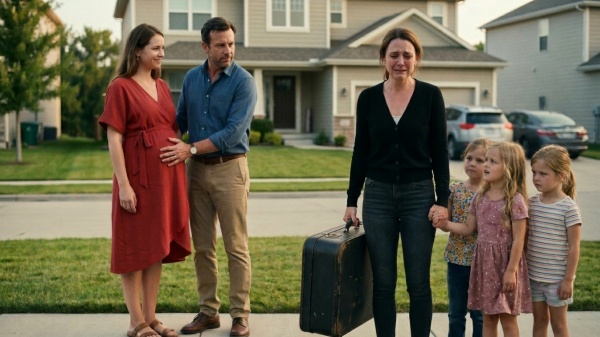
I Left My Wife and Daughters for the Son I Always Wanted — Then I Learned the Truth Too Late
I thought I was choosing the future I had always dreamed of: a new life, a new woman, and finally, the son I believed would complete me. So I signed the divorce papers, walked away from my wife, and broke the hearts of my two little girls. But after everything was legally over, the woman I chose told me the truth in a clinic waiting room. In that moment, I realized I had destroyed a real family for a promise that was never truly mine.
Part 1: The Family I Had and the Son I Thought I Needed
My name is Robert Mitchell, and I am thirty-eight years old. I am writing this from a studio apartment in Portland, Oregon, where the rent is $1,400 a month and the refrigerator hums louder than any human voice in the room. It is small, quiet, and painfully empty, which makes it the perfect place for a man who destroyed a full home and now has nowhere meaningful to go.
I am not writing this to make myself look like a victim. I am not the victim in this story. I am the man who had a good wife, two beautiful daughters, a warm house, and a life many people would have been grateful for, and I threw it away because I convinced myself that what I did not have mattered more than everything I did.
My ex-wife’s name is Jessica. Even now, calling her my ex-wife feels like swallowing glass, because there was a time when I believed she would be my wife until one of us was old and gray and holding the other’s hand in a hospital room. We met eleven years ago at a tech startup in Seattle, back when both of us were still young enough to think long hours and bad coffee were signs of ambition.
Jessica was a project coordinator, and she had the kind of competence that made chaotic people feel safe. She remembered deadlines, birthdays, meeting notes, dietary restrictions, and the names of everyone’s kids. She was not loud, but when she spoke, people listened because she usually had the answer everyone else had missed.
I was in product sales at the time, trying to become the kind of man who wore expensive watches and talked about equity like I understood the future. Jessica saw through some of that, I think, but she liked me anyway. She laughed at my jokes, even the ones that were not very good, and somehow made me feel less like I was pretending to be an adult.
We dated for two years before I proposed. I asked her during a weekend trip to the San Juan Islands, on a windy overlook where the water looked silver and the sky was the color of slate. She cried, said yes, and called her mother before we were even back in the car.
Our wedding was small and beautiful. Not Instagram beautiful, not the kind of wedding where people remember the flower wall more than the vows, but real beautiful. We got married with our families, a few close friends, salmon on the dinner menu, and a playlist Jessica made herself because she said no DJ could be trusted with our first dance.
For the first few years, we were happy in the way people are happy when they are tired but still on the same team. We rented a townhouse in Ballard, fought over parking, saved for a down payment, and ate cheap tacos on Fridays because we were trying to be responsible adults. Jessica made even ordinary evenings feel like they had been chosen carefully.
Then Emma was born.
I remember holding my first daughter in the hospital and feeling stunned by how small she was. Her hand wrapped around my finger, and everyone said I looked overwhelmed with love. I was. But I was also ashamed of the tiny, selfish disappointment I felt when the ultrasound had first revealed she was a girl.
I buried that feeling quickly. At least, I thought I did. I told myself we would have more children, that there was still time for the son I had imagined since I was a boy watching Mariners games with my dad.
Two years later, Jessica became pregnant again. This time, I was certain it would be a boy, not because of science or reason, but because wanting something badly can make a fool believe the universe owes him a pattern. When the technician smiled and said, “It’s a girl,” Jessica squeezed my hand, and I squeezed back.
I told her I was thrilled.
Part of me was.
Then Sophie arrived, fierce and pink and screaming like she had entered the world already offended by it. Jessica adored her instantly, the way she adored Emma. I loved both my daughters, and I need that to be clear, even though my choices later made it look like I did not.
But after Sophie’s delivery, things went wrong.
Jessica had severe complications and lost a frightening amount of blood. I remember doctors moving quickly, nurses speaking in controlled voices, my mother crying in the hallway, and me standing there useless, holding a newborn while the woman who had just given birth to her was rushed into emergency surgery. For several hours, I did not know whether my wife would survive.
She did survive, but the doctors were clear afterward. Another pregnancy would be dangerous. Not difficult, not inconvenient, but dangerous in a way no decent husband should ever ask his wife to risk.
Jessica cried when they told her. Not because she wanted a huge family, but because having the choice taken away hurt her. I held her hand and said all the right things.
“We have our girls,” I told her. “That’s enough.”
She believed me.
God help me, she believed me.
For a while, I believed myself too. We moved to Portland when I got a better job. We bought a modest but beautiful house in Northeast Portland with a front porch Jessica filled with potted herbs and a backyard where the girls ran barefoot in the summer. Jessica turned that house into the kind of place children remember with warmth for the rest of their lives.
She volunteered in classrooms. She packed lunches with little notes. She coached Emma’s soccer team when no other parent wanted to do it and sat beside Sophie during piano practice even when Sophie cried because her fingers “didn’t want to listen.” She gave up a promotion that would have required regular travel because she did not want the girls’ lives to become a spreadsheet of babysitters and missed bedtime stories.
Everyone told me I was lucky.
My parents said it. My sister said it. My coworkers said it after Jessica hosted a Fourth of July barbecue and somehow made everyone feel like family. I nodded and agreed because I knew it was true.
But inside me, resentment grew in a dark, embarrassing place I refused to examine.
I wanted a son.
I hated that sentence even then, because it made me sound small and ungrateful. But wanting does not become noble just because you hide it. I wanted to teach a boy how to throw a baseball, take him fishing on the Columbia River, give him my last name and see some younger version of myself running through the yard.
I know how ugly that sounds now. I know daughters can fish, play baseball, carry family names, inherit stories, and love their fathers with a loyalty sons are not guaranteed to give. I know that now because I learned it after losing the right to be trusted by the daughters I already had.
At the time, I let envy become a habit.
When friends posted photos of Little League games with their sons, I felt bitter. When my brother-in-law talked about teaching his boy to change a tire, I smiled while something in me twisted. I treated an imaginary son like a missing piece and my real daughters like evidence that life had cheated me.
That was the rot in me before Amber ever appeared.
She did not create it.
She only found it.
Part 2: The Affair I Chose and the Lies I Fed
I met Amber Hayes at a bar in downtown Portland on a Thursday night in March. I had gone out with coworkers after a client meeting, and I had been drinking more than I should have because the deal had gone well and praise had always been my favorite drug. Amber was our server, and she noticed me in a way I had not felt noticed in years.
She was twenty-eight, with dark hair, sharp eyes, and a smile that made every man at the table believe he was the one she had chosen to entertain. She laughed at my jokes. She touched my shoulder when she came by for drink orders. At the end of the night, she wrote her number on the bottom of my receipt.
I told myself I would throw it away.
I did not.
That is where the affair began, not when I texted her the next morning, not when we met for coffee, not when we kissed in the parking garage two weeks later. It began in the little private moment when I chose to keep the receipt. It began when I gave myself permission to become the kind of man I used to judge.
The first lie I told was not to Jessica.
It was to myself.
I told myself texting Amber was harmless. Then I told myself coffee was harmless. Then drinks were harmless because we were “just talking.” Then I told myself the first time I went to her apartment was a mistake, and a mistake only becomes a character flaw if you repeat it.
I repeated it for more than a year.
I became good at lying because I practiced constantly. I told Jessica I had late client calls, networking dinners, quarterly planning sessions, and overnight trips. I locked my phone, deleted messages, created a separate email address, and started paying cash for things like some pathetic amateur criminal in a movie.
The worst part is how ordinary the lies became.
I could kiss Sophie’s forehead goodnight and then drive across town to Amber’s apartment. I could sit at our kitchen table helping Emma with math homework while texting Amber under the table. I could listen to Jessica tell me about a school fundraiser and feel irritated that she was interrupting the fantasy life I was building at everyone else’s expense.
Amber lived in a one-bedroom apartment in the Pearl District. It had exposed brick, overpriced rent, and barely any furniture when I first started going there. Within a few months, I was paying $1,200 of her rent, buying her a couch, paying for dinners, covering car repairs, and sending her money whenever she said she was short.
I even helped her quit the bar.
A friend of mine knew someone who managed a medical office, and I got Amber hired as a receptionist. I told myself I was helping her get on her feet. In reality, I was making her more dependent on me because dependence felt like proof of love.
At home, Jessica noticed changes.
Of course she did.
She noticed that I was distracted. She noticed that I lost patience with the girls more quickly. She noticed new shirts, unfamiliar restaurant charges, and the way I turned my phone over when I left it on the counter.
One night, after the girls were asleep, she stood in the doorway of our bedroom while I pretended to answer work emails.
“Robert,” she said, “are you unhappy?”
I did not look up. “I’m just tired.”
“With me?”
I remember how small her voice sounded.
I should have confessed then. I should have told her everything. I should have fallen apart at her feet and begged for a chance to become someone better before I did more damage.
Instead, I sighed like she was being unreasonable.
“Jess, can we not do this tonight?”
That was how I trained her to stop asking. Not by convincing her nothing was wrong, but by making her feel guilty for noticing. I used her kindness against her.
Amber was the opposite of home, and that was what made her dangerous to a selfish man. She did not ask me to schedule dentist appointments, repair the leaky faucet, attend parent-teacher conferences, or remember that Sophie hated peas unless they were mixed into rice. She wanted dinner, drinks, attention, and money.
I mistook the absence of responsibility for romance.
I mistook being admired for being loved.
One night, about fourteen months into the affair, Amber and I were drinking wine in her apartment. I was relaxed, careless, and flattered because she had spent the evening telling me I deserved to be appreciated. Then she asked the question that should have made me leave and never come back.
“If I got pregnant with your son,” she said, “would you leave your wife?”
I remember laughing at first because the question sounded too dramatic, too direct, too much like something from a bad soap opera. But Amber did not laugh. She watched me with a stillness that made me feel like the answer mattered more than I understood.
I should have said no.
I should have said my daughters were enough. I should have said my wife had nearly died bringing Sophie into the world and that I would never punish her for surviving. I should have said any child conceived through betrayal deserved better than being used as a bargaining chip.
Instead, I said, “If you gave me a son, I would leave anyone.”
Amber smiled.
“Good to know,” she said.
That sentence should have haunted me immediately.
It did not.
I slept beside Jessica that night, listening to her breathe, and told myself the conversation with Amber had been meaningless. Just drunk talk. Just fantasy. Just another little sin in a life already full of them.
But Amber had heard exactly what she needed.
And I had handed her the weapon.
Part 3: The Pregnancy That Made Me Burn Down My Own House
Three months later, Amber told me she was pregnant.
She called me on a rainy Monday morning while I was in the parking lot outside my office. Her voice shook just enough to sound real, and she asked me to come over after work because she had something important to show me. When I got to her apartment, there was a positive pregnancy test on the bathroom counter.
I stared at it like it was a winning lottery ticket and a loaded gun at the same time.
Amber cried. I held her. I asked if she was sure, and she nodded, then showed me an appointment confirmation from an OB clinic. A week later, she showed me a grainy ultrasound image that I did not question because I saw what I wanted to see.
At first, I was terrified.
Then I became excited.
Then I became obsessed.
Amber said she wanted to wait until the anatomy scan around twenty weeks to find out the sex. I pretended to be patient, but inside, I was already building a life around the possibility of a boy. I imagined a nursery with navy walls, tiny sneakers near the door, and a son asleep on my chest while I watched late-night baseball highlights.
Meanwhile, Jessica was planning Sophie’s sixth birthday party.
She ordered cupcakes from a bakery in Sellwood, bought purple streamers, and asked me three times if I could pick up the balloons on Saturday morning. I forgot. She ended up taking both girls with her to get them, and when she came home, she looked so tired that for one second I almost confessed everything.
Then Amber texted: I miss you. The baby misses you too.
And I chose the lie again.
In February, Amber called me and told me to come to her apartment immediately. I left work early, claiming a family emergency, which was true in a twisted way. When I arrived, she opened the door holding an ultrasound photo and smiling like she had just handed me the future.
“It’s a boy,” she said. “Four months along. We’re having a son.”
I cannot describe the rush that went through me without hating myself. Joy. Relief. Triumph. All the ugly, childish longing I had hidden for years came roaring to the surface, and instead of feeling ashamed, I felt rewarded.
I picked Amber up and spun her around. I told her I loved her. I said the words quickly, easily, recklessly, because in that moment I loved what she represented more than I understood anything about her.
Then her smile changed.
“I want you to leave Jessica,” she said.
The room went quiet.
“I want us to be a real family,” she continued. “I want our son to have your last name and his father at home. I’m not going to be some secret woman raising your child while you go home to your perfect little wife.”
I told her it was complicated.
She said, “No, Robert. It’s simple. You file for divorce, or I’m not continuing this pregnancy.”
That sentence froze me.
I know how sensitive and personal pregnancy decisions are. I know now, in a way I did not understand then, that no man owns a woman’s body or has the right to control her medical choices. But in that room, with my selfish dream held in front of me, I did not think about autonomy, ethics, or the life of the woman I had betrayed.
I thought only about losing the son I believed I had finally been given.
Amber gave me two weeks.
Two weeks to choose.
The terrible truth is that there should have been no choice. Jessica had done nothing wrong. Emma and Sophie had done nothing wrong. Our marriage was wounded because I had stabbed it repeatedly and then blamed it for bleeding.
But I did not frame it that way.
I told myself I was choosing my child. I told myself a son needed his father. I told myself Jessica would recover, that the girls were young, that families changed all the time, that people survived divorce.
Selfish people love reasonable language.
It makes betrayal sound like planning.
I went home on a Thursday night and found Jessica in the kitchen packing lunches for the next day. Emma had a field trip, Sophie wanted a heart-shaped sandwich, and Jessica was writing their names on brown paper bags with a blue Sharpie. The house smelled like tomato soup and grilled cheese.
I stood in the doorway and said, “We need to talk.”
She looked up immediately.
I think part of her already knew.
I told her I was unhappy. I told her we had grown apart. I told her I did not think counseling would fix it. I used every cowardly sentence men use when they want to leave without admitting they have already built somewhere else to land.
Jessica sat down slowly.
“Is there someone else?” she asked.
I lied.
“No.”
She stared at me for a long time. Then she said, “Do not insult me on top of leaving me.”
That should have stopped me.
It did not.
I told her the truth in pieces because I was too cowardly to say it cleanly. There was someone else. Her name was Amber. She was pregnant. I believed the baby was a boy. I was leaving.
Jessica made a sound I had never heard from another human being.
It was not a scream. It was something smaller and worse, like all the air had been crushed out of her at once. She slid from the chair to the floor, shaking so hard I thought she was having a seizure.
I called 911.
The paramedics came. My daughters woke up and stood at the top of the stairs crying while strangers carried their mother out on a stretcher. Emma kept asking, “Daddy, what happened to Mommy?” and I could not answer because the honest answer was: I happened to Mommy.
At the hospital, Jessica was treated for a severe panic attack and emotional distress. Her sister, Lauren, arrived and slapped me across the face in the parking lot. I did not report it, not because I was noble, but because some part of me knew I deserved worse.
My parents called me the next day.
My mother cried. My father called me a fool. My sister said she could not believe I had become the kind of man she would warn her daughters about.
Still, I kept going.
Jessica filed for divorce two weeks later. Oregon is a no-fault divorce state, and once the process started, it moved with a cold efficiency that made me feel like my life was being dismantled by forms. Because I did not contest much, because guilt made me generous and Amber made me impatient, the settlement came together faster than anyone expected.
Jessica kept the house, at least until the girls were older. She received primary custody. I agreed to child support of $2,800 per month, plus medical expenses and school-related costs. Half our savings went to her, as they should have.
I signed the papers in March.
The divorce was finalized in May.
When I walked out of the courthouse, Amber was waiting in the car.
She kissed me and said, “Now we can finally be happy.”
I believed her.
That may have been the stupidest thing I ever did.
Part 4: The Truth After the Papers Were Signed
I married Amber in June, two weeks after my divorce from Jessica was final.
It was a courthouse ceremony in downtown Portland, with two of Amber’s friends as witnesses and no one from my family present. My parents refused to come. My sister sent a text that said, You are confusing consequences with love. Do not contact me today.
Amber wore a white dress that hugged her stomach, and I remember feeling proud as we stood together. Proud. That word disgusts me now.
She was visibly pregnant by then, and I saw every stranger’s glance as confirmation that I had made the right choice. I was building a new family. I was becoming the father of a son. I had destroyed one life, yes, but I told myself another life was beginning.
We moved into a two-bedroom apartment in Beaverton that cost $2,200 a month. It was more than I could comfortably afford with child support, legal fees, and Amber’s spending, but I told myself it was temporary. Once the baby came, everything would feel worth it.
That was the lie I repeated every morning while I made coffee in a kitchen that did not feel like home.
Amber changed after the wedding.
Or maybe she simply stopped performing.
She became irritated whenever I mentioned budgeting. She rolled her eyes when I talked about saving for the baby. She spent money on clothes, brunches, salon appointments, and weekend trips with friends while I was calculating whether I could pay rent, child support, and the minimum on two credit cards in the same week.
When I asked about prenatal appointments, she got vague.
When I asked if I could come, she said she preferred going alone because I made her anxious. When I asked for updated ultrasound pictures, she said the clinic had technical issues, or she forgot, or the baby was positioned badly. I accepted these answers because doubt would have required me to face what I had done.
In July, I insisted on going to an appointment with her.
I took the morning off work, bought coffee, and drove us to the clinic address she gave me. In the waiting room, I held her hand and thought about names. Robert Jr. felt too arrogant, but James sounded solid. William sounded timeless. Maybe we would call him Liam.
Amber was unusually quiet.
Then, five minutes before the appointment time, she pulled her hand away.
“We don’t need to go in,” she said.
I looked at her. “What do you mean?”
She sighed like I had asked something annoying. “I ended the pregnancy last week.”
For a second, the words did not become language in my head.
“What?”
“I ended it,” she said. “I’m not ready to have a baby. I thought I was, but I’m too young for this. I want to travel. I want to enjoy being married. We can have a kid later.”
I stared at her.
The waiting room continued around us. A couple filled out forms. A woman at the front desk answered the phone. Somewhere down the hall, someone laughed softly, and I remember thinking it was obscene that the world could keep making normal sounds while mine collapsed.
“You told me it was a boy,” I said.
Amber looked away.
“You told me if I didn’t leave Jessica, you wouldn’t continue the pregnancy.”
“I was scared,” she said. “And you said you wanted a son. I needed to know you were serious about me.”
I stood up too quickly, and the chair scraped against the floor.
People looked over.
“Was it even a boy?” I asked.
Amber’s silence answered before her mouth did.
“I don’t know,” she said.
The room tilted.
I had left my wife for an idea. I had broken my daughters’ hearts for an ultrasound I had not verified, a promise I wanted too badly, and a woman who had learned exactly which wound to press.
“Was the ultrasound real?” I asked.
She crossed her arms. “You’re being dramatic.”
“Was it real?”
“I was pregnant,” she snapped under her breath. “That part was real.”
“That part?”
Her eyes hardened. “Don’t act like you’re some innocent victim. You were married. You wanted a son more than you wanted your family. I gave you a reason to do what you already wanted to do.”
I wanted to hate her completely.
I did hate her in that moment.
But what made her words unbearable was that part of them was true.
I had chosen this. I had not been hypnotized. I had not been dragged away from my family by force. Amber had manipulated me, yes, but she had manipulated a desire I had protected instead of confronting.
I walked out of the clinic before I said something I could not take back.
Amber followed me to the parking lot, angry now. “Robert, calm down. We can have another baby later.”
“No,” I said.
“What do you mean, no?”
“I mean I gave up everything for this.”
She rolled her eyes. “You gave up a marriage you said was miserable.”
“It wasn’t miserable,” I said, and the truth hit me so hard I almost doubled over. “I was.”
Amber stared at me.
I got in the car, but I did not drive her home. I called a rideshare for her, then drove aimlessly for three hours through Portland, past neighborhoods I barely saw, across bridges, along streets where families pushed strollers and people walked dogs and life continued with insulting normalcy.
That night, I moved into a hotel.
A week later, I rented this studio.
I filed for divorce from Amber in August. I asked about an annulment first, but my attorney explained that Oregon annulments are limited and complicated, and my situation would most likely require a divorce. Amber did not fight it. By the time she was served, she was already spending time with another man.
The divorce was finalized in November.
My second marriage lasted less than six months.
My first marriage had lasted nearly nine years.
Only one of them had been real.
And I had destroyed the real one.
Part 5: The Life I Cannot Get Back
After Amber, I started learning things I should have known before I ever trusted her.
Some came from mutual acquaintances. Some came from people who contacted me after hearing what happened. I cannot prove every story, and I am careful now about repeating things as facts when they come through wounded people and rumor, but a pattern emerged that made me feel even more foolish.
Amber had a history of attaching herself to men who were married, lonely, financially stable, or desperate to feel young again. She had told at least one other man she was pregnant. Another had given her thousands of dollars for “baby expenses” before she disappeared from his life. A third claimed she used someone else’s ultrasound image to pressure him into leaving his girlfriend.
Maybe all of it was true.
Maybe only some of it was.
It almost does not matter, because the most important truth is the one I already know: I wanted the lie badly enough to stop asking questions.
I tried to go back to Jessica.
That sentence makes me sound even worse, because it was not love at first. It was panic. It was a man standing in the ruins of his fantasy, looking back toward the home he had burned down and wondering if the walls might somehow still be standing.
I called her. She did not answer.
I sent emails. She did not respond.
I mailed a letter to the house, then another, then flowers, until her attorney contacted mine and made it clear that further unwanted contact outside parenting communication would create legal problems for me. That was the first time I truly understood that remorse does not entitle you to access.
Finally, we met in a family mediation office to discuss the girls.
Jessica looked different.
Not worse. Not broken. Different.
Her hair was shorter. She wore a navy sweater I did not recognize. She looked tired, yes, but there was a steadiness in her that made my chest ache because I realized she had found it without me.
“Jess,” I said, and my voice cracked.
She looked at me like I was someone she used to know from a painful dream.
“I’m sorry,” I said. “I know that means nothing, but I am. Amber lied to me. The baby—”
Jessica raised one hand.
“Do not,” she said.
I stopped.
“Do not come in here and make your regret about Amber,” she continued. “You did not leave because she lied. You left because you wanted to. You chose a fantasy over your family, and now that the fantasy is gone, you want the family to still be waiting.”
I started crying.
I hate admitting that, but it is true.
Jessica did not cry.
That hurt more.
“You made your choice, Robert,” she said. “I am not your backup plan.”
I asked if she could ever forgive me.
She looked down at her hands for a long time. Her wedding ring was gone. The pale mark where it used to be was gone too.
“I am working on forgiving you for my own peace,” she said. “But forgiveness is not reconciliation.”
That sentence has lived in me ever since.
The girls did not want to see me at first.
Emma, who was eight, understood enough to be furious. She told Jessica’s sister that I had “picked a baby boy over us.” Hearing that sentence nearly destroyed me because it was exactly what I had done, even if I had dressed it up in adult language.
Sophie was six, and her hurt came out differently.
She asked if I had moved away because she was bad. She asked Jessica whether daddies could stop being daddies. She asked during one video call if my “new family” had better toys.
I had no answer that did not make me sound like a monster.
The court did not permanently take my children away from me. That is not how these things usually work when there is no abuse finding, no addiction issue, and no danger in the legal sense. But because the girls were deeply distressed and because I had acted unpredictably during the breakdown of the marriage, our parenting plan started carefully.
Supervised visits.
Parenting classes.
Therapy recommendations.
Structured communication through a co-parenting app.
Four hours every other Saturday in a visitation center where the walls were painted cheerful colors and every adult looked like they had seen every kind of human failure. I would sit at a small table with Emma and Sophie, trying to play Uno or help them color, while a social worker quietly observed from across the room.
Emma barely spoke to me.
Sophie sometimes forgot to be angry and climbed into my lap, then remembered and climbed down.
That was the punishment I deserved, and it was still almost more than I could bear.
I used to think losing a marriage would feel like one big event. A door slamming. A suitcase packed. Papers signed in a courthouse.
It is not like that.
It is a thousand small losses.
It is not knowing what your daughter wants for her birthday because you were not there when she started liking sea turtles. It is seeing a photo of Emma’s soccer game on Jessica’s sister’s social media and realizing another man, Jessica’s father, taught her the new move she had been practicing. It is paying child support every month and knowing money is the easiest part of fatherhood, not the hardest.
It is walking through Target and seeing purple lunch bags like the ones Jessica used to buy.
It is hearing a dad call his daughter “kiddo” in the cereal aisle and having to leave the store because grief has made you pathetic in public.
It is realizing your daughters were never consolation prizes.
They were the gift.
And you were too blind to see it while they still ran to the door when you came home.
My life now is not dramatic.
It is small.
I work, pay $1,400 in rent, pay $2,800 in child support, attend therapy every Wednesday, and show up to every scheduled visit with the girls even when Emma refuses to look at me. I send appropriate messages through the parenting app and do not ask Jessica personal questions. I do not beg anymore.
Begging is often just selfishness wearing regret as a costume.
Real remorse, I am learning, is quieter.
It is respecting the boundary even when it hurts. It is answering your daughter honestly when she asks a painful question without making her comfort you afterward. It is accepting that the people you hurt get to decide what healing looks like, even if healing excludes you.
My parents are civil but distant. My mother still says she loves me, but her voice has changed. My father talks mostly about work, weather, and the Mariners because he does not know how to speak to the son who abandoned his granddaughters.
My sister barely speaks to me.
When she does, she is blunt.
“You did not just cheat on Jessica,” she told me once. “You taught your daughters that their father thought a hypothetical boy was worth more than them.”
I wanted to argue.
I could not.
Because that is exactly what my actions said.
I do not know whether Jessica will ever remarry. Part of me hopes she finds someone kind, steady, and honest. Another part of me, the selfish part I am still trying to kill, feels sick imagining another man sitting at the dinner table I left behind.
But if that day comes, I will have no right to object.
Love is not ownership.
Marriage is not a storage unit where you can leave your family while you chase something else, then come back expecting everything to be untouched.
If Jessica finds happiness without me, that will not be an injustice.
It will be evidence that life can grow over ruins.
As for Amber, I have not spoken to her since our divorce was finalized. Sometimes I wonder whether she ever thinks about what she did. Most days, I understand that question is just another way of keeping her in the center of a story where my choices matter more.
Amber lied.
Amber manipulated.
Amber used my weakness.
But I opened the door.
I was the one who stood in my kitchen and told a good woman she was not enough. I was the one who watched my daughters cry and still walked out. I was the one who signed the divorce papers because I believed a son I had not even met mattered more than the daughters who loved me already.
That is the truth I live with.
Not that Amber destroyed my family.
I did.
I am thirty-eight years old, and I had everything people spend their lives trying to build. A wife who loved me. Children who trusted me. A home filled with noise, drawings on the fridge, soccer cleats by the door, bedtime stories, grocery lists, school forms, and ordinary happiness.
I called it boring.
I called it incomplete.
I called it not enough.
Now I come home to a studio apartment where no one has left shoes in the hallway, no one asks for help with homework, no one complains about broccoli, and no one runs to hug me. The silence is clean and total. It is the sound of getting exactly what my selfishness earned.
So if any man reads this while standing at the edge of the same mistake, hear me clearly.
Do not trade your real family for an imaginary life.
Do not confuse novelty with love.
Do not let disappointment turn into entitlement.
Do not punish your wife for surviving something dangerous. Do not make your daughters carry the shame of your obsession with having a son. Do not believe that the thing missing from your fantasy is more valuable than the people already sitting at your dinner table.
Because one day, the fantasy may collapse.
The person who promised you everything may walk away.
The child you thought would justify your betrayal may never exist.
And when you turn around, the family you abandoned may no longer be waiting.
Jessica once told me that love was built in ordinary moments. Packing lunches. Folding towels. Sitting through school concerts. Remembering which child needed the nightlight and which one wanted the door cracked open.
I thought ordinary meant replaceable.
I was wrong.
Ordinary was the treasure.
And I spent it like a fool.
