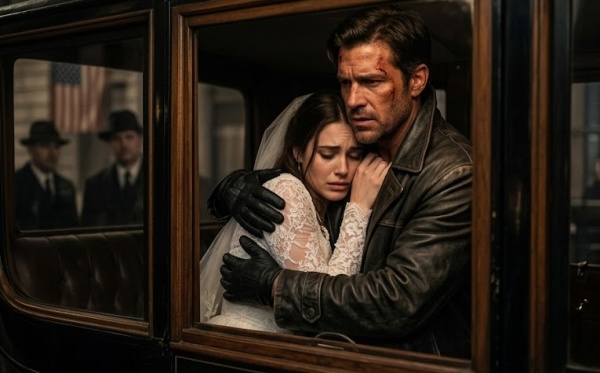
I Fled Her Forced Wedding and Hid in New Orleans’ Most Feared Billionaire’s Rolls-Royce: “I’ll protect you”. But the price of that protection changed her life forever.
I was running through New Orleans in a wedding dress, fleeing an arranged marriage to a man I didn’t love, when I made the most desperate decision of my life: I hid in a stranger’s Rolls-Royce. That stranger was Damien Blackwell, the most feared billionaire in the city, worth $3.8 billion and known as “The Devil of New Orleans.” When he found me shaking on his car floor, he whispered, “I’ll protect you.” But the price of that protection changed her life forever.
Part 1: The Wedding I Never Wanted
My name is Sophia Martinez, and I’m 24 years old. The night that changed my life forever started like a nightmare—with me running through the streets of New Orleans in a wedding dress I never wanted to wear, fleeing a marriage I never agreed to, desperate to escape a future that had been decided for me without my consent.
Let me back up and explain how I ended up in that situation. I grew up in New Orleans, in a tight-knit Latino community where family honor and tradition meant everything. My father, Miguel Martinez, owned a successful chain of restaurants across Louisiana—nothing fancy, but profitable enough that our family was comfortable. We lived in a nice four-bedroom house in Metairie, a suburb just outside New Orleans, and my father’s restaurants brought in about $2 million in revenue annually, leaving him with a personal income of around $300,000 a year after expenses.
My mother died when I was 16, and after that, my father became increasingly controlling. He had very traditional ideas about what a woman’s role should be—get married young, have children, support your husband, don’t pursue your own ambitions. I, on the other hand, had dreams of going to college, becoming a journalist, maybe moving to New York or Los Angeles and working for a major publication. I’d been accepted to Tulane University with a partial scholarship, planning to major in communications and journalism.
But my father had other plans. When I was 23, he sat me down and told me he’d arranged a marriage for me with Carlos Reyes, the 35-year-old son of his business partner. Carlos’s father, Hector Reyes, owned a construction company that did commercial development throughout the Gulf Coast, and he was worth an estimated $15 million. The marriage was supposed to strengthen the business relationship between our families and, in my father’s words, “secure my future.”
I was horrified. “Dad, you can’t be serious. This is 2023, not 1823. You can’t just arrange a marriage for me like I’m property.” My father’s face hardened. “Sophia, this is what’s best for you and for our family. Carlos is a good man from a good family. He’ll take care of you. The wedding is in six months, and that’s final.”
I tried everything to get out of it. I argued, I pleaded, I cried. I even tried to run away once, but my father found me at my friend’s apartment and dragged me home. He threatened to cut me off completely—no money for college, no support, nothing—if I didn’t go through with the marriage. He also made it clear that if I embarrassed him by refusing, he’d make sure I was cut off from our entire extended family and community. In our culture, family is everything, and being disowned meant losing not just my father but my aunts, uncles, cousins, everyone I’d grown up with.
So I went along with the wedding preparations, feeling more trapped with each passing day. I met Carlos a few times—he was polite but cold, clearly viewing this marriage as a business arrangement rather than a romantic relationship. He talked about his expectations for me: I’d quit school, stay home, have children within the first year, and focus on being a good wife. When I tried to talk about my own dreams and goals, he dismissed them. “You won’t need to work,” he said. “I make $200,000 a year. That’s more than enough for both of us.”
The wedding was scheduled for a Saturday evening in late October at a historic venue in the French Quarter—a beautiful old building with a courtyard and fountain, rented for $8,000 for the night. My father had invited 200 guests and spent over $50,000 on the wedding—the dress, the flowers, the catering, the band. It was supposed to be the social event of the season in our community.
The day of the wedding, I went through the motions like a zombie. I let the hairstylist do my hair in an elaborate updo. I let the makeup artist paint my face. I put on the wedding dress my father had chosen—a traditional white gown with a long train and intricate lace detailing that cost $4,500. I looked in the mirror and barely recognized myself. I looked like a bride, but I felt like a prisoner.
Part 2: The Escape That Changed Everything
The wedding ceremony was scheduled for 6:00 PM. At 5:45 PM, I was in a small room at the venue, waiting for my father to come get me for the processional. My hands were shaking. My heart was pounding. I felt like I couldn’t breathe. And suddenly, with a clarity that felt like a lightning bolt, I realized: I couldn’t do this. I couldn’t marry Carlos. I couldn’t give up my dreams and my freedom. I’d rather lose my family, my community, everything, than spend the rest of my life trapped in a marriage I never wanted.
So I ran. I grabbed my phone and a small purse with my ID and $200 in cash, hiked up my wedding dress, and slipped out a side door of the venue. I could hear music starting inside—the ceremony was about to begin. In minutes, everyone would realize I was gone. I had to move fast.
I ran through the French Quarter in my wedding dress and heels, drawing stares from tourists and locals alike. People probably thought I was doing some kind of photo shoot or bachelorette party stunt. If only they knew. I could hear my phone ringing constantly—my father, Carlos, my bridesmaids—but I ignored it. I just kept running, my lungs burning, my feet aching in the uncomfortable heels.
After about ten minutes of running, I realized I had no plan. I had $200, no credit cards (my father controlled all my accounts), and nowhere to go. I couldn’t go to friends’ houses—my father would check there first. I couldn’t go to a hotel—$200 wouldn’t get me far, and I’d need an ID which could be traced. I was in a full panic, standing on a street corner in the French Quarter, when I saw it: a black Rolls-Royce Phantom parked on the street, engine running, driver’s door open.
The car was worth at least $450,000, gleaming and pristine, clearly belonging to someone very wealthy. The driver had stepped away—probably gone into a nearby building for something—and the back door was unlocked. Without thinking, operating purely on instinct and desperation, I opened the back door and climbed inside, crouching down on the floor behind the front seats. I pulled my wedding dress around me, trying to make myself as small as possible, and prayed the driver wouldn’t notice me when he returned.
I heard footsteps, then the driver’s door closing. The car started moving, gliding smoothly through the streets. I stayed frozen on the floor, barely breathing, wondering what the hell I was going to do next. Maybe I could wait until the car stopped at a red light and slip out. Maybe I could—
“You can come out now.” The voice was deep, male, and came from the back seat directly above me. I nearly screamed. I looked up and saw a man sitting in the back seat, looking down at me with an expression that was equal parts amused and curious. He was probably in his mid-30s, devastatingly handsome, with dark hair, sharp features, and eyes that seemed to see right through me. He was wearing an impeccably tailored black suit that probably cost more than my father’s car.
“I—I’m sorry,” I stammered, starting to scramble toward the door. “I’ll get out. I didn’t mean to—” “Stop,” he said, his voice commanding but not unkind. “You’re shaking. And you’re wearing a wedding dress. I’m guessing you’re running from something. Or someone.”
I froze, torn between the instinct to run and the realization that I had nowhere to go. “Please,” I whispered, my voice breaking. “Please don’t call the police. I just need… I need time to think. I need to figure out what to do.”
The man studied me for a long moment, his expression unreadable. Then he leaned forward and spoke to his driver. “Marcus, take us to the penthouse. And make sure we’re not followed.” He looked back at me. “Sit up. You’re safe. For now.”
I climbed onto the seat, my wedding dress bunching around me awkwardly. “Who are you?” I asked, my voice barely above a whisper. A slight smile played at the corner of his mouth. “My name is Damien Blackwell. And based on the way you’re looking at me, I’m guessing you’ve heard of me.”
My blood ran cold. Everyone in New Orleans had heard of Damien Blackwell. He was the most powerful and feared businessman in the city—some said in the entire South. He owned Blackwell Industries, a conglomerate that controlled everything from real estate to shipping to technology, with an estimated worth of $3.8 billion. But his wealth wasn’t what made people fear him. It was the rumors about how he’d acquired that wealth and what he did to people who crossed him.
Part 3: The Devil’s Bargain
Damien Blackwell was known as “The Devil of New Orleans” in certain circles. Not because he was violent or openly criminal—he was far too smart for that. But because he had a reputation for being absolutely ruthless in business, for destroying competitors without mercy, and for having connections that extended into every corner of the city’s power structure. Politicians, judges, police chiefs—everyone owed Damien Blackwell favors or feared his influence.
There were rumors, never proven, that people who seriously crossed Damien had a way of losing everything—their businesses mysteriously failing, their reputations destroyed by scandals, their assets seized by sudden legal troubles. He operated in the gray areas of the law, always technically legal but morally questionable. And now I was sitting in his car, in a wedding dress, completely at his mercy.
“I know who you are,” I said quietly. “Everyone knows who you are.” Damien nodded. “Then you know I’m not someone to be trifled with. So I’m going to ask you once, and I want the truth: whose wedding were you running from, and why?”
I took a shaky breath and told him everything. About my father’s arranged marriage, about Carlos, about feeling trapped and desperate. About running from the venue with no plan and no resources. When I finished, Damien was silent for a moment, his expression thoughtful.
“Your father is Miguel Martinez,” he said. It wasn’t a question. “The restaurant owner. And Carlos Reyes is Hector Reyes’s son. I know both families. Your father owes me money, actually—I fronted him a loan two years ago to expand his restaurant chain. $500,000 at 8% interest. He’s been making payments, but he’s behind schedule.”
My stomach dropped. Of course my father owed Damien Blackwell money. Of course this situation was even more complicated than I’d thought. “I didn’t know,” I whispered. “I didn’t know about any loan.”
“I’m sure you didn’t,” Damien said. “Your father doesn’t strike me as the type to discuss business with his daughter. But here’s the situation, Sophia. Your father is going to be looking for you. So is Carlos and his family. And when they can’t find you, they’re going to be very angry. Your father will lose face in the community. The Reyes family will feel insulted. It’s going to cause problems.”
“I know,” I said, tears starting to fall. “I know I’ve ruined everything. But I couldn’t do it. I couldn’t marry someone I don’t love, give up everything I want for my life, just to make my father happy.” Damien reached into his jacket and pulled out a handkerchief, handing it to me. “I’m not judging you. I’m simply stating facts. Now, here’s what I’m going to offer you.”
He leaned back in his seat, his eyes never leaving my face. “I’ll protect you. I’ll make sure your father and the Reyes family can’t force you into anything. I’ll provide you with a place to stay, security, and enough money to start over. I’ll even pay for you to finish your education at Tulane if that’s what you want.”
It sounded too good to be true. “Why would you do that?” I asked suspiciously. “What do you want in return?” Damien smiled, but it didn’t reach his eyes. “I want you to work for me. I need someone I can trust, someone who’s intelligent and observant, someone who can move in certain social circles without drawing suspicion. You’d be my assistant, my representative at events, and occasionally, my companion when I need someone presentable at my side. Think of it as a job, with very generous compensation.”
“How generous?” I asked, my mind racing. “I’ll pay you $150,000 a year, plus cover all your living expenses—apartment, car, clothes, everything you need. You’ll work for me for three years. After that, if you want to leave, you’re free to go with no strings attached. I’ll even write you a recommendation letter for whatever career you want to pursue.”
It was an insane amount of money for someone my age with no work experience. It was also clearly more than just a job offer. “What exactly would I have to do as your ‘companion’?” I asked carefully. Damien’s expression didn’t change. “Attend events with me. Business dinners, charity galas, social functions. You’d be expected to look presentable, make conversation, and represent me well. Nothing illegal, nothing you’re uncomfortable with. I’m not asking you to be my mistress, if that’s what you’re worried about. This is a professional arrangement.”
“And if I say no?” I asked. “Then I’ll have my driver take you wherever you want to go, and you’ll never see me again,” Damien said. “But Sophia, be realistic. You have $200 and nowhere to go. Your father will find you eventually, and when he does, you’ll be right back where you started. I’m offering you a way out. A real way out. The question is whether you’re brave enough to take it.”
Part 4: The Price of Protection
I sat in that Rolls-Royce, my wedding dress crumpled around me, and thought about my options. I could refuse Damien’s offer and try to make it on my own with $200 and no support system. I could go back to my father and face the consequences of running from the wedding. Or I could accept this devil’s bargain and work for the most feared man in New Orleans for three years.
“If I agree,” I said slowly, “I want it in writing. A contract that specifies exactly what I’m expected to do, how much I’ll be paid, and that I can leave after three years with no retaliation.” Damien looked impressed. “Smart. I’ll have my lawyers draw up a contract tomorrow. In the meantime, you’ll stay in my guest suite at my penthouse. We’ll get you some clothes and necessities, and we’ll figure out how to handle your father.”
“How are you going to handle my father?” I asked nervously. Damien’s smile was cold. “I’m going to call him and explain that you’re under my protection now. I’m going to remind him about the $500,000 he owes me, and I’m going to suggest that if he wants favorable terms on that loan, he’ll leave you alone and cancel any plans to force you into marriage. Your father is a businessman. He’ll understand the math.”
It felt surreal. An hour ago, I’d been running through the streets in a wedding dress with no plan. Now I was sitting in a billionaire’s car, negotiating a three-year employment contract that would completely change my life. “Okay,” I said finally. “I’ll do it. I’ll work for you for three years.”
“Excellent,” Damien said. He extended his hand, and I shook it, feeling like I was sealing a pact with the devil himself. “Welcome to Blackwell Industries, Sophia. I think this is going to be a very interesting arrangement.”
We arrived at Damien’s penthouse—a stunning 8,000-square-foot space on the top floor of a luxury high-rise in the Central Business District, with floor-to-ceiling windows overlooking the Mississippi River. The penthouse was worth an estimated $12 million and was decorated with modern furniture, original artwork, and the kind of understated luxury that screamed wealth. Damien showed me to a guest suite that was bigger than my entire bedroom at my father’s house, with a king-size bed, a marble bathroom, and a walk-in closet.
“Get some rest,” he said. “Tomorrow we’ll go shopping for clothes and essentials. And I’ll call your father.” After he left, I sat on the edge of the bed in my wedding dress and started to cry. Not sad tears, but tears of relief and fear and overwhelming emotion. I’d escaped. I was free. But I’d also just agreed to work for a man who terrified half the city, and I had no idea what I’d really gotten myself into.
The next morning, I woke up to find a selection of clothes laid out for me—jeans, t-shirts, a sweater, all in my size. There was also a note from Damien: “Wear these for now. We’ll get you a proper wardrobe this afternoon. Come to the dining room for breakfast at 9 AM.” I got dressed and made my way to the dining room, where Damien was sitting at a long table, reading the newspaper and drinking coffee. He looked up when I entered. “Good morning. How did you sleep?”
“Better than I expected,” I admitted. “Thank you for the clothes.” “You’re welcome. Sit down. We have things to discuss.” Over breakfast—prepared by Damien’s private chef and far fancier than anything I’d ever eaten—Damien explained what had happened after I’d gone to bed. “I called your father last night. As expected, he was furious. He demanded I return you immediately. I explained that you’re an adult who made a choice, and that you’re under my protection now. I also reminded him about his loan and suggested that his cooperation would be in his best interest.”
“What did he say?” I asked, my stomach churning. “He said a lot of things, most of which I won’t repeat. But ultimately, he agreed to leave you alone. He’s not happy about it, but he’s a practical man. He knows he can’t fight me.” Damien took a sip of his coffee. “The Reyes family is another matter. Hector Reyes is very angry about the canceled wedding. He feels insulted, and he’s demanding compensation for the embarrassment.”
“Compensation?” I said incredulously. “What kind of compensation?” “Money, most likely. Or a business favor. I’ll handle it. That’s part of what you’re paying me for—protection from situations like this.” It was a strange feeling, having someone else handle my problems. Part of me felt relieved. Part of me felt like I’d traded one form of control for another.
Part 5: The Life I Never Expected
That was three years ago. Today, I’m 27 years old, and my three-year contract with Damien Blackwell ended six months ago. I could have left. I could have taken my savings—I’d managed to save about $200,000 from my salary over three years—and started fresh somewhere else. But I didn’t. Because somewhere along the way, this arrangement became something more than a business deal.
Working for Damien was nothing like I’d expected. Yes, I attended events with him—charity galas, business dinners, art openings. Yes, I represented him in social situations and made connections on his behalf. But he also encouraged me to go back to school. I enrolled at Tulane and finished my degree in journalism, taking classes during the day and working for Damien in the evenings and on weekends. He paid for everything—tuition, books, supplies—and never complained when my school schedule conflicted with work.
He also turned out to be nothing like his reputation. Yes, he was ruthless in business. Yes, he had power and influence that bordered on frightening. But he was also intelligent, surprisingly kind, and genuinely interested in helping me build a future. He introduced me to people in the journalism industry. He helped me get internships at major publications. He gave me advice and guidance that went far beyond what any employer would typically provide.
And slowly, over three years of working closely together, attending events together, spending countless hours in conversation, something shifted between us. It wasn’t something either of us planned or expected. It was just… there. A connection, a chemistry, a feeling that grew stronger with each passing month.
Six months ago, when my contract ended, Damien took me to dinner at the most expensive restaurant in New Orleans—a place where a meal for two cost $800. “Your contract is up,” he said over dessert. “You’re free to go, just like I promised. I’ve already written your recommendation letter. You can pursue any career you want, and I’ll support you however I can.”
I looked at him across the table, this man who’d terrified me three years ago and who now meant more to me than I wanted to admit. “What if I don’t want to go?” I asked quietly. Damien’s expression was carefully neutral. “Then you’re welcome to stay. But Sophia, if you stay, I need to know it’s because you want to, not because you feel obligated or trapped.”
“I want to stay,” I said. “Not as your employee. Not because of a contract. But because… because I want to be with you. If you want that too.” For the first time since I’d met him, Damien looked uncertain. “I’ve wanted that for longer than I should admit,” he said. “But I didn’t want to pressure you while you were working for me. I didn’t want you to feel like you had to say yes because I had power over you.”
“You don’t have power over me anymore,” I said. “The contract is over. I’m free to make my own choices. And I choose you.” That was six months ago. Today, I’m still in New Orleans, but my life looks completely different than it did three years ago. I graduated from Tulane with honors. I have a job as a junior reporter at the Times-Picayune, making $48,000 a year—not much, but it’s honest work that I love. I have my own apartment in the French Quarter, paid for with my own money. And I have Damien, who went from being my savior to my employer to my partner.
My father and I have a complicated relationship now. We talk occasionally, but there’s a distance between us that may never fully heal. He never apologized for trying to force me into marriage, but he did eventually admit that I “made the right choice for myself.” It’s not much, but it’s something. Carlos married someone else—a woman his family chose for him—and from what I hear, they’re about as happy as you’d expect from an arranged marriage.
As for Damien, he’s still the most feared businessman in New Orleans. But to me, he’s the man who saw a terrified girl in a wedding dress hiding in his car and offered her a way out. He’s the man who kept his promises, who protected me when I had no one else, and who gave me the freedom to choose my own future. Yes, there was a price for his protection—three years of my life, working for him, being part of his world. But looking back, I’d pay that price again in a heartbeat.
Because that night I ran from a forced marriage and hid in a billionaire’s car didn’t just change my life. It gave me my life back. And sometimes, the devil you make a deal with turns out to be your salvation.
