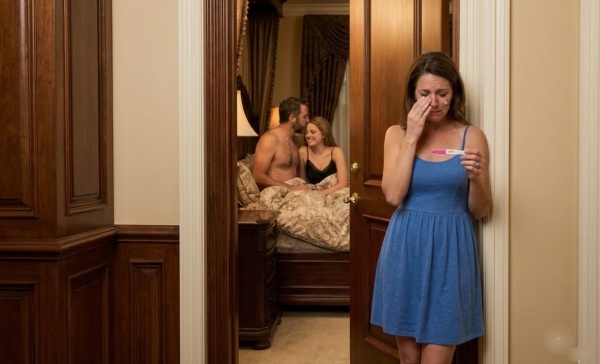
I Came Home With a Positive Pregnancy Test — Then Heard My Husband Whisper in the bedroom to another woman, “My Wife Will Never Know”…
I thought I was bringing home the happiest news of our seven-year marriage: a positive pregnancy test and a tiny pair of baby booties hidden in my purse. But when I opened our front door, I found two wineglasses in the hallway and heard another woman laughing upstairs in our bedroom. Then my husband whispered, “My wife will never know,” and the future I had imagined for our baby shattered before I ever got to tell him she existed. By morning, I understood that the child growing inside me was not a reason to stay in a lie — she was the reason I had to leave one…
PART I — THE SURPRISE IN MY PURSE
I thought I was coming home with the best surprise of our marriage.
At 5:48 p.m. on a rainy Thursday in Seattle, I sat in my car outside a small baby boutique in Queen Anne, staring at the tiny white booties in the paper bag on the passenger seat. They were soft, ridiculous, and barely bigger than my thumbs. I had bought them fifteen minutes after the nurse called and confirmed what three home pregnancy tests had already told me.
I was pregnant.
After two years of negative tests, specialist appointments, blood draws, ovulation calendars, quiet crying in bathrooms, and pretending I was happy at other people’s baby showers, I was finally pregnant.
I kept saying it out loud in the car.
“I’m pregnant.”
Then, because saying it once was not enough, I whispered, “We’re having a baby.”
The words felt impossible.
Beautiful.
Terrifying.
I imagined Ethan’s face when I told him. My husband had wanted to be a father since before we were married. He was the man who waved at babies in grocery stores, who crouched down to talk to toddlers like they were tiny executives, who saved articles about college funds and car seat safety long before we had any reason to shop for either.
At least, that was the man I believed I was married to.
My name is Mara Collins, though for seven years I had been Mara Whitaker. I was thirty-four, a senior marketing manager for a healthcare software company downtown, and I lived with my husband, Ethan, in a Craftsman house in Ballard with blue-gray siding, a red front door, and a maple tree that dropped leaves into the gutters no matter how often Ethan cleaned them.
I had always thought our house looked like a promise.
That night, I drove home through wet streets with my windshield wipers beating out a nervous rhythm. The pregnancy test was wrapped in tissue inside my purse. The baby booties were tucked beside it, along with a tiny card that said:
Hi Daddy. See you in eight months.
I had rehearsed the moment three different ways.
Maybe I would put the booties in a gift box and hand it to him after dinner.
Maybe I would set them on his pillow.
Maybe I would tell him I had bought him something at the boutique and watch him act confused until he understood.
I pictured him crying.
Ethan did not cry often, but when he did, he tried to hide it by looking away and laughing. I pictured that laugh. I pictured his hand on my stomach, too early to feel anything, but not too early to believe.
The rain got heavier as I turned onto our street.
Our porch light was already on.
That surprised me.
Ethan usually got home after six-thirty on Thursdays because he had late meetings with his firm’s West Coast clients. He was a commercial architect, meticulous and charming, the kind of man clients trusted because he could talk about building codes and childhood treehouses in the same breath.
His black Audi was in the driveway.
Another car was parked at the curb.
A silver Lexus.
I slowed.
For a moment, I thought maybe his sister had stopped by. Or one of his coworkers. Ethan sometimes brought clients home if they were discussing a residential design project, though he usually warned me first.
Then I saw the small pink umbrella leaning against our porch railing.
Not his sister’s.
Not a client’s, probably.
I pulled into the driveway behind his car and sat there with the engine running.
The baby booties rested in the bag beside me like a tiny accusation from a future that had not yet begun.
I told myself not to be foolish.
People visit houses.
Women own umbrellas.
A car at the curb does not mean betrayal.
Trust is supposed to be stronger than suspicion.
I turned off the engine, grabbed my purse, and stepped into the rain.
The front door was unlocked.
That was the first thing.
Ethan was careful about locks. Seattle was not dangerous in the way people from elsewhere sometimes imagined, but he was practical. He locked doors. He set alarms. He reminded me to close the garage.
That evening, the red door opened beneath my hand without a sound.
Inside, the house smelled like sandalwood and wine.
Not dinner.
Not coffee.
Wine.
There were two glasses on the entry console.
One empty.
One with lipstick on the rim.
A deep berry shade.
I did not wear berry lipstick.
I stood there with rainwater dripping from my coat onto the hardwood floor, listening.
At first, I heard nothing except the soft ticking of the wall clock and the low hum of the heater. Then, from upstairs, a woman laughed.
Not loudly.
Not nervously.
Comfortably.
It came from the direction of our bedroom.
My heart began to pound so violently I could feel it in my throat.
I should have called his name.
I should have demanded to know who was upstairs.
I should have made noise, forced truth into the open, shattered the moment before it could wound me any more deeply.
Instead, I moved forward silently.
The staircase in our house curved halfway up, and the third step from the top creaked if you stepped in the middle. I knew that because I had lived there for five years. Ethan knew it too. So I placed my foot against the left edge and climbed without making a sound.
The hallway light was off.
Our bedroom door was partly open.
Another laugh.
Then a woman’s voice, low and playful.
“She’s really not coming home early?”
Ethan answered.
His voice.
My husband’s voice.
“No. She has that work dinner tonight.”
I froze.
The work dinner had been canceled at noon.
I had texted him.
He had replied with a thumbs-up emoji.
He knew I might come home early.
Or maybe he had not cared enough to read the message.
The woman said something I could not hear.
Then Ethan laughed softly and whispered the sentence that ended my marriage before I opened my mouth.
“My wife will never know.”
For a second, everything inside me went perfectly still.
Not peaceful.
Not numb.
Still.
Like my body understood before my mind did that if it moved too quickly, it might break apart.
My hand went to my purse.
Inside were the positive pregnancy test, the baby booties, and the card that said Hi Daddy.
Daddy.
The word suddenly felt obscene.
I took one step backward.
Then another.
No one saw me.
No one heard me.
Ethan kept murmuring upstairs in the intimate voice he once used when he woke me on Sunday mornings. The woman laughed again, and this time the sound did not feel human. It felt like glass.
I walked back down the stairs.
Carefully.
Quietly.
At the front door, I paused and looked around the home I had decorated one room at a time.
Our wedding photo on the shelf.
The ceramic bowl we bought in Portland during our first anniversary trip.
The framed print of Mount Rainier Ethan gave me when I got promoted.
The blue umbrella stand by the door.
The place where I had planned to raise a child.
Then I stepped outside and closed the door behind me.
Softly.
Not because I was protecting him.
Because I was protecting myself from one more sound.
I got into my car, backed out of the driveway, and drove away with the best news of my life in my purse and the worst truth of my marriage echoing in my ears.
I did not cry until I reached the parking lot of a QFC three miles away.
Then I parked under a broken light, pressed both hands over my stomach, and sobbed so hard I scared myself.
A baby was growing inside me.
Our baby.
His baby.
And by morning, I would understand something that changed everything:
This child was not a reason to stay inside a lie.
This child was the reason I had to leave it.
PART II — THE MARRIAGE I THOUGHT I HAD
Ethan and I met nine years earlier at a friend’s rooftop barbecue in Capitol Hill.
It was one of those rare July evenings in Seattle when the sky stayed blue until almost ten and everyone acted personally responsible for the weather. I had gone because my friend Jenna promised there would be grilled salmon and at least three people who did not work in tech. Ethan was standing near the railing, holding a paper plate and explaining to someone why old buildings had better stories than new ones.
He was handsome in a thoughtful way.
Dark blond hair.
Gray eyes.
A smile that arrived slowly, like he wanted to mean it.
When Jenna introduced us, he asked me what I did, and when I gave the usual polite answer about marketing analytics, he asked a second question. Then a third. He listened as if answers mattered. At twenty-five, after several men who treated conversation like an intermission before talking about themselves, attention felt like romance.
Our first date was coffee near Pike Place Market.
Our second was a ferry ride to Bainbridge Island.
By the fifth, I knew he was dangerous to my independence.
Not because he controlled me.
Because life felt easier beside him.
Ethan proposed two years later at Gas Works Park, with the skyline behind us and a ring he had designed himself. He told me he wanted a life built slowly, honestly, room by room. Since he was an architect, I laughed and told him that was the most on-brand proposal in history.
I said yes.
Our wedding was small by American standards, ninety people at a converted warehouse in Sodo, with string lights, local wine, and my father crying through his entire toast. Ethan’s parents flew in from Denver, polite and reserved, proud in a careful way. My mother hugged him and whispered, “Take care of my girl,” because mothers still say things like that even when their daughters can take care of themselves.
For the first few years, we were happy.
Not perfect.
Happy.
We worked too much, argued about dishes, forgot anniversaries until noon, and sometimes ate cereal for dinner on the couch. But there was warmth in it. Partnership. The kind of daily kindness that does not look dramatic on social media but becomes the foundation of a life.
Then came the baby question.
At first, we treated it casually.
“We’ll start trying next year.”
Then next year came.
Then another.
By thirty-two, I had downloaded three fertility apps and knew more about my cycle than I had ever wanted to know. Ethan was gentle at first. He made tea after negative tests. He held me when I cried. He said, “We’ll figure it out,” in a voice that made me believe him.
Doctors found nothing dramatically wrong.
That was almost worse.
“Unexplained infertility” sounds like a diagnosis until you realize it mostly means medicine has not found the door. We tried medication. Timed cycles. One round of IUI. Insurance covered less than we hoped and more than others get, which made me feel guilty for being devastated.
Month after month, there was no baby.
Something changed between us then.
Not all at once.
Marriage rarely breaks like a plate.
It frays.
Ethan began staying later at work.
I became quieter.
Our conversations turned practical: groceries, bills, appointments, whether the dishwasher was making a weird sound. Sex became scheduled, then strained, then something we avoided because trying had turned intimacy into performance.
I thought the distance was grief.
Maybe some of it was.
Maybe some of it was him already leaving in ways I could not see.
The woman upstairs that night was named Clara Bennett.
I did not know that until two days later.
At the time, she was just a laugh behind a bedroom door.
Clara worked at Ethan’s firm. She was a senior interior designer, thirty-one, originally from San Diego, with glossy black hair and a reputation for being brilliant with high-end residential clients. I had met her twice at company events. She was charming, stylish, and one of those people who touched your arm when she spoke as if every sentence needed a small physical signature.
I had liked her.
That fact humiliated me later.
She had complimented my earrings at the firm’s holiday party.
She had asked whether Ethan and I had any trips planned.
She had said, “You two are so cute,” while standing beside my husband with her hand on the back of his chair.
I remembered that hand later.
Memory becomes cruel after betrayal.
It returns with evidence you did not know you were collecting.
That night, after I left the house, I drove to Jenna’s apartment in Fremont. I had known Jenna since graduate school, and she was the kind of friend who opened the door before asking why you were crying. She took one look at me, stepped aside, and said, “Okay. Come in.”
I tried to speak.
Nothing came out.
She sat me on the couch, put a blanket around my shoulders, and took my wet coat.
Then I pulled the baby booties from my purse and placed them on her coffee table.
Jenna’s face changed.
“Mara?”
“I’m pregnant,” I said.
Her hands flew to her mouth.
For one second, joy lit her face.
Then she saw mine.
“What happened?”
I told her.
Not well.
Not in order.
The lipstick glass.
The laugh.
The bedroom door.
“My wife will never know.”
Jenna went very still.
Then she said, “You are staying here tonight.”
It was not a question.
My phone had started buzzing before I reached her apartment.
Ethan.
Once.
Twice.
Then a text.
Hey, did you come home? Your coat isn’t here but the porch camera glitched.
I stared at the message.
Porch camera.
Of course.
Our doorbell camera had probably shown me entering but not leaving if the rain blurred the lens. Or maybe he had checked because some instinct told him the air in the house had changed.
Another text.
Mara?
Then:
Call me.
I did not answer.
Jenna read the texts over my shoulder.
“He knows something,” she said.
“He doesn’t know I know.”
“No. But he knows the world shifted.”
At 9:37 p.m., Ethan called again.
I turned off my phone.
Then I went into Jenna’s bathroom, locked the door, and sat on the floor with my hand over my stomach.
The tile was cold.
My body felt unfamiliar.
For years, I had imagined discovering pregnancy as an arrival into joy. I had imagined calling Ethan, telling my parents, buying prenatal vitamins, calculating due dates, joining online groups, worrying about caffeine, and smiling at nothing.
Instead, I sat on my friend’s bathroom floor while my husband’s betrayal unfolded behind my eyes in a loop.
The cruelest part was that I still wanted to tell him.
Even then.
Some wounded reflex inside me still wanted to call him and say, “I’m pregnant,” and hear him become the man I had needed him to be. I hated that reflex. I hated how love can remain in the body after trust has left.
Jenna knocked softly.
“Mara? Can I come in?”
I unlocked the door.
She sat beside me without speaking.
After a while, I said, “What if the baby needs a father?”
Jenna looked at me.
“The baby needs a mother who is safe.”
I started crying again.
Not loudly.
Quietly, which somehow felt worse.
That was the first time anyone named what I had not yet allowed myself to consider.
Safety.
Not physical safety.
Ethan had never raised a hand to me. He had never threatened me. He had never been cruel in ways that made obvious bruises.
But emotional safety matters too.
Reality matters.
A home where a pregnant woman is lied to, deceived, and made to live inside someone else’s secret is not safe just because the doors lock.
I slept maybe two hours.
At dawn, I turned my phone back on.
There were fourteen missed calls, nine texts, and one voicemail.
The voicemail was from Ethan.
His voice sounded strained.
“Mara, I don’t know where you are. I’m worried. Please call me. If something happened, just… please. I need to know you’re safe.”
I almost believed the worry.
Maybe it was real.
People can betray you and still worry when you disappear.
Both things can be true, which is one of the reasons betrayal is so disorienting.
His last text came at 6:12 a.m.
Please come home so we can talk.
I stared at it for a long time.
Then I wrote back:
I came home yesterday. I heard you. Do not contact me until I’m ready.
Three dots appeared immediately.
Then vanished.
Then appeared again.
Finally, one message came through.
Mara, please let me explain.
I looked at the tiny booties on Jenna’s coffee table.
Then at my still-flat stomach.
For years, I had prayed for a reason to build a family with Ethan.
Now I had one.
But a family built on a lie is not a home.
It is a trap with nice furniture.
So I typed the first honest sentence of my new life.
There is nothing you can say today that I need more than distance.
Then I called my OB-GYN and scheduled my first prenatal appointment.
Before I called a lawyer.
Before I called my mother.
Before I confronted my husband.
I chose the baby.
And choosing the baby meant choosing myself.
PART III — THE TRUTH HE THOUGHT I WOULD NEVER KNOW
I did not go home for four days.
That was the first thing that made Ethan panic.
Not my silence.
Not my accusation.
My absence.
A man who believes his wife will never know is rarely prepared for the moment she knows and refuses to stand there while he explains the betrayal into smaller pieces.
On Saturday morning, I met him in a quiet conference room at a therapist’s office in South Lake Union. Jenna drove me, waited downstairs, and said if I needed her to create a diversion, she could “suddenly become emotionally unstable near the receptionist.” I laughed for the first time in two days.
It hurt.
But I laughed.
The therapist was named Dr. Rebecca Miles. She specialized in marriage crisis and betrayal trauma, which sounded dramatic until I realized my nervous system was behaving exactly like someone injured. I could not sleep. I could not eat. I jumped when my phone lit up. Every time I closed my eyes, I heard Clara laughing.
Ethan arrived ten minutes early.
He looked awful.
Unshaven, pale, still wearing his wedding ring.
I hated that the sight of him hurt me.
I hated more that some part of me wanted to cross the room and let him hold me because for seven years he had been the person I went to when the world fell apart.
Now he was the reason it had.
He stood when I entered.
“Mara.”
I sat across from him.
“Don’t touch me.”
He stopped moving.
Dr. Miles began with rules.
No shouting.
No minimizing.
No blaming.
No graphic details unless specifically requested.
No using pregnancy, fertility struggles, or emotional pain to pressure the injured partner into immediate decisions.
Ethan looked confused at the word pregnancy.
Of course he did.
He did not know yet.
I kept one hand folded over my purse.
Inside was the test.
Not as a gift anymore.
As evidence of a life that now had to be protected from the chaos adults create.
Dr. Miles turned to Ethan.
“Mara has asked for a full disclosure of what she overheard and what has been happening outside her knowledge. This is not a debate. If you want any chance of rebuilding trust, you must start by telling the truth without forcing her to excavate it piece by piece.”
Ethan nodded.
Then he began.
Clara.
Six months.
It started after a late design charrette when their team stayed at the office until almost midnight finishing a presentation for a client in Bellevue. Drinks afterward. A conversation about pressure. A confession that his marriage felt “stuck.” Clara saying she understood what it was like to feel unseen.
I closed my eyes.
Unseen.
The preferred doorway of people who want sympathy before accountability.
He said they kissed in the parking garage that night.
Stopped for two weeks.
Started texting.
Met for coffee.
Then dinner.
Then a hotel near the airport when he told me he had to fly to San Francisco early for a client meeting.
I stared at him.
“You didn’t go?”
“I went the next morning.”
“So you used a business trip to hide it.”
“Yes.”
The word was quiet.
At least it was not dressed up.
He admitted she had been in our house twice before.
Once when I was visiting my mother in Spokane.
Once when I was at a leadership retreat in Portland.
The third time was the night I came home with the positive test.
The night he told her I would never know.
I asked him what he meant when he said that.
His face twisted.
“I don’t know.”
“Yes, you do.”
He looked down.
“I meant I thought I could keep it separate.”
Separate.
I almost laughed.
Men love the fantasy of compartments.
Wife here.
Affair there.
Home here.
Lie there.
As if betrayal does not leak under every closed door.
“Did you love her?” I asked.
He looked up quickly.
“No.”
That answer came too fast to comfort me.
“Did she think you did?”
Silence.
There it was.
Dr. Miles said, “Answer.”
“I think she wanted me to.”
“That is not an answer,” I said.
He swallowed.
“Yes. She thought I might leave.”
“For her?”
“Yes.”
“Were you going to?”
“No.”
Again too fast.
“Then why bring her into our bedroom?”
His face crumpled.
“I don’t know how to answer that without sounding like a monster.”
“You don’t need to sound like anything. You need to be honest.”
He pressed his hands together.
“Because I wanted what I wanted and convinced myself I could come back from it.”
The sentence landed heavily.
It was the first thing he had said that sounded true.
Not flattering.
Not soft.
True.
I opened my purse.
For the first time since I entered the room, I felt afraid.
Not of Ethan.
Of the moment.
Once I told him, the pregnancy would no longer belong only to me. It would become a fact between us, subject to his grief, his joy, his regret, his legal rights, his family, his pleading. I wanted one more second of the baby being mine alone.
Then I remembered Jenna’s words.
The baby needs a mother who is safe.
I placed the positive pregnancy test on the table.
Ethan stared at it without understanding.
Then his entire face changed.
“Mara.”
I placed the tiny booties beside it.
He made a sound I had never heard from him before.
Not quite a sob.
Not quite my name.
Something breaking.
“How long have you known?” he whispered.
“The day I came home.”
He covered his mouth.
I watched the realization move through him.
The test.
The booties.
The card I had not shown him.
The woman upstairs.
His sentence.
My wife will never know.
He looked like a man watching the best moment of his life arrive inside the worst thing he had ever done.
“Mara, I—”
“No.”
He flinched.
“You do not get to make this about your loss.”
His eyes filled.
“I know.”
“You don’t know. Not yet.”
I picked up the booties and put them back in my purse.
“I came home to tell you that you were going to be a father. Instead, I heard you reassure another woman that I would never know she was in our bedroom.”
He cried then.
Silently.
It did not move me the way I expected.
Maybe because his tears were late.
Maybe because mine had already been spent in a grocery store parking lot.
Dr. Miles asked if I had decided what I wanted.
I said no.
That was true.
I had not decided divorce.
I had not decided reconciliation.
I had decided only that I would not return to the house while Clara’s shadow still lived in it.
Ethan offered to leave immediately.
I accepted.
That surprised him.
It surprised me too, how quickly I said yes.
He moved into an extended-stay hotel near Lake Union that night. Jenna came with me to the house Sunday morning, and I walked through my own rooms like a stranger inspecting damage after a flood.
The bed was made.
The wineglasses were gone.
The porch smelled faintly of wet cedar.
I stood in the bedroom doorway for nearly a full minute before stepping inside.
Then I stripped the bed.
Not because sheets could erase betrayal.
Because I needed one physical act that said what happened here does not get to remain untouched.
Jenna helped me bag them.
We did not wash them.
We threw them away.
Over the next week, Ethan sent me everything I asked for.
Phone records.
Credit card statements.
Hotel receipts.
Calendar entries.
A written timeline.
I hated needing them.
I needed them anyway.
Betrayal makes a person into an investigator against their will. You search not because you want pain, but because your reality has been stolen and you are trying to reconstruct the crime.
The timeline confirmed six months.
The financial records showed hotel charges, restaurants, flowers, a bracelet from a boutique in Bellevue Square, and ride shares to Clara’s apartment in Capitol Hill.
Total marital money spent: $7,913.26.
I stared at that number for a long time.
Not because the money mattered most.
Because every dollar represented a moment he chose secrecy over me.
I hired an attorney named Nadia Rosen, whose office overlooked Elliott Bay and whose manner was calm enough to make me feel less like my life was on fire.
“Washington is a community property state,” she explained. “That does not mean everything is automatically split down the middle in every case, but assets and debts acquired during marriage are generally considered community. Infidelity itself usually does not determine property division here, but misuse of marital funds can matter in negotiations.”
I placed a hand over my stomach.
“And the baby?”
Her expression softened.
“Parentage, custody, support, and parenting plans can be addressed legally once the child is born. For now, your health, housing, and financial stability come first.”
I nodded.
“What if I don’t know whether I want to divorce?”
“You don’t have to decide today.”
It was the second time someone had said that.
It helped.
Nadia continued, “But uncertainty should not leave you unprotected.”
That became my rule.
I did not have to know the ending.
I only had to protect the beginning.
And the beginning was this baby.
PART IV — CHOOSING THE BABY MEANT CHOOSING THE TRUTH
Pregnancy after betrayal is a strange kind of loneliness.
People see the pregnancy and want joy.
They ask about cravings, names, due dates, nursery colors. They do not know that joy can coexist with legal consultations, panic attacks, and the knowledge that your husband’s affair partner once stood in the room where your child might have been conceived, celebrated, or rocked to sleep.
I told my mother when I was nine weeks along.
She drove from Spokane the next morning.
My mother, Linda, was sixty-three, retired from teaching elementary school, and built from equal parts tenderness and steel. She hugged me for a long time, then held my face between her hands.
“You are going to be okay,” she said.
I cried.
“I don’t feel okay.”
“That’s not the same thing.”
She stayed two weeks.
She cooked soup I barely ate, came to my first ultrasound, and sat beside me when I heard the heartbeat.
That sound changed me.
A fast, fluttering rhythm filling the small exam room.
Proof.
Life.
A future insisting on itself.
I cried so hard the technician handed me tissues without looking surprised.
Ethan was not there.
I had not invited him.
He asked, of course.
He asked carefully, through email, because I had told him I did not want emotional texts arriving at random times.
If you are comfortable, I would like to attend any appointment you allow. If not, I understand. Please know I want to support you and the baby in whatever way is appropriate.
Appropriate.
It was such a controlled word.
A word suggested by a therapist or attorney.
Still, I preferred it to desperation.
I sent him a copy of the ultrasound image three days later.
Not because he deserved it.
Because the baby did not deserve to be treated like a weapon.
He replied:
Thank you. I know this is more grace than I have earned. I will not confuse it with forgiveness.
That sentence made me sit down.
Because it showed me he was beginning to understand something important.
Access is not forgiveness.
Information is not reconciliation.
Co-parenting is not absolution.
Ethan continued therapy twice a week.
So did I.
We attended one joint session every other week with Dr. Miles, not to repair the marriage at first, but to establish rules for communication during pregnancy.
No showing up unannounced.
No contacting my mother for updates behind my back.
No discussing Clara unless I asked.
No asking me to make a decision about the marriage before the baby was born.
Full financial transparency.
Reimbursement of marital funds spent on the affair into a separate account in my name.
Ethan agreed to all of it.
Clara did not disappear quietly.
Women like Clara rarely do, though I learned eventually that she was less powerful than she had seemed in the dark hallway of my own house. She sent me one email from a personal account I did not recognize.
Subject line: Woman to woman
I almost deleted it.
Then I forwarded it to Nadia first.
After Nadia documented it, I read it.
Clara wrote that she was sorry for “the pain this situation has caused.” Not the pain she caused. The situation. She wrote that she and Ethan had formed a deep emotional connection during a difficult time. She wrote that she never intended to hurt me, which was a strange claim from someone who entered my bedroom and laughed upstairs while my purse held baby booties downstairs.
Then came the sentence that revealed her.
Ethan told me your marriage had been emotionally over for a long time.
I sat with that sentence.
Then I sent Ethan a screenshot during our next joint session and asked, “Did you tell her that?”
He looked sick.
“Yes.”
The honesty mattered.
The answer destroyed me anyway.
“What exactly did you say?”
He closed his eyes.
“I told her we were roommates. That you didn’t see me. That we hadn’t been okay for a long time.”
I nodded.
“Did you tell her we were trying to have a baby?”
He opened his eyes.
The silence was enough.
I laughed once, coldly.
“You told another woman our marriage was dead while trying to get me pregnant.”
Dr. Miles leaned forward slightly, watching both of us.
Ethan looked at me with tears in his eyes.
“Yes.”
That yes was the ugliest and most necessary word he had given me.
There are lies told to conceal affairs.
Then there are lies told to create permission for them.
Ethan had not only betrayed me.
He had rewritten me.
In Clara’s story, I became the distant wife. The cold wife. The woman who did not understand him. Maybe he needed me to become that so he could stand himself.
But I was not a character in his justification.
I was a person.
Pregnant.
Grieving.
Present.
Trying.
That day, something hardened in me in a healthy way.
Not bitterness.
Clarity.
I told Ethan I would be moving forward with a legal separation.
His face went pale.
“Is that different from divorce?”
“Yes,” Nadia had explained. “It can address finances and living arrangements while leaving the marriage legally intact, depending on your goals. It can also be a step toward divorce if that becomes necessary.”
Ethan nodded slowly.
“Okay.”
No pleading.
No bargaining.
No dramatic speech.
Just okay.
That helped more than begging would have.
My second trimester began with rain, nausea, and paperwork.
I signed documents.
Ethan signed documents.
He continued paying the mortgage while living elsewhere. We froze certain joint credit lines. We established a temporary support arrangement and a medical expense account for pregnancy-related care. These details sound unromantic because they are.
But protection often looks unromantic.
It looks like spreadsheets.
Passwords.
Beneficiary updates.
A new lock on the front door.
My belly began to show around seventeen weeks.
At first, I hid it under sweaters.
Then one morning, I stood in front of the mirror wearing leggings and a fitted shirt, and there it was.
A curve.
Small but undeniable.
I placed both hands over it and said, “Hi.”
Then I cried because nobody answered and also because, in a way, someone had.
I found out the baby was a girl at twenty weeks.
A daughter.
The ultrasound tech asked if I wanted the sex written down or said out loud.
“Out loud,” I said.
When she told me, my mother squeezed my hand.
Later that day, I sat in my car and drafted an email to Ethan.
The anatomy scan looked normal. The baby is a girl.
I stared at the words for ten minutes before sending.
His reply came twenty minutes later.
A girl. Thank you for telling me. I’m crying in my office, but I know that is not your burden. I am grateful she is healthy. I am grateful you are healthy.
I believed him.
That did not change my decision.
Believing someone is sorry is not the same as trusting them again.
By then, Clara had left Ethan’s firm.
Officially, she resigned for “personal reasons.”
Unofficially, Ethan disclosed the affair to HR because he had held seniority over some projects involving her, and the company needed to address potential conflicts. There was no public scandal. No dramatic lawsuit. No viral confrontation.
Just consequences.
Quiet ones.
Adult ones.
The kind people often resent because they cannot perform victimhood as easily when facts are documented.
Clara sent one more email after she left.
I did not read it.
Nadia did and said, “No response needed.”
So I gave none.
One of the hardest parts of healing was resisting the urge to explain myself to people who only knew fragments.
Some mutual friends noticed Ethan was not living at home.
Some asked careful questions.
Some chose him.
Some chose me.
Some tried to choose neutrality, which often meant preserving their comfort by avoiding my pain.
Jenna stayed.
My mother stayed.
My friend Alicia from work brought groceries and never once asked whether I was divorcing him. She simply said, “You can tell me when you know.”
That was love.
Not advice.
Presence.
At twenty-six weeks, I painted the smallest bedroom a warm cream color.
My mother helped.
Jenna assembled the crib after watching half a tutorial and declaring the manufacturer “emotionally manipulative.” We laughed until I had to sit down. For a few minutes, the nursery was not a symbol of betrayal or loss.
It was just a nursery.
I placed the white booties on the dresser.
The original ones.
The ones I had bought for Ethan.
For weeks, I could not look at them.
Then I realized they belonged to the baby more than to the ruined surprise.
So I kept them.
Not as evidence of what he destroyed.
As proof of the joy that existed before he touched it.
That distinction mattered.
One night, around seven months pregnant, I woke to my daughter kicking hard enough to move my hand.
I lay in bed alone, rain tapping against the windows, and understood with sudden peace that I was not alone in the way I had feared.
My marriage might end.
My family would not look like the one I imagined.
But there was life under my ribs.
There was a future.
There was me.
And I was still here.
PART V — THE REASON I WALKED AWAY
My daughter was born on a clear morning in May, after sixteen hours of labor and one moment when I told a nurse I was absolutely done and would be leaving the hospital immediately.
The nurse, who had clearly heard this before, patted my shoulder and said, “You’re doing great.”
I did not feel great.
I felt like my body had become a weather system.
Then, at 8:19 a.m., my daughter entered the world red-faced, furious, and perfect.
I named her Lila Grace Whitaker-Collins.
Both names.
Not as a tribute to Ethan.
Not as an act of punishment.
As an acknowledgment of truth: she came from both of us, but she would not belong to either of us as property, proof, or leverage.
Ethan was at the hospital.
Not in the delivery room.
That was my boundary.
He waited down the hall with my mother and Jenna, pacing enough that Jenna later told him if he wore a groove in the floor, the hospital would bill him.
After Lila was born, I allowed him to visit.
He came into the room quietly, as if entering a place where he had no right to make noise.
When he saw her, he stopped.
His face collapsed.
I had seen Ethan cry before.
A little.
At movies.
At his grandfather’s funeral.
When we got the call that our first IUI had failed.
But this was different.
He looked at Lila like regret and love had arrived in the same tiny blanket.
“She’s beautiful,” he whispered.
“Yes,” I said.
I did not hand her over immediately.
That was not punishment.
It was instinct.
For nine months, I had carried her through grief, appointments, legal documents, nausea, fear, and nights when the future felt like a dark hallway. My body had made her. My body had protected her while my life cracked open.
I needed a moment before sharing her with the man who helped create both the child and the wound.
Eventually, I said, “Sit down.”
He did.
I placed Lila in his arms.
His hands shook.
“Hi,” he whispered to her. “Hi, Lila.”
She opened her eyes for half a second, unimpressed.
He laughed through tears.
I looked away.
Not because I hated the sight.
Because I did not.
That was the complicated cruelty of it.
Ethan loved our daughter immediately.
I could see that.
And still, love for a child did not erase betrayal of her mother.
We finalized the divorce when Lila was seven months old.
People often ask why I waited.
The answer is simple and not simple.
Pregnancy is not the ideal time to make every permanent decision if you are in shock, but it is the right time to protect yourself. I used the legal separation to stabilize my finances, housing, medical care, and boundaries. After Lila was born, after months of therapy and distance, I knew with a calmness that surprised me.
I did not want to be married to Ethan anymore.
Not because he was irredeemable.
Not because I wanted revenge.
Because staying married would require rebuilding trust in the exact place where my body remembered betrayal most deeply: our home, our bedroom, the phrase my wife will never know.
Some people can rebuild after infidelity.
I believe that.
I know couples who have done it with honesty, accountability, and years of work.
But possibility is not obligation.
Just because a marriage can survive does not mean it should.
Ethan did not fight the divorce.
He looked devastated when I told him, but he did not argue.
He said, “I understand.”
Then, after a long silence, “I hate that I made understanding the right answer.”
That sentence was one of the reasons our co-parenting eventually became healthier than our marriage had been at the end.
He accepted the parenting plan.
Shared legal custody.
A gradual residential schedule appropriate for Lila’s age.
Child support calculated according to Washington guidelines despite his offer to pay more privately.
Medical expenses shared.
No introducing romantic partners to Lila without prior notice and a reasonable period of stability.
No using Lila to send messages.
No discussing adult betrayal in front of her.
We put everything in writing.
Not because we hated each other.
Because love for a child deserves structure stronger than adult moods.
Ethan sold the house.
I could have kept it under the settlement, but I did not want to raise Lila inside walls that still whispered. Instead, I bought a smaller townhouse in West Seattle, with a little deck, morning light, and a view of the water if you stood in exactly the right corner of the kitchen.
It was not the home I had imagined.
It became the home we needed.
Lila’s nursery was cream and pale green.
The white booties sat in a shadow box above her dresser beside the hospital bracelet from her birth. People assumed they were a sweet pregnancy memory. They were, in a way. Not because the day I bought them stayed sweet, but because I refused to let betrayal own every part of that day.
I had been happy when I bought them.
That happiness was real.
Even if it was followed by devastation.
I learned not to let the ending rewrite the beginning.
Ethan became a good father.
I do not say that to soften what he did.
I say it because truth matters even when it complicates the story.
He showed up.
He learned how to change diapers without acting heroic.
He read parenting books.
He attended pediatric appointments when invited, waited in the lobby when not, and never once asked me to pretend we were a family in the old way for his comfort.
When Lila was ten months old and had a fever, he drove over at midnight with infant Tylenol because the pharmacy near me was closed. He left it on the porch after texting. He did not ask to come in.
That mattered.
Accountability is often quiet.
At Lila’s first birthday, we had a small party at a park near Alki Beach.
My mother came.
Jenna came.
Alicia came.
Ethan came with his parents from Denver, who treated me with careful respect and never once suggested I should have stayed for the baby. His mother hugged me and whispered, “Thank you for letting us know her.”
I almost cried.
Because that was the thing.
I could have made everything harder.
I could have punished Ethan through access, used silence as a weapon, let bitterness become Lila’s inheritance.
I did not.
Not because Ethan deserved my generosity.
Because Lila deserved peace.
Peace did not mean pretending.
It meant telling the truth at the right level, at the right time, without handing a child adult pain she was too small to carry.
Years later, when Lila asked why her dad and I did not live together, I said, “We realized we could be better parents in two homes than unhappy partners in one.”
That was true.
Not the whole truth.
But enough for a six-year-old.
The whole truth could wait until she was old enough to understand that adults can fail each other badly and still love their children well.
Clara never met Lila.
Ethan eventually told me she had moved to California.
I felt nothing when I heard.
That surprised me.
For a long time, Clara had lived in my mind as the woman upstairs, the laugh behind the door, the shadow in my bedroom. But over the years, she became smaller. Not innocent. Not forgiven exactly. Just irrelevant.
The life I built became larger than the wound she helped create.
That is healing.
Not forgetting.
Expansion.
When Lila was four, I started dating again.
Slowly.
Awkwardly.
With the caution of someone who now understood that charm is not character and attention is not integrity.
I met Sam Rivera at a community fundraiser for a children’s literacy nonprofit. He was a high school history teacher, divorced, patient, funny in a dry way, and completely unfazed by the fact that my co-parenting calendar looked like air traffic control.
On our third date, I told him the outline of my divorce.
Not the graphic details.
Just enough.
He listened without rushing to reassure me.
Then he said, “That must have made trust feel expensive.”
I stared at him.
“Yes,” I said. “That’s exactly it.”
Trust did feel expensive.
But I learned expensive does not mean impossible.
It means you stop giving it away to people who have not shown they can afford the responsibility.
Sam met Lila after eight months.
At a playground.
Briefly.
Casually.
Ethan knew beforehand because that was our agreement.
He was quiet when I told him, but he only said, “Thank you for letting me know.”
Later, he began dating too.
A pediatric physical therapist named Megan.
I met her at Lila’s preschool winter program, where Lila sang half of “Jingle Bells” and then waved at both of us with such enthusiasm that she nearly knocked over a cardboard snowman.
Megan was kind.
I wanted to dislike her on principle.
I did not.
Life is inconvenient that way.
Today, Lila is eight.
She has Ethan’s gray eyes, my stubborn chin, and a laugh that fills every room like sunlight through glass. She loves sea otters, pancakes, soccer, and correcting adults who mispronounce dinosaur names. She keeps one pair of tiny white booties in her room because she likes hearing that I bought them the day I found out she existed.
I tell her that part.
Always.
“I was so happy,” I say.
“Did you cry?” she asks.
“Yes.”
“Happy cry?”
“At first.”
She accepts that because children understand more emotional complexity than adults give them credit for.
Ethan and I sit together at school events now.
Not like spouses.
Like parents who survived themselves enough to make room for our child’s joy.
Sometimes I look at him holding Lila’s backpack, kneeling to tie her shoe, laughing when she lectures him about recycling, and I feel a quiet ache for the family we almost were.
But ache is not regret.
I do not regret leaving.
I regret that leaving became necessary.
There is a difference.
If I had stayed because I was pregnant, I would have taught my daughter before she could speak that a woman’s pain matters less than keeping a family picture intact. I would have told myself I was sacrificing for her while quietly becoming smaller, angrier, less honest. Children feel that. They grow inside the weather of their parents’ choices.
Instead, I gave her two homes with truthful air.
Imperfect.
Sometimes complicated.
But truthful.
And I gave myself back to myself.
That was not selfish.
It was maternal.
The night I came home with the pregnancy test, I believed the baby was the reason I should fight for my marriage at any cost. By morning, I understood something deeper. A baby is not glue for broken vows. A baby is not a reason to live inside humiliation. A baby is a person who deserves a mother who can stand upright in her own life.
I walked away before I knew how I would manage.
Before I knew whether Ethan would become accountable.
Before I knew what motherhood alone would look like.
Before I knew if I would ever trust love again.
I walked away because the child growing inside me deserved more than a mother who heard the truth and taught herself not to believe it.
Years later, people still sometimes ask whether I think Ethan loved me.
I think he did.
That is the part people do not like.
They want betrayal to prove love was never real.
Sometimes it does.
Sometimes it proves love was real but not protected by character, honesty, or courage.
Love without integrity can still destroy a home.
I learned that the hard way.
But I also learned this:
One terrible night does not get to define every night after it.
The hallway where I stood listening to my husband whisper to another woman is not where my story ended.
It is where I stopped mistaking endurance for devotion.
It is where I chose truth before I knew how expensive truth would be.
It is where my daughter’s life quietly demanded that mine become honest.
I still have the card I never gave Ethan.
Hi Daddy. See you in eight months.
It sits in a box with hospital bracelets, ultrasound photos, and the first curl cut from Lila’s hair.
For a long time, I could not look at it without feeling sick.
Now I see it differently.
It was not a foolish card.
It was a hopeful one.
And hope, even when handed to the wrong person, is not shameful.
That woman in the hallway loved her husband and wanted to tell him he was going to be a father. She did not yet know she was about to become braver than she had ever planned to be. She did not know she would close the front door softly, drive into the rain, and begin the hardest, most honest chapter of her life.
But she did.
I did.
And every morning when Lila runs into my room with messy hair, warm cheeks, and some urgent announcement about pancakes or sea otters or missing socks, I know exactly why.
The baby growing inside me was never a reason to stay in a lie.
She was the reason I finally walked away from one.
