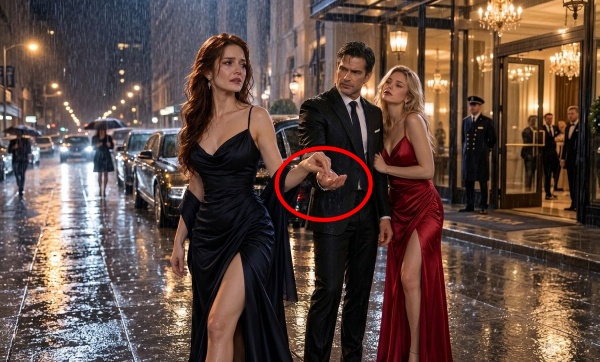
On our fifth wedding anniversary, I stood in the pouring rain, watching my husband carry the woman he had never stopped loving into his car. Minutes earlier, I had asked Vincent for a divorce. He didn’t argue. He didn’t beg. He simply walked away with his first love, leaving me alone in the storm as if five years of marriage meant absolutely nothing. What Vincent didn’t know was that I had finally stopped being the woman who waited for him, forgave him, and swallowed every humiliation in silence…
Part 1: The Anniversary Dinner
On our fifth wedding anniversary, my husband left me standing in the rain while he carried his first love to his car. I had asked him for a divorce less than five minutes earlier. He looked back once, told me we would talk at home, and drove away before I could answer.
I stood beneath the awning of a restaurant outside Portland, Maine, holding a small gift bag that had already gone soft at the bottom. Rainwater dripped from the edge of the awning onto my shoes. Through the window, I could see the table where Vincent and I had barely touched our anniversary dinner.
The woman he carried away was Lily Foster. She had slipped on the wet steps while hurrying toward the parking lot, and her ankle was swelling so quickly that even I could see she needed help. I did not blame Vincent for taking her to the emergency room.
What I could not understand was why Lily had been at our anniversary dinner at all. Vincent had told me she happened to be in the restaurant by chance. Twenty minutes later, I heard enough of their conversation to know that was a lie.
It began when our server came to the table with two glasses of sparkling wine. I had chosen the restaurant because it overlooked the water, and Vincent had promised he would be there on time. He arrived twenty-five minutes late, kissed my cheek, and said traffic had been worse than expected.
He apologized, and I accepted it. I had become very good at accepting apologies. Vincent was a contractor, and work emergencies had a way of appearing whenever we had plans.
Sometimes they were genuine. A burst pipe does not wait for an anniversary, and a delayed delivery can ruin an entire construction schedule. But after five years, I had begun to notice that his emergencies almost always required me to be patient and almost never required him to explain himself.
That evening, he placed a narrow jewelry box beside my plate. Inside was a silver bracelet with a small blue stone. I thanked him and handed him my own gift: a restored photograph of his father’s old workshop, which I had found in a box in our attic.
Vincent studied the photograph for a moment. His father had died before we met, and Vincent rarely spoke about him without becoming quiet. I thought the gift might remind him that I had listened to the stories he did tell.
“It’s beautiful,” he said. “I can’t believe you found this.”
I smiled, and for a few minutes the evening felt like the one I had imagined. We ordered dinner, talked about a house renovation he was finishing, and discussed whether we might take a trip before winter. Then his phone lit up beside his plate.
He glanced at the screen and turned it over. A minute later, he excused himself to take a call. I watched him cross the dining room and disappear near the hallway leading to the restrooms.
Our food arrived while he was gone. The server offered to keep his meal warm, but I told her he would be back soon. Ten minutes passed, and I began to feel foolish sitting alone at a table set for two.
When I stood to look for him, I saw him through the glass door leading to the covered patio. Lily was standing beside him in a dark green coat. Her hair was damp, and she was holding an envelope against her chest.
I knew who she was before Vincent introduced us. I had met her once at a neighborhood fundraiser, and I had seen old photographs of her in a box Vincent kept in our attic. She and Vincent had dated for several years before he met me.
At the fundraiser, he had called her an old friend. Later, when I found the photographs, he explained that Lily had been his first serious relationship and that they had parted ways long before our marriage. He said they occasionally exchanged messages because they still had friends in common.
I had no reason to object to him knowing someone from his past. But I did object to finding them alone on our anniversary after he had told me he was taking a work call. I pushed open the patio door just as Lily said, “You can’t keep asking me to wait until the timing is right.”
Vincent turned so quickly that he knocked his elbow against the railing. Lily stepped back, her face pale. The envelope slipped from her hands and landed on the wet concrete.
“What’s going on?” I asked.
“Lily had a question about a contractor,” Vincent said. “She recognized me when I walked in.”
“That’s not why I’m here,” Lily said.
He shot her a look. She bent to pick up the envelope, but the wind pushed it toward the steps. Vincent grabbed it before it reached the edge and tucked it inside his jacket.
Lily looked at me as though she wanted to speak. Instead, she said she was sorry for interrupting our dinner and went back inside. Vincent followed me to the table, where our meals had begun to cool.
He said Lily was dealing with a difficult situation and had asked him for advice. When I reminded him that he had just claimed she recognized him by chance, he said he had meant she recognized his car. I asked why she had said she couldn’t keep waiting, and he told me it was private.
“Private from me?” I asked.
“It’s her situation, Nora.”
I looked at the untouched food, the bracelet, and the photograph I had spent two weeks restoring. I thought about all the evenings I had sat at home waiting for him to return, all the times he had called at the last minute and asked me to be understanding. I had believed patience was something we were giving each other; lately, it felt like something he expected only from me.
“I don’t want to do this anymore,” I said.
He reached for his fork. “We can talk when we get home.”
“I’m not talking about dinner.”
He put the fork down. I told him I wanted a divorce. He stared at me, then gave a short laugh as if I had made a threat neither of us believed.
“Because Lily asked me a question?”
“Because you lied about why she was here. Because every time I ask what’s happening, you tell me to wait until you’re ready to explain.” I took a breath. “I don’t want to spend another five years waiting.”
He said I was reacting to a misunderstanding. I told him he was free to think that, but I was leaving. When I stood, he followed me out into the lobby.
Lily was near the entrance, speaking urgently on her phone. As she pushed through the door, her shoe slipped on the wet top step. She fell hard enough to cry out, and Vincent rushed past me to help her.
He checked whether she could move, then helped her sit beneath the awning. She said her ankle hurt and that she needed to get to a hospital. Vincent lifted her carefully, carried her to his car, and opened the passenger door.
“Call me when you get home,” he said to me.
“You brought me here.”
“Take a cab, Nora. We’ll talk later.”
Then he drove away.
I watched his taillights disappear into the rain. My phone was at eight percent, and I had no car because Vincent had picked me up from work. I could have called a taxi, but the number I dialed first belonged to someone I had not spoken to in almost a year.
My sister answered on the fourth ring. “Nora?”
“Hi, June.”
There was a pause. “What happened?”
I looked down at the gift bag in my hand. “I think I need to come home.”
Part 2: The Sister I Had Stopped Calling
June lived forty minutes away in a small house she had bought after our mother died. She worked as a librarian, kept too many plants in her kitchen, and had once been the person I called about everything. When we were children, she could tell whether I had a bad day by the way I closed the front door.
We were not close anymore. The distance had begun with an argument about money, though the money itself had never been the whole problem. Three years earlier, June asked me to lend her $6,000 for repairs after a pipe burst in her house.
I wanted to help. I had enough in my personal savings to lend her part of it, and she had offered a written repayment plan. Vincent told me June was irresponsible and that lending money to family would eventually damage our marriage.
I told June I couldn’t do it. She said she understood, but I repeated some of Vincent’s criticism when she asked why I had changed my mind. The words were mine by the time they left my mouth, and I could see how deeply they hurt her.
She found another way to pay for the repairs. We apologized in careful, incomplete conversations, then saw each other only at holidays. Whenever I thought about calling her, I worried she would hear in my voice that I still wanted her to tell me I had done nothing wrong.
Now, standing in the rain, I had called her anyway. I expected questions before an offer of help. June asked only for the restaurant’s name and told me to wait inside.
She arrived in a raincoat and sneakers, her hair tied back with a rubber band. When she saw me in the lobby, she opened her arms. I held on to her long enough for the restaurant’s host to quietly bring us both a glass of water.
On the drive to her house, I told her about Lily and the conversation on the patio. I also told her I had asked for a divorce. June kept both hands on the wheel and let me speak without interrupting.
“Did you mean it?” she asked when I finished.
“I think so.”
“Do you feel safe going home for your things tomorrow?”
“Yes. I just don’t want to see him tonight.”
She nodded. “Then tonight you can stay with me. Tomorrow can wait until morning.”
At her house, she gave me a dry T-shirt and a pair of sweatpants. We sat at the kitchen table while her cat inspected my shoes. I told her I was sorry about the argument three years earlier, and she said we didn’t need to solve every part of our relationship that night.
“I was unkind,” I said.
“You were.”
“I let Vincent’s opinion become my answer without admitting it.”
June poured more tea. “I was hurt, Nora. But I’m glad you called.”
Vincent began texting shortly after eleven. He said Lily’s ankle was badly sprained, that she was waiting for an X-ray, and that he would be home late. I wrote back that I was safe and staying with June.
His next message arrived almost immediately. You called June?
I could hear the surprise in those three words. Vincent had never forbidden me from speaking to my sister, but he had encouraged the distance whenever our disagreements came up. He said June judged him and that family gatherings were easier when she and I kept things polite.
Yes, I replied. I needed someone to pick me up.
He called, but I let it go to voicemail. Then he wrote that he was sorry about dinner and that Lily’s situation was complicated. He promised to explain everything in the morning.
I set the phone on the table. June asked whether I thought he was having an affair. I said I didn’t know, which was the truth and also the part that frightened me most.
The next morning, I woke to the smell of coffee and the unfamiliar sound of June opening kitchen drawers. For a few seconds, I forgot where I was. Then I saw my damp shoes by the door and remembered Vincent lifting Lily into his car.
There was another message from him, sent after two in the morning. Lily is home. Nothing is going on between us. Please don’t make this worse before I can explain.
I stared at the phrase make this worse. It assumed there was already something serious enough to worsen. It also placed responsibility for the next step on me, as though asking for the truth were the dangerous part.
June drove me to the house after breakfast. Vincent’s truck was in the driveway, and he came outside before I reached the door. He looked tired and said he had barely slept.
“I want to talk,” he said.
“I need clothes and my work laptop.”
“Fine. Then we can talk.”
Inside, the silver bracelet was still on the dining room table where I had left it after showing June a photograph. Vincent must have gone through my bag, because I had not taken the bracelet out at home. When I asked him about it, he said he had found the box in my coat pocket while looking for the house key.
I told him not to go through my things again. He apologized, but his attention was already on the bag in my hand. He asked whether I planned to stay with June for a few days or whether this was “another one of our arguments.”
“This isn’t another argument,” I said.
I packed while he stood in the hallway. He said Lily had called because she needed help with a family matter and that he had agreed to meet her before our dinner. He insisted he had not been unfaithful.
“Then why did you lie?” I asked.
“Because I knew you’d react exactly like this.”
I zipped my suitcase. “I reacted to the lie, Vincent.”
He rubbed his forehead and said I was leaving out years of good memories. He reminded me of the trip we took to Vermont, the weekends we spent fixing up the house, and the way we had cared for his mother after her surgery. All of those things were real, but none of them answered why Lily had been waiting on the restaurant patio.
As I reached for my laptop, I noticed an envelope on his dresser. It was the same cream-colored envelope Lily had dropped the night before. My name was not on it, and I did not open it.
Vincent saw me looking. He picked it up and put it in the drawer. “That belongs to Lily.”
I left with June, but the image stayed with me. There had been something written across the front in blue ink. I had only caught two words before Vincent covered them with his hand: For Ellie.
That afternoon, Lily called me from a number I didn’t recognize. She said she was sorry about the previous night and asked whether we could meet. When I asked who Ellie was, she went quiet.
“Vincent told me you didn’t know,” she said.
“Know what?”
“I think I should tell you in person.”
Part 3: The Child Vincent Never Mentioned
I met Lily at a coffee shop the following morning. Her ankle was in a supportive boot, and she moved slowly from the door to the table. She thanked me for coming and apologized again for the anniversary dinner.
“I didn’t know it was your anniversary until he told me last night,” she said.
“He asked you to meet him there?”
“Yes. I wanted to talk, and he said he had only a few minutes before meeting you.” She wrapped both hands around her coffee cup. “I should have asked why he couldn’t speak another time.”
Lily was not wearing a wedding ring, though that told me nothing about her life. I realized how little I knew about her beyond the version Vincent had offered: an old girlfriend, a person from his past, someone he occasionally encountered through mutual friends. She looked just as uncomfortable with the meeting as I felt.
“Who is Ellie?” I asked.
“My daughter. She’s six.”
She opened her bag and took out a photograph. A little girl stood in front of a birthday cake, wearing a paper crown that tilted over one eyebrow. She had a wide smile, dark curls, and a gap where one of her front teeth had been.
“Vincent is her father,” Lily said.
I looked at the photograph again. My first thought was that Ellie must have been conceived during our marriage, and Lily seemed to read the question on my face. She explained that she and Vincent had briefly reconnected before our wedding, more than six years earlier.
They had separated again before Lily learned she was pregnant. At the time, she was also beginning a relationship with another man, and she did not know who Ellie’s biological father was. She said the uncertainty had been painful and complicated, and she had not handled every decision well.
The other man, Sam, had been present when Ellie was born. Lily and Sam later married, and he had raised Ellie as her father. After Sam died unexpectedly two years earlier, Lily began revisiting questions she had postponed for years.
“Ellie had started asking about family history,” she said. “There were medical forms, school forms, things I couldn’t answer honestly without knowing.”
About eighteen months before our anniversary, Lily contacted Vincent. They spoke, sought appropriate advice, and arranged a paternity test. The result showed that Vincent was Ellie’s biological father.
For a moment, I could hear the coffee grinder behind the counter more clearly than Lily’s voice. Eighteen months earlier, Vincent and I had celebrated the end of a renovation project with a weekend trip. He had taken a photograph of me on a beach and written beneath it, My favorite person, always.
“Did he tell you I knew?” I asked.
“At first, he said he was going to tell you. A few months later, he said you were aware that we were sorting out a family matter, but you needed time before meeting Ellie.”
“That wasn’t true.”
“I know that now.”
Lily said Vincent had met Ellie gradually. At first, he visited as a friend of her mother’s, bringing books and helping repair a fence at their house. Eventually, Lily and Vincent agreed that Ellie deserved an age-appropriate explanation, and they worked with a family counselor on how to have that conversation.
“Does Ellie know?” I asked.
“She knows Vincent is her biological father. She also knows Sam is the dad who raised her and that nobody is asking her to replace him.” Lily paused. “She’s had a lot to understand, so we’ve tried to let her ask questions at her own pace.”
I appreciated that she spoke about Ellie as a person rather than a secret to be managed. I was angry with both adults for allowing me to remain uninformed, but the child had done nothing wrong. I asked whether Vincent saw her regularly.
“Usually twice a month. Sometimes more.”
I thought of the Saturdays Vincent said he was helping a friend with a renovation. I thought of the canceled weekend in Boston and the evenings he returned home smelling like sawdust, explaining that he had stopped at a worksite. Some of those stories may have been true in part, but they had also hidden a life I had never been allowed to understand.
“What was in the envelope?” I asked.
“School pictures and a drawing Ellie made. She wanted him to have them.”
Lily said the conversation on the patio had been about telling me the truth. Vincent kept postponing it, and she had grown uncomfortable with the explanations he gave Ellie. He had told the girl that Nora was “very busy” and that they would all meet when the time was right.
“I asked him to tell you before Ellie started wondering if she was something to hide,” Lily said. “When he said he was meeting you at the restaurant, I thought he was finally going to do it.”
“On our anniversary?”
“He didn’t tell me that part.”
I believed her, though belief did not require me to excuse her silence. She had known for months that Vincent was not telling me the full story. I asked why she had accepted his assurances for so long.
“Because I wanted him involved, and I was afraid he’d pull away if I pushed too hard,” she said. “That wasn’t fair to you, and it wasn’t fair to Ellie. I’m sorry.”
I thanked her for telling me. Before we left, she asked me not to confront Ellie with any of this. I told her I would never place the burden of an adult’s choices on a child.
Outside, the rain had stopped, but the sidewalks were still damp. Lily waited for a rideshare because she could not drive comfortably with her injured ankle. I stood with her until it arrived, and we exchanged numbers in case either of us needed to clarify something later.
Vincent was waiting at June’s house when I returned. He stood beside his truck with his hands in his jacket pockets. June was on the porch, watching him with an expression that suggested she had already told him he was not coming inside.
“You talked to Lily,” he said.
“Yes.”
He looked toward June. “Can we speak alone?”
I agreed to talk on the porch while June went inside, leaving the front door unlocked. Vincent said he had wanted to tell me about Ellie from the beginning. He said every time he tried, he imagined losing our marriage before I understood that the relationship with Lily had ended long ago.
“Did you think hiding your daughter would make me trust you more?”
“I thought I could find the right moment.”
“You had eighteen months.”
He stared at the steps. Then he said something that changed the shape of the conversation again. “I told my mother about Ellie last year. She helped me figure out what to do.”
I had seen his mother, Elaine, at least twice a month during that year. I had driven her to appointments, brought her groceries, and listened while she worried about Vincent working too hard. At Thanksgiving, she had sat across from me while he said he needed to leave early for a job.
“You both knew,” I said.
“Mom was trying to help me.”
“And what was she trying to do for me?”
He had no answer. For the first time, I understood that the silence around Ellie had not been a single moment of fear. It had become a family arrangement, maintained each time Vincent and Elaine looked at me and chose not to speak.
Part 4: The Things Everyone Knew
I called Elaine that evening. She answered warmly and asked whether Vincent and I had enjoyed our anniversary dinner. I wondered if she knew he had already told me the truth or whether she was waiting to see what I would say.
“I met Lily today,” I told her.
Elaine’s voice changed. “Did she explain about Ellie?”
“Yes.”
She was quiet for a long moment. Then she said Vincent had asked her not to tell me because he wanted to do it himself. She said she believed a mother should support her son when he was frightened.
“I understand supporting him,” I said. “I don’t understand helping him lie to me for eighteen months.”
“I told him he needed to be honest.”
“But when he wasn’t, you kept inviting me to dinner and pretending nothing had changed.”
Elaine began to cry. She said she had grown attached to Ellie and had not wanted to do anything that might make Vincent or Lily pull away. She also said she had been afraid I would see the child as a threat to the marriage.
“Did you ever ask me what I thought?”
“No.”
I told her I was happy Ellie had people who cared about her. I also told her that learning about the child was not the same as being given a choice about how to respond. Everyone had decided what I might do, then treated that imagined reaction as a reason to keep me in the dark.
Elaine apologized. I believed she regretted hurting me, but I was not ready to tell her the apology repaired anything. We ended the call with an agreement to speak again later.
The next week, I met with an attorney to understand my options. I did not know whether Vincent and I would ultimately divorce, but I wanted advice before making decisions about our home and shared finances. The attorney explained that I could take time to decide while still gathering information and establishing boundaries.
She asked about our bank accounts and household expenses. I told her Vincent had managed most of the bills because he was self-employed and preferred to organize payments around his projects. I had access to the accounts, but I usually looked at the balance rather than examining every transaction.
That evening, I logged in and downloaded recent statements. I found regular payments to Lily over the previous year, along with smaller purchases at a children’s clothing store and a local bookstore. There was nothing inherently wrong with Vincent contributing to Ellie’s care; what hurt was that he had hidden it while telling me we needed to postpone plans because money was tight.
Six months earlier, I had wanted to take a professional course in Boston on restoring historical photographs. It would have cost about $1,800, plus travel and lodging. Vincent said we should wait until his business had a stronger quarter, and I agreed.
Around the same time, the statements showed a payment toward repairs at Lily’s house. I called Vincent and asked whether he had paid for the work himself or through his business. He said he had used money from our joint account and meant to replace it after a client paid an invoice.
“Did you?” I asked.
“Some of it.”
“Why didn’t you tell me?”
“I thought you’d be angry.”
“I might have had questions. That’s what happens when two people share money.”
He said Ellie needed a safe home and that the repairs had been urgent. I did not dispute the importance of the repairs. I asked him to send me a clear list of the payments and how he had recorded them, and I forwarded the statements to my attorney.
We later worked through those expenses as part of a broader financial discussion. Some payments were accounted for, others became points of disagreement, and neither of us could simply declare the whole matter settled. I learned to ask for records without apologizing for wanting to understand them.
A few days after our call, Vincent suggested counseling. He said he would answer every question I had and that he wanted a chance to rebuild trust. I told him I was willing to attend a few sessions, but I could not promise they would save the marriage.
In the first session, he described the day Lily told him about Ellie. He said he felt shocked, frightened, and guilty that he had missed years of his daughter’s life. He also said he was afraid I would believe he had cheated on me, even though Ellie had been conceived before our wedding.
I could understand those fears. I could also see how he had used them to justify months of decisions made without me. Understanding his reasons did not make the consequences disappear.
The counselor asked him what he thought I had lost. He said I had lost trust in him and time with Ellie. I told him I had also lost the chance to decide what kind of family I wanted to build with the truth in front of me.
“I might have been scared,” I said. “I might have needed time. But you never gave me the chance to find out.”
Vincent cried during that session. I had seen him cry only a few times, and my instinct was to reach for his hand. I kept my hands in my lap, not to punish him, but because I needed to hear the rest of what he had to say without comforting him through it.
Over the next several weeks, he became more open about Ellie and the financial decisions. He gave me the list I requested and stopped calling June to ask whether I was coming home. He also told Elaine she should not have been placed in the position of keeping his secret.
Those were changes I wanted for him and for his daughter. They did not restore the marriage I had believed I was in. Each time we discussed moving back together, I felt myself preparing to wait for the next piece of information he had not yet decided to share.
One evening, after a counseling session, he asked whether I still loved him. We were standing beside our cars, and the parking lot lights had just come on. I told him I cared about him, but I no longer felt able to build a life with him as his wife.
He nodded and looked down. He did not argue or tell me I was overreacting. After a moment, he asked whether I would be willing to meet Ellie someday, if Lily thought it was appropriate.
“I don’t know,” I said. “I don’t want to make her a promise I can’t keep.”
“That’s fair.”
It was one of the first conversations we had ever ended without a promise to revisit it later. I drove back to June’s house with the windows cracked, despite the cold. I felt sad, relieved, and guilty in turns, and June told me I was allowed to feel all three.
Part 5: A Different Kind of Family
The divorce took several months. Vincent and I sold the house and worked through our financial agreements with our attorneys. We did not agree on every detail, but by then we had both stopped pretending the disagreements would disappear if we avoided them.
I used part of my share to rent an apartment near the waterfront. It had a small second bedroom with a north-facing window, which I turned into a workspace. I set up my computer, a light table, and the equipment I used to restore old photographs.
For years, that work had been something I did around other responsibilities. I restored family pictures for friends, repaired scans of damaged portraits, and dreamed about taking more formal training. After the separation, I enrolled in the course in Boston that I had postponed.
June drove down with me for the first weekend. She spent the day visiting bookstores while I learned from a conservator who had worked with archives for decades. That evening, we ate chowder near the harbor and argued about whether the bread was better in Maine or Massachusetts.
I apologized again for what I had said about her financial situation years earlier. This time, I did not add an explanation about Vincent. I told her I had repeated a judgment that wasn’t fair and had let our distance continue because I was embarrassed.
“I was angry for a long time,” she said. “Then I missed you for a long time.”
“I missed you too.”
We did not pretend the missing years had never happened. We began with phone calls on Sundays, then dinners every few weeks. Some conversations were easy, and others required us to stop and ask what the other person meant rather than assuming.
Elaine wrote me a letter after the divorce papers were filed. She said she had confused loyalty with silence and had allowed Vincent’s fear to become her excuse. She did not ask me to make her feel better, and she did not mention whether Vincent and I might reconcile.
I answered a month later. I thanked her for the letter and told her I needed our relationship to be different if it continued. She wrote back that she understood, and we began meeting occasionally for coffee.
Lily and I exchanged a few messages about practical matters. She sent one after Vincent told Ellie that he and I would no longer be married. Lily said Ellie had asked whether the divorce was her fault, and she wanted me to know how they had answered.
“They told her the truth,” Lily wrote. “That adults sometimes decide they can’t be married anymore, and that nothing she did caused it.”
I was grateful. I also felt the familiar ache of knowing a child had been drawn into a situation none of the adults had handled perfectly. I told Lily I hoped Ellie was doing well and left it at that.
Nearly a year after the anniversary, a local library hosted an exhibition of restored family photographs. June had helped organize the event and asked whether I would contribute a few pieces. I chose images whose owners had given permission: a fisherman with his dog, a wedding portrait from the 1940s, and two sisters standing outside a grocery store.
On the morning of the opening, June called to say Elaine had asked whether she could attend. Vincent wanted to come too, and Lily had wondered if Ellie could see the photographs. June told them she would ask me before answering.
I stood in my kitchen with my phone in one hand and a piece of toast in the other. I had imagined meeting Ellie many times, but never at an event that mattered to me professionally. I asked whether Lily and Vincent understood that I might only be able to say hello.
“They do,” June said. “And you can say no.”
I thought about it for the rest of the morning. Finally, I said they could come, as long as nobody presented the meeting to Ellie as a major family event. I wanted her to be free to look at the photographs, eat a cookie, and leave without feeling responsible for anyone’s emotions.
They arrived halfway through the opening. Vincent came in carrying a paper bag from the bakery across the street, with Lily and Ellie beside him. Elaine followed a few steps behind, holding the handrail carefully as she climbed the front steps.
Ellie wore a yellow raincoat even though the sky was clear. Lily explained that the forecast had mentioned showers and Ellie preferred to be prepared. The girl looked around the room with the serious expression of someone deciding which picture deserved her attention first.
Vincent introduced us. “Ellie, this is Nora.”
“Hi,” she said.
“Hi. Do you like photographs?”
“I like the dog,” she answered, pointing to the fisherman’s portrait.
I told her the dog’s name had been Captain and that the photograph’s owner believed he liked fish more than people. Ellie considered that information and said she liked fish too, especially when it came with fries. Then she moved toward the next picture with Lily beside her.
The meeting was brief and ordinary. That was exactly what I had hoped it would be. I did not look at Ellie and see the end of my marriage; I saw a child interested in a dog, a cookie, and whether the library had books about boats.
Vincent thanked me before they left. He said Ellie had enjoyed the pictures and that he was glad she had met me. I told him I was glad the introduction had been easy for her.
Outside, a light rain began. Ellie pulled up the hood of her yellow coat while Lily opened an umbrella. Vincent held the bakery bag above his head, and Elaine laughed at him for choosing pastries over his own hair.
I watched them go through the glass doors. There was a time when seeing Vincent with Lily might have made me search every gesture for an explanation. Now I knew enough: they were connected through their daughter, and the future of that connection belonged to them and Ellie.
June came to stand beside me. “Are you okay?”
“Yes,” I said, and realized I meant it.
After the exhibition closed, we carried the remaining photographs to my car. June suggested dinner at a place a few blocks away, and I checked the sky. The rain had grown heavier, so she opened her umbrella and held it between us.
“Do you remember the night I called you?” I asked.
“I remember thinking you sounded like you were trying not to cry.”
“I almost didn’t call.”
“I’m glad you did.”
We walked slowly, adjusting the umbrella whenever one of us drifted too far to the side. At the restaurant, June shook the rain from her coat while I asked for a table. The host led us to a seat by the window, and this time I did not have to wonder whether the person across from me would stay.
