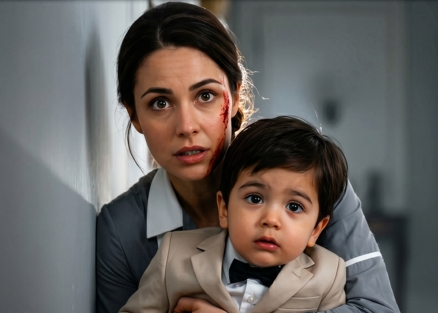
A nanny’s true story of love, neglect, and one explosive dinner party moment that exposed the truth about a broken family — and changed a child’s life forever.
Introduction
I was standing near the buffet table, trying to blend into the background the way good nannies are supposed to, when I heard the sound of small, desperate footsteps pounding across the marble floor.
Before I could turn around, thirty pounds of six-year-old boy crashed into my legs, grabbed my waist with both arms, and sobbed, “Mama, don’t go. Please don’t go.”
The entire room went silent.
His name was Ethan James Hargrove. He was wearing a tiny navy suit with a clip-on tie, and his face was wet with tears. And he had just called me — his nanny — Mom, in front of fifty of his parents’ closest friends, business associates, and social rivals.
I am going to tell you what happened that night. But to understand it, you have to go back to the very beginning. Because what exploded in that ballroom didn’t start there. It started three years earlier, on a rainy Tuesday morning in October, when I rang the doorbell of a house that would never feel like a home — and met a little boy who desperately needed one.
Here is my story.


Section 1: The Setup — A House Full of Everything Except What Mattered
I got the job through an agency. The listing was impressive — six-figure household income, private quarters for the nanny, full benefits, a structured schedule. The parents were Douglas and Vivienne Hargrove. Douglas was a corporate attorney. Vivienne ran a nonprofit foundation, though “ran” is generous — she attended events and gave speeches. The real work was done by her staff.
I remember my first interview with Vivienne. She sat across from me in a cream-colored living room that looked like it had been furnished by a magazine, not a family. There were no toys on the floor. No crayon marks on the walls. Everything was white, clean, and cold.
“Ethan is three,” she told me, flipping through my résumé without really reading it. “He’s going through a difficult phase.”
I asked what she meant by difficult.
She looked up. “He cries. A lot. It’s exhausting.”
I was a professional. I smiled and said I had plenty of experience with toddler emotional development.
What she didn’t say — what I would only discover over weeks and months — was that Ethan didn’t cry because he was going through a phase. Ethan cried because he was lonely. Profoundly, achingly lonely in a house full of expensive furniture and absent parents.
My first morning on the job, Vivienne left at 7:15 a.m. Douglas had already gone. Ethan was sitting at the kitchen table in front of an untouched bowl of cereal, staring at the door. When he heard my footsteps, he turned around. His eyes were swollen. He had clearly been crying before I arrived.
“Hi buddy,” I said softly. “I’m Claire. I’m going to spend the day with you.”
He looked at me for a long moment. Then he slid off his chair, walked over, and took my hand.
He didn’t say a word. He just held on.
That was the moment I should have understood what I was walking into. But I was twenty-eight years old and I told myself it was just separation anxiety. Normal toddler stuff. I was a professional. I had a contract. I had boundaries.
I kept telling myself that for three years.
By the time Ethan was four, I was more than his nanny. I was his breakfast, his bedtime, his sick days, his school pickups, his nightmares, and his Saturday mornings. I was the one who knew he was afraid of ceiling fans and loved strawberry waffles. I was the one he ran to when he fell off his bike. I was the one he asked, in a very serious four-year-old voice, “Claire, will you be my mom?”
I told him I was his nanny, and that he had a mom who loved him very much.
I believed that when I said it.
Section 2: Rising Tension — What Was Happening Behind Closed DoorsVivienne Hargrove was not a monster. I want to be careful about that. She was not cruel in the way people imagine when they hear stories like this. She didn’t hit him. She didn’t scream at him. Her neglect was the quiet kind — the kind that wears a designer dress and donates to children’s charities and genuinely believes that providing a child with every material advantage is the same as loving him.
She was absent. Consistently, predictably, thoroughly absent.
But as Ethan got older, something shifted. I started noticing things that went beyond absence. I noticed that when Vivienne was home, Ethan became smaller. He stopped asking questions. He stopped singing. He would appear in the kitchen doorway, watch his mother for a moment, and then disappear silently back to his room.
I noticed that Douglas was never home when Vivienne was.
I noticed that Ethan had started asking me, at five years old, whether people could get in trouble for lying.
One evening, about six months before the dinner party, I was putting Ethan to bed when he said something that stopped me cold.
“Mommy said if I’m bad, they’ll send me away.”
I sat down on the edge of his bed. “Send you where, sweetheart?”
“To the school that’s far away.” He paused. “She said you can’t come there.”
I kept my voice steady. “That sounds scary. Did something happen today?”
He nodded. “I spilled juice on her dress. She had to change before the party.”
A six-year-old. Threatened with exile for spilling juice.
I started paying closer attention after that. I started keeping notes — not because I had any plan to use them, but because something in my gut told me I needed to remember. I wrote down dates, times, things Ethan said. I noted the days he came to me with unusual bruising — twice, on his upper arms, in the shape of fingers — and the explanations Vivienne gave when I gently raised the subject. “He fell.” “He’s clumsy.” “Please don’t make this into something it isn’t, Claire.”
I told myself I was overreacting. I told myself she was his mother, and mothers know their children. I told myself it wasn’t my place.
But every night, when I turned out his light and he grabbed my hand and said, “Will you stay until I fall asleep?” — I stayed. Because he needed someone to.
Section 3: The Revelation — What I Heard Through the Wall
The dinner party was Vivienne’s idea of a statement. She hosted them quarterly — catered events for forty to sixty guests, the kind designed to reinforce social standing. Douglas would stand beside her, distinguished and quiet. Ethan would be dressed up and presented, like a prop that proved the marriage was functioning.
I was not usually present at these events. My job was to get Ethan ready, hand him off, and stay in my quarters. But that evening, Ethan had been anxious all day. He clung to me while I helped him into his navy suit. He kept asking if I would be nearby. I told him I would be in the house.
An hour into the party, one of the kitchen staff came to find me. “The little boy is upset,” she said. “He’s been asking for you.”
I found him in the hallway outside the main room, sitting on the bottom stair, still wearing his clip-on tie, his face streaked with tears. He looked up when he saw me and his entire body changed — like a held breath releasing.
“What happened?” I asked, crouching down.
“Daddy and Mommy were fighting,” he whispered. “Daddy said he was leaving. Mommy told me to go back to the party and smile.”
I held him for a moment. Then I heard it.
Two voices, low and taut, coming from behind the closed study door ten feet away. Douglas and Vivienne. I wasn’t trying to eavesdrop. But what I heard changed everything.
“You can’t keep doing this, Vivienne. The boy needs therapy. He needs—”
“He needs to stop being so dramatic. He’s embarrassing us.”
“He’s six years old.”
“And he will be fine. They always are. We turned out fine.”
A pause. Then Douglas, quieter: “I’ve talked to a lawyer.”
“About what.”
“About Ethan. About what happens to him if we—”
“Don’t you dare finish that sentence. Not tonight. Not here.”
I stepped back from the door. My hands were shaking.
I looked down at Ethan. He had heard it too. His eyes were wide and very still.
And then, before I could say anything, the study door opened and Vivienne stepped out. She saw us. She saw Ethan’s face. She saw mine.
And something in her snapped.
Section 4: The Counterattack — The Folder, the Call, and the Truth
What happened next happened fast.
Vivienne grabbed Ethan’s arm — not gently — and walked him back toward the party. He twisted and reached for me over his shoulder. She walked faster.
I followed at a distance, standing near the entrance to the main hall. I watched her position him beside Douglas, arrange her expression into a smile, and rejoin her guests. I watched Ethan stand there — small and rigid in his tiny suit, eyes scanning the room.
Then he saw me. And he ran.
Thirty pounds of terrified six-year-old covered that distance in seconds. He hit me so hard I nearly fell. He wrapped his arms around me and buried his face in my neck and said, loud enough for the room to hear it, “Mama. Don’t leave me. You’re my mama.”
The room went still.
Vivienne was across the ballroom in moments. Her voice was a controlled hiss that cut through the silence: “You brainwashed my son.”
Then she shoved me. Hard. I stumbled backward, still holding Ethan, and hit the edge of a side table. Pain shot up my back. Ethan screamed.
She looked at the room — not at her son — and said, “Get out of my house before I call the police.”
And then she turned to Douglas and said, in a voice that was almost eerily calm: “Look at them. Everyone is invading us tonight.”
I set Ethan down. I crouched in front of him. I looked him in the eyes and I said, quietly, “You’re going to be okay. I promise. I’m not going anywhere.”
Then I stood up and I addressed the room.
“My name is Claire Matthews. I have been Ethan’s nanny for three years. What you just witnessed is not the first time this child has been frightened in this house. I have documentation going back six months — written records, photographs, and statements. I will be contacting Child Protective Services tonight.”
Vivienne’s face went white.
Douglas looked at his wife. Then he looked at his son. Then he looked at me.
“I’ll show you out,” he said quietly. “And I’d like a copy of whatever you have.”
Section 5: Resolution & Lesson — What Justice Actually Looks Like(Turning Point 5: Aftermath and Moral Lesson)
I made the call to CPS that night from the parking lot, sitting in my car with my hands still shaking. The investigator arrived at the Hargrove home two days later.
What followed was not cinematic. Justice rarely is. There were interviews, assessments, home visits. Douglas filed for divorce and filed for primary custody. Vivienne hired three attorneys. The process took seven months.
During those seven months, I did not see Ethan.
That was the hardest part. No one talks about that part — the gap between doing the right thing and seeing the result of it. I had walked out of that house with nothing but a folder and a promise I couldn’t guarantee keeping. I didn’t know if he was okay. I didn’t know if I had made things better or worse.
Then, eight months after the dinner party, I got a call from Douglas’s attorney. Ethan had been asking for me. The custody arrangement had been finalized. Douglas had primary custody. Vivienne had supervised visits, pending completion of a parenting course and therapy program.
And Douglas wanted to know if I would be willing to return to work.
I met Ethan at Douglas’s new apartment on a Saturday morning. He was standing in the hallway when I arrived, wearing jeans and a t-shirt, looking like a completely different child — relaxed, bright-eyed, present.
He looked at me for a moment. Then he said, very seriously: “You came back.”
“I told you I wouldn’t go anywhere,” I said.
He nodded. “You also promised I’d be okay.”
“Did I keep that promise?”
He thought about it. “Yeah,” he said. “I think so.”
There is a lesson in this story, though it is not the one I expected to learn. I came into that house as a professional with clear boundaries and a contract. I left it as the person who loved a child enough to blow everything up for him. I don’t regret a single moment of it.
But the lesson I want to leave you with is this: a child’s emotional reality is always telling the truth, even when the adults around him are not. When a six-year-old runs toward someone at a party — terror on his face, arms outstretched — he is not confused. He is not brainwashed. He is doing the most honest thing a human being can do.
He is running toward safety.
Pay attention to who the children run toward. And ask yourself why.
ConclusionI still work for Douglas and Ethan. Ethan is eight now. He’s in second grade and he’s obsessed with Legos and space documentaries. He calls me Claire. Just Claire — which is exactly right.
Vivienne completed her parenting program. She sees Ethan on alternating weekends. I won’t pretend their relationship is easy. It isn’t. But it’s honest now, which is more than it ever was.
I don’t tell this story to make Vivienne into a villain. I tell it because I know there are children in homes right now who are dressed up and presented and quietly, thoroughly unseen. I tell it because I know there are caregivers who see the signs and talk themselves out of trusting what they see.
Trust what you see.
The child in the tiny suit, running across the ballroom floor — he wasn’t looking for drama. He was looking for the one person who made him feel safe in a world that hadn’t been safe enough.
I happened to be that person. I didn’t plan it. I didn’t ask for it.
But I am so deeply, profoundly glad I showed up for him every single day — until showing up meant doing the hardest, most necessary thing I have ever done.
If you’re in a similar situation — if you’re the nanny, the teacher, the neighbor, the aunt who sees something that doesn’t feel right — trust that feeling. Document it. Report it.
You might be the only one who does.
