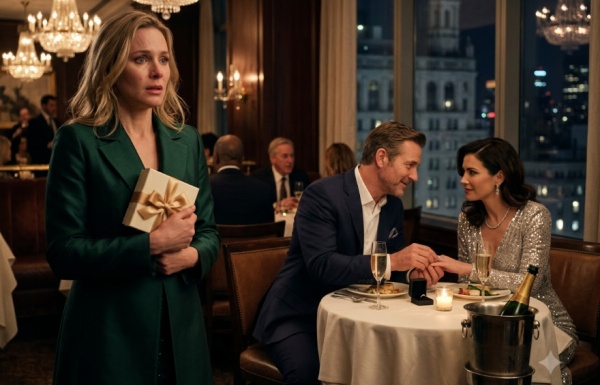
She came to their anniversary dinner ready to tell him she was pregnant, only to find him beneath their proposal chandelier with another woman and a jewelry box that was not hers.
In that instant, Audrey realized the baby she carried would never be safe inside a marriage built on control, legacy, and appearances. So she left one letter and Disappeared With the Secret He Wanted Most…
Part 1: The Gift Box
I arrived at our anniversary dinner carrying a gift box with a positive pregnancy test inside.
It was wrapped in ivory paper with a thin gold ribbon, the same colors we had used at our wedding five years earlier. I had chosen the box carefully from a stationery shop on Madison Avenue, then walked six blocks in the cold November air because I needed time to calm down before telling my husband he was going to be a father.
My hands kept trembling around the box.
Not from fear.
From hope.
Hope is dangerous when you have spent years training yourself not to expect too much.
My name is Audrey Vale Bennett, and until that night, I was married to Grayson Bennett, the founder and CEO of Bennett Urban Capital, a real estate investment firm based in New York City. Grayson was the kind of man magazines loved to describe in clean, admiring phrases: self-made millionaire, visionary developer, philanthropic force, Manhattan power player.
They rarely mentioned the other things.
The way he could make a room feel grateful for his attention.
The way he remembered everyone’s weakness after one conversation.
The way he apologized only when apology served a larger purpose.
The way he treated love like a merger: valuable if it expanded his holdings, disposable if it complicated the structure.
When I met him, I was twenty-eight and working as a corporate communications strategist for a nonprofit housing coalition. He was thirty-seven, already rich, already admired, already accustomed to people forgiving his arrogance because his checks cleared and his speeches photographed well.
He asked me to dinner after a charity panel in Tribeca.
I said no.
He asked again two weeks later.
I said no again.
The third time, he sent a handwritten note and a donation to our tenant legal defense fund with no conditions attached. I told myself any man who could be persistent and generous without demanding public credit deserved one dinner.
That was how it started.
One dinner became three.
Three became a weekend in Hudson Valley.
Six months later, he proposed under the central chandelier at Lumière, a private restaurant near Central Park South where the lighting was so flattering people joked it should be regulated by the FDA.
He had reserved the whole mezzanine.
White roses.
Champagne.
A string quartet.
A diamond ring that looked too heavy for my hand.
I cried before he finished the question.
He said, “I want to build a life with you, Audrey.”
I believed him.
Maybe he believed himself too.
People like Grayson can mean things in the moment and still betray them later. That is what makes them so convincing.
For the first two years, our marriage felt like a story I was embarrassed to admit I enjoyed. We lived in a penthouse overlooking the Hudson River. We traveled to Napa, Paris, Aspen, and Martha’s Vineyard. We hosted donor dinners where Grayson introduced me as “the conscience of the operation,” a phrase I found romantic before I understood it was also a job description.
Then came the baby conversations.
At first, casual.
Then scheduled.
Then medical.
Then painful.
I had two miscarriages in eighteen months.
The first one happened at nine weeks.
The second at eleven.
Both times, Grayson was kind in the beginning. He attended appointments, held my hand, sent flowers, told me we would try again when I was ready. But grief bored him after a while. Not because he was incapable of feeling it, but because grief cannot be conquered, acquired, branded, or controlled.
He hated things that did not respond to force.
After the second loss, I changed.
I became quieter.
Less available for events.
Less willing to sit through dinners where women in designer dresses asked when we were “expanding the family” as if pregnancy were a renovation plan delayed by permits.
Grayson changed too.
He became polished again too quickly.
He stayed late at the office.
He traveled more.
He began saying things like, “We can’t let loss define us,” when what he meant was, “I need you to return to the version of yourself that made my life easier.”
We never stopped trying officially.
But hope became private.
I took tests alone.
I tracked cycles silently.
I stopped telling him when I was late because I could not bear watching his face calculate disappointment before the result even appeared.
Then, on the morning of our fifth anniversary, I saw two pink lines.
I was standing barefoot in our marble bathroom with the winter sun spilling across the floor, staring at a drugstore pregnancy test like it was a legal document from heaven.
Positive.
I took another.
Positive.
Then a third.
Positive.
I sat on the closed toilet lid and covered my mouth with both hands.
I did not scream.
I did not call anyone.
I just cried in the quiet way women cry when joy arrives carrying the memory of everything they lost before.
That afternoon, my doctor’s office confirmed an early blood test.
The numbers looked promising.
Not guaranteed.
Never guaranteed.
But real.
I decided to tell Grayson at dinner.
Our anniversary dinner.
At Lumière.
Under the same chandelier where he had proposed.
It felt like a sign, and I was still foolish enough to want signs.
I placed one of the pregnancy tests in the gift box, wrapped it carefully, and wrote a small card.
Five years ago, you asked me to build a life with you. Today, I found out we already have.
I read the card ten times.
Then I tucked it inside the box and ordered a car.
The restaurant glowed when I arrived.
Lumière always looked as if money had learned restraint. Cream walls, dark wood, brass railings, velvet chairs, candlelight arranged so precisely that even shadows seemed curated. The hostess recognized me immediately and smiled.
“Good evening, Mrs. Bennett. Happy anniversary.”
“Thank you.”
“Mr. Bennett is already seated.”
That surprised me.
Grayson was rarely early unless someone important was waiting.
I followed her toward the mezzanine, gift box in my hands, heart beating so hard I could feel it in my throat.
Then I saw him.
Grayson was seated beneath the chandelier where he had once proposed to me.
But he was not alone.
Across from him sat Valentina Cross, a supermodel whose face had been on billboards in SoHo, perfume campaigns in airports, and magazine covers stacked in every salon in Manhattan. She was thirty-two, impossibly beautiful, and famous enough that even people who claimed not to follow fashion knew her name.
She wore a silver dress that caught the light like water.
Her hair was swept back.
Her laughter was low and intimate.
Grayson leaned toward her, smiling in a way I had not seen at home in months.
Then his hand moved under the table.
Not fully hidden.
Not accidental.
His thumb traced slowly over the inside of her wrist.
A familiar gesture.
One he used to do to me when he wanted to calm me, claim me, or remind me that we were together in a room full of strangers.
The gift box suddenly felt heavy.
I stopped walking.
The hostess stopped too.
“Mrs. Bennett?” she whispered.
Grayson looked up.
Our eyes met.
For one second, his face revealed everything.
Shock.
Annoyance.
Calculation.
Then he stood.
“Audrey.”
Valentina turned her head.
She did not look guilty.
That was what I remember most.
She looked curious.
As if I were an unexpected change in lighting.
I looked at the table.
Two champagne flutes.
A bottle of Krug in a silver bucket.
Oysters.
A small black velvet jewelry box near Valentina’s elbow.
Not mine.
I looked back at Grayson.
“This is our anniversary dinner,” I said.
My voice was calm.
Not because I felt calm.
Because something inside me had gone very still.
Grayson stepped away from the table.
“Let’s not do this here.”
Of course.
Men like Grayson are rarely ashamed of betrayal.
They are ashamed of witnesses.
Valentina lifted one perfectly shaped eyebrow.
“I didn’t realize—”
I looked at her.
“You didn’t realize he was married?”
She glanced at Grayson.
That glance told me enough.
She knew.
Maybe not everything.
But enough.
Grayson lowered his voice.
“Audrey, you’re making assumptions.”
I almost laughed.
His hand had been on another woman’s wrist under the chandelier where he proposed to me, on our anniversary, beside champagne and jewelry.
But I was making assumptions.
He looked at the gift box in my hands.
“What’s that?”
My fingers tightened around it.
For a brief, terrible second, I imagined opening it.
I imagined placing the pregnancy test on the table beside Valentina’s champagne and watching his face change. I imagined him abandoning the model, taking my hands, becoming the man I needed because the baby made me valuable again.
That thought saved me.
Because it was so ugly.
Not ugly because I wanted my husband to choose me.
Ugly because I understood he might choose the baby for the wrong reasons.
Grayson did not need another person to love.
He needed heirs, legacy, optics, continuation.
A child could become part of his empire before learning to speak.
I thought of his board members.
His lawyers.
His mother, Eleanor Bennett, who once told me over lunch that “Bennett men are difficult, but Bennett children are born to lead.”
I thought of the trust documents I had once skimmed at his attorney’s office.
The private schools he admired.
The building he wanted to name after his father.
The way he talked about bloodlines without using the word.
Then I understood with perfect clarity:
If I told him that night, my child would stop being mine before I reached the elevator.
Grayson stepped closer.
“Audrey.”
He expected me to make a scene.
He knew I had a temper when wounded. He had seen me cry after miscarriages, seen me argue with doctors, seen me break a glass once when his mother implied stress might have contributed to “the losses.” He expected tears, shouting, humiliation he could later reframe as instability.
Instead, I smiled.
It was small.
It cost me something.
“Happy anniversary, Grayson.”
His face tightened.
“Audrey, wait.”
I turned and walked away.
Not quickly.
Not dramatically.
I walked down the stairs, through the restaurant, past the hostess who looked devastated on my behalf, and out into the cold Manhattan night with the gift box still in my hands.
Behind me, my husband said my name once.
I did not stop.
Outside, I stood under the awning while traffic moved along the avenue and the city carried on with its usual indifference.
My phone buzzed.
Grayson.
I declined.
Then I opened my contacts and called the only person who could help me disappear legally, safely, and fast.
My older brother, Nathan Vale.
He answered on the first ring.
“Audrey?”
I looked down at the box in my hands.
“I’m pregnant,” I said.
Silence.
Then his voice changed completely.
“Where are you?”
“Outside Lumière.”
“Is Grayson with you?”
“No.”
“Are you safe?”
“For the next ten minutes, yes.”
“What happened?”
I closed my eyes.
“I need to leave before he finds out.”
Nathan did not ask if I was sure.
That is why I called him.
He simply said, “Go to the Peninsula lobby. Use cash if you can. I’ll send a car under another name. Do not go home. Do not answer his calls. I’m calling Marisol.”
Marisol was his wife, a family law attorney in Connecticut.
I began walking.
The gift box pressed against my coat.
Inside it, the pregnancy test waited like a secret with a heartbeat.
Part 2: The Empire I Married
Grayson did not build his empire alone.
That was the myth.
Every rich man has a myth, and Grayson’s was simplicity itself: a working-class kid from Queens who turned one distressed building into a real estate portfolio worth hundreds of millions. The story played beautifully at fundraising dinners. It had just enough struggle to flatter donors and just enough triumph to reassure investors.
Parts of it were true.
His father had driven a delivery truck.
His mother had worked in a dental office.
Grayson had earned scholarships, worked construction summers, studied finance at NYU, and bought his first small apartment building with borrowed money, terrifying confidence, and an appetite for risk that made older men mistake him for genius.
But the fuller truth was more complicated.
He built through leverage.
Debt.
Charm.
Pressure.
Relationships.
Women.
Silence.
My silence, eventually.
When we married, Bennett Urban Capital was expanding fast. Grayson was buying neglected buildings, rezoning parcels, converting warehouses, partnering with hotel groups, and giving speeches about revitalization that rarely mentioned who got priced out afterward.
I did not ignore the contradictions.
I argued with him about them.
That was one of the reasons he claimed to love me.
“You make me better,” he said once, after I pushed him to fund tenant relocation assistance for a building his company was redeveloping in Brooklyn.
“No,” I replied. “I make it harder for you to pretend better is bad business.”
He kissed me in the kitchen and said I was impossible.
I thought we were balancing each other.
Later, I realized I had become part conscience, part public relations shield.
When Bennett Urban Capital announced community investments, I was beside him.
When criticism arose, I softened language.
When donors questioned his motives, I vouched for his heart because I still believed I knew it.
He loved that version of me.
Useful love.
Elegant love.
Love that improved the brand.
But motherhood changed the equation.
My first pregnancy made Grayson almost frighteningly happy.
He bought a tiny cashmere blanket from a boutique on Bleecker Street before I was eight weeks along. He told his mother too early, despite my asking him to wait. He began discussing nursery designers, private school legacy admissions, and whether a Bennett child should have dual citizenship options “for flexibility.”
I laughed at first.
Then I felt uneasy.
“This is a baby,” I told him. “Not an acquisition.”
He smiled.
“Our baby can be both loved and prepared.”
Then I lost the pregnancy.
Grayson cried with me that night.
I do not want to lie and say he felt nothing.
He did.
But within days, his grief became logistical.
Better doctors.
Better monitoring.
Better outcomes next time.
He emailed specialists while I was still bleeding.
He spoke to his mother about “trying again quickly.”
He told me not to let fear win.
Fear had not won.
My body had lost something it wanted.
That distinction mattered to me.
Not to him.
After the second miscarriage, he stopped announcing hope.
He also stopped touching my stomach when we lay in bed.
He stopped calling me from work just to hear my voice.
He stopped asking how I felt unless a doctor was present.
I became the site of failed outcomes.
He did not say it.
He did not need to.
His mother said enough for everyone.
Eleanor Bennett was elegant, disciplined, and emotionally refrigerated. She had spent decades polishing Grayson’s origin story until poverty looked like nobility and ambition looked like destiny. She liked me in the beginning because I was educated, composed, attractive, and good for rooms where Grayson’s intensity needed softening.
After the miscarriages, she became watchful.
“Stress is terrible for the body,” she told me once over tea at Bergdorf Goodman.
“I know.”
“Women today are under such pressure to be everything. Sometimes the body protests.”
I set down my cup.
“Are you suggesting my miscarriages were caused by my work?”
Her smile did not move.
“I’m suggesting the body speaks.”
I went home and cried in the shower so Grayson would not hear.
When I told him what she said, he sighed.
“She’s from another generation.”
“She blamed me.”
“She’s clumsy with grief.”
“No. She’s precise with cruelty.”
He looked tired.
“Audrey, please don’t make me choose sides.”
I stared at him.
“I thought marriage meant you already had.”
He said nothing.
That silence became the foundation of everything that came later.
Valentina Cross entered our orbit through a luxury hotel project.
Bennett Urban Capital was partnering on a redevelopment near NoMad, a glass-and-stone building with branded residences, a rooftop restaurant, and wellness amenities designed for people who used the phrase “urban sanctuary” without irony. Valentina was hired as the face of the launch campaign.
I met her at a preview event.
She was more beautiful in person, which annoyed me because some clichés should have the decency to be false. But she was not stupid. She spoke carefully, read rooms well, and knew exactly how much attention to give a powerful man while making it appear accidental.
Grayson watched her.
I watched him watching.
Later, in the car, I said, “She’s impressive.”
He glanced at me.
“That sounded like a trap.”
“It wasn’t.”
“She’s useful for the launch.”
“So am I.”
He smiled faintly.
“You’re my wife.”
At the time, I let that reassure me.
It should not have.
Wife can mean partner.
It can also mean secured asset.
Over the next six months, Valentina appeared more often.
Business dinners.
Press events.
Charity galas.
An art opening in Chelsea.
A donor weekend in Palm Beach that I skipped because I had just received another discouraging test result and could not spend three days smiling near linen pants.
Grayson said Valentina was part of the hotel campaign.
Then part of investor relations.
Then part of “a broader lifestyle partnership.”
The language expanded as boundaries disappeared.
I asked him directly one night.
“Are you having an affair?”
He looked offended.
That was his first answer.
Then he softened.
That was his second weapon.
“Audrey,” he said, “I know you’re hurting. I know things have been hard between us. But don’t turn your pain into paranoia.”
Pain into paranoia.
A clean little phrase.
Cruel enough to wound.
Polished enough to deny.
I apologized.
That is difficult to write.
I apologized to the man who was betraying me because he made my suspicion sound like an illness.
After that, I stopped asking.
Not because I trusted him.
Because I started gathering myself quietly.
I did not know I was pregnant then.
I only knew something in my marriage had become unsafe.
Nathan noticed before anyone else.
My brother was forty-two, a cybersecurity consultant who had once worked in federal contracting and now lived in Greenwich, Connecticut, with Marisol and their two sons. Nathan disliked Grayson from the beginning but tolerated him because I loved him.
“You look smaller around him,” Nathan told me after Thanksgiving one year.
“That’s dramatic.”
“You shrink before you answer.”
“I do not.”
“You just did.”
I hated siblings.
They remember you before you learned to perform.
After the second miscarriage, Nathan became quietly protective. He never pushed, never demanded I leave, never insulted Grayson unless invited, which he mostly was not. But he asked practical questions.
Do you have your own bank account?
Do you have copies of your medical records?
Do you know what your insurance covers?
Is your passport accessible?
Do you know which attorney you’d call if things got ugly?
At the time, I thought he was being excessive.
Now I think he saved my life.
Not physically, perhaps.
But legally.
Emotionally.
Strategically.
Three weeks before my anniversary dinner, Nathan said, “If there is ever something you need to protect before Grayson knows about it, call me first.”
I laughed uneasily.
“What does that mean?”
“It means men with money do not always fight fair when legacy is involved.”
“I’m not hiding a crown jewel.”
“No,” Nathan said. “You’re hiding yourself.”
I did not understand then.
At Lumière, gift box in my hands, watching Grayson touch Valentina under the chandelier, I understood completely.
My child was not going to become a Bennett asset before taking a first breath.
Not if I could help it.
Part 3: The Disappearance
I did not vanish illegally.
That matters.
I did not fake my death, flee the country, empty accounts, steal documents, or invent accusations. I did not disappear in the way movies teach men to fear women with secrets. I disappeared in the only way a pregnant woman married to a powerful man should disappear if she wants to survive the legal aftermath.
Carefully.
With counsel.
With records.
With witnesses.
Nathan’s car arrived outside the Peninsula New York under the name “A. Vale.” The driver was a retired NYPD officer Nathan used for executive transport when clients needed discretion. His name was Frank, and he did not ask questions.
He drove me to a private residence in Westchester County owned by a friend of Marisol’s family.
During the ride, Grayson called fourteen times.
He texted between calls.
Where did you go?
Audrey, answer me.
You misunderstood what you saw.
Do not embarrass us tonight.
Come home and we’ll talk like adults.
Then:
Whatever is in that box, don’t weaponize it.
That message made me cold.
He knew the box mattered.
He did not know why.
At the house in Westchester, Marisol was waiting with tea, warm soup, and a legal pad. She hugged me first. Then she became an attorney, because good women know comfort and strategy are not enemies.
“Are you in immediate danger?” she asked.
“No.”
“Has he ever physically harmed you?”
“No.”
“Threatened you?”
“Not directly.”
“Coerced medical decisions?”
I paused.
Her eyes sharpened.
“Define coerced,” I said.
“We’ll come back to that.”
I told her everything.
The dinner.
Valentina.
The gift box.
The pregnancy.
The miscarriages.
Eleanor.
Grayson’s texts.
The trust documents I had seen but not fully understood.
Marisol listened without interrupting.
Then she said, “New York is a no-fault divorce state, and equitable distribution applies. Infidelity is emotionally important, but legally limited unless marital funds were used or there are other relevant issues. Pregnancy complicates timing, privacy, support, and future custody, but you are not required to announce your pregnancy to him at dinner, by text, or on his schedule.”
I exhaled.
I had not realized I was waiting for permission to keep breathing.
“What about leaving?”
“You are an adult. You can stay somewhere safe. But we need to avoid any appearance that you’re acting in bad faith regarding marital property or future parental rights. We document your reason: emotional distress, discovery of apparent infidelity, need for medical stability after prior pregnancy losses, and desire for legal advice before disclosure.”
“Will I have to tell him?”
“Eventually, yes. If the pregnancy continues, legal realities arrive. But timing and method matter.”
I placed the gift box on the table.
Marisol looked at it.
“Is the test in there?”
I nodded.
“Keep it. Also get medical confirmation, copies of labs, and communicate through counsel as soon as possible.”
“What do I do tonight?”
“Tonight, you sleep. Tomorrow, we call a New York family law attorney.”
I laughed.
It cracked halfway.
“Sleep.”
“I didn’t say you’d succeed.”
At 1:12 a.m., Grayson texted:
If you are trying to punish me, remember who you are married to.
Marisol took my phone gently.
“That one,” she said, “we save twice.”
The next morning, I met Helena Park, a Manhattan family law attorney known for handling powerful men who believed privacy meant impunity. She wore a black suit, no jewelry except a watch, and an expression that suggested nonsense had a short lifespan in her office.
“First,” Helena said, “you are not going to panic. Panic makes expensive mistakes.”
“I’ll try.”
“Second, do not post anything. Do not speak to press. Do not threaten him or the model. Do not access private accounts. Do not remove property beyond your own essentials without advice. Do not empty joint accounts. Do not lie to doctors, lawyers, or courts.”
“I understand.”
“Third, we protect your medical privacy while preparing for inevitable disclosure if the pregnancy progresses.”
She reviewed Grayson’s messages.
Her mouth tightened at remember who you are married to.
“That is useful,” she said.
“Useful?”
“Men like your husband often threaten poetically before their lawyers make it boring. We preserve the poetry.”
Despite everything, I smiled.
Helena filed nothing that day.
Instead, she sent a letter to Grayson’s counsel, because of course Grayson already had counsel by noon. The letter stated that I was safe, represented, and requesting that all communication go through attorneys for the time being. It also warned against harassment, public statements, or interference with my medical privacy.
Grayson’s first response was outrage.
His attorney claimed I had abandoned the marital residence without cause.
Helena replied with a timeline, restaurant witnesses, and copies of selected text messages.
The word abandoned disappeared.
Grayson’s second response was charm.
He sent flowers to the Westchester house.
No one had given him the address.
That terrified me.
Nathan immediately moved me to Connecticut.
This time, to a guest cottage on his property behind a security gate in Greenwich.
Grayson texted:
Running to your brother makes this look childish.
I did not respond.
Helena did.
After that, Grayson stopped contacting me directly.
For four days.
On the fifth day, Page Six ran a blind item about a “prominent real estate mogul” seen having an “intimate anniversary dinner mix-up” with a famous model and a missing wife. It did not name us, but everyone in our world knew. Grayson blamed me through counsel.
Helena asked if I had leaked it.
I had not.
Lumière had staff.
Valentina had assistants.
Rich men forget that humiliation creates many authors.
My pregnancy remained secret.
For now.
I attended weekly medical appointments in Connecticut under my maiden name for privacy in scheduling, though all insurance and legal records remained accurate. The pregnancy progressed cautiously. Every blood test felt like waiting for a verdict. Every ultrasound made me hold my breath until sound filled the room.
At six weeks, there was a heartbeat.
Fast.
Tiny.
Impossible.
I cried so hard the nurse squeezed my shoulder and said, “That’s a good sound, honey.”
I recorded it.
Not for Grayson.
For myself.
For the nights fear tried to convince me joy was reckless.
At nine weeks, Helena and Marisol agreed disclosure could no longer be delayed much longer. Not because Grayson deserved emotional access, but because legal planning required reality. We prepared a formal notice through counsel: I was pregnant, under medical care, and requesting privacy and noninterference due to prior pregnancy losses and stress concerns.
Grayson’s response arrived within three hours.
He demanded confirmation.
Then access to medical information.
Then participation in appointments.
Then assurance the child would bear the Bennett name.
There it was.
Not Are you okay?
Not I’m sorry.
Not How can I support you safely?
The name.
The access.
The claim.
Helena read the letter and said, “Predictable.”
I sat across from her, one hand over my still-flat stomach.
“What can he do?”
“He can pursue legal rights after birth. He may seek involvement before then in certain ways, but he cannot control your body or force himself into your medical appointments. Once the child is born, custody, parenting time, support, and decision-making will be addressed according to the child’s best interests. His wealth matters less than he thinks, more than we’d like, and exactly as much as we prepare for.”
That became our strategy.
Prepare.
I moved quietly into a rented house in Rye, New York, close enough to my doctors and attorneys, far enough from Grayson’s daily orbit. Nathan installed cameras. Marisol stocked the freezer. My mother came from Boston and stayed for three weeks, folding baby clothes she refused to call baby clothes until I was ready.
Grayson tried to see me twice.
Both times through intermediaries.
Both times denied.
Valentina disappeared from public events for a month.
Then she resurfaced in Los Angeles, photographed outside a studio wearing sunglasses and silence.
The jewelry box from Lumière never appeared on her social media.
Small mercy.
At twelve weeks, I wrote the letter.
The one everyone later talked about.
Not the legal notice.
Not the attorney correspondence.
A personal letter to Grayson.
Helena advised against emotional letters in general, then read mine and said, “This is controlled. Send through counsel if you send it.”
So I did.
It was one page.
No accusations I could not support.
No threats.
No begging.
No mention of Valentina beyond what I had witnessed.
It said:
Grayson,
On our fifth anniversary, I came to Lumière to tell you I was pregnant. I brought the news wrapped as a gift because I still believed some part of our marriage could meet joy with tenderness. Instead, I found you with another woman beneath the chandelier where you proposed to me. In that moment, I understood that our child would not be safe inside the version of family you perform for the world.
I am not hiding to punish you. I am stepping away to protect my health, my pregnancy, and the future of a child who deserves to be loved as a person, not absorbed into an empire. All legal communication can go through my attorney. I hope someday you understand the difference between being a father and claiming an heir.
Audrey
I cried after sending it.
Not because I regretted it.
Because it was the first time I said our child without imagining his hands closing around the words.
Part 4: The Millionaire Learns the Limits of Money
Grayson did not respond to the letter with understanding.
He responded with pressure.
First through lawyers.
Then through family.
Then through reputation.
Eleanor Bennett called my mother and said, “Audrey is emotionally fragile, and we are concerned she is being influenced.”
My mother, Diane Vale, was a retired high school principal from Boston who had spent thirty years managing teenagers, parents, budgets, and school board members with more volume than sense.
She replied, “My daughter is represented by counsel, under medical care, and unavailable for family theater.”
Then she hung up.
I loved her so much in that moment I forgave every curfew she had ever imposed.
Grayson’s attorneys requested mediation before birth regarding “cooperative family planning.” Helena declined anything that attempted to pre-negotiate custody of an unborn child as though my pregnancy were a pending asset. She did agree to structured discussions about communication boundaries, financial responsibilities for pregnancy-related expenses where appropriate, privacy, and non-disparagement.
Grayson hated boundaries.
He especially hated written ones.
His public image began fraying.
Not collapsing.
Men with money rarely collapse quickly.
But fraying.
The blind item became named gossip after a restaurant guest leaked a photo of him and Valentina at Lumière. The image was blurry but clear enough: Grayson leaning toward her, hand near her wrist, champagne between them.
His team issued no statement.
Silence can look dignified if the facts are expensive enough.
Then rumors of my pregnancy spread.
Not from me.
Not from Helena.
Probably from someone in Grayson’s circle trying to make him look sympathetic.
The narrative they floated was predictable: devastated husband, emotionally overwhelmed pregnant wife, unfortunate misunderstanding with a public figure, family hoping for reconciliation.
Helena killed it with one carefully worded attorney statement to a publication threatening legal action if false claims about my medical condition or marital circumstances were published.
No details.
No scandal.
Just enough steel.
The story quieted.
Privately, Grayson was furious.
His attorney wrote that I was “isolating the unborn child from the father.”
Helena replied that I was a pregnant adult under physician care, not a vessel subject to visitation.
I kept that sentence in a folder.
At sixteen weeks, I learned I was carrying a girl.
A daughter.
The ultrasound technician asked if I wanted to know.
I said yes.
Then I cried again.
Pregnancy made me cry at insurance commercials, grocery store music, and once at a bagel because it had too much cream cheese and I felt betrayed by abundance.
A girl.
I drove home afterward and sat in the nursery that was not yet a nursery, one hand on my stomach.
“I don’t know what I’m doing,” I whispered.
For the first time, I felt a flutter.
Maybe real.
Maybe imagination.
Either way, I took it as commentary.
Grayson sent a message through counsel asking whether I would consider the name Eleanor Grace Bennett if the baby was a girl.
I laughed so hard I scared my mother.
Helena’s official response was brief:
No.
My daughter’s name would not be assigned like a building.
As my pregnancy progressed, the legal and emotional worlds moved on separate tracks.
Legally, everything was preparation.
Financial disclosures.
Temporary support considerations.
Marital asset review.
Real estate holdings.
Trust interests.
Prenuptial agreement.
Yes, there was a prenup.
Of course there was.
Grayson’s attorneys had drafted it before our wedding. I had independent counsel review it, and it protected much of his premarital wealth and business interests. But it did not erase marital rights, support obligations, or child-related responsibilities. It also did not protect him from reputational consequences or from discovery into certain financial behavior during the marriage.
Helena found charges.
Lumière was not the first dinner.
There were hotel suites.
Jewelry.
Travel.
Payments routed through business-related accounts that raised questions his CFO would not enjoy answering.
In New York divorce, adultery was not going to win me a kingdom.
But waste, dissipation, and misuse of marital funds could matter.
More importantly, documentation mattered in negotiations.
Grayson wanted discretion.
Discretion became expensive.
Emotionally, everything was survival.
I learned to sleep on my left side.
I learned which crackers helped nausea.
I learned that fear can coexist with joy in the same body without asking permission.
I went to therapy twice a week.
I walked slowly along the Long Island Sound when weather allowed.
I stopped watching videos of Valentina because self-harm can wear the costume of curiosity.
At twenty-four weeks, Grayson requested one in-person meeting.
Helena advised against it unless controlled.
I surprised everyone by agreeing.
We met in Helena’s conference room.
Attorneys present.
No touching.
No private hallway conversation.
Grayson entered wearing a navy suit, wedding ring still on, face thinner than I remembered. For a moment, I saw the man who proposed beneath the chandelier. Then I saw his hand on Valentina’s wrist.
Both were true.
That was the cruelty of it.
He looked at my stomach.
I wore a black dress that made the pregnancy visible.
His face changed.
Wonder.
Possession.
Regret.
I could not tell which came first.
“Audrey,” he said softly.
“Grayson.”
He sat across from me.
For once, he did not begin with strategy.
“Are you okay?”
The question hurt because I had wanted it months earlier.
“I’m healthy.”
“That’s not what I asked.”
“It’s the answer I’m giving.”
He nodded.
His attorney shifted uncomfortably.
Grayson ignored him.
“I read your letter every day for two weeks.”
I said nothing.
“I hated it at first.”
“I assumed.”
“Then I hated that I hated it.”
Still nothing.
He looked down at his hands.
“I did think of a child as legacy. Not only that, but yes. I wanted a Bennett heir. I wanted something permanent that proved everything I built mattered.”
I felt my daughter move.
Small.
Insistent.
“She is not proof of you,” I said.
His eyes lifted.
“She?”
I had not meant to reveal it that way.
But there it was.
His face softened in a way that almost undid me.
Almost.
“A girl,” he whispered.
I placed one hand over my stomach.
“Yes.”
He closed his eyes.
For a moment, everyone in the room was quiet.
Then he opened them.
“What do you want from me?”
The honest answer was impossible.
A different past.
A safer husband.
A father who loved without claiming.
A man who chose me before being forced to confront what he lost.
Instead, I said, “Respect the boundaries. Cooperate legally. Stop trying to control the narrative. Stop sending your mother. Stop treating access as ownership.”
He nodded slowly.
“I can try.”
“No,” I said. “You can do it, or you can let a judge watch you fail.”
Helena’s mouth did not move, but I sensed approval.
Grayson almost smiled.
Not because it was funny.
Because he recognized me for the first time in months.
Maybe years.
“You’re different,” he said.
“No. I’m done making myself smaller so you can feel safe being powerful.”
That was the last time we met before the birth.
Part 5: The Child Who Was Not an Empire
My daughter was born on a rainy morning in May.
Not dramatically.
Not like movies.
There was no thunder, no sudden confession, no billionaire pounding on hospital doors. There was pain, fluorescent light, a nurse named Tanya who called me “mama” with such confidence I believed her, and my mother holding one hand while Marisol held the other.
Nathan waited outside and cried before anyone told him the baby had arrived.
Her name was Lila Rose Vale Bennett.
Vale for me.
Bennett because I chose not to erase half of where she came from.
Not for Grayson.
For her.
She weighed 7 pounds, 1 ounce and had dark hair, furious lungs, and fingers long enough for my mother to declare she would either play piano or cross-examine witnesses.
When they placed her on my chest, the world narrowed to warmth.
For months, I had feared Grayson’s empire would swallow her.
But in that moment, she was not an heir.
Not a headline.
Not a bargaining position.
Not a continuation of anyone’s name.
She was a baby.
My baby.
A hospital social worker handled the initial communication protocols. Grayson was notified through counsel after the birth, as previously arranged. He was not in the delivery room. That had been nonnegotiable.
He came the next day for a brief visit.
Supervised, agreed upon, calm.
He entered the room without Eleanor.
That was something.
He washed his hands without being asked.
That was also something.
When he saw Lila in the bassinet, he stopped.
All the language he had built his life around seemed to leave him.
No pitch.
No claim.
No legacy.
Just silence.
“She’s so small,” he said.
“Yes.”
He looked at me.
“Can I?”
I hesitated.
Then nodded.
A nurse helped place Lila in his arms.
Grayson held her like a man holding a country he had no right to govern.
Carefully.
Terrified.
His eyes filled.
“Hi,” he whispered. “Hi, Lila.”
I watched him.
I did not forgive him in that hospital room.
Birth is powerful, but it is not a legal settlement or a moral reset.
Still, I saw something begin.
Not redemption.
Possibility.
That would have to be earned.
The divorce moved forward after my recovery.
Custody negotiations were careful and slow. Because Lila was an infant and I was nursing, parenting time began in short, structured visits. Grayson agreed, partly because Helena made clear that aggressive litigation would create records he did not want, and partly because he was beginning to understand that fatherhood was not won by force.
Eleanor did not meet Lila for four months.
When she did, it was in my attorney’s office playroom with boundaries written in advance.
No social media.
No photographers.
No comments about names.
No unsolicited medical theories.
No discussion of legacy.
She cried when she saw Lila.
I did not comfort her.
That was not my job anymore.
Valentina Cross vanished from Grayson’s life before Lila was born. Officially, the campaign contract ended. Unofficially, she had no interest in becoming the woman blamed for complicating a millionaire’s divorce and custody case. I never spoke to her again.
I do not hate her now.
That surprises people.
She did wrong.
She knew enough.
But she was not the person who vowed to build a life with me.
Grayson was.
The divorce settlement was finalized when Lila was ten months old.
I did not walk away with half his empire.
That is not how law works, especially with a prenup.
I walked away with financial security, protected support arrangements, child support based on legal guidelines and income realities, safeguards around Lila’s privacy, structured decision-making, and a parenting plan that prioritized her needs over Grayson’s image.
I also walked away with my name restored.
Audrey Vale.
The first time I signed it again, I cried in the parking garage.
Not pretty crying.
Exhausted, hormonal, post-divorce crying.
A woman in a Subaru saw me and asked if I was okay.
I said, “Yes, actually.”
And I meant it.
Grayson changed in some ways.
Not enough to rewrite the past.
Enough to be a better father than husband.
He attended parenting classes without telling the press.
He learned how to warm bottles.
He showed up for pediatric appointments on time.
He stopped asking to bring photographers to charity events involving children after I stared at him for ten full seconds and said, “Do not make me regret civility.”
He laughed once.
Then realized I was not joking.
Lila is three now.
She has my eyes and Grayson’s stubborn chin.
She loves blueberries, pigeons, board books, and shouting “I do it myself” at objects that have wronged her. She calls Grayson “Daddy Gray” because she heard someone call him Grayson and decided titles needed variety.
Our co-parenting is not perfect.
But it is functional.
Written.
Boundaried.
Surprisingly peaceful when everyone remembers the rules.
Grayson still has an empire.
Men like him often do.
But Lila is not part of it.
Not in the way he once imagined.
Her image is not used in press.
Her birthday parties are private.
Her school is not chosen for donor optics.
Her trust is managed with independent oversight.
Her name belongs to her future, not his marketing.
Once, when she was two, Grayson tried to call her “my legacy” while she stacked blocks on his living room floor.
I looked at him.
He stopped.
Then corrected himself.
“My daughter.”
That mattered.
Small corrections become structure when repeated.
Last year, Lumière invited me to a charity dinner.
I almost declined.
Then I went.
Not to reclaim the chandelier.
Not to prove I was healed.
I went because the housing coalition I still supported was being honored, and I refused to let one room in Manhattan own my body’s memory forever.
I wore navy.
No gift box.
No wedding ring.
During dessert, I glanced up at the mezzanine.
The chandelier still hung there, glittering over expensive tables and fragile illusions.
For a moment, I saw myself five years younger, standing with a box in my hands, watching my husband touch another woman’s wrist.
Then the image faded.
Not completely.
But enough.
After dinner, I walked outside into the cold and called Nathan.
He answered, “Do I need to send a car?”
I smiled.
“No. I just wanted to say I’m okay.”
He was quiet.
Then he said, “I know.”
People still tell the story wrong.
They say the pregnant wife vanished after catching her millionaire husband with a supermodel.
They say she left one letter.
They say she disappeared with his heir.
They say she brought him to his knees.
Stories like drama more than truth.
The truth is quieter.
I left because staying would have given Grayson time to turn my pregnancy into his possession.
I wrote the letter because I needed one place where the truth stood without trembling.
I protected my child because love without boundaries is just another form of surrender.
The night of our anniversary, I arrived carrying a gift.
I left carrying a secret.
For a while, that secret was the only thing that felt untouched.
Not by Grayson.
Not by Valentina.
Not by Eleanor.
Not by the empire.
Just mine.
Then she became Lila.
Real.
Loud.
Sticky-fingered.
Alive.
No longer a secret.
Never an asset.
A child.
My daughter.
And the greatest lesson of my life was this:
A man can own buildings, companies, headlines, and rooms full of people willing to flatter him.
But he does not own the woman who walks away.
He does not own the child she protects.
And he does not get to call control love just because he can afford better lighting.
