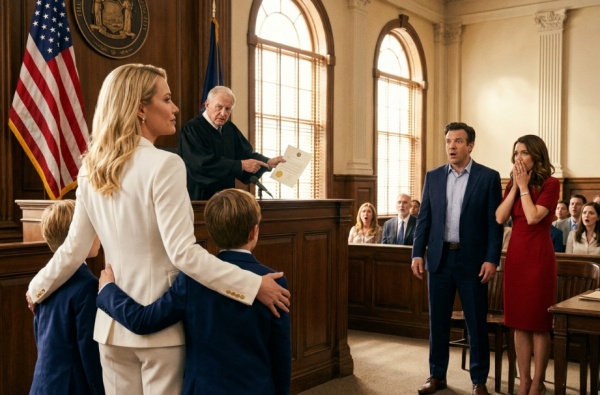
My husband walked into court with his glamorous mistress and the confidence of a man who thought money could rewrite history. He believed I would leave with nothing but heartbreak while he walked away with the company, the fortune, and their twin boys. But when the judge opened the company’s original ownership records, one name changed the entire room….
Part 1 — The Day He Brought Her to Court
My husband walked into divorce court like he already owned the room.
Not just the building, not just the marble hallway outside Courtroom 4B in downtown Chicago, but every person breathing inside it. He wore a charcoal Tom Ford suit, a silver tie, and the expression of a man who had spent too many years being told that confidence was the same thing as truth.
Behind him came three attorneys.
One carried a leather trial binder thick enough to look like a weapon. One held an iPad and whispered into my husband’s ear like a campaign adviser. The third, a woman with sharp glasses and sharper cheekbones, walked with the chilly calm of someone paid six hundred dollars an hour to make other people feel small.
And then came Vivienne.
She was not supposed to be there, at least not if shame still meant anything. But shame had never been one of Vivienne Cross’s stronger qualities. She entered the courtroom in a cream designer coat, red-bottom heels, and a diamond bracelet I recognized because my husband had once told me it was “a client gift.”
She sat two rows behind him.
Not beside him, because even my husband understood optics. But close enough that when he turned, she could give him the soft, confident smile of a woman who believed she had already won another woman’s life.
I sat at the opposite table with one attorney, one folder, and the exhaustion of a mother who had spent the morning making peanut butter toast for twin boys before walking into the fight that would decide whether I got to tuck them in at night.
My boys were six.
Oliver and Noah.
Oliver liked dinosaurs, hated peas, and asked questions so precise they could humble a scientist. Noah was softer, louder, always singing made-up songs to the dog and leaving toy cars in my shoes. They were identical to strangers, but to me they were two completely different universes.
My husband wanted full custody of them.
Not because he packed their lunches. Not because he knew which one needed the blue nightlight and which one cried if a sock seam sat wrong against his toes. Not because he had ever once sat through a pediatric fever at 3 a.m. without asking me where the thermometer was.
He wanted custody because he knew it would destroy me.
That was the part no prenup could say out loud.
The papers called it “primary residential custody.” His petition said he could provide “greater financial stability, superior educational opportunities, and a structured home environment.” It described me as emotionally reactive, financially dependent, and “insufficiently equipped to manage the children’s long-term needs without significant support.”
I read that line so many times it stopped looking like English.
Financially dependent.
That was what Grayson called me after twelve years of marriage, two children, and a company I had helped build so thoroughly that my fingerprints were in every system, every vendor contract, every payroll file, every client relationship that still kept the lights on.
My name was Amelia Hart Caldwell.
Before I married Grayson Caldwell, I was Amelia Hart Bennett.
Before Grayson discovered venture capital, private equity dinners, and women like Vivienne who smelled like French perfume and ambition, he was a charming sales manager with a leased BMW and $41,000 in credit card debt. He could talk anyone into anything, including me.
Especially me.
We met at a charity 5K along Lake Michigan, where he spilled coffee on my running shoes and somehow turned it into a twenty-minute conversation. He was funny, apologetic, handsome, and attentive in the way lonely women mistake for kindness. I was twenty-eight, grieving my father, running the small food distribution company Dad had left behind, and pretending I was not terrified of ruining his legacy.
Grayson made me feel less alone.
That was the first gift.
The second was the lie.
He told me he believed in me. He told me he saw how smart I was, how careful, how loyal my employees were because I treated them like people instead of costs. He said Bennett Foods could become a national brand if only I stopped thinking like a daughter protecting her father’s storehouse and started thinking like a CEO.
I believed him because I wanted to.
Within three years, Bennett Foods became Caldwell Harvest Group. The name change had been Grayson’s idea. He said my father’s name sounded “too regional” and “too sentimental” for expansion.
I cried the night I signed the rebranding documents.
Grayson held me and said, “Your dad would want growth, Amelia. He would want you to be brave.”
What he meant was that my father’s name was inconvenient.
I understand that now.
At the time, I thought love sometimes required letting go.
The company grew fast. We distributed specialty pantry goods, local sauces, organic grains, and regional food products to grocery chains across the Midwest. Grayson was brilliant in front of investors. He could stand in a conference room in New York and make shelf-stable soup sound like the future of American retail.
I stayed behind and made sure the future shipped on time.
I managed supplier relationships, dealt with warehouse problems, renegotiated freight contracts, calmed angry buyers, and remembered which employee’s mother was sick and which driver needed Tuesdays off for dialysis. Grayson called it “operations.” He said the word like it was important but not glamorous.
He was the face.
I was the foundation.
Then we had the twins, and the world rearranged itself around two tiny bodies who needed everything. I stepped back from public leadership because someone had to keep the babies alive, the house functioning, and the company stable while Grayson chased larger deals. He told everyone I had “chosen motherhood.”
I had chosen survival.
The prenup had been signed three days before our wedding.
Grayson’s attorney drafted it. My attorney, recommended by Grayson, reviewed it quickly while I sat in a conference room with floral centerpieces still unpaid for and my mother calling every ten minutes about the seating chart. I was told it was standard protection for both of us.
The agreement said each party’s separate property remained separate. Any business interest titled solely in one spouse’s name would not become marital property unless transferred in writing. Future appreciation of separate business assets would remain with the titled owner.
Grayson loved that prenup.
He called it ironclad.
By the time he filed for divorce, he had spent months telling me that Caldwell Harvest Group was his company. He said the prenup protected him. He said I had no meaningful ownership because, over the years, documents had shifted, titles had changed, and he had become CEO, chairman, and majority shareholder.
“You’ll get a generous settlement,” he told me one night in our kitchen while the boys slept upstairs. “Don’t make this ugly.”
That was two weeks after I found Vivienne’s earring in his car.
One week after I discovered the apartment in River North.
Three days before he filed for full custody.
He did not say he was sorry.
Men like Grayson do not apologize when they believe the paperwork loves them more than the wife does.
So there I sat in divorce court, watching him adjust his cufflinks while Vivienne watched me with a pitying smile. My attorney, Laura Kim, placed one steady hand on the folder in front of her. She was not flashy. She did not perform outrage or speak in dramatic whispers.
That was why Grayson had underestimated her.
Laura was the kind of lawyer who did not need to look dangerous because the danger was already alphabetized.
The judge entered at 9:04 a.m.
Judge Margaret Hensley was in her sixties, with silver hair, rimless glasses, and the facial expression of someone who had spent decades listening to people confuse money with morality. Everyone stood. Grayson stood slowly, almost lazily, like even the court’s authority was something he was willing to indulge.
The hearing began with temporary custody.
Grayson’s attorneys painted him as a visionary father, a stable provider, and the only parent capable of maintaining the boys’ lifestyle. They mentioned the private school waitlist, the house in Winnetka, the college accounts, the tutors, the pediatric specialist, the therapist Grayson had suddenly hired after ignoring my requests for one for Oliver’s anxiety for eight months.
Then they painted me.
Not as a mother.
As a problem.
They said I had become “increasingly emotional” since discovering the marriage was ending. They said I had limited Grayson’s access to the children, though he had canceled six visits and returned them early twice because “work ran long.” They said I lacked independent income, had no current executive role, and might attempt to use the children as leverage in the financial dispute.
I sat still while they said it.
That was the hardest thing I have ever done.
Not crying. Not defending myself. Not turning around to ask Vivienne whether she knew Noah still called for me whenever thunder woke him, or whether she knew Oliver would only eat waffles if the squares were cut apart.
Laura squeezed my wrist once beneath the table.
Wait, that squeeze said.
So I waited.
Then Grayson’s lead attorney, a man named Victor Sloane, stood and turned to the financial issue.
“Your Honor,” he said, “the parties executed a valid premarital agreement. The business assets at issue are clearly controlled by Mr. Caldwell. Mrs. Caldwell may have assisted operationally over the years, and no one seeks to diminish her contributions as a spouse and mother, but Caldwell Harvest Group is not a marital asset in the way opposing counsel is attempting to suggest.”
Assisted.
That word moved through me like a dull blade.
I thought of my father teaching me to read invoices when I was sixteen. I thought of standing in a freezing warehouse at 5:30 a.m. because a truck from Wisconsin arrived with a broken refrigeration seal. I thought of the year we nearly lost our largest grocery account and I personally drove to Omaha to fix the relationship while Grayson stayed in Chicago for a golf charity event.
Assisted.
Judge Hensley looked down at the papers.
“Ms. Kim,” she said, “your response?”
Laura stood.
“Your Honor, we agree the premarital agreement exists. We do not agree with opposing counsel’s characterization of ownership. Before the court accepts Mr. Caldwell’s assertion that Caldwell Harvest Group is his separate business asset, we ask the court to review the company’s original ownership records, formation documents, and the pre-marital share ledger.”
Grayson’s attorney smiled faintly.
“Your Honor, we have provided current corporate records.”
Laura did not look at him.
“I did not say current records,” she replied. “I said original records.”
For the first time that morning, Grayson stopped moving.
It was tiny. A pause. A stillness. His hand, which had been turning his wedding ring around even though he no longer had any right to wear it, froze.
Judge Hensley adjusted her glasses.
“Do you have those records, Ms. Kim?”
Laura opened the folder.
“Yes, Your Honor.”
And that was when Grayson’s confidence began to die.
Part 2 — The Records He Thought Were Buried
The first company record was not impressive.
It was not embossed, leather-bound, or intimidating. It was a scanned copy of an old Illinois Secretary of State filing, the kind of document most people sign once and forget forever. There was a coffee stain near the bottom left corner because my father had probably reviewed it at our kitchen table.
Seeing it made my throat tighten.
Bennett Regional Foods, LLC.
Filed eleven years before I married Grayson.
Organizer: Thomas Bennett.
Initial Managing Member: Amelia Hart Bennett.
That was my name.
My first name.
Not Grayson’s.
Not Caldwell.
Not any version of the life he had later convinced the world he created.
Mine.
Judge Hensley looked at the document for a long moment. Then she turned the page to the original ownership ledger.
Laura had found it in a banker’s box in my mother’s basement.
I had not known it still existed. After Dad died, I packed most of his business records in a haze of grief, labeling boxes with words like taxes, vendor files, old insurance, and miscellaneous. Grayson told me to throw most of them away during the rebrand.
“Clutter keeps people small,” he said.
My mother kept them instead.
My mother kept everything.
The ledger listed three names.
Amelia Hart Bennett — 51%
Thomas Bennett Family Trust — 39%
Marlene Ortiz — 10%
Marlene Ortiz had been my father’s warehouse manager and the first person he ever trusted with a key. She had died four years before the divorce hearing, but her shares had been repurchased by the company according to a buy-sell agreement my father drafted with a local attorney. Grayson had once called that agreement “small-town paperwork.”
Laura called it Exhibit 12.
Judge Hensley read silently.
Then she looked over her glasses at Grayson.
“Mr. Caldwell,” she said, “if you founded this company, why is the very first ownership interest listed under your wife’s maiden name nearly a decade before your marriage?”
The color drained from his face.
Not gradually.
All at once.
I had seen Grayson angry, charming, bored, seductive, impatient, and cold. I had seen him fake tenderness so well that even I believed it sometimes. But I had never seen him look exposed.
His attorney stood quickly.
“Your Honor, we object to the characterization. The company underwent substantial restructuring after the marriage, including rebranding, recapitalization, and expansion under Mr. Caldwell’s leadership.”
Judge Hensley did not take her eyes off Grayson.
“That may be relevant to valuation,” she said. “It does not answer my question.”
Grayson swallowed.
Vivienne shifted behind him.
For the first time, her smile was gone.
Grayson said, “The company at that time was not the company that exists today.”
His voice sounded smaller than usual.
Judge Hensley nodded once. “That was not my question either.”
The courtroom went so quiet I could hear paper sliding under someone’s hand.
Laura stepped forward.
“Your Honor, we also have the pre-marital restructuring documents signed eighteen months before the wedding. These documents show that Ms. Bennett retained controlling Class A voting shares, while certain non-voting profit interests were later issued for expansion financing. Mr. Caldwell was granted an employment role after the marriage, then later appointed CEO by board vote. There is no document transferring Ms. Bennett’s controlling interest to him.”
Grayson’s second attorney, the woman with sharp glasses, leaned toward him and whispered something.
His jaw tightened.
Laura continued. “We further have correspondence indicating Mr. Caldwell repeatedly represented himself publicly as founder and majority owner, despite internal records reflecting otherwise.”
Victor Sloane stood again. “Your Honor, this is a temporary hearing, not a corporate trial.”
Judge Hensley looked at him.
“Then your client may wish to stop making final-sounding claims about ownership before the corporate record is fully examined.”
I looked down at my hands.
They were trembling.
Not because I was afraid.
Because for the first time in months, the truth had entered the room wearing its own clothes.
Grayson had rewritten our history so slowly that even I had begun doubting parts of it. He told investors he had built the company from nothing. He told employees he had rescued a failing family business. He told friends I was “more of a heart person than a numbers person,” as if I had not kept that company alive before he knew how to read a freight contract.
He even told me.
That was the worst part.
After years of hearing him say it, I had started saying “his company” too.
A lie repeated inside a marriage becomes furniture. You bump into it every day until you forget it was not always there.
But the original records remembered.
So did my mother.
So did Laura.
The next exhibit was an email from Grayson to our former CFO, dated five years earlier.
We need to clean up the legacy ownership language before the Series B packet goes out. Investors don’t need a history lesson. The story is stronger if I’m positioned as founder/operator and Amelia as family legacy/brand continuity.
Family legacy.
Brand continuity.
That was what my life became in his pitch deck.
The CFO replied:
We can simplify the narrative for marketing, but we cannot alter the actual ownership ledger. Amelia remains Class A majority holder unless she signs transfer documents.
Grayson answered:
She’ll sign whatever I tell her is necessary. She hates paperwork.
I closed my eyes.
Because he was right.
I did hate paperwork. I hated legal language, cap tables, filings, governance minutes, and anything that made my father’s warm, human business feel like a machine. Grayson had used that against me for years.
He put papers in front of me while I was nursing twins.
He asked for signatures during dinner.
He said, “It’s just routine.”
He said, “You trust me, right?”
He said, “Don’t make me feel like the enemy when I’m trying to protect us.”
Judge Hensley read the email without expression.
Then she looked at Laura.
“Do you have any signed transfer documents?”
Laura turned one page.
“We have documents Mr. Caldwell claims function as transfers. We dispute their validity and scope. We also have two signatures Ms. Caldwell states are not hers.”
My husband’s face changed again.
This time, it was not shock.
It was fear.
Real fear.
Victor Sloane stood so fast his chair scraped the floor.
“Your Honor, allegations of irregular signatures are serious and inappropriate for argument without expert testimony.”
Laura nodded calmly.
“We agree they are serious. That is why we are asking for preservation orders, forensic review, and restrictions preventing Mr. Caldwell from disposing of, encumbering, or representing unilateral control over the company pending full adjudication.”
Judge Hensley leaned back.
For the first time that day, she looked at me.
Not as a wife.
Not as a mother accused of being emotional.
As a person who might have been telling the truth all along.
“Mrs. Caldwell,” she said, “did you sign documents transferring your controlling ownership to your husband?”
I stood because it felt wrong to answer sitting down.
“No, Your Honor.”
My voice shook, but it held.
“Did you understand yourself to be giving up control of the company your father founded and placed in your name?”
“No, Your Honor.”
“Did you authorize anyone to sign on your behalf?”
“No, Your Honor.”
Grayson stared at the table.
Vivienne stared at him.
And somewhere inside me, a door I had been holding shut for years finally opened.
Part 3 — The Mistress Who Thought She Was Marrying a King
The court took a brief recess at 10:36 a.m.
I went into the hallway with Laura, and the moment the courtroom door closed behind us, my knees almost gave out. Laura caught my elbow, not dramatically, just enough to steady me.
“Breathe,” she said.
“I forgot how to do that.”
“You’re doing fine.”
“I feel like I’m falling apart.”
“Then fall apart later,” she said. “For now, drink water.”
That was Laura’s version of comfort.
I loved her for it.
Across the hallway, Grayson’s legal team formed a tight circle around him. Vivienne stood outside it, no longer smiling, no longer glowing, no longer looking like a woman arriving at a coronation. She looked confused.
That gave me a bitter kind of satisfaction.
Vivienne Cross had been Grayson’s vice president of brand partnerships. She was thirty-three, glamorous, and very good at making wealthy men believe her attention proved something about them. She joined Caldwell Harvest two years before the divorce, and within six months, Grayson began caring a great deal about late meetings, West Coast conferences, and brand strategy retreats in Napa.
I found the first message by accident.
Not because I snooped.
Because Grayson’s iPad was connected to his phone, and Noah had been using it to play a spelling game when Vivienne texted:
I hate waking up without you. Tell me again how soon you’ll be free.
Noah sounded out the word “free” while I stood frozen behind him.
That night, Grayson did not deny the affair.
He simply turned it into my failure.
“You’ve been gone for years, Amelia,” he said. “You disappeared into motherhood and resentment. Vivienne sees me.”
I remember looking at him and thinking, I have seen you more clearly than anyone, and that is why you had to find someone else.
But I did not say it.
I cried instead.
Then I apologized for crying.
That was how low I had gotten.
Vivienne believed Grayson was leaving a bitter, dependent wife who had never understood him. He told her I was unstable. He told her I refused to accept that the marriage was over. He told her the company was his and that I would walk away with a settlement if I had “the sense not to embarrass myself.”
He probably told her she would become Mrs. Caldwell before Labor Day.
Maybe she imagined herself in my house, standing in my kitchen, drinking from my mugs, posting photos of “bonus mom life” from the boys’ soccer games. Maybe she imagined school fundraisers where other women whispered but still envied her. Maybe she imagined the fortune.
Women like Vivienne do not fall in love with men like Grayson by accident.
They fall in love with the story those men tell.
The problem was that Grayson’s story had footnotes.
During the recess, Vivienne walked toward the women’s restroom, then stopped when she saw me near the water fountain.
For a second, I thought she would keep walking.
She did not.
“Amelia,” she said.
Laura stepped beside me.
Vivienne noticed and gave a tight smile. “I’m not here to start anything.”
“That would be a first,” I said.
The words came out before I could stop them.
Vivienne flinched.
Good.
She lowered her voice. “Grayson told me the business was his.”
“I’m sure he did.”
“He said you signed everything years ago.”
“I’m sure he said that too.”
Her eyes moved toward the courtroom doors. “I didn’t know about the ownership records.”
I almost laughed.
Of all the things to not know.
Not that he was married when their affair began. Not that his children cried when he missed bedtime. Not that I had spent nights on the bathroom floor trying not to fall apart while the twins slept down the hall.
Ownership records.
That was the revelation that frightened her.
“Vivienne,” I said quietly, “did you think a man who lied to his wife would be honest with his mistress?”
Her face went red.
Laura murmured, “Amelia.”
A warning.
Not because I was wrong.
Because hallways are not private, and courtrooms do not reward satisfying sentences as much as people think.
Vivienne looked like she wanted to strike back, but something stopped her. Maybe the sight of Grayson across the hall, pale and whispering with three lawyers. Maybe the realization that if he had lied about the company, he might have lied about what she was going to inherit from the wreckage.
“He said you were using the boys against him,” she said.
That one cut.
I stepped closer.
“No,” I said. “He is using the boys against me. There’s a difference.”
Vivienne looked away.
I wondered then whether she had ever watched Grayson parent for more than an hour. Whether she had seen him hand a crying child back because he had a call. Whether she knew he called Noah “dramatic” for needing comfort and Oliver “difficult” for asking too many questions.
Did she know he once missed their preschool graduation because a buyer from Denver wanted drinks?
Did she know he gave both boys the same birthday card because he forgot to buy two?
Did she know he had filed for full custody three days after telling me I would “behave better” if I understood what I could lose?
Probably not.
Or maybe she did and had found a way to make it romantic.
People in affairs are very good at calling selfishness complicated.
The recess ended.
We returned to the courtroom.
This time, Grayson did not turn around to look at Vivienne.
She noticed.
So did I.
Judge Hensley resumed with the custody issue, and the tone of the room had changed. Grayson’s attorneys still argued forcefully, but their confidence had cracks now. It is difficult to call a mother unstable while your own client sits under questions of possible document manipulation.
Laura presented the parenting records.
The school emails I answered. The pediatric appointments I attended. The therapy intake forms I completed. The calendar showing Grayson’s canceled visits and early returns. The text message where he wrote:
If you push me on money, I’ll make sure the boys know you’re the reason their family fell apart.
Victor Sloane objected.
Judge Hensley overruled him.
Laura then submitted another message.
Full custody gives us leverage. She won’t risk losing them.
That one was from Grayson to Vivienne.
My stomach turned.
I did not look back at her.
I did not need to.
The whole courtroom seemed to inhale.
Judge Hensley read the message twice.
Then she looked at Grayson.
“Mr. Caldwell, do you consider custody of your children to be leverage?”
Grayson’s mouth opened.
Nothing came out.
His attorney stood. “Your Honor, that message lacks context.”
Judge Hensley’s voice cooled.
“Counsel, I am growing weary of context being used as a storage unit for poor judgment.”
Even Laura blinked at that.
Grayson finally spoke. “I was frustrated. It was a private message.”
Judge Hensley said, “Private messages often reveal public intentions.”
His face tightened.
I thought of all the nights I had lain awake, terrified that money could buy my children away from me. Terrified that a judge would see Grayson’s house, Grayson’s attorneys, Grayson’s polished confidence, and decide I was less stable because I cried more honestly. Terrified that motherhood could be erased by a man with better stationery.
But Judge Hensley was not looking at stationery.
She was looking at evidence.
By the end of the hearing, she issued temporary orders.
The boys would remain primarily with me. Grayson would have scheduled parenting time, but exchanges would be structured. Neither parent could disparage the other to the children. Neither parent could introduce romantic partners into parenting time without further agreement or court order.
Vivienne looked down at her lap.
The company assets were frozen from major transfer, sale, encumbrance, or restructuring without court approval. A forensic accountant would review the ownership records, disputed signatures, transfers, and corporate governance documents. Grayson was prohibited from representing himself as sole owner pending further findings.
That last part nearly killed him.
Not financially.
Spiritually.
Because Grayson could lose money and still call it strategy.
But losing the story was different.
Part 4 — What My Father Protected
The months after that hearing were not clean.
People like to imagine a courtroom revelation fixes everything. It does not. It opens the door to a hallway full of more doors, most of them expensive, exhausting, and labeled in legal language that makes your head hurt.
Grayson fought.
Of course he fought.
He hired a corporate litigation firm. He claimed the original records were outdated, irrelevant, superseded by later agreements. He argued that even if I had once held controlling interest, my conduct over the years showed implied consent to his leadership.
Implied consent.
That was what they called trust after it had been harvested.
The forensic review took four months.
During that time, I learned more about my own company than I had known when I was supposedly running it. I learned that Grayson had created side agreements with investors that positioned him as founder. I learned that marketing materials had quietly edited my role from owner to “brand steward.” I learned that two documents bearing my signature had been scanned copies inserted into updated packets I did not remember signing.
One signature was mine.
One was not.
The expert could not say who placed it there, only that it was inconsistent with my known signatures and appeared digitally transferred from another document.
Laura warned me not to expect fireworks.
“Civil court is not a movie,” she said. “Sometimes the consequence is not a dramatic confession. Sometimes it is a judge refusing to let a lie continue operating.”
I learned to accept that.
Mostly.
My mother, however, wanted fireworks.
She was seventy-one, five feet two, and had the emotional subtlety of a cast-iron skillet. When I told her about the disputed signature, she put down her coffee and said, “Your father should have haunted that man harder.”
“Mom.”
“I said what I said.”
My mother had never liked Grayson.
She was polite to him, because Midwest women can serve pie to a man they distrust with terrifying grace. But she saw him. She saw the way he interrupted me, the way he corrected my stories, the way he referred to my father’s business as “our launchpad” before he had earned the right to call it anything.
After the first hearing, Mom gave me another box.
It was blue plastic, dented on one side, with my father’s handwriting on the lid.
AMELIA — COMPANY / DO NOT TOSS
Inside were letters, old ledgers, attorney notes, and a yellow envelope sealed with tape.
On the envelope, Dad had written:
If Grayson ever forgets whose name came first.
I sat at my mother’s kitchen table and cried before I opened it.
My father had been dead for nine years. Lung cancer. Six months from diagnosis to funeral. Long enough to say goodbye, not long enough to say everything.
Inside the envelope was a letter.
Millie,
Only Dad called me that.
If you are reading this, I am either gone or too stubborn to admit I was right. I hope I was wrong about Grayson. I hope he becomes the kind of man who deserves your loyalty. But I have been in business long enough to know the difference between a partner and a man measuring the curtains before he owns the house.
I had to stop.
My mother sat across from me, eyes wet, hands folded around her mug.
I kept reading.
The company is yours because you earned it before he arrived. I started it, yes, but you saved it after my first surgery. You negotiated the grocery contract when I was too tired to stand. You learned margins, spoilage, freight, payroll, insurance, and every ugly thing people don’t put in brochures. Do not let anyone turn your labor into his origin story.
My tears fell onto the paper.
I had Martin prepare the ownership records carefully. Your Class A shares are yours. The family trust was designed to keep control from being pressured away quickly, especially in marriage. If Grayson is a good man, he will never care that these protections exist. If he is not, you will be glad I was annoying.
I laughed through the tears.
Dad had been annoying.
Beautifully, lovingly annoying.
The final paragraph broke me.
You may love a man and still protect yourself from him. That is not betrayal. That is wisdom. And if the day comes when you must stand in a room where he acts like he built what you carried, remember this: the first name on the record matters because the truth usually enters quietly before the applause begins.
I pressed the letter to my chest.
For years, I had thought my father left me a company.
Only then did I understand he had left me a shield.
The forensic accountant’s final report confirmed what Laura had argued from the beginning. My original controlling interest had never been validly transferred. Later documents had muddied governance, diluted profit rights, and created valuation questions, but they did not make Grayson the sole owner.
The prenup still mattered.
Just not the way Grayson thought.
It protected separate property.
Mine.
That was the part his own arrogance had missed.
He loved the prenup because he believed all meaningful assets would be titled under him by the time it mattered. He had spent years building that illusion, but he had never fully undone the original record. He had assumed charm could do what paperwork did not.
My father’s paperwork outlived his charm.
The custody case shifted too.
Grayson did not lose his children. I did not want that, even after everything. The boys loved him, and love is not a switch a court can turn off without hurting the children more than the adults.
But he did not get to use them as leverage.
The parenting evaluator noted what I had lived for years: I was the boys’ primary caregiver. Grayson was capable of parenting, but inconsistent, image-conscious, and prone to minimizing the boys’ emotional needs. The evaluator recommended that the boys remain primarily with me, with a structured schedule for Grayson and clear boundaries around communication.
Grayson hated the word structured.
He preferred control.
Vivienne disappeared from court after the first major corporate report.
I heard later that she left Caldwell Harvest and took a position at a beauty startup in Los Angeles. Before she left, she sent me one email.
I believed him. I know that does not excuse me. I am sorry for my part in hurting you and your children.
I read it twice.
Then I archived it.
Not every apology needs an answer.
Some apologies are just receipts for damage already done.
Grayson’s world did not collapse overnight. Men with money rarely fall that cleanly. But his board began asking questions. Investors demanded corrected disclosures. Employees who had spent years watching him take credit for my work started speaking more freely.
Marlene’s son, who still worked in logistics, sent me a text:
Your dad would be proud. Also, Grayson never knew how cross-docking worked and we all knew it.
I laughed for the first time in weeks.
A real laugh.
The kind that made Oliver ask from the living room, “Mommy, are you okay?”
I walked over and kissed the top of his head.
“Yes,” I said. “I think I’m getting there.”
Noah looked up from his Legos. “Getting where?”
I sat on the floor between my sons.
“Back to myself.”
They did not understand.
That was all right.
One day, I hoped they would not need to.
Part 5 — The Fortune He Never Owned
The final settlement conference happened eleven months after the first hearing.
Grayson arrived with only two attorneys this time.
No Vivienne.
No dramatic entrance.
No absolute confidence.
He looked thinner, older, and angry in a way he could not dress up as ambition anymore. His suit was still expensive, his watch still flashed beneath his cuff, but something essential had changed. He no longer entered rooms like they belonged to him.
He checked first.
That gave me more satisfaction than I am proud to admit.
The financial terms were complex, because life is complex and court orders are not fairy tales. Grayson retained compensation tied to his executive work, though his role was reduced pending board review. Certain marital assets were divided. Some appreciation and income streams required negotiation.
But Caldwell Harvest Group did not become his prize.
The controlling Class A interest remained mine.
The family trust remained protected.
The company my father built, that I carried, that Grayson tried to turn into his kingdom, did not leave the courthouse in his briefcase.
Neither did my sons.
The custody order gave us shared legal decision-making in defined areas, but the boys’ primary residence stayed with me. Grayson received regular parenting time, holiday rotations, and obligations he could no longer treat as optional. Communication would go through a parenting app because the court had grown as tired of his “misunderstandings” as I had.
When the judge reviewed the final terms, Grayson stared straight ahead.
Judge Hensley looked at both of us.
“This court is not here to punish marital failure,” she said. “It is here to make lawful findings, protect children’s best interests, and ensure that financial claims are supported by evidence rather than assumption.”
Then she looked at Grayson.
“Mr. Caldwell, there is a difference between building value and owning the origin of it.”
He said nothing.
For once.
Afterward, in the hallway, Grayson approached me.
Laura stepped closer, but I shook my head. I could handle a hallway now.
Grayson stopped a few feet away.
“Amelia,” he said.
I waited.
He looked like he wanted to say many things and could not decide which version of himself would work best on me. The wounded husband. The betrayed business partner. The regretful father. The man who had simply made mistakes.
I knew all his costumes.
None of them fit anymore.
“I never thought it would go this far,” he said.
That was the closest he came to honesty.
“You mean you never thought I would,” I replied.
His jaw tightened.
Then, quietly, he said, “You didn’t have to humiliate me.”
I almost laughed.
Not because it was funny.
Because even then, after everything, he still believed exposure was the crime and not the thing being exposed.
“You brought your mistress to court,” I said. “You asked for full custody of children you barely knew how to comfort. You tried to take a company whose first record had my name on it. And you think I humiliated you?”
He looked away.
That was answer enough.
For one second, I saw him as he had been when we met. Handsome, charming, coffee spilled on my running shoes, smiling like fate had a sense of humor. I remembered loving him. I remembered believing him. I remembered the life I thought we were building.
Then I saw the man in front of me.
Not a monster.
That would have been easier.
Just a man who wanted the rewards of love without the discipline of loyalty. A man who mistook my trust for permission. A man who thought paperwork, money, and intimidation could erase the first name on the record.
Mine.
“I hope you become a better father than you were a husband,” I said.
His eyes flickered.
Maybe that hurt him.
Maybe it only offended him.
It no longer mattered.
I walked out of the courthouse into a bright, cold Chicago afternoon. The wind off the lake cut through my coat, sharp enough to make my eyes water. For the first time in nearly a year, I did not feel like I was walking away from something.
I felt like I was walking toward my life.
That evening, I picked up Oliver and Noah from my mother’s house.
They ran to me in matching dinosaur sweatshirts, both talking at once. Oliver had lost a tooth. Noah had drawn a picture of our dog driving a spaceship. My mother stood in the doorway with flour on her sweater and victory in her eyes.
“Well?” she asked.
I smiled.
“Dad’s paperwork held.”
She pressed one hand to her mouth.
Then she looked up, as if my father might be leaning against the porch railing somewhere, pretending not to cry.
“Of course it did,” she said. “That man labeled the Christmas lights by bulb color.”
That night, after the boys fell asleep, I sat at the kitchen table with my father’s letter.
The house was quiet except for the dishwasher humming and the soft creak of winter wind against the windows. For months, quiet had frightened me because it left too much room for fear. That night, quiet felt like ownership.
Not of money.
Not even of the company.
Of myself.
I thought about the first day in court, Grayson walking in with three attorneys, an ironclad prenup, a glamorous mistress, and the certainty that he would leave with our fortune and our boys. I thought about Vivienne’s cream coat, his silver tie, the way his lawyers said “assisted” as if my life’s work had been a polite hobby.
Then I thought about Judge Hensley opening the original ownership records.
The coffee stain.
The old filing.
The first name listed.
Amelia Hart Bennett.
Before the marriage.
Before the rebrand.
Before the twins, the affair, the lies, the custody threats, the public story where Grayson was founder and I was footnote.
My name had been there all along.
That was what nearly broke me and saved me at the same time.
Because sometimes the truth is not loud. Sometimes it does not arrive with revenge music or dramatic speeches. Sometimes it sits quietly in a banker’s box in your mother’s basement, waiting for the day a man who underestimated you asks the wrong court to believe the wrong lie.
A year later, Caldwell Harvest Group changed its name again.
Not back to Bennett Foods exactly. I loved my father, but I was no longer only his daughter protecting his dream. I was a woman who had survived the theft of her own story and decided the next chapter would have my fingerprints all over it.
We became Bennett Hart Foods.
At the company meeting, I stood in front of two hundred employees and told them the truth without turning it into a scandal.
I said the company began as a family business, grew through many hands, and would move forward with transparency, accountability, and respect for the people who did the work when no cameras were around. I thanked the warehouse teams, the drivers, the account managers, the buyers, the finance staff, and the people who kept answering emails at 6 a.m. because grocery shelves do not fill themselves.
I did not mention Grayson.
That omission felt better than revenge.
Afterward, Marlene’s son hugged me so hard my ribs hurt.
“Your dad would love the new name,” he said.
“I hope so.”
“He would,” he said. “But he’d complain about the logo first.”
I laughed.
He was right.
Grayson remained in the boys’ lives. Imperfectly. Sometimes sincerely. Sometimes performatively. The parenting app helped. So did consequences. He learned, slowly and resentfully, that fatherhood could not be delegated to assistants, girlfriends, or legal threats.
Oliver and Noah adjusted in the uneven way children do.
Some weeks were hard.
Some nights, Noah cried because he missed “when everybody lived in one house.” Some mornings, Oliver asked whether Daddy left because they were too loud. Those questions broke me more than court ever did.
I answered carefully.
“No, sweetheart. Grown-up problems are never children’s fault.”
I said it until they believed me.
I said it until I believed me too.
On the anniversary of the first hearing, I took the boys to my mother’s house for Sunday dinner. She made pot roast, mashed potatoes, green beans, and the chocolate cake my father used to request every birthday even though he claimed he did not like sweets.
After dinner, the boys played in the backyard while Mom and I sat on the porch.
She handed me a small envelope.
“What’s this?”
“Something your father wrote on the back of an old inventory sheet,” she said. “I found it in another box.”
I opened it.
The paper was yellowed, the ink slightly faded.
In my father’s handwriting, it said:
If Millie ever forgets: the company was never the treasure. She was.
I cried then.
Not the broken kind of crying.
The healing kind.
The kind that rises from the place where grief and gratitude meet and decide they can share the same room.
My boys ran across the yard, laughing, grass stains on their knees, sunlight in their hair. My mother sat beside me, pretending not to watch me cry. Somewhere in the evening air, I could almost hear my father complaining about the grill, the Cubs, or the cost of good tomatoes.
I folded the note and held it against my heart.
Grayson had tried to take the fortune.
He had tried to take the boys.
He had tried to take the company, the story, the credit, and the version of me that still believed love meant staying quiet to keep peace.
But he missed one thing.
The first name on the record was not just a legal fact.
It was a reminder.
Before I was his wife, I was my father’s daughter. Before I was called emotional, dependent, difficult, or replaceable, I was the woman who knew how to keep trucks moving through snowstorms, employees paid through downturns, and children safe through heartbreak.
The judge only asked Grayson one question.
But it was the question that ended his favorite lie.
“If you founded this company, why is the first ownership interest listed under your wife’s maiden name?”
He had no answer.
Because there was none.
And that was how the man who walked into court certain he would leave with everything learned that the fortune he wanted most had never truly belonged to him.
